
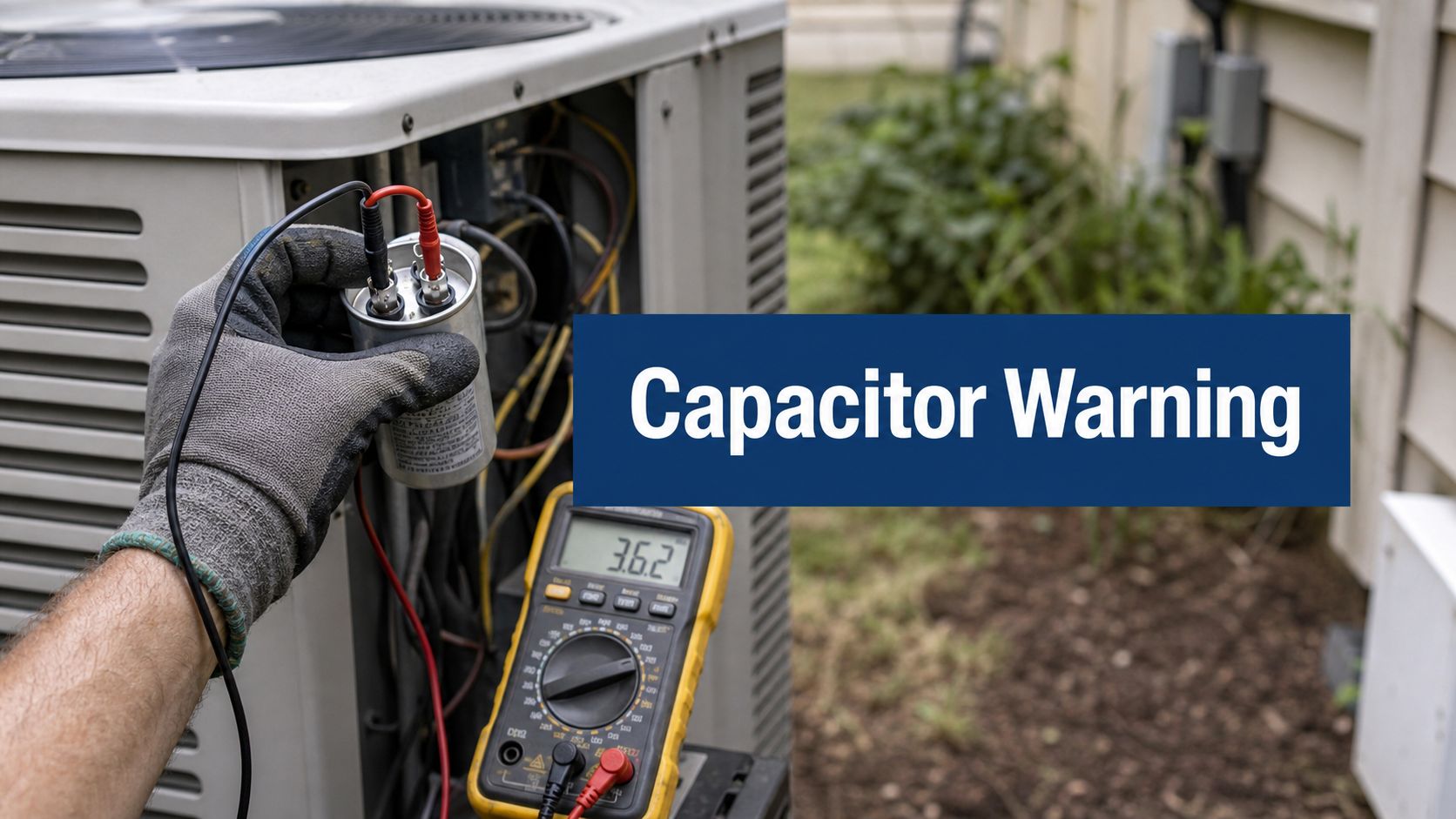
A Mesa summer can push an air conditioner to the edge fast, and the capacitor is one of the first parts to show it. When that component starts to fail, the system may still act like it wants to run, but the compressor or fan can't get the startup help they need, so the whole unit becomes unreliable right when Arizona heat is at its worst.
The signs an AC capacitor is failing usually start small, then get harder to ignore. If the system is humming, short-cycling, blowing weak air, or tripping the breaker, those are real warning signs, not just “normal AC behavior” in the East Valley. For homeowners trying to keep a rooftop unit or side-yard condenser alive through dust, sun, and monsoon season, catching the problem early can save a lot of stress. For a broader look at seasonal prep, see how to prepare your AC.
1. AC Won't Turn On or Keeps Shutting Off Without Cooling
A capacitor problem often shows up as a unit that seems ready to start, then quits before it cools the house. The thermostat may call for cooling, the outdoor unit may make a hum or click, and then nothing useful happens. In Mesa, that usually gets noticed first on the hottest afternoon of the week, when the system is already under heavy load.
This symptom matters because the capacitor's job is to give the compressor and fan the electrical surge they need to start. When that surge falls short, the motor may try, stall, and quit. Guidance from Bryant notes that weak capacitors can make the motor draw excess amperage and repeatedly trip the breaker, while typical replacement cost lands around $100 to $400 with parts and labor included. Bryant's capacitor replacement guide makes the financial trade-off pretty clear, a relatively small repair can stop a much bigger one.
A few field habits help separate a capacitor issue from a thermostat setting mistake.
- Check the thermostat first. Make sure it's in Cool mode before calling for help.
- Turn the system off if it only hums. Repeated failed starts can damage the compressor motor.
- Note the timing. If it fails only during peak heat, that detail helps a technician narrow it down faster.
- Don't keep restarting it. Every failed start adds stress to the system.
If the unit keeps shutting off without delivering cold air, urgent AC repair is the safer next step than hoping it clears up on its own.
2. Weak or Reduced Airflow from Vents
Not every failing capacitor creates a dramatic no-cool emergency. Some units keep running, but the airflow through the vents feels weak enough that bedrooms stay warm while the thermostat says the system is on. In older East Valley homes, that often shows up as one room cooling fine while the rest of the house feels stuck behind it.
A weakening capacitor can slow the fan motor or keep it from running at full strength. That matters because the fan is what moves cooled air through the ductwork. If the airflow drops, the compressor has to run longer to deliver the same comfort, which is hard on the system and frustrating for the homeowner. A troubleshooting guide for weak AC output is useful here, because a failing capacitor is only one of several possible causes.
The trick is to compare the problem from room to room, not just at one register.
- Feel multiple vents. One weak vent can point to a duct issue, but several weak vents suggest a system-wide problem.
- Check the filter first. A clogged filter can mimic capacitor-related airflow loss.
- Watch for gradual change. Slow decline over weeks fits capacitor wear better than a sudden blockage.
- Use fan-only mode for a quick comparison. If airflow changes a little when the compressor isn't running, that can point toward capacitor weakness.
Weak airflow is easy to dismiss because the system still seems to be operating. In Arizona, that delay is what makes it expensive. A unit that's “sort of working” in June can turn into a full breakdown by July if the fan or compressor keeps straining.
3. Capacitor Appears Visibly Swollen, Bulging, or Leaking
A capacitor that looks swollen, bulged, cracked, oily, or discolored is already giving you a clear warning. Once the condenser panel is open and the part shows visible damage, there is little guesswork left. In Mesa and the East Valley, I often see this after long stretches of hard sun or after the unit has been pushed through repeated high-load starts during extreme heat.
Heat is hard on capacitors. Over time, a failing part can overheat and expand internally, which is why swelling and bulging show up so often at the end of its life. Field checks also line up with other signs, including bulging, swelling, oil leakage, corrosion, discoloration, and a burning smell. A technician still needs to test it, but a capacitor that already looks damaged is not a part to keep running.
A few practical steps matter right away.
- Don't touch it. A capacitor can hold a charge even when the system is off.
- Turn off the AC immediately. Keeping the unit energized can lead to more damage.
- Take a photo from a safe distance. That gives the technician a clear look at the part before the replacement visit.
- Keep kids and pets away. Treat the outdoor unit like live equipment until it has been serviced.
If the condenser sits on a side yard or rooftop and you smell something burnt, treat it as a real failure signal. Mesa AC repair is the right call for that kind of problem, especially when the unit is visibly damaged and the cooling has already started to drop.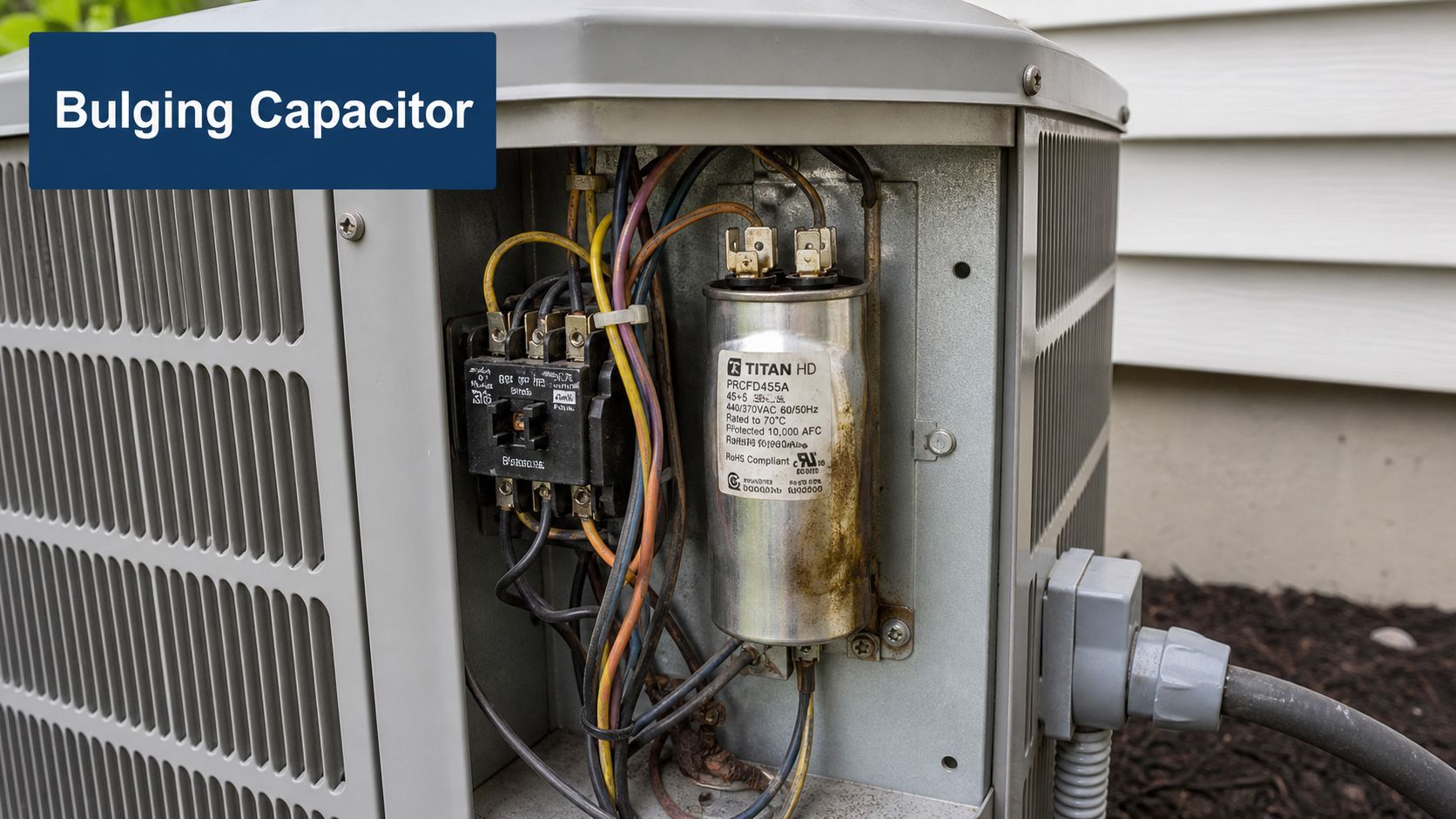
4. System Starts but Compressor Doesn't Engage, Fan Runs Alone
This one fools a lot of homeowners because the outdoor unit sounds active. The fan may be spinning, the indoor blower may be pushing air, and the thermostat may even say cooling is on, but the house never really gets colder. In practical terms, the fan is moving air while the compressor isn't doing the actual cooling work.
That symptom happens because many systems use separate capacitors for the fan and compressor. One can still limp along while the other is already dead or too weak to start. A hard-start kit overview helps explain why startup support matters so much, but a hard-start kit is not a cure for a bad capacitor. It may assist a struggling compressor in some cases, yet it won't fix a failed part that can't hold charge.
Homeowners often mistake capacitor trouble for a refrigerant problem. The distinction matters, because the system may be running without cooling.
- Listen outside for the compressor hum or vibration. Fan noise alone is not enough.
- Look for cold air at the vents. If the vents stay warm, cooling isn't happening.
- Don't let it run for hours in this state. That wastes power and adds stress.
- Note any power outage or surge. Electrical stress can tip a weak capacitor over the edge.
In Mesa summer conditions, this kind of failure can snowball fast. A unit that sounds “fine” outside but never drops indoor temperature is a strong reason to call for service instead of waiting for the next cool morning. The unit may be moving air, but it isn't delivering comfort.
5. Unusual Noises Like Humming, Buzzing, Clicking, Grinding, or Squealing
ACs are never silent, but they shouldn't sound strained. A steady hum at startup, repeated clicking, or a buzzing relay noise often means the capacitor is trying to help the motor start and failing to do the job. If the sound turns into grinding or squealing, the situation has moved beyond a simple annoyance and into mechanical stress territory.
Common air conditioner humming causes can include several things, but capacitor trouble is high on the list when the hum happens right as the system tries to start. The research also notes that a failing capacitor can lead to louder startup noise as the motor struggles, and repeated failed starts can eventually stress the compressor and bearings. That's why the sound itself matters, not just whether the system eventually cools.
What to watch for in real homes around Mesa and the East Valley:
- A hum that lasts several seconds before startup. That usually means the motor is straining.
- Rapid clicking from the outdoor unit. That can show repeated failed start attempts.
- Grinding or squealing during startup. That can mean the system is already under mechanical stress.
- Noise after a monsoon surge or outage. Electrical damage is a realistic possibility.
Record a short audio clip if it's safe to do so. That saves time on the phone and helps a technician tell the difference between a capacitor issue, a contactor issue, and a compressor problem. If the smell gets hot or electrical, shut the unit down rather than testing it again.
Noise is one of the best clues because it happens in real time, before the unit fully quits. In Arizona heat, that early warning is worth taking seriously.
6. Utility Bills Rise Sharply Despite Thermostat Settings Staying the Same
A bad capacitor doesn't just make an AC act strange. It can also make the bill ugly. When the compressor or fan has to work harder to do the same job, the system runs longer, starts more often, and wastes energy doing it. In the East Valley, that kind of change stands out fast when the thermostat setting hasn't moved.
The practical clue is simple. If the house is set the same way it was last summer, but the bill climbed anyway, the AC deserves a look. The research on capacitor failure notes that a weak capacitor can lead to longer run times and more frequent cycling, which is exactly the kind of inefficiency homeowners feel in their utility costs. That's especially true in Arizona, where the unit already works hard during long, hot cooling seasons.
A few ways to check the pattern without guessing:
- Compare the same month year over year. Seasonal heat matters more than last month's bill.
- Look at daily usage data. Spikes on hotter days can expose a struggling system.
- Keep thermostat settings written down. That helps rule out comfort changes.
- Watch for rising cost without lifestyle changes. That's the key warning sign.
The challenge is that a higher bill doesn't automatically prove the capacitor is the only problem. Dust on coils, dirty filters, duct leakage, and aging equipment can all add load. Still, if the bill jumps and the system is also slow to start or weak at the vents, a failing capacitor moves way up the suspect list.
7. AC Only Works After the System Sits Off for Several Hours
Intermittent failures are especially frustrating because the AC can seem normal at one time of day and weak or dead later. A unit may start in the morning after sitting all night, then refuse to cooperate after it's been running through the afternoon heat. That pattern is common enough in Arizona that homeowners often call after they notice the house cools early, then drifts warm by late day.
A weak capacitor can lose its charge or stop performing under extended demand, then seem a little better after rest. The research specifically calls out slower response to thermostat changes, reduced airflow, short cycling, and difficulty starting during extreme heat as early-stage complaints that often get overlooked. In Mesa, that kind of failure often looks worse during peak afternoon temperatures, which is when the AC is already under the most stress.
A few details make the diagnosis tighter.
- Log the start and stop times. Repeating daily timing can reveal a real pattern.
- Note how long it sat off. Overnight rest can make a weak part look temporarily normal.
- Try a short rest, then restart. If it works after cooling down, that's a useful clue.
- Check scheduling mode. Smart thermostats can create false patterns if the schedule is off.
This is the kind of issue that shows up a lot in the East Valley when units are older and the weather is punishing. A system that works fine at 7 a.m. but fails at 3 p.m. is telling on itself. Find AC troubleshooting help if you need a better sense of what's likely capacitor trouble and what could point somewhere else.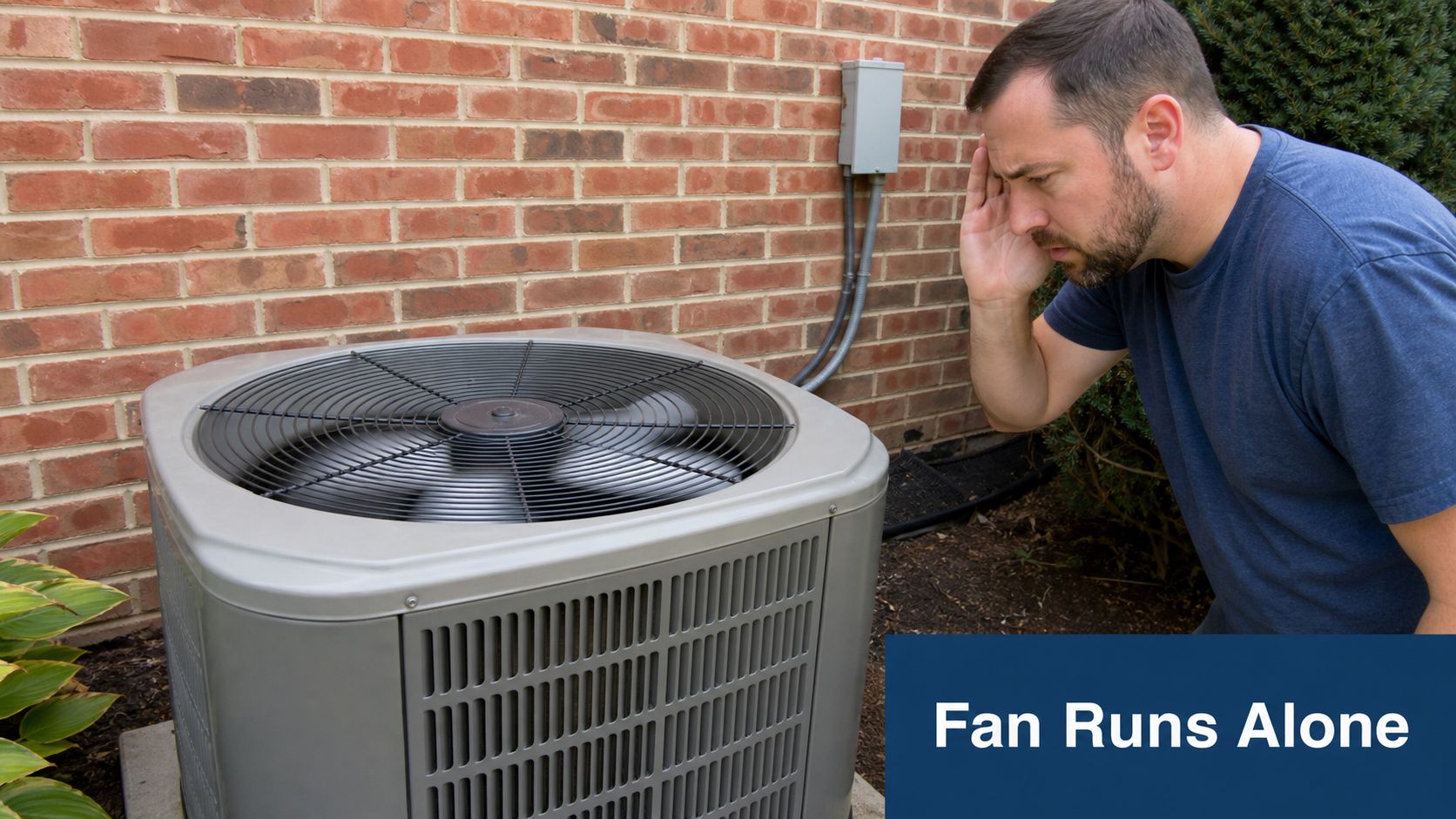
7-Point Comparison: Signs of a Failing AC Capacitor
| Symptom | Diagnostic complexity | Resources required | Expected outcome | Ideal action / use case | Key advantage |
|---|---|---|---|---|---|
| AC Won't Turn On or Keeps Shutting Off Without Cooling | Medium, electrical tests often needed to confirm capacitor | Multimeter/capacitor tester or HVAC tech; part replacement ($150–$300) | Likely capacitor replacement restores start; urgent to avoid compressor damage | Turn off unit; avoid repeated restarts; call professional immediately | Clear, noticeable failure that prompts timely repair and prevents larger damage |
| Weak or Reduced Airflow from Vents | Medium, could be capacitor, fan motor, filter, or ducts | Airflow checks, filter inspection, HVAC diagnostic; possible fan capacitor replacement | Replacing weak capacitor usually restores airflow and efficiency | Check/replace filter first; compare vents; schedule service if problem persists | Early, fixable warning that prevents strain and higher energy use |
| Capacitor Appears Visibly Swollen, Bulging, or Leaking | Low, visual confirmation is usually definitive | Immediate professional inspection and safety gear; capacitor replacement | Immediate replacement required; high urgency to prevent further electrical damage | Turn off system, keep distance, take photo, call technician immediately | Definitive visual evidence simplifies diagnosis and speeds correct repair |
| System Starts but Compressor Doesn't Engage (Fan Runs Alone) | Low–Medium, distinct symptom often points to compressor capacitor | Audible/visual check, HVAC technician, likely compressor capacitor or hard-start kit | Replacement typically restores compressor function; generally low-cost vs. compressor rebuild | Listen at condenser; do not run continuously; arrange prompt service | Clear distinction avoids misdiagnosing as refrigerant or compressor failure |
| Unusual Noises: Humming, Buzzing, Clicking, Grinding, Squealing | Medium, audio patterns help but electrical testing needed | Recordings/video, technician diagnostic; possible capacitor/contactor replacement | Repair often stops noises; may indicate advanced wear needing prompt action | Record the noise, power down if smell/overheat, call pro quickly | Audible warning that signals imminent failure and need for immediate attention |
| Utility Bills Rise Sharply Despite Same Thermostat Settings | Medium, requires usage data review plus system inspection | Bill comparison, thermostat logs, HVAC efficiency check; likely capacitor replacement | Fix reduces run-time and energy costs; non-emergency but cost-effective | Compare year-over-year bills; request inspection if increase ≥20% | Economic indicator that motivates timely repair and pays back via lower bills |
| AC Only Works After System Sits Off for Several Hours (Delayed Start) | Medium, intermittent pattern can be harder to replicate | Log times/temperatures, technician diagnosis; capacitor replacement likely | Replacing failing capacitor restores reliable operation | Log failure timing, try short rest test, schedule professional evaluation | Time-based pattern helps pinpoint capacitor decline before full failure |
What to Do Next, Repairing Your AC Capacitor in Mesa
A failing AC capacitor is more than a small part acting up. In Mesa and the East Valley, it can be the first sign that the compressor and fan are starting to take on extra stress they shouldn't have to carry in the first place. The biggest mistake homeowners make is waiting until the system fully dies, because the problem rarely gets cheaper once the unit starts hard-starting, short-cycling, or tripping the breaker.
The safest next step is a professional diagnosis. That matters because the same symptom, like humming, weak airflow, or random shutdowns, can point to more than one part, and a technician needs to confirm whether the capacitor is out of spec or whether another component is involved. HVAC service also matters because a capacitor can still hold a charge even after the power is off, so this is not the right repair to guess on.
Comfort Experts provides local AC repair in Mesa, AZ for homeowners dealing with failed starts, weak cooling, strange noises, and shutdowns that show up when the Arizona heat is at its worst. Call 480-207-1239 or use schedule service to get a technician on it before a marginal capacitor turns into a bigger cooling problem.
Comfort Experts helps Mesa and East Valley homeowners catch capacitor problems before they turn into compressor damage, lost cooling, or a weekend without AC. If the outdoor unit is humming, the vents feel weak, or the system only works when it feels like it, visit Comfort Experts and request a professional diagnosis from a local team that knows Arizona heat and how hard it hits HVAC equipment.