

A quote for a new AC in Mesa can look clean on the page and still be missing half the job. That's why an AC replacement quote checklist for Arizona homeowners matters, especially when one bid is fast and cheap, another is detailed, and the third seems to describe a different house entirely.
In East Valley heat, dust, and monsoon season, the question isn't just what the system costs. It's whether the quote covers the equipment, the scope, the ductwork, the permits, and the house-side corrections that keep the new system from becoming an expensive compromise.
Why Quotes for the Same Arizona Home Can Vary by Thousands
Two contractors can walk through the same Mesa home and come back with very different numbers because they're not always pricing the same work. One may be quoting only the box swap. Another may be including duct corrections, airflow changes, permits, removal, and startup testing. The price gap often comes from assumptions, not just from brand choice.
A strong starting point is comparing the bid against Arizona installed-price benchmarks. One 2026 Arizona guide puts a full replacement at $6,500 to $15,000+, while another statewide pricing guide places central AC-only replacement at $4,800 to $9,500 and full HVAC replacement at $5,200 to $14,000 in Arizona, with some larger or more complex jobs going above $18,000 (Arizona AC replacement cost guide). Those numbers only help if the quotes are describing the same scope.
Why the lowest quote can be the weakest quote
The cheapest bid is often the one missing the most line items. A contractor may leave out ductwork, electrical corrections, airflow balancing, or permit responsibility, then reintroduce them later as extras. That's how a quote that looks competitive on day one turns into a budget problem on install day.
For homeowners comparing options, a useful local reference is the 2026 AC replacement costs in Arizona. It helps anchor the discussion before anyone starts talking tonnage, efficiency, or adders that only show up after the old unit is already out.
Documents and Home Information to Have Ready
A contractor can only build a real quote if the home details are real too. Handing over the right information up front keeps the conversation out of guesswork, which is where weak bids usually start. That matters in the East Valley, where one home may have a rooftop package unit, another may have an attic split system, and a third may have a sun-baked addition that changes the load.
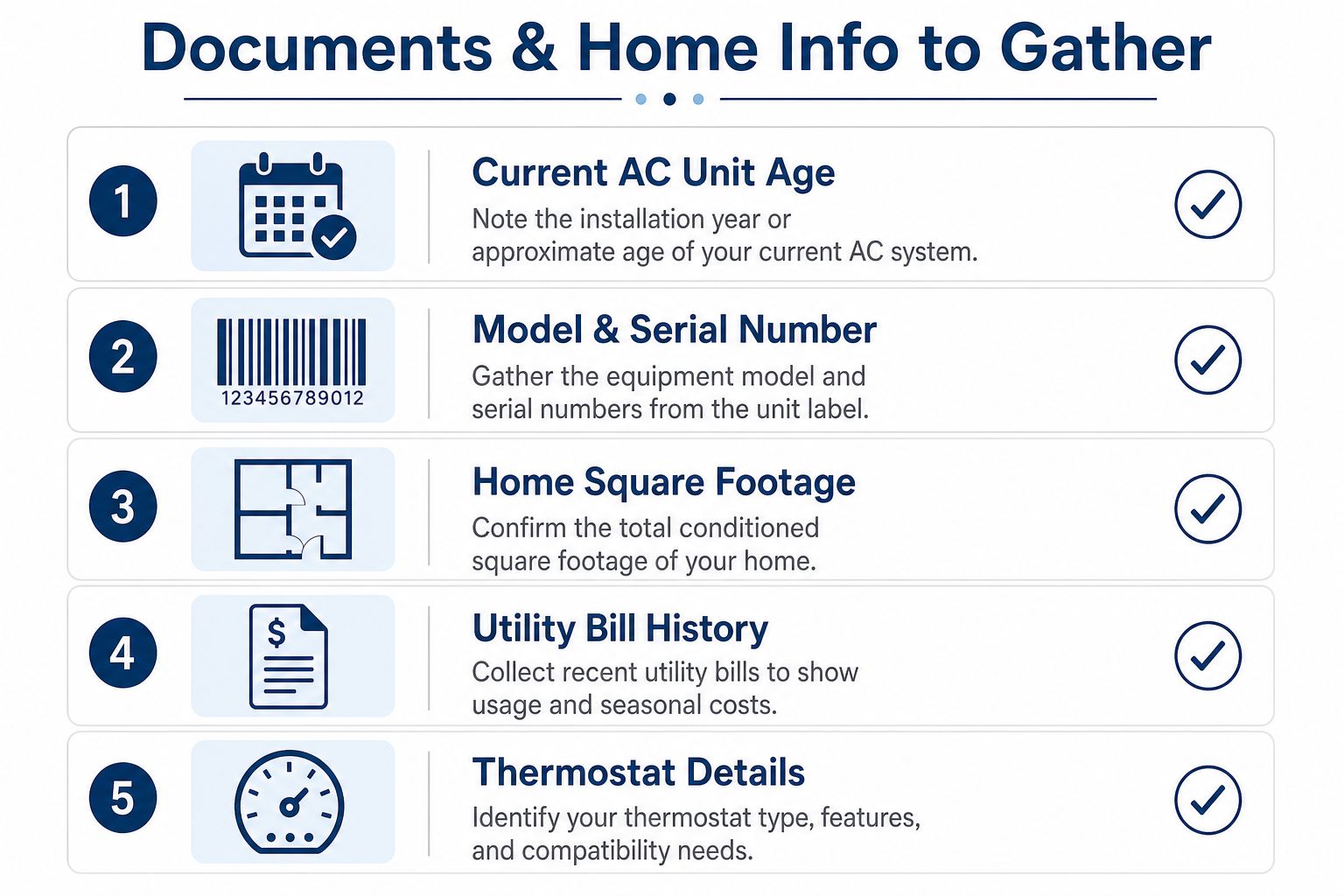
Before the comfort advisor arrives, gather the basics that shape the quote:
- Current unit age and history. The age helps frame whether the system is still worth repairing or whether replacement is the smarter path.
- Model and serial number. These identify the exact equipment already on the home, not a rough guess.
- Square footage and layout. A single-story Gilbert home and a two-story Mesa home rarely need the same solution.
- Utility bill history. Bills help the contractor understand how the system has been behaving over time.
- Thermostat details and any prior duct repairs. These tell the installer what's already in place and what may need to change.
Extra detail for rooftop package units
For East Valley homes with rooftop units, roof condition and access matter too. A contractor needs to know whether the roof can handle the work sequence, whether access is simple or tight, and whether existing electrical capacity creates a limitation. If that information is missing, the quote can look fine and still miss the actual installation conditions.
The point isn't to turn the homeowner into a technician. It's to make sure the contractor is quoting the house in front of them, not a generic box and labor guess. A prepared homeowner usually gets a more accurate number and a better comparison between bids.
Technical Specs Every Quote Must Show
A quote that leaves out the technical details is hard to compare and easy to game. The equipment may sound premium on a phone call, but if the paperwork doesn't show the exact pairing, the efficiency claim doesn't mean much. That's especially true in Arizona, where runtime, comfort, and humidity control depend on how the system is matched and installed.
The model numbers and certification matter
A defensible quote should list the exact outdoor unit model, indoor coil or air handler model, and thermostat model. It should also include the matched-system AHRI certification so the homeowner can confirm the quoted efficiency belongs to that specific equipment pair, not a brochure description. Without that, bids aren't really apples to apples.
The quote should also state the SEER2 and HSPF2 ratings, plus whether the system is single-stage, two-stage, or variable-speed. If the paperwork doesn't show those details, the homeowner can't tell whether one bid is offering a basic build while another is offering a system that runs differently under Arizona load. For a plain-language refresher on efficiency labels, understanding SEER ratings for ACs is a useful companion.
Refrigerant and commissioning are part of the spec
The refrigerant type should be written down too, specifically whether the system uses R-410A or R-454B. Phoenix-area quote guidance has started to ask for refrigerant type because the market is moving through a refrigerant transition, and serviceability matters after the install, not just on day one (Phoenix HVAC cost guidance). A cheap bid that doesn't explain the refrigerant architecture can be harder to own long term.
The document should also show commissioning, startup testing, and any thermostat or control upgrades needed for the selected equipment. In Arizona, that's not a luxury line. It's part of whether the system performs the way the label suggests.
How to Read an Itemized Quote Line by Line
A lump-sum quote is fast to write and hard to trust. An itemized one makes each part of the job visible, which is the only fair way to compare bids in a hot climate where adders are common. If one contractor says “replace AC system” and another breaks out the scope, the second quote usually gives the homeowner the better view of the job.
| Quote line | Lump-sum quote | Itemized quote |
|---|---|---|
| Equipment | One total price for “new AC” | Outdoor unit, indoor coil or air handler, thermostat listed separately |
| Labor | Included but not explained | Installation labor shown clearly |
| Materials | Hidden in the total | Line set, refrigerant, mounts, small parts identified |
| Permits | Unknown | Permit handling and inspection responsibility listed |
| Disposal | Often missing | Old-equipment removal and hauling shown |
| Startup | Usually omitted | Commissioning and system testing listed |
An itemized quote doesn't mean the bid is padded. It means the homeowner can see what's being bought. That matters because the same total can hide very different scopes, and the cheaper-looking option can become more expensive once the contractor starts adding on the things the first quote skipped.
Scope Items Most Homeowners Forget to Confirm
The hidden problems usually live in the scope, not the equipment box. In older East Valley homes, the most common mid-job surprises are duct defects, return-air problems, electrical corrections, and drain issues. Those are not nuisance details. They're the parts that determine whether the new system runs well or struggles from the first hot week.
The write-it-down items
A serious quote should spell out these items before anyone signs:
- a system-sizing review. This shows the system size is based on the home, not a square-foot rule.
- Permit handling and inspection responsibility. The paperwork should say who pulls the permit and who schedules the inspection.
- Refrigerant recovery and line-set work. The old refrigerant and piping work should be clear.
- Duct inspection or sealing. Older duct systems often need more than a new outdoor unit.
- Condensate drain safety. Drain protections matter in attics and tight utility spaces.
- Electrical disconnect and breaker sizing. These details affect safe operation and code compliance.
- Old-equipment removal and startup testing. The job isn't done when the old condenser is gone.
A good local checklist also rejects square-foot-only sizing and asks for a system sizing or equivalent load calculation because the home's insulation, windows, duct condition, and climate all affect the result (HVAC quote checker). That's the kind of detail that keeps a replacement from becoming a repeat service call.
Pricing Benchmarks and the Replace vs Repair Threshold
The best quote comparison starts with a reality check, not a sales number. Arizona replacement pricing is broad because homes are broad. Larger systems, higher-efficiency equipment, attic work, duct corrections, and electrical upgrades all move the price, and those changes are normal in this market.
How to sanity-check a quote
One Arizona-focused cost guide says repair becomes a stronger candidate for replacement when it passes the 50% rule, meaning the repair exceeds 50% of the cost of a new unit. The same guide uses the $5,000 rule, where the homeowner multiplies system age by the repair estimate and considers replacement if the result is above $5,000 (West Valley repair vs replacement guide). Those checks don't replace judgment, but they keep the conversation grounded.
For broader context on equipment projects, 2026 pool equipment replacement costs is a useful example of how scope, access, and installed labor can change a quote in another home system too. The pattern is the same. The headline price only matters when the scope behind it is clear.
When homeowners compare repair and replacement directly, AC repair vs replacement gives a practical frame for the decision. In the Arizona market, the low bid is only a bargain if it includes the work that keeps the system reliable.
Questions to Ask Each Contractor Before Signing
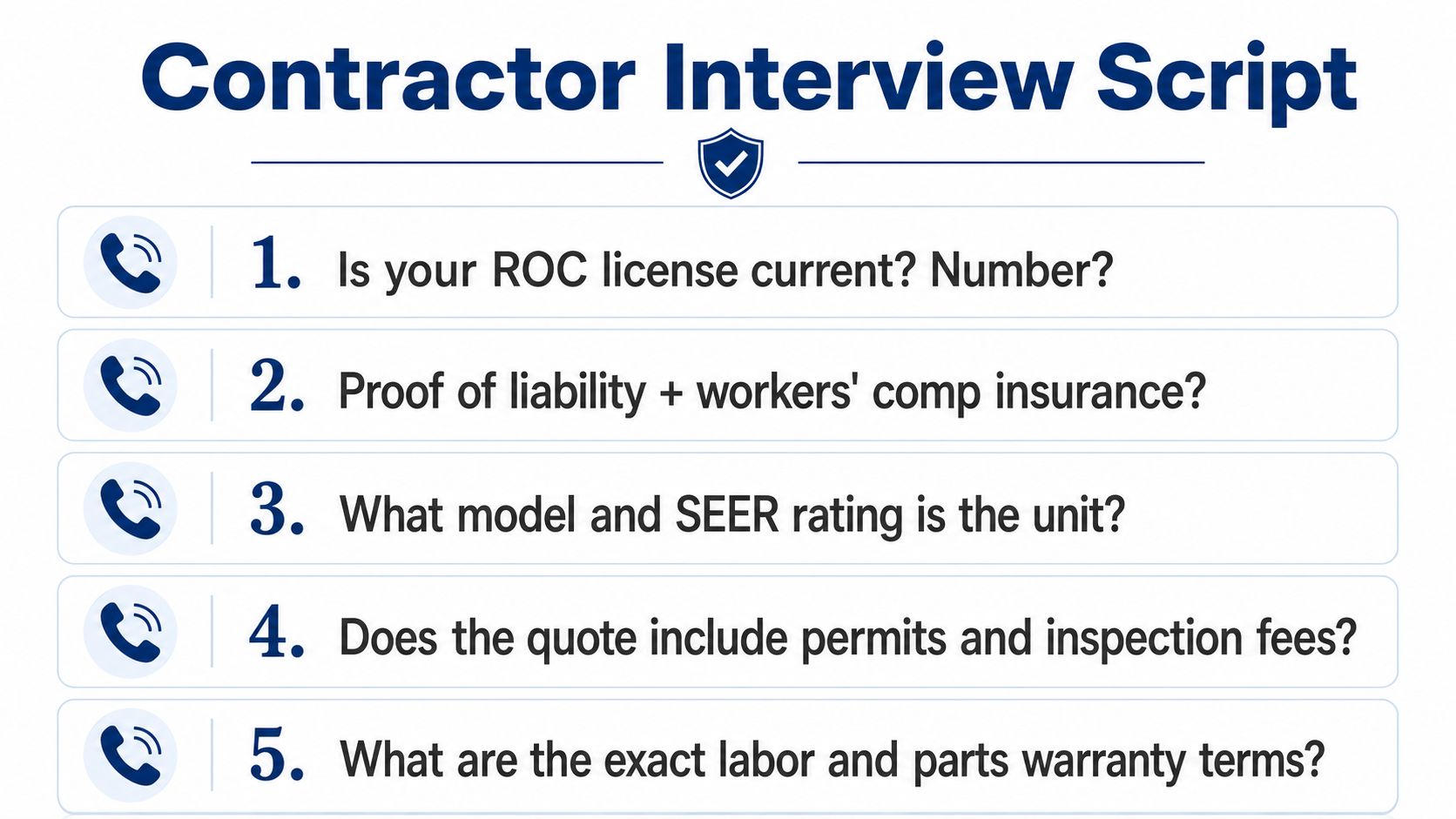
A quote should survive direct questions. If the answers stay vague, the paperwork usually will too. A homeowner can use the phone call below as a script and ask every contractor the same thing.
Ask these questions exactly
- Is your ROC license current, and what number should be verified? This confirms the contractor is licensed for Arizona HVAC work.
- Can proof of liability and workers' comp insurance be provided? That protects the homeowner if something goes wrong on site.
- What exact model numbers are being quoted? This avoids a bait-and-switch on the equipment.
- Will the quote include all permitting and inspection fees? The homeowner needs to know who owns that process.
- Is a a system-sizing review included? If not, the system size may be a guess.
- What's excluded from the bid? Duct work, electrical corrections, thermostat replacement, and drywall access should be clear.
- What does commissioning include? Startup testing should be spelled out, not implied.
- Will the same crew that bids the job do the install? If not, the homeowner should know who is coming.
For help sorting good answers from vague ones, what to look for in an HVAC gives a useful filter. The key sign of a weak contractor is not a high price. It's an answer that sounds polished but doesn't end up in writing.
Warranty and Labor Terms to Compare in Writing
Warranty language looks small on a quote, but it's one of the biggest ownership differences between bids. The equipment warranty and the installer's labor warranty are not the same thing, and both should be easy to find in the paperwork. If the quote buries them, the homeowner usually finds out later that the fine print matters.
What belongs in the warranty section
The quote should separate the manufacturer warranty from the workmanship warranty. It should also show whether equipment registration is required, whether maintenance is required to keep coverage valid, and whether the system has to be installed by approved contractors. Those conditions can affect a claim later even when the equipment itself is fine.
A partial swap deserves extra scrutiny. Mixing a new condenser with an old coil can create warranty and performance problems, especially when the system is not a true matched pair. That's why the model numbers and AHRI match information matter earlier in the process, not after the install is over.
For Mesa and East Valley homeowners, the simplest rule is this. If the warranty terms are vague, the quote is incomplete.
Permits, Code, and Arizona Utility Rebates
Permit responsibility should never be a guess. The quote needs to say who pulls the permit, who pays for inspection-related work, and who closes the job with the local jurisdiction. In Mesa and nearby East Valley cities, that clarity keeps the homeowner from inheriting a code problem after the installer leaves.
Rebates should be shown, not assumed
Arizona utilities such as APS and SRP periodically offer rebates on qualifying high-efficiency equipment and heat pumps, and those offers can change. The quote should say whether a rebate has already been factored into the price or whether the homeowner will need to file it separately. The equipment pairing matters here, because rebate eligibility depends on the exact system selection.
A useful companion for homeowners comparing rebate language is the Comfort Experts rebate breakdown. The main point is simple. A quote that ignores permit and rebate details can look cleaner than it really is.
Quick Reference Checklist Before You Sign
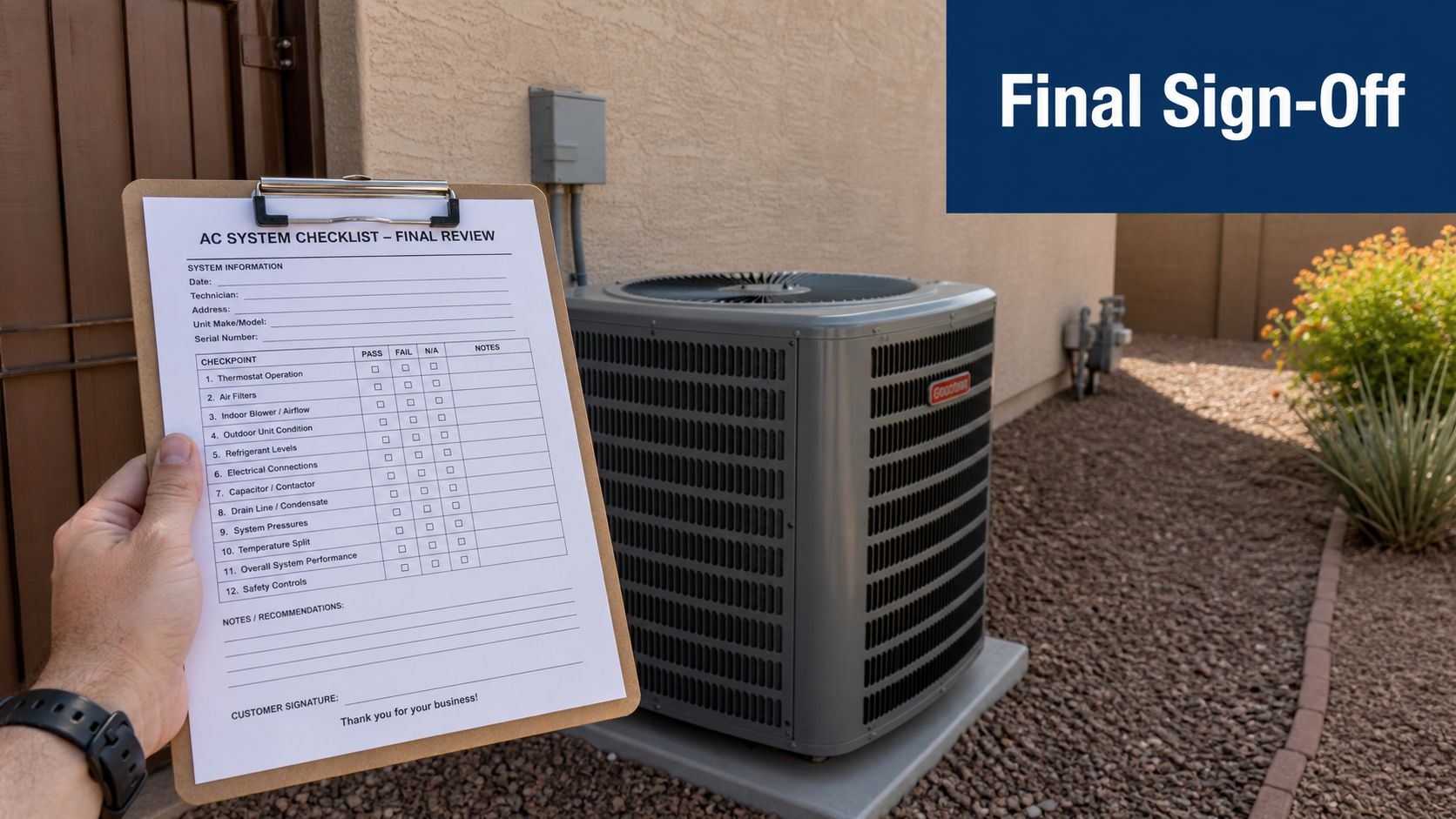
Use this as a quick screen before approving any bid:
- Home info ready: age, model, serial, layout, utility bills, roof or attic access.
- Technical specs shown: model numbers, AHRI match, SEER2, HSPF2, stage type, refrigerant type.
- Scope itemized: equipment, labor, permits, removal, startup, duct or electrical work.
- Work included: system sizing, commissioning, drain safety, permit handling, inspection.
- Price checked: compare the quote against Arizona installed-price benchmarks and repair thresholds.
- Questions answered: license, insurance, exclusions, warranty, and who does the install.
- Paperwork clear: permit responsibility and rebate handling are written out.
For homeowners comparing contractor paperwork, understanding contractor insurance coverage is a useful reminder of why proof matters before the work starts. If a quote can't clear this checklist, it's not the right one to sign.
Next Step for Mesa and East Valley Homeowners
The right quote isn't the cheapest one. It's the one that proves the load calculation, names the exact equipment, and spells out the scope, permit, and warranty terms in writing. That's the difference between a clean replacement and a budget surprise in July.
Mesa and East Valley homeowners who want a second set of eyes can call Comfort Experts at 480-207-1239 or schedule service. A careful review before signing usually costs a lot less than fixing a bad install later.
Comfort Experts handles AC replacement, installation, repair, maintenance, duct sealing, thermostats, and other cooling work across Mesa and the East Valley. If a quote needs a reality check against the actual scope of work, visit Comfort Experts and compare the bid before the old system gives out in peak heat.