
The expensive question is not “Can this AC be fixed?” Most systems can be fixed. The better question is whether the repair is buying you real time or just another nervous month before the next breakdown.
This guide is for Arizona homeowners trying to decide between AC repair and AC replacement. Comfort Experts handles both, so we are not going to pretend every failed unit deserves a new system. Sometimes a repair is the right call. Sometimes it is throwing good money at hot air.
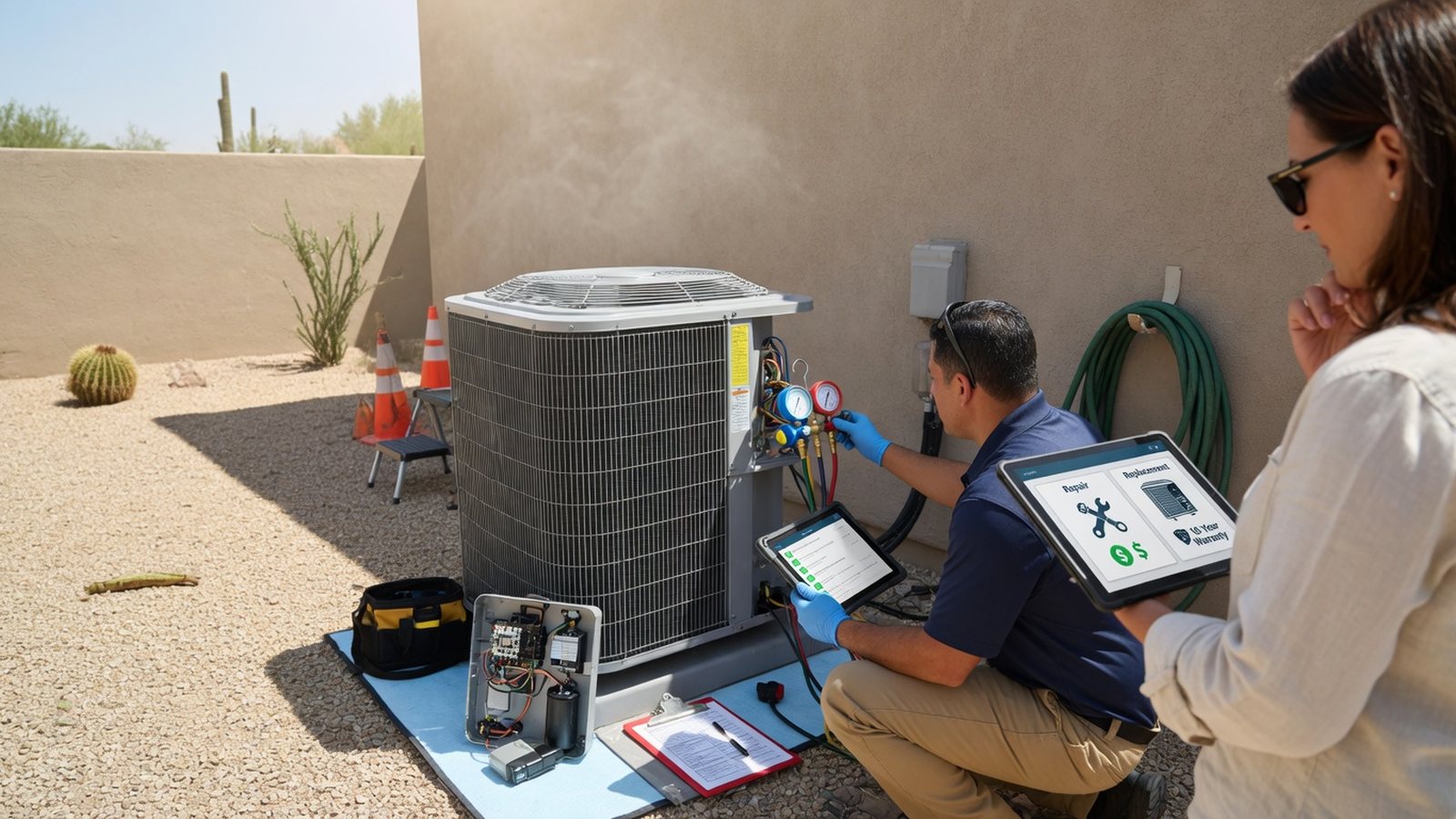
The repair-versus-replacement table
| Decision factor | Repair usually makes sense | Replacement deserves a serious look |
|---|---|---|
| System age | Under 8 to 10 years with normal maintenance | 12 to 15+ years, especially with repeat failures |
| Repair type | Capacitor, contactor, drain issue, thermostat, minor electrical repair | Compressor failure, major coil leak, repeated refrigerant loss, major motor failure on an old unit |
| Comfort before failure | The home cooled evenly and bills were predictable | Hot rooms, long run times, poor airflow, or bills kept climbing |
| Warranty | Parts or labor may still be covered | Warranty is gone and the next repair is fully out of pocket |
| Future risk | The repair buys real time | The repair is likely one more payment toward a system you will replace soon |
Why Arizona changes the math
An AC unit in Mesa does not get a gentle life. Long cooling seasons, dust, monsoon moisture, and brutal afternoon sun all push the system harder. The Department of Energy says central air systems depend on the outdoor unit, indoor coil, ductwork, and controls working together DOE central air conditioning guide. When one part keeps failing, the issue may be bigger than one part.
Maintenance still matters. Dirty coils, clogged drains, weak airflow, and neglected filters can make a good system act old. The DOE maintenance guide specifically points to filters, coils, fins, condensate drains, and controls as important maintenance items DOE air conditioner maintenance guide. If the system has been ignored for years, fix the basics before blaming the equipment.
When repair is the cleaner move
- The unit is not old and has had few major repairs.
- The failure is isolated and easy to explain.
- The system cooled the home well before the breakdown.
- The repair has a clear parts and labor warranty.
- You are not dealing with a compressor failure or major refrigerant leak on an aging unit.
If that sounds like your system, start with AC repair in Mesa, AZ and ask the technician to explain the failed part, not just the price.
When replacement deserves a real estimate
- The system is near or beyond the typical end of useful life.
- You have paid for several repairs in the last few seasons.
- The home has hot rooms even when the system is running.
- The compressor or coil has failed on an older unit.
- The utility bill keeps climbing and maintenance is not fixing it.
If you are comparing replacement, read How much does it cost to replace an AC unit in Arizona? before you sit through a sales appointment. Ask whether the proposed outdoor unit and indoor coil are an AHRI matched system. The AHRI certification directory exists so equipment ratings can be verified instead of guessed.
The honest version of the 5000 rule
The “5000 rule” is a shortcut: multiply repair cost by system age. If the number is over 5000, replacement gets discussed. It is useful because it slows down impulse repairs. It is also too simple to be the whole decision.
A $700 repair on a 10-year-old unit is not automatically dumb. A $1,900 repair on a 14-year-old system with bad airflow probably is. Context matters. So does comfort.
Comfort Experts can diagnose the AC, explain the repair, and give you replacement context if the repair does not make sense. Schedule service
FAQs about AC repair versus replacement
Is it cheaper to repair or replace an AC in Arizona?
Repair is cheaper today if the failure is minor and the system still has useful life. Replacement can be smarter when an old unit needs a major repair, runs poorly, or keeps failing during summer.
What is the 5000 rule for HVAC?
Some contractors multiply the repair cost by system age. If the number is over 5000, they suggest replacement. It is a shortcut, not a law. Use it as a conversation starter, then look at comfort, warranty, efficiency, and the actual diagnosis.
Should I replace my AC before it completely dies?
Sometimes, yes. If the system is old and unreliable, replacing before peak summer can give you more time to choose equipment instead of buying under emergency pressure.
Do I need the same size AC unit I have now?
Not automatically. Replacement sizing should account for the home, insulation, windows, ducts, and heat gain. A load calculation is safer than copying the old unit size.
Comfort Experts handles both AC repair in Mesa and AC replacement and installation, so homeowners can compare both paths.
Sources used
- U.S. Department of Energy: central air conditioning
- U.S. Department of Energy: air conditioner maintenance
- ACCA system sizing residential load calculation
- AHRI certification directory
- Comfort Experts AC repair in Mesa
- Comfort Experts AC replacement cost in Arizona