
When a heat pump starts running longer, blowing less air, or making a new noise in Mesa, the problem usually didn't start that day. It built up through heat, dust, and long run times. That's why heat pump service in Mesa, AZ matters so much. A proper tune-up isn't just a quick look at the unit. It's the work that helps a system survive the East Valley climate with fewer surprises.
Need heat-pump service? Visit Comfort Experts’ heat-pump service page for Mesa or call 480-207-1239.
What a Full Heat Pump Service Actually Includes
A real heat pump service covers both sides of the system. That means the outdoor unit where heat is rejected or absorbed, and the indoor air handler where airflow, filtration, and temperature delivery happen. If a technician only rinses the condenser and leaves, that's not a full service.
For homeowners who want a broader view of seasonal upkeep, get your HVAC tune-up guide as a useful companion to local service recommendations. For Mesa-specific heat pump maintenance, the important part is what gets checked and why.
Outdoor unit work that actually matters
A technician should inspect the outdoor cabinet, fan section, coil condition, and electrical compartment. In Mesa, that outdoor coil takes a beating from dust, yard debris, and long summer cycles. Dirty coil surfaces make heat transfer harder, which pushes the unit to work longer than it should.
A thorough overview of what a professional heat pump service entails, ensuring optimal performance and longevity.

Key outdoor tasks usually include:
- Electrical inspection that checks wire condition, tightens terminals, and looks for heat stress at contact points
- Capacitor and contactor testing because weak electrical parts often fail during high-load weather
- Coil cleaning to remove packed dust and improve heat transfer
- Fan and motor check for wobble, bearing noise, amp draw concerns, or blade damage
- Refrigerant verification to catch signs of low charge or other performance issues
Indoor service that affects comfort and airflow
The indoor side is where a lot of comfort complaints begin. Low airflow, dirty filters, blocked drain lines, thermostat issues, and weak blower performance can all make a good outdoor unit look bad.
A proper indoor service often includes:
- Filter inspection so airflow restrictions can be identified early.
- Blower compartment review to check dirt buildup on moving parts and surfaces.
- Thermostat testing to make sure settings, response, and staging are acting normally.
- Drain and condensate check because water problems can create shutdowns or hidden damage.
- Temperature and performance checks to confirm the system is operating within a normal range.
Some service calls also uncover duct-related issues, especially in older Mesa homes or homes with additions, garage conversions, or uneven rooms. In those cases, the heat pump itself may not be the only problem.
What a homeowner should expect after service
A worthwhile service visit should answer three practical questions:
| Question | What a good technician should clarify |
|---|---|
| Is the system operating safely? | Electrical connections, controls, and core components should be checked for obvious risk or wear. |
| Is it moving air correctly? | Filter condition, blower operation, and airflow restrictions should be addressed. |
| Is there a repair to plan for? | Weak parts, dirty coils, and performance issues should be identified before they become no-cool calls. |
That's the difference between maintenance and a rushed visual inspection. One helps a homeowner plan. The other just delays the next breakdown.
Why Regular Service Is Critical in Mesa
Mesa isn't a mild-duty market for heat pumps. These systems don't get a long off-season. They switch between cooling demands, mild winter heating, dust exposure, and monsoon humidity. A unit that might coast in another climate has to stay ready here.
One of the biggest local issues is airflow loss. Dust accumulation from Mesa's Sonoran Desert environment reduces heat pump airflow by 15–20% within 6 months if filters aren't replaced monthly, leading to frozen evaporator coils and a 35% increase in repair calls for “frozen unit” issues during pre-monsoon maintenance windows according to Action Mechanical's Mesa heat pump repair page.
Dust doesn't stay outside
People often think of dust as a housekeeping problem. In HVAC, it's a performance problem. Fine desert dust collects on filters, indoor coils, blower components, and outdoor surfaces. Once airflow drops, the system can't move heat the way it was designed to.
That can show up as:
- Long cooling cycles even when the thermostat is set normally
- Weak air at the vents in the hottest part of the day
- Ice on the indoor coil or refrigerant line caused by poor airflow
- More strain on motors and compressors because the system keeps trying to catch up
Mesa homeowners who want a clear local schedule can review how often to service HVAC based on Arizona operating conditions.
Heat and humidity create a rough combination
The summer load is obvious. What catches some homeowners off guard is how humidity changes things during monsoon season. In Arizona, heat pumps operating in desert climates like Mesa experience significantly reduced efficiency during monsoon season when humidity spikes above 60%, causing the outdoor coil to struggle with heat rejection and increasing energy consumption by up to 25% compared to dry summer days according to AZ Comfort Experts heating information.
That means a system that looked “good enough” in dry weather may start exposing problems once humidity rises. A dirty coil, weak capacitor, or marginal refrigerant issue gets harder to ignore when the unit has to reject heat in stickier air.
Older homes feel the difference faster
A lot of East Valley homes still have aging equipment or duct systems that were never updated when insulation, windows, or room layouts changed. Older heat pumps can still run, but “running” and “running well” aren't the same thing.
Regular service helps homeowners sort out three separate questions that often get mixed together:
- Maintenance issue such as dirty coil or clogged filter
- Repair issue such as weak capacitor or failing motor
- Replacement issue where age and efficiency make continued patching hard to justify
That distinction matters because the right answer isn't always a new unit. But in Mesa, waiting usually makes the eventual decision more expensive and less convenient.
Common Heat Pump Problems We Find in the East Valley
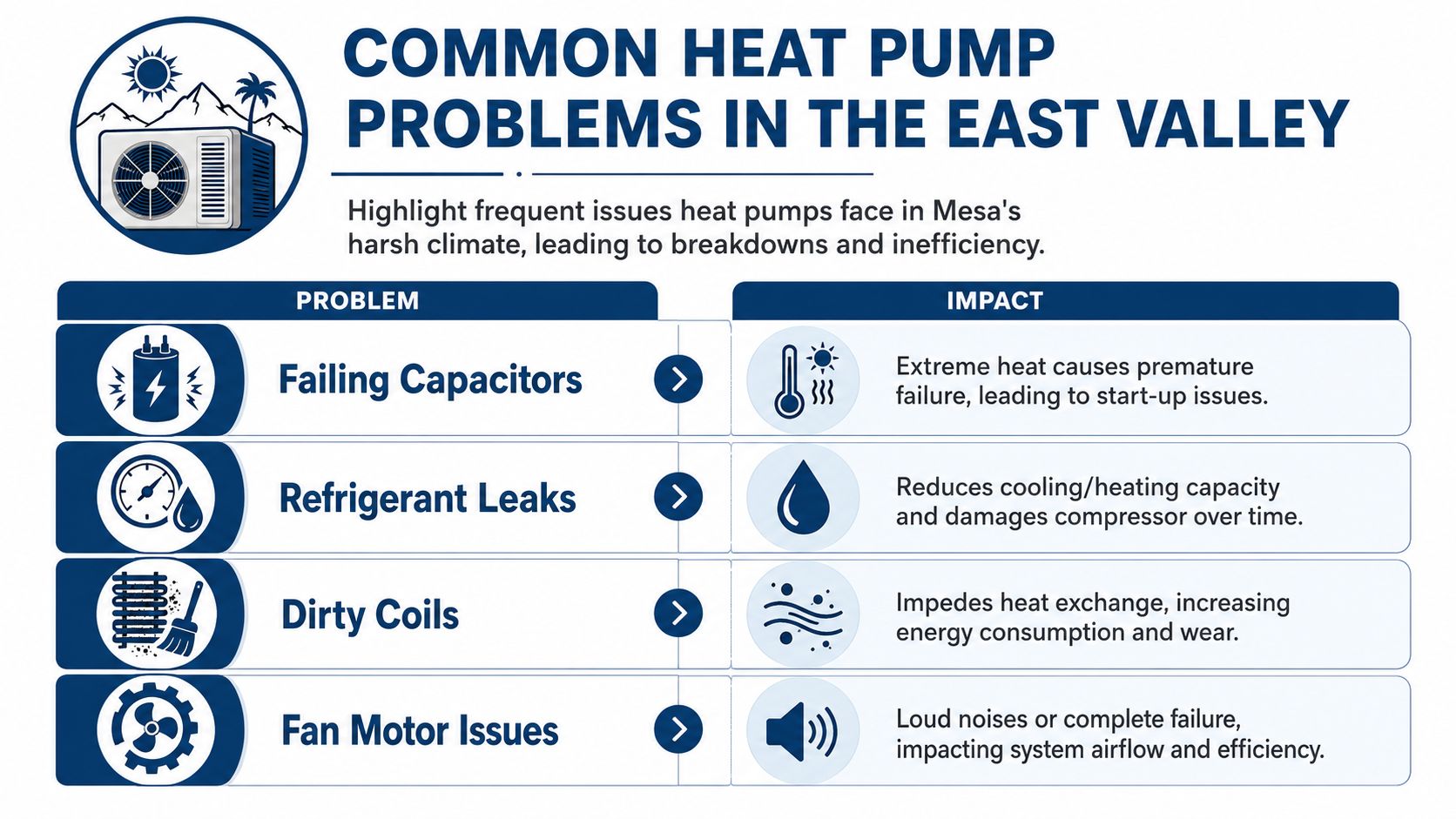
Some heat pump failures are dramatic. Many aren't. The system still turns on, but it cools poorly, runs too long, or sounds rough. In the East Valley, a few problems show up again and again because the climate pushes the same components hard.
A useful way to think about it is symptom first, cause second.
Startup issues and electrical failures
When a heat pump hums, struggles to start, or trips off unexpectedly, the problem often traces back to electrical components under stress. Capacitors and contactors take repeated punishment in high-heat operation. Once they weaken, the system may still run for a while, but it won't start reliably.
Mesa's average July high of 106°F forces heat pumps to run continuously for 12–16 hours daily during peak heat, accelerating wear on the compressor and reversing valve, with breakdowns occurring 2.3 times more frequently in July than in any other month across the Phoenix metro area according to this local Mesa listing reference.
That's why a no-cool call in July often starts with parts that looked merely “aging” in spring.
Warm air, low capacity, and hidden leaks
If a homeowner notices warm supply air, poor cooling, or ice where it shouldn't be, refrigerant issues become part of the diagnosis. Low charge can come from leaks, and leaks don't fix themselves. Running too long with a refrigerant problem can put larger components at risk.
This visual breaks down several of the issues that show up most often in the Valley.
The repair calls that shouldn't wait
Certain symptoms deserve a faster response than routine maintenance. These include:
- Buzzing or clicking without proper startup which can point to electrical trouble
- Blowing warm air in cooling mode which may involve refrigerant, controls, or compressor problems
- Loud fan noise or grinding sounds that suggest motor or blade issues
- Frequent short cycling where the system starts and stops too often
- Unit runs but comfort keeps dropping which usually means performance has already fallen off
When those signs show up, homeowners usually need diagnosis rather than another filter change. That's the point where heat pump repair in Mesa becomes the more useful next step than a standard tune-up.
Understanding Heat Pump Service and Repair Costs
A Mesa homeowner usually asks one practical question first: am I paying for maintenance, a repair, or the start of a replacement decision? That distinction matters because those are three different calls, with three different scopes of work.
A scheduled service visit is predictable. A repair visit is not. One may stop at cleaning, testing, and adjustment. The other can expand once voltage problems, failed parts, airflow restrictions, or refrigerant faults show up under diagnosis.

What repair costs usually depend on
In Mesa, repair pricing often falls on the lower end for smaller electrical or control issues and climbs fast when the problem involves major components, difficult diagnosis, or sealed-system work. A capacitor, thermostat issue, or minor electrical fault is a different job from a compressor or reversing valve problem.
The final number usually comes down to a few things:
| Cost factor | Why it changes the price |
|---|---|
| Part complexity | A contactor or capacitor costs far less than a compressor, fan motor, or reversing valve. |
| Labor time | Some faults test quickly. Others require step-by-step electrical checks and system verification. |
| System condition | Dust buildup, neglected filters, and coil restriction can hide or contribute to other failures. |
| Repair depth | One failed part is straightforward. Multiple issues on a hard-run Mesa system change the scope of the visit. |
Mesa adds its own pressure to these costs. Extreme summer runtime wears electrical parts harder, dust affects airflow and coil performance, and monsoon humidity can expose drainage and control issues that stay hidden in drier months. That is why two homes with the same model heat pump can end up with very different repair bills.
Maintenance cost versus replacement pressure
Routine service is usually the less expensive path because it gives a technician a chance to catch wear before it turns into a no-cooling call in July. The more expensive conversations usually start when a major part fails on an older unit.
If a compressor is on the table, homeowners need more than a yes-or-no repair quote. They need context on age, condition, warranty status, and how the rest of the system is holding up after years of desert use. For that decision point, understanding heat pump compressor expenses helps frame whether a major repair still makes sense.
Lower utility bills matter too, especially if a struggling heat pump has been running longer than it should. Airtight Spray Foam Insulation's energy tips can help homeowners cut wasted energy on the house side while they sort out HVAC repairs.
What doesn't work
Waiting usually costs more in Mesa. A unit that keeps running through extreme heat with weak airflow, failing capacitors, or dirty coils rarely fixes itself. It just runs longer, pulls harder, and puts more strain on expensive parts.
Repeated cheap repairs can also become the costly option if the system is already near the end of its useful life. A good service provider should be able to separate routine maintenance, repairable problems, and replacement-level issues without blurring them together. Comfort Experts is one local option for scheduled maintenance and diagnostics, and that kind of clear diagnosis is what homeowners should expect from any company they hire.
A Practical Maintenance Schedule for Mesa Homeowners
A Mesa heat pump can be cooling the house hard on a 110 degree afternoon, then dealing with dust buildup, then switching over during a chilly desert morning a few months later. That workload calls for a maintenance routine that fits our climate, not a generic once-a-year reminder.
For most homes here, two professional service visits a year is the right schedule. One should happen in spring, before the long run of extreme heat. The other should happen in fall, after summer wear and before heating demand starts. In Mesa, that is basic upkeep for a system that works nearly all year.
A clear, easy-to-follow schedule for Mesa homeowners to ensure their heat pump runs efficiently year-round.
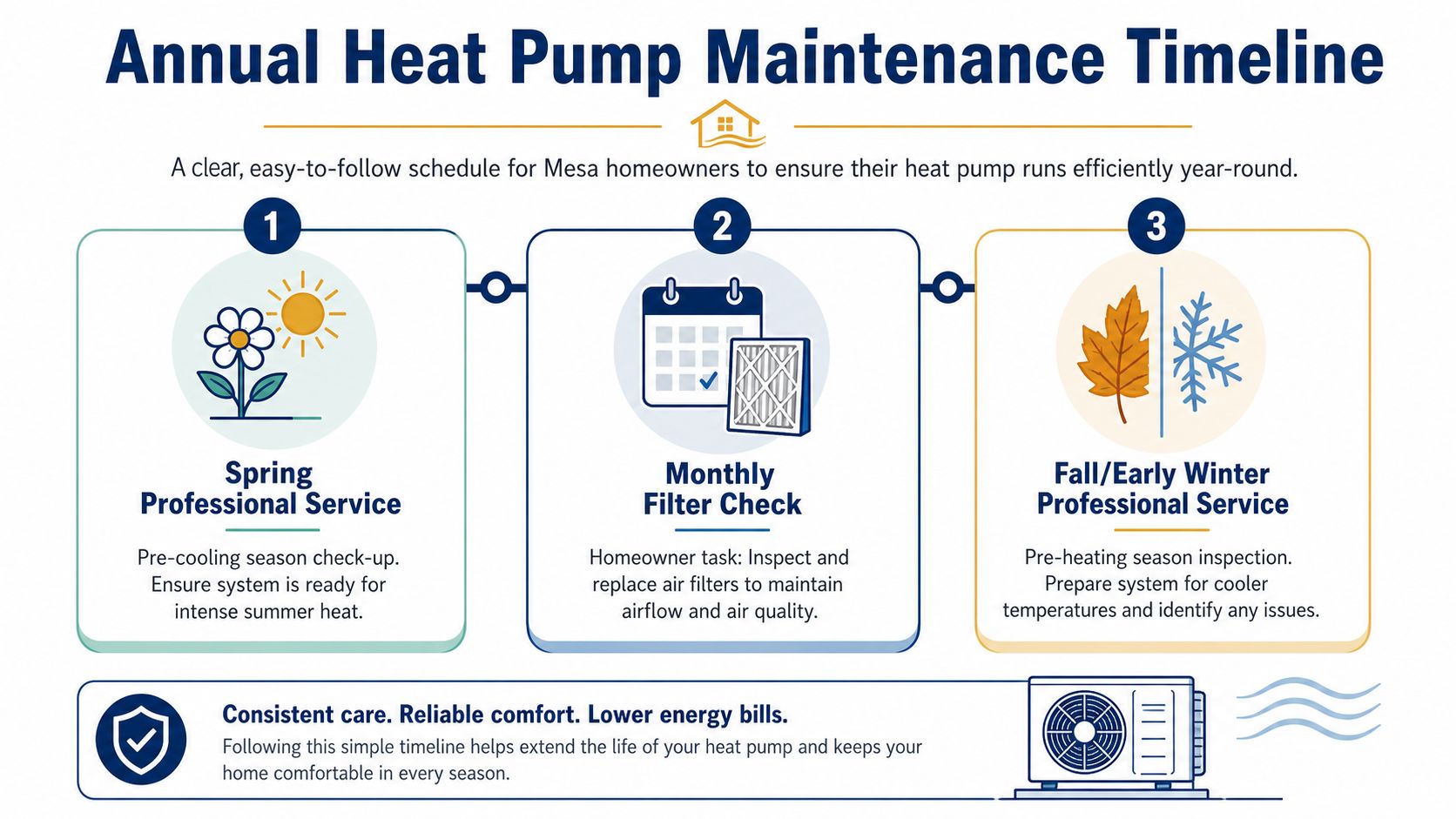
A practical schedule looks like this:
- Spring service before triple-digit weather settles in. This is the time to test electrical components, check refrigerant performance, inspect airflow, and clean the coil if desert dust has started to pack in.
- Monthly filter checks because Mesa dust can load a filter fast. Homes with pets, kids, renovations, or more foot traffic may need changes more often.
- Fall service to inspect heating operation and catch the wear summer leaves behind, especially on capacitors, contactors, and outdoor coils.
- Quick visual checks around the outdoor unit during the year so weeds, trash, and stored items do not block airflow.
One habit makes a bigger difference than homeowners expect. Check the filter regularly. In Mesa, a clogged filter can turn into weak airflow, longer run times, and higher strain on the system in a hurry.
Older equipment needs closer attention. Many older Mesa homes still have lower-efficiency systems, and those units usually cost more to run than newer heat pumps. That does not mean replacement is the right call this minute. It does mean it is smart to watch utility bills, indoor comfort, and repair frequency more closely if the equipment is aging.
For homeowners trying to cut utility waste beyond HVAC service alone, Airtight Spray Foam Insulation's energy tips add some helpful whole-home ideas. For service planning tied directly to equipment care, Comfort Experts' HVAC checklist is the practical local version.
Homeowner maintenance is simple, and that is fine. Safe tasks include checking and replacing filters, keeping the outdoor unit clear, watching for unusual noise or weak airflow, and making sure the thermostat is set correctly. Technician work is different. Electrical testing, refrigerant checks, motor testing, capacitor diagnosis, and coil cleaning with full access should be left to a pro.
That split matters in the East Valley. Desert dust, extreme summer run time, and monsoon moisture can create problems that look minor from the outside but put real stress on the system underneath. A good maintenance schedule catches those issues early, before they turn into a no-cooling call in the middle of July.
Ready for Reliable Comfort? Here's Your Next Step
For most Mesa homeowners, the decision comes down to timing. If the heat pump is making noise, blowing warm air, icing up, or struggling to keep up, it's time for diagnosis. If it's running normally but hasn't had seasonal care, routine service is the smarter move before the next weather swing.
The bigger point is simple. In the East Valley, heat pumps live a hard life. Dust, long cooling cycles, and monsoon humidity don't leave much room for neglect. Even businesses in the industry invest in visibility and operations support. For example, contractors looking to optimize your HVAC local search are usually doing it because local homeowners need fast, specific help when systems start failing.
A good next step is to treat service as prevention first, repair second, and replacement only when the numbers and condition point there.
If a heat pump is overdue for service or showing signs of trouble, Comfort Experts serves Mesa and the East Valley with practical HVAC help. Call 480-207-1239 or schedule service.