
Duct cleaning has not been shown to reduce allergies or prevent health problems, and it's justified only when specific contamination such as substantial visible mold, pests, or heavy debris is documented. For Mesa and East Valley households, the useful distinction is between a problem inside the duct system and dust or allergens coming from somewhere else.
The Short Answer and What the Evidence Shows
Duct cleaning isn't a proven allergy treatment. The U.S. Environmental Protection Agency's duct-cleaning guidance states that cleaning has “never been shown to prevent health problems,” and available studies haven't conclusively demonstrated that dirty ducts increase household particle levels.
That finding can seem surprising when a photograph shows dusty ductwork. But dust resting inside a duct isn't the same as dust entering someone's lungs. Much of that material can cling to duct surfaces instead of circulating through rooms.
Evidence strength for duct cleaning claims
The distinction below follows the EPA's guidance. An established reason to consider cleaning is not an established promise of allergy relief.
| Situation | Evidence strength | What EPA says | How to use it |
|---|---|---|---|
| Substantial visible mold growth in ducts | Established reason to clean | Lists it as a condition where cleaning may be appropriate | Document it before booking |
| Vermin infestation in the system | Established reason to clean | Lists it as a condition where cleaning may be appropriate | Address the pests first, then clean |
| Heavy dust and debris released into living spaces | Established reason to clean | Lists it as a condition where cleaning may be appropriate | Confirm debris reaches rooms through registers |
| Ordinary settled dust with no other problem | Weak | Studies don't conclusively show dirty ducts raise household particle levels | Treat source control as the priority |
| Routine cleaning to prevent allergies or health problems | Unsupported | Cleaning has never been shown to prevent health problems | Don't buy it as an allergy treatment |
| Cleaning alone to end allergy symptoms | Unsupported | Doesn't establish symptom relief from cleaning alone | Combine appropriate work with source control and clinical advice |
For the question “does duct cleaning help with allergies,” the evidence supports a cautious answer, not a blanket yes. There's no routine cleaning calendar to follow based on this guidance. System age and time since the last cleaning don't substitute for an inspection.
For Arizona households considering the next step, these allergen reduction tips for Phoenix homeowners provide a broader starting point than treating duct dust as the only possible source.
When Visible Contamination, Pests or Renovation Debris Matter
The useful inspection question is what's present, where it's located, and whether it's entering occupied rooms. The EPA's archived duct-cleaning guidance supports targeted cleaning for documented contamination rather than ordinary dust accumulation.
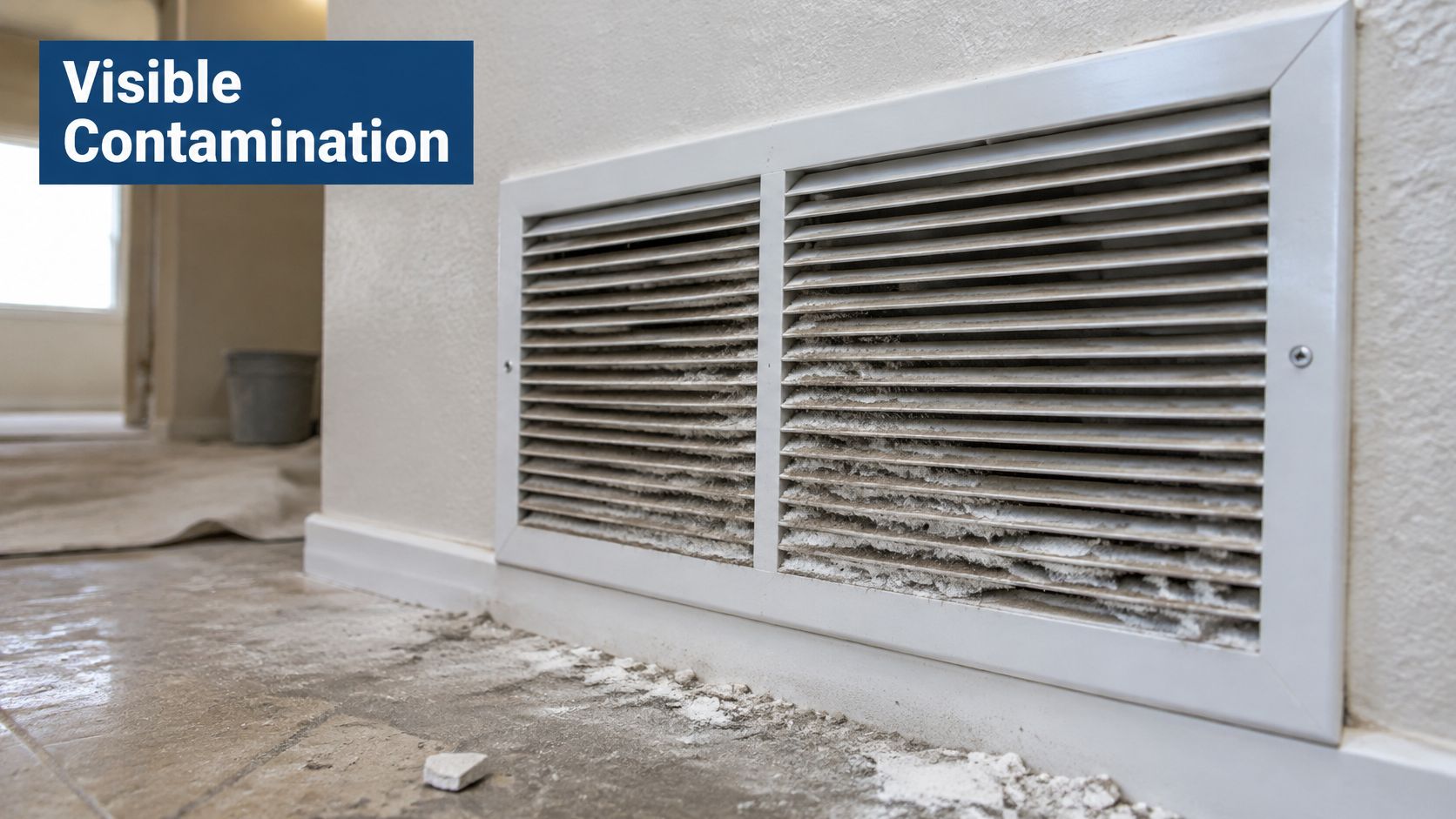
- Suspected mold: Visible growth warrants investigation, but a dark patch or musty smell doesn't establish its identity. Understanding the common causes of mold in ductwork helps keep attention on the moisture source, not just the stain.
- Pest evidence: Droppings, nests, insects, or rodent signs call for pest assessment before cleanup. Wildlife Control Services, LLC provides background on how histoplasmosis spreads, but that resource isn't a diagnosis of material found in an Arizona home.
- Heavy debris: Material visibly blowing from supply registers deserves documentation. A dusty grille alone doesn't prove that the entire duct system needs cleaning.
- Renovation residue: Drywall or sanding dust after remodeling is a reason to request an inspection, not automatic proof that cleaning is necessary.
Safe observations from the room
A homeowner can use a flashlight to look at exposed register and return-grille surfaces without removing equipment panels or reaching into ductwork. A photograph and a note about when debris appears are more useful than an assumption about its cause.
Suspected mold or pest waste shouldn't be disturbed for a closer look. Water damage and active pests need the appropriate professional attention first, followed by a documented explanation of what cleaning would address.
Source Control Checklist Before You Book Cleaning
A filter with a gap along its edge works like a screen door left ajar: the material it was meant to stop still gets inside. Source control means stopping or removing material where it originates, which is cheaper and more reliable than paying to clean up afterward. Before booking a cleaning service, a household can sort its dust into three buckets: what settles in rooms, what enters through gaps, and what the equipment itself is doing.
Source-control checklist before buying duct cleaning
| Check | What to look for | Action before cleaning |
|---|---|---|
| Filter fit and change schedule | Filter sits flat in its slot, seals at the edges, and follows the manufacturer's replacement schedule | Correct the fit or replace the filter, with installer guidance if needed |
| Return leaks | Gaps at return connections or the filter cabinet, dust rings around the filter edge | Have a licensed technician assess and seal confirmed leaks |
| Flooring and textiles | Heavy dust near returns, carpets and rugs holding dust | Vacuum regularly and wash bedding weekly |
| Pets | Pet material on furniture, bedding, and near return grilles | Consider limiting bedroom access and clean textiles regularly |
| Outdoor dust | Dust entering through open doors, gaps, or unsealed penetrations | Address entry points and clean deposited dust after storms |
| Moisture | Condensation, water stains, or a damp equipment area | Find and fix the water source before cleaning |
| Renovation debris | Drywall or construction dust after remodeling | Obtain an inspection and documented scope |
The checklist is an observation and planning tool, not a way to diagnose allergies. A dust ring around a filter edge is worth showing a technician, yet the ring alone does not confirm a leak.
Filter fit matters more than a label
The ASHRAE handbook's air-cleaning guidance identifies filter sealing, pressure drop, dust loading, airflow, system capacity, and replacement requirements as important design factors. Notice how many of those describe fit and airflow rather than the rating printed on the packaging. Air reaching a poorly seated filter takes the path of least resistance, which means around the frame instead of through the media.
Filter loading and airflow are technician measurements, not homeowner ones. When heating or cooling performance is in question, have the system assessed rather than judging the filter by how dirty it looks in the slot.
Installing a more restrictive filter without checking compatibility can create an airflow problem, particularly during long Arizona cooling runtimes. For households researching how to find filters that trap airborne allergens, the decision should stay tied to what the equipment can push air through, not to an allergy-relief promise on the packaging.
Return-Side Dust and Duct Leakage
The return side carries room air back toward the heating and cooling equipment. A gap along that path can provide an unintended entry point, so cleaning and sealing answer different questions: cleaning addresses deposited material, while sealing addresses an air pathway.
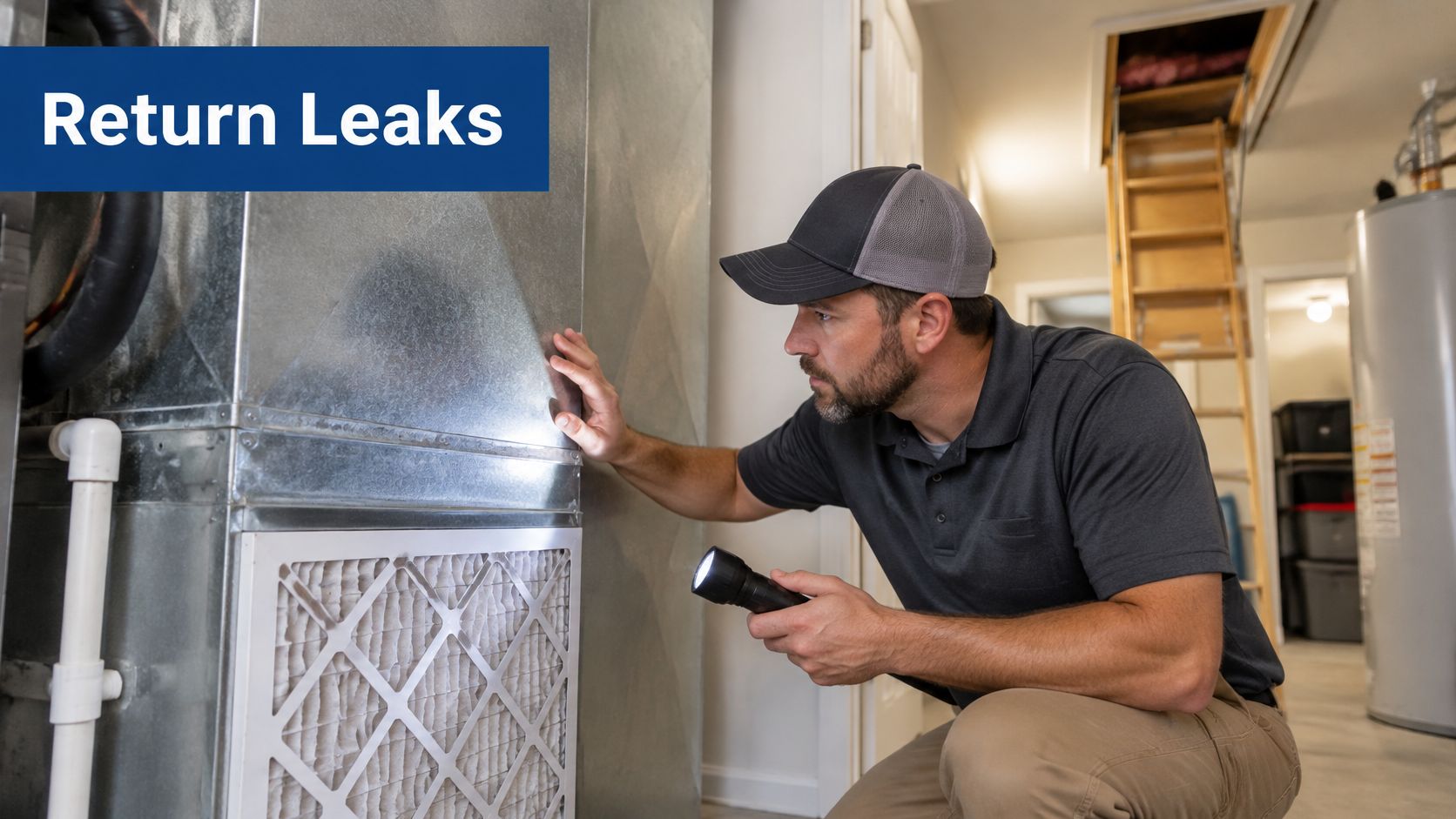
The ASHRAE chapter on indoor bioaerosols identifies house dust, cat allergen, dust-mite allergen, and endotoxins as indoor particulate contaminants. Their presence doesn't establish that ducts are the original source or that cleaning will control exposure.
A useful technician inspection sequence
- Inspect the air path: Examine accessible supply and return ducts and record which areas couldn't be reached.
- Check the filter assembly: Evaluate the filter, its fit, and cabinet sealing.
- Look beyond the ducts: Inspect relevant coils, the blower compartment, and drain pans for contamination or moisture.
- Correct the cause: Address confirmed leakage and water damage.
- Define remaining cleaning work: Identify which components still contain contamination requiring removal.
Dust trails near a return, a dusty filter edge, or rooms that become dusty after operation are observations worth recording. None is a remote diagnosis.
For older Mesa homes with inaccessible duct runs, the inspection report should distinguish inspected sections from assumptions. The same applies to rooftop or packaged equipment: homeowners shouldn't climb onto a roof or open equipment to investigate.
Work to seal leaky ducts should follow a confirmed finding. Household tape or changes inside an air handler aren't a substitute for professional assessment and repair.
When Duct Cleaning Will Not Solve the Problem
Cleaning a duct won't remove material from a mattress, carpet, sofa, or room surface. The EPA's residential air-cleaner review explains that larger allergen-containing particles settle rapidly and recommends washing bedding weekly, vacuuming carpets and furniture frequently, and dusting hard surfaces.
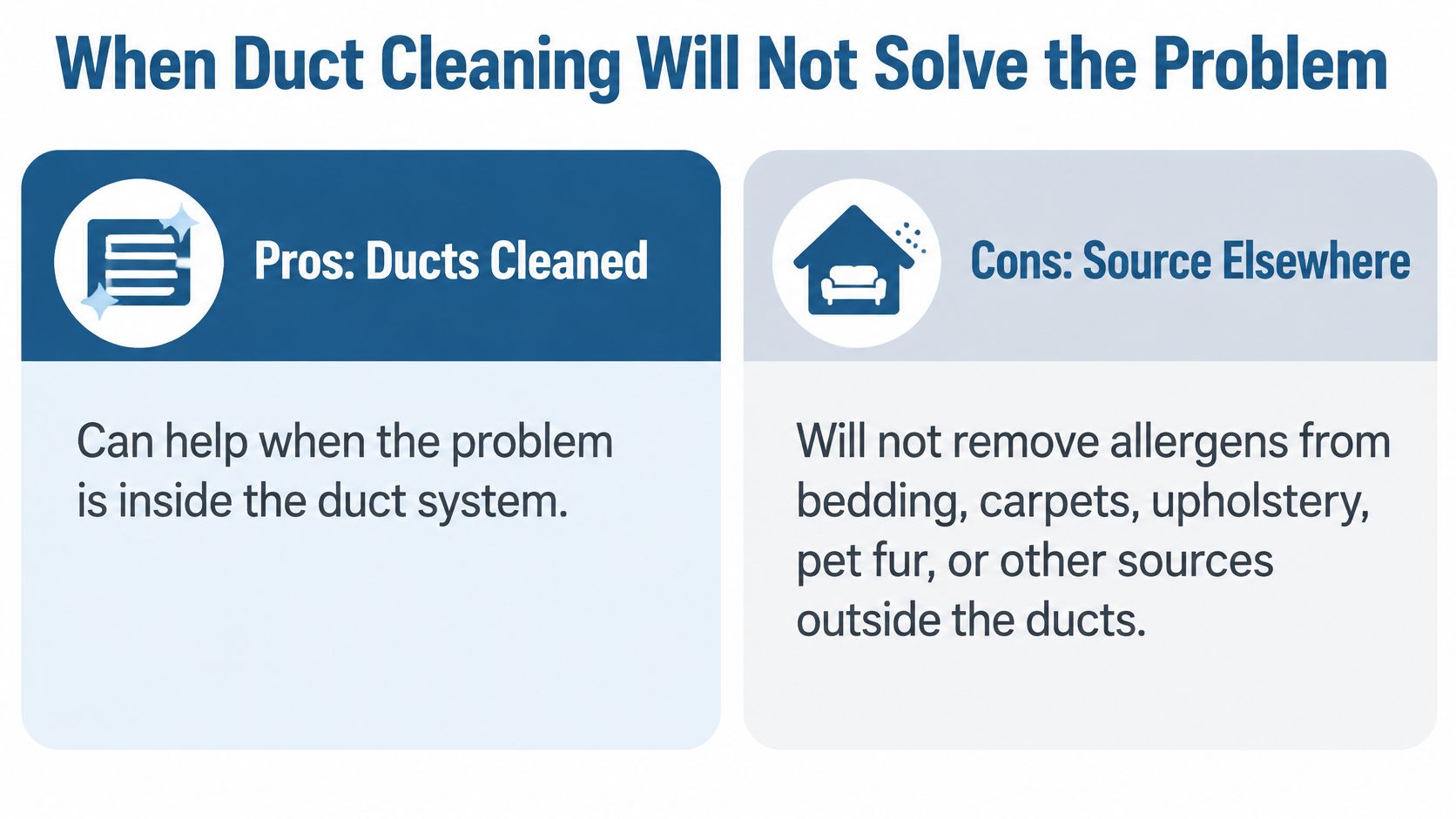
The likely mismatch is between the service purchased and the source that remains:
- Outdoor dust: Open doors and unsealed entry points require attention, particularly after an East Valley dust event.
- Textile reservoirs: Bedding, upholstery, and carpets need their own cleaning plan.
- Room-side moisture: Growth on a wall or another damp surface isn't removed by cleaning ducts.
- Unrepaired return leaks: Removing old deposits doesn't close an ongoing entry path.
- Outdoor pollen exposure: Cleaning indoors doesn't eliminate exposure outside the home.
For example, a household might clean its ducts while leaving dusty rugs and frequently used pet bedding untouched. The service hasn't addressed those separate reservoirs.
Comparing air purifiers for pollen and dust is another equipment decision, not evidence that symptoms will improve. Documented duct contamination can still merit cleaning, but it shouldn't replace attention to the actual exposure sources.
Medical Limits and When to Involve a Clinician
Lower particle levels don't automatically mean better health outcomes. The EPA's household air-cleaner guidance says air cleaners may reduce airborne allergens without completely preventing adverse effects, and describes weak evidence for reducing asthma symptoms associated with certain airborne cat-dander and dust-mite particles.
Duct cleaning isn't medical treatment. An HVAC technician can assess equipment and duct conditions, but can't determine which substance causes a person's symptoms.
Symptoms need their own assessment
- Wheezing or chest tightness: These warrant medical attention rather than an assumption that ducts are responsible.
- Shortness of breath: A clinician should evaluate it; severe breathing difficulty requires emergency care immediately.
- Recurring symptoms: Repeated symptoms or symptoms that continue after household source-control efforts belong in a medical discussion.
A primary care clinician or allergist can decide whether testing is appropriate and interpret the results alongside symptoms and exposure history. Sunridge Medical describes a precision allergy evaluation at Sunridge Medical, but an individual's clinician should determine whether that particular evaluation fits the situation.
A useful appointment record includes when symptoms occur, where they occur, and whether pets, outdoor activity, cleaning, or HVAC operation coincides with them. Timing can inform an assessment without proving a cause.
Prescribed medication shouldn't be stopped because ducts were cleaned or an air purifier was installed. Treatment changes belong with the prescribing clinician, separate from the HVAC service decision.
Questions to Ask Before Hiring a Duct Cleaning Company
A useful proposal explains the finding, the work, and the limits. A sales pitch that starts with an allergy cure skips the most important part: establishing whether the duct system needs attention at all.
Questions that make proposals comparable
- What specific condition was found? The proposal should identify its location and how it will be documented.
- What else will be inspected? Filter fit, return connections, moisture, and airflow concerns should be considered before settling on cleaning.
- What cleaning procedure or standard will be followed? Any claimed standard should be identified clearly rather than described as an unnamed industry requirement.
- What does the written scope include? Registers, duct sections, and equipment components should be listed separately.
- What won't the service change? A clear answer should distinguish contamination removal from health outcomes.
- Can the business's current license be verified through the Arizona Registrar of Contractors? Credentials should be checked rather than inferred from advertising.
Comfort Experts diagnoses HVAC conditions using symptoms, equipment condition, airflow, controls, equipment history, and operating measurements rather than a guess. That process helps separate an equipment or air-distribution problem from an unsupported cleaning recommendation.
Red flags worth questioning
- Health promises: Claims to prevent allergies or guarantee symptom relief go beyond the evidence.
- Inspection-free pressure: An urgent recommendation without a documented finding deserves scrutiny.
- Unclear scope: A price without a component list makes comparison difficult.
- Vague treatments: Talk of sanitizing or killing germs needs a specific explanation of the proposed product, purpose, and limitations.
Where pests are involved, The Green Advantage's discussion of pest treatment decisions for Indiana homeowners offers a separate pest-service perspective. It isn't Arizona-specific HVAC guidance.
Price comparisons should begin with scope, access, and included work. A flat quote isn't proof of poor service, but a quote offered before inspection shouldn't be mistaken for a documented assessment.
Decide Whether to Request a Duct Assessment
The next step should match the finding, not the strength of a cleaning advertisement. A household can use a straightforward decision process:
- Documented contamination or a credible warning sign: Visible suspected mold, pest evidence, water damage, or debris entering rooms warrants an inspection and written scope.
- Ordinary dust only: Start with household source control and correct filter fit rather than assuming duct cleaning is necessary.
- Persistent symptoms: Seek clinical advice instead of purchasing repeated cleaning visits without a newly identified problem.
Comfort Experts' indoor air quality service options provide the service next step for Mesa and East Valley households considering duct cleaning. Its indoor air and ductwork services include airflow work, filtration, duct cleaning, duct sealing, and duct repair.
A confirmed leak or moisture problem may require repair before contamination removal makes sense. The assessment should distinguish that corrective work from cleaning and explain what remains outside the proposed scope.
The deciding factor is a documented condition, not a calendar date. Cleaning can be appropriate maintenance for a contaminated system without being an allergy treatment or a promise of symptom relief.
Comfort Experts offers duct cleaning, duct sealing, and related indoor-air assessments for Mesa and East Valley homes. For help separating a duct problem from ordinary household dust, call 480-207-1239 or schedule service to request an assessment.