
Standard homeowners insurance generally covers AC replacement only when the system is damaged by a sudden, listed event, not when it fails from age, ordinary wear, or inadequate maintenance. A 12-year-old compressor that quits during normal operation usually isn't covered, and even an approved claim may be reduced by depreciation unless replacement-cost coverage or an equipment-breakdown endorsement applies.
A Mesa homeowner can wake up during an East Valley heat spike, find the indoor temperature climbing, and assume the insurer will pay for a new system. That assumption often leads to the wrong first move: authorizing full replacement before the cause is documented, or filing a claim without checking the deductible and settlement terms.
Does Homeowners Insurance Cover AC Replacement in Mesa
The short answer is sometimes, but only when the cause of damage fits the policy. A permanently installed central AC system is generally treated as part of the dwelling, so dwelling coverage may respond when a covered peril physically damages the equipment. The National Association of Insurance Commissioners identifies permanently installed air-conditioning systems as fixtures under dwelling protection, while also stating that homeowners insurance isn't a maintenance contract and doesn't pay for items that wear out. NAIC consumer guidance explains that the policy's covered perils, exclusions, limits, deductible, and valuation method control the result.
That means the age of the unit isn't the deciding fact. A newer condenser damaged by lightning may present a claim, while an older or newer compressor that fails from an internal mechanical problem may not be covered under a standard policy. In Mesa, desert dust, heat exposure, monsoon weather, and long cooling demand can all be part of the surrounding circumstances, but the adjuster still needs the technician to identify the actual cause of loss.
Two mistakes create avoidable problems. First, a homeowner may describe the issue as “the AC stopped working” without identifying whether hail, wind, lightning, fire, vandalism, or internal failure caused the loss. Loss of cooling is a symptom, not a covered peril. Second, a homeowner may approve a complete replacement before the insurer has inspected the equipment or given written direction. A rushed replacement can make it harder to preserve the failed component and prove that a covered event caused the damage.
A window unit also shouldn't automatically be treated like a built-in central system. The permanently installed central unit is generally associated with dwelling coverage, while a window unit may fall under personal-property terms. The policy language and declarations page decide the classification, so homeowners with unusual installations should confirm the category with the insurer.
For broader context on how policy structure can differ by state, a resource about home insurance for California homeowners can help illustrate why local policy wording matters. It shouldn't be used as a substitute for an Arizona policy review.
When a full system is damaged by a covered event, the next handoff is a documented inspection and a replacement assessment. Homeowners can review AC replacement in Mesa after the insurer confirms that the equipment may be replaced, but the contractor shouldn't be asked to manufacture a cause of loss or promise an insurance outcome.
Covered Peril Versus Wear and Tear
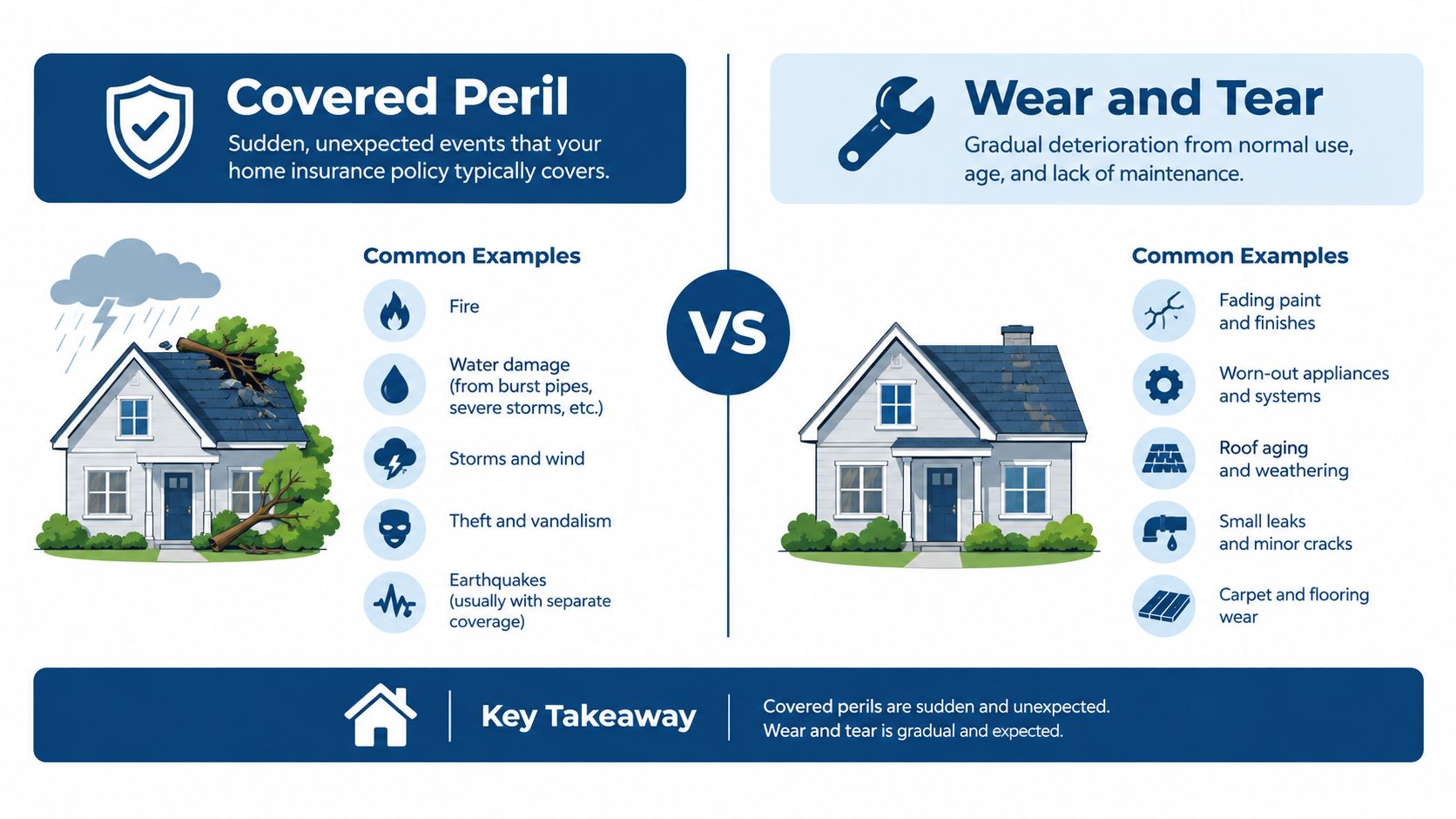
A cause-of-loss matrix is more useful than a simple yes-or-no answer. It separates events that may fit the policy from failures that usually point to maintenance, age, or an internal breakdown. No category guarantees payment, because exclusions, deductibles, limits, policy forms, and evidence still control the claim.
| Cause or event | What the scenario may look like | Coverage direction |
|---|---|---|
| Storm damage | Hail dents or crushes a condenser, wind damages rooftop equipment, or lightning harms electrical components | May be covered if the event and resulting physical damage are covered by the policy |
| Fire | Fire damages the condenser, air handler, wiring, or related permanently installed equipment | May be covered, subject to the policy's exclusions, deductible, limits, and valuation |
| Theft or vandalism | A covered act damages or removes equipment or components | May be covered when the policy includes the event and the evidence supports the loss |
| Accidental damage | A covered accidental discharge or sudden physical event damages the system | Depends on the policy wording and whether the event qualifies as a covered peril |
| Mechanical failure | A compressor, motor, or electrical component fails internally during normal operation | Usually not covered by standard homeowners insurance, though equipment-breakdown coverage may change the analysis |
| Maintenance problem | Dirty coil, clogged filter, restricted airflow, refrigerant loss, corrosion, or neglected drainage contributes to failure | Usually treated as maintenance, gradual deterioration, or an excluded condition |
| Age and ordinary wear | A 12-year-old compressor stops working without a storm or other external event | Generally not treated as an insured loss under a standard policy |
The Insurance Information Institute lists accidental discharge or overflow from an air-conditioning system and sudden, accidental tearing apart, cracking, burning, or bulging of an air-conditioning system among policy-peril examples. Exact coverage varies by policy form, so the institute's disaster coverage guidance should be treated as general context rather than a claim decision.
Arizona weather creates confusing combinations. A monsoon may bring wind and hail that physically damages a condenser, while the same season also brings dust that restricts airflow. The first situation may support a covered-loss investigation. The second usually points toward maintenance or gradual operating stress. A technician's written diagnosis needs to distinguish those conditions instead of labeling every summer breakdown “storm damage.”
A refrigerant leak also needs careful handling. Refrigerant loss by itself doesn't prove that a covered event damaged the system. The technician should identify whether a visible impact, sudden break, corrosion, worn component, or another cause produced the leak. Similarly, a dirty coil may explain poor performance but doesn't establish that insurance owes a replacement.
Homeowners reviewing damage after a severe weather event can also use a general resource about storm-damaged property repairs to organize the broader property response. For an AC claim, photographs, preserved components, and a cause-specific diagnostic report remain more useful than a general statement that a storm occurred.
Policy Limits, Depreciation, and Claim Settlement Math
An approved claim doesn't necessarily produce enough money for a brand-new equivalent system. The settlement depends on how the policy values the damaged property, what the dwelling limit permits, and how the insurer applies the deductible and exclusions.
A permanently installed central AC is generally treated as part of the dwelling rather than ordinary personal property. That classification matters because the dwelling section may respond to covered physical damage, but the policy still sets limits and conditions for that protection. A window unit may be treated differently under personal-property coverage, which is another reason homeowners shouldn't assume that every cooling device has the same claim treatment.
The most important valuation distinction is between actual cash value and replacement cost. Under actual-cash-value coverage, depreciation is deducted from the value of the damaged equipment. An older AC may therefore qualify for a payment that falls well below the amount needed to purchase and install a new equivalent system. Replacement-cost treatment can be more favorable, but it remains subject to the policy limit, deductible, claim conditions, and any required documentation.
Why an approved claim can still leave a gap
Consider the policy sequence without inventing a dollar estimate:
- The adjuster determines whether a covered peril caused physical damage.
- The insurer evaluates the damaged equipment under the policy's valuation method.
- Depreciation may reduce the amount under actual-cash-value terms.
- The deductible is applied.
- Policy limits, exclusions, matching rules, or code-related provisions may affect the remaining amount.
- Replacement-cost benefits, if available, may require compliance with the policy's repair or replacement conditions.
The homeowner should ask whether the insurer is valuing the entire system or only the failed component. A damaged condenser may not automatically justify replacing every indoor and outdoor component under the policy. Compatibility, matching, code upgrades, and obsolete equipment can affect the scope, but the policy language controls whether those items are payable.
Arizona homes can also have rooftop or package equipment, older duct systems, split systems, and additions served by separate units. A contractor can describe what the property needs to restore reliable operation, while the adjuster decides what the policy may owe. Those are related decisions, but they aren't the same decision.
A policy-reading resource such as the Restore Heroes policy reading guide may help homeowners locate declarations, exclusions, endorsements, and loss-settlement language. The insurer's actual policy forms still govern.
Homeowners considering replacement outside an insurance claim can use a practical 2026 AC replacement cost Arizona guide for planning questions, but no general article can calculate the amount an insurer will pay. The correct figure depends on the property, equipment, policy, diagnosis, and settlement method.
Documentation Before Repairs and Adjuster Expectations
The strongest claim file answers five questions plainly: what happened, when it happened, what was damaged, what was done to limit further damage, and what the policy representative instructed next. Homeowners shouldn't open energized equipment, handle pressurized components, climb onto a roof, or dismantle a condenser to gather evidence.
Safe ground-level photographs can show the outdoor unit, surrounding property, hail or debris impact, displaced panels, visible scorching, fallen limbs, and the relationship between the equipment and the reported event. Photographs should be taken only from locations that don't expose anyone to electrical, roof, heat, or structural hazards.
Claim-documentation checklist
- Policy language: Save the declarations page, dwelling limit, deductible, exclusions, loss-settlement terms, and endorsements. Look specifically for equipment-breakdown coverage.
- Dates: Record when cooling stopped, when unusual weather occurred, when the problem was first noticed, and when each service visit took place.
- Photos: Capture the equipment and surrounding damage from safe ground access before parts are discarded or disturbed.
- Diagnostic findings: Request a written report that identifies the failed component and the likely cause, such as lightning damage, hail impact, internal electrical failure, corrosion, refrigerant loss, or restricted airflow.
- Service history: Preserve invoices, maintenance records, prior diagnostic notes, and replacement information if available.
- Mitigation steps: Keep records of reasonable steps taken to protect the home from additional damage, such as safely limiting operation after a burning smell or visible impact.
- Insurer direction: Record the claim number, adjuster's instructions, inspection date, approved scope, and any written direction received before full replacement.
A temporary cooling measure can be reasonable during extreme heat, but emergency mitigation shouldn't become an unapproved full replacement. The homeowner should ask the insurer whether temporary repairs, equipment protection, or an inspection must happen before permanent work begins. If water is entering the home or a fire-related hazard exists, people should leave the unsafe area and contact the appropriate emergency service before dealing with the AC.
A contractor's diagnostic visit has a separate purpose from an insurance inspection. Homeowners researching the cost of AC diagnostic in Mesa should focus on whether the visit produces a clear written explanation of the failure, not on obtaining language designed to force coverage.
The adjuster evaluates coverage and claim payment. The HVAC professional evaluates equipment condition, cause indicators, repair feasibility, system compatibility, and the work needed for safe operation. Neither role should replace the other.
Equipment Breakdown Coverage Versus Home Warranties
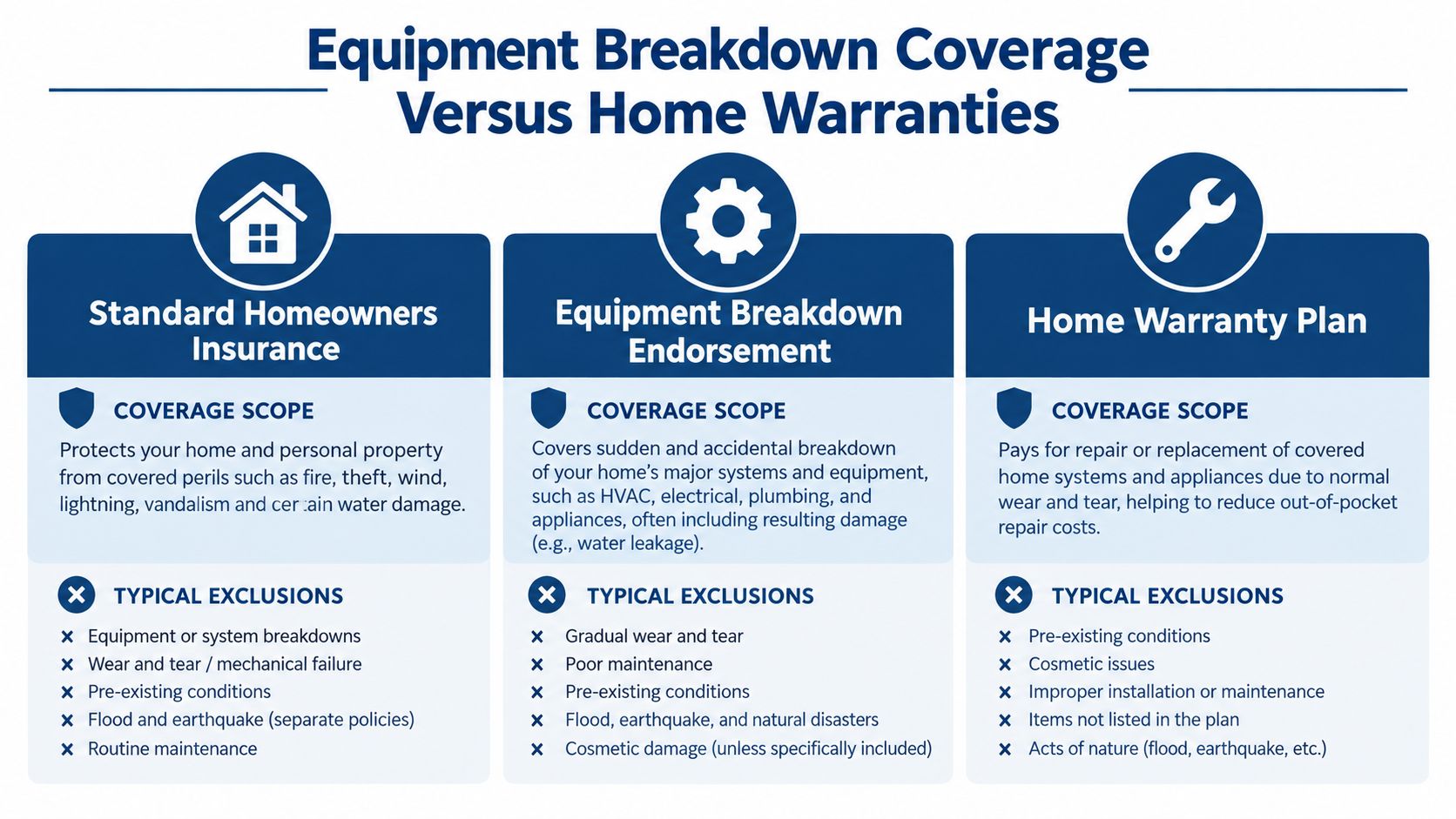
Three forms of protection are often mixed together, but they answer different questions.
Standard homeowners insurance is primarily cause-based. It may respond when a permanently installed AC is physically damaged by a listed external peril such as lightning, fire, hail, wind, vandalism, or a falling object. It generally doesn't pay for a compressor that just wears out, a refrigerant leak caused by deterioration, or a dirty coil caused by neglected maintenance. The NAIC explains that standard homeowners coverage isn't a maintenance contract, and its shopping materials distinguish that protection from equipment-breakdown coverage.
An equipment-breakdown endorsement is designed for sudden mechanical or electrical failures of covered home systems, including central air-conditioning equipment. NAIC equipment-breakdown shopping guidance identifies central air and heating systems as examples of equipment that this type of coverage may repair or replace after a covered breakdown.
That difference can change the claim path. A compressor damaged by lightning may be considered under the standard policy's covered-peril terms. An abrupt internal electrical or mechanical failure may be considered under an equipment-breakdown endorsement if the homeowner has one. Neither route promises payment, because the endorsement can contain its own deductible, sublimit, exclusions, maintenance conditions, and definition of an accident or breakdown.
Where a home warranty fits
A home warranty is a service contract, not homeowners insurance. It may offer a repair or replacement pathway for covered household systems under its own contract, service-call rules, exclusions, contractor network, authorization process, and limits. It shouldn't be used as proof that an insurance claim exists, and an insurance policy shouldn't be treated like a warranty for ordinary aging.
The practical comparison looks like this:
| Protection | Main question | Common problem |
|---|---|---|
| Standard homeowners insurance | Did a listed peril physically damage the system? | Wear, age, maintenance, and internal failure may be excluded |
| Equipment-breakdown endorsement | Did a sudden covered mechanical or electrical breakdown occur? | The endorsement may contain exclusions, sublimits, and special definitions |
| Home warranty plan | Does the service contract cover this system and failure under its terms? | Authorization, service fees, exclusions, and plan limits can control the outcome |
Homeowners should read the declarations page and endorsements before calling a claim. The insurer should be asked whether HVAC equipment is included, whether the central system is classified under dwelling coverage, what deductible applies, and whether the settlement is actual cash value or replacement cost.
A separate comparison of parts vs labor warranty coverage can help distinguish manufacturer or contractor warranty terms from both insurance and home warranty protection. Those warranties may address parts, labor, or both, but their actual terms must be reviewed before relying on them.
What to Do When Insurance Does Not Cover Replacement
A denial often means the evidence points to age, maintenance, ordinary wear, or an excluded internal failure. It doesn't necessarily mean the homeowner did something wrong. In Mesa's long cooling season, a system can lose capacity or fail without any insured event, and a standard policy usually isn't designed to fund routine replacement.
The next step is a professional diagnostic that separates repairable failure from a system that no longer makes practical sense to repair. The assessment should address the failed component, the cause, the condition of connected equipment, duct performance, airflow, thermostat operation, and whether the existing system can be matched with available replacement components. A contractor should never be asked to call wear and tear storm damage to support a claim.
A sensible decision path
- Start with the diagnosis: Confirm whether the failure is a compressor issue, electrical component problem, refrigerant-side issue, airflow restriction, control fault, or another condition.
- Compare repair and replacement: Consider the repair scope, remaining equipment condition, compatibility, and the risk that a partial repair won't address broader system problems.
- Check the property setup: Rooftop package units, split systems, ductless equipment, additions, and older ductwork can require different replacement planning.
- Review the handoff: If replacement is selected, keep the denied claim documents and diagnostic report with the installation records.
- Ask for a written proposal: The proposal should identify the recommended equipment, included work, and exclusions without promising insurance payment.
Arizona homeowners should also avoid treating a denied insurance claim as a reason to rush into the first available system. A proper replacement assessment can identify sizing, duct sealing, zoning, thermostat, indoor-air-quality, and heat-pump considerations that affect the installation decision. Those technical recommendations should be based on the property and equipment, not on an insurer's claim outcome.

The Comfort Experts replacement guide can help homeowners organize questions before accepting a proposal. The useful comparison isn't only the equipment label. It includes the condition of the full cooling setup, installation requirements, controls, ductwork, and the property's comfort needs.
The decision is straightforward once the cause and policy are separated. A sudden covered event may justify an insurance investigation. Age, wear, maintenance, and ordinary mechanical failure usually lead to a homeowner-funded repair or replacement decision, unless a separate equipment-breakdown endorsement or home warranty applies.
Comfort Experts provides AC diagnostics, repair, replacement assessments, and installation support for homeowners in Mesa and the East Valley. Homeowners can call 480-207-1239 or schedule service for a documented evaluation, and can review Comfort Experts for the next step when insurance doesn't cover the failed system.