
A like-for-like furnace replacement usually takes about 4 to 8 hours on site, so plan for one full working day. Total project time still depends on equipment, permits, and any ductwork or gas changes.
The hours a crew spends in the closet are only one clock. Equipment delivery and the city's permit and inspection schedule run on their own calendars, and either one can stretch a straightforward swap well past the day the old furnace comes out. In Mesa and the East Valley, tight attic hatches, crowded closets, and older gas connections are the usual reasons a job that looked simple on paper runs long.
How Long a Furnace Replacement Usually Takes
A standard residential furnace replacement generally requires about 4–8 hours on site when the replacement is substantially like-for-like, according to Carrier's gas furnace installation guidance. That window covers removal, site preparation, cabinet and duct transitions, electrical and gas connections, venting, condensate management where the model needs it, thermostat integration, startup, and commissioning. It is a range, not a promise.
The short end is realistic when the new furnace matches the existing capacity, orientation, vent arrangement, duct dimensions, and fuel, and the crew can reach the cabinet without a fight. The long end shows up when supply or return plenums need resizing, flue or combustion-air piping changes, gas piping is adjusted, or an electrical issue has to be corrected. A furnace that physically fits still needs airflow and safety checks before it goes into service. Excessive external static pressure, the wrong temperature rise, poor combustion air, or bad venting can cause nuisance shutdowns or unsafe operation. Reserve a full workday. A two- or three-hour visit is the wrong plan.
| Scenario | On-site time | Calendar note |
|---|---|---|
| Like-for-like swap using existing connections | About 4-8 hours | Usually one working day once equipment is on hand |
| Substantial duct, gas-line or venting changes | Longer than a single-day swap; hours follow the scope | May need added days for corrections or materials |
| Permit and inspection | Separate from crew labor | Timing set by the city and inspector schedule |
| Equipment delivery | Not counted in on-site hours | Lead time follows the model; ask for a confirmed date |
Three clocks get mixed together. Crew labor is the only one measured in hours. Equipment delivery ends when the right cabinet and parts are on the truck. Permit and inspection close when the city says the work is done. Only the first clock fits inside one working day.
A practical test before you book the day
If the new furnace matches the old capacity, fuel type, vent arrangement, and duct dimensions, and the equipment is easy to reach, you are likely near the shorter end. Change any of those, or park the furnace in a tight Mesa attic or closet, and both the visit and the calendar get longer.
Pre-Install Review, Venting and Equipment Access
Many delays start before the truck rolls. The installer should confirm the new furnace's capacity suits the house, not just that it matches the label on the old unit. Ask how the unit was sized, and what was measured. A quick glance at the old data plate does not account for added insulation, a closed-in patio, or rooms that never heat evenly.
Venting and combustion air come next. The flue, the combustion-air path, and the vent connection should match the installation manual for that model. A venting mismatch found on install day turns a one-day job into a return visit while parts or a new route get sorted.
Then walk the path the furnace will take, from the driveway to the closet, attic hatch, or crawlspace. Note doorway widths, stairs, and ceiling clearance. Ask whether stored boxes or built-in cabinets have to move. In older East Valley homes the hatch is often the bottleneck, not the cabinet size.
For equipment planning, gather model information, repair history, room-level comfort concerns, and any duct or control work already completed. Finished duct or control work changes what the installer still has to review, and it belongs in the written scope. The same habit helps when you compare Arizona AC replacement bids, because heating and cooling often share the air handler, the ducts, and the thermostat.
Before you book, ask three things: how the unit was sized, which vent route is planned, and whether access limits are already in the scope.
Permits and Inspections That Add Calendar Days
A one-day swap can still leave the permit open. Mesa's mechanical code requires a permit before an owner or authorized agent constructs, enlarges, alters, repairs, moves, or replaces a regulated mechanical system, and that list includes replacement. For an equal-or-lower-BTU replacement furnace serving one dwelling unit, the code allows only minor electrical, plumbing, and mechanical connection changes, and the serving gas utility must be notified before the appliance is energized. Requirements still depend on the equipment, fuel, dwelling type, and how much the connections change, so confirm them before install day.
Changing electrical connections is a different category. Mesa's residential construction guidance treats a new circuit or altered wiring as work that needs a construction permit, which can move the job out of a simple like-for-like path. Mesa's current residential pages also say permits are valid for 180 days after issuance, and that the city uses the 2024 International Residential, Mechanical, and Fuel Gas codes with the 2023 National Electrical Code. Ask which editions apply to your scope.
Questions to settle before the date
- Who pulls the permit: Get the permit number in writing before installation day.
- Who schedules the final inspection: Ask whether that visit is already on the contractor's list.
- What a correction does to heat: If the inspector requires a change, ask who does the fix, who books the reinspection, and whether you have heat while you wait.
The sequence is installation, any correction, then the final inspection before the work is closed. Administrative time, not the physical swap, is often the longer wait.
Removal and Gas, Electrical, Condensate and Duct Transitions
On install day the work follows one order. Clearances, connections, drains, and combustion air come from the manufacturer's installation manual for that model. Homeowners should stay out of the work area and should not open gas, electrical, or flue components.
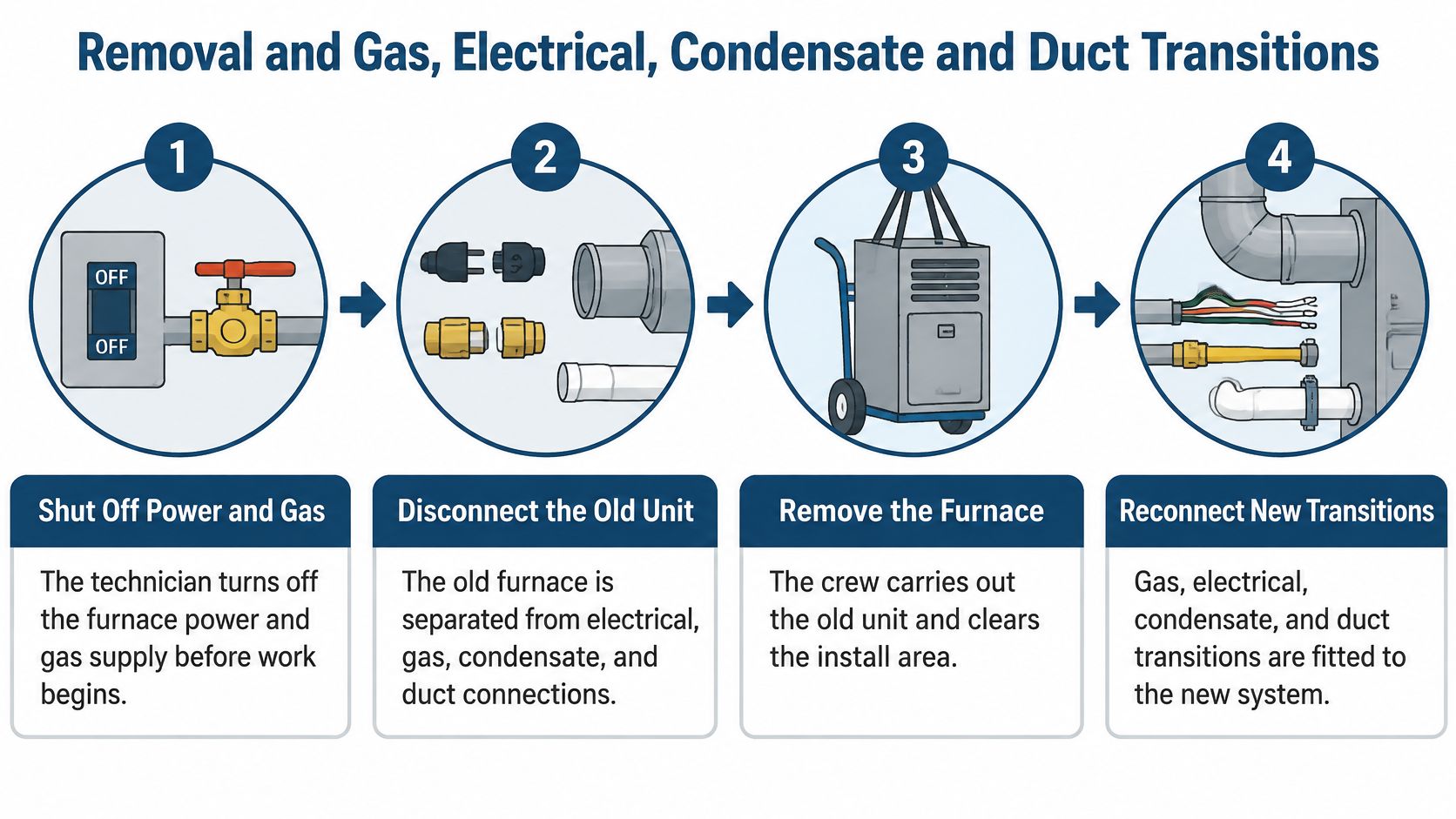
- The technician shuts off power and the gas supply, then disconnects the old electrical, gas, flue, and drain connections. A stuck shutoff or a corroded union is the usual delay here.
- The old furnace comes out along the access route, and the crew checks the cabinet opening and duct connections it reveals. A narrow attic or crawlspace is what makes this step slow.
- The new unit is set level, with clearance for service and combustion air. Shimming a cabinet on an uneven platform takes longer than it looks.
- Gas piping is adapted to the new connection and checked for leaks before any appliance is energized. Extra fittings or a relocated shutoff add time before startup.
- Electrical connections go to the new unit, and the circuit and disconnect are checked against the furnace manual. A circuit that does not match the nameplate stops the job until it is corrected.
- If the model makes condensate, the drain is routed to an approved point, with a trap or pump when the layout needs one. A pump and a longer drain line are the common add.
- Supply and return transitions are fitted to the existing ductwork and sealed. Mismatched duct sizes mean new sheet metal, not a quick clamp-on collar. If the transitions show crushed or open joints, duct repair belongs in the same conversation, because a new furnace cannot fix a leaking trunk.
Startup, Thermostat Setup and Commissioning Records
Setting the cabinet and proving the furnace are separate schedule items. Carrier's furnace installation guidance treats commissioning as its own block: operating gas pressure, ignition and flame proving, vent draft, thermostat sequence, high-limit and pressure-switch operation, temperature rise across the heat exchanger, and combustion analysis on gas equipment when the manufacturer or local practice requires it. Thorough commissioning can take roughly 45–60 minutes after the unit is in place. Substantial ductwork or gas-line changes can extend the whole job to 10–15 hours. Permit timing sits outside crew labor, and a final inspection can add days after the visit.
Startup follows the procedure in that model's manual. Temperature rise is compared with the manufacturer's specification, not with how warm the nearest register feels.
Thermostat, then the paperwork
Confirm whether the existing thermostat works with the new furnace or needs replacing, check the low-voltage wiring, program the schedule, and run a heating call so the sequence is proven. If the old stat is incompatible, thermostat installation is part of the same day, not a later errand.
Before you sign off, ask for a written scope that says whether the quoted duration includes removal, code-related modifications, startup measurements, commissioning documentation, cleanup, and permit coordination. Keep the startup readings, model and serial numbers, the permit final if one applies, and notes on any vent, drain, or duct change in a home file.
Factors That Extend a Furnace Swap
Changes to the existing system drive the timeline. The more a job alters ducts, venting, gas piping, the electrical circuit, or the fuel type, the more checks, corrections, and inspections land on the calendar. Access limits stretch the working day. Reinspection stretches the days after the crew leaves.
| Factor | Why it adds time | Confirm before approving |
|---|---|---|
| Attic or crawlspace access | Tight space slows removal and setting | Written access plan and crew size |
| Vent route changes | Flue or combustion-air piping may need rework | Vent work and any correction are in the scope |
| Duct modifications | Plenums and transitions may need resizing | Whether ductwork changes are included |
| Gas piping changes | Added checks before startup | Gas work scope and utility notice |
| Electrical circuit work | Needs permit and inspection | Who handles electrical work and permit |
| Fuel or equipment type conversion | Changes venting and gas connections | Whether conversion is in the quote |
| Condensate drain routing | Drain or pump additions take extra time | Approved drain route before install day |
| Equipment availability | Specialized models can have longer waits | Confirmed delivery date and backup plan |
| Reinspection after correction | Adds days before heat is restored | Who schedules corrections and reinspection |
Fastest is a like-for-like swap with clear access and a reusable flue, duct connection, and electrical circuit. Slowest is a fuel conversion, a rerouted vent, or a new condensate pump. Mark each row as in scope, not in scope, or unknown before you approve the work. If the furnace is still running and the question is repair versus replacement, you can find furnace repair in Mesa and compare that path with a full changeout before you commit the calendar.
Homeowner Readiness Checklist Before the Crew Arrives
Comfort Experts uses four-hour arrival windows for scheduled calls, so the house should be ready before that window opens, not after the truck is in the driveway. Ask the scheduler to confirm the time and whether the job is booked as a full day.
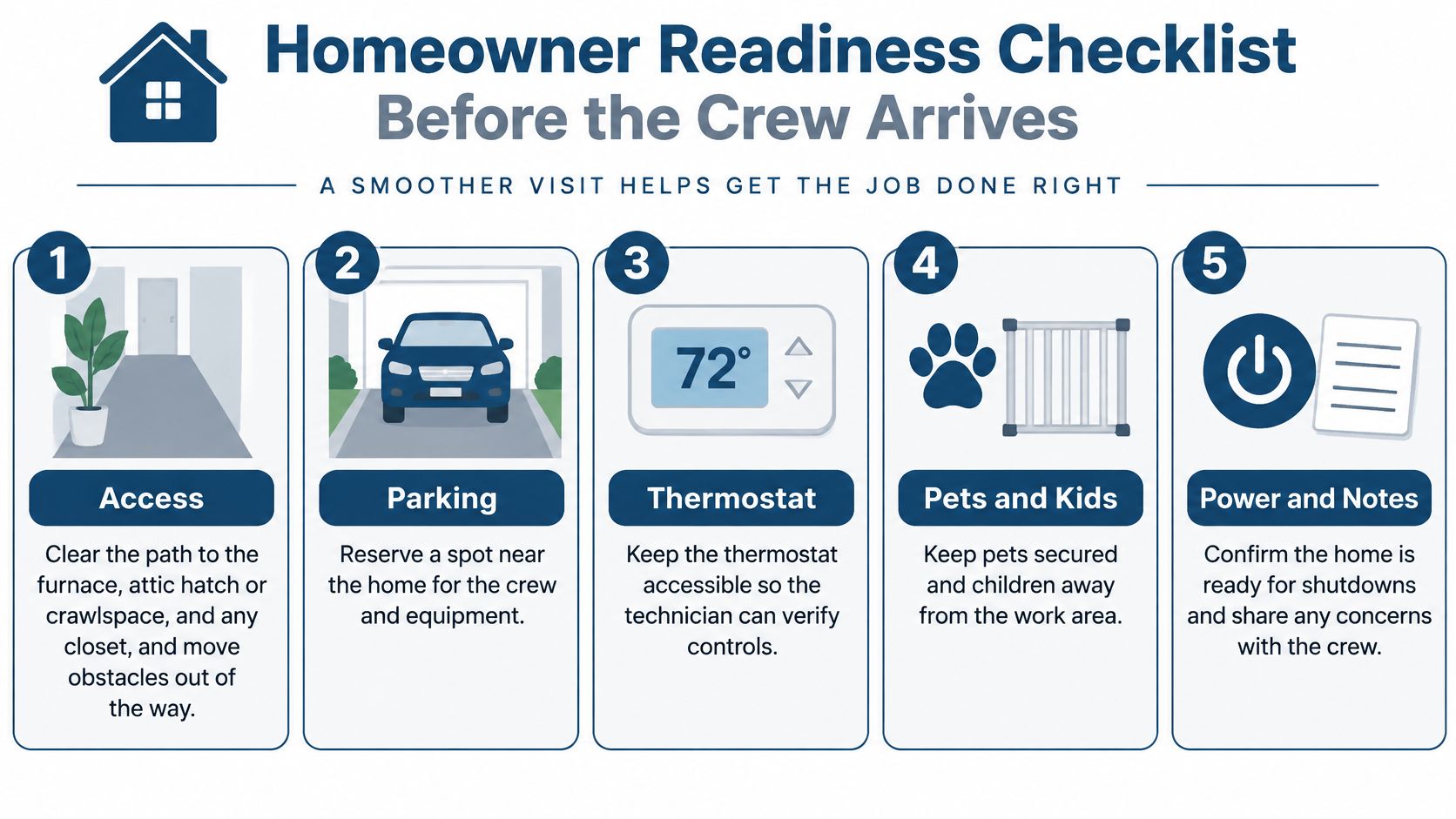
- Access. Clear the path to the furnace, the attic hatch or crawlspace, and any closet. Move stored items the week before, not the morning of.
- Pets. Confine dogs and cats to a room away from the work area and the path the crew will use. Doors will open often.
- Thermostat. Note the make, model, current settings, and whether it is a smart model. Ask if it will be reused.
- Utility shutoff. Ask when power and gas will be off, how long the home may be without heat, and who restores service. Do not operate gas valves yourself.
- Venting. Write down any flue or vent concerns you have already seen so the installer can review them on site.
- Drain routing. If the model produces condensate, confirm where the line will drain before install morning.
- Permits. Confirm who pulls the permit and whether the final inspection is already scheduled.
- Commissioning records. Ask that startup readings be written down and handed to you before the crew leaves.
Confirm the Scope and Schedule Before You Book
Compare a written scope with this guide before you book. The scope should list removal, code-related modifications, startup measurements, commissioning documentation, cleanup, and permit coordination, plus expected on-site hours and which items wait on equipment delivery or inspection. Equipment replacement estimates are free, and Comfort Experts explains the findings, price, and next step before work starts.
A missed call during that back-and-forth is its own delay. A contractor answering service can keep scheduling questions from sitting unanswered while you are comparing scopes. Customers can call 480-207-1239 for help choosing between repair, maintenance, replacement, or a second opinion.
For a furnace changeout in Mesa, the next step is the furnace installation and replacement page. Questions about operating cost belong with energy savings from high efficiency furnaces, after the scope and the calendar are clear. To move ahead, schedule service or call 480-207-1239.
A like-for-like swap is usually one working day on site. Larger changes take longer. Permit and equipment timing run on separate clocks. Keep the written startup records after the install.
Comfort Experts is a locally owned Mesa HVAC company that handles furnace replacement for East Valley homes, from the written scope through startup. If you are planning the day and want the labor, equipment, and permit clocks spelled out for your house, visit Comfort Experts to request an assessment or schedule the visit.