

There isn't one correct calendar for commercial HVAC filters. The right interval starts with quarterly to semiannual change-outs, then moves earlier or later based on measured pressure drop, the filter's final pressure limit, and what the building is doing day to day.
If a facility manager wants a straight answer, this is it, stop using the calendar as the decision and start using it as the starting point. In Mesa and the East Valley, dust, long cooling runtimes, and outdoor air loading make that difference matter fast.
Why Calendar-Only Schedules Fail for Commercial Filters
A fixed date sounds tidy, but commercial filters do not fail on a clock. Two rooftop units can both sit on a 90-day schedule and still need different service, because one is over a quiet office and the other is pulling in dust, smoke, and long run hours.
Use the calendar as a starting point, then decide from the filter's condition. Replace filters when pressure drop and site conditions say they're loaded, not because the calendar says so. ASHE says replacement should follow the manufacturer's schedule, with more frequent changes under extreme conditions, and it recommends monitoring static pressure across the filter bank, with differential-pressure measurement on filter banks above MERV 12. ASHE filter replacement guidance
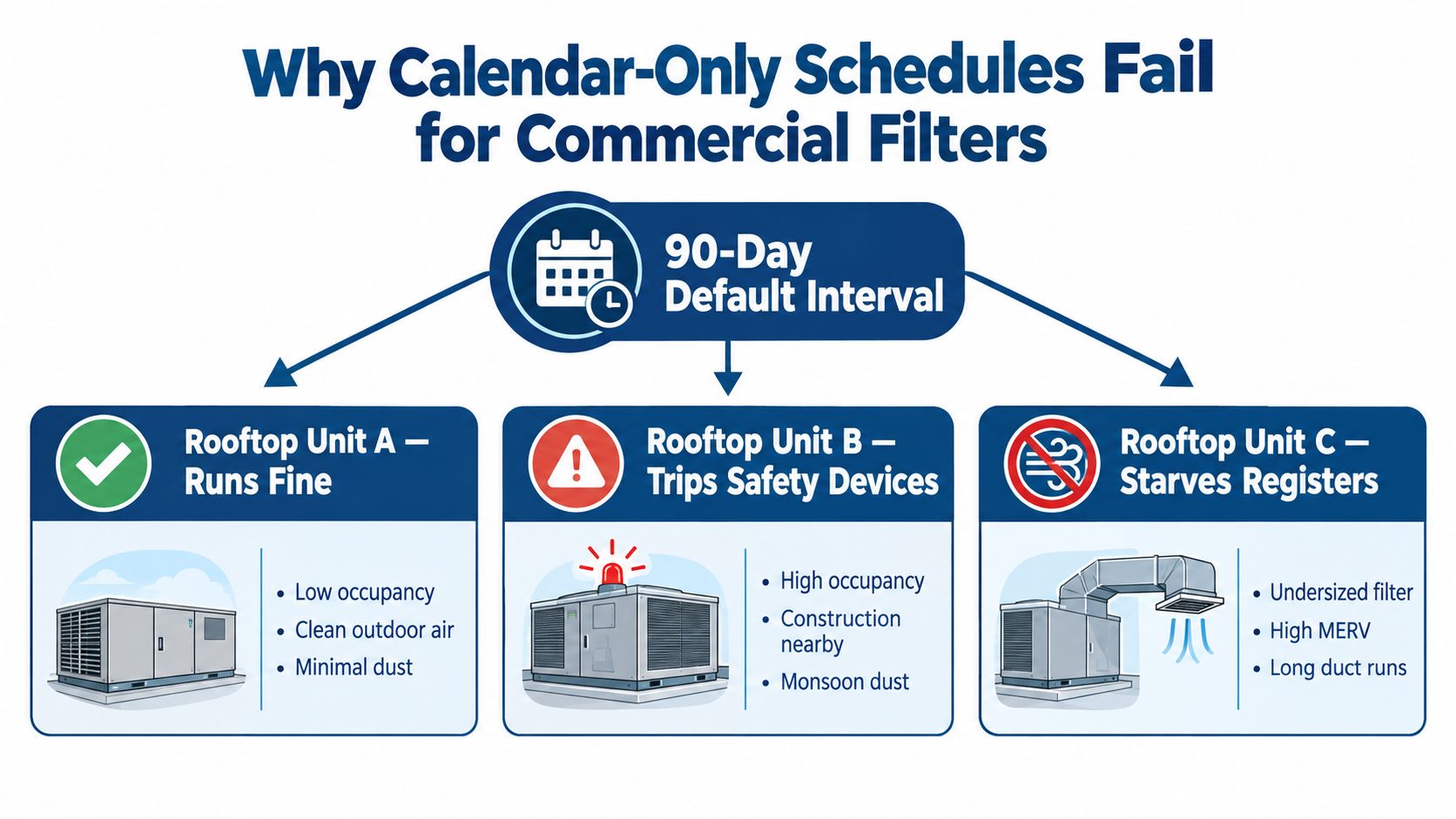
A fixed cadence spends labor on filters that did not need it, while loaded filters stay in place until airflow suffers. A clogged filter can starve registers, raise fan strain, and reduce delivered airflow long before anyone notices a date on the service calendar. A filter can also look clean and still be loaded enough to matter when the media is catching fine dust or smoke.
Facility teams that want a broader maintenance framework should browse HVAC reliability services and compare that approach against a date-based swap. The right local move is to pair inspections with preventive commercial HVAC maintenance and record what the filters do in service.
Filter Type and Depth Change the Interval
Not every filter loads the same way. A shallow pleated panel, a deeper rigid cell, and a bag or HEPA-style arrangement all move air differently, so the replacement interval changes with the filter's depth, surface area, and efficiency.
Higher-efficiency media generally captures more particles, but ASHRAE also notes that increasing efficiency usually increases pressure drop, which can reduce airflow and raise fan energy. At the same time, a higher-capacity filter can sometimes hold more dust before resistance becomes unacceptable, as long as the equipment can still move the required air. That is why depth matters as much as MERV rating. ASHRAE filtration and disinfection FAQ
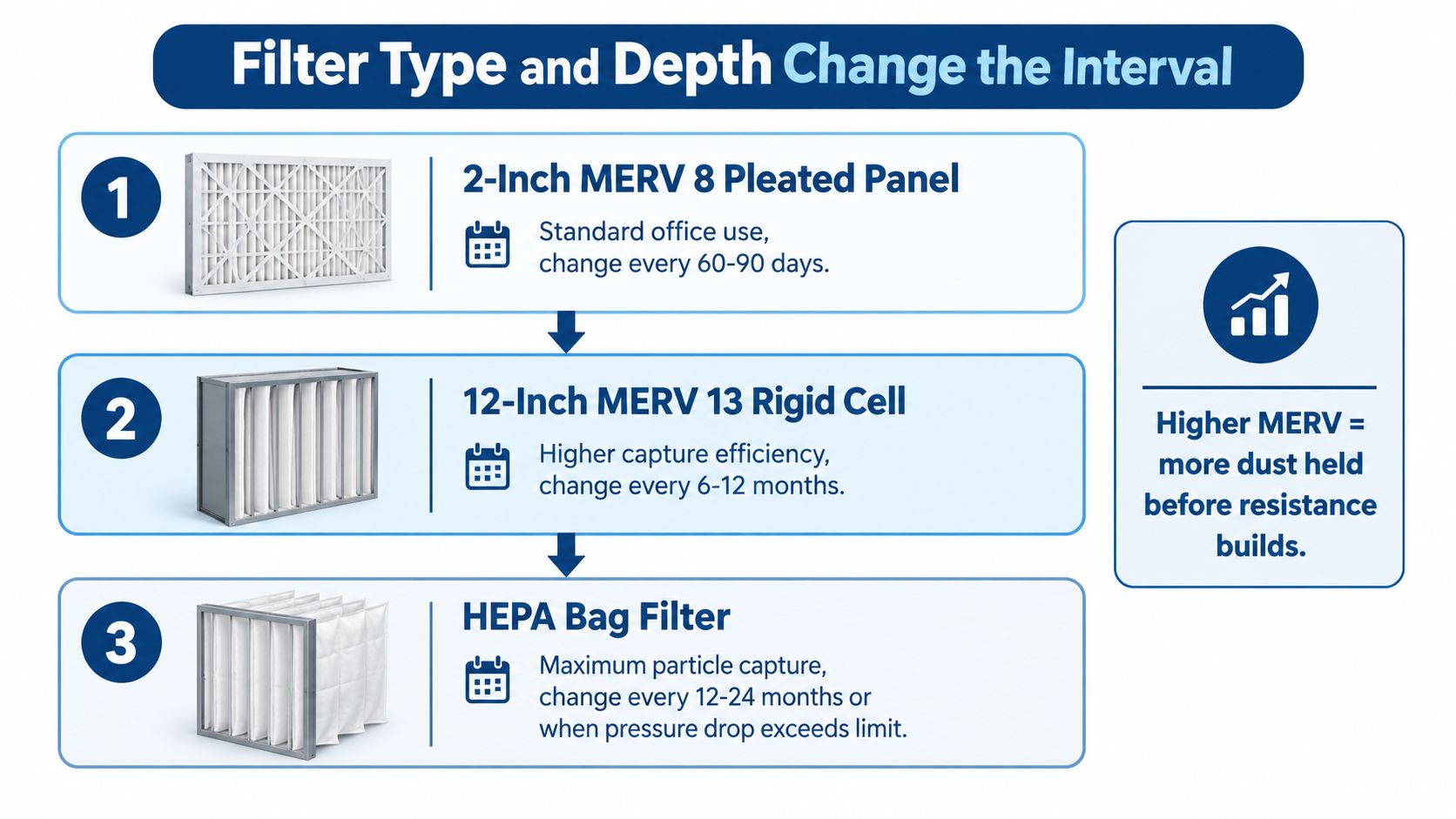
For East Valley rooftop and packaged units, that usually means this: thin filters need closer attention, deeper filters can often stay in service longer, and both need to be checked against the unit's airflow limits. Comfort Experts' filter guide is a useful starting point for matching filtration to building conditions, especially when a space struggles with dust or allergies. Comfort Experts' filter guide
The takeaway is blunt. A filter's construction can change the inspection rhythm just as much as the calendar can. If the equipment was designed around a lower-resistance filter and someone ups the filtration without checking static pressure, the replacement interval can shorten instead of lengthening.
Reading Differential Pressure Like a Technician
Differential pressure is the cleanest replacement trigger because it measures what the filter is doing to airflow. ASHRAE wildfire-smoke guidance recommends a pressure port or gauge on at least one air-handling unit so staff can record a clean baseline and compare later readings under similar fan conditions. It also gives a rule of thumb, change the filter when pressure drop reaches about twice the initial clean reading, subject to the equipment manufacturer's limit and airflow requirements. ASHRAE wildfire-smoke guidance
That means a clean filter reading of 0.20 inches of water column points to a practical change-out near 0.40 inches, unless the unit's own limit comes first. Readings only make sense when the airflow conditions are comparable, so the baseline has to be taken on a clean filter and the later checks need to be logged the same way.
| Reading vs Baseline | Clean Baseline | Service Signal | Replace Now | Investigate Further |
|---|---|---|---|---|
| Differential pressure | Clean and recorded | Rising but still under limit | At or near the manufacturer's maximum final pressure drop | Pressure rises too fast or airflow drops early |
The point is not to chase one perfect number. The point is to create a defensible trigger that says the filter is loaded enough to change, not just dirty to the eye. For facilities that already track static pressure issues, Comfort Experts static pressure diagnostics gives a helpful model for what to watch when airflow problems show up before a scheduled swap.
Occupancy, Runtime, and Dust Loading
Two similar buildings can burn through filters at very different speeds. The difference is usually occupancy, outside-air intake, and runtime. The U.S. Department of Energy notes that filters can need replacement at least twice as often when buildings increase outside-air ventilation or operate air-handling units continuously. DOE Better Buildings fact sheet
What shortens the interval in Mesa and the East Valley
- Long cooling hours: Summer operation keeps air handlers moving for much of the day, so filters load faster.
- More outdoor air: Economizer use and higher fresh-air settings pull in more dust.
- High occupancy: More people usually means more particles and more load on the media.
- Nearby construction: Dust from tenant improvements, road work, and site development can fill filters early.
- Monsoon and wildfire events: Fine particulate spikes can overwhelm a normal service cadence.
- Poor seating or bypass gaps: A filter that isn't seated correctly can look clean and still fail the job.
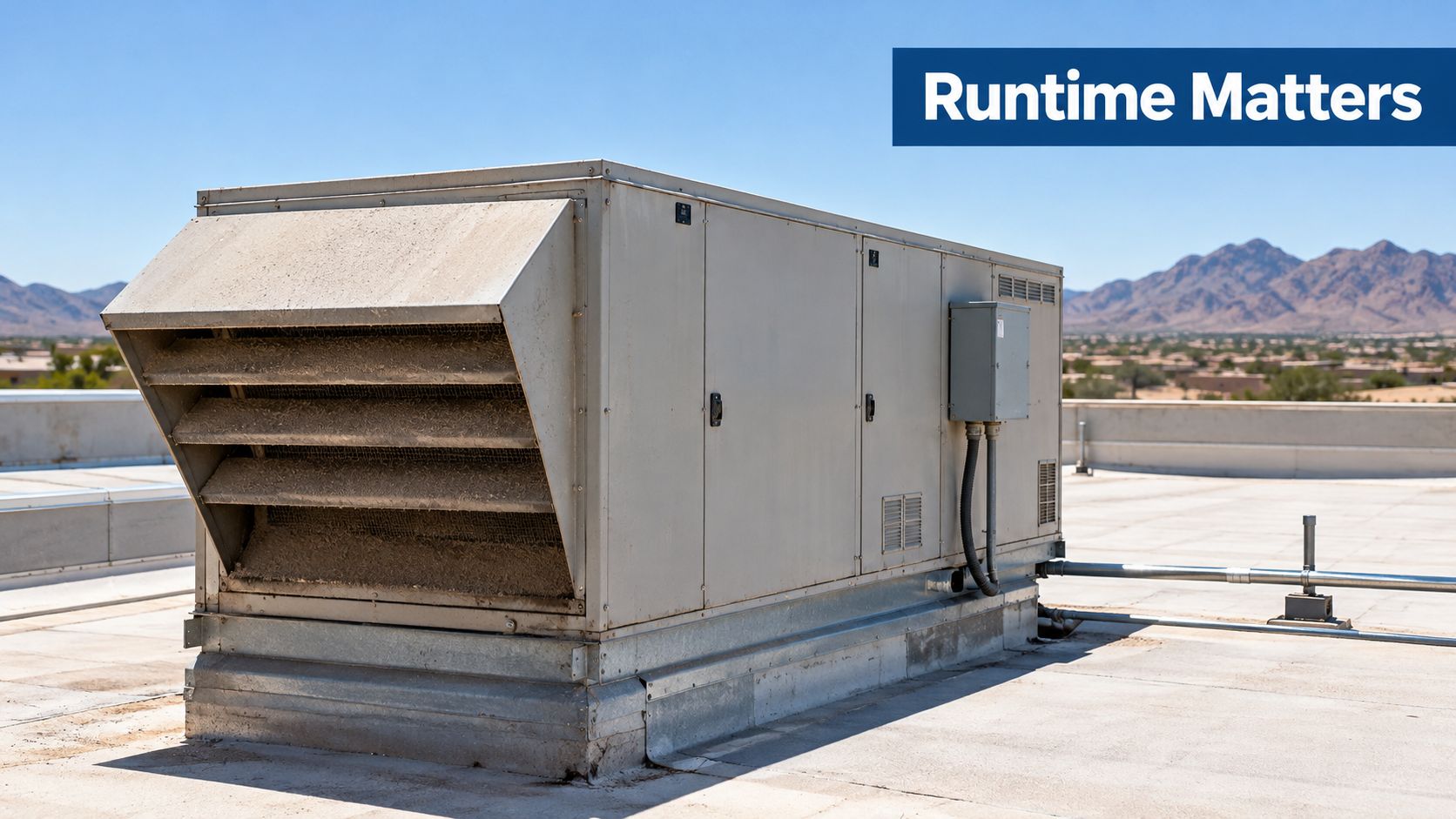
A visual inspection still matters, but it can't be the only check. Fine desert dust and smoke can load a filter before it looks dramatic, and a loaded filter can still look “okay” from the aisle. For a practical local reference on dust control, practical steps for cleaner air is relevant to building managers who are trying to reduce how fast filters fill up.
The local rule of thumb
If the building runs hard, inspects should be more frequent than the changes. That is the safest pattern for Mesa offices, retail spaces, and properties that stay busy through the summer.
Facility-Condition Interval Matrix
The most useful answer is a starting point matched to the building, then adjusted by pressure readings and site conditions. Use the matrix below as a starting interval, not a universal rule.
| Facility Type | Default Inspection | Default Replacement | Shorten the Interval If |
|---|---|---|---|
| Office | Monthly | About 90 days | Occupancy rises, outside air increases, or pressure drop climbs quickly |
| Retail | Monthly | 60 to 90 days | Doors open often, foot traffic is high, or dust tracks in from outside |
| School/daycare | Monthly | About 90 days | Occupant load is high, cleaning activity is heavy, or the building runs extended hours |
| Light industrial | Monthly | 30 to 60 days | Process dust, forklifts, or loading activity adds particulate |
| Renovation | Weekly | On pressure-drop trigger | Dusty work, return-air exposure, or active demo is nearby |
| High-dust use | Weekly to monthly | On pressure-drop trigger or very short intervals | Desert dust, construction, smoke, or continuous operation pushes loading up fast |
A cleaner office with a larger filter bank may stay in service longer than a dusty retail shell or a light industrial space, but only if the pressure readings support it. A school or daycare usually needs a tighter inspection pattern because occupancy and runtime vary more than managers expect, especially during seasonal breaks and special events.
For Arizona property teams, the safe assumption is simple. Quarterly can work as a starting point, monthly inspections are the smarter habit, and the actual replacement date belongs to the filter rack data. That is the only way to make the schedule defensible across different buildings and use patterns.
Kitchens, Renovation, and High-Particulate Spaces
Grease, smoke, drywall dust, and concrete dust do not treat filters gently. These spaces load media faster and more unevenly than standard office air, so the change-out pattern has to get tighter the moment the space starts making particulate.
What to do when the space is dirty by nature
- Restaurants and food prep areas: Check filters often, because grease aerosols can blind ordinary pleats quickly.
- Renovation zones: Isolate return air when possible, because construction debris can collapse media and spike static pressure.
- Woodworking or fabrication spaces: Treat dust capture as a maintenance priority, not a convenience.
- Packaged DX systems upstream of coils: Don't let restricted airflow linger, because it can trigger icing or compressor stress.
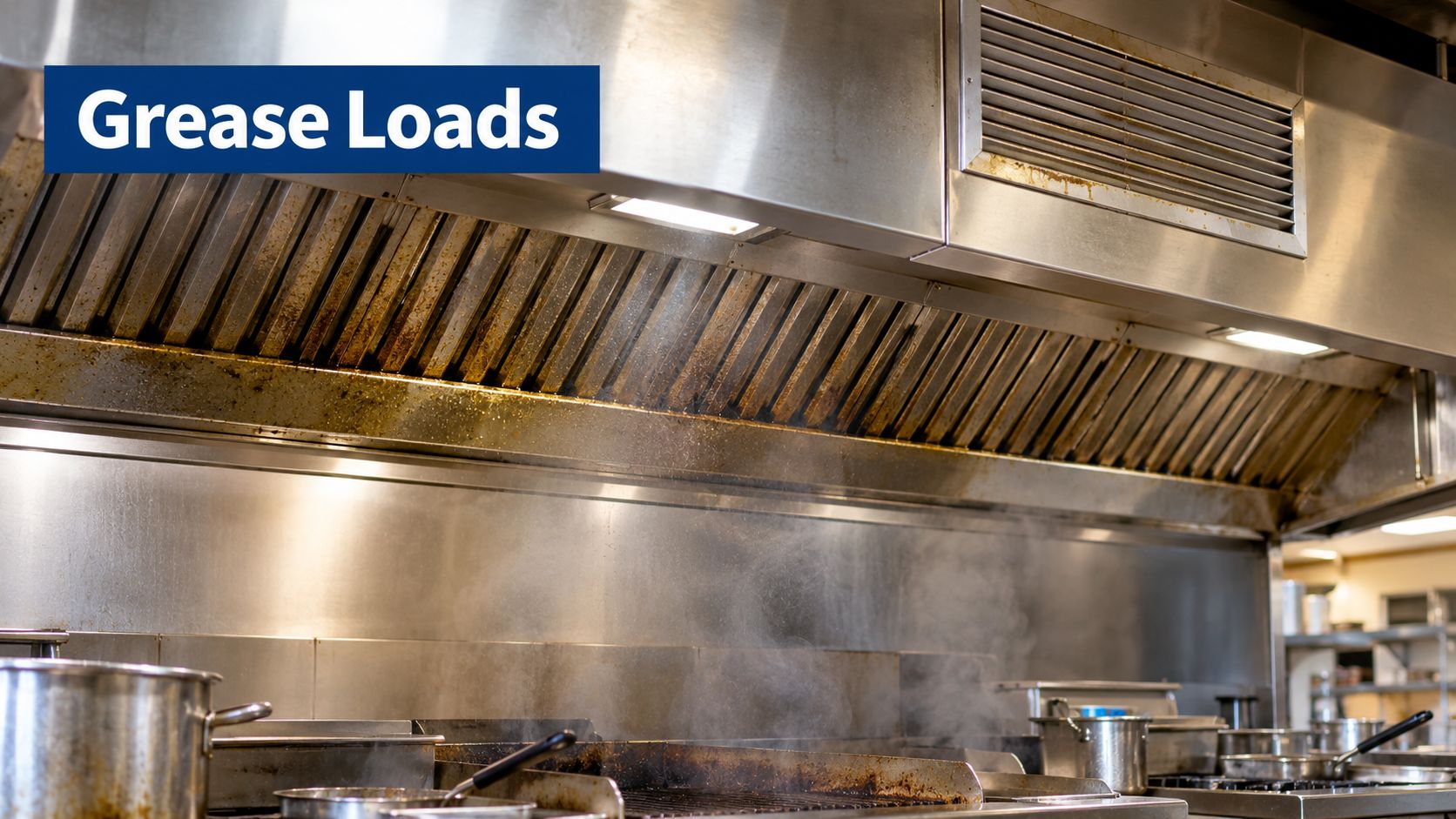
These spaces often need higher-efficiency filtration, but the rack has to support it. If the filter loads unusually fast, the problem may not be the media alone, it may be bypass, bad sealing, or an air handler pulling more debris than the system was meant to handle.
That is the point where a technician should step in instead of letting staff keep swapping filters by habit. A fast-loading filter in a dusty or greasy space is a maintenance signal, not just a consumable problem.
The Filter Log a Facility Should Actually Keep
A change without a record is just a guess with a receipt. The log is what turns filter maintenance into a decision process that can be defended later.
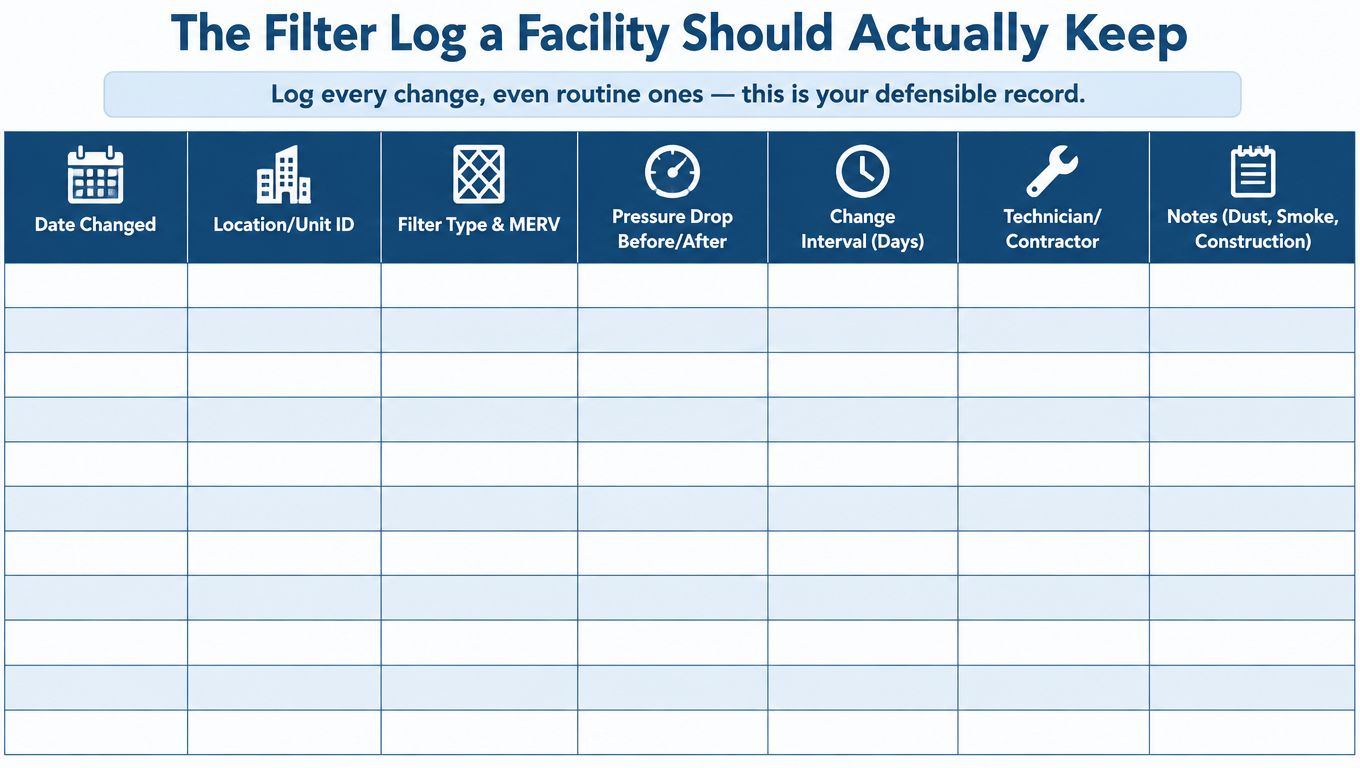
| Date Changed | Location/Unit ID | Filter Type & MERV | Pressure Drop Before/After | Change Interval (Days) | Technician/Contractor | Notes (Dust, Smoke, Construction) |
|---|---|---|---|---|---|---|
Keep the log with every change, even the routine ones. The date and unit ID show where the problem sits, the filter type shows whether the rack is compatible, and the pressure readings show whether the swap happened for a real reason or just because someone thought it looked dirty.
Runtime hours and complaint notes matter just as much as the pressure reading. A filter that keeps failing early in the same unit usually means the load is coming from somewhere else, not from the filter itself.
Compliance, Standards, and Auditable Records
Commercial filter programs get stronger when they follow a written standard instead of a memory-based routine. ASHRAE Standard 180 covers inspection and maintenance practices for commercial HVAC systems, and ASHRAE Standard 52.2 governs the test method used to rate air filters. EPA indoor-air resources also expect maintenance records to identify the filter size, type, replacement frequency, and date of the last change. ASHRAE commercial HVAC resources
That record trail is what a manager can hand to ownership, a consultant, or an auditor. A clean log should show the filter model, the unit location, the inspection date, the pressure-drop trend, and the follow-up action, not just a pile of invoices. For teams building a procurement or compliance process around maintenance records, a procurement compliance matrix can help organize what belongs in the file and what belongs in the field.
The same documentation idea shows up in California commercial-care rules, which require records of filter inspection, cleaning, or replacement, including static-pressure drop and filter efficiency. Arizona facilities aren't bound by that rule, but the recordkeeping logic is the same. Comfort Experts commercial HVAC guide is a useful follow-up for managers who want the filter log tied to a broader maintenance plan.
When Unusual Loading Signals a Larger Problem
A filter that loads much faster than expected is usually telling on the system. If the same rack keeps filling early, the issue may be bypass leakage, a stuck outdoor-air damper, coil contamination, or another upstream restriction.
Watch for these signals:
- Hot or cold zones: Airflow is no longer balancing the space well.
- Coil icing or weak supply air: Restricted airflow is affecting the coil or fan performance.
- Rising blower strain: The unit sounds loaded or works harder than usual.
- Repeated complaints: Occupants notice dust, odor, or uneven temperatures.
- Fast pressure rise after a fresh change: The rack may be leaking around the media.
A filter change fixes a loaded filter. It does not fix a leaking rack or a system that is pulling too much dust through bypass gaps. Do not open energized or pressurized equipment without proper training, and do not assume a fast-loading filter is just bad luck.
Who Should Inspect and When to Bring in a Pro
Trained in-house staff can handle basic inspections with a flashlight, a manometer, and the filter log. They can confirm the size, check seating, note visible loading, and record the pressure reading. That is enough for many monthly inspections.
Rooftop and packaged units, quarterly service, and any swap that requires access near live electrical disconnects or belt-drive components belong with a commercial technician. That is where Comfort Experts fits for Mesa and East Valley properties, as a local option for filter logging, scheduled maintenance, and pressure-drop checks tied to the rest of the air handler.
If a building keeps pushing filters past their normal life, the right move is a professional inspection, not a tighter guess. The technician should verify airflow, static pressure, outdoor-air settings, and rack condition before the next change interval is written down.
Next Steps for Mesa and East Valley Facilities
Start with the air handler model, the installed filter size, and a clean baseline pressure reading. Then set the inspection cadence from the facility-condition matrix above, log each change, and shorten the interval if the building runs hard, pulls in dust, or shows a faster-than-normal pressure rise.
For Mesa and East Valley properties that need a commercial HVAC check, call Comfort Experts at 480-207-1239 or schedule service. A commercial tune-up can document filter loading, verify airflow limits, and reset the replacement plan around the actual building conditions, not a guess.
Comfort Experts helps Mesa and East Valley property managers turn filter changes into a documented maintenance decision, not a calendar habit. If the filters are loading too fast or the unit needs a pressure-drop check, visit Comfort Experts and request a commercial assessment that fits the building, the runtime, and the dust load.