

A Mesa homeowner may hear the air conditioner run through a long summer afternoon, then notice weak airflow, rising utility bills, or a sudden shutdown during the worst heat. That's usually when the question becomes urgent: is an HVAC maintenance agreement worth it, or is it just another recurring household expense?
The answer depends less on the promise printed in the brochure and more on the equipment's condition, the home's exposure to dust and heat, and what the contract covers. A plan with real performance testing can be useful. A plan that only provides a quick visual inspection may offer much less value.
What Actually Happens During a Mesa Summer Without Maintenance
An older East Valley home can feel comfortable in spring and still struggle badly by late summer. The outdoor condenser may sit beside a block wall or on a gravel side yard while desert dust settles across the coil. Inside, restricted airflow and a thermostat that runs longer can signal that the system is working harder than it should.
During monsoon weather, wind can push more dust and debris around the outdoor unit. Coil fouling reduces heat transfer, while a small refrigerant issue or drifting control can remain unnoticed until the system cannot keep up. The homeowner may first notice a warm bedroom, longer cycles, or an electrical component that finally fails under heavy demand.
The difference between a manageable repair and a major disruption often comes down to timing. A technician who finds a dirty coil, loose electrical connection, airflow imbalance, or control problem during a scheduled visit has more options than a homeowner calling after the system stops on a hot afternoon.
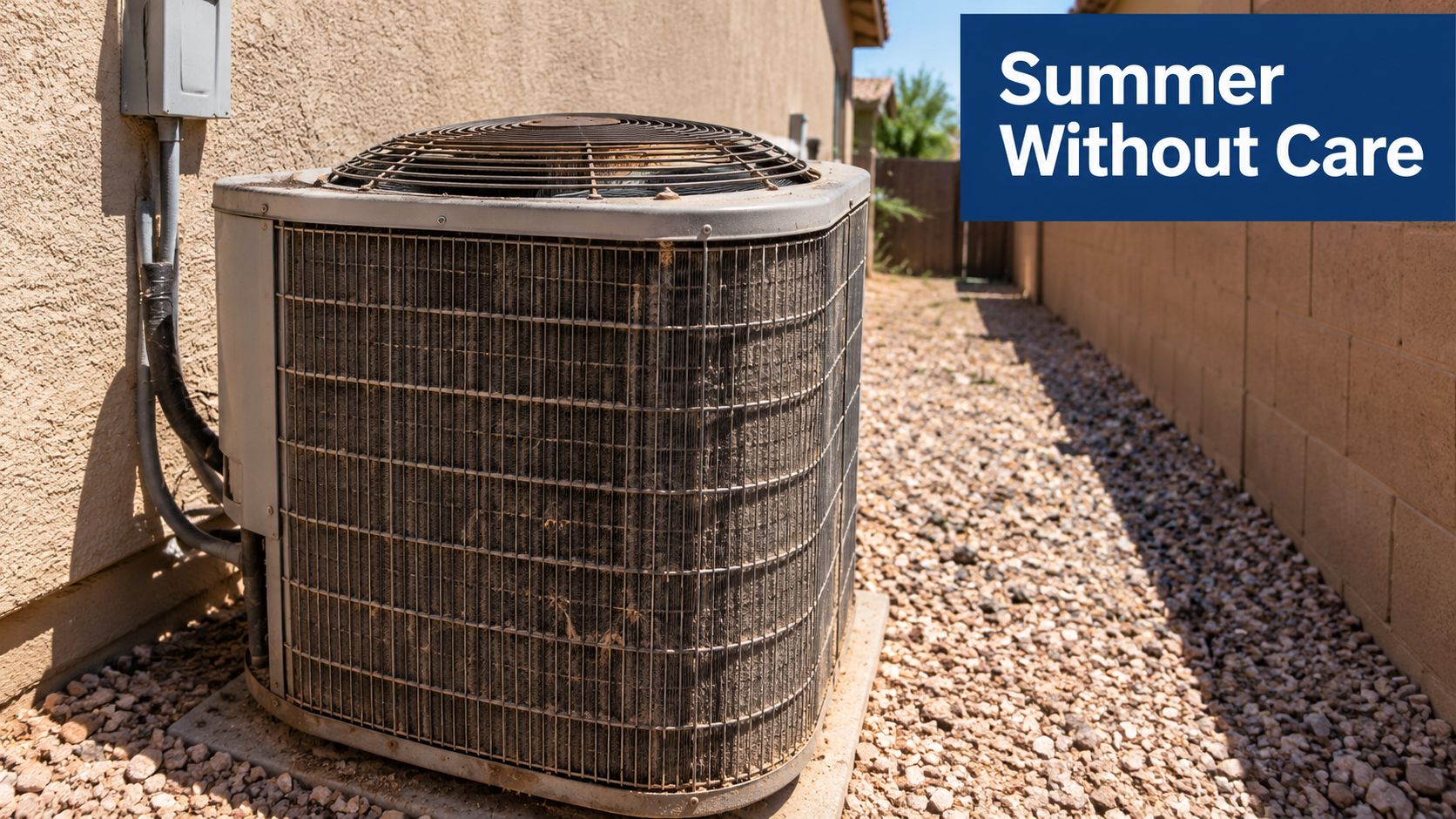
The Comfort Experts on dust and coils gives Mesa homeowners a useful reminder: outdoor cleanliness matters, but wiping away visible dust isn't the same as checking system performance. Maintenance should connect cleaning with measurements, component testing, and recommendations based on the unit's actual condition.
How HVAC Maintenance Agreements Are Structured
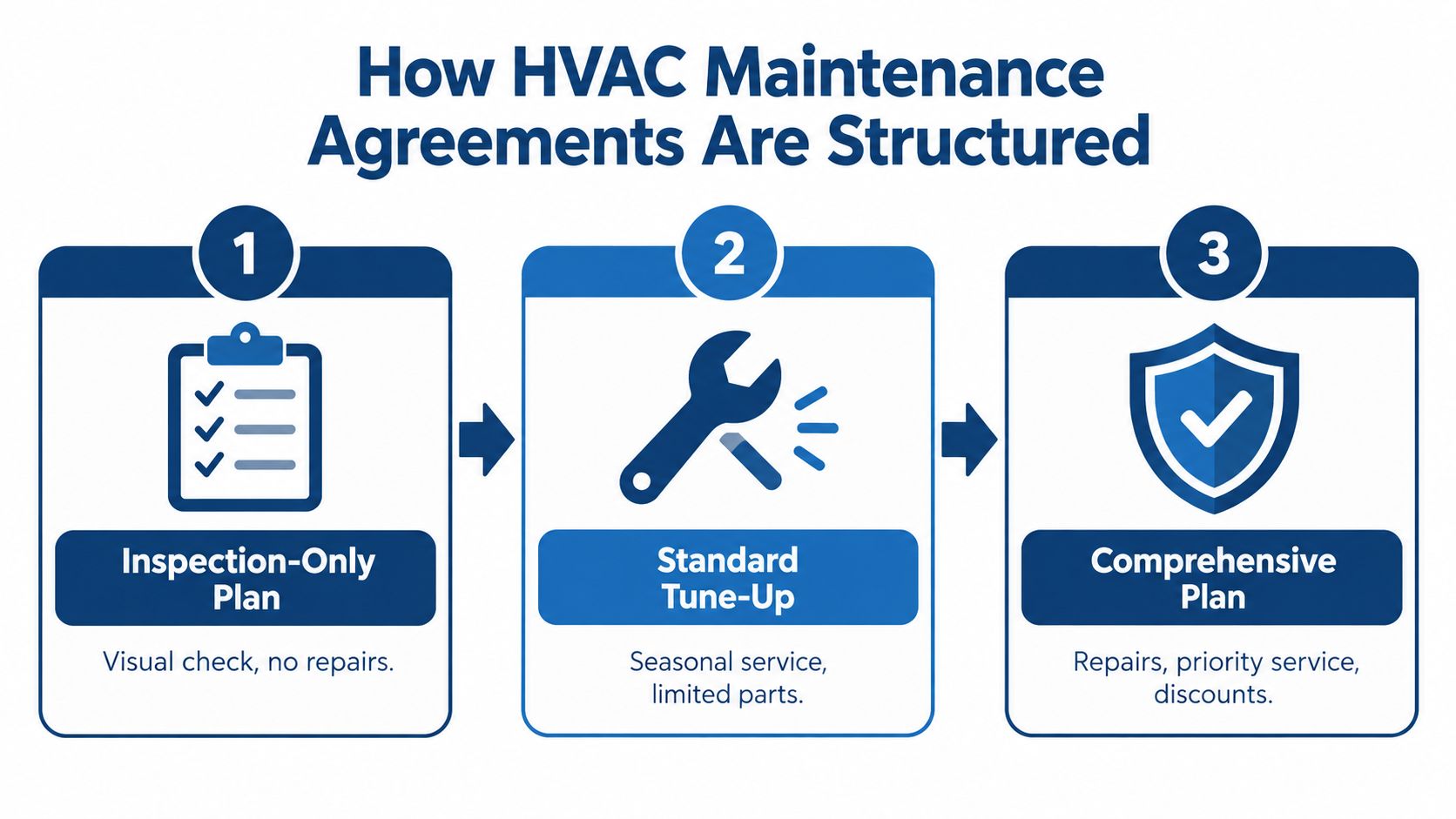
HVAC agreements usually fall into three broad categories. The names vary by contractor, so the written scope matters more than the label.
An inspection-only plan may include a visual review, basic operating checks, and a list of recommended repairs. That can help identify obvious problems, but it may not include coil cleaning, detailed electrical testing, refrigerant diagnostics, or repair labor. It's the least protective option when the homeowner expects the contractor to correct problems during the visit.
A standard tune-up agreement generally includes recurring seasonal service. Depending on the contractor, that can involve coil inspection or cleaning, airflow checks, thermostat verification, electrical testing, condensate evaluation, and heating or cooling startup checks. The agreement may still exclude replacement parts and most repair labor.
A full-service plan combines scheduled maintenance with additional service benefits. Those may include priority scheduling, reduced diagnostic charges, labor allowances, or discounts on repairs. Major components, pre-existing conditions, neglect-related damage, and replacement equipment are commonly excluded, so "full coverage" doesn't mean unlimited benefits. Contract guidance describes the difference between inspection-only, labor-inclusive, and broader agreements, along with common exclusions, in this maintenance agreement overview.
What a useful visit should verify
ASHRAE's preventive-maintenance guidance uses recurring walk-through inspections, seasonal checks around cooling and heating startup, and longer-term validation within a 3–5 year O&M plan. The guidance shows why a generic tune-up isn't enough for every property. Controls, actuators, airflow, and sensors can create comfort and energy problems before a complete breakdown occurs. See the ASHRAE preventive-maintenance checklist for the underlying maintenance framework.
For a Mesa homeowner, the key question is simple: does the plan include actual checks that reveal declining performance? The AC maintenance in Mesa service page can be compared against any agreement's written scope, especially for coil condition, electrical components, refrigerant-related diagnostics, airflow, and system operation.
Cost, Savings, and What the Numbers Actually Show
The financial case has three parts: energy performance, avoided service disruption, and contract benefits when a repair is needed. None should be treated as automatic. A plan pays for itself only when its included work and risk protection match the home.
One peer-reviewed study reported about 20.18% energy savings, equal to roughly 6,600 kWh per year per unit, after preventive work restored components closer to design performance. The study linked the improvement to cleaner heat-transfer surfaces and better-tuned controls, which reduced compressor workload and stabilized operation. Those results support paying for performance checks, not assuming every low-cost inspection produces the same outcome. The peer-reviewed HVAC maintenance study provides the technical source.
Independent coverage also reports that maintenance contracts can provide 10%–20% discounts on repairs and equipment, while some plans reduce or waive diagnostic and service-call charges. Those benefits matter most when the home needs service during the agreement period. They don't turn an inspection-only plan into full equipment insurance.
| Plan Type | Typical Coverage | Best For |
|---|---|---|
| Inspection-only plan | Visual review, basic operating check, recommendations | Newer systems with a homeowner who wants periodic professional oversight |
| Standard tune-up | Seasonal inspection, cleaning or testing as specified, limited repair benefits | Homes with regular cooling use and equipment that needs structured attention |
| Comprehensive plan | Scheduled maintenance plus priority service, discounts, and broader service terms | Older, heavily used, or failure-prone systems where response and repair costs matter |
The fee is only one line in the calculation
A newer system in a moderate-use home may not justify a broad agreement if it has a reliable service history and the owner already schedules appropriate care. An older unit, a rooftop package system exposed to dust, or a home that cannot tolerate a cooling outage creates a different risk profile.
A homeowner should compare the annual fee with the actual included value, not the advertised list of benefits. Ask whether the plan covers both cooling and heating visits, whether repair discounts apply to labor and parts, whether diagnostic fees are reduced, and whether priority scheduling is guaranteed or merely described as a preference.
Comfort Experts AC maintenance pricing can help homeowners separate the cost of a standalone tune-up from the broader value of an agreement. The right comparison isn't “membership versus free maintenance.” It's “standalone service when needed versus predictable service plus contract benefits.”
Why Mesa Heat and Dust Change the Calculation
Mesa's long cooling season puts more operating pressure on air conditioners than a mild-climate home typically experiences. A system that runs for long periods through extreme heat has less room for a dirty coil, restricted filter, weak capacitor, drifting sensor, or airflow problem.
Desert dust adds another layer. Outdoor coils need to release heat, and contamination can interfere with that process. Interior dust and duct leakage can also contribute to airflow complaints, although a maintenance agreement shouldn't be used as a substitute for proper duct evaluation or filtration decisions.
Arizona guidance citing the U.S. Department of Energy associates proper HVAC maintenance with about 5%–20% annual energy savings, and Arizona-facing guidance commonly recommends service twice a year for homes that operate air conditioning heavily through extreme heat seasons. See the Arizona HVAC maintenance frequency guidance for that regional context.
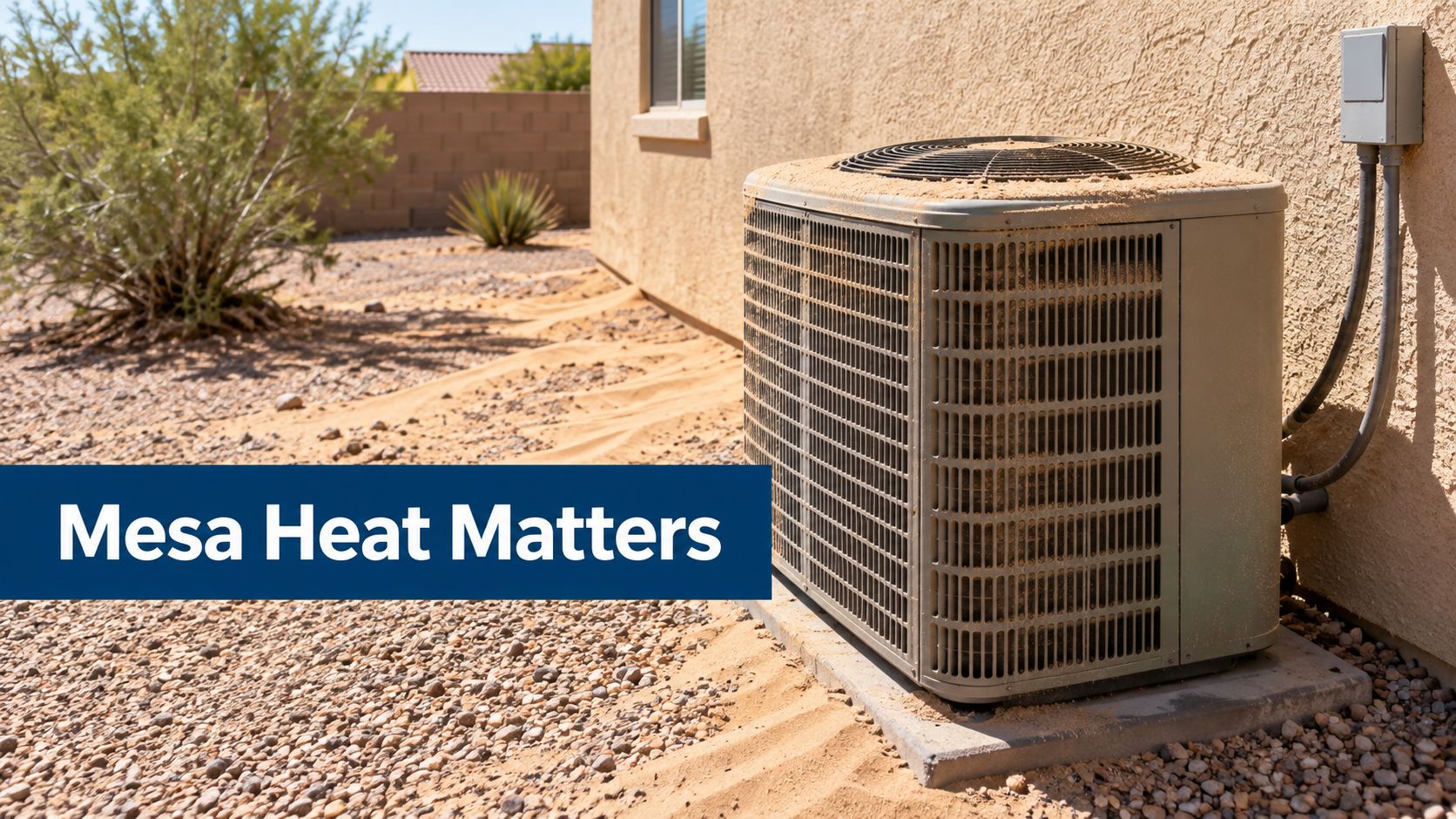
The timing of service matters as much as the number of visits. A spring cooling check can identify problems before the system carries the full summer load, while a post-monsoon inspection can address dust exposure and operating changes. The Comfort Experts monsoon AC maintenance guide offers local planning context for that seasonal risk.
Arizona-specific guidance also claims that well-maintained systems can use 20%–40% less energy than neglected units. That figure should be treated as a condition-dependent estimate, not a promise for every home. Equipment age, duct condition, thermostat settings, insulation, and the quality of the maintenance all affect the result. The Arizona energy-efficiency guidance explains the local rationale.
How to Evaluate and Compare Local Maintenance Contracts
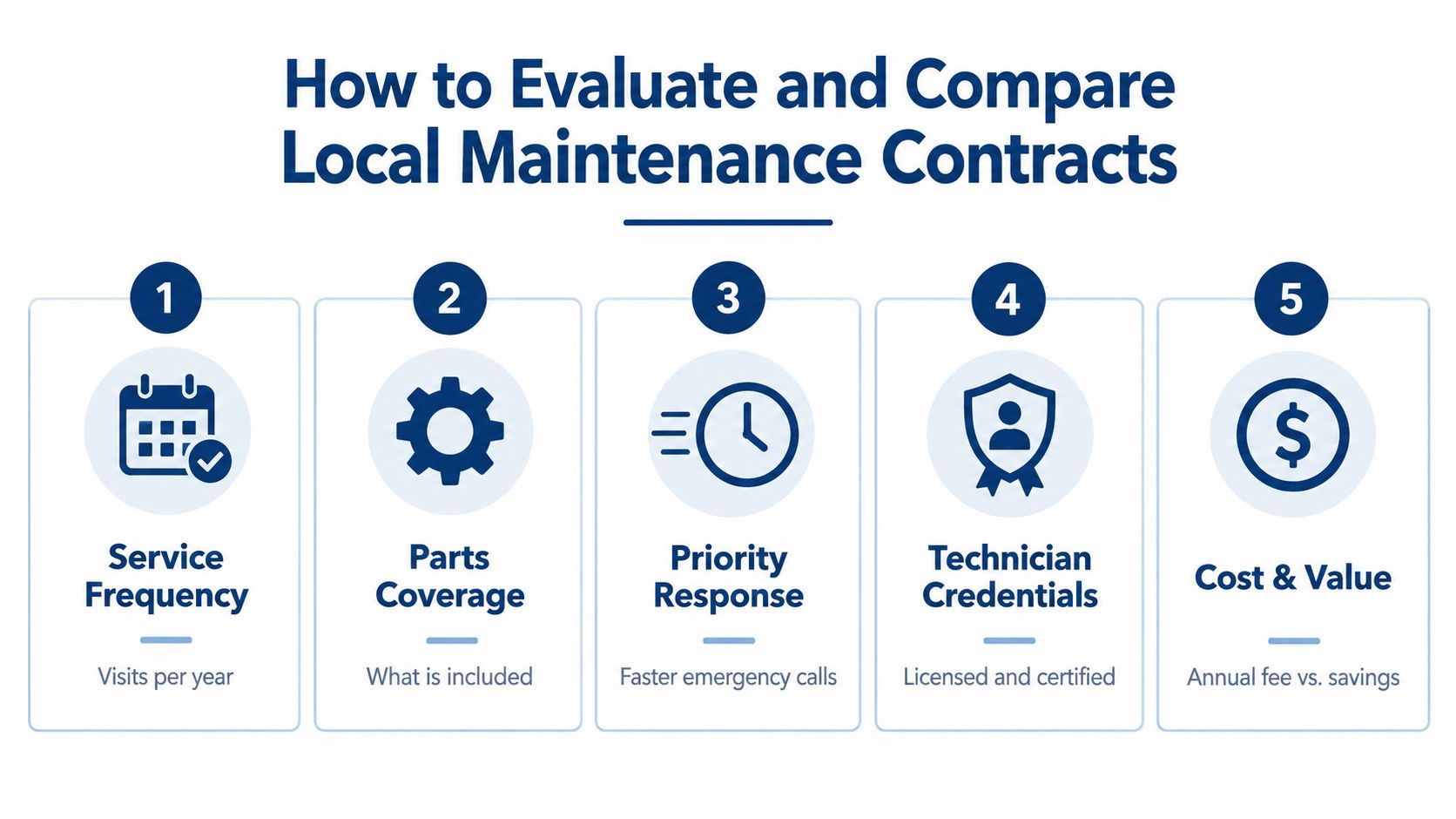
A contract should be judged by what happens during a visit and what happens after a failure. Homeowners comparing plans can use the following checklist before agreeing to recurring service.
- Service frequency: Confirm how many cooling and heating visits are included and when they occur. ASHRAE's interval-based approach supports recurring attention rather than a single vague annual check.
- Parts coverage: Ask whether filters, capacitors, contactors, motors, refrigerant, and major components are included, discounted, or excluded. Get the answer in writing.
- Priority response: Determine what “priority” means during a Mesa heat wave. Ask whether it changes scheduling order, diagnostic fees, after-hours access, or only the call-center notes.
- Technician credentials: Verify that the contractor is properly licensed for the work and that the person performing the service is qualified to inspect the equipment involved. A contract should identify who is responsible for the work, not just display a sales label.
- Cost and value: Compare the annual fee with standalone maintenance, repair discounts, service charges, and any credits. A discount has no value if the homeowner can't use it under the contract's conditions.
Questions that expose the real terms
Before signing, ask for the full contract rather than relying on a salesperson's summary. The document should state the service schedule, cancellation rules, renewal terms, repair discounts, excluded parts, diagnostic charges, and treatment of existing defects.
A useful question is, “What happens if the technician finds a problem during the included visit?” Some contractors repair minor issues within the visit, while others provide a separate estimate and charge for all corrective work. Both approaches can be reasonable, but the homeowner should know before the appointment.
Another question concerns replacement. If the system is beyond economical repair, does the agreement provide any equipment credit, or does it end when the system is replaced? Comfort Experts can be one local option to compare with others, and a Mesa AC repair company comparison can help homeowners build a broader evaluation list.
Common Red Flags and Exclusions to Watch
The most misleading contracts aren't always the cheapest. A low monthly payment can look attractive while leaving out the repair categories that matter most to an older air conditioner.
Watch for vague terms such as “complete coverage” without a component list. The phrase doesn't explain whether the plan covers labor, parts, refrigerant diagnostics, drain service, electrical failures, or only the inspection itself. A contract can provide frequent visits and still leave the homeowner responsible for the expensive failure that prompted the purchase.
Common exclusion areas include major component replacement, neglect-related damage, pre-existing conditions, and issues caused by deferred maintenance. These exclusions are not automatically unreasonable. The problem arises when the salesperson presents the agreement as broad protection without clearly explaining the limits.
Other warning signs deserve attention:
- Unclear renewal language: The homeowner should know whether the agreement renews automatically and how cancellation works.
- Restricted emergency service: “Priority” may not mean immediate availability, particularly during peak demand.
- Large deductibles or trip charges: A discount can be offset by fees that apply before any repair begins.
- Repair approval limits: Some agreements require specific authorization steps before covered or discounted work starts.
- No condition assessment at enrollment: A contractor should document known defects instead of treating old problems as newly discovered exclusions later.
A maintenance agreement is not a warranty and shouldn't be evaluated as one. It's a service arrangement with defined benefits and limits. Homeowners should reject any plan that makes those limits difficult to find.
Making the Final Decision for Your Mesa Home
An HVAC maintenance agreement is more likely to be worthwhile for a Mesa home with an aging system, heavy summer use, recurring dust exposure, difficult rooftop access, or a household that needs predictable service coordination. It can also make sense for a property manager who values scheduled inspections and a clear response process across several systems.
A plan may be less compelling for a newer, reliable system in a well-maintained home when the owner already schedules seasonal service and the agreement adds little beyond a basic inspection. In that situation, a standalone tune-up may provide the needed attention without broader contract benefits.
The decision should come down to five checks:
- Does the agreement include meaningful performance testing?
- Does the service schedule fit Mesa's cooling and heating demands?
- Are the repair discounts and service charges clearly stated?
- Do the exclusions leave the homeowner exposed to the feared failures?
- Does the equipment's age and condition justify recurring risk protection?
Homeowners should also separate maintenance from replacement decisions. Cleaning and testing can address accumulated efficiency losses, but a plan can't make unsuitable equipment new again. If a system has repeated failures, poor airflow, or serious comfort imbalance, a professional evaluation may be more useful than automatically renewing another agreement.
For East Valley residents, the strongest choice is usually the plan that matches the property's actual risk. A low-cost inspection can be enough for one home, while a more complete agreement can be sensible for an older, hard-working unit that must survive another hot season. The contract should earn its place through documented service, clear terms, and benefits the homeowner can realistically use.
Comfort Experts provides seasonal HVAC maintenance, cooling and heating tune-ups, repair evaluations, and system planning for Mesa and East Valley properties. Homeowners can review the available approach at Comfort Experts, call 480-207-1239, or schedule service to discuss whether a maintenance agreement or standalone visit fits the equipment and the home.