
Deciding on a new cooling system in the Arizona heat is a major investment, one that impacts your home's comfort and your family's budget for years. The big question—ductless mini split vs central air—really boils down to one thing: do you want uniform, whole-home cooling through hidden ducts, or targeted, room-by-room temperature control without them? Your answer will depend on whether you prioritize consistent, set-it-and-forget-it cooling or flexible, zoned efficiency for your home.
Choosing the Right AC for Your Phoenix Home
When the relentless Arizona sun is baking your roof, your air conditioner isn't just a luxury—it's the only thing keeping your home livable. But picking the right system is a huge decision. For decades, central air has been the go-to standard for most Phoenix homes, offering that familiar, integrated cooling solution we all know.
You know what? Lately, ductless mini splits have been gaining serious traction, and for good reason. Their incredible efficiency and knack for solving common cooling headaches—like that one upstairs bedroom that’s always 10 degrees hotter or a newly converted garage—make them a powerful alternative. To dive deeper into the specifics, you can review more about cooling system options for your Phoenix Home.
| Feature | Ductless Mini Split | Central Air |
|---|---|---|
| Cooling Method | Zoned, room-by-room | Whole-home, uniform |
| Ductwork | Not required | Required |
| Installation | Less invasive | More complex, requires ducts |
| Energy Efficiency | Typically higher | Potential for duct loss |
How Each Cooling System Actually Works
Before we get into the nitty-gritty of a ductless mini split vs central air comparison, you need to understand how each system actually cools your Phoenix home. They work on completely different philosophies, and that core distinction drives everything from cost and efficiency to your daily comfort.
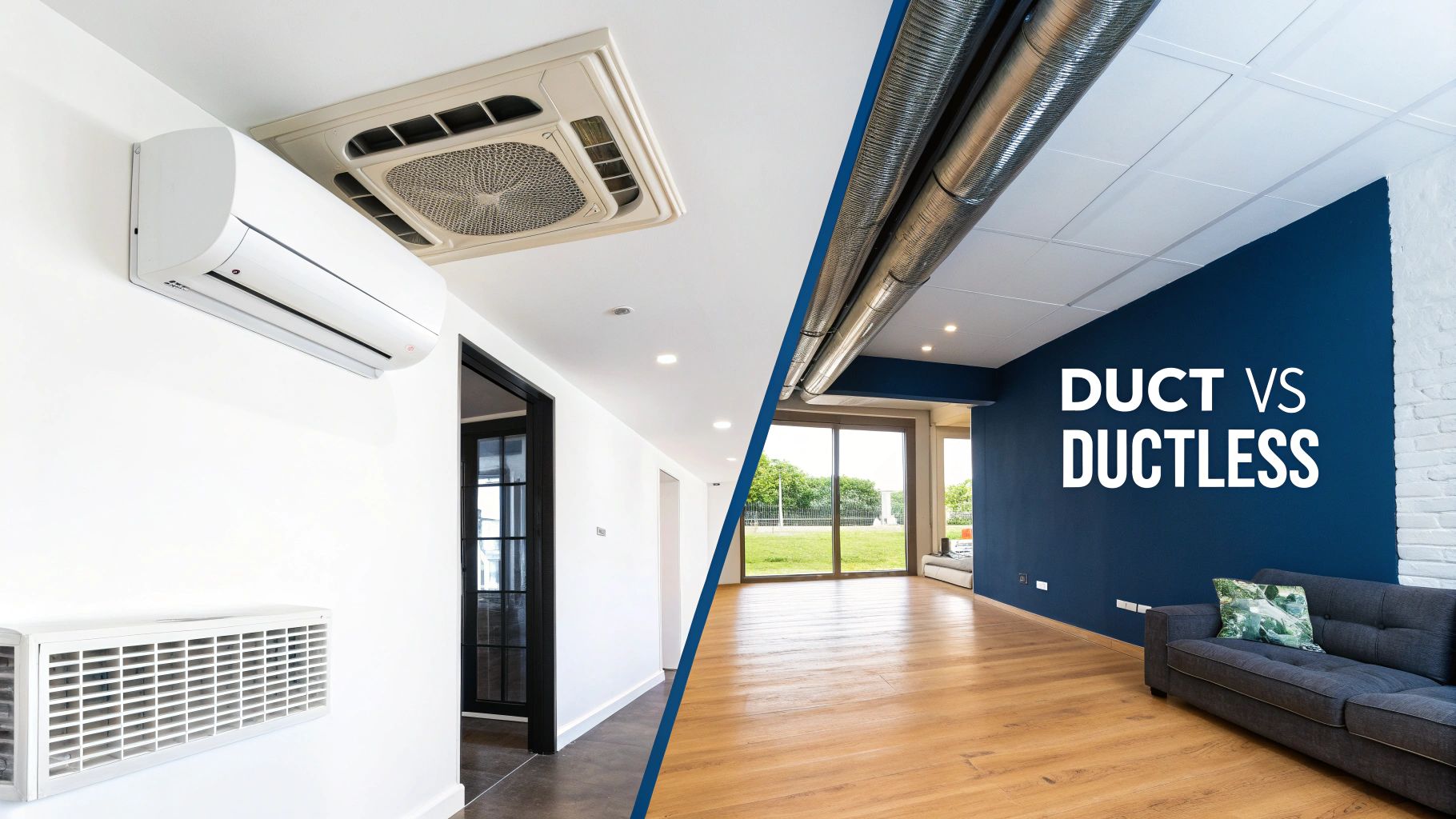
The Central Air Conditioning Approach
Think of central air as the classic, whole-home solution. It’s a unified system built for widespread, consistent cooling. But how does it really do its job?
Here’s the basic play-by-play:
- A Central Hub: An outdoor unit (the condenser) teams up with an indoor unit (the evaporator coil, usually tucked inside your furnace). This setup cools a huge volume of air all at once.
- The Ductwork Network: A powerful fan blasts this cold air through a network of ducts hidden in your attic, walls, or crawlspace. The air makes its way into each room through vents in the ceiling or floor.
- Single-Point Control: In most homes, the temperature for the entire house is managed by a single thermostat. When it calls for cooling, the system fires up and pushes cold air to every room connected to that ductwork.
This method is fantastic for keeping a uniform temperature everywhere, but its total reliance on ductwork is both its greatest strength and its biggest potential weakness.
The Ductless Mini Split Philosophy
A ductless mini-split system flips the script, taking a decentralized, room-by-room approach to cooling. Instead of one big unit serving the whole house, it creates independent "zones" of comfort.
Here’s the thing—understanding this core difference in philosophy is the key to seeing why one might be a perfect fit for your lifestyle while the other falls short. The choice is between cooling your entire house or cooling just the rooms you're using.
The system is pretty simple. It has two main parts:
- An outdoor condenser/compressor unit.
- One or more indoor air-handling units, which most people just call "heads."
These components are connected by a small conduit that holds the refrigerant lines and electrical wiring. Installing it only requires a tiny three-inch hole in an outside wall. Each indoor head cools a specific room or zone and has its own remote control or thermostat.
This means you can set the master bedroom to a frosty 72°F while leaving an unused guest room completely turned off, which can save a ton of energy. If this flexible approach sounds interesting, you can learn more about the specifics of ductless AC services in Mesa to see if it’s the right call for your home.
Comparing Upfront Costs and Lifetime Value
Let's talk about the money—the real financial picture of choosing between a ductless mini-split and a central air system. This decision goes way beyond the initial price on an estimate. You're not just buying an air conditioner; you're investing in years of comfort, monthly power bills, and the value of your home.
Honestly, the sticker shock can be real. On paper, the upfront cost for a single ductless unit might look higher than a traditional central air system. But that initial number is only one part of a much bigger financial story, especially for homes here in the Phoenix Valley.
Deconstructing the Initial Investment
When you get a quote for a new AC, you’re paying for two main things: the equipment itself and the skilled labor to install it. This is where the ductless mini-split vs central air comparison gets interesting. A central air unit might have a lower equipment cost, but if your house needs new or repaired ductwork, the installation price can balloon.
For older homes, historic properties, or even just houses with poorly designed ducts, the cost to install or replace that network can easily add thousands of dollars to the job. Ductless systems, on the other hand, completely sidestep this massive expense. That’s why a higher equipment cost can often lead to a lower total installation cost in many retrofit scenarios.
Lifetime Value: The True Cost of Cooling
The most financially savvy homeowners we work with look beyond installation day. They think about the lifetime value of their investment. This isn't just the upfront price; it’s the ongoing energy use, routine maintenance, and potential repairs over the next 15-20 years.
And that’s where the numbers really start to shift in favor of ductless technology. Let me explain.
- Energy Bills: Because mini-splits don’t lose precious cool air through leaky ducts and let you cool only the rooms you're actually using, their running costs are significantly lower. This translates into direct, measurable savings on your APS or SRP bill every single month.
- Maintenance Needs: Central air systems need duct cleaning and sealing to stay efficient—an ongoing expense that ductless systems just don't have. While both need professional tune-ups, the scope of central air maintenance is often bigger.
- Replacement Scenarios: For homeowners adding a new room or converting a garage, extending existing ductwork is often expensive and inefficient. A single-zone mini-split is a far more cost-effective and energy-smart solution for these projects.
For many Phoenix homeowners, the choice boils down to this: pay more upfront for central air ductwork in a retrofit, or invest that money into a more efficient, flexible ductless system that pays you back in energy savings.
This financial comparison is critical for Arizona homeowners. While ductless units can range from $1,000 to $4,000 or more per indoor head, you have to weigh that against the context of your specific home. In the established neighborhoods across the Valley, retrofitting with mini-splits avoids the huge expense of installing or replacing ducts.
At Comfort Experts, we've seen this shift firsthand; approximately 40% of our service calls now involve customers looking to replace old central systems with modern mini-splits. In one recent case, we quoted a $16,000 multi-room system for a couple looking to solve stubborn hot and cold spots—a testament to the value homeowners see in targeted comfort. Learn more about the evolving ductless HVAC market.
A Clear Financial Snapshot
To make this easier to visualize, let's break down the key financial factors. Remember, these are general estimates—the real figures will depend on your home's size, layout, and specific needs. For a detailed breakdown of local pricing, check out our guide on AC replacement costs in Arizona.
Financial Snapshot: Mini Split vs Central Air
This table breaks down the key financial factors for each system, from initial purchase and installation to ongoing operational costs.
| Cost Factor | Ductless Mini-Split System | Central Air Conditioning System |
|---|---|---|
| Initial Equipment | Typically higher per cooling zone | Often lower for a single, whole-home unit |
| Installation Cost | Lower if no ductwork exists; no duct costs | Higher if new ductwork is required or existing ducts need major repairs |
| Monthly Energy Bill | Generally lower due to higher efficiency and zoned cooling | Higher due to potential energy loss through ductwork (up to 30%) |
| Long-Term Maintenance | No duct cleaning needed; filter cleaning is simple | Requires regular duct inspection, cleaning, and sealing |
| Flexibility & Scalability | Excellent; add zones as needed for additions or remodels | Limited; extending ductwork is complex and costly |
Ultimately, while central air might seem like the budget-friendly choice at first glance for new construction, a ductless mini-split often delivers superior long-term financial value, especially for existing homes in our community.
Unpacking Energy Efficiency and Utility Savings
For any Phoenix resident staring down a triple-digit forecast, the real question is simple: which system will save me the most money on my SRP or APS bill? When we're talking ductless mini split vs central air, energy efficiency isn’t just a buzzword—it’s a direct measure of how much you'll pay to survive our brutal summers.

The main reason ductless systems often win the efficiency race is the tech under the hood. They use advanced inverter-driven compressors, which is a fancy way of saying the system intelligently adjusts its own power. Think of it like cruise control in your car; it sips just enough energy to maintain the temperature you set, rather than constantly slamming on and off at full blast like older central air units.
The Hidden Cost of Central Air Ducts
Here’s the thing about central air—its biggest weakness is baked right into the design. That sprawling network of ducts running through your scorching hot attic is a massive source of energy waste. Over time, those ducts develop leaks, cracks, and bad connections that just bleed cooled air before it ever reaches your living room.
And this isn't a minor issue. It's a huge drain on your wallet and your system's performance.
According to the U.S. Department of Energy, the energy loss from ductwork in a typical home can account for more than 30% of your cooling energy consumption. That means nearly a third of the money you spend on AC could be getting lost in your attic or walls.
Ductless systems just sidestep this problem completely. Since the cool air is delivered directly into the room from the indoor unit, there's zero opportunity for it to get lost along the way. This duct-free design gives it a fundamental advantage in the hunt for lower utility bills.
Comparing Efficiency Ratings
When we talk about AC efficiency, the key number is its SEER (Seasonal Energy Efficiency Ratio) rating. A higher SEER rating means it's more efficient. While modern central air systems have gotten much better, ductless mini-splits often lead the pack, with some models hitting ratings well into the 30s. You can learn more about what a SEER rating means for your home in our detailed guide.
This superior efficiency adds up, fast. Head-to-head comparisons consistently show that ductless systems can be up to 30% more efficient than traditional HVAC setups. In Arizona, where cooling dominates our power bills, a 30-40% drop in energy use means real, substantial monthly savings. It’s also critical to remember that a sloppy central air installation can kill its efficiency by another 30%, which really drives home the need for expert technicians like ours at Comfort Experts.
Of course, your AC unit isn't the only player. External factors have a big impact on your bills, too. Exploring how sun blocker window screens can cut down on heat gain is another smart way to lower your energy costs in Arizona.
The Power of Zoned Cooling
Finally, the ability to create "zones" is a massive energy-saving feature you only get with mini-splits. With central air, you’re paying to cool the entire house—including the empty guest rooms, storage areas, and that formal living room you hardly ever use.
A ductless system lets you cool only the rooms you're actually in. By turning off the indoor units in unused spaces, you’re not just making things more comfortable; you're actively stopping wasted energy every single hour. For Phoenix families, this level of control is what makes the efficiency of a ductless mini-split system so compelling.
Comfort, Control, Aesthetics, and Noise: The Day-to-Day Difference
Beyond all the numbers and efficiency ratings, the real gut-check question is simple: How will this system actually feel when you're living with it every day? This is where the debate between a ductless mini split vs central air system gets personal. We're talking about individualized comfort, how the units look on your walls, and the sounds they make.
These are the things that shape your daily experience far more than any spec sheet ever will.

The Ultimate Advantage: Zoned Comfort
Let’s be blunt: this is where ductless mini-splits run circles around traditional central air. Zoned comfort—the ability to set different temperatures in different rooms simultaneously—is the killer feature that central air just can't match without adding expensive, complex dampers and controls.
Think about the classic thermostat wars in your family. With central air, it's a one-size-fits-all game. The temperature you punch in is what the system tries to blast into every single room. This is why the downstairs living room feels like a meat locker while the upstairs master bedroom is still stuffy and warm.
Ductless systems fix this brilliantly. Each indoor unit, or "head," has its own remote and thermostat. This means you can finally:
- Keep your bedroom a crisp 72°F for perfect sleeping conditions.
- Let the living room idle at a comfortable 76°F during the day.
- Shut the unit off completely in that spare guest room you never use, saving a ton of energy.
This level of room-by-room control not only makes everyone in the house happier but also skyrockets the system's real-world efficiency. You're simply not paying to cool empty space anymore.
A Tale of Two Aesthetics
How a cooling system actually looks inside your house is a huge deal for a lot of people. In this category, central air is the undisputed champion of stealth. Its presence is almost invisible, marked only by discreet vents in the ceiling, floor, or walls that can be painted to blend right in with your decor.
Ductless mini-splits, on the other hand, have a more visible footprint. The indoor air handlers are typically mounted high on an interior wall. While modern designs are much sleeker and more compact than the clunky units of the past, they are still a noticeable piece of hardware in your room.
For homeowners who prize a clean, minimalist interior, the near-invisibility of central air is a massive win. But for those who value performance and pinpoint control over pure aesthetics, the presence of a ductless head is a tiny trade-off for perfect, zoned comfort.
The Sound of Silence vs. The Familiar Hum
Operational noise is another one of those "little things" that becomes a big deal fast. A loud air conditioner can mess with your sleep, interrupt conversations, and just be a general daily annoyance. This is another area where ductless technology has taken a huge leap forward.
Modern ductless mini-splits are engineered to be whisper-quiet. The indoor units can operate at sound levels as low as 19 decibels—that's quieter than leaves rustling outside. The parts that make all the noise, the compressor and condenser fan, are housed in the outdoor unit, far away from your living space.
Central air systems, while not necessarily loud, are certainly more noticeable. You get that familiar whoosh of air when the system kicks on and starts pushing air through the ductwork. The main indoor unit, often stashed in a closet or the attic, can also create a low hum that vibrates through the house. And if your system starts making new sounds, that's often a sign of trouble, which we cover in our guide on why your AC might be making loud noises.
So, what matters more to you? Is it the uniform, hidden cooling of central air? Or is it the personalized, silent, and hyper-efficient control that only a ductless system can deliver? Thinking about how each option would look, feel, and sound in your own home is the key to making the right call.
Installation: A Tale of Two Timelines
When it comes to putting a new cooling system in your home, the experience can range from a quick, clean job to a week of drywall dust and chaos. Let's get practical about the installation process, because honestly, this is one area where ductless mini-splits and central air couldn't be more different.
A ductless mini-split installation is surprisingly straightforward. The whole process involves mounting an indoor unit on the wall, setting the outdoor unit, and connecting them with a small conduit line. That connection only needs a single three-inch hole through an exterior wall. That's it. For a standard single-zone setup, a professional team can have you up and running in a matter of hours.
The Central Air Installation Mess
Installing a new central air system, on the other hand, is a whole different ballgame—especially if your home doesn't already have ductwork. It's a major construction project that involves cutting into your home's bones to create a network for cool air.
Technicians will need to get into just about every corner of your property, often squeezing into tight, difficult spaces:
- Attic and Crawlspace Takeover: This is where most of the ductwork is run. It’s a hot, messy job.
- Cutting into Walls and Ceilings: Holes have to be cut for supply and return vents in almost every single room.
- The Unavoidable Cleanup: Drywall dust and debris are simply part of the deal.
A complete central air and ductwork installation can easily take several days, sometimes even a week. It’s a serious disruption to your daily life, which is why it's almost always done during new home construction before the drywall even goes up.
Why Mini-Splits Are a Retrofitter's Dream
This is precisely where mini-splits become a game-changer for so many Phoenix homeowners. They are the perfect solution for older homes, historic properties, or any house built without a duct system in the first place. The minimal disruption means you can add powerful air conditioning without signing up for a massive, expensive renovation.
The same logic holds true for home additions or converted spaces. If you've turned your garage into a workshop or added a new master suite, trying to extend your existing central air ductwork is often clunky and inefficient. A dedicated single-zone mini-split gives you the cooling you need without messing with the integrity of your current system. You can see what a new system could look like with our professional AC replacement and installation services in Mesa.
The choice often comes down to this: are you prepared for a significant construction project inside your home, or do you prefer a solution that can be installed in a day with minimal impact? For existing homes, the answer is often clear.
The growing preference for this less disruptive approach is easy to see in the market. The global ductless HVAC market is projected to hit roughly $144.7 billion by 2030, a sure sign that homeowners value their efficiency and installation flexibility. This isn't some niche technology; choosing a mini-split is a mainstream, future-forward decision for modernizing your home's comfort.
Making Your Final Decision: A Practical Checklist
After sorting through all the pros and cons, the ductless mini-split vs central air decision really boils down to your specific house and your goals. We can simplify the whole debate by focusing on the most common situations we see right here in the Phoenix area.
This handy decision tree lays it all out.
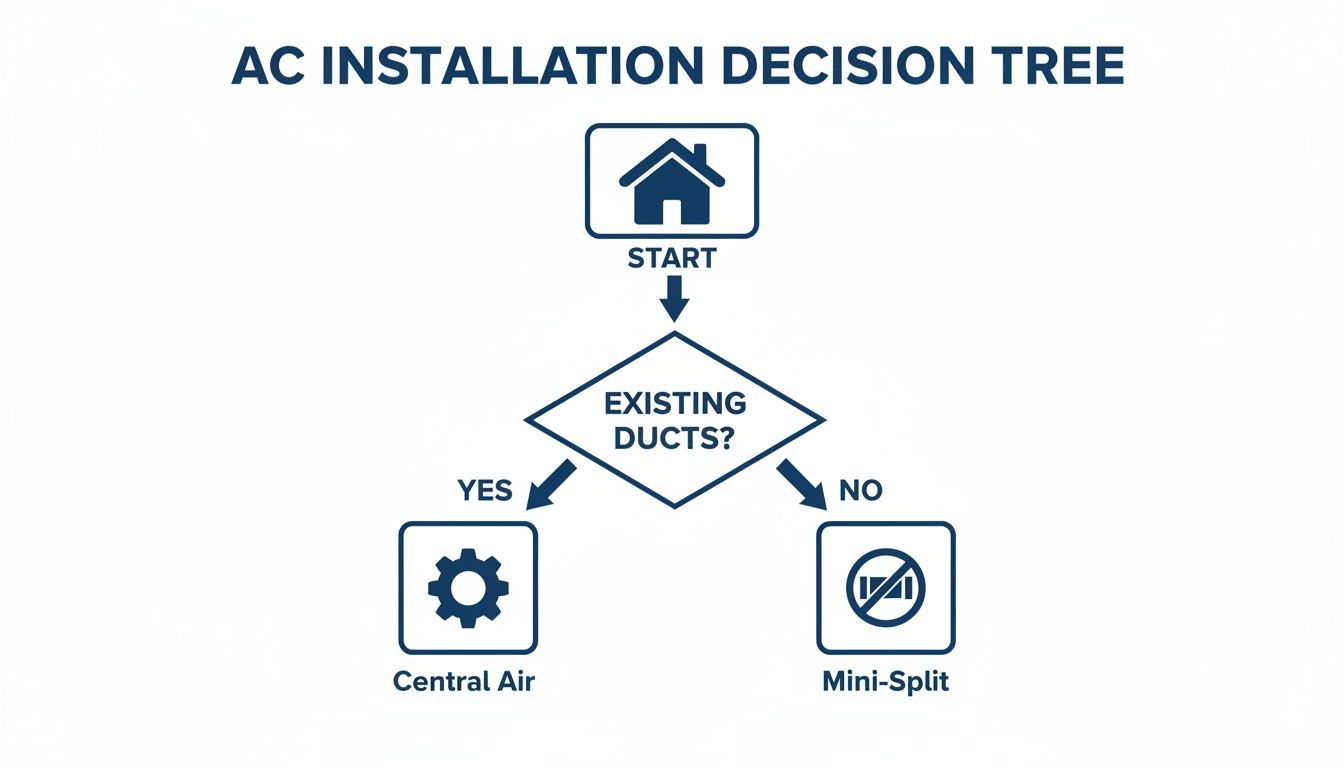
As you can see, one question changes everything: Do you already have good, usable ductwork in your home? The right answer for you forks pretty dramatically from there.
Situational Recommendations
Let's put this into real-world terms to make the choice even clearer.
- You're Building a New Home: This is the easiest one. If you're building from the studs up, putting in ductwork is simple and makes the most sense. Central air is the slam-dunk choice for efficient, whole-home cooling from day one.
- You Have a Historic Home (or No Ducts): For older Phoenix homes, especially those with unique architecture or materials where tearing into walls is a nightmare, ductless mini-splits are a game-changer. It's the best way to get modern cooling without destroying the character of your home.
- You Need to Fix Hot Spots or Cool a New Addition: Is your newly converted garage an oven? Does that upstairs bedroom never seem to get cold? A targeted, single-zone ductless mini-split is the perfect, most efficient fix for these exact problems.
The big takeaway is this: central air is fantastic for homes that were built for it. Ductless mini-splits are brilliant problem-solvers, adding powerful cooling exactly where you need it most.
Still Have Questions? Let's Clear Things Up.
To wrap this up, let's run through a few of the most common questions we get from Phoenix homeowners trying to sort out their cooling options. Getting a straight answer can make the final call on the whole ductless mini split vs central air debate a lot easier.
Can a Ductless Mini Split System Really Cool an Entire Phoenix House?
You bet it can. A multi-zone ductless system that's been properly sized and designed is more than a match for our summer heat, even across a whole house. The secret is placing the indoor units where they'll do the most good, making sure every corner gets the coverage it needs.
Think of it this way: central air is an all-or-nothing deal, forcing you to cool empty rooms. A multi-zone system lets you put that cooling power exactly where you're living. This targeted approach is a huge reason they deliver such significant energy savings over time. When our technicians visit, we do a detailed load calculation to map out a system that fits your home's layout perfectly.
How Do Mini Splits Handle Arizona's Dust and Air Quality?
Today's ductless mini splits are surprisingly good at this. They come with advanced, multi-stage filtration systems that do a great job of grabbing the dust, pollen, and other gunk common in Arizona's air. Each indoor unit—or air handler—has its own washable filter, making routine upkeep pretty simple for homeowners.
If you've got serious allergy concerns or just want cleaner air, many systems can be upgraded with specialized, higher-rated filters. While a central system can be fitted with a whole-home purifier, the point-of-use filtration in a mini split is incredibly effective for the zone it serves. It's cleaning the air right where you breathe it.
Are There Rebates for Mini Splits Here in Arizona?
Yes, and this is a major plus. Many of the high-efficiency ductless mini splits we install qualify for some nice rebates from our local utility providers like SRP and APS. Some models are even eligible for federal tax credits. These programs exist specifically to nudge homeowners toward more energy-smart technology.
Just keep in mind that the rebate amounts and the rules for qualifying can shift from year to year. Your best bet is always to chat with an HVAC pro who stays on top of the latest incentives. That’s how you make sure you’re getting every dollar of savings you can on a new installation.
At Comfort Experts, keeping up with every available program is part of our job, so we can help our customers find the best value out there. If you’re ready to get a personalized recommendation and figure out which cooling system is the perfect fit for your home, our friendly team is here to help. Just give us a call at 480-207-1239 or schedule service online today.