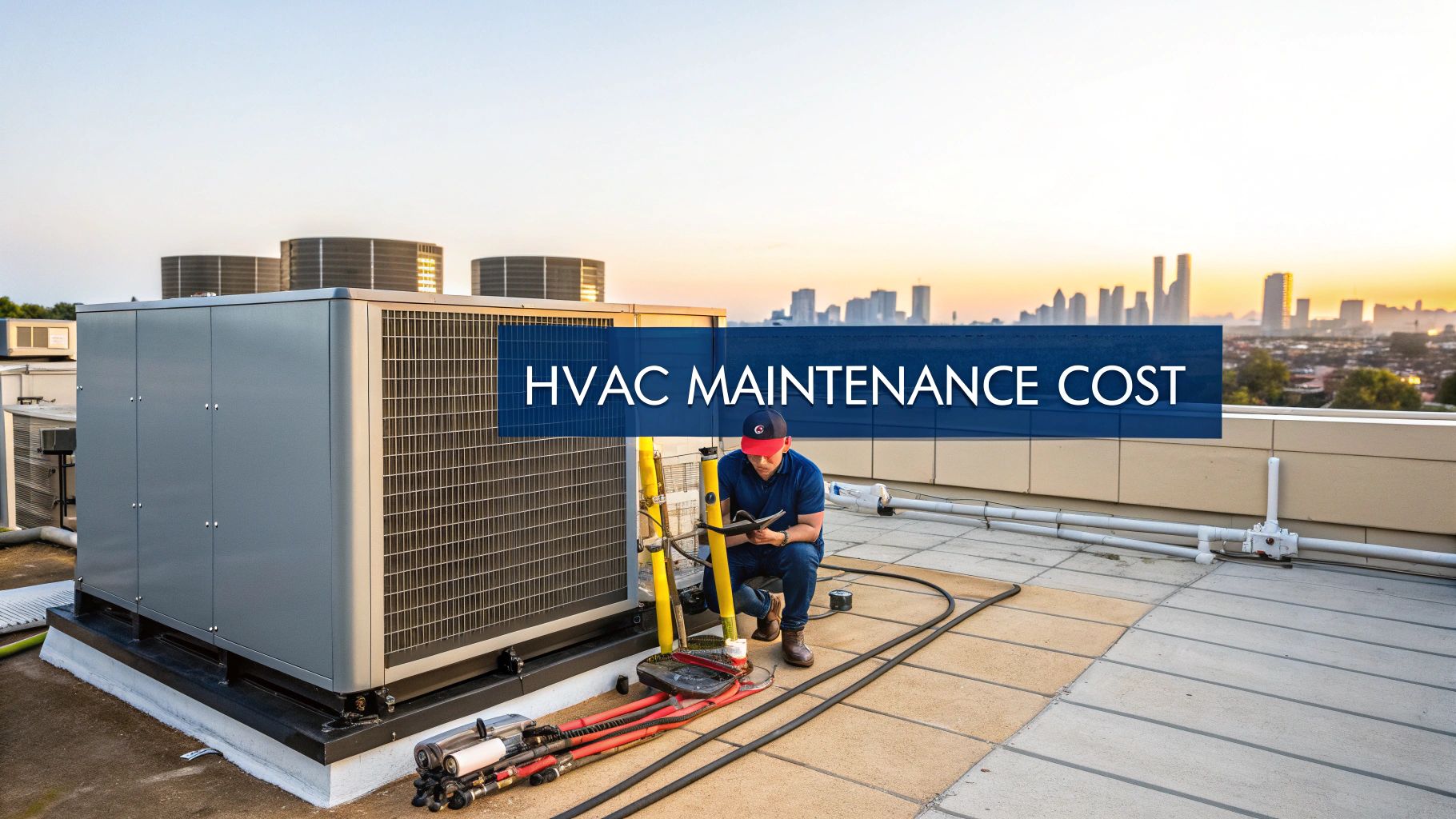
As a business owner, you’re already juggling a dozen different operational expenses, so the last thing you need is a surprise HVAC breakdown throwing your budget into chaos. Trying to figure out the commercial hvac maintenance cost can often feel like a shot in the dark, but it's a critical number for any business here in Phoenix or Mesa. Let's demystify those figures and turn a reactive headache into a smart, strategic investment for your company.
Decoding Your Commercial HVAC Maintenance Cost
Your HVAC system is the quiet hero of your commercial property, keeping employees productive and customers happy. It’s also one of the biggest line items in your operating budget. So, what’s the real deal with maintenance pricing? A one-time commercial HVAC maintenance visit can run anywhere from $200 to over $1,000, while a more predictable annual contract usually falls between $1,000 and $10,000+. Seeing those numbers is the first step, but understanding what drives them is the key to making an informed decision.
Here in the Valley, our brutal summer heat puts an incredible strain on these systems, making regular upkeep non-negotiable. Skipping it is a gamble that almost never pays off, often leading to emergency repairs that can easily cost more than an entire year of proactive maintenance. As a company with decades of experience servicing commercial units across Arizona, we've seen firsthand how preventive care is the single most effective way to protect a business's bottom line.
Understanding the Pricing Models
You generally have two ways to pay for maintenance: one visit at a time or through an annual contract. A one-time visit is like paying à la carte—you get a specific service for a single price. This might feel cheaper upfront, but you miss out on the cost predictability and long-term perks of a contract.
An annual maintenance contract, on the other hand, is like having an insurance policy for your comfort. It locks in multiple scheduled visits per year, priority service, and often discounts on repairs, giving you a much clearer picture of your yearly expenses.
Let's break down these service models so you can see where your business might fit. It’s important to remember that commercial systems are a completely different beast than residential units. While a home AC needs care, the scale and complexity of a commercial rooftop unit are on another level. If you're curious about the home side of things, our guide on the average AC tune-up cost is a great resource.
Comparing Service Models at a Glance
To make this crystal clear, here’s a quick look at what you can expect from different approaches to maintaining your commercial HVAC system.
| Service Model | Typical Cost Range (Phoenix/Mesa) | Best For |
|---|---|---|
| One-Time Visit | $200 – $1,000+ | Businesses with newer systems or those wanting to try a provider before signing a contract. |
| Basic Annual Contract | $1,000 – $3,500 | Small businesses with standard rooftop units that need essential seasonal check-ups. |
| Comprehensive Contract | $3,500 – $10,000+ | Larger facilities with multiple or complex units that demand frequent checks and priority service. |
The True Cost of Neglect Versus Proactive Maintenance
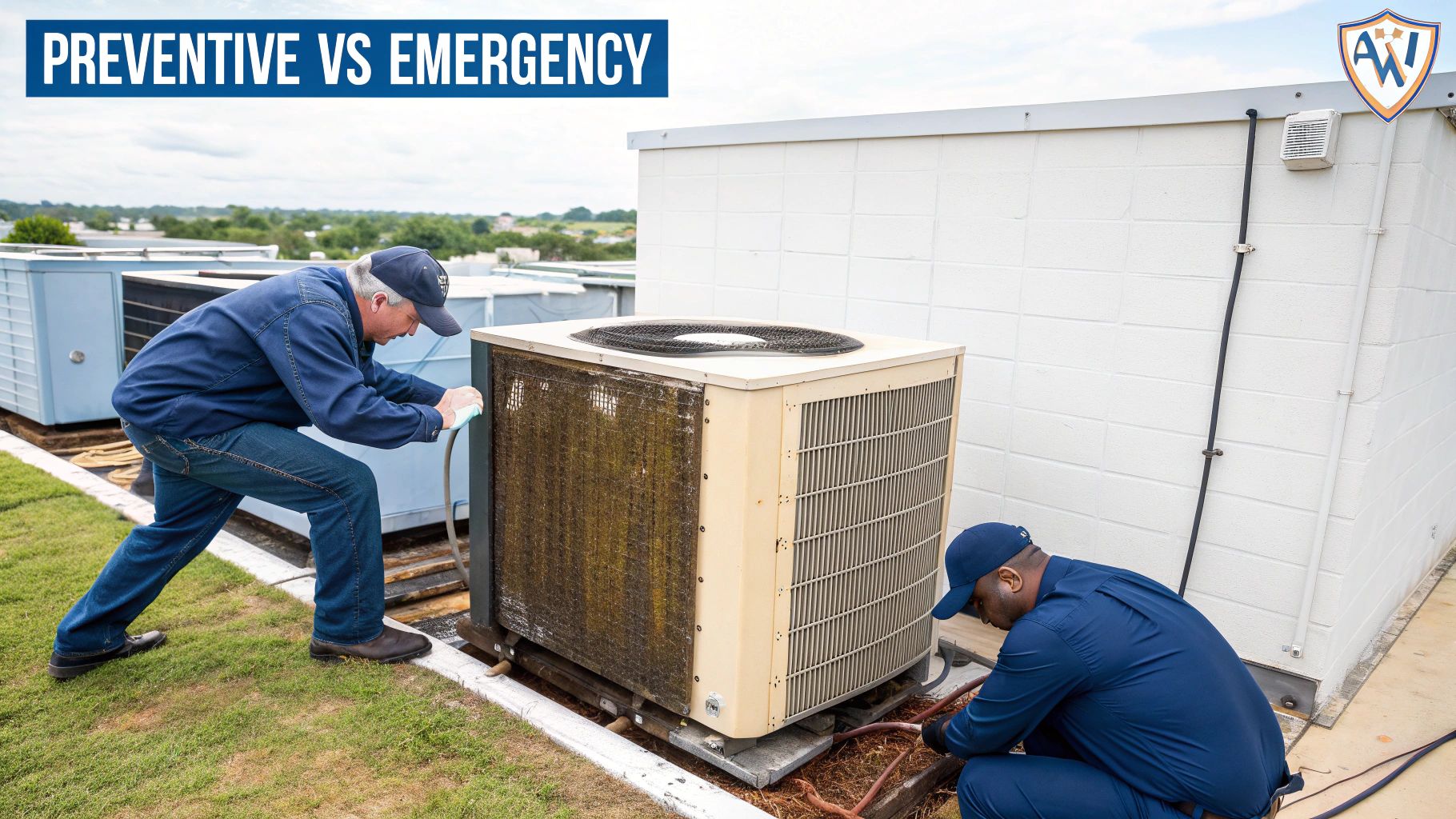
It’s easy to look at a maintenance plan and just see another line item on the budget. In the daily grind of running a business, pushing off something like an HVAC tune-up to "save money" can feel like a savvy move. But here in Arizona, that’s a dangerous gamble—one that almost always backfires in the most expensive way possible. Have you ever wondered what that gamble really costs?
The truth is, proactive maintenance isn't a cost. It’s one of the smartest forms of financial risk management you can implement for your facility.
Think of it like changing the oil in your company trucks. You don't wait for the engine to seize before you act, because you know the repair bill will be catastrophic compared to the small price of prevention. Your HVAC system is no different.
Let me explain. The commercial hvac maintenance cost is a planned, predictable operating expense you can budget for. A catastrophic failure in July is an unplanned, budget-destroying emergency that brings a whole host of other costs with it.
The Snowball Effect of Putting Off Maintenance
When you skip routine maintenance, you aren't actually saving money—you're just delaying a much, much larger bill. Small issues, like a worn-out fan belt or a clogged drain line, don't fix themselves. Instead, they create a domino effect, putting massive strain on critical—and expensive—components like compressors and motors.
This isn't just a theory; it’s a well-documented financial reality.
According to insights from Pacific Partners Consulting Group, every single dollar you defer on maintenance eventually turns into $4 in capital renewal costs down the line. That's a 400% penalty for kicking the can down the road.
This happens because a simple fix you ignore today becomes a major component failure tomorrow. That minor, inexpensive repair you skipped in April could easily lead to a full system meltdown in the blistering heat of July, forcing an emergency replacement. If you want to see just how big that financial leap is, take a look at our guide on the full AC replacement cost in Arizona.
Calculating the Real Price of an Emergency
An emergency breakdown costs far more than just a new part. The expenses spiral outward, hitting your entire operation in ways a simple maintenance visit never would.
Here’s what a reactive "fix-it-when-it-breaks" strategy really costs you:
- Premium Emergency Rates: After-hours and weekend emergency calls are always more expensive. We have to dispatch technicians immediately, which means premium labor charges that can be 50-100% higher than our standard rates.
- Business Interruption: A dead HVAC system in a Phoenix summer means an uninhabitable building. This can force you to close your doors, send employees home, and lose a full day—or more—of revenue.
- Lost Productivity: Even if you try to stay open, a sweltering environment kills productivity. Employee efficiency plummets when office temperatures get too hot.
- Reputation Damage: For any customer-facing business like a restaurant, retail store, or clinic, an uncomfortable building can drive people away and tarnish your reputation for good.
When you add it all up, the financial damage is staggering. Data shows that letting equipment run until it fails can inflate your repair expenses to be 3 to 10 times the price of a proactive maintenance program. Worse, unplanned downtime costs U.S. businesses a jaw-dropping $50 billion every year.
The planned commercial hvac maintenance cost is a tiny fraction of that potential fallout.
Key Factors That Influence Your HVAC Maintenance Pricing
So, why does one Phoenix business pay a lot more for commercial HVAC maintenance than another one just down the street? It’s not just random. A handful of real-world variables go into building a maintenance quote, and once you understand them, you can see where the value is and where you have some control.
The final price on your maintenance plan comes down to the labor, complexity, and risk involved in keeping your specific system running right. It’s a custom calculation, not just a number pulled from a chart.
System Size and Tonnage
The most straightforward factor is the raw size of your HVAC system, which we measure in tonnage. Think of it like this: one ton of cooling is equal to 12,000 BTUs, roughly the heat it takes to melt a ton of ice in a day. A small retail shop might have a 5-ton rooftop unit, while a big office building could have a whole fleet of them totaling 100 tons or more.
It's a simple matter of scale. A larger system has more components to inspect, more coils to clean, more filters to swap out, and more refrigerant levels to check. A 50-ton system will always take more time and resources to service than a 10-ton unit, and that directly affects the labor costs and your final commercial HVAC maintenance cost.
Type and Complexity of Equipment
Not all commercial HVAC systems are built the same, and the type of equipment you have plays a huge role in the price. Here’s the thing: the more specialized the system, the more specialized the technician needs to be.
Here’s a quick rundown of what we see most often around Mesa and what it means for maintenance:
- Rooftop Packaged Units (RTUs): These are the workhorses you see on top of most commercial buildings. They’re self-contained, but just getting up there to work on them requires specific safety gear and protocols.
- Split Systems: Common in smaller offices or shops, these have an outdoor unit and one or more indoor air handlers. Servicing them means our technicians are working in multiple locations, which can add time to the visit.
- Chiller Systems: You'll find these in large facilities like hospitals or high-rises. They are incredibly complex, using chilled water to cool the air. They require specialized knowledge of pumps, cooling towers, and water treatment, making their maintenance significantly more involved and expensive.
- Variable Refrigerant Flow (VRF) Systems: These modern, highly efficient systems are fantastic, but they’re also a web of extensive piping and sophisticated electronic controls. They demand a technician with specific factory training to properly diagnose and service them.
A building with a complex chiller or VRF system will always cost more to maintain than one with standard rooftop units. It just comes down to the level of expertise needed to do the job right.
Age and Condition of Your Units
An older, neglected HVAC system is a lot like a high-mileage car that’s missed its fair share of oil changes. It's just going to need more attention to keep it from breaking down. Our technicians know this and have to factor it into the maintenance quote.
An aging unit, especially one that's 10+ years old, is far more likely to have worn-out belts, corroded wiring, and failing capacitors. On these systems, a "maintenance" visit often blends into a "minor repair" visit as we spend more time doing detailed diagnostics to catch parts that are about to fail.
On the flip side, a brand-new system might only need basic service for its first few years, which can lower the initial contract price. The unit's efficiency also plays a part. As we explain in our guide on SEER ratings impact performance, a well-cared-for, high-efficiency unit is like a well-oiled machine that needs less corrective work during a tune-up.
Accessibility and Location
This one surprises a lot of people, but where your units are located can have a real impact on your maintenance bill. A unit sitting on the ground is simple to get to. But in the Phoenix area, most commercial units are on the roof for good reason—space, noise, and security.
If a technician needs a specialized lift to reach a high or awkwardly placed unit, that extra time and equipment cost gets folded into the quote. Same thing if roof access is through a secure area or an occupied tenant suite. Safety is everything, and a tough-to-access unit requires more time for setting up harnesses and maneuvering carefully, which adds to the labor cost. It's a practical reality that directly shapes the bottom line of your service agreement.
Breaking Down Commercial HVAC Maintenance Contracts
Picking the right service agreement for your commercial HVAC system can feel like you're trying to decode a legal document—it's dense, confusing, and full of fine print. It doesn't have to be that way.
Think of a maintenance contract not just as another business expense, but as a strategic partnership. It’s designed to protect one of your most critical assets and keep your doors open when the heat is on.
A Preventive Maintenance Agreement (PMA) is basically your playbook for keeping that system healthy, predictable, and efficient. It clearly lays out what services you'll get, how often, and for what price. This removes the guesswork and helps you avoid those budget-busting emergency calls. Let’s unpack the different types so you can find the perfect fit for your business.
From Basic Tune-Ups to All-Inclusive Coverage
Not every business needs the same level of protection. A small Mesa retail shop with a single, brand-new rooftop unit has completely different needs than a sprawling Phoenix office complex with a dozen aging systems.
That’s why maintenance contracts usually come in tiers. This allows you to scale the coverage to match your specific operational risks.
This is where a lot of business owners get stuck. They either overpay for services they don't really need or, far more dangerously, they under-invest and leave themselves exposed to a major failure on a 115°F day. The key is to understand what each level offers and match it to your equipment's age, complexity, and how vital it is to your daily operations.
The core factors that shape any contract’s cost—your system's size, the type of units you have, and their current condition—are the foundation of this decision.
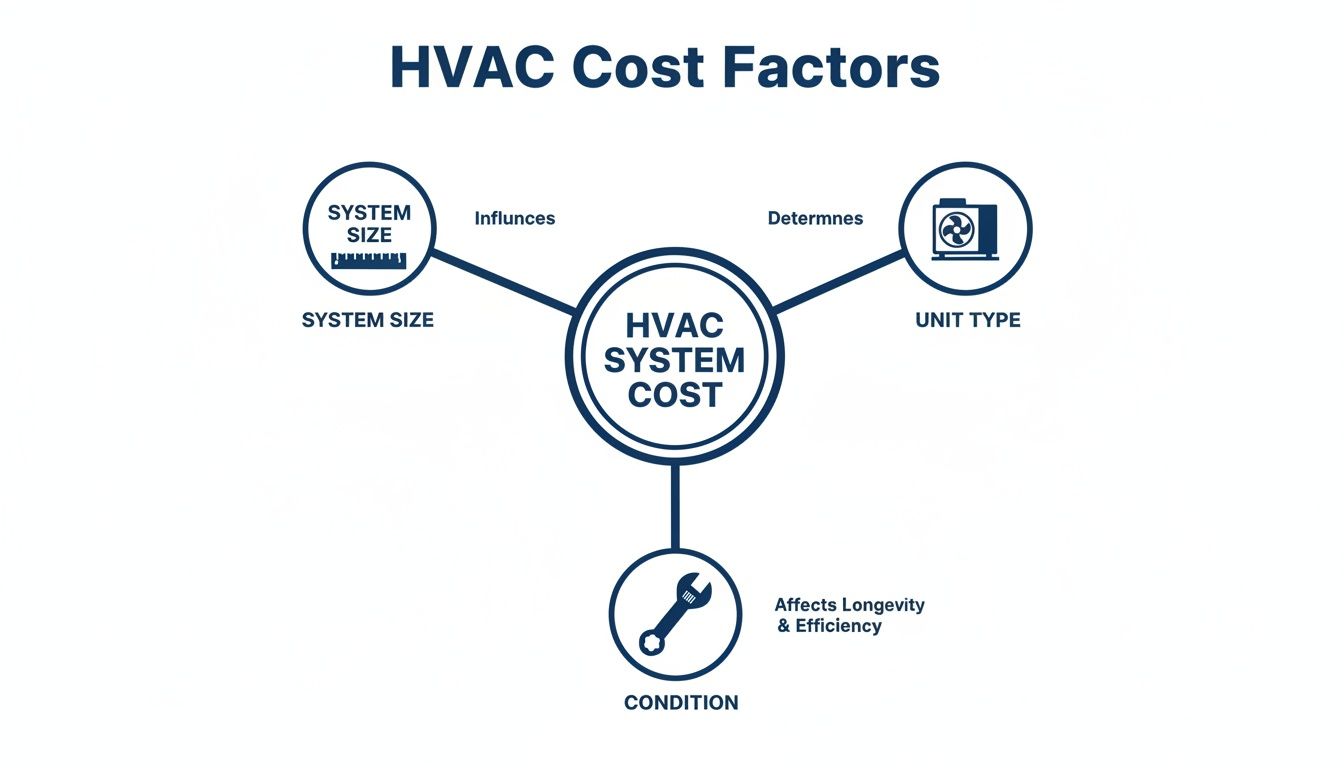
This breakdown gets right to the point: the physical reality of your equipment is the starting line for any cost conversation. A larger, more complex, or older system is naturally going to require a more robust—and therefore more comprehensive—maintenance strategy.
Comparing Commercial HVAC Maintenance Contract Tiers
To make this choice a lot clearer, let's look at the most common contract tiers side-by-side. Seeing the differences in black and white helps you figure out where the real value is for your specific business. The right commercial HVAC maintenance cost is all about balancing your upfront investment with long-term risk reduction.
| Feature / Service | Basic (Preventive) | Standard (Comprehensive) | Premium (All-Inclusive) |
|---|---|---|---|
| Scheduled Tune-Ups | 2 per year (seasonal) | 4 per year (quarterly) | 4+ per year (customized) |
| Service Checklist | Essential tasks only | Full system inspection | Exhaustive diagnostics & cleaning |
| Priority Service | Standard scheduling | Yes (guaranteed response time) | Immediate (24/7 priority) |
| Repair Labor | Discounted rate | Covered for most repairs | Fully Covered |
| Replacement Parts | Discounted parts | Discounted parts | Fully Covered (select parts) |
| Emergency Calls | Standard after-hours rates | Discounted after-hours rates | No extra charge for emergencies |
| System Reporting | Basic summary | Detailed performance reports | Advanced analytics & forecasting |
| Best For | New systems, small budgets | Aging systems, mid-sized facilities | Mission-critical operations, large facilities |
So, what does this all mean in practice?
A Basic plan is a great, budget-friendly starting point for keeping a new, reliable system in good working order. It covers the essentials and ensures you stay compliant with manufacturer warranties.
A Standard plan, on the other hand, gives you a much stronger safety net. It’s perfect for systems that are a few years old or work under heavy strain. With quarterly visits and priority service, potential issues are caught faster. When something does break, you get back online quicker without feeling the full sting of repair costs.
Finally, the Premium or All-Inclusive tier is the ultimate peace-of-mind package. It's built for facilities where HVAC failure is simply not an option—think data centers, medical clinics, or large tenanted commercial buildings. By covering nearly all labor and parts, it effectively transforms your HVAC costs into a fixed, predictable operational expense. To see how we structure our agreements for Valley businesses, you can learn more about the Comfort Experts maintenance plan.
Choosing the right contract is really an exercise in risk assessment. You're not just buying tune-ups; you're buying operational continuity, budget stability, and the assurance that when it’s blazing hot outside, your business will keep running smoothly.
Making the right call requires a clear-eyed look at your equipment and your tolerance for unplanned expenses. A higher-tier plan might have a larger initial commercial HVAC maintenance cost, but it can save you thousands in a single emergency, making it an incredibly wise investment for many local businesses.
The Real-World ROI of Smart HVAC Maintenance
It’s easy to look at your commercial HVAC maintenance cost as just another number on a spreadsheet—a necessary evil you have to pay. But that’s one of the biggest, and most expensive, mistakes a business owner can make. You know what? A smart maintenance plan isn’t an expense; it’s an investment. It’s a strategy focused on keeping your business running smoothly, your people productive, and your long-term finances healthy.
Beyond just dodging a massive, unexpected repair bill, what’s the actual return you can expect? The benefits are real, they’re measurable, and they hit your bottom line directly.
Let’s connect the dots between proactive care and your bank account.
Slashing Your Energy Consumption
One of the first places you’ll see a return is on your monthly utility bill. When an HVAC system is caked with dirt, has clogged filters, or grimy coils, it has to fight to do its job. That extra strain sends your energy consumption through the roof, especially during a brutal Phoenix summer.
The U.S. Department of Energy isn't guessing when they say that consistent, professional HVAC maintenance can cut your annual energy spending by 5-20%. For a decent-sized commercial building, that’s not pocket change—it can easily add up to thousands of dollars a year.
A clean, well-lubricated system runs the way it was designed to, using the minimum amount of energy to keep your space comfortable. That saved money goes right back into your operating budget. Plus, some well-maintained, efficient systems can qualify for local utility rebates, sweetening the deal even more.
Extending the Life of Your Equipment
Your commercial HVAC units are some of the most expensive assets your business owns. Just like a company vehicle or any other critical piece of machinery, how long it lasts comes down to how well you take care of it. A neglected system that’s constantly struggling is going to die years before a system that gets regular attention.
Routine maintenance is all about catching the small problems—a belt that’s starting to fray, a capacitor on its last legs, a tiny refrigerant leak—before they snowball into a catastrophic failure. A new compressor can cost a fortune, but replacing an entire rooftop unit is a massive capital expense most businesses aren't ready for. Proactive care pushes that replacement date far down the road, letting you get every ounce of value out of your original investment.
Boosting Productivity and Keeping Tenants Happy
The true cost of a failing HVAC system goes way beyond parts and labor. The environment inside your building has a direct impact on the people who work or live there. Things like poor indoor air quality, wild temperature swings, and high humidity can lead to "sick building syndrome," causing headaches, fatigue, and other health issues for your team.
When people don't feel well, they don't work well. Productivity drops and sick days pile up. The numbers are staggering—the global market for commercial HVAC maintenance is projected to hit $52.02 billion by 2030 largely because businesses are realizing how much a broken system actually costs them. In the U.S. alone, unplanned HVAC downtime costs companies up to $50 billion a year in lost productivity.
If you’re a property manager, a reliable HVAC system is non-negotiable. It’s one of the biggest factors in tenant retention. Constant AC problems are a top complaint that sends good tenants looking for a new lease, leaving you with costly vacancies to fill. A solid maintenance plan isn't just about the equipment; it’s an investment in keeping your employees productive and your tenants loyal. To get the most out of your maintenance plan, it helps to use efficient field service scheduling software to ensure technicians arrive on time, every time.
Your Essential Commercial HVAC Maintenance Checklist

So, what should a professional technician actually be doing when they're up on your roof? Knowing what's on their clipboard is the key to understanding the value in your commercial HVAC maintenance cost. A real tune-up is so much more than just swapping out a filter; it's a deep dive into your system's health, designed to spot trouble before it turns into a shutdown.
Think of this checklist as your guide to what a comprehensive service visit should look like. It helps you make sure you’re getting the thorough, professional care your equipment—and your business—deserves.
Core Cooling Season Tasks
As the relentless Arizona heat ramps up, getting your AC system ready is non-negotiable. A technician’s spring checklist should be all about efficiency, reliability, and cooling performance.
- Inspect and Clean Coils: Both the indoor evaporator and outdoor condenser coils get dirty, period. Filthy coils can force your system to work harder, driving up energy use by over 30% and leading to premature failure. This is a must-do.
- Check Refrigerant Levels: The tech will hook up gauges to verify the refrigerant charge matches the manufacturer's specs. If it's too high or too low, your cooling capacity plummets and you risk damaging the compressor—the heart of the whole system.
- Clean Condensate Drains: A clogged drain line is a simple problem that causes big headaches, from water damage inside your building to automatic system shutdowns. Flushing these lines is a critical, preventive step.
Core Heating Season Tasks
Even in the Valley, a reliable heater is essential for those chilly winter mornings. For the heating check, the focus shifts to safety and making sure the system is ready to fire up reliably when you need it.
Honestly, the heating check is just as much about safety as it is about comfort. Technicians must inspect the heat exchanger for any cracks or corrosion, a critical step to prevent dangerous carbon monoxide leaks in gas-powered units.
Key tasks for the heating season include:
- Test All Safety Controls: This means verifying that limit switches and other safety mechanisms are working. These are the failsafes that shut the system down if it overheats, preventing a much bigger problem.
- Inspect and Clean Burners: For gas furnaces, clean burners and proper ignition are vital for both efficiency and safe operation. A lazy flame is a wasteful—and potentially hazardous—one.
- Check Electrical Connections: The constant vibration of an HVAC unit can loosen electrical connections over time. A quick check and tightening can prevent short circuits and surprise breakdowns.
For a more granular look, a detailed HVAC preventive maintenance checklist can give you even more specifics. By understanding these core service points, you can confidently tell if you're getting the quality maintenance you're paying for.
Your Commercial HVAC Maintenance Questions Answered
Running a business means you have enough on your plate without worrying about the air conditioning. As the team Phoenix Valley businesses trust, we get asked a lot of the same questions. Here are some straight answers to the things we hear most, so you can make a smart call for your building.
How Often Does My Commercial System Really Need Service?
In a place like Arizona, twice a year is the bare minimum for most commercial systems. We come out once in the spring to get it ready for the summer beating, and again in the fall to check on the heating side.
But if your system is in a high-stress spot—think a busy restaurant kitchen or a medical clinic—or if the unit is just getting old, quarterly inspections are a much safer bet. This lets our techs spot small issues before they turn into a catastrophic failure right in the middle of July.
What Are the Warning Signs of a Neglected System?
Your HVAC unit will usually give you a few hints that it needs help. If you ignore them, you're pretty much guaranteeing an emergency call down the road.
Keep an eye out for these red flags:
- Rising Energy Bills: A sudden jump in your utility costs without a clear reason is the classic sign of a system that's struggling and burning through electricity.
- Strange Noises: If you hear banging, rattling, or screeching, those are the sounds of mechanical parts failing. They need attention, and fast.
- Weak Airflow: Feel like the air is barely trickling out of your vents? That could be anything from a clogged filter to a dying blower motor or a problem in the ductwork.
- Inconsistent Temperatures: When you start noticing hot and cold spots around the building, it means the system can’t push air around evenly anymore.
Does a Maintenance Agreement Really Save Money?
Yes. It’s not even a close call. While there's an upfront commercial hvac maintenance cost, a good preventive plan saves you money in so many other ways. Regular tune-ups prevent the massive, expensive breakdowns that always seem to happen at the worst possible time.
A well-maintained system also runs more efficiently, which shows up as a lower power bill every single month. The global commercial HVAC market is on track to hit $119.76 billion by 2034 for one simple reason: business owners know that ignoring maintenance is far more expensive than paying for it. A routine visit might average around $250, which is a tiny fraction of the $5,000+ you'll spend on a replacement when a system dies from neglect. A struggling system can also jack up your energy use by 30% or more. You can explore more about these market trends and their financial implications.
A maintenance plan transforms a volatile, unpredictable expense into a stable, manageable operating cost. You're not just buying tune-ups; you're buying budget certainty and operational continuity.
Protecting your building's most critical asset is one of the smartest investments you can make. Here at Comfort Experts, we build transparent, reliable maintenance plans designed for the tough demands of the Phoenix Valley. Secure your business's comfort and keep things running smoothly by calling us today at 480-207-1239 or schedule service online.