When your AC gives out during a brutal Phoenix summer, the first question that pops into your head is always about the cost to replace an AC unit. The short answer? It varies, but to give you a real-world starting point, most Arizona homeowners can expect to invest between $7,500 and $16,000 for a complete, professionally installed system. That initial range gives you a solid baseline for budgeting before we dig into the details.
Your Quick Guide To AC Replacement Costs
Facing an AC replacement can feel stressful, especially when you're trying to nail down the potential cost. You're not alone in this. While the final price tag depends on a few factors specific to your house, we can start with some clear, reliable figures to get you pointed in the right direction.
National averages are a decent place to start. Across the country, the cost to replace a central air conditioner in 2026 hovers around $8,500. The full spectrum can stretch anywhere from $5,500 to $16,000, depending on the unit's size, efficiency, and how complex the installation is.
Estimated AC Replacement Cost In Phoenix At A Glance
Now, let's bring those numbers closer to home and look at what you can expect right here in the Phoenix metro area. This table gives you a quick snapshot of estimated costs, broken down by common system sizes and efficiency tiers.
Just keep in mind, these are ballpark figures. An exact, locked-in quote always requires an in-home evaluation to see what your specific situation calls for.
A new, properly sized and installed air conditioner isn't just a purchase; it's a long-term investment in your home's comfort, air quality, and energy efficiency. Choosing the right system can lead to significant savings on your monthly utility bills for years to come.
This table should help you quickly find a range that lines up with your home's needs.
| System Size (Tons) | Standard Efficiency (14-16 SEER2) | High-Efficiency (17+ SEER2) |
|---|---|---|
| 2.5 Ton | $7,500 – $9,500 | $9,800 – $12,000 |
| 3.0 Ton | $8,000 – $10,500 | $10,500 – $13,500 |
| 4.0 Ton | $9,000 – $12,000 | $12,500 – $15,000 |
| 5.0 Ton | $10,000 – $13,500 | $14,000 – $16,000+ |
As you can see, both the size of your home (measured in tons) and the efficiency level you choose play a huge role in the final price.
If you want to get a deeper understanding of the entire process, from quote to installation, you can learn more from our guide on AC replacement and installation in Mesa, AZ.
When you are ready for an equipment-specific number, request an AC replacement evaluation in Mesa rather than relying only on statewide averages.
Breaking Down Your AC Replacement Quote
When you get a quote for a new air conditioner, it’s natural to zero in on that final number at the bottom of the page. But a good quote tells a story, and understanding the different chapters is key to making a smart decision.
An AC replacement isn't like buying a TV off the shelf; it's a complete system installation. Every line item, from the big equipment to the small but critical details, plays a part in that total price.
This chart gives you a quick snapshot of what homeowners in our area typically invest, from a straightforward swap to a high-end, high-efficiency system.
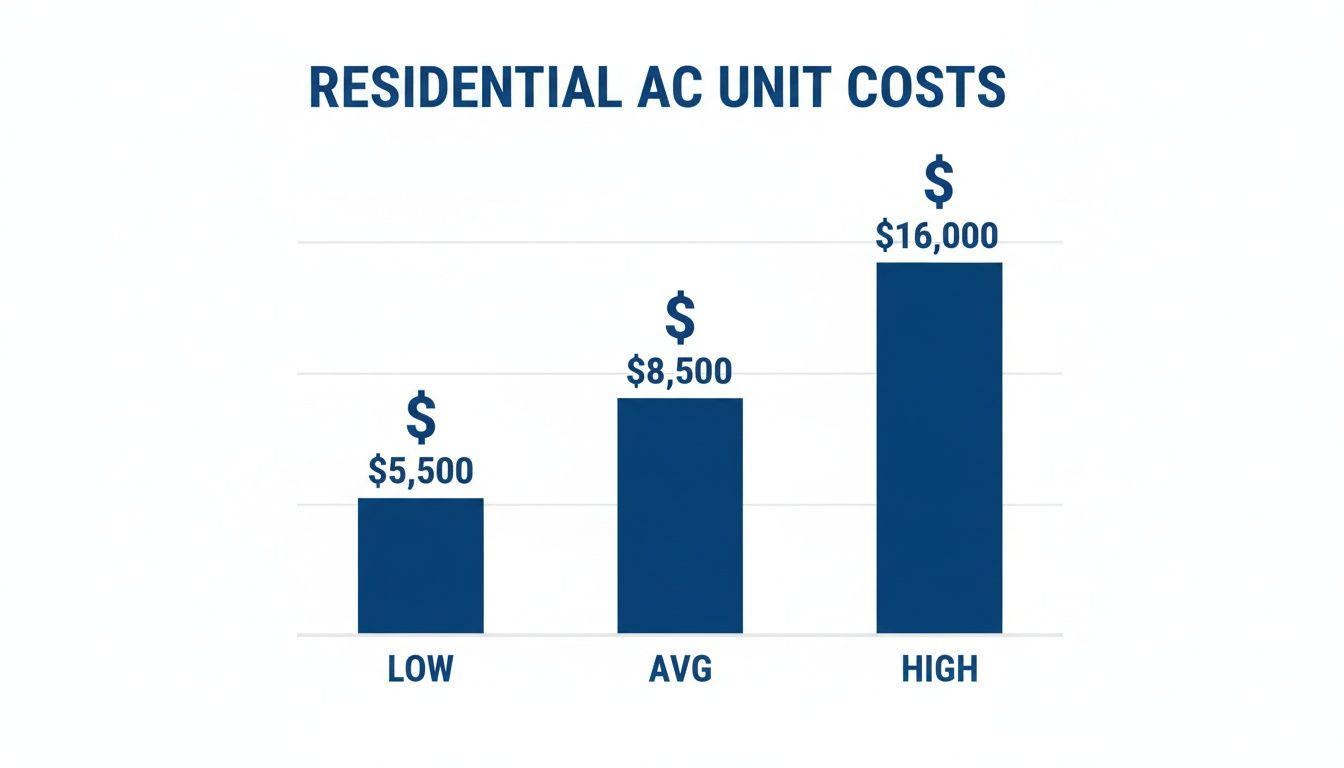
As you can see, while an average project lands around $8,500, that number can swing quite a bit depending on what your home actually needs. Let's pull back the curtain on where that money goes.
The Core Equipment Cost
This is the heart of your new system and usually the biggest chunk of the quote, making up 40% to 60% of the total. It’s not just one box, but a matched set of components engineered to work together.
- Outdoor Condenser Unit: This is the workhorse sitting outside your home, containing the all-important compressor and the coils that release heat into the air.
- Indoor Air Handler or Furnace: Tucked away in an attic, closet, or garage, this unit holds the evaporator coil and the powerful fan that pushes cool air through your ducts.
- Refrigerant Lines: Think of these insulated copper lines as the circulatory system connecting the indoor and outdoor units, allowing refrigerant to flow and move heat.
The price for this hardware depends heavily on the brand, its cooling capacity (tonnage), and its efficiency rating (SEER2). Higher-efficiency units cost more upfront but pay you back over time with lower SRP and APS bills.
A professional quote should always list the exact model numbers for both the indoor and outdoor units. This is your proof that you’re getting a properly matched system that will actually deliver its advertised efficiency and qualify for the full manufacturer's warranty.
Skilled Labor and Installation
Great equipment is only half the battle. The quality of the installation is just as critical, and this is where true expertise comes in. Labor costs typically account for 20% to 30% of the project and cover the skilled technicians who make sure your system runs right from day one.
This is far more than just connecting a few wires. A proper installation involves:
- Safely removing the old system and recovering the old refrigerant according to EPA rules.
- Precisely setting and leveling the new condenser on a solid foundation.
- Meticulously connecting the indoor and outdoor units with brazed, leak-proof joints.
- Handling complex electrical wiring and charging the system with the exact amount of refrigerant.
- Running a full set of diagnostic tests to confirm everything is operating to peak factory specifications.
The 'Hidden' but Necessary Costs
Beyond the equipment and labor, several smaller costs are essential for a safe, legal, and complete job. These are the things that separate a professional installation from a corner-cutting headache.
Permits and Inspections
Cities like Mesa and Phoenix require a permit for an HVAC replacement. It’s not just red tape—it’s an independent check that ensures the work was done safely and to code, protecting both your family and your home’s value. These fees usually add $100 to $300 to the total.
Disposal of Old Equipment
You can't just toss an old AC unit in a landfill. It contains refrigerant and other materials that require special handling. A professional contractor will include the cost of proper, EPA-compliant disposal, which can run from $100 to $250.
System Upgrades and Add-ons
During your consultation, we might suggest optional upgrades to improve your comfort or efficiency. These aren't mandatory, but they can make a big difference in how you experience your home.
- Smart Thermostat: Adds $250 to $600 but can trim your cooling costs by 10-12% through smarter scheduling.
- Ductwork Modifications: If your ducts are leaky or too small for the new system, fixing them is critical for performance. This could add $1,000 or more, but it’s often money well spent.
- Whole-Home Air Purifier: To combat dust and allergens, these systems can be added for $800 to $2,000.
Sometimes, the main problem is just the outdoor unit's coil. To see if a partial repair might be a better fit, check out our guide on the cost to replace a condenser coil.
Key Factors That Influence Your Final Cost
Ever wondered why your neighbor paid $8,000 for a new AC, while the quote for the house across the street came in at $15,000? It’s a fair question. The final price tag isn't just pulled out of a hat; a handful of key factors shape the total investment you'll make.
Understanding these variables is the key to seeing why the cost to replace an AC unit varies so much from one Phoenix home to the next.
Let's unpack what really drives the price. Knowing this will help you have a much more productive conversation with your HVAC contractor and make choices that fit both your budget and your comfort goals.
System Size Or Tonnage
One of the biggest cost drivers is the size of the system, which we measure in "tons." This has nothing to do with weight—it’s all about cooling capacity. One ton represents the ability to remove 12,000 BTUs (British Thermal Units) of heat from your home in an hour.
Getting the size right is absolutely critical, especially in our brutal Arizona climate. A system that’s too small will run nonstop without ever catching up, torching your energy bills and burning itself out. On the flip side, a unit that’s too big will cool the house so fast it shuts off before pulling any humidity out, leaving you with that dreaded cool but clammy feeling.
A true professional will perform a "Manual J load calculation" to find the perfect fit. This isn't a simple guess based on square footage. It's a detailed analysis that looks at:
- Your home's layout and square footage
- Ceiling heights and window quality
- The amount of sun your home gets
- Insulation levels in the walls and attic
This calculation ensures you get a unit that’s just right. As you’d expect, a beefy 5-ton unit for a sprawling ranch home in Mesa will cost a lot more than a 2.5-ton system for a smaller townhouse in Gilbert.
System Efficiency SEER2 Rating
Next up is the system's efficiency, measured by its SEER2 (Seasonal Energy Efficiency Ratio 2) rating. The easiest way to think about SEER2 is like a car's MPG rating—a higher number means it sips energy instead of guzzling it.
In our Southwest region, the federal minimum SEER2 rating for a new system is 14.3. While these units have the lowest upfront price, high-efficiency models with ratings of 17 SEER2 or higher can deliver huge long-term savings on your monthly power bills.
Upgrading from an old 10 SEER unit to a new 16 SEER2 system can slash your cooling energy use by over 35%. In a place like Phoenix where the AC runs for months straight, those savings add up fast and can often pay back the extra investment over the system's life.
Choosing a higher SEER2 unit costs more initially, but it's an investment in lower energy bills for the next 10 to 15 years. For a deeper dive, check out our guide on what the SEER rating means for your home.
Brand And Equipment Tier
Just like with cars or kitchen appliances, HVAC brands offer different tiers of quality and features. Premium brands known for their rock-solid reliability, advanced tech, and great warranties will naturally come with a higher price tag. At Comfort Experts, for instance, we often recommend Trane systems because we know they're built to survive our extreme climate.
But even within a single brand, you’ll find different levels of equipment:
- Entry-Level Models: These are your basic, no-frills workhorses. They meet federal efficiency standards and get the job done reliably.
- Mid-Tier Models: These often add features like two-stage or variable-speed compressors for better comfort, quieter operation, and higher efficiency.
- Top-Tier Models: This is the best of the best, offering maximum efficiency, communicating technology for pinpoint temperature control, and whisper-quiet performance.
The brand and tier you choose can easily swing the final price by several thousand dollars.
Condition Of Your Existing Ductwork
Think of your air ducts as the freeway system for cold air in your home. If that freeway is full of potholes (leaks), has lanes that are too narrow (undersized), or has collapsed sections, your brand-new, high-efficiency AC won't perform like it should.
During an in-home evaluation, any good contractor will take a hard look at your ductwork. If it’s in bad shape, repairs or even a full replacement might be on the table, which will add to the project's bottom line. Ignoring bad ductwork is like putting a racecar engine in a car with four flat tires—you’re just not going to get the performance you paid for.
A full HVAC installation can range nationally from $5,000 to $10,000, but that number can easily climb toward $20,000 if significant ductwork repair or replacement is needed. Here in the Phoenix Valley, a new 3-ton system might average around $8,500 installed, but that cost can jump quickly if the duct system needs an overhaul.
How Different Factors Impact Your AC Replacement Quote
To see how these pieces fit together, this table breaks down how different choices can affect your final quote.
| Influencing Factor | Low-Cost Impact | High-Cost Impact | Why It Matters |
|---|---|---|---|
| System Size | A smaller 2-ton unit for a condo or small home. | A larger 5-ton unit for a multi-story or large ranch home. | The system must be sized precisely for your home's heat load; bigger isn't always better. |
| SEER2 Efficiency | A standard 14.3 SEER2 unit that meets the minimum requirement. | A high-efficiency 18+ SEER2 variable-speed system. | Higher efficiency costs more upfront but delivers significant savings on monthly power bills. |
| Brand & Tier | An entry-level model from a value-focused brand. | A top-tier, communicating system from a premium brand like Trane. | Premium brands offer better build quality, advanced features, and quieter operation. |
| Ductwork Needs | Existing ducts are in good shape, sealed, and properly sized. | Leaky, damaged, or undersized ducts require extensive repair or full replacement. | Your new AC is only as good as the duct system delivering the air. |
As you can see, the final cost is a blend of equipment choices and the unique needs of your home. A clear, detailed quote should break these elements down so you know exactly what you're paying for.
Saving Money With Rebates And Financing
A new air conditioner is a huge investment, but the price you see on a quote is almost never the final number you have to pay. The truth is, a little smart planning can unlock thousands of dollars in savings, making a high-efficiency system far more affordable than most people think.
You don't have to shoulder the full cost of a new AC unit all at once. Between government incentives, local utility programs, and flexible payment options, there are some powerful tools out there to shrink your out-of-pocket expense.

This section is your roadmap to finding those opportunities. We'll show you how to hunt down and apply for these savings so you can get a new, reliable air conditioner without wrecking your budget.
Tap Into Tax Credits And Utility Rebates
One of the easiest ways to knock down the initial cost is to take advantage of programs designed to reward you for picking an energy-efficient system. These aren't just small coupons; they can add up to some serious money.
- Federal Tax Credits: The federal government often offers big tax credits for homeowners who install high-efficiency HVAC equipment. These can slash your federal tax liability by up to $2,000 in some cases, which directly lowers the net cost to replace an AC unit.
- Local Utility Rebates: Right here in Arizona, our big utility providers like Salt River Project (SRP) and Arizona Public Service (APS) have generous rebate programs. They give you money back for installing systems with certain SEER2 ratings because it helps reduce the strain on the power grid for everyone.
- Manufacturer Promotions: On top of that, top brands like Trane run their own rebates and special deals throughout the year on select high-efficiency models. A good contractor is always in the loop on these and can help you time your purchase to get the best deal.
Think of rebates and credits as an instant return on your investment. By choosing an energy-saving model, you don't just lower your future power bills—you get cash back right away from federal and local programs.
How To Find And Apply For Savings
Trying to find all these savings opportunities on your own can feel like a chore, but it's simpler than you might think. The key is to work with an HVAC partner who knows the local landscape inside and out.
At Comfort Experts, we keep a running list of every incentive available. We can help you pinpoint which credits your new system qualifies for and walk you through the paperwork to make sure you get every single dollar you're entitled to. You can see what's out there right now by exploring the current HVAC rebates available to Arizona homeowners on our dedicated page.
Flexible Financing Options
Even with a pile of rebates, paying for a new AC system in one lump sum isn't always practical. That’s where financing comes in. Instead of draining your savings account or maxing out a credit card, you can spread the cost out over time with monthly payments that actually fit your budget.
Many reputable HVAC companies, including us, partner with lenders to offer flexible financing plans. These often include features like:
- Low Monthly Payments: Making it much easier to fit a new, reliable system into your monthly cash flow.
- 0% Interest Options: For qualified buyers, some plans offer zero interest as long as the balance is paid off within a specific promotional window.
- Simple Application Process: Applying is usually fast and painless, with credit decisions coming back quickly.
Financing lets you get the high-efficiency system you really want now, instead of settling for a cheaper, less effective unit just because of the upfront cost. You can start enjoying the comfort and energy savings right away while paying for the system over time.
Choosing The Right HVAC Contractor For The Job
Picking the right HVAC company is every bit as important as picking the right AC unit. Let me explain. You can buy the most expensive, high-efficiency system on the market, but a botched installation will turn it into an energy-guzzling nightmare. You’ll be stuck with years of frustration, shockingly high utility bills, and a system that dies way too soon.
A quality installation from a skilled, professional team is the absolute foundation of a reliable home comfort system. This isn't just about connecting a few wires and pipes; it’s about precision, deep expertise, and a commitment to doing the job right the first time. Here in the Phoenix area, where your AC is basically a lifeline, the contractor you choose will determine your family's comfort for the next decade or more.
What To Look For In A Reputable HVAC Company
When you start vetting potential contractors, there are a few non-negotiable qualifications that should be at the top of your checklist. These are the clear markers of a professional, trustworthy business that actually stands behind its work. Don't be shy about asking for proof—any company worth its salt will be happy to show you.
Look for these key credentials:
- Proper Licensing and Insurance: The company absolutely must have an active Arizona Registrar of Contractors (ROC) license. This proves they meet state standards for knowledge and business practices. They also need to carry full liability and worker's compensation insurance to protect you and your home from any potential accidents.
- Positive Customer Reviews: Look for a long, consistent history of positive reviews on sites like Google, Yelp, and Angi. Just as important, pay attention to how the company responds to any feedback, good or bad. It shows their real commitment to customer satisfaction.
- Detailed, Written Quotes: A professional quote is not a number scribbled on the back of a business card. It should be a detailed, itemized document that lists the exact equipment model numbers, a clear scope of work, all the warranty information, and the final, total price.
Red Flags To Watch Out For
Knowing what to look for is only half the battle; you also have to know what to avoid. Certain tactics are giant warning signs that a company might not have your best interests at heart. Protecting yourself from a bad deal starts with recognizing these red flags from a mile away.
Be wary of any contractor who gives you a price over the phone without a thorough in-home inspection. A proper quote requires a real load calculation and an assessment of your home's unique layout, ductwork, and electrical setup. A sight-unseen quote isn't a quote at all—it's just a wild guess.
Watch out for these common warning signs:
- High-Pressure Sales Tactics: If a technician pressures you to sign a contract on the spot with a "today only" deal, it's a major red flag. A good contractor will give you the space and time you need to review the quote and make an informed decision.
- Quotes That Seem Too Good To Be True: An unusually low bid often means corners are being cut somewhere. This could mean they're using unlicensed labor, skipping required permits, or installing mismatched or lower-quality equipment than what was promised.
With a massive wave of HVAC replacements on the horizon, choosing a stable, experienced contractor is more important than ever. Industry research projects that a staggering 3.5 million HVAC system replacements will occur in 2026, as units installed back in the mid-2000s finally reach the end of their lifespan.
Why Experience And Trust Matter
An experienced local contractor brings more than just technical skill to the table; they bring a deep understanding of our unique climate and home construction styles. They know what works—and more importantly, what doesn't—during a brutal Phoenix summer. This local expertise ensures they recommend a system that’s perfectly suited to handle the extreme heat efficiently and reliably for years to come.
For an even more detailed breakdown of what separates the pros from the rest, check out our guide on how to choose the right HVAC company for your project. This is a partnership that will last for years, so building confidence and trust from that very first conversation is the key to a great outcome.
Got Questions About AC Replacement Costs? We've Got Answers.
When it's time to replace your AC, a lot of questions come up. We hear them from homeowners across Mesa and the East Valley every single day. Below, we've tackled some of the most common ones to give you clear, straightforward answers from our team on the ground.
How Long Does An AC Unit Last In Arizona?
You know what? An air conditioner here in the Phoenix Valley works much harder than one in a milder climate. While a system might last 15-20 years somewhere like San Diego, our relentless summer heat means a typical lifespan is closer to 10 to 14 years.
Consistent, professional maintenance is the single best way to push that number higher. Regular tune-ups keep your system running efficiently, catch small problems before they become catastrophic failures, and honestly, they're the best way to get the most out of your investment.
When Is The Best Time Of Year To Replace An AC Unit?
The best time to replace your AC is during the "shoulder seasons"—specifically, spring and fall. During these milder months, HVAC companies aren't getting slammed with emergency calls from people whose systems died in the middle of a 115-degree day.
Booking your install during these calmer periods usually means you'll find:
- More flexible scheduling options.
- Potentially better pricing and access to off-season promotions.
- A more relaxed installation process without the pressure of a brutal heatwave.
Planning ahead for a spring or fall replacement is a smart move that can save you a whole lot of stress and money.
How Long Does The Installation Process Take?
For a standard, straightforward swap—where the new unit is a similar size and type as the old one—the process usually takes a full day. A professional crew can typically get the job done in about 8 to 10 hours.
Now, if the job involves major ductwork modifications, electrical upgrades, or relocating the equipment, it could easily extend into a second day. A good contractor will always give you a clear and realistic timeline before any work begins, so there are no surprises.
It's important to remember that a rushed job is often a poor job. The focus should always be on a precise, high-quality installation that ensures your new system performs to factory specifications, not just on getting it done as fast as possible.
Can I Save Money By Installing A Smaller Unit?
While it might seem like a clever way to cut the initial cost, installing an undersized AC unit is one of the worst mistakes a homeowner can make. A system that’s too small for your house will run constantly, struggling to keep up with the heat but never quite getting there.
This leads directly to:
- Sky-high energy bills because the unit never gets a break.
- Poor comfort levels and frustrating hot spots throughout your home.
- Premature failure of the compressor and other key parts from being overworked.
Always, always insist on a proper Manual J load calculation. Here’s the thing: this is the engineering behind sizing a system perfectly for your home’s unique layout, windows, and insulation. It's the only way to guarantee both comfort and efficiency for years to come.
Ready For a Clear and Honest Quote?
Figuring out an AC replacement can feel like a maze, especially when you’re trying to connect all the dots on cost. You don't have to navigate it alone. Since 2011, Comfort Experts has been helping homeowners all across the Phoenix Valley find the right cooling solution, treating every customer like a neighbor. Our process is built on trust, with straight-up diagnostics, transparent pricing, and quality installations built to last. We're not just selling a box; we're your long-term partner in home comfort. When you're ready for a no-pressure quote that puts your needs first, give Comfort Experts a call at 480-207-1239 or schedule service online to book your free, in-home consultation.