
Keeping your home comfortable in the Phoenix Valley's demanding climate isn't just magic—it's the result of a well-maintained HVAC system. A detailed hvac preventive maintenance checklist is your single most powerful tool to ensure efficiency, prevent costly breakdowns, and extend the life of your equipment. Honestly, ignoring routine care is one of the biggest (and most expensive) mistakes a homeowner can make, especially when summer temperatures consistently soar past 100°F.
This guide isn't just another generic list. We've designed a comprehensive, actionable checklist specifically for residents in Mesa and the greater Phoenix area. We'll break down everything you need to know, from simple monthly DIY tasks to critical annual professional inspections. You will learn precisely what to check, how often to do it, and when to call in the experts from Comfort Experts to avoid a minor issue turning into a major emergency.
We'll cover essential tasks like air filter replacement, condenser coil cleaning, thermostat calibration, and even professional-level checks like refrigerant level verification and gas furnace safety inspections. Our goal is to empower you with the knowledge to take control of your system's health, saving you money on energy bills and future repairs. To effectively manage all these tasks and ensure nothing is missed, implementing a robust preventive maintenance schedule template can significantly optimize uptime and efficiency. Let’s dive into the specifics that will keep your system running strong all year long.
1. Air Filter Replacement and Inspection
The single most impactful task on any hvac preventive maintenance checklist is diligent air filter replacement. This simple component serves as the first line of defense for your entire system, trapping desert dust, pollen, pet dander, and other airborne contaminants. A clean filter ensures robust airflow, allowing your HVAC unit to operate efficiently without straining, which is crucial for surviving the intense Phoenix heat.
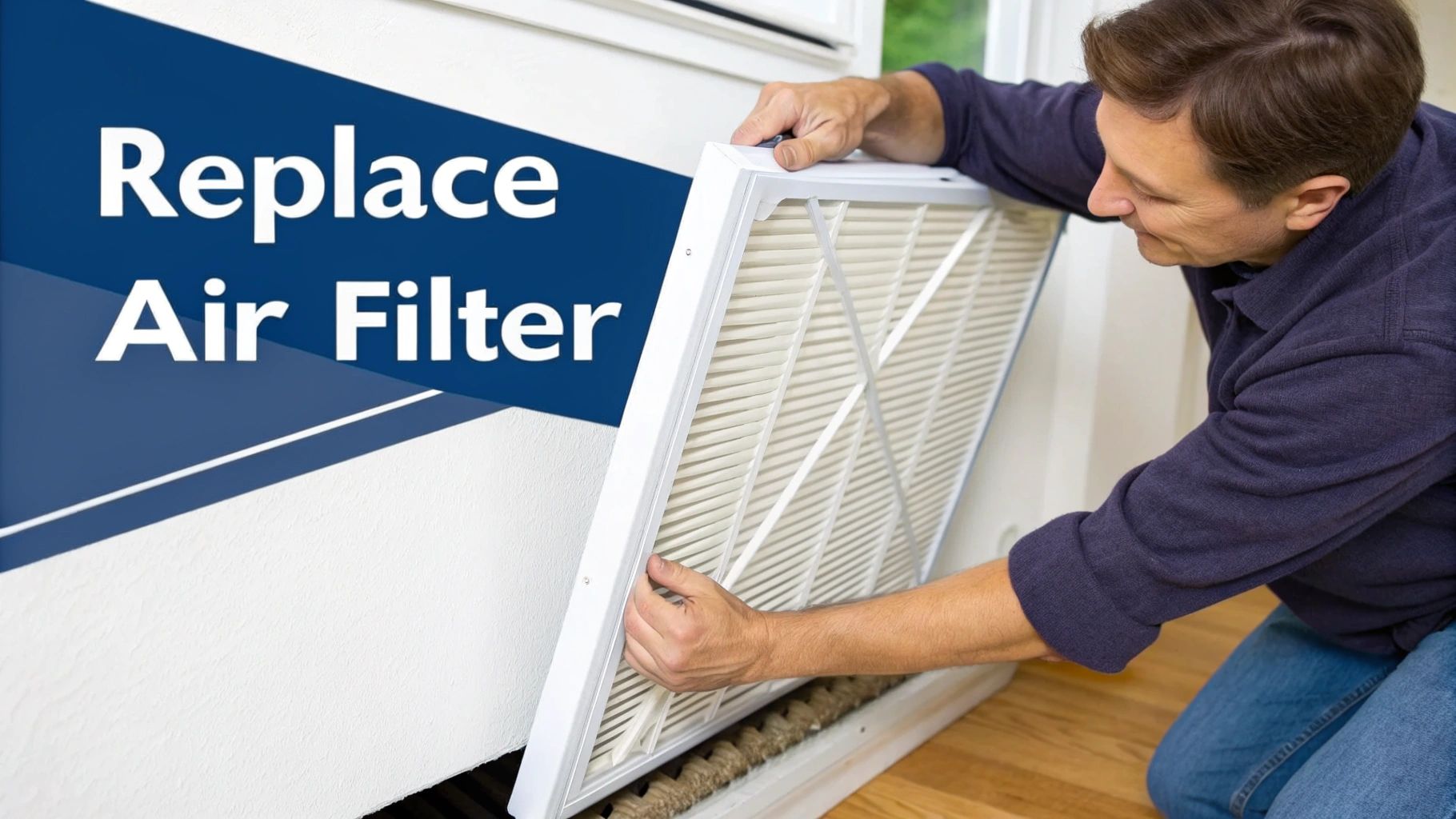
Neglecting this task forces your system to work harder, consuming more energy and leading to premature wear on critical parts like the blower motor and evaporator coils. For Valley residents, the combination of high cooling demand and frequent dust storms means filters clog much faster than in other climates.
Implementation and Best Practices
For most Phoenix-area homes, checking the filter monthly is a non-negotiable habit. Replacement frequency typically lands between 1-3 months, but certain factors can accelerate this timeline.
- Pets: Homes with multiple pets often benefit from monthly changes to manage dander and hair.
- Dust Storms: After a significant haboob rolls through Mesa or Chandler, inspect your filter immediately, as it can become completely saturated in just a few hours.
- Allergies: If anyone in your home suffers from allergies or respiratory issues, consistent filter changes are vital for maintaining healthy indoor air quality.
Pro Tip: Set a recurring monthly reminder on your phone or calendar. Don't rely on memory alone. Also, keep a few spare filters on hand so you can replace a dirty one immediately without having to make a trip to the store. For families especially concerned with particulates, beyond regular filter changes, tools like an air scrubber rental can further contribute to cleaner indoor air. Understanding the ideal schedule is key, and you can learn more about how often you should replace your air filter for optimal performance.
2. Refrigerant Level Check and Recharge
Refrigerant is the essential lifeblood of your air conditioning system, a specialized compound that absorbs heat from your indoor air and transfers it outside. A correct refrigerant charge is a non-negotiable part of a professional hvac preventive maintenance checklist, especially in a climate like Phoenix where AC units are pushed to their limits. Low levels are almost always a sign of a leak, which severely cripples cooling capacity, efficiency, and can lead to catastrophic compressor failure.
When your system is undercharged, it runs longer and works harder to achieve the set temperature, causing your energy bills to skyrocket. Technicians use specialized gauges to measure pressure and temperatures, ensuring the system operates precisely to manufacturer specifications. In the punishing 110°F+ summer heat of Tempe and Scottsdale, a perfectly charged system is the difference between cool comfort and a struggling, expensive-to-run unit.
Implementation and Best Practices
This is strictly a job for a licensed professional with EPA 608 certification. Handling refrigerant is regulated and requires specialized tools for recovery and charging. A professional check should be part of your annual spring tune-up before the cooling season begins.
- Weak Cooling is a Red Flag: If your AC is running but not cooling effectively, a refrigerant leak is a prime suspect. Don’t ignore it; immediate service can prevent a costly compressor burnout.
- Leak Repair is Mandatory: Simply "topping off" refrigerant without fixing the source of the leak is a temporary, ineffective fix. A reputable technician will always perform a leak search to find and repair the problem first.
- Budgeting for Older Systems: If your unit is over 10 years old, it may use R-22 refrigerant, which has been phased out and is now extremely expensive. A significant leak might make replacing the entire unit a more financially sound decision than repeated, costly recharges.
Pro Tip: Always request that the technician locates and repairs the source of the leak, not just add more refrigerant. Keep service records that detail the refrigerant type, the amount added, and what repairs were made. This documentation is invaluable for future service calls and warranty claims.
3. Condenser Coil Cleaning and Inspection
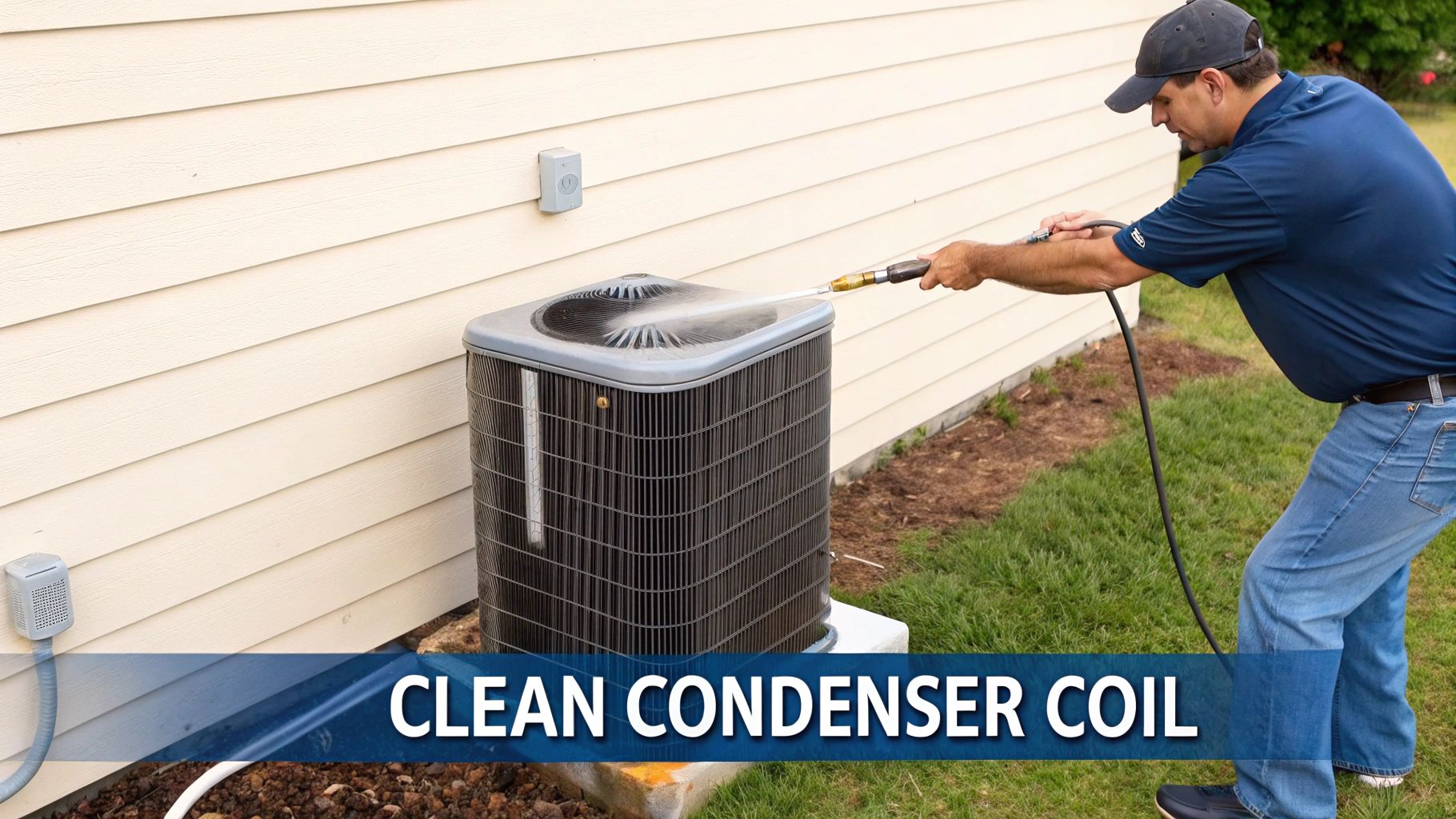
A critical item on any comprehensive hvac preventive maintenance checklist is cleaning the outdoor condenser coil. This component is your system's radiator, responsible for expelling the heat absorbed from inside your home. In the dusty Phoenix climate, these coils act like a magnet for dirt, pollen, and debris, forming an insulating blanket that severely hinders heat transfer. A dirty coil forces your compressor to work much harder and longer to cool your home, driving up energy bills and straining the most expensive part of your AC unit.
This isn't a trivial issue in our climate. For commercial properties in Scottsdale with rooftop units, seasonal coil maintenance can lead to direct energy savings of 10-15%. Homeowners see a direct impact too; some in dusty Chandler neighborhoods report their compressors running at temperatures up to 20°F cooler after a professional cleaning, a significant reduction in system stress.
Implementation and Best Practices
For Valley residents, inspecting and cleaning the condenser coil should happen at least once a year, ideally twice. Scheduling this before the summer peak (April-May) ensures your system is ready for the intense demand ahead.
- Maintain Clearance: Always keep the area around your outdoor unit clear. Trim back bushes, grass, and weeds to maintain at least two to three feet of open space for proper airflow.
- Gentle Rinsing: As a DIY step, you can gently rinse the coil fins with a garden hose on a low-pressure setting. Do this during cooler morning hours to prevent steam and potential mineral buildup.
- Professional Cleaning: Annual professional cleaning is non-negotiable. Technicians use specialized, non-acidic coil cleaners and proper techniques to remove deeply embedded grime without damaging the delicate aluminum fins.
- Avoid Harsh Chemicals: Never use high-pressure washers or harsh household chemicals, as they can bend fins and corrode the coil material, leading to expensive repairs.
Pro Tip: Don't wait for your AC's performance to decline before addressing the coils. By the time you notice a problem, the efficiency loss has already cost you money. Proactive cleaning is a key investment in your system's longevity and performance. For units with heavy, baked-on grime, advanced services can restore efficiency by over 25%.
4. Evaporator Coil Inspection and Cleaning
Tucked away inside your indoor air handler, the evaporator coil is the unsung hero of Arizona cooling. This component absorbs heat and humidity from your home's air, but this constant moisture makes it a prime target for dust, debris, and biological growth. A clean coil is a non-negotiable part of any comprehensive hvac preventive maintenance checklist, as a dirty one chokes airflow, reduces cooling capacity, and can severely degrade your indoor air quality.
When layers of grime accumulate, the coil cannot effectively transfer heat. Your system is then forced to run longer and harder to achieve the temperature on your thermostat, leading to higher energy bills and increased strain on the compressor. Worse, the damp, dark environment is an ideal breeding ground for mold and mildew, which can circulate throughout your home and cause musty odors or allergic reactions.
Implementation and Best Practices
While a visual inspection is something a homeowner can do, cleaning evaporator coils is best left to a trained professional due to their delicate nature and the use of specialized chemical cleaners.
- Professional Cleaning: Schedule a technician to inspect and clean the coils during your bi-annual tune-ups. They have the right tools to clean the fragile aluminum fins without causing damage.
- Drain Line Maintenance: Ensure the condensate drain line connected to the coil is clear. A clog can cause water to back up, leading to water damage and promoting microbial growth on and around the coil.
- Humidity Control: In homes with persistent moisture issues, keeping indoor humidity below 50% is crucial. This discourages the biological growth that thrives on damp coils.
Pro Tip: If you notice a persistent "dirty sock" or musty smell when your AC kicks on, it's a strong indicator that your evaporator coil needs professional cleaning and sanitization. For an even higher level of protection, consider asking your technician about installing a UV light system, which uses ultraviolet germicidal irradiation to neutralize mold and bacteria on the coil surface 24/7.
5. Thermostat Calibration and Battery Replacement
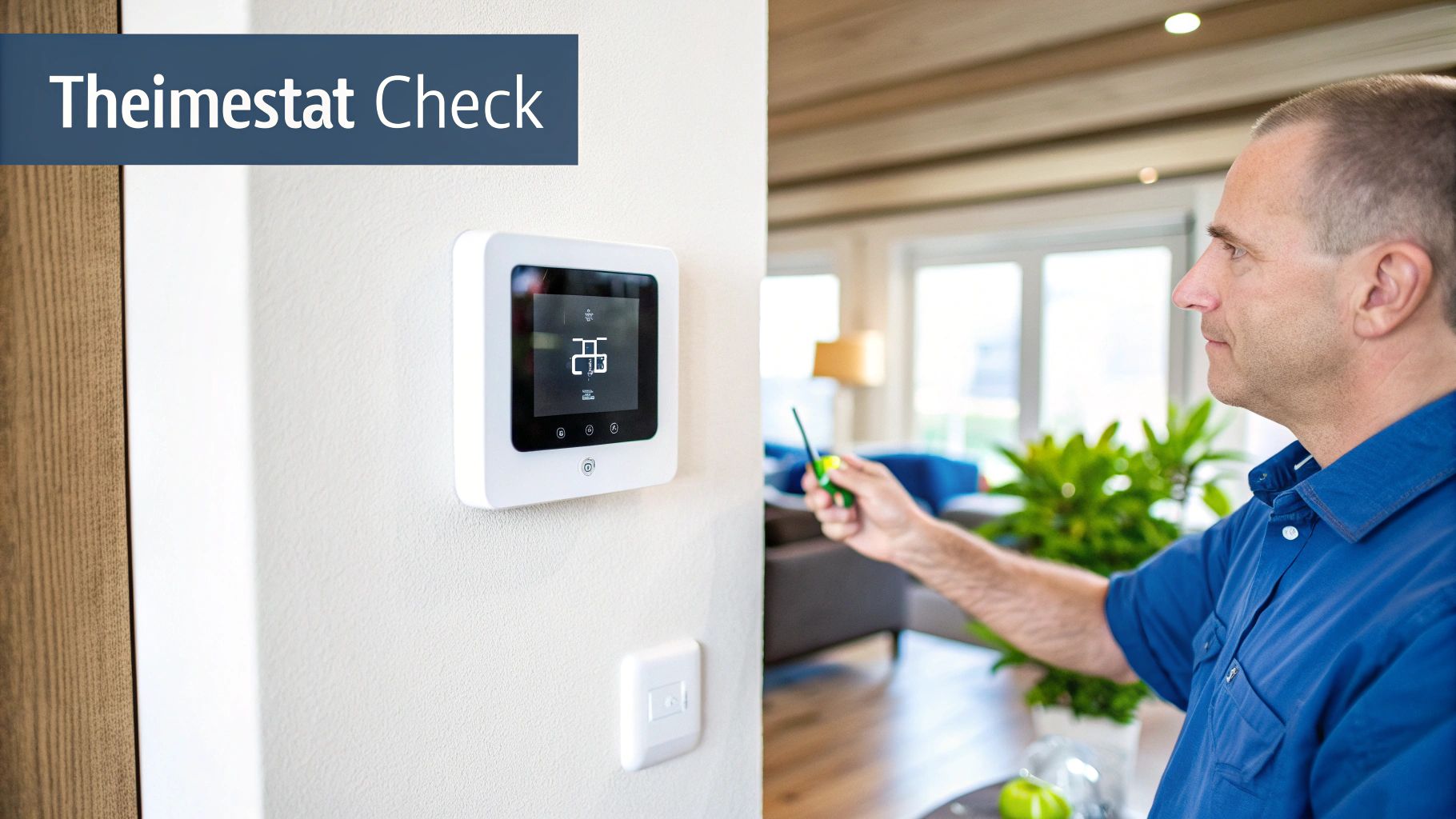
Often overlooked, your thermostat is the brain of your HVAC system, and its accuracy is a critical part of any hvac preventive maintenance checklist. This small device dictates when your AC kicks on and off, directly impacting your comfort and energy bills. A miscalibrated thermostat can read the room temperature incorrectly, causing your system to run too long or not long enough, leading to wasted energy and discomfort in the relentless Phoenix heat.
During professional maintenance, a technician verifies the thermostat's reading against a calibrated thermometer to ensure it's accurate. They also check sensor elements, programming, and connectivity for smart models. Forgetting this step means you could be fighting a losing battle for comfort, even with a perfectly functioning AC unit, simply because the instructions it's receiving are flawed.
Implementation and Best Practices
Regularly checking your thermostat's function is a simple yet effective way to maintain system efficiency. For homeowners in Scottsdale and Tempe, where precision cooling is paramount, these practices can make a significant difference.
- Battery Replacement: Wireless thermostats with low or dead batteries can cause erratic operation or complete system shutdowns. Proactively replace the batteries every 12 months to avoid being left without AC.
- Accuracy Test: You can perform a basic accuracy test by placing a reliable room thermometer next to your thermostat for 30 minutes. If the readings are off by more than a couple of degrees, it may need professional calibration.
- Smart Thermostat Upgrades: If your thermostat is over a decade old, upgrading to a smart model like a Nest or Ecobee can yield significant savings, often between 12-18% annually, by learning your habits and optimizing schedules.
Pro Tip: When a technician is on-site for maintenance, ask them to double-check your thermostat’s settings and programming. Sometimes, complex "hold" or "vacation" modes are accidentally left on, which can override your desired schedule and waste energy. Also, ensure your thermostat is not placed in direct sunlight or near heat-generating appliances, as this will skew its temperature readings.
6. Blower Motor and Capacitor Inspection, Testing, and Replacement
The blower motor is the powerful heart of your air circulation system, while the capacitor provides the critical jolt of electricity needed to start it and other key components. These two parts are essential for moving conditioned air from your HVAC unit through the ducts and into your Mesa home. This task is a cornerstone of any professional hvac preventive maintenance checklist because failure in either component can bring your entire system to a grinding halt, often on the hottest day of the year.
Dust accumulation on blower fan blades reduces airflow efficiency, forcing the motor to work harder and consume more energy. Capacitors, which typically have a 3 to 5-year lifespan in Arizona's extreme heat, can degrade and fail, preventing motors from starting. A technician inspects these parts for wear, cleans them, and tests their electrical performance to prevent an inconvenient and costly breakdown. For instance, a Mesa homeowner’s AC might fail to start on a blistering July afternoon, only to find a bulged and failed capacitor was the culprit; a quick replacement can restore function in minutes.
Implementation and Best Practices
This is a task best left to trained professionals during your bi-annual tune-ups due to the high voltages involved. However, being an informed homeowner can help you understand what the technician is looking for and why it’s so important.
- Listen for Trouble: Pay attention to unusual sounds coming from your indoor unit. Grinding, squealing, or whining noises can indicate failing motor bearings.
- Monitor Airflow: If you notice reduced or uneven airflow from your vents, it could be a sign of a dirty blower wheel or a struggling motor.
- Proactive Replacement: If your system is 8-10 years old, budgeting for a proactive capacitor replacement can be a smart move to avoid a mid-summer emergency. A weak capacitor puts extra strain on your motors.
- Prioritize Clean Filters: The easiest way to reduce stress on your blower motor is to keep your air filters clean. A clogged filter is the number one cause of premature motor failure.
Pro Tip: During your next maintenance visit, ask the technician to show you the capacitor and explain its condition. Visual signs like bulging or leaking oil are clear indicators of imminent failure. Also, request that they measure the motor’s amperage draw to see if it’s working harder than it should be, which can identify hidden stress. If you've ever wondered why your AC fan is not spinning, a faulty capacitor is one of the most common causes.
7. Ductwork Inspection, Sealing, and Cleaning
An often-overlooked but critical component of any hvac preventive maintenance checklist is the network of ducts hidden in your attic, walls, and crawlspaces. This ductwork is the circulatory system for your home's conditioned air. Unfortunately, according to ENERGY STAR, the average home loses 20 to 30 percent of the air moving through the duct system due to leaks, holes, and poor connections. In the Phoenix area, that means you're paying to cool your attic instead of your living room.
Neglecting ductwork issues forces your HVAC system to run longer and harder to achieve the temperature set on your thermostat, leading to higher energy bills and accelerated wear. Leaky ducts can also pull in dust, insulation fibers, and other pollutants from attics and crawlspaces, degrading your indoor air quality and creating a dusty, allergen-filled environment.
Implementation and Best Practices
A thorough inspection will identify disconnected sections, gaps at joints, and obvious tears. Professional sealing involves using mastic sealant or specialized tape to close these leaks. For a more comprehensive and permanent solution, advanced technologies are available.
- Aeroseal Technology: This patented process pressurizes the duct system from the inside, forcing a non-toxic sealant to find and permanently seal leaks, even those in inaccessible areas. Many older Phoenix homes have seen energy bill reductions of 25-35% after this service.
- Balancing Airflow: Sealing is often paired with balancing, which ensures each room receives the correct amount of conditioned air. This resolves common issues like having one hot bedroom and a freezing living room.
- Professional Cleaning: Scheduling a professional cleaning every 3-5 years is crucial, especially for families with pets, allergies, or after a renovation. This removes years of accumulated dust, dander, and debris from the system. You can explore the benefits and process of professional duct cleaning to see if it’s right for your home.
Pro Tip: Before committing to sealing, ask your technician for a blower door test. This diagnostic tool measures the exact amount of duct leakage in your system, providing a baseline to quantify the improvement after the work is completed. Keep detailed records of any ductwork maintenance for future service calls and potential home buyers.
8. Heat Pump Defrost Cycle Verification and Testing
For Phoenix Valley homeowners with heat pumps, verifying the defrost cycle is a crucial but often overlooked task on the hvac preventive maintenance checklist. A heat pump provides heat by reversing its cooling cycle, pulling warmth from the outside air. When temperatures drop, this process can cause ice to form on the outdoor coils, restricting airflow and severely hampering heating performance. The defrost cycle is designed to periodically reverse the system back to "cool mode" just long enough to melt this ice.
If this cycle malfunctions, the unit becomes a block of ice, forcing it to work extremely hard while producing very little heat. This strains the compressor and reversing valve, wastes significant energy, and can leave you without warmth on a rare but impactful Arizona cold snap. A professional check ensures the defrost sensors and controls are functioning correctly before they fail when you need them most.
Implementation and Best Practices
A technician should test the defrost cycle during annual fall maintenance. This is a professional task that involves manually initiating the cycle and verifying each step of the sequence.
- Proper Timing: Schedule heat pump maintenance in the fall, ideally before you switch from cooling to heating for the season. This ensures it's ready for the first chilly night.
- Sensor and Valve Checks: The technician will test the defrost thermostat, control board, and the reversing valve, which is responsible for switching the refrigerant flow. A faulty reversing valve is a common point of failure.
- Mountain and High-Desert Homes: For residents in higher-elevation areas like Flagstaff, where reliance on heat pumps is greater, this annual check is absolutely essential for winter readiness and system longevity.
Pro Tip: When your technician is on-site, ask them to show you the reversing valve and listen for the distinct "whoosh" or "click" sound it makes when the defrost cycle engages. Also, monitor your unit during the first cold night. If you notice excessive ice buildup on the outdoor coil that doesn't melt away, it's a clear sign of a defrost problem that needs immediate attention.
9. Gas Furnace Safety Inspection and Combustion Testing
While Phoenix is known for its scorching summers, a reliable furnace is essential for those surprisingly chilly winter nights. For homes with gas heating, a rigorous safety inspection is a non-negotiable part of any hvac preventive maintenance checklist. This professional service goes far beyond basic cleaning, focusing on preventing potentially lethal issues like carbon monoxide (CO) leaks, gas valve failures, and unsafe combustion.
Neglecting this annual inspection is a significant risk. Technicians methodically examine the heat exchanger for cracks, test gas pressure, verify ignition sequences, and analyze flue gas for dangerous CO levels. Because Phoenix-area furnaces sit idle for most of the year, components can degrade or fail unexpectedly when first activated, making a fall tune-up critical for safe operation.
Implementation and Best Practices
A comprehensive gas furnace inspection should be scheduled every fall, ideally between August and October, well before the heating season begins. This proactive timing ensures your system is safe and ready when you need it.
- Heat Exchanger Integrity: A cracked heat exchanger can allow carbon monoxide to mix with your home's air. A technician will perform a visual inspection and combustion analysis to detect this critical failure.
- Combustion Analysis: This test measures CO levels in the exhaust flue, ensuring the furnace is burning fuel cleanly and safely. High CO readings indicate an immediate problem that needs correction.
- Component Checks: Technicians will test safety controls like the flame sensor, limit switches, and gas valve. For instance, detecting a weak flame sensor during maintenance and replacing it can prevent a no-heat situation on a cold night.
Pro Tip: Always install and regularly test battery-powered carbon monoxide detectors on every level of your home as a vital backup safety measure. When booking your fall maintenance, explicitly request a full combustion analysis and a visual heat exchanger inspection. If a technician finds a cracked heat exchanger, the furnace must be replaced; it cannot be safely repaired. For any issues uncovered during an inspection, it's wise to understand your options for professional furnace repair in Mesa, AZ to restore safe operation.
10. System Performance Testing and Efficiency Measurement
Beyond visual inspections, a comprehensive hvac preventive maintenance checklist must include quantitative performance testing. This involves using specialized tools to measure your system's actual output against its design specifications. A technician will evaluate key metrics like airflow velocity, system pressures, electrical draw, and the temperature difference between the air entering and leaving the indoor unit to verify it is operating at peak efficiency.
These empirical measurements are critical for identifying subtle degradation before a catastrophic failure occurs. A gradual loss of efficiency often signals underlying issues such as a slow refrigerant leak, coil blockages, or a failing motor. For Phoenix homeowners, ensuring your system performs optimally is non-negotiable, as even a small drop in performance can lead to higher energy bills and inadequate cooling during the brutal summer months.
Implementation and Best Practices
Professional performance testing is an essential component of your annual tune-up, ideally scheduled in the spring before the high-demand cooling season begins. This establishes a baseline and ensures your system is ready for the intense workload ahead.
- Benchmark Annually: Request that your technician document the key measurements from your spring tune-up. Comparing this data year-over-year provides a clear picture of your system's health and can reveal slow-developing problems.
- Diagnose Uneven Cooling: If a Chandler home has rooms that are consistently warmer than others, performance testing can uncover issues like low static pressure in the ductwork, pinpointing the exact cause of the comfort imbalance.
- Catch Issues Early: A technician might find an AC's temperature drop is only 14°F, below the ideal 15-20°F range. This small variance could indicate a refrigerant leak that, if caught early, prevents a costly compressor failure down the line.
Pro Tip: When discussing performance, ask your technician how the measurements relate to your unit's efficiency rating. Understanding the key metrics behind your system's performance can help you better appreciate what is a good SEER rating and how preventive maintenance directly protects your investment and keeps energy costs in check.
10-Point HVAC Preventive Maintenance Comparison
| Item | Implementation complexity | Resource requirements | Expected outcomes | Ideal use cases | Key advantages |
|---|---|---|---|---|---|
| Air Filter Replacement and Inspection | Low — simple check/replace, DIY or tech | Low — replacement filters ($15–50), spares | Improved indoor air quality, restored airflow, modest energy savings | Homes with pets, high dust (Phoenix), routine maintenance | Low cost, immediate benefits, easy to perform |
| Refrigerant Level Check and Recharge | High — requires EPA-certified technician and leak detection | Moderate–High — refrigerant, gauges, leak-detection tools;R-22 costlier | Restored cooling capacity, leak identification, protects compressor | Systems with weak cooling, older units, suspected leaks | Restores performance, prevents major failures, regulatory compliance |
| Condenser Coil Cleaning and Inspection | Moderate — professional cleaning, careful handling of fins | Moderate — water/cleaners, fin combs, tech time | Improved heat transfer, lower operating temps, energy savings | Outdoor units in dusty areas, pre-summer maintenance | Immediate efficiency gains, prevents overheating, affordable |
| Evaporator Coil Inspection and Cleaning | Moderate — indoor access, delicate cleaning required | Moderate — specialized cleaners, drain clearing tools, technician skill | Better IAQ, restored cooling capacity, reduced mold/musty odors | Homes with high indoor humidity, mold smells, allergy concerns | Improves air quality, prevents water damage, restores performance |
| Thermostat Calibration and Battery Replacement | Low–Moderate — battery swap easy; calibration needs tools/skill | Low — batteries, calibration thermometer, minimal tech time | Accurate temperature control, energy savings, reliable operation | Miscalibrated or old thermostats, smart thermostat setup | Low cost, improves comfort and efficiency, prevents unexpected shutdowns |
| Blower Motor and Capacitor Inspection, Testing, and Replacement | Moderate–High — electrical testing and possible component replacement | Moderate — multimeter, amp meter, replacement capacitors/motors, trained tech | Reliable airflow, avoided startup failures, extended system life | Systems with weak airflow, noisy motors, aging equipment | Prevents emergency failures, inexpensive fixes vs compressor replacement |
| Ductwork Inspection, Sealing, and Cleaning | Moderate–High — access, possible complex sealing (Aeroseal) | High — Aeroseal equipment, labor, duct repair materials;costly initial investment | Reduced leakage, improved room balance, better IAQ, energy savings | Older homes with leaky ducts, uneven temperatures, allergy households | Large energy savings, improved comfort, ROI typically 2–3 years |
| Heat Pump Defrost Cycle Verification and Testing | Moderate — specialized diagnostics and observation | Moderate — diagnostic tools, possible sensor/reversing valve parts | Reliable heating during cold snaps, prevented ice buildup and damage | Homes with heat pumps, regions with occasional freezing nights | Prevents heating failures, catches valve/sensor issues early |
| Gas Furnace Safety Inspection and Combustion Testing | High — combustion analysis, certified technician required | Moderate–High — combustion analyzer, CO detectors, possible parts replacement | Detects CO leaks, ensures safe combustion, prevents life‑threatening hazards | Gas furnace homes, pre‑winter tune‑ups, older furnaces | Life‑safety assurance, regulatory compliance, prevents catastrophic failures |
| System Performance Testing and Efficiency Measurement | High — comprehensive measurements and data collection | High — airflow meters, pressure gauges, thermometers, time for baseline testing | Baseline system performance, early detection of issues, documented efficiency | Annual tune‑ups, unexplained efficiency drops, warranty documentation | Proactive problem detection, objective benchmarks, optimized system efficiency |
Ready to Get Proactive with Your HVAC Maintenance?
You’ve made it through the ultimate hvac preventive maintenance checklist, a comprehensive roadmap designed to empower Phoenix Valley homeowners and business managers. We've navigated the essential tasks, from the simple monthly filter change to the complex annual inspections of blower motors and gas furnace safety systems. You now have a clear understanding of which tasks are manageable for a dedicated DIYer and which ones absolutely require the trained eye and specialized tools of a professional technician. This knowledge is your first and most powerful line of defense against the brutal Arizona heat and unexpected, costly breakdowns.
The core takeaway is simple: proactive care is always more effective and affordable than reactive repair. By consistently addressing the items on this checklist, you are not merely ticking boxes. You are actively extending the lifespan of your equipment, optimizing its energy efficiency to lower your SRP or APS bills, and safeguarding the indoor air quality for your family or employees. Think of it as an investment in your property’s most critical system, one that pays dividends in reliability, cost savings, and priceless peace of mind.
From Checklist to Action: The Path to Total Comfort
Let’s be honest, while a detailed checklist is invaluable, it’s the consistent application of this knowledge that truly makes a difference. The distinction between a DIY inspection and a professional tune-up is crucial. A homeowner can spot obvious issues like a dirty filter or debris around the outdoor unit, but a seasoned technician sees beyond the surface. They use diagnostic tools to measure refrigerant pressures, test electrical components like capacitors for signs of weakness, and perform combustion analysis on furnaces to ensure safe operation. These are the details that prevent a minor issue from escalating into a catastrophic failure during a 115-degree monsoon afternoon.
This isn’t just about avoiding disaster; it’s about maximizing performance. Your HVAC system is a complex machine, and just like a high-performance vehicle, it requires expert tuning to operate at its peak. Here’s the thing: mastering this checklist means recognizing your own limits and knowing precisely when to call for backup. It's about building a partnership with a trusted HVAC provider who can handle the technical side, allowing you to focus on the simple, regular tasks that keep the system running smoothly between professional visits. This collaborative approach ensures nothing is overlooked.
The True Value of Professional Partnership
Ultimately, this hvac preventive maintenance checklist serves two purposes: to guide your own efforts and to help you understand the immense value a professional maintenance plan delivers. When a technician from Comfort Experts visits your home, they are performing every relevant professional-grade task on this list and more, using their experience to interpret the results in the context of our unique desert climate. They understand how the relentless sun, fine dust, and long cooling seasons impact your specific equipment.
This level of expertise transforms maintenance from a chore into a strategic asset. It ensures your system is not just running, but running efficiently and safely. You gain confidence knowing that every component has been meticulously inspected, cleaned, and calibrated for the demanding season ahead. Don’t let your comfort be a matter of chance. Take the knowledge you’ve gained from this guide and translate it into decisive action. Your comfort, your budget, and your HVAC system will thank you for it.
You know what? This checklist covers the critical tasks that keep your system humming, but the real value comes from the experienced eye of a professional who can spot subtle issues before they become catastrophic failures. At Comfort Experts, we've been serving the Phoenix Valley since 2011, treating every home like our own. Our licensed and insured technicians (ROC #275914) provide the thorough, honest service you deserve, from comprehensive tune-ups to high-efficiency Trane installations. Don't wait for a breakdown in the middle of a 115°F day, take control of your comfort and your budget. Ready for peace of mind? Give us a call at 480-207-1239 or schedule service online today with Comfort Experts.