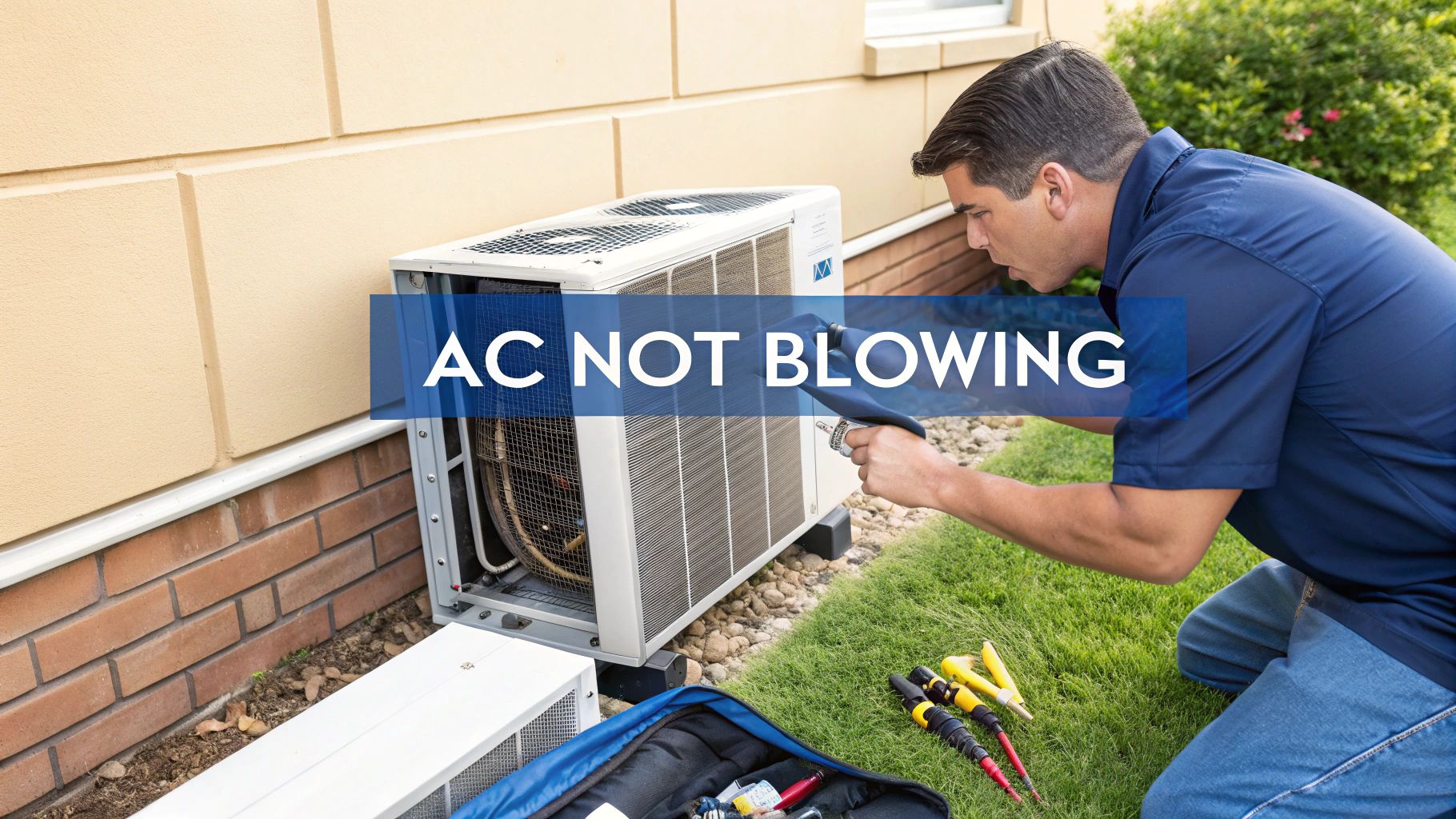
There's nothing quite like that sinking feeling when your AC goes silent on a sweltering Phoenix day. When you're faced with an ac not blowing, it’s easy to jump to the worst-case scenario of a costly repair. But before you panic, many common issues are surprisingly simple fixes you can handle yourself.
Your First Checks When the AC Stops Blowing Air
That moment of quiet dread when the airflow stops is a classic Phoenix experience. Honestly? The solution is often something small you can handle without calling for help. Before you assume the whole system has given up, a few quick, logical checks can often get things moving again.
Think of this guide as your first line of defense. We’ll walk you through the most common culprits that stop an AC from blowing air. These are the basics—safe, simple steps that require no special tools. More often than not, one of these will solve the problem and save you the cost and hassle of a service call.
Start with the Thermostat
It sounds almost too obvious, but we see it all the time. As HVAC professionals with over a decade of experience in the Valley, we can tell you firsthand that the thermostat is the brain of your entire HVAC system, and a simple settings mix-up is a top offender. A wrong setting can make a perfectly healthy AC unit play dead.
First, make sure it’s set to “Cool.” It’s easy for it to get bumped to “Off” or even “Heat,” especially if you have kids or after a brief power outage resets things.
Next, look at the temperature setting. If the thermostat is set to 78°F but the room is already 76°F, the air conditioner has no reason to kick on. It’s just doing what it’s told. Lower the set temperature a few degrees below the current room temp and see if it wakes up.
Pro Tip: If you have a digital thermostat, check for a low battery warning. Weak batteries can cause all sorts of strange behavior, from incorrect temperature readings to a total failure to communicate with your AC. It's a two-dollar fix that can prevent a major headache.
Inspect Your Circuit Breaker and Vents
Okay, so the thermostat settings are correct. The next place to look is the power source. Your air conditioner is a powerful machine, and it runs on dedicated circuits in your home’s electrical panel.
This flowchart lays out the simple path for these initial checks. It’s all about ruling out the easy stuff first.
As you can see, systematically checking the thermostat, power, and airflow obstructions helps you quickly narrow down the possibilities.
Here’s how to check these two key areas:
- Find Your Breaker Box: Head to your main electrical panel. You’re looking for breakers labeled "AC," "HVAC," or "Air Handler." You might have two of them—one for the indoor unit (the air handler) and another for the outdoor unit (the condenser).
- Reset the Breaker: If a breaker is tripped, it will be in the middle or "Off" position. To reset it properly, you have to push it firmly all the way to "Off" first, then flip it back to "On." A tripped breaker often happens after a power surge and is a very common fix.
- Check All Air Vents: Do a quick walkthrough of your house. Make sure all the supply and return air vents are open and aren't blocked by anything. It’s amazing how often a new piece of furniture, a stray rug, or a kid's toy is the culprit, choking off airflow and causing the system to shut down.
The Most Common Culprit: A Clogged Air Filter
If the thermostat and breaker checked out, it’s time to look at the single most common reason an AC stops blowing cold air in an Arizona home: a dirty, clogged air filter.
Here in the Valley, our air is a mix of dust, pollen, and pet dander. Your HVAC system breathes all of it in, and the filter is the only line of defense protecting its sensitive, expensive internal parts. When that filter gets choked with grime, it's like asking your system to breathe through a thick blanket. Air simply can't get through.
You know what? This is where the problem lies more often than not.
Why a Dirty Filter Is So Destructive
A neglected filter doesn't just block cool air—it actively harms your entire HVAC system. The blower motor has to strain itself just to pull air through the clogged mesh. This immense stress puts it at high risk for an expensive burnout.
We’ve seen it hundreds of times. A clogged air filter is behind up to 70% of airflow disruptions in homes we visit for the first time. A single packed filter can slash airflow by 50%, forcing the compressor to overwork, spiking energy bills by 15-25%, and often causing the evaporator coil to freeze solid.
This restricted airflow is also the number one cause of a frozen evaporator coil, another headache we'll get to later. In short, this one small, inexpensive part can set off a chain reaction of failures if it's ignored. For a closer look, you can read our guide on how often you should change your air filters in Arizona.
Finding and Checking Your Air Filter
Don’t worry, finding your air filter is usually pretty easy. It’s almost always in one of two spots:
- In the return air duct: This is that big vent, often in a central hallway ceiling or wall. The filter typically sits right behind the grille.
- At the air handler: Look for a slot on the indoor unit itself (usually tucked away in a closet, attic, or garage) where the main duct connects.
Once you’ve found it, just slide the filter out and hold it up to a light. Can you see light through it? If not, it's toast. A clean filter is white or off-white; a dirty one will be covered in a gross gray mat of dust and debris.
Choosing the right replacement matters, especially with our desert dust.
Air Filter Replacement Guide for Arizona Homes
Not all filters are created equal, and our dusty environment puts them to the test. This quick guide breaks down the common types and how often they really need changing here in the Phoenix Valley.
| Filter Type | Recommended Replacement Frequency (Standard Home) | Frequency (Home with Pets/Allergies) | Pros | Cons |
|---|---|---|---|---|
| Fiberglass (Basic) | Every 30 days | Every 2-3 weeks | Inexpensive, promotes good airflow. | Captures only large particles like dust and lint. |
| Pleated (MERV 8-11) | Every 60-90 days | Every 30-45 days | Balances airflow with good filtration of smaller particles. | Can restrict airflow if not changed on schedule. |
| Electrostatic (Reusable) | Wash every 30 days | Wash every 2-3 weeks | Cost-effective over time, eco-friendly. | Requires regular cleaning to be effective. |
| High-Efficiency (MERV 12+) | Every 6 months | Every 3-4 months | Excellent for allergies, captures tiny particles. | Can be restrictive for some older systems. |
Picking the right filter and swapping it out on schedule is the single best piece of preventive maintenance you can do. It's cheap, it's easy, and it solves a surprising number of AC problems before they start.
What to Do About a Frozen Evaporator Coil
Okay, so you've ruled out the easy stuff—the thermostat is fine, and you’ve swapped out that filthy air filter—but your AC is still silent and the house is getting stuffy. When you're still dealing with an AC not blowing, a frozen evaporator coil is the next prime suspect. It sounds dramatic, but spotting it is usually pretty straightforward.
Think of your evaporator coil as the part of your indoor AC unit that actually does the cooling. It’s a network of super-chilled pipes that pulls heat and humidity out of your home’s air as the blower motor pushes air across it. But if something messes with that airflow—like the clogged filter we just talked about—the coil gets too cold, and the moisture on it freezes solid.
Suddenly, you have a block of ice right where air is supposed to be moving, bringing your home’s air circulation to a dead stop.
How to Spot a Frozen Coil
You don't need any special tools for this, just your eyes and ears. Most of the time, the signs are pretty obvious if you know what you’re looking for.
Keep an eye out for these tell-tale symptoms:
- You can see ice. This is the most direct clue. You might spot frost or a layer of ice on the copper lines that run into your indoor air handler. If you can safely pop open the access panel to the coil itself, you’ll likely see the whole thing encased in ice.
- There’s a puddle of water. When the AC cycles off, that block of ice starts to melt. It can easily overwhelm the small drain pan, spilling water all over the floor around your furnace or air handler. If you find a mysterious puddle, a frozen coil is a very likely cause. We cover this in more detail in our guide on why your AC might be leaking water inside.
- You hear strange noises. Sometimes you’ll hear odd hissing or even gurgling sounds coming from your refrigerant lines as the system struggles to work against the ice buildup.
Seriously, Don't Do This. Whatever you do, never try to hack away at the ice with a screwdriver or anything sharp. Those coils and aluminum fins are incredibly fragile. Puncturing one will cause a very expensive refrigerant leak and could wreck the entire unit. The only tool you need right now is patience.
Your First Move: Thaw It Out
Found ice? Your immediate job is to let it melt. Completely. This isn't optional.
Go to your thermostat and turn the cooling mode to “Off.” Next, switch the fan setting from "Auto" to “On.” This kills the cooling cycle but keeps the blower running, which will push room-temperature air across the coil and speed up the thawing process significantly. Depending on how bad the ice is, this could take anywhere from a few hours to an entire day.
While poor airflow from a dirty filter is the number one cause, a frozen coil can also point to a refrigerant leak. Low refrigerant levels are behind about 30% of 'not blowing cold air' calls we get nationwide, and that number climbs as high as 45% in a hot climate like ours in Arizona. A refrigerant leak is something that absolutely requires a certified pro to handle safely.
Spotting a Blower Motor or Electrical Failure
Alright, so you’ve ruled out the easy stuff. The filter is clean, and you don’t see a block of ice on your coils, but there’s still absolutely nothing coming out of your vents.
At this point, we're getting into the heart of your HVAC system—an area with high-voltage components where DIY repairs are a definite no-go. This is where a professional technician earns their keep. Our goal here isn’t to teach you how to fix it, but to help you understand what’s likely happening so you can have an informed conversation when you call for service.
The Heart of Airflow: The Blower Motor
Think of the blower motor as the powerful lungs of your home's cooling system. It's a heavy-duty fan with one job: to grab the cold air from your AC and push it through all the ductwork into your rooms. If that motor is dead, the whole system comes to a standstill.
Even if the outdoor unit is running and the indoor coil is ice-cold, that conditioned air is trapped. Without the blower, it has nowhere to go.
A failing motor rarely just dies without a little drama first. It often gives you some warning signs before it quits for good.
Signs of a Failing Blower Motor or Capacitor
When your AC not blowing is the problem, the blower motor is a primary suspect. Before it stopped completely, did you happen to notice any of these classic red flags?
- Weird Noises: A high-pitched screeching or squealing sound is often the tell-tale sign of bad motor bearings. If you heard a loud humming or buzzing, that points more toward an electrical problem with the motor itself.
- A Funky Burning Smell: This one is serious. If you smelled a sharp, metallic, or electrical burning odor coming from the vents just before the air stopped, the motor has likely overheated and fried its wiring.
- An Overheating Motor: After you’ve killed the power to your system at the breaker box, you can carefully feel the motor housing inside your air handler. If it's unusually hot to the touch, it was probably struggling and overheating long before it failed.
Another very common culprit is the run capacitor. Let me explain. It's a small, cylinder-shaped part that gives the blower motor the electrical kick it needs to get spinning and keep running. A bad capacitor is a much cheaper and quicker fix than replacing the whole motor, but the result is the same: a motor that just hums but won't turn, or one that won’t even try.
Our article on why an AC fan might not be spinning dives a little deeper into this.
A Critical Safety Warning: We can't say this enough—blower motors and capacitors are tied directly to dangerous electrical currents. Please do not try to diagnose or replace these parts yourself. A simple mistake can lead to serious injury or cause even more expensive damage to your system. These symptoms are your signal to pick up the phone and call a licensed professional.
Why Proactive Maintenance is Your Best Defense
So far, we’ve been playing defense—reacting to a clogged filter, a frozen coil, or a motor that just gave up. But what if there was a better way? The single best way to handle an AC that's not blowing air is to stop it from happening in the first place.
Let's be honest: an air conditioner in Phoenix works harder and under more stress than almost anywhere else on the planet. Just hoping it will keep running without any care is a gamble that rarely pays off, especially when it's 110°F outside.
This is where we shift from putting out fires to preventing them. The secret to a reliable, long-lasting AC isn't some magic trick; it's consistent, professional maintenance. Viewing a seasonal tune-up as just another expense is a mistake. Think of it as a critical investment in your home's comfort, your wallet, and your peace of mind.
What a Real Tune-Up Includes
A professional maintenance visit from a team like ours is a world away from just swapping out the filter. It's a comprehensive health check-up for your entire HVAC system, designed to catch the small, sneaky issues before they turn into catastrophic failures.
Our technicians follow a meticulous checklist to make sure every component is clean, calibrated, and ready for the grueling summer ahead. We’re talking about a deep clean of both the indoor and outdoor coils to maximize cooling power, testing every electrical connection to prevent dangerous overloads, and verifying refrigerant levels to ensure peak efficiency.
Think of it like this: You wouldn't drive your car for 20,000 miles without an oil change and expect it to run well. Your AC runs for thousands of hours each year in extreme heat; it needs the same level of professional attention to avoid a breakdown.
The Tangible Benefits of Prevention
Investing in regular tune-ups pays you back in more ways than just avoiding the misery of a dead AC. The data is clear: well-maintained systems simply perform better, use less energy, and last longer.
Here are the direct benefits you can expect:
- Improved Efficiency and Lower Bills: A clean, finely-tuned system doesn't have to fight to cool your home. This translates directly into lower monthly energy bills, often saving homeowners up to 30% on cooling costs.
- A Longer Lifespan for Your Unit: The average HVAC system is built to last 15-20 years, but neglected units in our climate often fail years earlier. Regular maintenance prevents the excessive wear and tear that leads to premature replacement.
- Fewer Surprise Breakdowns: It's a staggering statistic, but studies show that a whopping 90% of all AC failures are a direct result of a lack of routine maintenance. A tune-up catches failing parts when they are small, easy fixes.
- Better Indoor Air Quality: During a visit, we clean the components where dust, mold, and bacteria love to hide, helping your family breathe cleaner, healthier air.
Ultimately, proactive care is about control. For more detailed strategies, our article covering essential AC maintenance tips for Arizona residents is a great next step. It's all about ensuring your system is ready for the demands of a Phoenix summer, giving you reliable comfort when you need it most.
When to Call the Comfort Experts
So, you’ve done your homework. You’ve checked the thermostat settings, reset the breaker, swapped out that grimy filter, and made sure your evaporator coil isn’t a solid block of ice. And yet… crickets. Your home is still getting warmer by the minute, a sure sign this AC not blowing problem is beyond a simple DIY fix.
This is the exact point where guessing games become risky and expensive. You’ve successfully ruled out all the usual suspects, which means the real issue is likely buried in the more complex mechanical or electrical guts of your HVAC system.
Recognizing the Professional-Only Problems
Certain symptoms are clear red flags telling you to put down the tools and pick up the phone. Trying to tackle these issues without years of training and specialized diagnostic tools can be dangerous, and frankly, it often leads to even more expensive damage.
These are the signs that absolutely demand a licensed technician:
- Stubborn Electrical Issues: If you reset a circuit breaker and it trips again right away, or even a few minutes later, stop. There’s an underlying electrical fault that needs a professional to trace it safely.
- Signs of a Refrigerant Leak: A faint hissing sound near the unit, greasy gunk on the copper lines, or an AC that runs forever but only pushes out lukewarm air are classic giveaways. Handling refrigerant is not a DIY job—it requires EPA certification for a reason.
- A Failing Blower Motor: Loud, unusual noises like screeching, banging, or a deep humming from your indoor unit are serious warnings. If you smell a distinct burning odor, that’s another major red flag pointing to a failing motor or capacitor, both of which are high-voltage components.
- Constant Short-Cycling: Is your air conditioner turning on and off every few minutes? That’s a symptom of a much deeper problem, like a major airflow restriction, a refrigerant issue, or even a system that was improperly sized for your home from the start.
Here’s the thing. When it comes to your home's HVAC system, our team's experience is your greatest asset. As a locally owned company serving the Valley since 2011, we’ve built our reputation on honest diagnostics and safe, effective repairs. We treat your home’s system with the same care we would our own.
Your Trusted Partner for Arizona HVAC Repairs
You've done an excellent job narrowing down the problem, and that knowledge is valuable. Now, it's time to let our team take it from here. The technicians at Comfort Experts have the professional diagnostic tools and years of hands-on experience to pinpoint the exact cause of your airflow problem—quickly and safely.
We get it. The urgency during a Phoenix heatwave is real. If the situation feels like an emergency, you can learn more about what qualifies for emergency AC repair and see how we can help.
Our trucks are stocked and ready to handle everything from a complex capacitor replacement to a full blower motor installation. We focus on getting the job done right the first time to restore your comfort and peace of mind with reliable, lasting solutions. Don’t let a stubborn AC problem ruin your day.
You've done the troubleshooting; now it's time for a professional solution. For fast, reliable service from a team you can trust, call Comfort Experts today at 480-207-1239 or schedule service online to get your cool air flowing again.