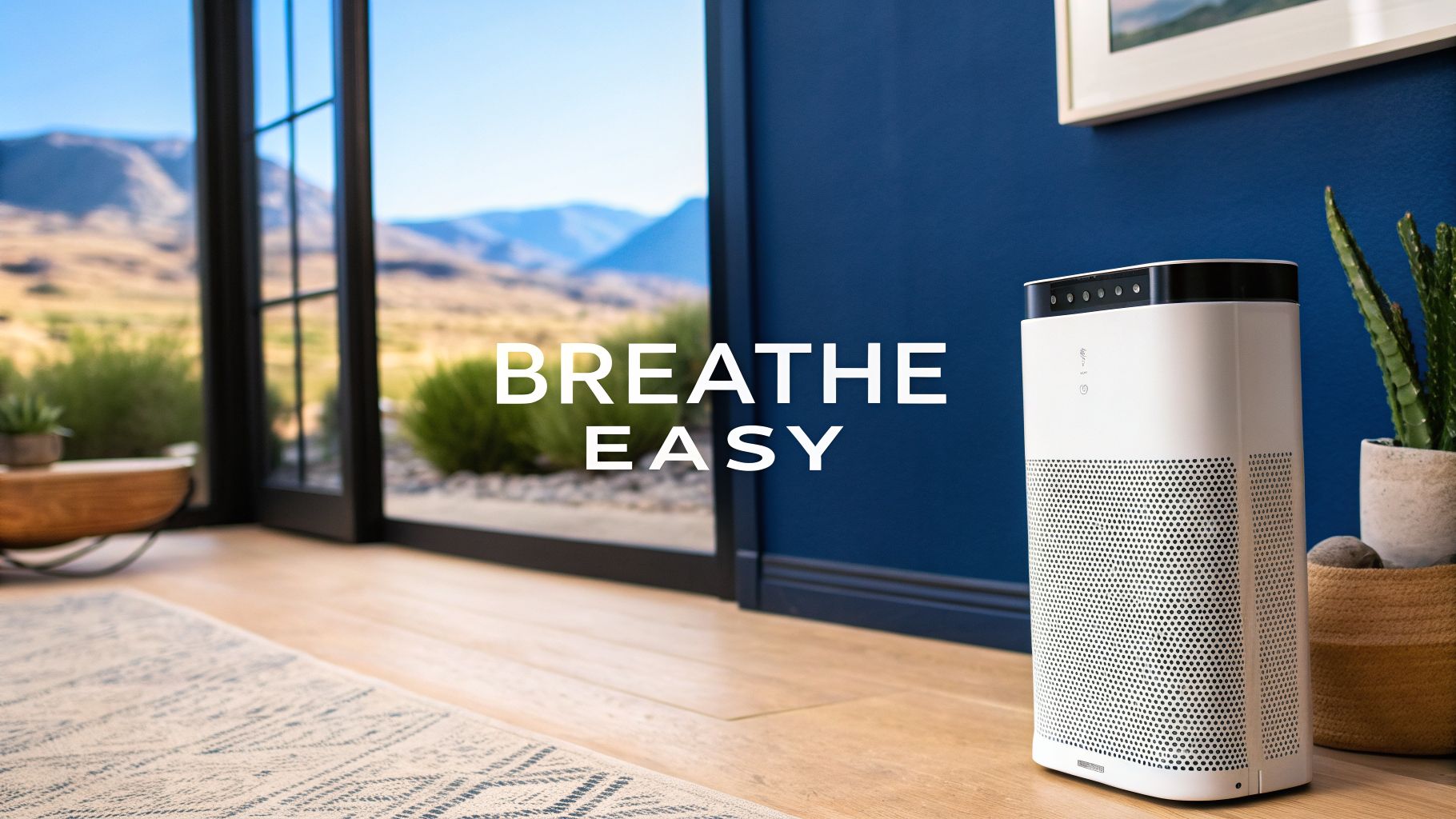
Feeling overwhelmed by all the choices when you ask yourself how to choose an air purifier? You know what? You're not alone. The secret isn't just grabbing the most popular model off the shelf; it's about understanding your home's unique needs first and then matching them with the right technology, like a true HEPA filter.
Think of it less like buying an appliance and more like making a real investment in your family's health. It’s a process: assess your environment, do some simple math to get the right size, and then zero in on the features that will actually make a difference for you.
Why the Right Air Purifier Is a Game-Changer in Arizona
Living in the Phoenix Valley means our air is a unique cocktail of particles that a generic, off-the-shelf purifier just can’t keep up with. I'm not just talking about the obvious dust you see after a big haboob, either.
It’s the invisible stuff that really gets you. The fine desert dust that’s always there, the seasonal pollen from plants like palo verde and mesquite, and even smoke particles drifting in from distant wildfires. All of that gets trapped and circulates inside our homes.
Ever wonder why you're constantly waking up with a stuffy nose or find your allergies are worse indoors? Your home’s air is almost certainly the culprit. Since 2011, we at Comfort Experts have seen it firsthand: the right air purification system can be a night-and-day difference for homeowners across Mesa and Phoenix. It’s not just about comfort—it's about your family's long-term health.

The Growing Need for Clean Indoor Air
This focus on clean indoor air isn't just a local thing; it's happening everywhere. The worldwide air purifier market is on track to jump from around USD 15.28 billion in 2024 to a massive USD 29.09 billion by 2032.
That huge growth is driven by the fact that modern, energy-efficient homes can trap pollutants inside—a problem that gets amplified here in the Valley.
A high-quality air purifier delivers real, tangible benefits you can feel:
- Allergy Relief: It grabs common triggers like pollen, pet dander, and dust mites right out of the air.
- Less Dust: A properly sized system drastically cuts down on how much dust settles on your furniture, which is also a sign of healthier ductwork. (We talk more about the connection in our article on professional duct cleaning.)
- A Healthier Home: It removes the microscopic particles that can get deep into your lungs and impact your respiratory health.
As local HVAC pros, we’re convinced that picking the right purifier is one of the most powerful things a Phoenix-area homeowner can do for their family. It turns your home from a trap for outside air into a genuine sanctuary.
For more in-depth advice tailored to our local environment, check out this great guide on how to choose an air purifier for Arizona homes.
Pinpointing Your Home's Air Quality Hotspots
Before you can even start comparing models, you have to know what you’re up against. Honestly, choosing an air purifier without first figuring out your home’s specific air quality issues is like trying to fix a car without looking under the hood. It all comes down to what’s really bothering you and your family day-to-day.
This self-assessment is the single most important part of picking an air purifier that will actually make a difference. Start by paying attention to the little things. Is there a stubborn musty smell in the basement? Do you find yourself sneezing more in the bedroom than anywhere else? These clues point directly to your home’s air quality hotspots and the culprits behind them.
For most of us here in Arizona, the list of potential troublemakers is long. It's a mix of outdoor irritants that sneak inside and indoor pollutants we create without even thinking about it.
Common Arizona Air Quality Culprits
Here are some of the most common problems we see in homes across the Phoenix and Mesa areas. See which of these sound familiar:
- Pollen and Seasonal Allergens: Come spring, palo verde, olive, and mulberry trees unleash a tidal wave of pollen. If your allergies only act up during certain times of the year, this is a prime suspect.
- Persistent Dust: Our desert environment means fine dust is a constant battle. If you’re dusting surfaces only for them to be covered again in a day or two, your air is saturated with these particles.
- Pet Dander and Odors: We love our pets, but their dander (microscopic skin flakes) is a major allergen for a lot of people. Lingering pet smells are another clear sign of airborne particles that need tackling.
- Cooking Fumes and VOCs: Simply frying on the stovetop or using common household cleaners can release smoke, grease, and volatile organic compounds (VOCs) into your air.
The goal isn't just to buy a device; it's to create a targeted strategy. By understanding your primary enemies—whether it's dust, dander, or pollen—you can select a purification system designed to defeat them effectively.
Beyond these usual suspects, it’s also smart to check for moisture issues, which can lead to mold and mildew. When identifying your home's problem areas, don't forget to look at places prone to issues like black mold on window sills, which can seriously degrade your indoor air.
Likewise, the fine PM2.5 particles from wildfire smoke, even from fires hundreds of miles away, often sour our local air quality. If your regular HVAC filter can't trap these tiny threats, they're just circulating through your home again and again. To get a better handle on your current setup, you might find our guide on locating the air filter in your house helpful. Knowing what you're dealing with is the first step to making a smart choice.
Decoding Air Purifier Metrics Like a Pro
Now that you know what airborne troublemakers you’re up against, it’s time to talk numbers. Let me explain: the technical specs on an air purifier box can look intimidating, but they’re actually your best tool for figuring out if a unit is a powerhouse or just a pricey fan.
The most important metric to wrap your head around is the Clean Air Delivery Rate (CADR).
Think of CADR as a simple performance score. Developed by the Association of Home Appliance Manufacturers (AHAM), it tells you exactly how quickly and effectively a purifier can clean a room of three common types of pollutants.
Understanding the Three CADR Numbers
You’ll almost always see three separate CADR numbers listed for a purifier. Each one corresponds to a different airborne particle size, giving you a much clearer picture of what the unit is actually good at filtering.
This infographic gives you a nice visual of these common culprits.

The three numbers show how well the purifier removes smoke, dust, and pollen, which conveniently cover a range from very small to much larger particles.
- Smoke: This number represents the smallest, most difficult-to-capture particles, like those from tobacco, cooking fumes, or the wildfire smoke we get here in Arizona. A high smoke CADR is critical if you're trying to eliminate odors and fine particulate matter.
- Dust: This covers mid-sized particles, including that fine layer of dust that settles on everything, plus dust mite debris and some mold spores.
- Pollen: This reflects the unit's ability to grab larger particles like tree and grass pollen. If seasonal allergies are your biggest battle, pay very close attention to this number. Our guide on the best air purifiers for allergies dives much deeper into this specific topic.
Matching CADR to Your Room Size
The goal here isn't just to buy the purifier with the highest numbers. It's about matching the CADR to your room's actual square footage.
A good rule of thumb is the "2/3 rule": an air purifier's smoke CADR should be at least two-thirds of the room's area in square feet. So, for a 150-square-foot bedroom, you’d want a purifier with a minimum smoke CADR of 100.
But here’s the thing: for a truly noticeable improvement, especially for allergy sufferers or in our dusty Phoenix homes, you should aim for a system that provides four to five air changes per hour (ACH). This means the entire volume of air in your room gets scrubbed clean every 12 to 15 minutes.
Using an undersized purifier is one of the most common mistakes we see people make. It ends up running on high all the time, struggling to keep up, which just wastes electricity without ever truly cleaning the air.
To make it simple, we put together this table to help you find the right power level for your space. It's based on that more aggressive goal of 4-5 air changes per hour, which is what we recommend for the best results.
Recommended CADR Rating by Room Size
| Room Size (Square Feet) | Common Room Type | Minimum Recommended CADR |
|---|---|---|
| Up to 150 sq. ft. | Small Bedroom, Office | 100 |
| 150 – 250 sq. ft. | Master Bedroom, Den | 170 |
| 250 – 350 sq. ft. | Living Room, Playroom | 230 |
| 350 – 500 sq. ft. | Great Room, Open Area | 330+ |
Use this as your cheat sheet. Find your room size, and you've got a great starting point for the CADR you need. It takes the guesswork out of comparing models and ensures you get a unit that can actually do the job.
Understanding Your Filter Options
The engine of any air purifier is its filter. This is what does the real work of cleaning your air, and not all filtration methods are created equal. Choosing the right one is what separates a purifier that actually solves your problems from one that just makes noise.
Let’s break down the main types you'll run into when figuring out how to choose an air purifier.
The undisputed champ for grabbing tiny particles is the True HEPA filter. It's the gold standard for a reason: it’s certified to capture an incredible 99.97% of airborne particles all the way down to 0.3 microns. To put that in perspective, a human hair is about 50 microns thick. A HEPA filter traps the microscopic irritants you can’t even see—dust, pollen, pet dander, and mold spores.
But a HEPA filter is built for solid particles. It can't do a thing about gases, smells, or chemicals. That’s where the second key player comes in.
The Role of Activated Carbon
If you're dealing with pet odors, lingering cooking smells, or those fumes from cleaning supplies—known as volatile organic compounds (VOCs)—you absolutely need an Activated Carbon filter.
This type of filter works through a process called adsorption. The carbon is specially treated to be extremely porous, creating a massive surface area that traps gas and odor molecules. Think of it like a super-sponge, but for smells and chemical vapors.
For a truly effective system, you want a purifier that combines both a True HEPA filter for particles and an Activated Carbon filter for gases and odors. You can dig deeper into how different filter types compare in our guide on the best HVAC filters for allergies.
Industry data backs this up. The air purifier market is projected to hit USD 36.26 billion by 2035, with proven tech like HEPA filters holding a commanding 72.8% market share. As more homeowners prioritize whole-home HVAC solutions over single-room portables, this matters for us here in Phoenix. A central system that filters 100% of your home's air can slash contaminants by 80-90% with every pass. You can see the full market analysis from Precedence Research to understand the trends.
Advanced Technologies and What to Avoid
Beyond HEPA and carbon, you’ll see other technologies like UV light and ionizers. While they sound high-tech, it’s important to know their specific roles and potential downsides.
- UV-C Light: This is designed to neutralize germs, viruses, and bacteria by using ultraviolet light to destroy their DNA. The catch? For it to be effective, microorganisms need enough direct exposure time, which can be tough in a fast-moving airstream.
- Photocatalytic Oxidation (PCO): PCO systems pair a UV light with a catalyst (usually titanium dioxide) to create a reaction that breaks down pollutants. Like UV-C, it’s targeted at germs and VOCs, but its real-world effectiveness can vary.
Then there are ionizers. While some are safe, many produce a harmful byproduct you need to be very wary of.
A Word of Caution on Ozone: Some air purifiers, particularly certain ionizers and "ozone generators," release ozone as part of their cleaning process. Ozone is a known lung irritant that can worsen asthma and other respiratory problems. We strongly advise homeowners to avoid any purifier that intentionally produces ozone.
Ultimately, the most effective and safest approach for most homes is a multi-stage system built around a True HEPA and an Activated Carbon filter. These are proven, reliable technologies that provide a powerful defense against the widest range of common indoor air pollutants without introducing any new risks into your home.
Portable Units vs. Whole-Home Air Purification
Once you’ve nailed down the right filter technology for your needs, you’ll hit the next big fork in the road: do you go with a portable purifier or a whole-home system? This decision really boils down to how you want to approach the problem—tackling it room by room, or cleaning the air across your entire house in one fell swoop.
In many cases, a portable air purifier is an excellent, practical solution. They offer a ton of flexibility and are a fantastic entry point for anyone looking to improve their air quality without a major upfront investment.

When Portable Purifiers Make Sense
A standalone unit can be the perfect fit if you find yourself in one of these situations:
- You're Renting: If you don't own your home, making permanent changes to the HVAC system is usually off the table. A portable unit gives you immediate control over your air quality without altering the property.
- You're on a Tighter Budget: Portable purifiers are significantly more affordable upfront than integrated systems, putting cleaner air within reach for almost everyone.
- You're Targeting a Specific Area: Maybe your primary concern is the bedroom to help with sleep, or the home office where you spend eight hours a day. Placing a single, powerful unit in that one room is a highly effective and targeted strategy.
While portable units are great for zoned coverage, the bigger picture shows a clear trend. The global air purifier market is projected to jump from USD 18.09 billion in 2025 to USD 30.08 billion by 2033, a surge driven by growing awareness of airborne pollutants. And with residential use making up 60% of that market, it's clear homeowners are taking this seriously.
The Power of Whole-Home Purification
Now, if you're a homeowner looking for the most complete, set-it-and-forget-it solution, a whole-home system is in a league of its own.
Unlike a portable unit that only cleans the air in one room, a whole-home purifier integrates directly into your existing HVAC system. This means it cleans every single cubic foot of air your furnace or air conditioner circulates.
From our experience installing systems like the Trane CleanEffects™ Air Cleaner, a whole-home solution essentially turns your HVAC system into a powerful, house-wide air purification machine. It creates a fortress of clean air, actively removing pollutants before they even reach your living spaces.
Here in Arizona, that’s an incredibly powerful advantage. Our AC systems run almost constantly for a huge chunk of the year. A whole-home system leverages this constant circulation, making it the most efficient and effective way to maintain pristine air quality throughout every room. It just works silently in the background, capturing dust, pollen, and other irritants at the source.
For homeowners who are serious about their air quality, our guide to whole-home air purifiers is a great next step. By combining a professional-grade system with services like Aeroseal duct sealing, you can ensure that the clean air your system produces is delivered exactly where it needs to go—not lost through leaky ducts.
Turning Your Research into Cleaner Air
You’ve done the homework. By now, you know how to assess your home’s unique air quality challenges—from desert dust and pet dander to wildfire smoke—and how to make sense of things like CADR ratings and filter types. You're no longer guessing about the difference between a simple portable unit and a powerful whole-home system.
That's a huge step. But turning that knowledge into genuinely cleaner air for your family requires one more move: action. It’s time to make sure the system you choose is a perfect match for your home's layout, your existing HVAC setup, and your family's health.
From Information to Installation
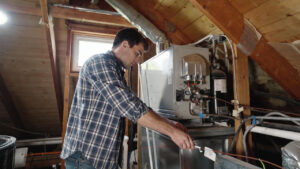
This is where the guesswork stops and real-world results begin. While plugging in a portable purifier is simple enough for a single room, integrating a whole-home system is a job that needs an expert eye. A professional consultation bridges that critical gap between what you've learned and what your home actually needs.
An experienced technician can spot issues that are almost impossible to see on your own. Things like:
- The current state of your ductwork and whether it’s secretly contributing to poor air quality.
- Your HVAC system's capacity and how it will work alongside a whole-home purifier without strain.
- The unique airflow patterns in your house that can create "hotspots" for dust and allergens.
A pro doesn't just look at one room; they see your entire home as an interconnected system. This ensures the solution you invest in delivers the clean, healthy air you expect everywhere, not just in the living room. It’s the difference between buying an appliance and making a permanent upgrade to your family’s well-being.
A licensed HVAC expert doesn't just sell you a box; they give you a clear, actionable plan. By factoring in your specific health concerns, your home's age, and the unique challenges of our desert environment, they can pinpoint the system that will give you the most bang for your buck.
Your Path to a Healthier Home Starts Here
You’ve come this far—don't let the final step become a hurdle. You've done the research and you know what's at stake. Now, let a professional make sure your investment is a smart one. At Comfort Experts, our licensed technicians (ROC #275914) specialize in creating custom indoor air quality solutions for homes all across the Phoenix Valley.
We listen to your family's specific concerns, whether it's fighting seasonal allergies, getting pet dander under control, or just wanting to breathe easier day-to-day. We give you straightforward, honest recommendations that fit your home and your budget, so there’s no more uncertainty. Stop guessing and start breathing cleaner air.
Ready for a definitive plan to improve your home's air quality? The team at Comfort Experts is here to help you take that final step. Give us a call at 480-207-1239 or schedule service online today for a professional consultation.