
That nagging cough you can’t kick. The headaches that seem to vanish the moment you walk out the door. If you’ve ever wondered, is my house making me sick, you’re not alone; many homeowners struggle with unexplained symptoms that seem to originate within their own walls. We’re here to help you connect the dots between those mystery symptoms and what might be going on inside your home.
The Reality of Sick Building Syndrome at Home
It sounds strange, but the air inside your home can be far more polluted than the air outside. The EPA has found that indoor pollutant levels can be 2 to 5 times higher than outdoor levels—and in some cases, they’re a shocking 100 times worse. Considering most of us spend about 90% of our time indoors, your biggest exposure to pollution is probably happening right where you live. You can learn more about these risks directly from the American Lung Association website.
The idea of a "sick building" isn't just for big office towers. It happens in homes all the time when contaminants get trapped, tanking the air quality and leading to health issues known as Sick Building Syndrome.
Figuring out what you're breathing every day is the first real step toward making your home a healthier place. Let me explain. Your house is a sealed environment, and without proper ventilation and filtration, allergens, chemicals, and germs build up over time. If you're ready to dig deeper, our guide on indoor air quality solutions is a great place to start.
Figuring Out the Clues Your Body Is Giving You
Your body is pretty smart. It’s always sending signals about the world around it. Have you noticed you feel run-down at home but the symptoms seem to disappear when you’re out and about? That’s not a coincidence—it's a massive clue that something inside your house is the real problem.
Think of yourself as a detective. A nagging cough that only shows up on the couch, headaches that hit you in the afternoon at home, or constant fatigue are your first pieces of evidence. That stuffy nose you can’t seem to shake? It could easily be your body reacting to dust mites getting blasted through the vents every time the AC kicks on.
This simple diagram shows the connection we see all the time: a person feeling sick, the "sick" house they live in, and the usual suspects causing the trouble.
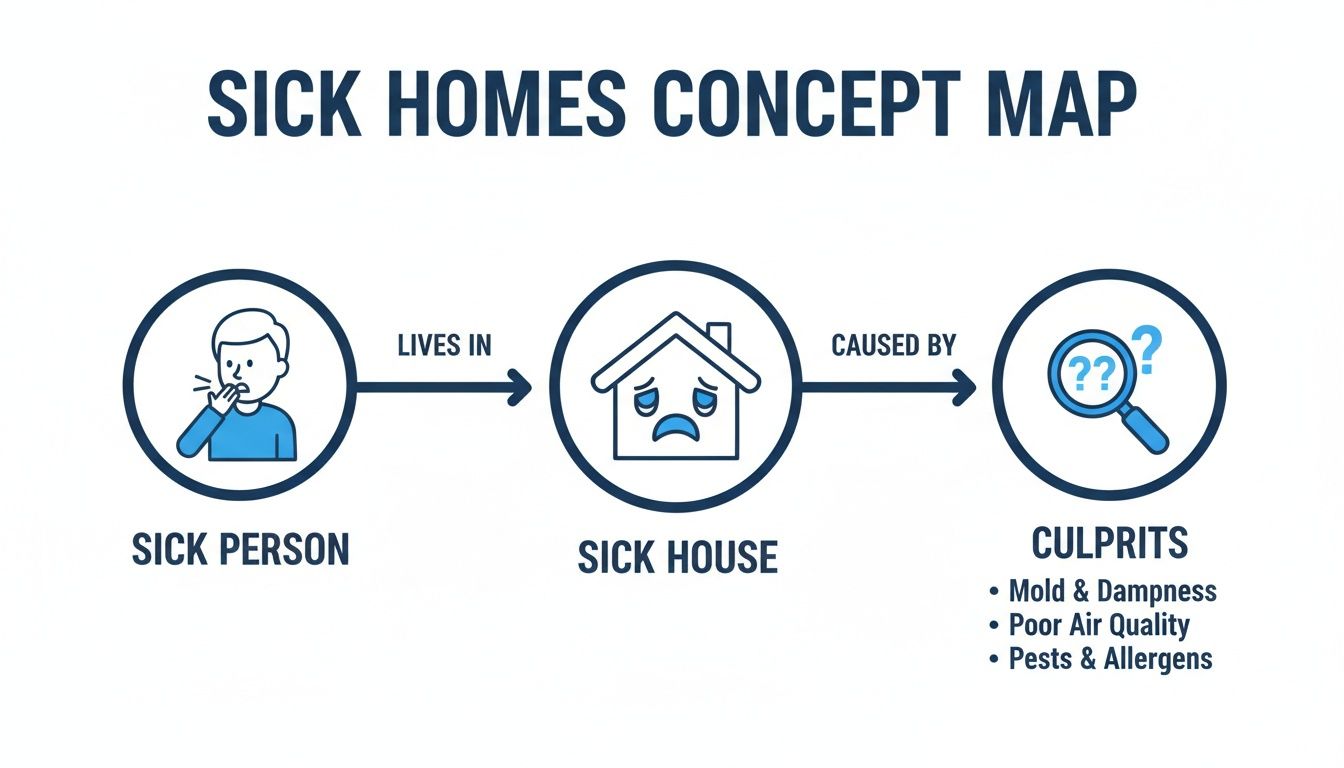
When you feel off, the trail often leads right back home. Once you start looking closer at the environment, you can start to pinpoint the specific issues making you feel unwell. Let’s break down the most common physical clues your body might be giving you.
Respiratory and Allergic Reactions
Your lungs and sinuses are usually the first to raise the alarm about airborne junk. If it feels like you're stuck in a never-ending allergy season or fighting off a cold that just won't quit, your home’s air is the prime suspect.
These symptoms often feel worse indoors simply because that’s where the pollutants are trapped and concentrated. A house with poor ventilation and a dirty HVAC system just keeps recycling the same allergens over and over, forcing you to breathe them in.
Here's the key giveaway: If your symptoms consistently get better after you’ve been out of the house for a few hours or a whole day, that’s a huge red flag pointing to a problem inside your home.
Common signs that your respiratory system is unhappy with your indoor air include:
- Persistent Coughing or Wheezing: This is a classic reaction to things like mold spores, pet dander, or fine dust circulating in the air.
- Chronic Stuffy Nose or Sneezing: Often a dead giveaway of an allergic reaction to airborne particles trapped inside.
- Shortness of Breath: This can be triggered by a wide range of indoor pollutants, especially if you have asthma or other sensitivities.
- Itchy, Watery Eyes: A common response to allergens like pollen that get tracked inside and then endlessly circulated by your air system.
A lot of these pollutants get snagged by your HVAC filter. If you're not even sure where to look for it, our guide on how to locate the air filter in your house is a great place to start.
Neurological and Skin Symptoms
The effects of a "sick" house aren't just limited to your breathing. Invisible culprits can mess with your head and your skin, too.
Volatile Organic Compounds (VOCs) are a big one. These are gases that off-gas from everyday stuff like fresh paint, new carpets, cleaning products, and even those plug-in air fresheners. They’re well-known for causing headaches and that frustrating "brain fog" feeling. Your skin, being your body's largest organ, can also react to chemicals and allergens, either from the air or from direct contact with things like laundry detergent residue on your clothes and bedding.
To help connect the dots between how you're feeling and what might be going on at home, we put together this checklist. Use it to guide your investigation.
Symptom and Potential Household Source Checklist
Use this table to connect your symptoms to possible culprits within your home. It's a first step in guiding your investigation.
| Symptom Category | Common Symptoms | Potential Household Cause |
|---|---|---|
| Neurological | Frequent Headaches or Migraines Brain Fog or Difficulty Concentrating Unexplained Fatigue or Lethargy |
VOCs from paint, carpet, or cleaners Poor ventilation trapping carbon dioxide Mycotoxins from certain mold species |
| Dermatological (Skin) | Unexplained Rashes or Hives Dry, Itchy Skin or Eczema Flare-ups Irritation where clothes fit tightly |
Chemical residues from laundry detergents Allergens like dust mites in bedding Low humidity from dry indoor air |
| General | Symptoms improve when away from home Musty or chemical odors in certain rooms Multiple family members have similar symptoms |
A combination of any of the above causes |
Try keeping a simple symptom journal for a week or two. Just jot down what you’re feeling, when it happens, and where you are in the house. This simple step can reveal powerful patterns, helping you zero in on problem areas and gather the evidence you need to finally fix the issue.
Unmasking the Hidden Culprits in Your Home
If you’ve been feeling off and can’t pin it on anything else, it might be time to look at your house itself. The things that make a home "sick" are almost always invisible, working behind the scenes and contributing to everything from a nagging cough to constant fatigue. Let's peel back the layers and look at the most common troublemakers we find lurking inside Arizona homes.
Mold and Mildew: The Uninvited Guests
Even here in sunny Arizona, mold is a surprisingly common problem. All it takes is a bit of moisture to get going—think of a tiny, slow leak under a bathroom sink, condensation dripping inside your AC, or a steamy bathroom with poor ventilation. Once it finds a foothold, it starts pumping microscopic spores into the air.
These spores are serious allergens and irritants. Breathing them in can set off a whole range of respiratory issues, from allergy-like symptoms and asthma attacks to more severe reactions in people who are particularly sensitive.
If you suspect a problem, getting a definitive answer is key. You might need professional mold inspections to know for sure, especially for hidden growth.
A musty, earthy smell is the classic signature of mold. If you smell it but can't see it, the problem is likely hiding behind drywall, under flooring, or deep inside your HVAC system.
A Compromised HVAC System
Think of your HVAC system as your home’s lungs. The ductwork is like a branching network of airways, delivering air to every single room. So, what happens when that system is clogged with years of dust, pet dander, pollen, and other debris?
Every time the AC or heater kicks on, it blasts those contaminants throughout your home, forcing you to breathe them in again and again. A dirty system doesn't just move air; it actively pollutes it. If it’s been years since your ducts were looked at, a professional cleaning can make a world of difference. You can learn more about what that involves in our guide to duct cleaning in Mesa, AZ.
Volatile Organic Compounds: The Chemical Cocktail
You know that 'new car' or 'fresh paint' smell? It’s often a sign of something unhealthy. Those smells come from Volatile Organic Compounds (VOCs), which are chemicals that easily turn into gas at room temperature and get released right into the air you breathe.
They’re everywhere. VOCs off-gas from a surprising number of everyday household items, making them a major source of indoor air pollution. Honestly, the list is longer than you’d think.
Common sources of VOCs include:
- Paints and Finishes: Even so-called "low-VOC" paints release some chemicals as they cure.
- New Furniture and Carpeting: The adhesives and treatments used in manufacturing can off-gas for months.
- Cleaning Products and Air Fresheners: Aerosol sprays and scented plug-ins are often loaded with VOCs.
- Building Materials: Plywood, particleboard, and certain types of insulation can be hidden sources.
Constant exposure to this chemical soup is a common reason your house could be making you sick, leading to headaches, dizziness, nausea, and irritation of the eyes, nose, and throat.
Pests and Their Hidden Byproducts
When you think about pests, you probably picture a stray cockroach or mouse. But the real health threat often comes from the invisible mess they leave behind.
Waste, saliva, and shed body parts from dust mites, cockroaches, and rodents are incredibly powerful allergens. These particles are microscopic, becoming airborne easily and mixing with household dust. For a lot of people, these unseen allergens are a primary trigger for year-round sniffles and asthma flare-ups.
Imbalanced Humidity: Too Much or Too Little
Humidity plays a delicate balancing act in your home's health. The sweet spot for indoor humidity is generally between 30% and 50%. When it strays outside this range, problems pop up.
- High Humidity (Above 50%): Air that’s too damp creates the perfect breeding ground for mold and mildew. It also helps dust mite populations explode, making allergy issues worse. You'll feel it, too—your home will seem stuffy, sticky, and just uncomfortable.
- Low Humidity (Below 30%): Overly dry air, a constant battle in our desert climate, is just as bad. It dries out your skin, throat, and nasal passages, leaving you more vulnerable to colds, sinus infections, and sore throats. It can also aggravate conditions like asthma and eczema.
This isn’t just about comfort. The consequences of poor indoor air quality are serious. Globally, household air pollution was responsible for an estimated 2.9 million deaths in 2021, with kids being especially vulnerable. This underscores why investing in professional HVAC maintenance, high-efficiency air filtration, and proper ventilation isn’t just a luxury—it's a critical part of protecting your family's health.
Your Action Plan for a Home Health Inspection
So, you’ve got a hunch your house might be the real culprit behind those nagging sniffles, headaches, or fatigue. Where do you even start? The good news is you don’t need a lab coat or a ton of fancy gear to start connecting the dots.
Think of this as a fact-finding mission. It’s all about trusting your own senses. If something looks, smells, or just feels off, you’re probably onto something. We'll walk through the common trouble spots, room by room. Just grab a notepad or your phone to jot down what you find.
Kitchen and Bathroom Hotspots
Kitchens and bathrooms are basically moisture magnets. Because of all the water, they’re ground zero for mold and mildew, so they deserve a very close look—especially in the spots you don’t see every day.
Start by checking under every single sink. Get a flashlight and hunt for any signs of water leaks, past or present. You're looking for:
- Dark, discolored stains on the cabinet floor or the wall behind the pipes.
- Wood that feels soft, warped, or spongy when you press on it.
- A musty, earthy smell that hits you the moment you open the cabinet door.
Next, get up close with the grout and caulk lines around your sinks, showers, and tubs. Any black, green, or even pinkish spots are a telltale sign of mildew or mold trying to move in. While you're in the bathroom, flick on the exhaust fan. Does it sound like it's actually moving air, or is it just making a weak, rattling noise? A wimpy fan won't pull damp air out, giving mold a perfect place to grow.
Bedrooms and Living Areas
In the spaces where you relax and sleep, the clues are usually tied to dust, allergens, and airborne moisture. Since you spend most of your time here, the quality of the air is a huge deal.
Take a good look at your window sills and the corners of the glass panes. See any condensation, little water droplets, or small puddles? That’s a classic indicator of excess humidity, which creates a five-star resort for mold and dust mites.
Also, make a note of where dust settles. Pay close attention to electronics (they’re dust magnets) and the areas right around your air vents. If you’re seeing thick, gray blankets of dust show up just a few days after cleaning, it's a sign that your air is carrying a heavy load of particles.
Remember, this isn't about finding a final diagnosis on the spot. It's about gathering clues. Every water stain, musty corner, or dusty surface is another piece of the puzzle.
Your HVAC System The Home's Lungs
Your heating and cooling system is arguably the most critical place to look, since it’s responsible for circulating every breath of air in your home. If there’s a problem here, it affects everywhere.
First things first: check the air filter. Pull it out and give it an honest assessment. Is it still mostly white or light gray, or is it choked with a thick, dark mat of grime? A clogged filter can’t do its job, forcing your system to work harder while letting pollutants sail right on by.
Next, look up at your air vents—both the ones blowing air out and the larger ones pulling air in. Are the grilles caked in dust? Do you see dark smudging or "sooting" on the ceiling around the edges? This is a strong hint that your ductwork could be dirty, blowing contaminants directly into your rooms. A healthy HVAC is non-negotiable for a healthy home, and our HVAC preventive maintenance checklist can help you keep it that way.
Creating a Healthier Home with Long-Term Fixes
Okay, so you've pinpointed a few problem areas and you’re tired of wondering if your house is making you sick. That’s a huge first step. But putting a band-aid on the issue—like opening a window or running a small room purifier—only gets you so far.
To really solve the problem for good, you need to go after the source. These are the kinds of permanent fixes that do more than just mask symptoms; they make a real, lasting difference for your family's health.
Professional Duct Cleaning and Sealing
Think of your home’s ductwork as its lungs. Over the years, those air passages collect everything floating in your air: dust, pet dander, allergens, and who-knows-what-else. If the ducts are dirty, the air you breathe will be too.
Professional duct cleaning isn't just a quick vacuum job. We use powerful, specialized equipment to scrub the gunk out from deep inside your system. But cleaning is only half the battle. So many homes, especially older ones, have leaky ducts. These tiny gaps and cracks suck in dusty, unfiltered air from your attic or crawlspace, mixing it right back into your "clean" air supply. Duct sealing plugs those leaks, making sure the only air circulating is the air you’re paying to cool and clean.
Upgrading Your Home’s Air Purification
That standard 1-inch filter you slide into your HVAC unit is a good start, but it’s designed to protect your equipment, not your lungs. It simply can’t trap the microscopic particles, germs, or chemical vapors that cause the most irritation.
For truly clean air, you need a whole-home purification system. Here’s a quick breakdown of the technologies we install and what they’re best at targeting.
| Purification Technology | How It Works | Best For Targeting |
|---|---|---|
| High-MERV/HEPA Filters | These are super-dense, pleated filters that physically trap a very high percentage of airborne particles as they flow through your system. | Dust, pollen, pet dander, mold spores, and other larger allergens. |
| UV Light Purifiers | A powerful UV-C lamp installed inside your ductwork zaps organic pollutants, sterilizing the damp surfaces of your indoor coil. | Mold, bacteria, and viruses that love to grow in the dark, damp parts of your HVAC system. |
| Air Scrubbers | These advanced systems use a process called photocatalytic oxidation to actively hunt down and destroy contaminants. They send out charged molecules that neutralize pollutants in the air and on surfaces. | Viruses, VOCs, smoke, odors, and bacteria throughout your entire house, not just in the ducts. |
Every home is different, and sometimes the best solution is a combination—like a high-MERV filter to catch particles and a UV light to kill germs. You can see how we put these systems together in our guide to whole-home air purifiers.
Controlling Home Humidity
Humidity in Arizona is a tricky balance. Most of the year, the air is bone-dry, leading to scratchy throats and dry skin. Then monsoon season hits, and suddenly you’ve got pockets of high humidity perfect for mold growth.
A whole-home humidifier or dehumidifier solves this by integrating directly with your HVAC system. It automatically keeps your home’s moisture level in the sweet spot—between 30-50%. This not only stops mold in its tracks but also protects your sinuses and even your wood furniture.
The Importance of Strategic HVAC Maintenance
Your HVAC system is the heart of your home's air circulation. If it's not healthy, your air won't be either. Professional tune-ups are about more than just efficiency; they’re a critical health checkup.
During a maintenance visit, our technicians deep-clean the components where mold and bacteria thrive, like the indoor coils and blower motor. This proactive cleaning stops contamination before it starts, ensuring your system moves clean air all year long. It’s a simple investment with a huge payoff for your health. While you're at it, it's smart to think about other risks, like preventing foodborne illness at home, to create a comprehensively safe environment.
The good news is that indoor air pollution has become a major focus globally. Deaths from household air pollution fell by 26 percent between 2010 and 2020. Even more telling, death rates in high-income countries like ours dropped below 0.1 deaths per 100,000 people. For us here in the Phoenix Valley, these numbers show that modern HVAC systems and air quality upgrades truly work. You can read the full report on these global air pollution trends to see the data for yourself.
When to Call for a Professional Home Health Check
Let’s be honest—some home health issues are simply too big or too hidden for a DIY fix. Knowing when to put down the cleaning supplies and pick up the phone is a critical part of protecting your home and your family, especially if that nagging question, is my house making me sick?, just won’t go away.
If you’ve tried the simple fixes and your symptoms keep coming back, it’s time to call in a pro.
There are a few clear red flags that tell you the problem has moved beyond a weekend project:
- That persistent musty, earthy smell. If you can’t seem to get rid of it, it almost always points to hidden moisture or mold that you can’t see.
- Visible mold growth bigger than a couple of square feet. Trying to clean a large patch on your own can be risky, potentially sending a huge cloud of spores right into your air.
- Any time after a water damage event. After a flood, a burst pipe, or even a serious roof leak, getting a professional assessment is crucial to stop mold before it ever gets a foothold.
- Symptoms that vanish after you clean, only to return immediately. If your relief only lasts a day or two, it’s a sure sign the source of the problem is still there.
When your own detective work hits a wall but your symptoms don’t, it’s no longer a DIY issue. It's time to bring in a professional who has the specialized tools and experience to give you definitive answers.
Frequently Asked Questions About Home Health
Once you start connecting the dots between your home and your health, it's normal for a dozen new questions to pop up. We get it. We talk to homeowners every day who are trying to figure out if their house is the real reason they feel run-down. Let's tackle some of the most common questions we hear out in the field.
How Often Should I Have My Air Ducts Cleaned
There’s no single hard-and-fast rule, but a good rule of thumb is to have your air ducts professionally cleaned every 3 to 5 years. But that’s just a baseline. You should definitely think about doing it more often if you’re in one of these situations:
- You have pets: Dander, hair, and dust from furry family members build up fast inside your ductwork.
- Someone has allergies or asthma: Clean ducts mean fewer irritants like dust mites and pollen getting blown through your home, which can be a game-changer for respiratory issues.
- You just finished a renovation: No matter how careful you are, construction dust gets everywhere—especially inside your HVAC system.
Can a New Air Conditioner Really Improve My Health
Absolutely. It’s one of the most common questions we get, and the answer is a definite yes. A modern, high-efficiency AC does a lot more than just crank out cold air. It’s light-years ahead of older units at two things that are critical for your health: pulling moisture out of the air and filtering out the junk you breathe.
Upgrading your system can make a night-and-day difference in your home's air quality. By keeping humidity low, a new AC robs mold of the moisture it needs to grow. At the same time, its advanced filtration system traps way more dust, pollen, and other airborne gunk, giving you cleaner, healthier air to breathe.
What Is the Difference Between an Air Filter and an Air Purifier
This is a great question, and knowing the difference is key to getting the right solution for your home. Here's the thing: you can think about it is as defense vs. offense. A filter plays defense, while a purifier goes on the attack.
A standard HVAC air filter (the MERV-rated one you slide into your furnace) is a passive barrier. It physically traps bigger particles like dust, pollen, and pet dander as air flows through it. An air purifier, like a UV light system or an air scrubber, actively works to neutralize or destroy the microscopic stuff—like viruses, bacteria, and chemical vapors—that are small enough to slip right past a normal filter.
At Comfort Experts, we believe your home should be your safe haven, not a source of mystery illnesses. If you’re tired of wondering and want real answers about your home’s air quality, our team of seasoned professionals is ready to help you figure it out. Give us a call at 480-207-1239 or schedule service online to get the peace of mind you deserve.