When you're staring down another triple-digit Arizona forecast, the last thing you want to worry about is whether your air conditioner will survive the day. So, when is the best time to replace your air conditioner? Let me explain: it's less about a specific date and more about making a smart, strategic decision based on your AC's age, performance, and the current season.
Your Guide to Smart AC Replacement in Arizona
Here in the Phoenix Valley, your AC isn't just for comfort—it's the heart of your home. It’s what makes life bearable when the pavement is hot enough to cook on. But how do you know when that heart is getting tired and it's time for a transplant?
Making the call to replace your AC unit feels like a huge decision, but with the right information, it doesn't have to be a stressful one. As HVAC professionals with decades of experience serving Arizona homeowners, we at Comfort Experts believe in empowering you with knowledge. Our expertise comes from being in the field, day in and day out, helping families make this exact choice.
Why Proactive Replacement Matters
Honestly, waiting for your AC to completely die is the most expensive and miserable way to deal with it. An emergency replacement almost always means you're stuck with limited choices, paying a premium for urgent service, and sweating through a few miserably hot days while you wait for the install. Does that sound familiar?
Planning your replacement, on the other hand, puts you completely in control.
You get to research and choose the right system for your home's needs, not just whatever is available. You can schedule the installation during the HVAC off-season for better pricing and availability. It’s a strategic home investment, not a desperate fix for a broken appliance.
We wrote this guide to give you the expert playbook. We’ll show you how to spot the warning signs, understand the financial tipping point between a simple repair and a full replacement, and pinpoint the best months to get the job done right. This is the same advice we give our own families.
What You'll Learn
We're going to break down the essential factors every local homeowner needs to weigh before pulling the trigger. By the end, you'll have a clear understanding of:
- The Telltale Warning Signs: Learn to recognize the subtle (and not-so-subtle) clues your air conditioner is sending that it’s nearing the end of its road.
- The Financial Tipping Point: We’ll introduce you to the simple "50% Rule" that helps you decide if a costly repair is just throwing good money after bad. For a deeper dive on this, our article on how long AC units last is a great resource.
- Seasonal Strategy: You'll know the exact months to schedule your replacement to get the best deals and find the most availability from qualified installers.
A major investment like a new AC system should fit into your overall home care strategy. It’s a good idea to see how this fits with other projects by reviewing a solid annual home maintenance checklist built for Arizona homes.
With this roadmap, you’ll be ready to make a decision that keeps your home cool and comfortable for years to come.
Understanding the Age and Efficiency Equation
When you're trying to figure out the right time to replace your air conditioner, it really boils down to two numbers: your unit's age and its efficiency rating.
Think of your AC like a car. An old, inefficient one guzzles electricity the same way a classic sedan guzzles gas—it gets you where you’re going, but it costs a fortune and feels like it could break down at the worst possible moment. In Arizona, that "worst possible moment" is usually a July heatwave.
The Age Factor in Arizona
Age isn't just a number; it’s a direct measure of wear and tear. Experts might say the average lifespan of a central air conditioner is around 15 years, but that number doesn't account for the brutal workload they handle here in the Phoenix Valley. Our long experience has shown us this firsthand.
Our long, intense cooling seasons mean a 10-year-old Arizona AC has worked much harder than a 10-year-old unit in a milder climate. Leaning on a system that's over 10 years old is a gamble every summer. Each year past that mark, you’re increasing the odds of a catastrophic failure that leaves you scrambling.
You're not the only one thinking about this. A recent data analysis showed that a whopping 30% of homeowners are planning to replace their AC systems in the next five years. This trend is a mix of aging units, rising energy costs, and the appeal of new, far more efficient technology. You can discover more insights about AC replacement trends on ACdirect.com.
If your system is getting close to that 15-year mark, it’s not just getting old—it’s living on borrowed time.
Decoding Your AC's Efficiency Rating
The second crucial number is your unit's SEER rating, which stands for Seasonal Energy Efficiency Ratio. It’s basically your AC’s MPG—a higher number means it uses less energy to do its job.
An older unit from 15 years ago might have a SEER rating of 10 or 12. Today, new systems have to meet much stricter standards, with ratings of 17, 20, or even higher. This isn't just some technical detail; it translates directly into real money saved on your monthly SRP or APS bill.
The concept here is simple: diminishing returns. As an AC unit ages, its parts wear down. That means its real-world efficiency drops well below the original SEER rating on the sticker. It has to run longer and harder to produce the same amount of cool air, causing a slow but steady creep in your energy bills.
To really get a handle on what this rating means for your home’s performance, you should check out our guide on SEER ratings. Understanding this number is the first step to seeing how much a new system could save you.
The Real-World Savings of a High-Efficiency Upgrade
The difference in operating cost between an old, low-SEER unit and a new, high-efficiency one can be staggering. We’re not talking about a few bucks; we’re talking about hundreds of dollars in savings every year. Over the life of the new system, that adds up to thousands.
This isn’t just about dodging repair bills. It’s about a permanent reduction in your monthly household expenses.
To make this crystal clear, let’s look at what upgrading your AC could mean for a typical Phoenix home. This table shows the potential savings when you move from an old, clunky unit to a modern, high-efficiency model.
Energy Savings Snapshot: Upgrading Your AC's SEER Rating
| Old Unit SEER Rating | New Unit SEER Rating | Estimated Annual Savings |
|---|---|---|
| 10 SEER | 17 SEER2 | Up to $750 |
| 12 SEER | 17 SEER2 | Up to $550 |
| 12 SEER | 20 SEER2 | Up to $850 |
| 14 SEER | 20 SEER2 | Up to $600 |
Note: Savings are estimates and can vary based on your home’s size, insulation, and usage patterns. Our technicians can provide a more precise calculation based on your specific home.
As you can see, jumping from an outdated 10 or 12 SEER unit isn’t just an expense—it’s an investment that starts paying for itself immediately. You stop wasting money on an inefficient machine and start putting it right back in your pocket.
The Financial Choice: Repair or Replace?
Sooner or later, every Arizona homeowner gets the dreaded news: the AC is on the fritz, and it’s going to be an expensive fix. Making a clear-headed financial decision when your house is turning into an oven is tough. It’s easy to make a snap judgment you'll regret later.
That’s why we rely on a simple, powerful guideline we use in the field every day. It’s called the “50% Rule,” and it cuts right through the stress.
The 50% Rule is straightforward: If the cost to repair your air conditioner is 50% or more of the price of a new, comparable system, it’s almost always smarter to replace it.
Think of it this way: you wouldn't spend half the price of a new car to fix the engine on a 15-year-old clunker with 200,000 miles, would you? The same logic applies here. Sinking a huge chunk of cash into an aging, inefficient AC unit is just throwing good money after bad.
The Math Behind the Decision
Let’s put some real numbers on this. Picture this scenario: your 12-year-old air conditioner finally gives up during a July heatwave. We come out and find the compressor is shot. The quote to replace it is $3,000.
Meanwhile, a brand-new, high-efficiency system properly sized for your home would cost $7,000 to install. That $3,000 repair is almost half the cost of a completely new unit. That’s a massive red flag.
If you choose the repair, you've just spent a ton of money on a system that’s already past its prime. It still has old parts, it's out of warranty, and it’s an energy hog. There's a good chance another major part will fail next summer, and you’ll be right back where you started. For a deeper look at system expenses, check out our guide on the cost to replace an AC unit in Arizona.
This flowchart breaks down the key factors at a glance. It shows exactly why an older, less efficient unit is a clear candidate for replacement.
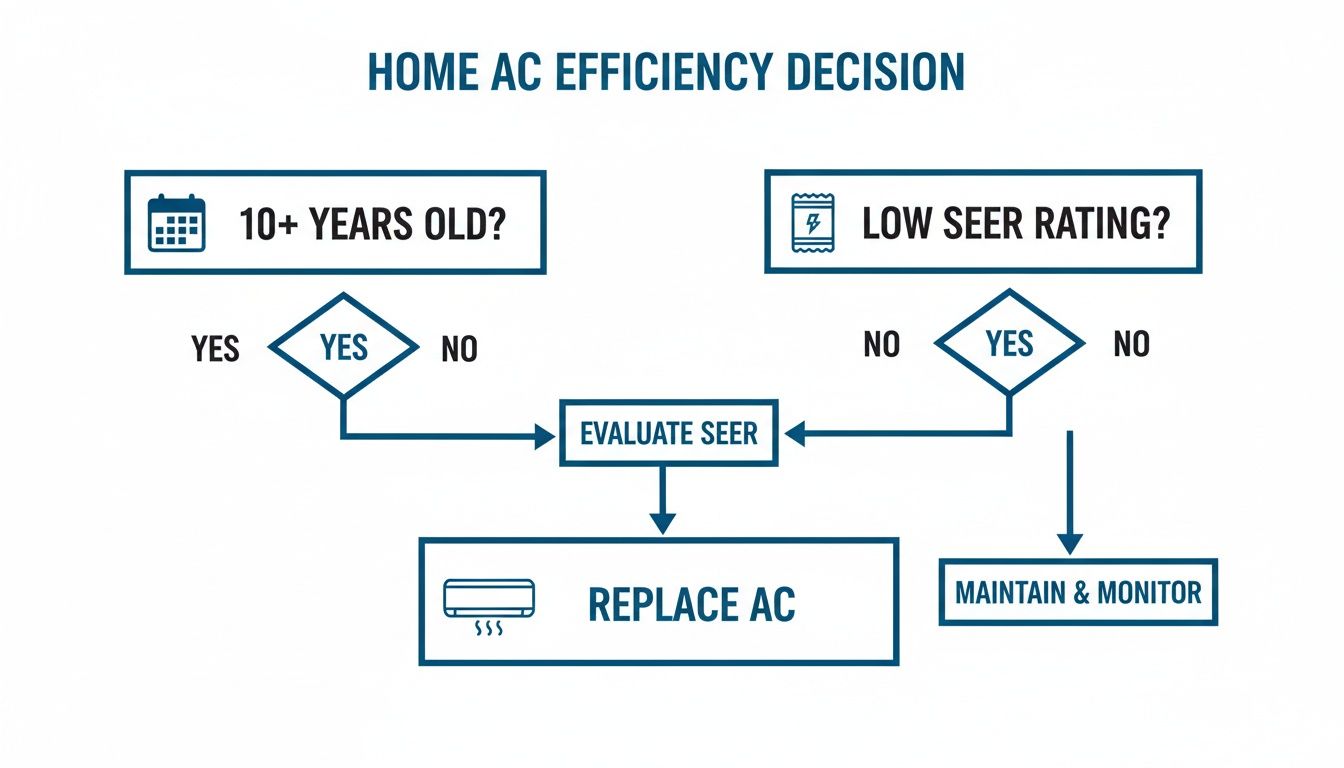
As you can see, once an AC crosses that 10-year mark or has a low SEER rating, the math almost always points toward replacement.
When Repair Frequency Becomes a Warning Sign
The 50% Rule is great for a single, big-ticket repair, but what about death by a thousand cuts? If you and your AC technician are becoming regulars, that’s your system waving a giant white flag. Patching it up every summer is a losing game.
We see this pattern all the time:
- Summer 1: A $450 repair for a failing fan motor.
- Summer 2: A $700 bill to track down and fix a refrigerant leak.
- Summer 3: Now you're looking at a $1,200 quote for a new control board.
Before this latest problem, you’d already sunk $1,150 into the unit. Add another $1,200, and you're at $2,350 spent on a system that’s living on borrowed time. That money could have been a solid down payment on a reliable, warrantied, and whisper-quiet new system that saves you money every month.
Constant repairs and declining performance are huge signals. Air conditioners in our climate have a tough life, typically lasting 10-15 years before they start to degrade under the relentless sun. After a decade, breakdowns are far more common, and old units can lose 20-30% of their original efficiency, which you’ll definitely feel on your summer power bills. To make an informed financial decision, it's essential to understand the true cost of replacing both a furnace and an air conditioner.
Seasonal Timing for Your AC Replacement in Arizona

In a place as hot as the Phoenix Valley, your air conditioner isn't just an appliance—it's the only thing standing between you and a 115-degree afternoon. So when it comes to replacing it, timing is everything. Picking the right time of year isn't about convenience; it's a strategic move that can save you a ton of money and even more stress.
The absolute worst time to buy a new AC is when you’re forced into it. Think mid-July, the unit is dead, and your house is quickly turning into an oven. You're hot, stressed, and at the complete mercy of a contractor’s schedule and peak-season pricing. A proactive approach is always better, and that means aiming for the "shoulder seasons."
The Sweet Spot: The Shoulder Seasons
The best time to replace your air conditioner is during the milder, off-peak months that bookend our brutal summers. Here in Arizona, that gives us two perfect windows:
- Spring (March – April): The weather is gorgeous, your AC isn't working overtime yet, and HVAC companies haven't hit their summer stride.
- Fall (October – November): The summer heat has finally broken, emergency calls plummet, and contractors are looking to fill their schedules before winter.
During these periods, the simple law of supply and demand works completely in your favor. With fewer homeowners in a panic, HVAC teams like ours have more flexibility in our schedules. That means we can get to you at a time that works for you, without the frantic rush of a summer heatwave.
Even better, manufacturers often roll out promotions and rebates during these slower months to keep sales moving. Planning your replacement for spring or fall gives you a better shot at the best equipment, better pricing, and a much calmer installation process.
Why Summer and Winter Are a Bad Idea
Trying to schedule an installation in the thick of summer (June-August) is just asking for trouble. You know what? It's organized chaos. Every good technician in the valley is racing from one emergency repair to the next. You’ll face longer wait times just to get a quote, and you’ll almost certainly pay a premium for urgent service.
Winter (December-January) has its own challenges. While it's not a cooling emergency, it's when technicians are swamped with furnace repairs and heating tune-ups. It's just not the focus.
Here’s the bottom line: A planned replacement in the shoulder season is a calm, controlled process where you hold all the cards. An emergency replacement in summer is a rushed, reactive decision made under duress, which almost always costs you more money and limits your options.
Planning ahead also gives you time to make other smart moves, like learning how to reduce your cooling costs in the Arizona summer before the new unit even goes in.
Quantifying the Savings of Smart Timing
The financial upside of timing your AC replacement isn't just a guess—it's real and measurable.
Spring and early fall are consistently the best times to buy, especially in a seasonal climate like ours. Professional contractors will tell you that the slower business during these off-peak months opens the door to manufacturer specials and better pricing that can shave 10-15% off the final bill.
On an average $7,000 AC replacement, that’s $700 to $1,050 back in your pocket.
That’s a world away from the financial hit you take during a mid-summer meltdown. When your AC dies on a scorching afternoon, you're not in a position to negotiate or comparison shop. You just want the cool air back on, and that kind of urgency always, always costs extra.
Warning Signs Your Air Conditioner Is Failing
Most air conditioners don’t just die out of the blue. They usually give you hints—distress signals that things are going downhill long before the system quits on a scorching Phoenix afternoon. Learning to spot these warning signs is the key to avoiding a frantic, middle-of-summer emergency and deciding on the best time to replace your air conditioner on your own schedule.
Ignoring these symptoms is a lot like ignoring the check engine light on your car. You might get away with it for a little while, but that small problem almost always turns into a much bigger, more expensive headache. Think of these red flags as your AC’s way of telling you it’s on its last legs.
Strange Noises Beyond the Usual Hum
Your AC unit should operate with a consistent, predictable hum. When new and alarming sounds start interrupting that background noise, it’s a clear sign something is mechanically wrong. Don't just turn up the TV to drown them out; these are important clues.
Listen for these specific sounds:
- Grinding: This often points to a serious issue with the compressor's motor or bearings. If you hear a grinding noise, it's best to shut the system down immediately to prevent a catastrophic failure.
- Squealing or Screeching: A loud, high-pitched squeal is often a cry for help from a failing fan motor bearing or a worn-out belt on the indoor blower.
- Banging or Clanking: This is a big one. It usually means a part has come loose inside the compressor, like a connecting rod or piston pin. This is a sign of a major internal problem that needs immediate attention.
Weak Airflow and Lukewarm Air
Does it feel like the air is just trickling out of your vents instead of flowing strongly? If you can barely feel the air moving even when the system is running at full blast, you’ve got a major problem. This could be caused by anything from a failing compressor to a blockage in your ductwork.
Even worse is when the air that is coming out is lukewarm. That means your AC isn't doing its one primary job: cooling the air. It’s a definite signal that the system is struggling to keep up with the desert heat.
A healthy air conditioner should provide strong, consistent, and cold airflow to every room in your house. When that performance starts to fade, the system is telling you it can't handle the workload anymore—especially during a brutal Arizona summer.
When you’re facing these issues, you’re stuck between a repair and a full replacement. Understanding what's involved in an AC repair service near you can help you weigh your options more clearly.
Indoor Humidity and Unexplained Dust
A properly working air conditioner does more than just cool your home; it’s also your primary defense against our muggy monsoon humidity. If you start noticing your home feels sticky or damp even when the AC is running, it's a sign your system is no longer dehumidifying effectively. This is a classic symptom of an aging or undersized unit.
On a similar note, do you feel like you’re dusting more often than you used to? A sudden increase in household dust can point to leaky ducts or an old system that’s struggling to filter the air properly. Instead of capturing dust and allergens, your AC is just blowing them around the house.
Frequently Asked Questions About AC Replacement
Once you start seriously thinking about replacing your AC, the questions pile up fast. We get it. We talk to Phoenix-area homeowners every day, so we've heard just about every concern there is.
Here are some straight, simple answers to the most common ones we hear, based on our years of experience right here in the Valley.
How Long Does a Typical AC Installation Take?
For a standard, straightforward AC swap, you can plan on it taking one full day. Our crews are usually on-site for 8 to 10 hours to get the job done right.
Here’s the thing: that gives us enough time to carefully remove your old system, set the new unit perfectly, and run a whole series of tests to make sure it’s performing exactly as it should. If your project is more complex—like if it involves major ductwork changes or we’re moving the unit to a totally new location—it could take longer. At Comfort Experts, we lay out a realistic timeline for you upfront, so there are no surprises.
Are There Any Rebates or Financing Options Available in 2026?
Absolutely. You can almost always find programs that help bring down the cost of a new, high-efficiency system. We keep a close eye on this stuff because it saves our customers real money.
Utility companies like SRP and APS offer rebates for installing energy-efficient models, and federal tax credits are also frequently available. These programs change year to year, but we make it our job to know what's current. We also provide flexible financing options to make sure a new system can fit your budget. We’ll walk you through every available dollar in savings during your consultation.
What Are the Benefits of a Ductless Mini-Split System?
We love ductless mini-splits. They’re an incredibly efficient way to solve specific cooling problems, and we’re installing more of them in Arizona homes every year.
They are a game-changer in a few key situations:
- Older Homes: If you have a historic home or a building without any existing ductwork, mini-splits deliver powerful cooling without the massive cost and mess of installing ducts.
- New Additions & Casitas: They’re the perfect solution for a new room, a casita, or a converted garage, since you don't have to overhaul your main AC system.
- Problem Hot Spots: If one room is always hotter than the rest of the house, a single mini-split head can give you targeted, room-by-room temperature control.
Beyond just solving problems, their biggest benefits are their incredible energy efficiency and the advanced air filtration built into them. For tough cooling challenges, they are often the smartest answer.
Will a New AC Unit Increase My Home's Value?
In a climate like ours, the answer is a definite yes. A brand-new, high-efficiency AC system is a huge selling point for any Arizona home.
Think about it from a buyer’s perspective: a modern AC means reliable comfort, lower energy bills, and one less major expense to worry about after moving in. It signals that the home has been well-maintained. It's one of the first things savvy buyers look at. While you’ll enjoy the immediate benefits of better comfort and lower bills, you’re also making a solid investment in your home’s long-term equity and marketability.
Knowing when to replace your AC is half the battle. The other half is choosing who you trust to do the work. At Comfort Experts, we've built our reputation on trust, expertise, and a genuine commitment to our community. When you're ready for a real conversation about your home's cooling system with a team you can count on, give our friendly experts a call at 480-207-1239 or schedule service online to book your appointment.