Is there anything more frustrating than feeling like you can't escape your allergies, even in your own home? For many in Phoenix, the constant battle with sniffles, sneezes, and itchy eyes feels like a never-ending cycle, but creating a clean-air sanctuary is more achievable than you think. Understanding how to reduce allergens in home is about creating a smart strategy that combines targeted cleaning with optimizing your home's most powerful air-moving tool: your HVAC system.
Your Game Plan for Tackling Phoenix Allergens
Creating a true sanctuary from irritants starts with understanding the unique challenges of our desert climate. The combination of high pollen counts from palo verde and ragweed, frequent dust storms (haboobs!), and near-constant AC use means our homes can trap an incredible amount of allergens. The strategy is twofold: control what gets in from the outside, and deal with what’s already made itself at home inside.
To stop airborne irritants at the perimeter, you can even install specialized pollen mesh screens on windows and doors. They act as a surprisingly effective first line of defense. Once inside, you're usually fighting a few common culprits:
- Dust Mites: These microscopic critters love to live in bedding, upholstery, and carpets. They’re a primary trigger for indoor allergies and thrive in humidity.
- Pet Dander: It’s not the fur, but the tiny, sticky flakes of skin from our beloved pets that get everywhere. As experienced technicians, we can tell you it's one of the main components clogging up filters and ductwork.
- Mold Spores: In a dry climate, we often forget about mold. But a small leak from a monsoon storm or high indoor humidity from everyday activities is all it takes for spores to grow and get circulated by your HVAC.
- Pollen: This outdoor troublemaker hitches a ride inside on our clothes, hair, and pets, settling on every surface imaginable.
Winning this fight takes a combination of smart cleaning routines and putting your home's HVAC system to work for you. Here’s the thing: a huge part of that is addressing the years of contaminants hiding in your air ducts. We see it all the time at Comfort Experts—even a clean-looking home can have dirty air if the ducts are full of dust and debris.
Deep Cleaning Your Way to Better Air
Your first and most powerful move against indoor allergens isn’t some expensive gadget—it’s a smarter cleaning routine. We're not just talking about a quick dusting here and there. This is about systematically removing allergens from the surfaces you live with every day. Honestly, consistency is what delivers the real, noticeable results in how you feel.
This isn't about turning your home into a sterile lab, which is impossible anyway. It’s about being strategic. Let's focus on the high-impact areas where allergens like dust mites, pet dander, and pollen love to pile up.
The Power of a HEPA Vacuum
You might be surprised to hear that regular vacuum cleaners can actually make allergy problems worse. They suck up dust from the floor, sure, but their exhaust can blast the smallest, most irritating particles right back into the air you breathe. Isn't that a frustrating thought? You need a tool that traps these microscopic troublemakers for good.
That's where a HEPA vacuum comes in. A vacuum with a true HEPA (High-Efficiency Particulate Air) filter is engineered to capture 99.97% of particles as small as 0.3 microns. That includes the nasty dust mite fragments and pet dander that trigger your worst symptoms.
By making vacuuming with a HEPA filter a non-negotiable part of your weekly routine, you’re not just cleaning—you’re actively purifying your home’s surfaces. As professionals dedicated to indoor air quality, we consider this one of the most effective single actions you can take.
The experts agree. The Asthma and Allergy Foundation of America (AAFA), a leading authority on the subject, points to vacuuming carpets, rugs, and upholstery at least once or twice a week as a critical step for controlling dust mites. Our own experience in thousands of homes confirms that consistent, high-quality vacuuming measurably reduces the allergen load that HVAC systems have to handle.
Conquer the Laundry Pile
Your bed can be one of the biggest allergen hotspots in your entire home. Microscopic dust mites thrive on the dead skin cells we all naturally shed, and they absolutely love the warm, humid environment of our bedding.
The solution is wonderfully simple: hot water.
Washing your sheets, pillowcases, and blankets weekly in water that’s at least 130°F is the magic temperature for killing dust mites. For items that can't be washed in hot water, a 15-minute tumble in the dryer on a high heat setting will also do the trick.
- Bedding: Aim for a weekly wash of all sheets, pillowcases, and duvet covers. No excuses.
- Curtains and Drapes: These are dust magnets that people always forget. Wash or dry-clean them seasonally, or even more often if you have severe allergies.
- Throw Pillows and Blankets: Anything you cuddle up with on the couch needs the same hot-water treatment as your bedding.
Don't forget other fabric items, either. Washable throw rugs, pet beds, and even your kids' stuffed animals can harbor a shocking amount of allergens and should be laundered on a regular basis.
Declutter for Clearer Breathing
You know what? Every single item sitting out in your home is a landing pad for dust. Bookshelves packed with trinkets, stacks of magazines on the coffee table, and piles of clothes are all just dust reservoirs. That makes decluttering an allergy-fighting superpower.
Fewer surfaces mean fewer places for dust to settle. That translates directly to less cleaning work for you and less sinus-irritating exposure for your family. A more minimalist approach to decor can have a direct and positive impact on your indoor air quality.
Think about it this way:
| Allergen Hotspot | The Problem | The Solution |
|---|---|---|
| Knick-Knacks & Decor | Each item collects dust and needs to be individually cleaned. | Store sentimental items in sealed boxes; display only a few key pieces. |
| Piles of Clothes | Fabric is a magnet for dander, dust, and pollen. | Get laundry put away immediately in closets and drawers. |
| Stacks of Books/Paper | Creates countless surfaces for dust to settle between pages. | Move books to closed bookcases or switch to digital versions. |
By simplifying your living spaces, you make cleaning faster and far more effective. You're not just tidying up; you're engineering a healthier environment. This strategy also pays dividends for your HVAC system, since less airborne dust means less work for your air handler and coils. If you've ever wondered about the gunk that can build up, our article on the importance of air handler coil cleaning is a real eye-opener. A cleaner home truly leads to a cleaner system.
Using Your HVAC System to Fight Allergens
While deep cleaning tackles the allergens you can see, your HVAC system is your secret weapon against the ones you can't. Think of your heating and cooling system as the lungs of your house—it's constantly pulling air in and pushing it back out. With a few smart moves, you can turn it into a powerful, whole-home air filtration machine.
Most of us only pay attention to our HVAC when we’re too hot or too cold. But with the right strategy, it can become your number one ally in the war against dust, dander, and pollen. It's a core part of how we help homeowners really reduce allergens for good.
Upgrading Your Air Filter
It all starts with your air filter, but not all filters are created equal. Their power is measured by a MERV (Minimum Efficiency Reporting Value) rating, which tells you how well a filter grabs tiny airborne particles.
Ratings run from 1 to 20. That cheap, see-through fiberglass filter you can get for a buck? That's maybe a MERV 1-4. It’ll catch large dust bunnies and pet hair but lets microscopic allergens sail right on through. As the MERV rating goes up, the filter's ability to trap smaller and smaller particles gets much better.
For homes in the Phoenix Valley, where we’re constantly battling dust and seasonal pollen, a filter with a MERV rating between 8 and 13 is the sweet spot. This level of filtration is strong enough to capture a huge percentage of allergens without choking your HVAC system and straining the equipment.
HVAC Air Filter Comparison MERV vs HEPA
To make sense of the options, it helps to see how different filters stack up. A basic filter does very little for allergies, while high-MERV and HEPA filters make a significant difference.
| Filter Type | MERV Rating | Particle Capture Efficiency | Best For |
|---|---|---|---|
| Fiberglass | 1-4 | Captures <20% of large particles (dust, lint, carpet fibers). | Protecting the HVAC unit from large debris, not improving air quality. |
| Pleated | 8-10 | Captures >70% of large particles (mold spores, dust mite debris, pet dander). | Good balance of allergen capture and airflow for most homes. |
| High-MERV | 11-13 | Captures >85% of large particles and 50% of smaller ones (lead dust, fine particles). | Homes with moderate allergies or sensitivities to dust and pollen. |
| HEPA | 17-20 | Captures 99.97% of particles at 0.3 microns (bacteria, smoke, most viruses). | Maximum allergen reduction; requires a whole-home system or purifier. |
Choosing the right filter is a critical first step. For a deeper dive, check out our guide on the best HVAC filters for allergies to find the perfect fit for your home.
This infographic shows just how big of an impact a few key strategies can have.
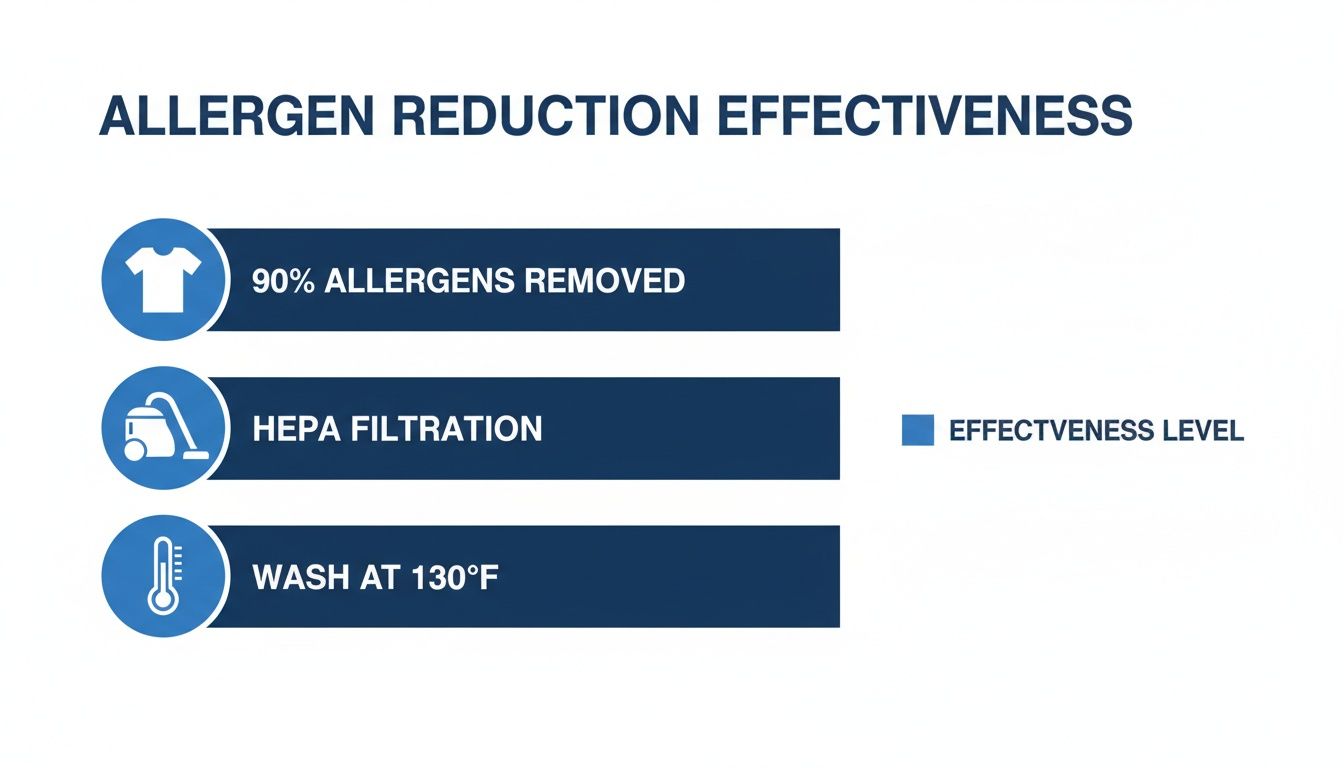
The data makes it clear: when you combine high-efficiency filtration with practical habits like hot-water washing, you create a powerful defense against indoor allergens.
When To Consider a Whole-Home Air Filtration System
A high-MERV filter is a fantastic start, but for families dealing with serious allergies or asthma, it's often not enough.
A whole-home air filtration system works with your existing HVAC unit to provide a level of air cleaning that a standard 1-inch filter just can't touch. These systems use thick, high-capacity media filters—often 4 to 5 inches deep—that can achieve a MERV 16 rating or even higher.
The extra depth and surface area let the filter trap the absolute tiniest particles without restricting the airflow your HVAC system needs to run efficiently. It’s the best of both worlds. As a bonus, these beefy filters last much longer, typically 6 to 12 months, compared to the 1-to-3-month lifespan of a standard filter.
Advanced Solutions: UV Purifiers and Duct Integrity
For those who need the ultimate level of protection, we can go beyond just trapping particles and actively neutralize them.
UV (Ultraviolet) air purifiers are installed right inside your HVAC system's indoor unit. They target the damp evaporator coil, a prime breeding ground for mold and bacteria. The UV-C light bombards these microorganisms, destroying their DNA so they can't reproduce and get blown through your home's air.
Another crucial piece of the puzzle is your ductwork. Leaky or poorly sealed ducts can pull dusty, allergen-filled air from your attic, crawlspace, or wall cavities and distribute it all over your house. No matter how good your filter is, it can't stop contaminants that sneak in past it. If mold is a concern, knowing how to remove mold from air ducts is key, but prevention is even better.
Professional duct sealing ensures that the only air your system circulates is the clean, filtered air from inside your living space.
As Trane specialists, we at Comfort Experts have seen the night-and-day difference these indoor air quality solutions make. We’ve watched families finally get relief from chronic allergies once their home's air is truly clean.
The Overlooked Impact of Home Humidity
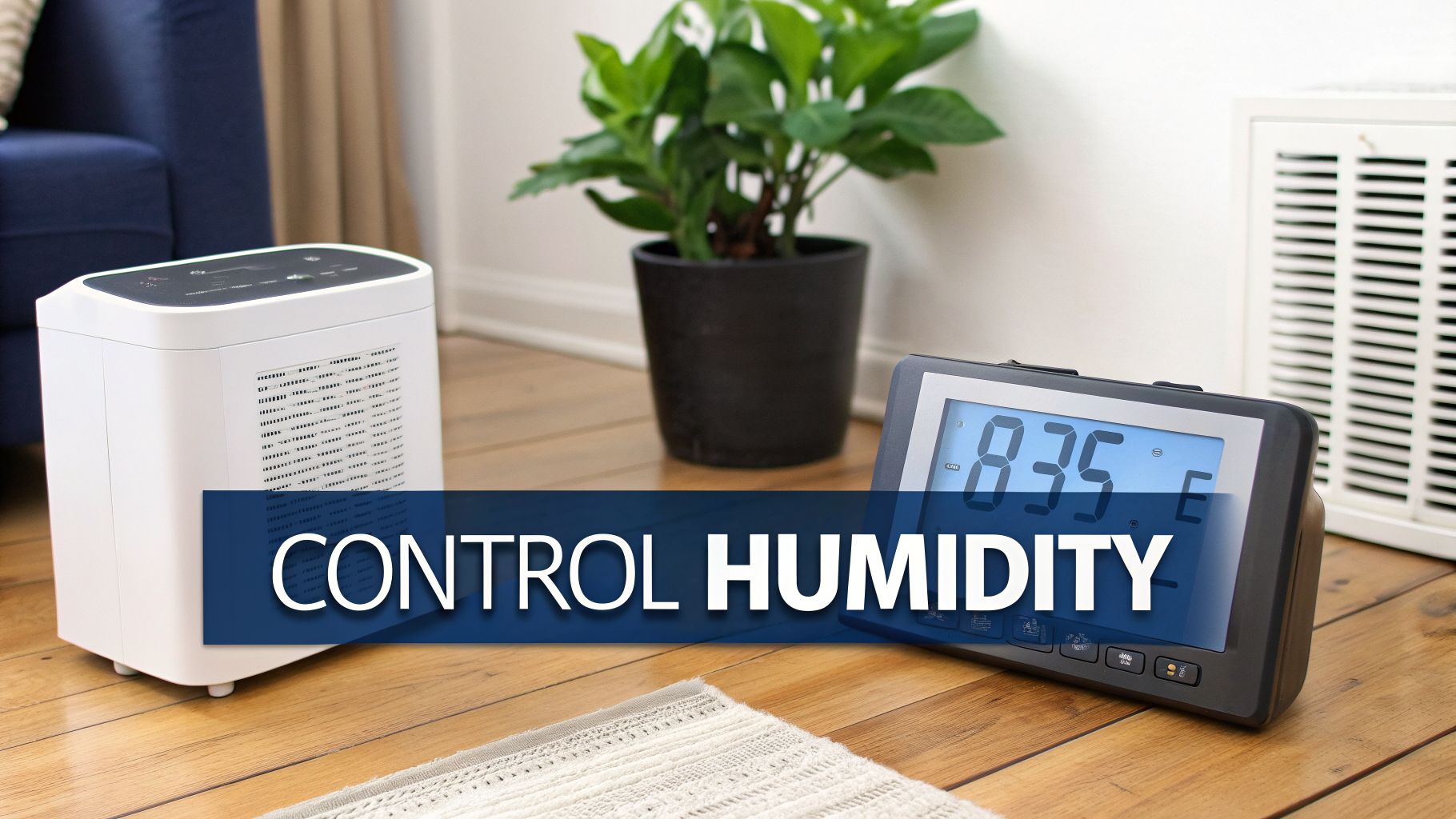
When we talk about home allergies, everyone jumps to dust and pollen. But we’ve found that the real troublemaker—the one that helps those allergens multiply—is often the invisible moisture in your air.
Managing humidity is a huge piece of the puzzle, especially for stubborn irritants like mold and dust mites. Get it right, and you’re pulling the rug out from under them.
Even though we live in Arizona, our homes can easily become humid pockets. Everyday stuff like cooking, running the dishwasher, or taking a hot shower releases a surprising amount of moisture into the air. Without a way out, it gets trapped and creates a perfect breeding ground for allergens.
Finding the Humidity Sweet Spot
So, what’s the right number? For your health and for keeping allergens in check, you want your home's relative humidity between 30% and 50%.
Once you go over 50%, you’re practically inviting dust mites and mold to move in. But if you dip below 30%, you’ll start dealing with dry sinuses, itchy skin, and annoying static electricity.
You can grab a simple, inexpensive hygrometer to see where your home actually stands. You might be shocked to see the bathroom hit 80% humidity after a shower or the kitchen get muggy while you’re making dinner.
The connection is direct: controlling moisture starves two of the most pervasive indoor allergens. Dust mites and mold cannot multiply in a dry environment. By maintaining that 30–50% range, you’re not just making your home feel more comfortable; you’re actively creating an inhospitable environment for them.
And this isn’t just a theory. Keeping your indoor humidity in that 30% to 50% range is a powerhouse move. Your air conditioner is already your best friend for this, as it naturally removes moisture while it cools. In some controlled studies, proper humidity control has been shown to slash dust mite allergen levels by an incredible 70-90%.
Everyday Strategies for Humidity Control
Before you think about new equipment, there are some simple habits that make a big difference. Your AC does a lot of the heavy lifting during our hot seasons, but it can’t do it all.
- Use Your Exhaust Fans: This is a big one. Always run the exhaust fan in your bathroom during a shower and for at least 20 minutes after. Do the same with your kitchen’s range hood when you cook. These fans are designed to vent that moist, stale air directly outside.
- Check for Leaks: That slow drip under the sink might not seem like a big deal, but it’s a constant moisture source for mold. Make it a habit to regularly inspect pipes, faucets, and window seals.
- Properly Vent Appliances: Make sure your clothes dryer is vented correctly to the outdoors. A clogged or poorly connected vent can pump warm, humid, lint-filled air right back into your house.
Adding these small tasks to your routine can have a massive effect on your home’s humidity and, in turn, its allergen load.
When to Consider a Whole-Home Solution
For some homes, especially if you have family members with severe allergies or you’re constantly fighting that musty smell, daily habits might not be enough. If you’re seeing condensation on your windows all the time, it’s probably time for a more powerful fix.
A whole-home dehumidifier integrates directly with your HVAC system, giving you precise, automated control over your entire home's humidity level. It works right alongside your air conditioner, pulling excess moisture from the air as it circulates. This keeps every room in that ideal 30-50% sweet spot without you having to think about it.
At Comfort Experts, we often recommend these systems as part of a complete strategy to make a home healthier. When you tackle humidity, you’re addressing a root cause of so many allergy and breathing issues. A whole-home dehumidifier isn’t just about comfort—it's about creating a healthier space for your family to breathe.
You can check out more of our comprehensive indoor air quality solutions that target allergens from every angle.
When to Call in the Pros for Lasting Relief
You've washed the bedding, vacuumed with a HEPA filter, and even bought a fancy hygrometer to watch the humidity. But you're still waking up stuffy. The sneezing and itchy eyes just won't quit.
When your best DIY efforts aren’t enough, it’s usually a sign that the problem isn’t just on the surfaces of your home—it’s inside its systems. For lasting allergy relief, sometimes you have to call in a pro.
When to Suspect Your Ductwork Is Working Against You
Let me explain. Have you ever seen the inside of your air ducts? For most people, the answer is no. Over years of circulating air, this hidden network of tunnels becomes a five-star resort for dust, pet dander, construction debris, and pollen. We’ve pulled pounds of the stuff out of duct systems.
Every single time your AC or furnace kicks on, it can send a fresh plume of these settled allergens into every room of your house. It’s a frustrating cycle that makes you feel like your cleaning efforts are being erased in real-time.
You might need to have your ducts looked at if you notice:
- The Dust Is Relentless: You wipe down a table, and a new layer of dust settles just a day or two later.
- Surprise Allergy Attacks: Your symptoms are worse at home, even on days when the pollen count outside is low.
- Funky Smells: A musty or stale odor that seems to appear when the air starts blowing can be a tell-tale sign of mold or mildew hiding deep in the system.
A professional duct cleaning is so much more than just sticking a powerful vacuum hose in a vent. As certified technicians, we use specialized agitation tools—think high-powered brushes and whips—that scrub the inner walls of your ductwork, breaking free years of caked-on gunk that suction alone could never touch.
Beyond Cleaning: Why Sealing Your Ducts Is a Game-Changer
Cleaning gets rid of the debris that’s already there. But what if the ducts are just going to get dirty again in a few months? That’s where sealing comes in.
Here's something most homeowners don't realize: many duct systems, especially in older homes, are full of tiny leaks. Small gaps, loose connections, and cracks at the joints are incredibly common.
These leaks create a negative pressure problem, forcing your HVAC system to suck in dusty, unfiltered air from your attic, crawlspace, or from behind your walls. That air is loaded with insulation fibers, dust, and who-knows-what-else. It completely bypasses your fancy air filter and gets pumped directly into your living space.
This is where a process like Aeroseal duct sealing is so effective. It’s a pretty clever process: we pressurize your duct system and inject a non-toxic, aerosolized sealant into the network. The tiny sealant particles are drawn to the leaks and bond together, sealing every last crack and hole from the inside out.
The results are immediate and twofold:
- Dramatically Fewer Allergens: It completely stops your ducts from pulling in dirty air from those unconditioned spaces.
- Better Efficiency: It makes sure all the conditioned air you’re paying for actually makes it to your rooms. This often leads to real savings on your monthly energy bills.
The Power of a Professional HVAC Tune-Up
You wouldn't drive your car for years without an oil change, and the same logic applies to your HVAC system—especially if you're an allergy sufferer. A professional tune-up goes far beyond what a homeowner can do.
When our Comfort Experts perform a maintenance visit, we’re doing a deep dive. We thoroughly clean the indoor and outdoor coils, which are magnets for dust and potential mold. We test electrical components, check airflow, and make sure the whole system is calibrated for peak performance. This is a critical piece of the puzzle when you're figuring out how to reduce allergens in home for good.
Here’s a quick look at the difference between DIY tasks and what a pro tune-up covers.
| Task | DIY Homeowner Action | Professional HVAC Maintenance |
|---|---|---|
| Air Filter | Change your 1-inch filter every 1-3 months. | Inspect and replace the filter; we'll also tell you if a higher-MERV filter would work with your system. |
| Coil Cleaning | Lightly rinse the outdoor unit with a garden hose. | Deep clean both the indoor evaporator and outdoor condenser coils using specialized, non-corrosive cleaning solutions. |
| Condensate Drain | Pour vinegar or use a shop vac on the outside line. | Thoroughly flush the entire drain line and pan to remove built-up sludge, preventing water damage and mold growth. |
| System Inspection | Listen for odd noises or look for obvious problems. | Perform a full diagnostic: test capacitors, check motor amperage, measure refrigerant levels, and calibrate the entire system. |
Regular, professional service turns your HVAC system from a potential source of allergens into your greatest ally in keeping the air clean. If you're trying to figure out who to trust with this work, our guide on finding the best HVAC company near you has some honest tips on what to look for.
Your Top Questions About Home Allergens
Even after you've got a game plan, a few questions always pop up. We get it. Here are the most common ones we hear from Phoenix homeowners who are tired of sneezing and ready to clear the air for good.
How Often Should I Really Clean My Air Ducts?
This is one of the most common questions we get, and the honest answer from the field is: it depends on your home and your family.
For an average house, getting your air ducts professionally cleaned every 3 to 5 years is a solid rule of thumb. That’s enough to handle the slow-and-steady buildup of dust and debris that happens over time.
But some homes need a closer look, more often. We recommend getting your ducts inspected sooner if any of these sound familiar:
- Someone in the house has severe asthma or allergies.
- You have shedding pets—dander is a primary ingredient in the gunk we find in ducts.
- You just finished a big remodel. Drywall dust gets everywhere.
- You’re in a new-to-you home and have no idea when—or if—it was last done.
Before you commit to anything, though, make sure you’re hiring a team that uses a camera for inspection first. A pro should be able to show you exactly what’s inside your ductwork, so you know for a fact that you’re paying for a service you actually need.
Are Portable Air Purifiers as Good as a Whole-Home System?
Portable air purifiers definitely have their place. A good one with a true HEPA filter can be a game-changer for a single room, especially a bedroom. Since you spend a third of your life there, cleaning the air where you sleep is a fantastic first step for allergy relief.
But a whole-home air filtration system is playing a completely different game. It’s a more powerful and permanent solution because it’s integrated directly into your HVAC system. It cleans the air in every room with a vent, every single time your system kicks on.
Think of it this way: a portable purifier is like a high-powered fan with a filter attached—great for one spot. A whole-home system treats the air your entire family breathes, quietly and automatically, from the master bedroom to the living room.
Here’s how they stack up side-by-side:
| Feature | Portable Air Purifier | Whole-Home Filtration System |
|---|---|---|
| Coverage Area | One specific room (e.g., bedroom, home office). | The entire house. |
| Operation | Runs on its own, taking up floor space and power. | Works silently inside your existing HVAC system. |
| Maintenance | Filters need changing often (every 3-6 months). | High-capacity media filters last much longer (6-12 months). |
| Effectiveness | Cleans air locally in one zone. | Continuously filters all air circulating through your home. |
While a portable unit is a great starting point, a whole-home system is the undisputed winner for families who want total control over their indoor air quality.
Will a New AC Unit Really Help My Allergies?
Yes, absolutely. A modern air conditioner can make a massive difference for allergy sufferers, and it comes down to two big improvements: better air filtration and far better humidity control.
The AC units we install today are engineered to handle thicker, higher-rated air filters (like MERV 11 or 13) without choking the system. That means they can trap microscopic particles—like pollen, dander, and mold spores—that older systems would just circulate right back into your rooms.
They’re also masters at pulling moisture out of the air. In our humid monsoon season, that’s critical. By keeping your indoor humidity down, a new AC robs mold and dust mites of the damp environment they need to thrive.
At Comfort Experts, we believe you shouldn't have to fight allergies in your own home. You deserve to feel comfortable and breathe easy. If you’re ready to explore how a modern AC, a whole-home filtration system, or even just a thorough duct inspection can bring your family lasting relief, we’re here to help. Give our team a call today at 480-207-1239 or schedule service online to chat with one of our friendly specialists.