

It’s a sweltering Phoenix afternoon, and the silence from your vents is deafening. Yep, your air conditioner not blowing just became a very hot reality, and honestly, the immediate wave of panic is something every Arizona homeowner understands. Before you start imagining the worst, take a deep breath; the fix is often simpler than you think.
Quick First Checks for a Silent AC
When your AC goes quiet, it's easy to assume the worst. But jumping to conclusions is a recipe for unnecessary stress. Before you even start thinking about frozen coils or busted motors, a few simple checks can often solve the problem in minutes. This is your calm, logical first response—no tools required. Think of it as the 15-minute diagnostic you can do yourself to potentially save a service call.
Check Your Thermostat Settings
Let me explain: the thermostat is the brain of your whole system, and you'd be surprised how often a simple setting error is the culprit. It's always the first place you should look. So, is it possible the solution is that simple?
- Mode Setting: Make sure the thermostat is actually switched to "Cool." It's easy for it to get bumped to "Heat" or "Fan Only," especially during those weird transitional spring and fall weeks we get in Arizona.
- Temperature Setting: This one trips people up all the time. The temperature you set must be lower than the current room temperature. If you have it set to 78°F but the room is already a comfortable 75°F, the system has no reason to kick on.
- Fan Setting: Check if the fan is set to "Auto" instead of "On." If it’s on "On," the fan will run constantly, even when the AC isn’t actively cooling. This can sometimes make you think there's a cooling problem when there isn't one.
Inspect the Circuit Breaker
Your next stop is your home's electrical panel. An air conditioner is a beast of an appliance, and it will sometimes trip a circuit breaker to protect itself from an electrical surge.
Safety First: If a breaker keeps tripping, never try to force it to stay in the "On" position. A repeatedly tripping breaker is a clear red flag for a more serious electrical issue. That's a job for a professional, no exceptions. As experienced technicians, we at Comfort Experts have seen the damage that can result from ignoring this warning sign.
Find your breaker box and look for the switch that controls your AC or HVAC system. If it’s sitting in the middle or flipped to "Off," push it firmly back to the "On" position. Sometimes, that simple reset is all it takes to get the air flowing again.
This decision tree gives you a simple, logical path for these first checks.
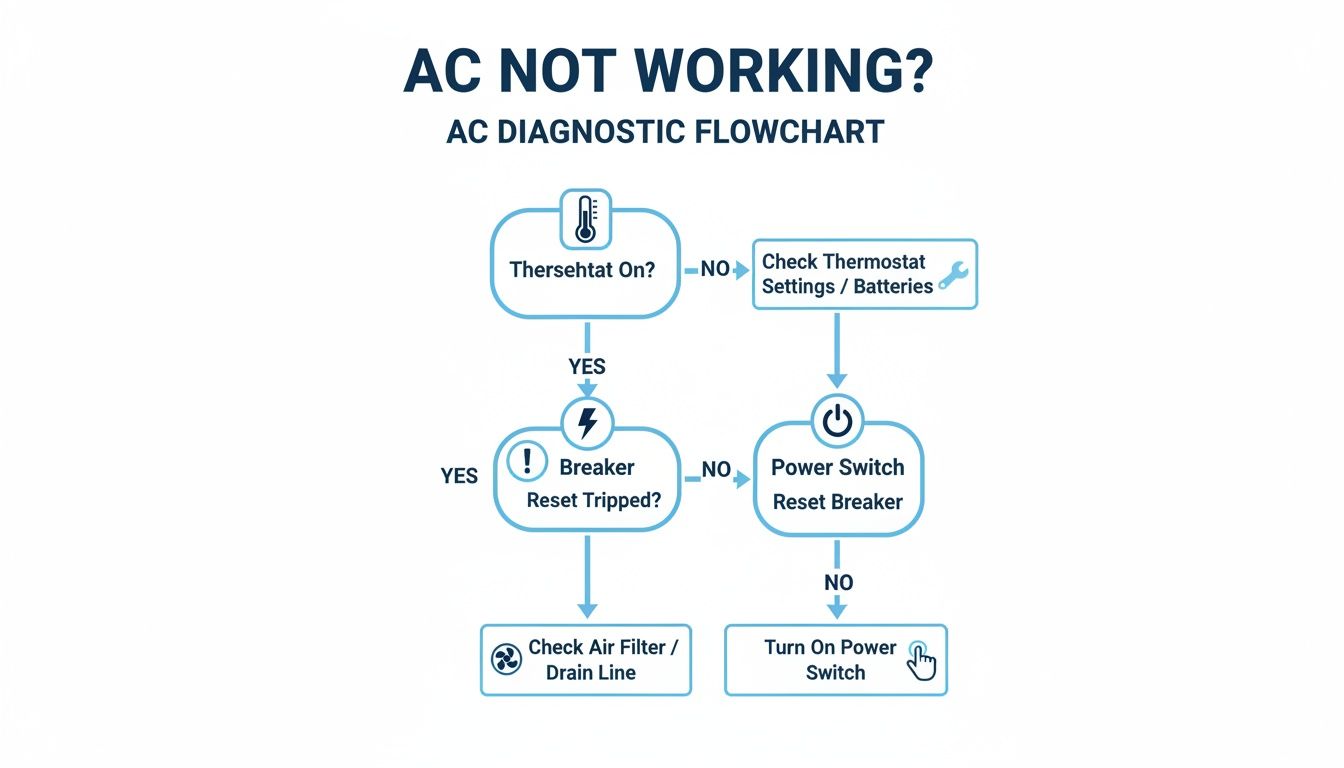
As the chart shows, always start with the easy stuff—thermostat, breaker, and power switch—before you start worrying about more complex problems.
Verify the Outdoor Power Disconnect
Last on the quick-check list: head outside to your big condenser unit. Look for a small metal box mounted on the side of your house right near the unit. That's the power disconnect. This switch is designed to cut power directly to the outdoor unit for safety during maintenance. If a landscaper or pest control tech was working in the yard, they might have flipped it off and forgotten to turn it back on. Just open the box and make sure the switch is in the "On" position.
Of course, regular upkeep can prevent a lot of these surprises. For a bigger picture of home care, this comprehensive seasonal home maintenance checklist for Arizona is a great resource. And when it comes to your AC specifically, keeping up with routine tasks is critical, as you can see in these essential AC maintenance tips for Arizona residents.
Is a Clogged Air Filter Choking Your System?
If those first power checks didn’t get you anywhere, the next place to look is your air filter. It’s a simple part, but it’s probably the number one reason an air conditioner not blowing becomes a problem, especially here in the dusty Phoenix metro. A clogged filter is like trying to breathe through a thick blanket—it literally suffocates your HVAC system. This chokes off the airflow, forcing your system to work way harder than it should. The immediate result? The indoor evaporator coil can get so cold it freezes into a solid block of ice, completely blocking any air from getting through. We see this all the time. I remember a Mesa homeowner who was sure his entire AC had died, but the real culprit was a filter that hadn't been touched in over a year.
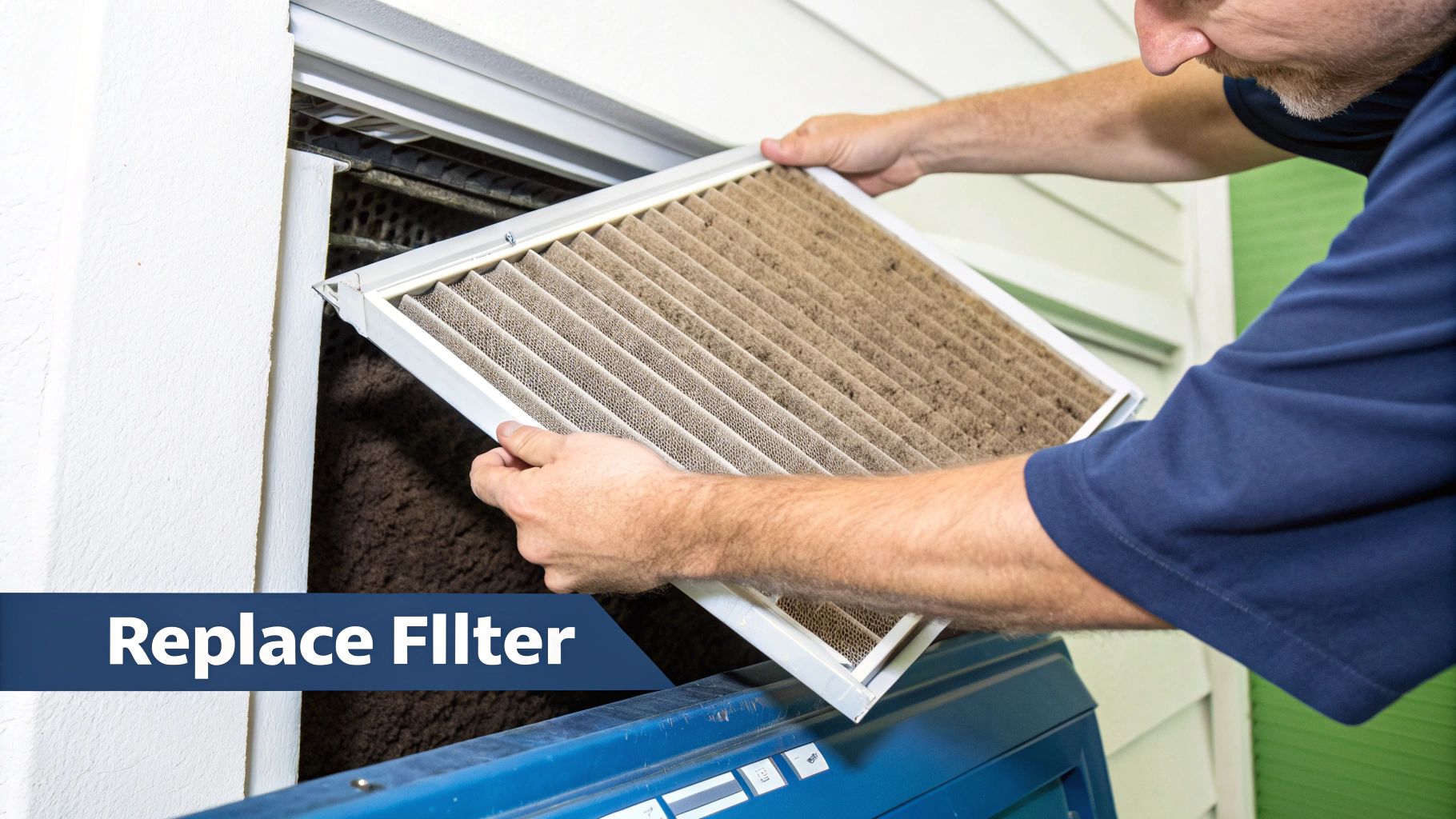
Finding and Checking Your Air Filter
Luckily, finding your air filter is usually pretty easy. In most Arizona homes, you'll find it in one of two spots:
- Behind a big return air grille on a wall or ceiling.
- Inside a slot in the indoor air handler unit itself.
Once you find it, just slide the old filter out. You don’t need to be an expert to spot a dirty one. If it’s gray, caked with a layer of dust, and you can’t see any light through it, it’s long overdue for a swap.
Putting this off is more common than you’d think. A dirty filter is one of the most frequent—and preventable—issues we see. An HVAC system with choked airflow can use 15-20% more energy just to keep up, putting a ton of extra strain on expensive parts.
The Right Way to Replace the Filter (And What to Do Next)
Replacing the filter is a breeze. Just check the dimensions printed on the side of the old one and grab a new one. Slide the new one in, but make sure the arrow on the filter's cardboard frame points in the direction of the airflow—that means pointing toward the air handler unit itself.
Now, if your coils were frozen, a new filter won't fix things instantly. You have to give that ice time to melt. To do this, turn your thermostat to "Off," but switch the fan setting to "On." This will circulate room-temperature air across the ice and help it thaw out much faster. This can take a few hours, so be patient. Once you're sure it’s thawed, you can switch the AC back to "Cool" and see if your airflow is back to normal.
If a new filter doesn't do the trick, the blockage might be deeper in the system. In that case, professional HVAC system cleaning services can clear out built-up grime and get things moving again. For Phoenix homeowners, the real key is getting into a routine. To figure out the right schedule for your home, check out our guide on how often you should change your air filters.
Inspecting the Outdoor Condenser Unit
Alright, you’ve checked things out inside, so now it’s time to head out back and take a look at the condenser unit. This is the big metal box with the fan on top, and it’s the workhorse of your entire AC system. Its whole job is to pump all that unwanted heat out of your house, and if it can't breathe, your whole system grinds to a halt. Now, this is purely a visual inspection. Seriously. We’re just looking for obvious problems, not touching anything. These units have high-voltage components, so we're playing detective, not technician.
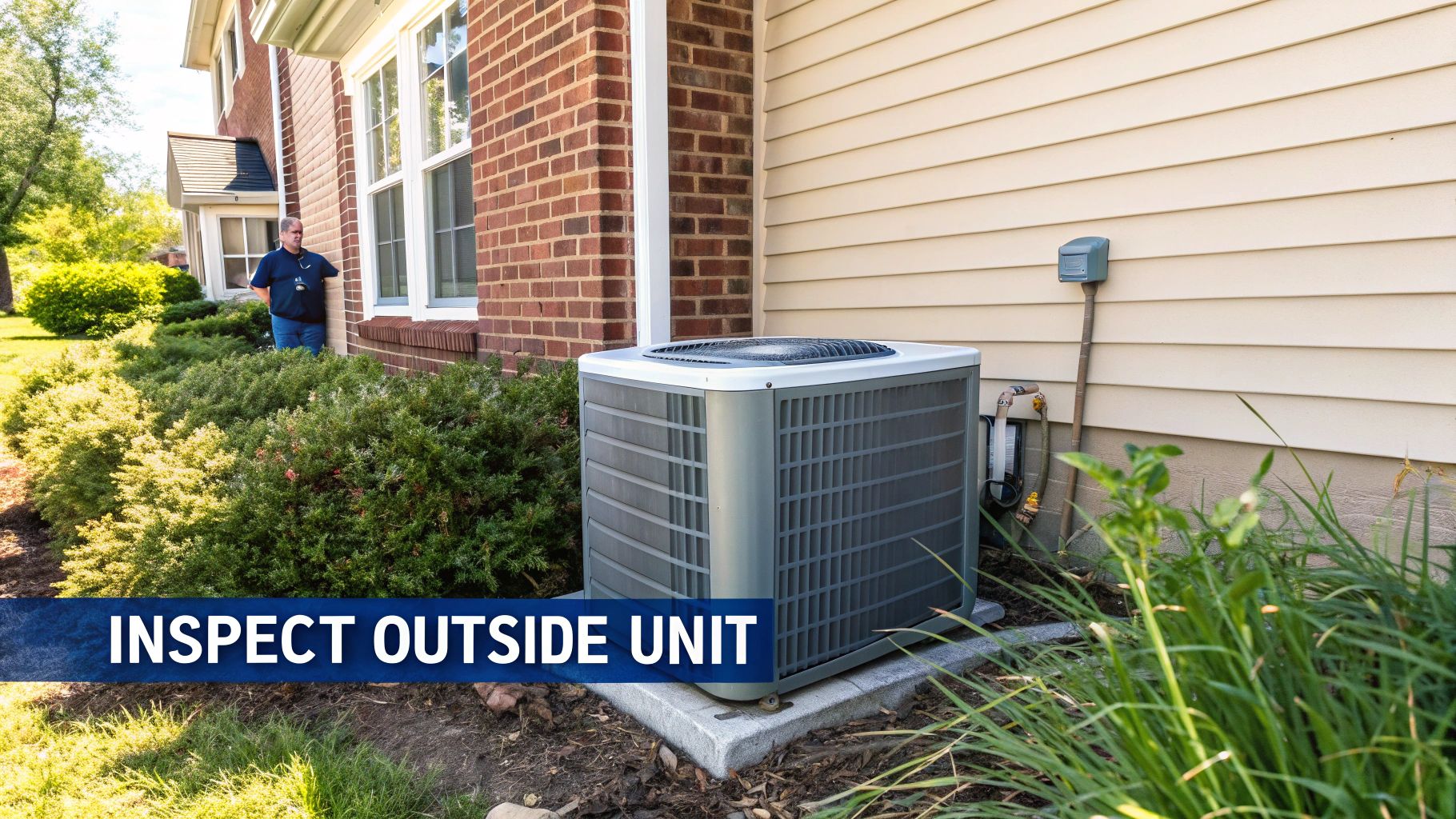
Give the Unit Some Breathing Room
Your condenser pulls air in through the fins on the sides and blasts hot air out the top. Anything that gets in the way of that airflow is a problem. Take a slow walk around the unit. You’re looking for anything that’s crowding it:
- Plants Gone Wild: Are your bushes starting to hug the unit? We see this all the time. You need at least two feet of clear space on all sides for it to work properly.
- A Blanket of Debris: After a monsoon storm or even just mowing the lawn, things like leaves, grass clippings, and dust can get sucked right up against the fins, essentially suffocating the unit.
- Yard Obstacles: Is a recycling bin pushed up against it? A patio chair? A tarp? Move anything that’s physically blocking the sides.
Look for a Block of Ice
Next, take a closer look at the unit itself, especially the metal fins and the copper pipes running into your house. Do you see ice? I don’t mean a little frost—I mean a solid chunk of ice building up. If so, you’ve found a major clue.
A frozen outdoor unit is a dead giveaway that something is seriously wrong. It almost always points back to a major airflow problem (like that dirty filter we talked about) or a refrigerant leak. Either way, the system can't absorb heat correctly, so the moisture on the coils freezes solid.
If your unit looks like a block of ice, your one and only move is to turn the AC system off at the thermostat and let it thaw out naturally. Please, do not try to speed it up by chipping at the ice or spraying it with a hose. You can easily damage the delicate metal fins. Seeing ice is a symptom of a much bigger issue that needs a professional eye. Understanding the potential cost to replace a condenser coil makes it pretty clear why you don’t want to risk damaging it.
When the Problem Is a Hidden Mechanical Failure
So, you’ve checked the power, swapped the filter, and gave the outdoor unit a good look-over, but your AC is still silent. You know what? When the simple stuff doesn’t work, it’s usually a sign that the problem is a little deeper inside the system. You might hear the system click on or maybe even a faint hum, which tells you it’s trying to work. But if no air ever comes out of the vents, it almost always points to a mechanical or electrical failure—the kind of issue that really needs a pro’s touch to diagnose safely.
The Blower Motor and Capacitor
Inside your indoor unit is a powerful fan called the blower motor. Think of it as the lungs of your HVAC system; its only job is to push all that nice, cold air through the ductwork and into your home. If this motor gives up, your AC could be cooling air perfectly, but that air has nowhere to go. More often than not, it’s not the motor itself that’s the problem. It’s a much smaller, less expensive part called a run capacitor. This little cylinder-shaped component gives the blower motor the electrical kick it needs to get started and keep running.
| Common Blower Issues | Potential Cause | Is it a DIY Fix? |
|---|---|---|
| AC makes humming noise, no air | Bad Run Capacitor | No. Involves high voltage. |
| Fan won't start at all | Failed Blower Motor | No. Requires professional replacement. |
| Weak airflow, but fan is on | Multiple causes (Filter, Frozen Coils) | Check filter first. Call a pro if it persists. |
| Breaker trips when AC starts | Electrical short in motor windings | No. Major electrical hazard. |
Capacitors fail all the time, especially under the strain of a brutal Phoenix summer. When one goes bad, the motor can’t start. You’ll often hear a distinct humming or buzzing sound without any air moving—that’s the sound of the motor trying, and failing, to spin. If this sounds familiar, our guide on a non-spinning fan has more detail: why your AC fan is not spinning.
Expert Insight: A bad capacitor is one of the most common repairs we handle. While the part itself is fairly inexpensive, swapping it out means dealing with high-voltage components. This is a perfect example of a repair that looks simple but is best left to a trained technician for safety.
When Refrigerant Issues Freeze Up Your System
Another common culprit is a problem with your system’s refrigerant. If your system develops a leak and refrigerant levels drop, it sets off a nasty chain reaction. The pressure inside the evaporator coil plummets, causing it to get incredibly cold—so cold that it freezes into a solid block of ice. Once that coil is encased in ice, air can’t pass through it. At all.
For Phoenix homeowners, a refrigerant leak is a serious issue. Handling refrigerant is legally restricted to EPA-certified technicians. Furthermore, the repair itself can be pricey. Putting off this repair is a huge gamble. It can lead to the catastrophic failure of the compressor, the single most expensive part of your AC, which can easily cost $1,500-$3,000 or more to replace.
Could Leaky Ductwork Be the Real Culprit?
What if I told you your AC unit could be working perfectly fine, but the cold air just isn't getting where it needs to go? It’s a frustrating scenario we see all the time. The problem isn't always the air conditioner itself, but the hidden network of ducts snaking through your attic and walls. Leaky, damaged, or even completely disconnected ductwork can sabotage your system’s airflow, leaving you with weak cooling in some rooms and none at all in others.
This is a massive—and often totally invisible—source of energy waste, especially here in Arizona. Just picture your attic on a 110°F day in Phoenix. Year after year, that relentless, baking heat breaks down the seals, tape, and materials of your ductwork, causing it to crack and pull apart at the seams. Those gaps become huge leaks, dumping a huge portion of that precious, expensive cold air right into your scorching attic instead of your living room. The result? An AC that runs nonstop while your house never actually feels cool.
The Hidden Cost of Leaky Ducts
According to the U.S. Department of Energy's Energy Star program, a typical home can lose 20% to 30% of the air moving through the duct system because of leaks and bad connections. In a Phoenix home, that staggering loss can easily add up to hundreds of dollars in wasted cooling costs every single year.
Think about that for a second. For every dollar you spend on your power bill to cool your home, up to 30 cents of it could be getting dumped straight into your attic. Those losses add up fast, forcing your AC to work way harder and longer than it was ever designed to. That leads to premature wear and tear on expensive parts like your compressor and fan motor.
Pinpointing and Sealing the Leaks
Unfortunately, diagnosing leaky ducts isn’t something you can easily do with a visual inspection. This is where professional diagnostics come in. At Comfort Experts, our technicians use specialized tools to measure the exact amount of leakage in your entire duct system. We can pressurize the network to pinpoint precisely where the cold air is escaping. Once we know where the problems are, we often recommend a process called Aeroseal. It’s a game-changer. By sealing your ducts from the inside out, we can restore strong, consistent airflow to every single room. You can learn more about how this technology works by reading about our Aeroseal duct sealing services.
When You’ve Tried Everything and the AC Still Won’t Start
So, you’ve reset the breaker, put in a fresh filter, and even cleared away the tumbleweeds from your outdoor unit. And still… silence. It’s an incredibly frustrating moment, especially when you can feel the Phoenix heat starting to creep into your home. You’ve done all the right things, but some problems go deeper than a simple DIY fix. Continuing to force an air conditioner to run when it has a serious internal issue can quickly turn a minor repair into a complete system replacement. When you’ve hit that wall, it’s time to call in a pro.
Why Call Comfort Experts?
Here at Comfort Experts, we live and work in the Valley, too. We know that a broken AC isn’t just an inconvenience—it’s an emergency. Our goal is to get your home comfortable again, quickly and honestly. We skip the confusing jargon. Instead, we walk you through what we find, show you the problem, and lay out your options in plain English. Our team is built on a few simple promises:
- Honest, Clear Diagnostics: We use the right tools to find the real problem. No guesswork.
- Fast, Local Service: You can’t wait a week for cool air. Our local crews are staged to get to you quickly.
- Solutions That Last: We’re not interested in band-aid fixes that will fail again in a month. We fix the root cause.
We treat every customer’s home like it’s our own mom’s house. That means showing up when we say we will, keeping things clean, and giving you fair, straightforward pricing before any work begins. Your trust is everything to us.
Don’t let the heat win. When you’ve done everything you can and the air still isn’t moving, our certified technicians are ready to take over. We have the training and equipment to safely handle complex electrical work, refrigerant services, and all the other tricky jobs that are best left to an expert. We’ll get it done right the first time.
When your comfort is on the line, trust the local team at Comfort Experts. Give us a call at 480-207-1239 or schedule service online today, and let us bring the cool air back.