
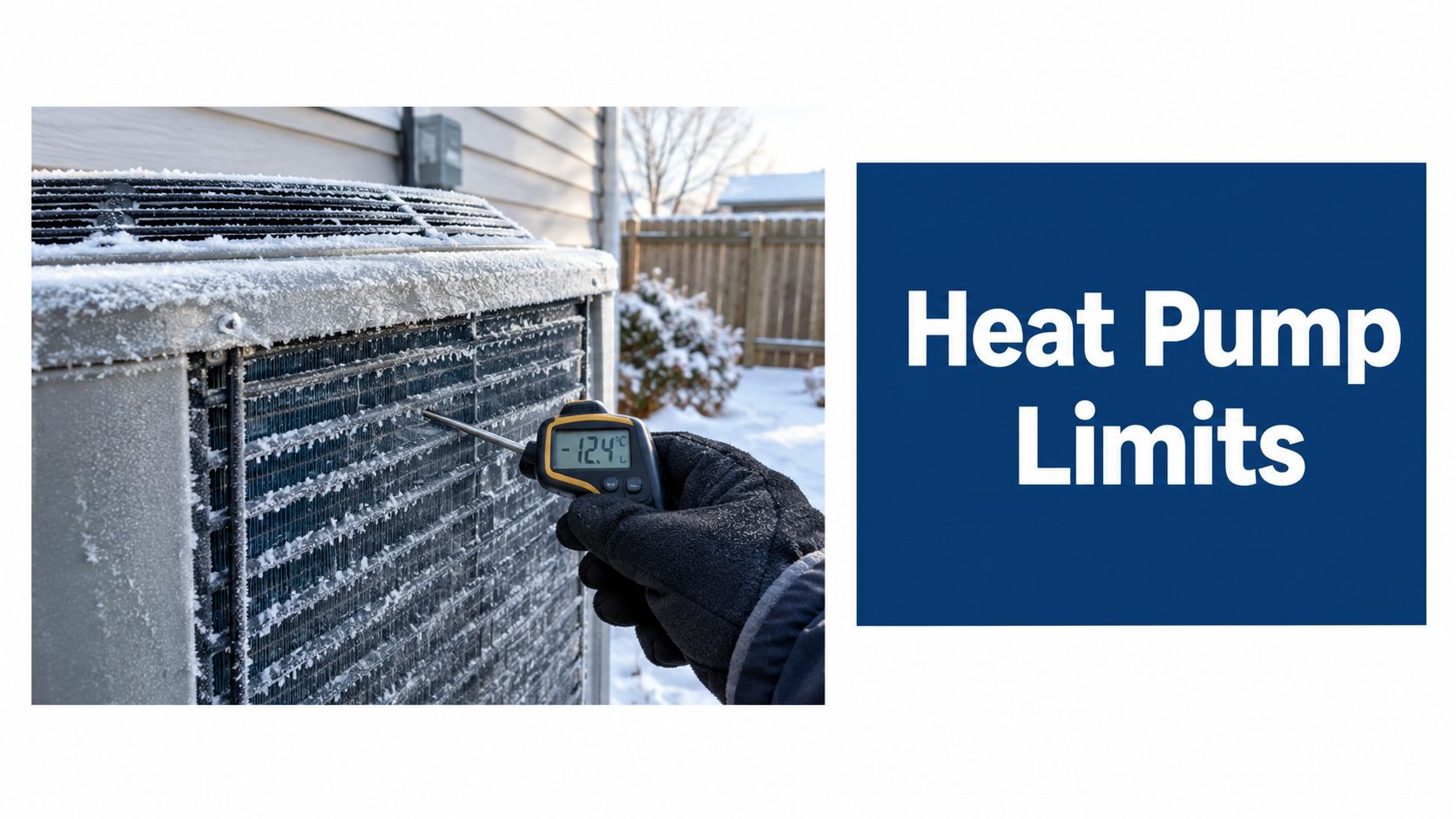
A heat pump does not have one universal temperature where it suddenly stops working. ENERGY STAR cold-climate systems are tested at 5°F (-15°C), and certified units must still deliver useful heat there, but a home may need auxiliary heat long before the equipment fully quits.
The actual answer is that the system's capacity and efficiency decline as outdoor temperatures fall, so the practical cutoff depends on the model, the house, and how the backup heat is set up.
The Myth of a Universal Shutoff Temperature
A lot of homeowners hear a simple rule, then repeat it like it applies to every system in every climate. That's not how heat pumps work in Mesa, Phoenix, or anywhere else. A heat pump usually keeps running in cold weather, but its output drops as outdoor temperatures fall, which means the unit may still operate while no longer meeting the house's full heating demand.
That distinction matters because the compressor and refrigerant circuit are not the same thing as the building's comfort level. A system can be mechanically active and still feel weak inside if the home is leaky, undersized, or set up with weak auxiliary heat. The more useful question is not the outdoor temperature alone, it's the balance between the home's heat loss and the unit's declining capacity.
For a Mesa homeowner, that becomes obvious on a cold desert night. A heat pump may still run and deliver warm air, but a drafty older home, a poor thermostat setup, or a weak backup system can make it look like the unit “can't handle the cold.” That's why appliance-style thinking misleads people. HVAC performance is tied to the whole house, not just the temperature on the weather app.
Comfort Experts has a practical overview of the refrigerant-cycle basics in its heat pump basics for Arizona homes, and that foundational idea explains why the same outdoor temperature can feel fine in one house and marginal in another.
Standard Versus Cold-Climate Equipment Benchmarks
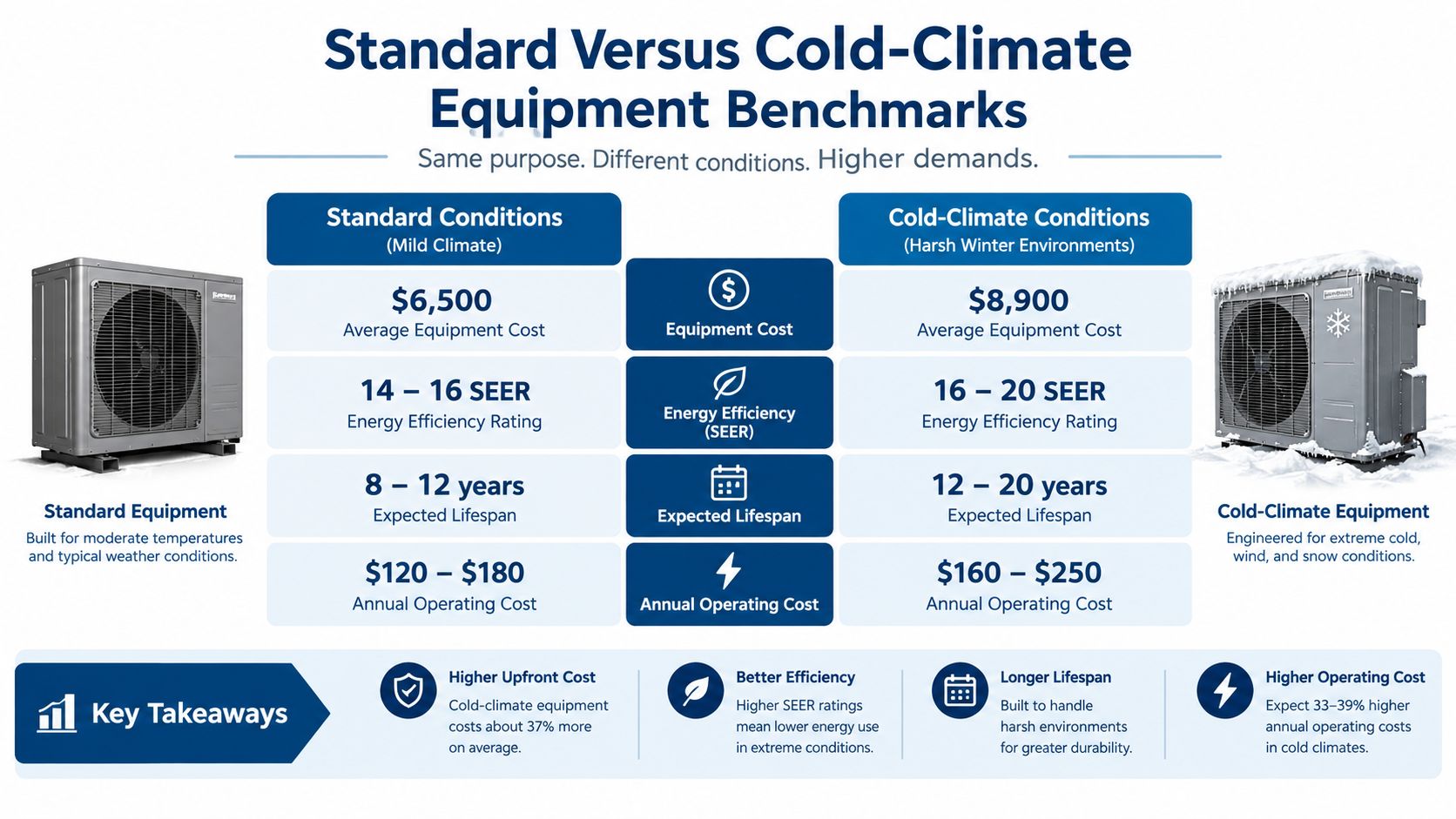
What the 5°F benchmark really means
ENERGY STAR uses 5°F as a key benchmark for cold-climate heat pumps, and qualifying equipment has to be independently tested there. To earn the designation, a unit must reach a COP of at least 1.75 at 5°F and keep at least 70% of its heating capacity compared with its rated capacity at 47°F. A COP of 1.75 means the system delivers 1.75 units of heat for every unit of electricity it uses under those test conditions. ENERGY STAR
That benchmark does not mean every heat pump behaves the same at 5°F. It sets a measurable floor for equipment built to keep producing useful heat when outdoor air turns very cold. It also shows why a low outdoor temperature is not a universal shutoff point. ENERGY STAR notes that certified cold-climate systems can keep operating below 5°F, even though supplemental heat may become the more efficient helper as temperatures fall further.
Why capacity tables matter more than a slogan
The better comparison is the manufacturer's performance table, not a broad marketing claim. Those tables show how much heat the unit can deliver at several outdoor temperatures, and they show where the equipment begins to depend on backup heat. Field validation work from DOE also found that cold-climate systems still delivered useful performance below 30°F, while auxiliary heat was needed only for a small fraction of heating time in the tested homes. PNNL-37127
The same point shows up in current cold-climate development. DOE's residential challenge has included systems optimized for 5°F and another segment optimized for -15°F (-26°C), which shows the industry now designs to different low-temperature targets instead of one fixed cutoff. NREL and Xcel Energy study
For buyers in Arizona, the takeaway is straightforward. A system with a strong cooling rating can still be the wrong heating choice if its low-ambient table is weak. If a quote does not show capacity at several temperatures, it does not tell the full story.
Understanding the Balance Point and Auxiliary Heat
The point where the house outruns the heat pump
The balance point is the outdoor temperature where a home's heat loss matches the heat pump's maximum output. Above that point, the heat pump can hold the thermostat by itself. Below it, the system needs auxiliary heat, usually electric resistance strips in all-electric homes, or another backup source if the setup includes one.
That switchover is a control decision, not a sign of failure. In Mesa, it matters because a mild daytime reading can still turn into a heating problem once the sun drops and the home starts losing heat faster than the equipment can replace it. For a practical look at why a heat pump won't shut off, the longer runtime often shows up when a system is working near its balance point.
A heat pump that runs longer on a cold night may be trying to hold the setpoint while its available capacity falls.
What backup heat changes for the homeowner
Auxiliary heat changes comfort and operating cost. DOE field validation found that auxiliary heat was used only for a small fraction of total heating between 0°F and 35°F in the tested homes, yet it still became part of the load when temperatures fell and the system needed help. PNNL-37127
That is why the important question is not whether a heat pump can run at all. The better question is whether the home's insulation, ductwork, and equipment sizing let the heat pump carry most of the load before backup heat steps in. If that balance is off, homeowners usually notice longer cycles, cooler supply air during winter operation, and more reliance on electric resistance heat.
For a look at bill pressure from electric backup operation and other load factors, homeowners can also review tips to lower electricity costs. The balance point is house-specific, so two homes on the same street can behave very differently on the same cold night.
Frost Accumulation and Defrost Cycles in Desert Winters
Why cold air can trigger a temporary comfort dip
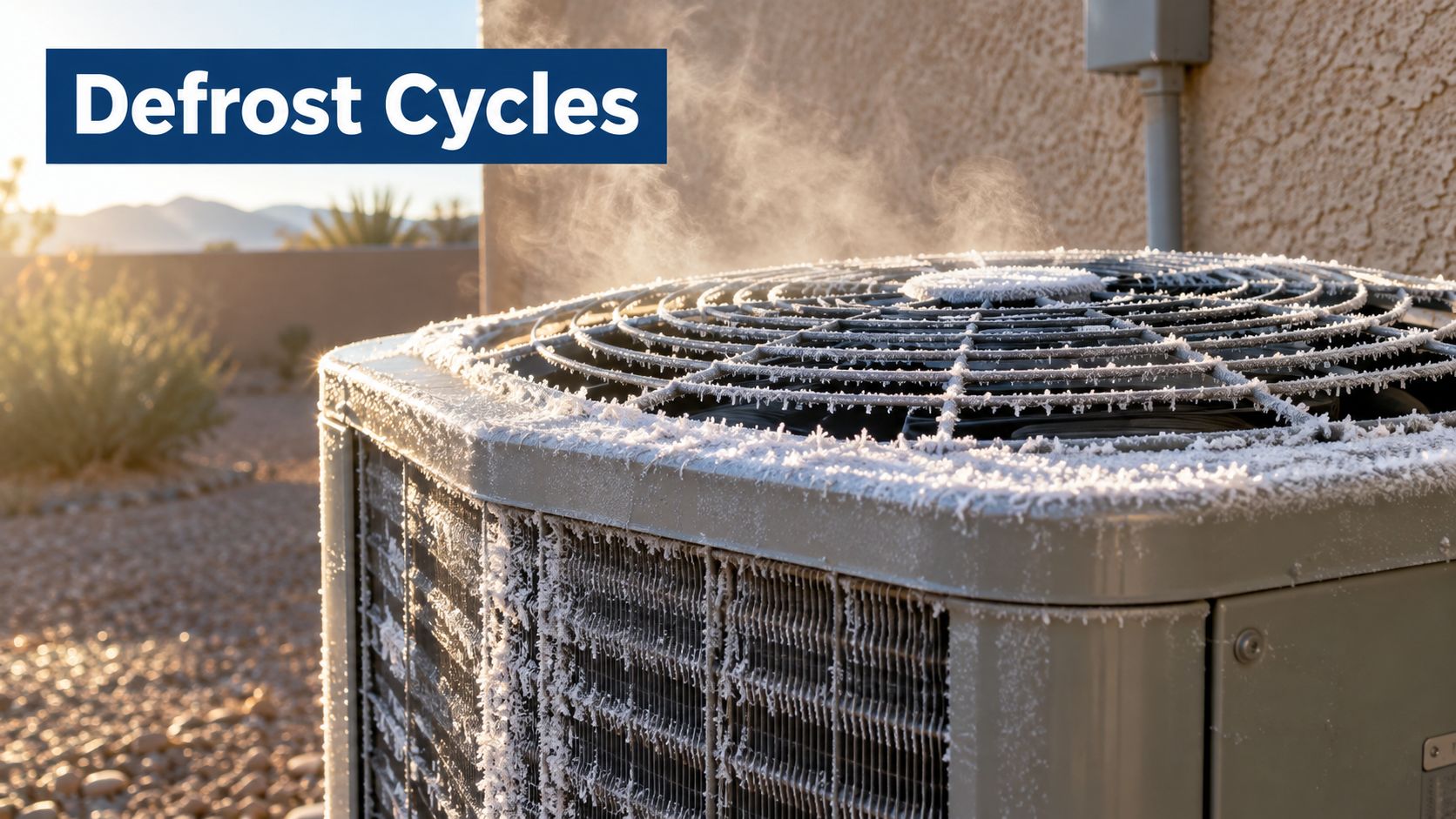
Low temperature is only part of the winter picture. Frost forms when the outdoor coil falls below the dew point and moisture freezes on the surface, which reduces heat transfer and lowers capacity. The unit then enters defrost mode, reverses operation briefly, and melts the ice off the coil. During those cycles, heating delivery drops or pauses, and some systems energize supplemental heat to keep cold air from being blown indoors. NREL frost and defrost paper
That behavior can surprise a homeowner in Mesa because the climate is dry most of the time. But winter humidity, a cloudy cold snap, restricted airflow, or debris around the unit can still create the conditions for frost. A brief dip in supply temperature does not automatically mean failure.
What is normal and what is not
A normal defrost cycle is temporary. Field research on inverter-driven heat pumps found that defrost begins when the coil stays cold for a specified period and ends after the coil reaches a control temperature. In one monitored case averaging -9°F, a unit entered defrost three times in 2.5 hours, and supply-air temperature fell to about 80°F near the end of the cycles. Inverter-driven heat pumps in cold weather
That's why repeated ice buildup deserves attention, while a short change in airflow may be normal. If a system struggles around 30°F to 40°F, the issue may be airflow, coil cleanliness, charge, sensors, or defrost control rather than a normal low-temperature limit. A homeowner who spots recurring icing should use heat pump maintenance to keep the system clean and verified before the next cold snap.
Arizona Climate Context and Equipment Selection
Mesa winters are milder than northern states, but that does not mean every home has the same heating need. Older block homes, leaky ducts, and rooms with higher heat loss can still feel cold on January mornings. Higher-elevation parts of the East Valley can also see overnight lows that put more strain on equipment than people expect.
Mesa Winter Heating Decision Matrix
| Property Profile | Typical Winter Lows | Recommended Equipment Strategy | Auxiliary Heat Reliance |
|---|---|---|---|
| Tight newer home in lower-elevation Mesa | Mild desert cold snaps | Standard heat pump with verified low-ambient capacity table | Usually limited, but still needed at the coldest point |
| Older home with weaker insulation | Occasional colder nights | Stronger capacity model, careful sizing, and backup heat strategy | More likely during overnight dips |
| Higher-elevation East Valley property | Colder mornings and more frequent cold snaps | Cold-climate or expanded-performance equipment | Moderate, depending on load and duct condition |
| Home with leaky ducts or long runs | Similar outdoor lows, weaker delivered heat | Fix duct losses before upgrading equipment | Higher than expected if duct issues remain |
| All-electric home with no backup furnace | Any sustained cold spell | Heat pump with clear auxiliary-heat switchover plan | Built-in resistance heat matters more |
The question in Mesa is not whether a heat pump can run in winter. It is whether a specific house can hold temperature as outdoor conditions drop and the equipment output falls with them. Home envelope quality, duct losses, and installation quality decide that balance point.
Comfort Experts has a related breakdown on heat pump replacement timing in Arizona, and replacement makes the most sense when low-temperature performance no longer matches the home's actual load.
For some Arizona homes, a standard system is enough. For others, especially homes with weak insulation or sensitive occupants, cold-climate equipment gives more margin on the coldest nights.
Troubleshooting Cold Air and Winter Performance Issues
A safe homeowner checklist
A heat pump that blows cool air on a winter night is not always broken. The first check is the thermostat. It should be set to Heat, and the fan should usually be on Auto unless a technician has given different instructions. Next, look at the filter. A clogged filter restricts airflow and makes the whole system struggle.
The outdoor unit matters too. If there's heavy frost or debris around the coil, the system may be in a normal defrost cycle or may be short on airflow. Give the unit time to finish defrosting, and check whether the indoor heat comes back. Homeowners who want a broader homeowner checklist can compare it with custom home builder FAQ for related system-planning considerations during a remodel or new build.
- Confirm the thermostat setting: Make sure the system is calling for heat, not cooling or fan-only operation.
- Check the filter: Replace or clean a clogged filter before assuming the outdoor temperature is the problem.
- Look at the outdoor unit: Frost, leaves, or blocked airflow can make the heat pump act weak.
- Give defrost time to finish: Temporary cool air during defrost is normal.
- Call for service if the problem persists: Repeated icing or no heat after a short wait needs diagnosis.
Do not open energized components or try to force a defrost cycle by jumping wires or removing covers. That belongs to a licensed technician. If the unit ices over repeatedly, or if cold air continues after a reasonable defrost period, the issue may be refrigerant, airflow, sensors, or controls.
Sizing and Professional Installation for Winter Comfort
Why good equipment still fails in a bad setup
Even a strong cold-climate heat pump can underperform if it's oversized, undersized, or installed poorly. The right system starts with a proper load calculation, not a guess based on square footage alone. ACCA system sizing accounts for insulation, windows, infiltration, and design temperature, which is exactly why two homes of the same size can need different equipment.
That same sizing logic is why a homeowner comparing systems should also find the right AC size. Cooling and heating equipment live in the same house, and the same duct system can help or hurt both seasons.
What a good replacement quote should answer
A serious quote should show how the contractor thinks about the house, not just the brand. It should also make the switchover plan clear so the homeowner knows when auxiliary heat will come on and whether the backup system is electric resistance, gas, or something else. If the installer can't explain that, the estimate is incomplete.
When Comfort Experts evaluates a heat pump, the useful questions are practical:
- What is the heating capacity at the temperatures Mesa sees?
- Where is the balance point for this house?
- How will auxiliary heat be controlled?
- Are ducts and airflow ready for winter operation?
- Does the outdoor unit have enough clearance and proper drainage?
That is the difference between a system that merely runs and one that keeps the house comfortable through a cold snap. For Mesa and the East Valley, the right answer to “at what temperature does a heat pump stop working” is usually, “It depends on the equipment, the load, and the installation.” The best next step is a real assessment, not a rule of thumb.
If the heat pump in your Mesa or East Valley home is struggling on cold mornings, Comfort Experts can check the system, verify the balance point, and review whether the backup heat strategy still matches the house. Comfort Experts offers heating service, replacement planning, and winter diagnostics for homes that need a clearer answer than a single temperature guess. To talk through your system and book an assessment, call 480-207-1239 or schedule service.