

A Mesa heat pump can look fine in spring and still be one hot afternoon away from a major repair. If the system is entering its twelfth summer, runs nearly nonstop in July, or leaves the home warm after sunset, the question isn't just how old it is. The main question is whether another repair makes financial sense under Arizona operating conditions.
A Mesa Homeowner Staring at Another Phoenix-Summer Heat Pump
An East Mesa homeowner may face the same choice after another Phoenix summer: the heat pump was installed during the last housing boom, dust has collected around the outdoor unit, and July demand keeps it running for hours. By two in the morning, the thermostat still shows 80 degrees. A capacitor has already been replaced, and another service call is scheduled.
That pattern needs a replacement decision, not a generic lifespan chart. Phoenix-area equipment handles long cooling seasons, extreme summer temperatures, monsoon humidity spikes, blowing dust, and winter heating cycles. NOAA Phoenix climate data lists a 100°F normal daily maximum and 74°F normal minimum for late May in Phoenix, showing that heavy cooling demand begins well before the peak of summer.
Age matters, but it does not settle the question. Judge the system by four factors: compressor run-time, dust exposure, refrigerant and equipment transition issues, and the frequency and cost of repairs. A unit that is not especially old can still be a poor investment if it runs constantly, struggles to hold temperature, or keeps needing parts.
Before requesting an evaluation, record the outdoor unit's model number and collect the last two service invoices. Those documents can identify the equipment's age and refrigerant type while showing whether failures are recurring. They also help a contractor compare another repair with a properly matched replacement.
The widely used replacement window begins around 10 years, according to ENERGY STAR guidance. A properly installed high-efficiency replacement can save up to 20% on heating and cooling costs, though results depend on equipment, sizing, ductwork, thermostat settings, and the home.
If the unit is near the end of its practical service life, has repeated failures, and no longer maintains comfort, request replacement quotes. A younger system with one isolated failure can remain a sensible repair candidate.
How Heat Pumps Age in the Arizona Desert
A national lifespan estimate can mislead Mesa homeowners because it assumes average operating conditions. AHRI guidance places expected heat pump life at about 14 years when recommended maintenance is followed. Other residential guidance cites a broader 10 to 15 year range, while the National Association of Home Builders estimate summarized by ACHR News through HVAC.com places average heat pump life at 16 years.
Arizona-focused guidance narrows the practical expectation. A low-desert heat pump is commonly treated as a 10 to 15 year replacement candidate because it cools through extreme heat and heats during winter nights (Arizona HVAC lifespan guidance). That doesn't mean every system fails at the same age. Correct sizing, clean coils, protected ductwork, and regular service can change the outcome.
What shortens service life
The compressor carries the largest burden. During prolonged heat, it must move indoor heat outdoors while the outdoor air is already hot. Year-round operation adds more starts, stops, and total wear than a cooling-only system that sits idle through winter.
Dust creates a second problem. Fine debris coats outdoor coils, loads filters, and can settle on blower components. Restricted airflow makes the heat pump work harder, while a dirty coil reduces heat transfer. Homeowners dealing with repeated dust buildup can use this guide to AC coil care in Arizona as a practical reference.
The original installation matters just as much. An oversized system may cycle too often, while an undersized system may run continuously during hot afternoons. Both patterns create unnecessary compressor stress, and neither problem is solved by installing a new thermostat alone.
Three measurements matter most
The install date remains useful, but it shouldn't stand alone. A technician should look at:
- Operating history: Long daily run times and constant cycling indicate a heavier duty cycle.
- Repair pattern: Repeated failures in capacitors, contactors, motors, or controls point to broader wear.
- Performance change: Rising bills, weaker cooling, and longer recovery times show that the system isn't delivering the same output it once did.
A heat pump approaching the mid-teens, especially with declining efficiency or a major component failure, is usually closer to replacement than routine repair. A system near 10 years old deserves a serious inspection rather than an automatic replacement order.
Warning Signs Your Heat Pump Is Nearing the End
Heat pump failure rarely arrives without clues. Mesa homeowners should pay attention to changes in operation, not just whether the outdoor fan still turns.
Performance and utility changes
Rising electricity use with no meaningful change in household habits can indicate declining cooling efficiency. A tired compressor, restricted coil, low refrigerant charge, or duct problem may force longer run times. SEER2 measures seasonal cooling efficiency across a range of temperatures, while HSPF2 measures heating efficiency, so both ratings matter when evaluating replacement equipment (Carrier efficiency explanation).
Warm or lukewarm air from the vents during peak afternoon demand also deserves attention. The cause may be a refrigerant issue, a failing metering component, a dirty coil, weak airflow, or a compressor that can no longer move heat effectively. A homeowner shouldn't add refrigerant without finding out why the charge is low.
Mechanical and electrical clues
Scraping or grinding may indicate motor or bearing wear. Hard-start clicking, buzzing, or repeated attempts to start can point to a weak capacitor, contactor, or compressor. Arizona heat places heavy stress on electrical components, and monsoon-related power events can add another layer of risk.
Short cycling is another warning sign. A failing sensor, low refrigerant, incorrect sizing, or control problem can cause the system to start and stop too often. That pattern wastes energy and puts extra strain on the compressor.
Ice on refrigerant lines during heating operation isn't normal. In Arizona, low refrigerant is one possible cause, although airflow and other faults must also be checked. Turning the system off and arranging troubleshooting heat pump problems is safer than scraping the ice away and continuing to run the equipment.
A burning electrical smell after a storm requires immediate attention. The system should be switched off at the thermostat, and a qualified HVAC technician should inspect it before operation resumes. Multiple signs together, especially on an older system, shift the decision toward replacement.
Repair or Replace How to Decide in Mesa
Mesa homeowners need a decision based on operating conditions, not age alone. The right comparison combines compressor run-time, dust exposure, repair frequency, efficiency, and comfort. A heat pump that runs through long Phoenix cooling seasons and works in heavy desert dust can reach the end of its practical life before its calendar age tells the whole story.
A unit near the 10 to 15 year low-desert window deserves serious replacement consideration when a major compressor, coil, or reversing-valve repair appears. ENERGY STAR advises considering replacement once a heat pump or air conditioner is more than 10 years old. A single capacitor failure on a younger, maintained system points toward repair.
Compare the repair estimate with the full replacement proposal. The often-used 30% to 50% repair-cost range and the 50% rule are useful decision guides, not fixed laws. Ask for both options in writing, including equipment, installation, warranty, and any duct or electrical work.
The Mesa decision table
| Factor | Lean Toward Repair | Lean Toward Replace |
|---|---|---|
| Age | Younger system with documented maintenance and no major history | Unit near or beyond the low-desert replacement window |
| Failure | One isolated capacitor, contactor, sensor, or control issue | Compressor, coil, reversing valve, or multiple major components |
| Repair pattern | No recent repeat failures | Two meaningful repairs across two cooling or heating seasons |
| Efficiency | Bills and run times remain consistent | Rising usage and longer cycles without changed habits |
| Comfort | The home reaches the thermostat setting reliably | Warm rooms, weak airflow, or poor recovery during afternoon heat |
| Refrigerant | Charge is correct and no leak is found | Repeated top-offs or a confirmed leak in aging equipment |
Track compressor run-time and service calls across cooling and heating seasons. Longer cycles, rising bills, and repeated repairs carry more weight when they occur together. Dust buildup also matters because restricted airflow makes the system run harder and can turn a repairable fault into a larger failure.
Repeated capacitor or contactor failures after monsoon storms can signal a broader electrical problem. A hard-start kit may help a compressor start, but it cannot restore worn components or fix a refrigerant leak. Adding refrigerant to an older R-22 or early R-410A system may delay failure without restoring efficient operation.
For a broader comparison, review this AC repair vs replacement guide. Repair an isolated fault on a younger, stable system. Replace an aging unit when major failure signs combine with rising energy use, frequent service calls, or declining comfort.
Best Time of Year to Replace a Heat Pump in Arizona
The most practical replacement window for a Mesa heat pump is mid-February through early April. Temperatures are generally more manageable for an installation, the homeowner can test the new equipment before the harshest cooling demand, and scheduling is usually easier than during the summer rush.
Spring also gives the contractor time to complete the work properly. A replacement may involve equipment selection, a load calculation, duct inspection, electrical and refrigerant work, commissioning, and thermostat setup. The installation shouldn't be rushed because the calendar has reached the first extreme-heat warning.
How each season changes the decision
- Spring: The strongest planning window. The system can be evaluated before peak cooling demand, and the homeowner has more scheduling flexibility.
- Summer: The riskiest time to wait. A failing heat pump may break down when demand is high and the home is hardest to keep comfortable.
- Fall: A workable alternative, especially for a system showing heating problems, but an older unit may still fail during the next cooling season.
- Winter: Often the quietest service period, yet a replacement can become urgent if heating performance drops during a cold night.
A pre-summer inspection should include thermostat operation, refrigerant pressure, capacitor condition, outdoor and indoor coil condition, duct static pressure, airflow, and condensate drainage. The contractor should also perform a proper load calculation before selecting equipment.
Efficiency Standards Refrigerant Rules and Arizona Energy Costs
Replacement decisions now involve equipment standards as well as age. Residential heat pumps moved to SEER2 and HSPF2 ratings on January 1, 2023, and the federal minimum for split-system heat pumps is 14.3 SEER2 and 7.5 HSPF2. Packaged heat pumps have minimums of 13.4 SEER2 and 6.7 HSPF2, according to AHRI's updated efficiency standards.
That doesn't mean every older system is automatically unsafe or illegal to operate. It does mean an older unit may sit well below the efficiency and sizing expectations used for replacement equipment. DOE guidance calls for ENERGY STAR-certified equipment sized with ACCA system sizing and selected using ACCA Manual S (DOE and PNNL heat pump guidance).
Refrigerant affects repair economics
New heat pumps use R-454B under the EPA's AIM Act transition, while many older systems use R-410A or, in still older equipment, R-22. Recent industry coverage describes newer R-454B equipment as 5% to 12% more efficient than older R-410A systems (Arizona heat pump refrigerant discussion). That figure is not a promise for every home. Actual savings depend on system size, duct leakage, maintenance, thermostat settings, insulation, and utility rates.
Homeowners comparing options should also understand the distinction between a refrigerant transition and a repair requirement. An older system doesn't need replacement solely because a newer refrigerant exists. However, a leaking, inefficient heat pump near the end of its practical life may no longer justify repeated refrigerant service.
The useful calculation is local and personal. Compare recent summer bills, run time, comfort, repair history, and the proposed system's ratings. For technical comparisons, this overview of the extreme-heat performance of R-32 and R-454B adds context without treating one refrigerant as the right answer for every property.
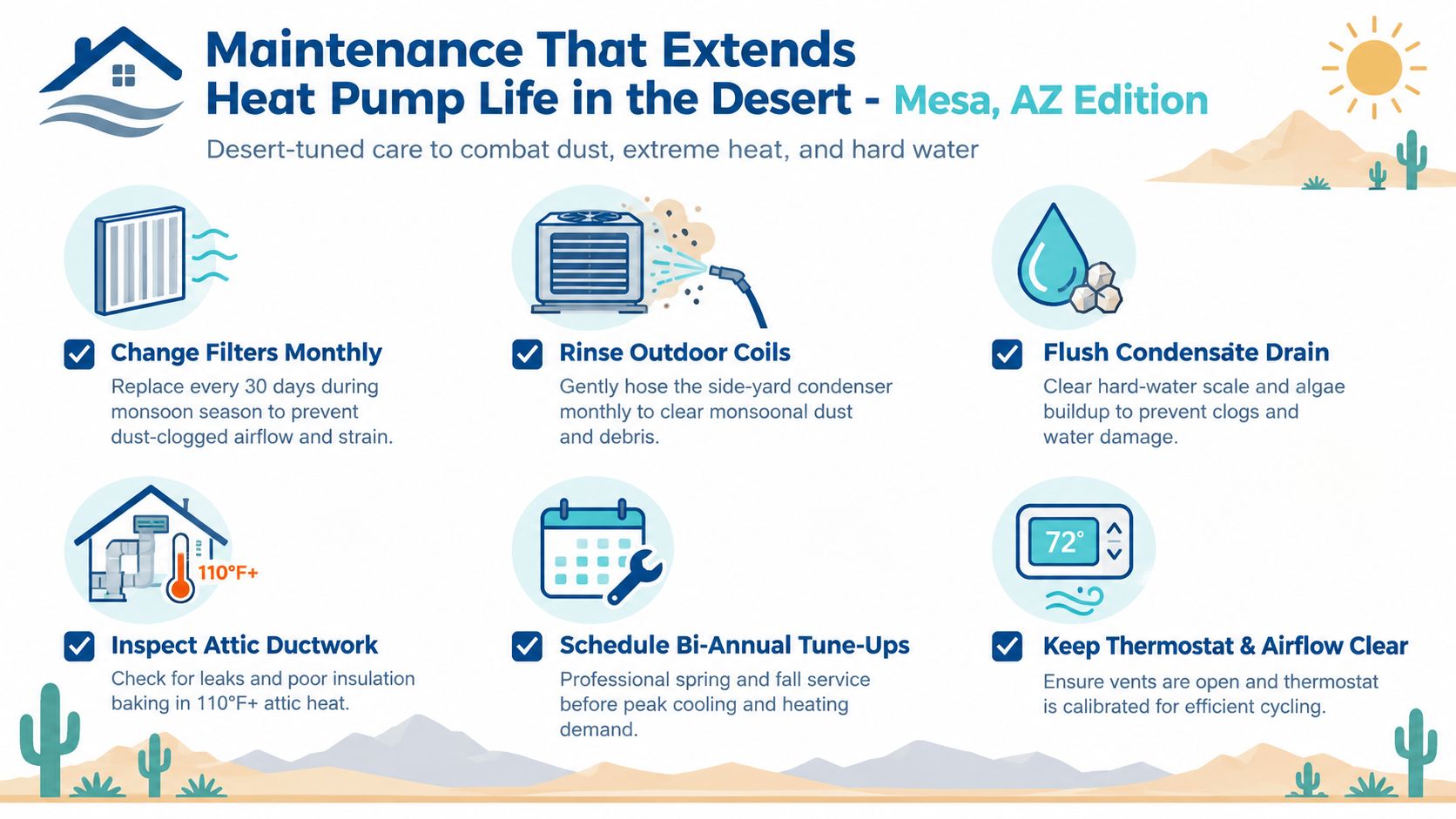
Maintenance That Extends Heat Pump Life in the Desert
Desert maintenance must address more than a standard filter reminder. Dust, monsoon debris, intense sun, attic heat, and condensate buildup all affect how hard a heat pump works.
A practical Mesa routine
- Change filters monthly during monsoon season: Dust-loaded filters restrict airflow and make the blower work harder. Filter needs vary by home, pets, construction, and indoor air quality equipment.
- Rinse outdoor coils gently: A low-pressure rinse after significant dust exposure can clear debris. Power washers can bend fins and damage the coil.
- Flush the condensate drain every six months: Algae and mineral buildup can block drainage and cause water to back up.
- Keep the side-yard unit clear: Maintain open airflow around the condenser and remove leaves, cottonwood debris, and windblown material.
- Inspect attic ducts: Leaks, damaged insulation, and extreme attic temperatures can undermine comfort even when the heat pump itself works correctly.
- Schedule professional service in spring and fall: A tune-up should include refrigerant checks, capacitor testing, coil inspection, electrical review, airflow evaluation, and thermostat calibration.
Maintenance can extend useful life, but it can't reverse a worn compressor or a leaking coil. No verified source supports promising that a specific maintenance routine adds a fixed number of years, so homeowners should treat maintenance as risk reduction, performance protection, and earlier fault detection.
Next Steps Inspection Quotes and Choosing a Mesa Installer
Once replacement becomes the likely choice, the next step shouldn't be a phone quote based only on the old model number. Arizona homes often have mismatched equipment, leaky ducts, uneven airflow, or rooms that were added after the original system was installed.
A proper evaluation should include an in-home load calculation and duct inspection. ACCA system sizing helps determine the home's heating and cooling load, while Manual S guides equipment selection. The installer should explain whether the existing ductwork, air handler, thermostat, and electrical components are suitable for the proposed heat pump.
Compare quotes line by line
A written proposal should identify:
- Equipment model numbers: The exact indoor and outdoor equipment matters more than a product family name.
- SEER2 and HSPF2 ratings: Confirm the efficiency rating for the matched system.
- Refrigerant type: The proposal should state whether the system uses R-454B or another approved refrigerant.
- Scope of work: Look for duct modifications, thermostat setup, condensate work, old-unit removal, commissioning, and permits.
- Warranty terms: Separate compressor coverage from parts and labor conditions.
- Sizing method: Ask whether the contractor completed a load calculation rather than matching the old capacity.
Homeowners can use this Arizona homeowners AC guide when comparing proposals. A contractor who refuses to provide model numbers, pushes a same-day decision, or avoids discussing sizing deserves caution.
The installer should also demonstrate Arizona experience, hold the required ROC license, and provide technicians with relevant training such as factory training and ongoing education when applicable. Experience with Mesa and East Valley heat pumps matters because proper commissioning, airflow, duct performance, and outdoor-unit placement all affect results.
The decision can be summarized. A younger heat pump with one isolated failure usually merits repair. A system near the low-desert replacement window, with repeated repairs, weaker comfort, rising energy use, or a major refrigerant or compressor problem, should be evaluated for replacement before another Phoenix summer.
Comfort Experts provides heat pump diagnostics, repair, maintenance, and replacement evaluations for Mesa and East Valley homes. Homeowners can visit Comfort Experts, call 480-207-1239, or schedule service to arrange an in-home assessment and compare repair with replacement based on the equipment's actual condition.