
Published by Comfort Experts in Mesa, Arizona. Updated August 2026. This guide is for homeowners comparing new HVAC equipment; always follow the exact equipment label and manufacturer instructions.
If you are shopping for a new air conditioner or heat pump, you may see two unfamiliar refrigerants on proposals: R-32 and R-454B. Both are lower-global-warming-potential alternatives used in newer equipment, both carry an A2L safety classification, and both can work well in Arizona when the system is designed, installed, and commissioned correctly.
The useful answer is not “one refrigerant wins.” R-32 has attractive capacity, efficiency, and service characteristics. R-454B has a lower published GWP and was selected for most of Trane’s current residential portfolio. But the complete system; the compressor, coils, controls, airflow, certified equipment match, and high-ambient operating envelope; matters more than the refrigerant name by itself.
R-32 is a single-component refrigerant with no temperature glide and strong capacity and efficiency potential. R-454B is a near-azeotropic blend with a lower GWP and operating characteristics intended to stay relatively close to R-410A. Neither is a drop-in substitute for the other, and neither belongs in equipment designed for R-410A.
For an Arizona homeowner, compare the exact equipment model, AHRI-certified match, delivered capacity at high outdoor temperatures, installer quality, warranty, parts support, and serviceability. Choose the system; not just the refrigerant.
Why R-32 and R-454B are showing up now
The American Innovation and Manufacturing Act directed the Environmental Protection Agency to phase down higher-GWP hydrofluorocarbons. EPA’s Technology Transitions rules began restricting certain higher-GWP products and new systems as early as January 1, 2025. For residential and light-commercial air conditioning and heat pumps, a key threshold is a GWP limit of 700 for covered new equipment and systems.[1]
That threshold does not force every manufacturer to use the same refrigerant. EPA lists both R-32 and R-454B as acceptable for qualifying new residential and light-commercial air-conditioning and heat-pump equipment, subject to use conditions.[2] Manufacturers then design equipment around the refrigerant that fits their engineering, product, supply, and environmental goals.
EPA’s current rule does not restrict the continued use of existing refrigeration, air-conditioning, and heat-pump systems. Existing equipment can be serviced and repaired through its useful life, including component replacement.[1] A working R-410A system does not need to be replaced solely because newer equipment uses R-32 or R-454B. Our guide to AC refrigerant and “Freon” terminology explains how R-22, R-410A and the newer refrigerants fit together.
R-32 vs. R-454B at a glance
| Category | R-32 | R-454B | What it means for a homeowner |
|---|---|---|---|
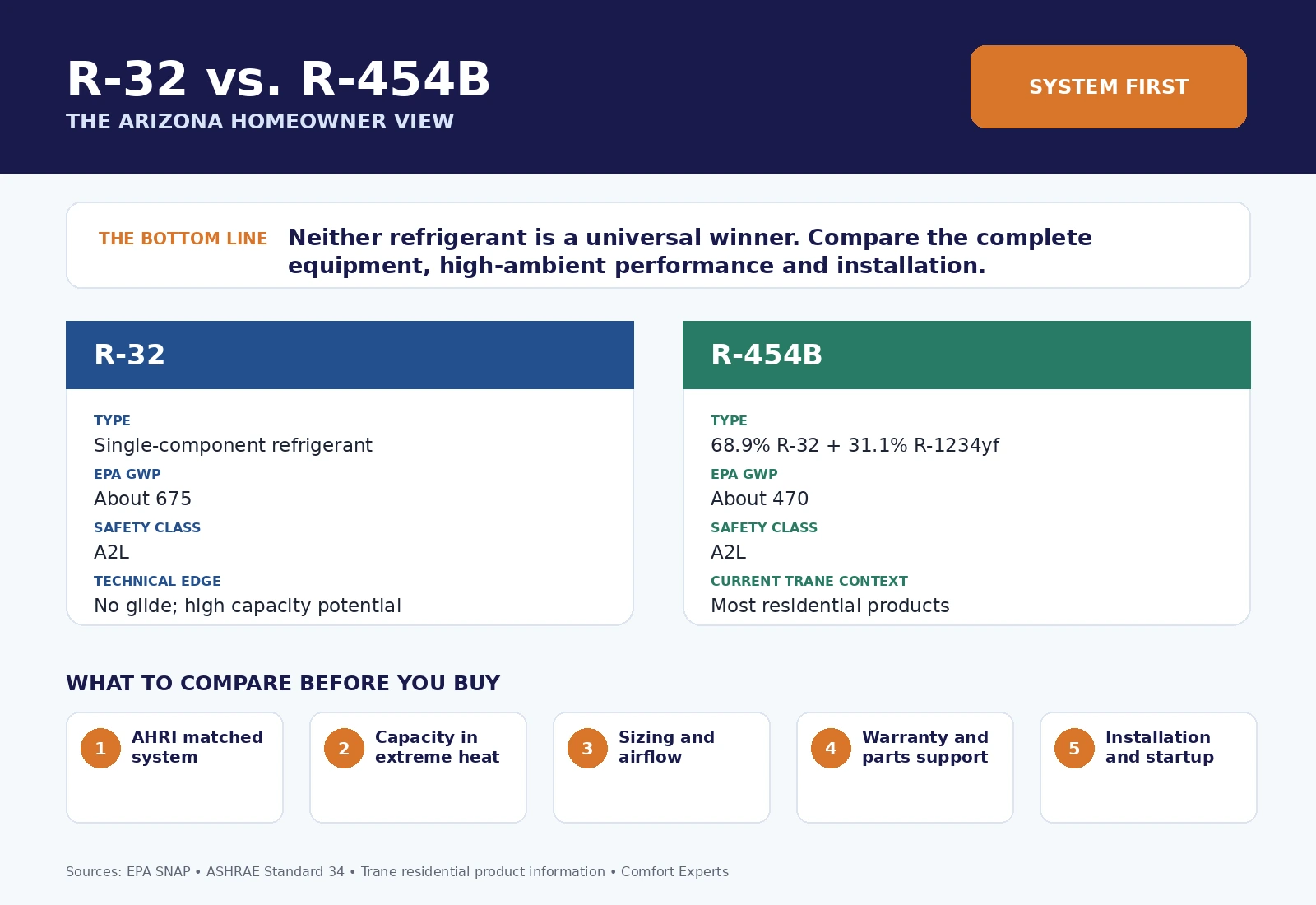
| Type | Single-component HFC refrigerant | Blend of 68.9% R-32 and 31.1% R-1234yf by mass | R-32 is chemically simpler; R-454B is engineered to combine properties of two components. |
| EPA-listed GWP | About 675 | About 470 | Both fall below the 700 threshold; R-454B has the lower direct climate-impact number. Published values can differ slightly by assessment basis and rounding. |
| Safety classification | A2L | A2L | Both require equipment and service procedures designed for lower-flammability refrigerants. |
| Temperature glide | None | Low, but not zero | Technicians must follow the charging procedure for the exact refrigerant and equipment. |
| Capacity potential | Generally higher volumetric capacity | Closer to R-410A in many designs | The manufacturer may optimize compressor size, coil design, charge, and controls differently. |
| Discharge temperature | Generally higher | Generally closer to R-410A and lower than R-32 | Compressor and control design must account for the refrigerant’s operating characteristics. |
| Service handling | Single component; no blend fractionation concern | Blend; charge as a liquid and follow OEM procedures | Neither is a homeowner DIY material. Use a trained technician with A2L-compatible equipment. |
| Current Trane context | Used in some Trane products | Used by most current Trane residential products | Comfort Experts prefers Trane equipment but can install other brands when another system is the better fit. |
The composition and A2L classifications come from ASHRAE Standard 34 materials.[9] EPA’s current substitute table lists R-32 at approximately 675 GWP and R-454B at approximately 470 GWP.[2]
What the A2L classification actually means
ASHRAE classifies both R-32 and R-454B as A2L.[9] In that system, “A” indicates lower toxicity and “2L” identifies a lower-flammability refrigerant with a low burning velocity.[9] “Mildly flammable” does not mean “use it exactly like R-410A,” and it does not mean a properly designed system is waiting to catch fire.
New A2L equipment can include updated labeling, refrigerant detection or mitigation controls where required, and installation requirements tied to equipment charge and occupied-space volume. Technicians must verify that recovery machines, vacuum pumps, leak detectors, cylinders, and other tools are suitable for A2L work. They also follow the equipment manufacturer’s instructions and current code requirements.[14]
For the homeowner, the practical rule is simple: do not mix refrigerants, do not treat a new system like an old one, and do not hire someone who shrugs at the equipment label.
Where R-32 has a real advantage
Single-component simplicity
R-32 is one refrigerant rather than a blend. Arkema’s technical guide notes that it has no temperature glide and no blend-fractionation concern, which can simplify recovery and refrigerant management.[4]
High capacity potential
R-32 has high volumetric capacity. That can allow an OEM to achieve a target capacity with a lower mass flow rate, a smaller refrigerant charge, or differently sized components; but only when the equipment is designed around it.[4]
Strong thermodynamic potential
R-32 can perform very efficiently in equipment optimized for it. Daikin explicitly considers energy efficiency across very hot and very cold conditions when selecting refrigerants for its products.[11]
Tradeoff: discharge temperature
R-32 generally runs a higher compressor discharge temperature than R-454B. That is not automatically a defect; it is an engineering condition the compressor, controls, lubricant, and operating envelope must handle.
What about the reported 11% efficiency advantage?
A frequently repeated number comes from Daikin representatives discussing a specific inverter-compressor rooftop unit tested with identical hardware. In that commercial-unit configuration, R-32 improved IEER by 11% compared with R-454B.[6]
That is useful technical evidence, but it is not proof that every R-32 residential system is 11% more efficient than every R-454B residential system. It was a particular commercial test, in particular hardware, reported by a manufacturer that supports R-32. Residential systems designed separately around each refrigerant can produce a different result.
Where R-454B has a real advantage
Lower published GWP
EPA’s listed GWP is approximately 470 for R-454B versus approximately 675 for R-32.[2] That makes R-454B the lower direct-emissions choice on this particular measure.
Closer to R-410A behavior
R-454B was developed to remain relatively close to R-410A in capacity and operating characteristics. That can help manufacturers transition established product platforms while still redesigning the system for the new refrigerant.
Lower discharge temperature than R-32
Industry testing and technical reporting generally place R-454B discharge temperature closer to R-410A and below R-32. That can provide additional compressor-design margin, especially as condensing temperatures rise.[14]
Which refrigerant performs better in Arizona heat?
Neither refrigerant wins automatically. That may feel unsatisfying, but it is the technically honest answer.
When outdoor temperature climbs, the system must reject heat into hotter air. Condensing pressure, compressor lift, discharge temperature, fan power, controls, coil surface area, refrigerant charge, and airflow all matter. A strong refrigerant in weak equipment is still weak equipment. A carefully engineered system can manage the tradeoffs of either refrigerant.
A Department of Energy and Oak Ridge National Laboratory high-ambient evaluation demonstrates why the whole system matters. The researchers tested lower-GWP candidates in existing rooftop equipment at conditions including 114.8°F outdoors and an “extreme” condition above that. R-32 showed strong capacity in the unoptimized test platform, but its relative efficiency changed at the most extreme condition and its higher discharge temperatures remained an engineering consideration.[10] The report itself explains that modest differences can often be changed through system optimization.
Ask for the manufacturer’s extended performance data for the exact matched system; not a generic claim about the refrigerant. Look for delivered cooling capacity, watts or EER, compressor limits, and any derating near the outdoor temperatures your home actually sees.
What Trane’s refrigerant choice means for Comfort Experts customers
Trane is Comfort Experts’ preferred equipment brand, although we can install other brands when the home, application, or proposal calls for something else. Trane’s current residential direction makes this comparison especially relevant: the manufacturer says most residential products use R-454B, while some products use R-32.[7]
Trane’s 2025 residential portfolio announcement says the redesigned lineup was performance-optimized for R-454B and tested in its System Extreme Environmental Test lab. The current lineup includes variable-speed, multi-speed, and single-stage options rather than one universal design.[8]
That is the right way to think about this transition. A Trane R-454B system should be judged as a complete Trane system. An R-32 system from another manufacturer should be judged as that manufacturer’s complete system. Comparing refrigerants while ignoring the equipment is like comparing engine oil while ignoring the engine.
If you are also comparing manufacturers, the existing Trane vs. Goodman air-conditioner guide explains why model, installer support and total system fit matter more than the badge alone.
Seven things that matter more than the refrigerant label
- Correct load sizing. Replacing the old unit with the same tonnage is not a load calculation. Arizona sun exposure, windows, insulation, ducts, infiltration, and occupancy affect the result.
- A certified matched system. The outdoor unit, indoor coil or air handler, furnace where applicable, and controls should form an approved match. Ask for the AHRI reference number and verify it in the AHRI Directory.[12]
- High-ambient performance. Standard efficiency ratings are important, but Arizona buyers should also ask how much capacity the exact system delivers as outdoor temperature rises.
- Ductwork and airflow. Static pressure, return-air capacity, supply restrictions, leakage, and balancing can ruin a premium equipment purchase.
- Installation and commissioning. Evacuation, pressure testing, refrigerant charge, airflow setup, electrical setup, drainage, and control configuration all affect reliability and performance.
- Warranty and parts support. Compare parts coverage, labor coverage, registration requirements, local parts availability, and who will service the equipment during peak season.
- The proposal’s total value. Compare exact models, included work, efficiency, comfort features, noise, controls, electrical or duct modifications, maintenance, and financing terms; not just the bottom-line price.
Can R-32 and R-454B be mixed or swapped?
No. R-32 and R-454B are not interchangeable even though R-32 is one component of the R-454B blend. Equipment components, controls, safety provisions, lubricant strategy, charge, and operating envelope are selected for a specific refrigerant.
Neither refrigerant should be used as a field retrofit in equipment designed for R-410A. Use only the refrigerant printed on the equipment nameplate and required by the manufacturer. If a proposal suggests “converting” an existing R-410A condenser by changing refrigerant, that is a red flag.
Common myths about the refrigerant transition
A practical checklist for your next AC estimate
When comparing a new air conditioner or heat pump, ask each contractor for the same information. The Arizona AC replacement quote checklist gives you a separate proposal-by-proposal worksheet.
- The exact outdoor and indoor model numbers
- The refrigerant used by that exact system
- The AHRI certificate or reference number
- The system’s SEER2, EER2, and heat-pump HSPF2 ratings where applicable
- Extended cooling performance at relevant high outdoor temperatures
- The sizing method used for your home
- Any required duct, electrical, drain, line-set, pad, or control changes
- Parts and labor warranty details
- Local parts and service support
- What is included in startup and commissioning
If one contractor talks only about refrigerant and another can explain the complete equipment match, load, airflow, high-ambient data, installation scope, and warranty, the second conversation is usually more useful.
Frequently asked questions
Is R-32 better than R-454B?
Not universally. R-32 is a single-component refrigerant with strong capacity and efficiency potential. R-454B has a lower published GWP and generally lower compressor discharge temperature. The better purchase is the complete system that fits the home, performs at Arizona temperatures, and has strong installation and service support.
Which refrigerant is better for Arizona heat?
Neither one wins solely because of its chemistry. Ask for high-ambient performance data for the exact matched equipment. Coil size, condenser airflow, compressor design, controls, charge, and installation quality can outweigh the theoretical refrigerant difference.
Does Trane use R-32 or R-454B?
Trane says most of its residential products use R-454B and some products use R-32. Confirm the refrigerant on the exact model and equipment label before purchase.
Is R-454B safer than R-32?
Both are classified A2L by ASHRAE. Their specific flammability characteristics are not identical, but both require equipment, installation, and service procedures intended for A2L refrigerants. Homeowners should rely on listed equipment and trained technicians rather than trying to choose based on the safety label alone.
Can I put R-32 into an R-454B system?
No. The refrigerants are not interchangeable. Use only the refrigerant specified on the equipment nameplate and in the manufacturer instructions.
Can R-32 or R-454B replace R-410A in my current AC?
No. These refrigerants are intended for equipment designed for them, not as a drop-in conversion for an existing R-410A air conditioner or heat pump.
Will R-32 be phased out soon?
Under current federal rules, R-32 remains EPA-listed as acceptable with use conditions for qualifying new equipment and falls below the current 700-GWP threshold. Policy can continue evolving, so compare current equipment, manufacturer support, and service availability rather than trying to predict decades of regulation from one headline.
Do I need to replace my R-410A system now?
No. If the system is operating safely and economically, the refrigerant transition alone is not a reason to replace it. Existing systems can continue to be used and repaired. Replacement becomes a practical decision when age, repair cost, efficiency, comfort, reliability, or parts and refrigerant economics justify it.
Compare the complete system; not just R-32 vs. R-454B
Comfort Experts can evaluate your current system, explain repair versus replacement, and compare equipment options for your Mesa or East Valley home. Trane is our preferred equipment brand, but we can install other brands when another option makes more sense for the application.
Sources and further reading
- U.S. EPA; Technology Transitions HFC Restrictions by Sector
- U.S. EPA; Substitutes in Residential and Light Commercial Air Conditioning and Heat Pumps
- Arkema; Forane R-32 Technical Guide
- ACHR News; An HVAC Technician’s Guide to R-32
- Trane; What Is R-454B Refrigerant?
- Trane; Refreshed Residential Product Portfolio with R-454B
- ANSI/ASHRAE; Standard 34 Addendum for R-32 and R-454B
- U.S. Department of Energy / Oak Ridge National Laboratory; High-Ambient Refrigerant Evaluation
- Daikin; Key Considerations for Refrigerant Choice
- AHRI Directory of Certified Product Performance
- ACHR News; An HVAC Technician’s Guide to R-454B