Are you tired of the constant sneezing, itchy eyes, and stuffy nose that allergies bring into your home? Picking the best HVAC filters for allergies is often the single most impactful move you can make to clear the air and finally get some relief. For most folks struggling with allergies, a pleated media filter with a MERV rating between 11 and 13 is the sweet spot, providing a powerful defense without overworking your AC system.
Your HVAC Filter Is Your First Defense Against Allergies
Here in Phoenix and Mesa, we live with a year-round storm of desert dust, pollen, and other airborne irritants. That makes your HVAC filter way more than just a maintenance part—it's the bouncer at the door of your home's air supply. It’s the main barrier standing between all those invisible allergens and the air your family breathes.
A cheap, flimsy filter might catch the big dust bunnies, but it lets the real troublemakers—the tiny particles that actually set off your allergies—sail right on through to get circulated again and again. Honestly, that's just not going to cut it if you're serious about feeling better.
The Role of Your Filter in a Healthy Home
Every time your air conditioner or heater kicks on, it sucks in air from your rooms, runs it through the system, and pushes it back out. That constant cycle is where the filter does its job. A good filter is designed to grab and hold onto those microscopic particles as the air zips past.
This is a huge deal for allergy sufferers because it cuts down the sheer volume of triggers floating around your house. Without an effective filter, your HVAC system accidentally becomes an allergen delivery service, blasting irritants into every single room.
An effective air filter doesn't just protect your AC unit from getting clogged with dust. It actively scrubs the air, pulling out the exact particles that cause sneezing, itchy eyes, and that tight-chest feeling.
Why Phoenix-Area Air Quality Matters
Living in the Valley means dealing with a unique menu of airborne gunk. Are you constantly battling a layer of dust on every surface? It's not just you. We're constantly up against:
- Persistent Dust: Our dry climate means fine dust is everywhere, all the time, just waiting to get kicked up.
- Seasonal Pollen: From the yellow blizzard of palo verde in the spring to ragweed in the fall, there's always something blooming.
- Pet Dander: We love our pets, but their dander is one of the most common indoor allergens around here.
- Mold Spores: You might not think "mold" in a desert, but spores can easily grow in damp spots and get into the air.
Choosing the right filter is your first and most powerful weapon against these local irritants. As you'll see in this guide, understanding the different ratings and types is the key to making a smart choice for a healthier home. Of course, keeping the whole system in shape is just as important; you can find more on that in our guide to AC maintenance tips for Arizona residents.
Decoding MERV Ratings for Allergy Relief
When you're trying to hunt down the best HVAC filters for allergies, there's one term that matters more than any other: MERV.
It stands for Minimum Efficiency Reporting Value, which is really just a fancy way of telling you how good a filter is at catching tiny particles floating in your air. Think of it as a report card for your filter’s ability to trap the junk that makes you sneeze. Let me explain.
A low-MERV filter is like a fishing net with giant holes. It’ll catch the big stuff—dust bunnies, pet hair—but microscopic pollen, dander, and mold spores sail right on through. They get sucked into your AC and blown right back out into the air you’re breathing. Not exactly helpful, right?
On the flip side, a filter with a high MERV rating is more like a fine-mesh screen. It’s designed to trap much smaller particles, scrubbing them from the air before they can find their way into your lungs. Getting a handle on this scale is the first real step toward finding relief.
Your HVAC filter is a critical chokepoint in your home’s defense system against allergens, as you can see below.
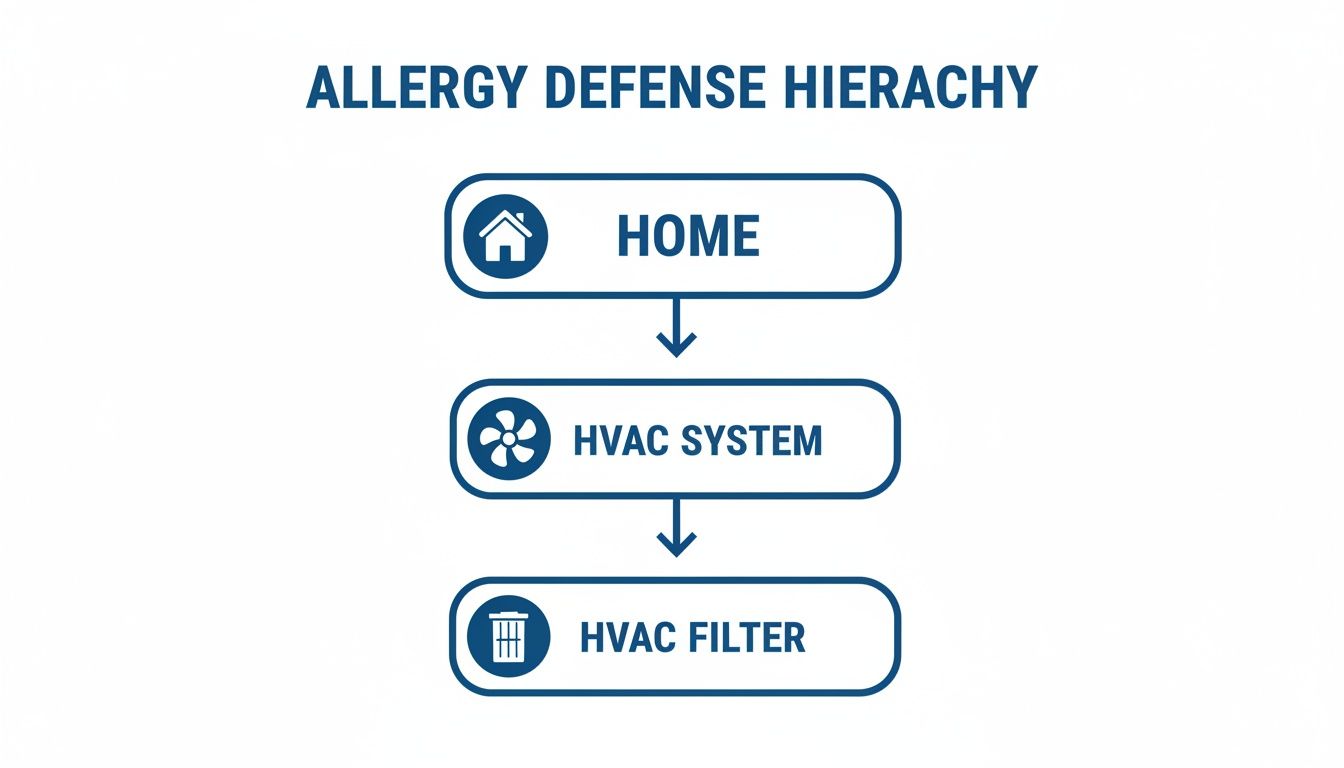
While your whole home is the environment, your HVAC system controls the air. And the filter? That's the gatekeeper.
Finding the Allergy Sweet Spot
So, what MERV rating should you be looking for? It’s all about finding the right balance between powerful filtration and healthy airflow. You want to trap allergens, not choke your air conditioner.
Here’s a simple breakdown of what the numbers mean for your allergies:
- MERV 1-4: These are your basic, cheap fiberglass filters. They mostly just protect your HVAC equipment from big debris. They do next to nothing for allergy sufferers.
- MERV 5-8: This is a decent starting point. Filters in this range can grab things like mold spores and dust mite debris. A MERV 8 is a solid baseline for improving general air quality.
- MERV 11-13: This is the sweet spot for most people with allergies. These high-efficiency pleated filters are dense enough to trap fine particles like pollen, pet dander, and even some bacteria, usually without starving your system for air.
- MERV 14-16: These offer incredible, near-HEPA level filtration. But be careful. Their super-dense material can restrict airflow so much that it strains your AC’s motor and drives up your energy bills if your system isn’t built for it.
For Phoenix homeowners dealing with our constant dust and seasonal pollen, a MERV 11 to MERV 13 filter delivers the best defense against common local allergens without putting your air conditioner at risk.
The Science Behind MERV and Allergy Relief
Picking the right MERV rating isn’t just a hunch; it’s backed by real-world proof. As professionals in the HVAC field since 2011, we at Comfort Experts have seen first-hand the difference a filter upgrade makes. Study after study shows that upgrading your filter is one of the most direct ways to improve your indoor air quality. Researchers looking at allergic rhinitis, for example, have seen major drops in both dust mite levels and allergy symptoms just by using better filters.
Even better, computer models show that a MERV 13 pleated filter can slash airborne cat allergen by an incredible 65-90% compared to a basic fiberglass filter. This is exactly why jumping from a low-MERV filter to one in the MERV 11-13 range feels like such a game-changer for families with pets or pollen sensitivities.
The trick is simply matching the filter's strength to your system's capability, which you can learn more about how higher-rated filters tackle allergens and protect your equipment.
Comparing the Most Common Types of HVAC Filters
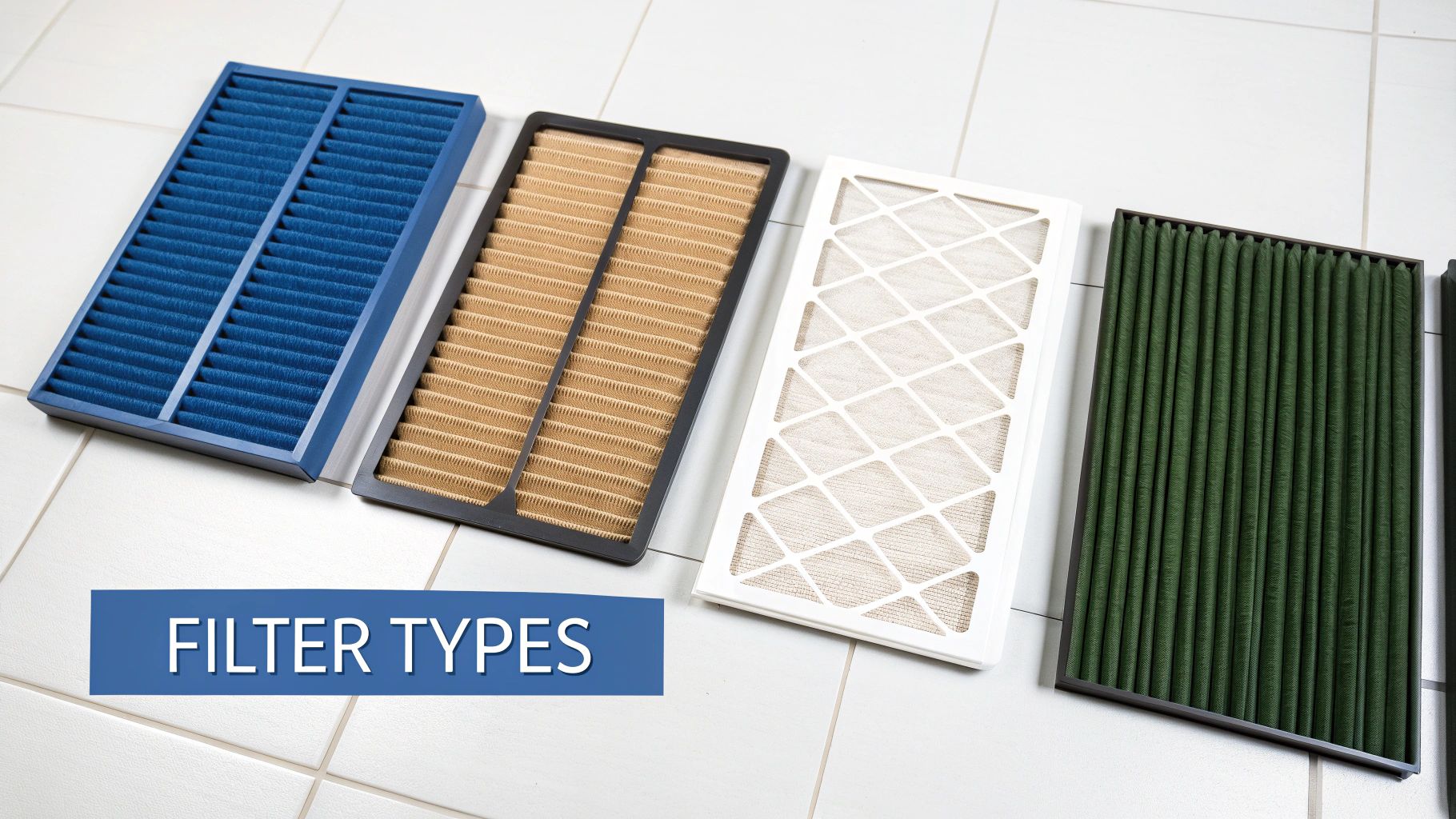
Knowing your target MERV rating is half the battle. The other half is understanding that not all filters are built the same, even if they share a number on the box. The materials and design play a huge role in how a filter actually performs, impacting everything from its allergen-trapping ability to how long it lasts.
Think of it like making coffee. You wouldn't use a paper filter for an espresso machine, and you wouldn't use a metal basket for a pour-over. Each one is designed for a specific job, and picking the right one is the key to getting the result you want—in our case, clean, breathable air.
Fiberglass Filters: The Bare Minimum
These are those cheap, flimsy, often blue filters you can practically see through. Their main job isn't to clean your air; it's to protect your HVAC system from big stuff like dust bunnies, pet hair, and debris that could clog it up.
With a low MERV rating (typically 1-4), they do almost nothing to capture the microscopic particles that make your allergies go crazy. While they're very cheap and don't restrict airflow, they aren't a real solution if you're serious about finding the best HVAC filters for allergies.
Pleated Filters: The Allergy Sufferer’s Go-To
This is where true indoor air quality improvements begin. Pleated filters, usually made from paper or polyester, are folded into an accordion-like shape. This simple design trick dramatically increases the filter's surface area.
More surface area means the filter can trap a much higher volume of contaminants before it gets clogged and starts choking your system's airflow. It’s why they can hit those desirable MERV 11-13 ratings that are so good at grabbing pollen, mold spores, and pet dander. For most homes in the Phoenix area, a quality pleated filter is the perfect sweet spot between performance and price.
A pleated filter's design allows it to hold significantly more particles than a flat fiberglass filter. This extended capacity not only improves filtration but also helps maintain proper airflow to your HVAC system for longer.
Washable Electrostatic Filters: A Reusable Option
The idea behind electrostatic filters is appealing: buy one, wash it, and reuse it for years. These filters use self-charging fibers to create a static field that attracts airborne particles like a magnet. They're pretty good at capturing fine particles and are an eco-friendly choice.
But there's a major catch, especially in a dusty place like Arizona. They demand frequent and thorough cleaning—often monthly—to stay effective. If you don't clean them perfectly, they can quickly become a breeding ground for mold and bacteria, which is the last thing an allergy sufferer needs. Our experience shows that the maintenance commitment is often more than homeowners bargain for.
| Filter Type | Pros | Cons | Best For |
|---|---|---|---|
| Fiberglass | Very inexpensive, maximum airflow. | Does not capture small allergens. | Protecting HVAC equipment only. |
| Pleated | Excellent allergen capture, good airflow, cost-effective. | Must be replaced regularly (1-3 months). | Most homeowners with allergies. |
| Electrostatic | Reusable and long-lasting, good at trapping fine dust. | Requires frequent, thorough cleaning; can lose effectiveness. | Eco-conscious homeowners without severe allergies. |
| HEPA | Unmatched filtration of microscopic particles. | Severely restricts airflow; requires professional modification. | Homes with medical-grade air quality needs. |
HEPA Filters: The Gold Standard
HEPA stands for High-Efficiency Particulate Air, and these filters are the undisputed champions of filtration. To earn the HEPA name, a filter must be certified to capture at least 99.97% of airborne particles down to 0.3 microns in size. We’re talking about trapping tobacco smoke, bacteria, and the tiniest of allergy triggers.
But here’s the reality check: HEPA filters are so dense that they’re too restrictive for almost any standard residential HVAC system. Forcing your AC to breathe through one would be like trying to run a marathon while breathing through a straw—it would strain your equipment and could cause serious damage.
True HEPA filtration usually requires a separate, professionally installed whole-home air purification system that works alongside your existing setup. Fortunately, many high-MERV pleated filters offer near-HEPA performance, with some certified to remove over 92% of dust mite debris and 95% of pollen while maintaining safe airflow. You can discover more insights about how top-tier filters reduce allergens on totalcomfortcooling.com.
The Hidden Danger of Restricting HVAC Airflow
It’s tempting to grab the filter with the highest possible MERV rating, thinking more is always better for allergies. You know what? This is one of the most common—and potentially expensive—mistakes a homeowner can make. A filter that’s too dense for your specific HVAC system acts like a dam in a river, choking off the airflow your unit needs to do its job.
Think of it like trying to breathe through a thick wool blanket. Your lungs would have to work way harder to pull in enough air. Your HVAC system’s blower motor faces that exact same struggle when you install a filter that's too restrictive. This strain doesn't just make your system less efficient; it sets the stage for some pretty serious mechanical failures.
What Happens When Airflow Is Too Low
When your system can't pull in enough air, a dangerous chain reaction starts. The lack of warm indoor air moving across the evaporator coil—the part that gets ice-cold to cool your home—can cause its temperature to plummet below freezing. This leads to a buildup of ice, which can completely encase the coil.
A frozen coil can't transfer heat, which means your AC will run and run without actually cooling your home. Here in the Phoenix area, an iced-over coil on a 110°F summer day is a true emergency that can lead to compressor failure—one of the most expensive repairs you can face.
Restricting airflow with an overly dense filter forces your entire system to work harder for longer. This not only spikes your monthly energy bills but also dramatically shortens the lifespan of critical components like the blower motor and compressor.
Finding Your System's MERV Limit
So, how do you find the right balance? Most residential HVAC systems are designed to handle filters up to a certain MERV rating. Going beyond that limit is just asking for trouble.
Here are a few tell-tale signs that your filter is too restrictive for your system:
- Loud Noises: You might hear a whistling or straining sound from your air handler or vents as the system struggles for air.
- Reduced Airflow: The air coming from your vents just feels weaker than it used to.
- System Short-Cycling: The unit turns on and off more frequently because it's overheating from the strain.
Every HVAC unit has a maximum recommended MERV rating specified by the manufacturer. You can often find this in the owner's manual or on a label inside the air handler cabinet. If you can't find it, it's far safer to stick within the MERV 8-13 range for most standard systems. Pushing into the MERV 14-16 territory without getting a professional to confirm your system can handle it is a significant risk.
Dirty ductwork can also contribute to poor airflow, making the problem even worse. You can learn more about how professional duct cleaning services can remove hidden blockages and restore proper circulation throughout your home. Before you make a major filter upgrade—especially if you have severe allergies and are eyeing a very high-MERV option—a professional consultation is the safest route to protect your investment and ensure your comfort.
Advanced Solutions for Whole-Home Air Quality
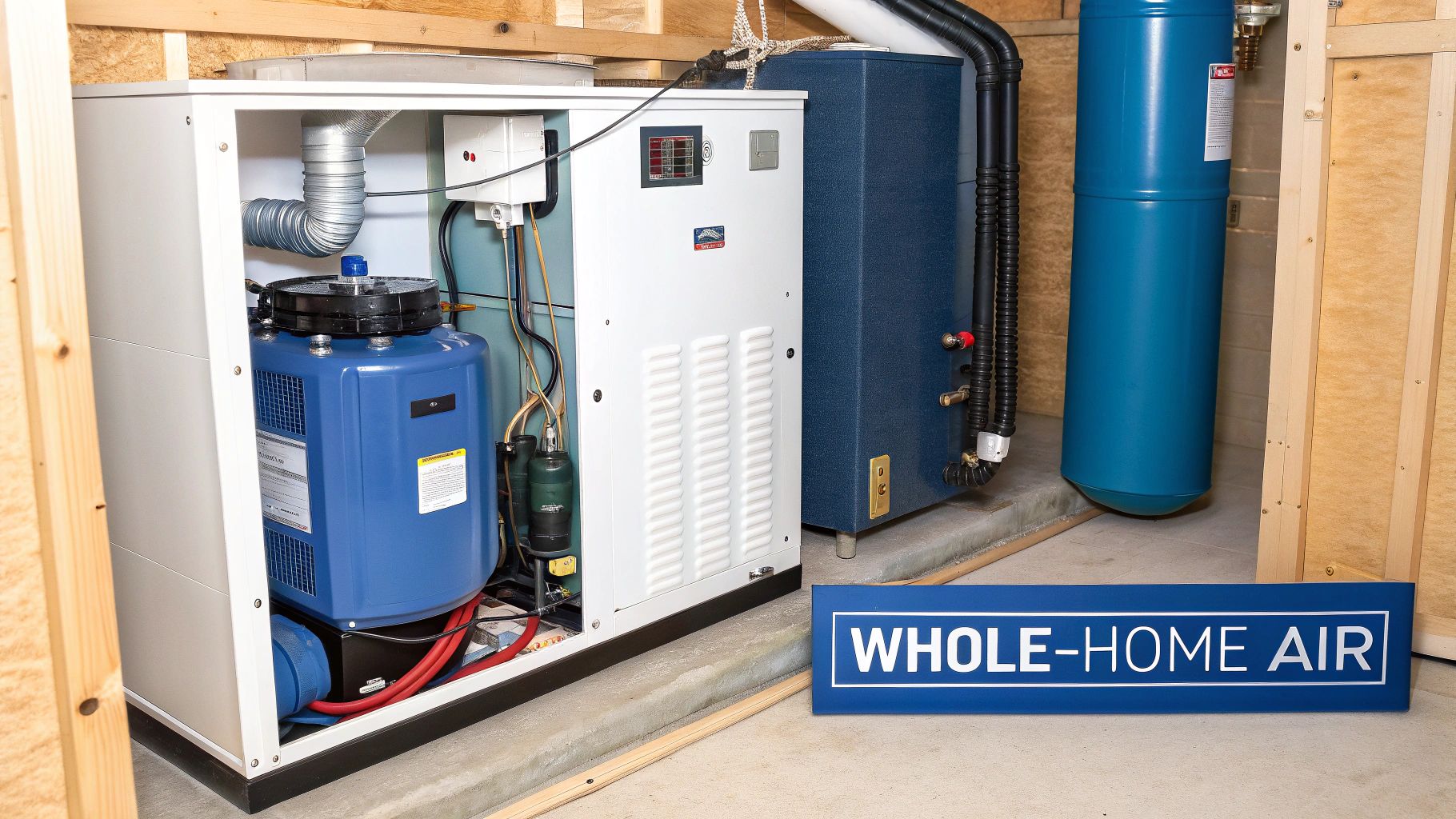
Let’s be honest: sometimes even the best HVAC filters need backup. Here’s the thing, this is especially true here in the Phoenix area for families dealing with severe allergies, asthma, or other respiratory issues. When a high-MERV filter just isn’t cutting it, you can step up your game with advanced, whole-home solutions that work with your filter to create the cleanest possible air.
Think of it this way: your filter is like a net catching the bigger particles. These advanced systems are the specialized tools that go after the microscopic threats the net might miss. For families who are serious about pure air, this is the next level of defense.
UV Air Purifiers: A Light That Kills
You’ve probably seen UV light used for sterilization in hospitals or doctor's offices. Well, that same powerful technology can be installed right inside your HVAC system’s ductwork. UV air purifiers use ultraviolet light to zap biological contaminants that are often too small for even good filters to reliably trap.
As your system’s fan moves air past the lamp, the UV-C light waves scramble the DNA of microorganisms. This zapping process stops them from reproducing and renders them harmless.
- Mold Spores: Kills airborne mold spores before they can circulate and find a damp spot to grow.
- Bacteria and Viruses: Helps knock down the spread of airborne germs and bacteria throughout your home.
This technology is a silent guardian, working 24/7 to scrub your air of the living organisms that can trigger nasty allergic reactions and illnesses.
Electronic Air Cleaners: Superior Filtration Without the Strain
One of the biggest downsides to a high-MERV filter is the potential for restricting airflow and making your system work harder. Electronic air cleaners get around this problem in a pretty ingenious way. Instead of relying on a super-dense physical barrier, these systems use an electrostatic charge to pull particles out of the air like a powerful magnet.
An electronic air cleaner can capture an incredible 95% of airborne particles down to 0.3 microns—including pet dander, dust, and pollen—without choking your HVAC system’s airflow. This makes them a fantastic high-performance option for systems that can't handle a thick, restrictive filter.
The Critical Role of Professional Duct Cleaning
Think of your home's ductwork as its lungs. Over the years, those hidden passages can get coated with thick layers of dust, pollen, pet dander, and who knows what else. It doesn’t matter how great your filter is if the allergens are already caked onto the inside of the ducts.
Every single time your AC or furnace kicks on, it can dislodge some of that settled gunk and blow it right back into your rooms. Professional duct cleaning is the only way to truly reset the system, removing those built-up reservoirs of irritants so your filter has a fighting chance.
A Multi-Layered Approach for Maximum Relief
For the best possible allergy relief, a layered strategy is always the winner. A good pleated filter is your first line of defense, but adding an air purifier or getting your ducts cleaned tackles the problem from entirely different angles. And the results are real. Did you know that just upgrading to a high-efficiency MERV 12 furnace filter can dramatically cut down allergy symptoms? A landmark 2011 study showed that HVAC servicing combined with MERV 12 filters led to a 26% reduction in morning symptoms and a 24% reduction in evening symptoms for allergy sufferers.
Your filter handles airborne particles, but comprehensively tackling allergens means going after sources like carpets, too. It can be helpful to understand what type of carpet cleaning is best for allergies to further improve your home’s air.
To explore these advanced options further, check out our guide on whole-home air purifiers and see how they can be integrated right into your existing system.
A Few Common Questions About Filters and Allergies
We get a lot of the same questions from homeowners in Mesa and Phoenix who are trying to get a handle on their allergies. Here are a few of the most common ones, answered in plain English.
How Often Should I Really Be Changing My Filter Here in Arizona?
If you’re dealing with allergies in a place as dusty as the Valley, you need to be more aggressive than the package says. For a typical 1-inch pleated filter, plan on changing it every 30-60 days.
If you have pets or we’re in the middle of a bad dust or pollen season, check it every month, no exceptions. A clogged filter doesn't just stop catching allergens; it chokes your entire AC system, making it work way too hard. That leads to higher bills and, eventually, a breakdown right when you need it most. For a deeper dive on this, check out our guide on how often you should change your air filters.
Can a High-MERV Filter Actually Help My Asthma?
Yes, without a doubt. The very things that trigger asthma attacks—dust mites, pet dander, mold spores, and pollen—are exactly what higher-rated filters (MERV 11-13) are built to trap. By pulling those microscopic troublemakers out of the air, you directly lower the concentration of irritants your family is breathing in.
This isn't just theory. Reducing the amount of junk floating around in your air often leads to real relief—fewer flare-ups and better breathing for anyone in the house with asthma or bad allergies. It’s one of the most direct ways to make your home a safer space.
Will a "Better" Filter Make My Energy Bill Go Up?
It’s a common worry, but the answer is usually no. The real energy hog isn't an efficient filter; it's a dirty one. Any filter, whether it's a cheap fiberglass one or a top-of-the-line pleated model, will spike your energy bill once it gets clogged with dust.
A filthy filter is like trying to breathe through a pillow—it restricts airflow and forces your system to run longer and harder just to keep up. The smart move is to use the highest MERV rating your system can handle without straining and then commit to changing it on schedule. A clean, high-MERV filter is always more efficient than a dirty, low-MERV one.
Partner with Phoenix's Air Quality Experts
Figuring out the world of indoor air quality—from MERV ratings to whole-home purifiers—can feel like homework you never signed up for. Picking the right filter is a great start, but creating a genuinely healthy home often takes a bit more than a trip to the hardware store. You don’t have to go it alone.
At Comfort Experts, we’ve been helping families across Mesa and the greater Phoenix Valley breathe easier since 2011. As a licensed and insured contractor (ROC #275914), our whole approach is built on trust and real-world expertise. We give you honest diagnostics and clear recommendations that are actually designed for your home, your family's allergies, and what your HVAC system can handle.
Your Local Team for Cleaner Air
Whether you need a hand picking the perfect filter for pollen season, you're thinking about a serious whole-home air purifier, or it's time for a professional duct cleaning to get rid of years of built-up gunk, we’re here to find solutions that work. We get the unique challenges our desert climate throws at us and know how to make a real difference in your home's air.
Knowing how to find the right partner for the job is half the battle. You can learn more about what to look for in our guide on how to choose an HVAC company you can actually trust.
When you're ready to get serious about winning the war against allergies, our experts at Comfort Experts are here to help. For a healthier, more comfortable home, give us a call at 480-207-1239 or schedule service online to get started.