

Getting a commercial hvac load calculation right isn't just a box to check—it's the single most important decision you'll make for your building's comfort and efficiency, especially in a demanding climate like Phoenix. Think of it as the blueprint for your entire system. Get it wrong, and you’re setting yourself up for high energy bills, uncomfortable tenants, and premature equipment failure.
The Cornerstone of an Efficient Commercial HVAC System

A proper commercial hvac load calculation is step one in protecting a massive business investment. It’s a scientific process, not a guess, that directly impacts your long-term operational costs, the comfort of your employees and customers, and how long that expensive equipment on your roof will actually last.
Honestly, in our decades of experience providing commercial HVAC services in the Phoenix area, the difference between a system that runs smoothly for years and one that’s a constant headache almost always traces back to this initial calculation. It’s where professional expertise, backed by real-world experience, proves its worth from day one.
Why It's Way More Than Just Square Footage
Have you ever wondered if there's an easy formula for sizing an AC unit? One of the most dangerous myths in our industry is that you can size a commercial unit based on square footage alone. In Arizona, that "rule of thumb" is a recipe for disaster. A professional load calculation digs into dozens of variables that a simple square-foot estimate completely misses.
We look at factors like:
- The Building Envelope: This is everything that separates your conditioned space from the desert outside—the R-value of your insulation, the type of roofing material, and the efficiency and orientation of your windows.
- Occupancy and Use: How many people are in the building on a typical day? A busy restaurant kitchen generates a completely different heat load than a quiet law office.
- Internal Heat Gains: All the heat coming off your computers, servers, lighting, and specialized machinery has to be accounted for.
- Local Climate Data: We use Phoenix-specific data for temperature, humidity, and sun angles to ensure your system can handle the brutal peak of a July afternoon without breaking a sweat.
Beyond the HVAC unit itself, a modern system should work as part of a bigger strategy. Integrating it with a comprehensive Building and Energy Management System is key to truly optimizing how your facility uses energy.
A correctly performed load calculation ensures you install a system that is perfectly matched to your building’s unique needs, preventing the costly consequences of both undersizing and oversizing from day one.
This analysis truly sets the standard for your entire system's performance for years to come. To see how we apply this detailed approach, learn more about our commercial HVAC solutions.
Why Accurate Load Calculation Is a Business Imperative
Viewing a commercial HVAC load calculation as just another technical step on a project plan is a massive business mistake. It's actually a strategic decision that directly protects your capital investment, dictates your long-term energy bills, and ensures your employees and customers are comfortable enough to be productive and stick around.
Getting this wrong has real, painful consequences that can haunt your business for years. And it’s a widespread problem—industry benchmarks show that improper sizing contributes to 20-40% of all commercial HVAC energy waste worldwide. Considering the global market hit a staggering US$88.6 billion in 2024, that's a monumental amount of wasted money.
The Hidden Costs of an Oversized System
You might think "bigger is better" when it comes to HVAC, but in the world of commercial air conditioning, that’s a recipe for expensive problems. An oversized unit is a huge headache, especially here in Arizona.
The core issue is a phenomenon called short-cycling. Because the unit is too powerful, it blasts the space with cold air, hits the thermostat's setpoint way too fast, and then shuts off. A few minutes later, it jerks back on. This rapid on-off-on-off cycle repeats all day long.
An oversized HVAC system might feel like it's working because it cools the air quickly, but it's one of the most inefficient and damaging ways to operate your equipment. The constant stop-and-start accelerates wear on critical components like compressors and fan motors.
Here’s the thing: this constant cycling doesn't just wear out your equipment faster. It also fails to properly manage humidity. A system needs longer, steadier run times to pull moisture from the air—something an oversized unit never achieves. During Arizona's monsoon season, this leaves your building feeling cool but clammy and uncomfortable, a dead giveaway of a botched calculation.
The Clear Dangers of an Undersized System
The problem with an undersized system is far more obvious but just as damaging. Put simply, the unit just can’t keep up. On a blistering 110-degree Phoenix afternoon, an undersized system will run nonstop, desperately trying to reach the temperature on the thermostat but never quite getting there.
This constant, frantic operation pushes the equipment way beyond its designed limits, leading to a perfect storm of problems:
- Sky-High Energy Bills: The unit runs continuously at maximum capacity, burning through an enormous amount of electricity.
- Unhappy People: Employee productivity plummets, and customers won’t linger in a sweltering retail store or restaurant.
- Premature Failure: The unrelenting strain on compressors, motors, and coils dramatically shortens the system's operational lifespan.
You know what? The cost of a new unit is substantial, and that doesn't even account for the lost business during downtime. The expenses tied to major repairs and early replacement can be crippling; you can see what’s at stake in our guide on commercial HVAC maintenance costs.
Ultimately, an accurate commercial HVAC load calculation isn't an expense—it's an insurance policy. It ensures every dollar you spend on equipment and energy delivers maximum value, comfort, and reliability. At Comfort Experts, our entire approach is built on years of local experience, specifically designed to prevent these expensive errors from ever happening.
Critical Factors Influencing Your HVAC Load
Figuring out the right size HVAC system for a commercial building isn't just about square footage. It's a deep dive into dozens of details that all add up to your building's unique heat load. Think of us as detectives, piecing together clues from blueprints, site visits, and conversations with you about how your business actually runs.
Let me explain. A busy restaurant in Mesa and an office building in Scottsdale might have the exact same footprint, but their cooling needs are worlds apart. The restaurant’s blazing kitchen, constant flow of customers, and big sunny windows create a massive heat challenge the office simply doesn't face. This is exactly why a one-size-fits-all approach is a recipe for disaster in our climate.
This diagram shows the main puzzle pieces we put together to get the full picture of your building’s cooling demands.
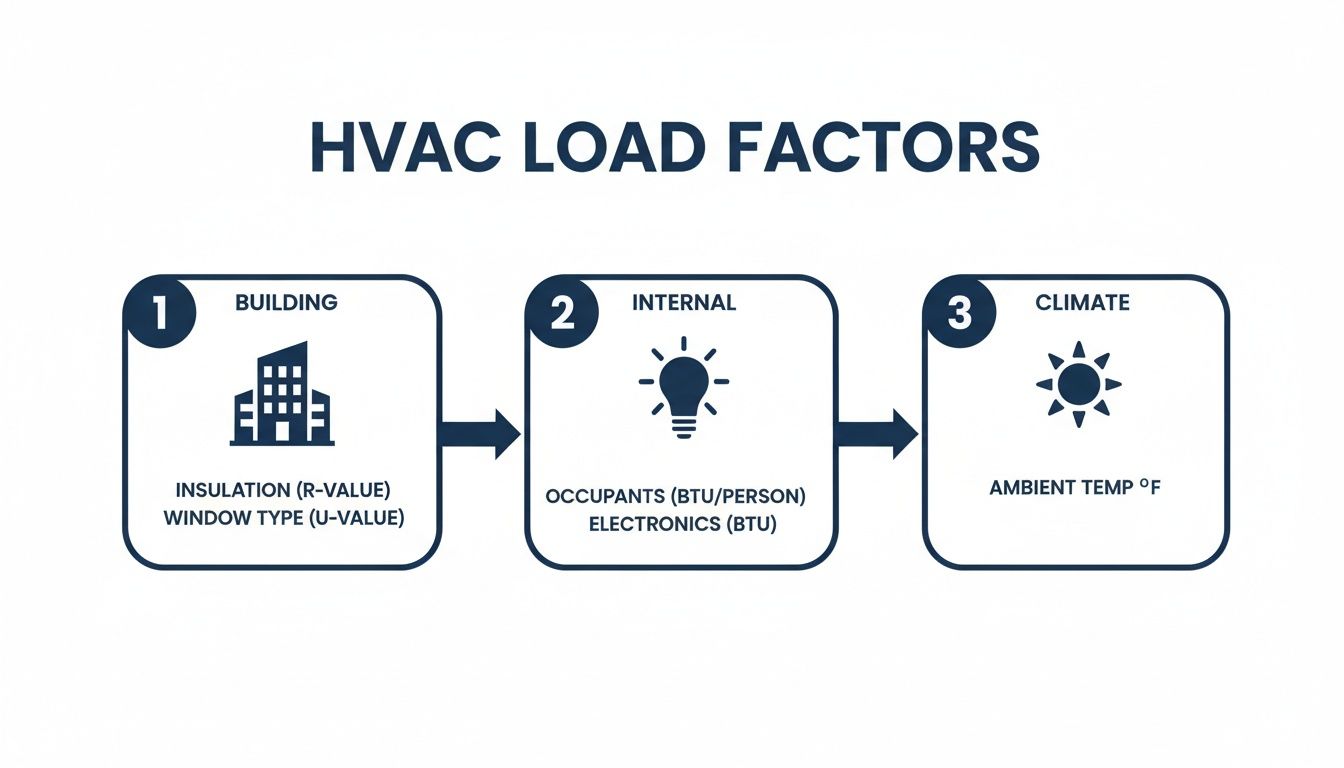
As you can see, the final number is a blend of your building’s construction, what happens inside it every day, and the relentless Phoenix sun it has to fight.
To really understand what we're measuring, it helps to separate the two main types of heat we have to remove: sensible heat (the kind you feel) and latent heat (the moisture in the air). Both are critical for comfort.
Understanding Heat Gains in a Commercial Space
| Type of Heat Gain | What It Is | Common Sources in a Commercial Building |
|---|---|---|
| Sensible Heat | The heat that raises the air temperature. It's the dry heat you feel from the sun or a hot piece of equipment. | Sunlight pouring through windows, heat from lights and computers, hot roofing materials, people's body heat. |
| Latent Heat | The "wet" heat or moisture in the air. Removing it is key to controlling humidity and making a space feel less sticky. | People breathing and sweating, cooking steam from a kitchen, and humid outdoor air brought in for ventilation. |
A system that only handles the temperature but ignores the humidity will leave your space feeling clammy and uncomfortable, even if the thermostat says it's 75°F. That's why we calculate both loads separately.
The Building Envelope Itself
First, we look at your building’s envelope—the shell that separates your cool indoor space from the brutal heat outside. Every part of this shell either helps you or hurts you, and we have to account for all of it.
We analyze:
- Insulation: We check the R-value in your walls but pay special attention to the roof and attic. A poorly insulated roof in Arizona is like wearing a black hat in July.
- Roofing Material & Color: A dark, flat roof absorbs a ton of solar radiation, directly adding to the cooling load. A lighter color or specialized coating can make a huge difference.
- Windows & Doors: This is a big one. We measure every window and note its type (single-pane, double-pane), efficiency (Low-E coatings), and orientation. That west-facing wall of glass can easily be a business’s single biggest source of afternoon heat gain.
- Building Orientation: How your building is positioned on the lot tells us which walls get hammered by the sun during the hottest parts of the day. This is a crucial detail for proper system design.
Internal Heat Gains from Business Operations
Next, we move inside to figure out the internal gains. This is all the heat generated by the day-to-day stuff happening inside your space. For many businesses, this internal load is surprisingly large and easy to overlook.
A common mistake is focusing only on the heat coming from outside. The reality is, the heat from people, lights, and equipment can be massive and will absolutely lead to an undersized system if it's not calculated correctly.
This is where talking to you, the business owner, is so important. We need to know exactly how you use your space.
Key sources we quantify include:
- People: Every person in the building gives off heat. We need to know your average and peak occupancy for every area, from offices to conference rooms to retail floors.
- Lighting: The type and number of lights matter. Old-school fluorescent or incandescent bulbs throw off way more heat than modern LEDs.
- Computers & Electronics: A standard office workstation can easily add 500 BTUs/hour or more to a room. Server rooms are a whole other beast and often need their own dedicated cooling.
- Specialized Equipment: This is a huge factor for places like restaurants (ovens, fryers), laundromats (dryers), or manufacturing floors with heavy machinery.
Ventilation and Air Infiltration
Finally, we look at how air gets into your building, both on purpose and by accident. This includes ventilation (fresh air brought in to meet code) and infiltration (air that leaks in through cracks, gaps, and door openings).
Every time your door opens, hot, dusty air rushes in, forcing your AC to work harder. At the same time, commercial codes require a certain amount of fresh air, which also adds to the cooling load. It's a tricky balance. In the U.S., commercial HVAC systems account for about 40% of a building's total energy use. When a system is even slightly mismatched, it can cause 15-20% efficiency losses.
This is exactly why we've been using these detailed calculation methods for our clients since 2011. For businesses here in Phoenix, facing solar loads that can hit 300 BTU/hr per square foot on a west-facing wall, getting this right isn't just about comfort—it's about your bottom line. If you're curious how these principles translate to system sizing, you might find our guide on what size air conditioner you need helpful.
Professional Calculation Methods and Industry Standards
A professional commercial HVAC load calculation isn't based on guesswork. Long gone are the days of using dangerously inaccurate "rules of thumb," like slapping a tonnage number on a building based on square footage alone. As experienced and trustworthy professionals, we are governed by strict industry standards to get it right.
The primary authority in our field is ASHRAE (American Society of Heating, Refrigerating and Air-Conditioning Engineers). This organization sets the global standards, publishing the fundamental data every credible HVAC engineer and designer uses. Following ASHRAE's guidelines isn't just a good idea—it’s what separates a professional, engineered solution from a costly mistake.
The Modern Approach to HVAC Calculation
Today, accurate load calculations are all about sophisticated computer modeling. These methods let us run a dynamic, hour-by-hour simulation of how heat moves in and out of your specific building all year long, not just on the hottest day.
The two main methodologies endorsed by ASHRAE are the gold standard:
- Heat Balance Method (HBM): This is the most precise method out there. It creates a perfect balance sheet of all heat gains and losses at any given moment to determine the exact load. Think of it as perfect accounting for every single BTU.
- Radiant Time Series (RTS) Method: A slightly simplified but still highly accurate method derived from HBM. RTS is fantastic for calculating cooling loads by analyzing how radiant heat from the sun and internal sources is absorbed and released over time.
These advanced methods are the engines humming behind the powerful software tools that true professionals use.
Leveraging Professional Software and Expertise
At Comfort Experts, we lean on industry-leading software like Trane TRACE 3D Plus and Carrier's Hourly Analysis Program (HAP). These programs allow us to build a digital twin of your facility, feeding in the hundreds of data points we've gathered—everything from window U-values to the heat output of your specific computer models.
But these powerful tools are only as good as the data fed into them and, more importantly, the expertise of the person running the analysis. This is where professional experience becomes everything. An engineer has to correctly interpret building plans, verify conditions on-site, and make informed judgments about how you actually use the space.
A load calculation isn't just about entering numbers into a program; it's about understanding the story those numbers tell about your building.
This expertise ensures the final design is perfectly tailored to your real-world operational needs, not just a theoretical model. For anyone wanting to dig deeper, it’s helpful to check out a professional's guide to HVAC load calculation standards like Manual J and Manual N.
This level of detail is especially critical in sectors with unique demands. The rise of data centers, projected to consume 8% of global electricity by 2030, is a perfect example of this growing market and its HVAC demands. A single large facility can generate cooling loads of 20-50 MW, where even a 10% oversizing error can inflate operating expenses by millions each year.
Closer to home, here in the Phoenix Valley where commercial retrofits are growing at a 6.8% CAGR, our expertise in calculating diversified loads for rooftop units is what saves businesses from overspending.
Our commitment is to combine these state-of-the-art tools with decades of hands-on experience in the Valley. This ensures we deliver a commercial HVAC load calculation that is not only scientifically precise but also practical and fully compliant. For businesses needing these robust solutions, you can see our approach to commercial cooling services in Mesa, AZ.
Common Mistakes We See in Phoenix (and How to Avoid Them)
Of all the places a commercial HVAC project can go sideways, the load calculation is one of the sneakiest. Even with the right software, the final number is only as good as the real-world details someone plugs into it. We've seen it happen time and again across the Valley—small misses on paper that turn into huge, expensive problems down the road.
These aren't just technical goofs. They’re the kind of blunders that lead to brand-new systems that can't keep up, rooms that are always stuffy, and energy bills that make you wince. Knowing what to look for is the best way to spot a contractor who's cutting corners. Let's walk through the most common traps we see so you can ask the right questions from day one.
Forgetting Your Business Is Going to Grow
One of the easiest mistakes to make is sizing a system for the business you have today, with zero thought for the business you'll be in two or five years. Your company isn't frozen in time. You’re planning to hire more people, add more computers, or maybe bring in new equipment that throws off its own heat.
A calculation that only looks at your building on move-in day is a recipe for an undersized system. We once stepped in to help a Scottsdale office where the original math was technically perfect for their starting headcount. The problem? No one factored in the 15-person call center they planned to add six months later. That single change made their brand-new AC unit completely inadequate.
A professional load calculation has to look forward, not just at the present. It's absolutely critical to talk about your 1-year and 5-year growth plans with your HVAC partner. The design needs enough breathing room to handle what's next.
Trusting Old Blueprints Without a Walk-Through
Relying on old building plans without getting on-site to verify everything is another classic pitfall. Buildings change. Renovations happen, walls move, and materials get updated. The original blueprints might as well be ancient history.
Just think about all the things that could have changed over the years:
- Were new, more efficient (or less efficient) windows installed a decade ago?
- Did someone quietly convert a storage closet into a small server room?
- Has insulation been added or removed from the attic since the place was built?
Details like these are almost never updated on the original drawings, but they have a massive effect on how your building gains and loses heat. A thorough site survey to confirm the actual conditions isn't just a good idea—it's non-negotiable for an accurate calculation.
Ignoring the "Little" Things: Internal Heat and Ductwork
It’s easy to get fixated on the big heat sources like sun-blasted windows and roofing. But more often than not, it’s the hidden internal loads and forgotten ductwork that quietly sabotage a system's ability to keep up.
We see this all the time in spaces like:
- Tech-Heavy Offices: Every single computer, monitor, and printer is a mini-heater. A dense open-office layout has a far bigger internal heat load than a few private offices.
- Busy Restaurants: The kitchen equipment is the obvious part. But what about the body heat from a constant flow of customers and staff?
- Overlooked Hot Spots: Those little server closets, copy rooms, or storage areas packed with electronics are frequently missed, creating uncomfortable hot spots the main system was never designed to handle.
Worse yet is ignoring the ductwork itself. Here in Phoenix, ducts often run through scorching, unconditioned attics. As cold air travels through them, it picks up a massive amount of heat—we call this duct gain. By the time that "cool" air finally reaches your vents, it's already several degrees warmer, forcing your AC to work overtime. Leaky duct seals just pour salt in the wound. A proper commercial HVAC load calculation has to account for where your ducts are, how well they're insulated, and how much air they're leaking.
Partnering with an Expert for Your HVAC Needs

While it’s good to understand the bones of a commercial HVAC load calculation, the real work is a complex engineering task. The financial and operational risks of getting this wrong are just too high to leave to an amateur.
Partnering with a licensed and experienced team like Comfort Experts isn't just about getting a number; it’s about getting the right number. It means your calculation is backed by years of on-the-ground experience right here in the Phoenix climate. That professional partnership delivers peace of mind, knowing your system is perfectly sized for your business's unique needs.
Why Professional Expertise Is Non-Negotiable
A DIY or “good enough” approach almost always leads to expensive corrections down the road. Bringing in a professional protects your investment from day one with a few critical advantages you just can't get any other way.
Choosing a reputable partner ensures:
- Accountability: A licensed firm stands behind its calculations and its installations. If issues pop up, you have a professional partner who is committed to making it right.
- Code Compliance: We live and breathe local building codes and ASHRAE standards. This fluency ensures your project sails through inspections without the kind of delays that cost you money.
- Long-Term Strategy: We don’t just size a system for your business today. We take the time to talk about your future growth plans to make sure this investment can support you for years to come.
Choosing a qualified expert for your commercial HVAC load calculation isn't an expense; it's a critical investment in your building's efficiency, comfort, and long-term operational budget. It prevents the kind of expensive surprises that no business owner wants to face.
Don't gamble with the comfort of your employees and customers—or your bottom line. An accurate calculation is the foundation of a reliable, efficient system, and finding the best HVAC company near you is the first step in building that foundation correctly.
Your Load Calculation Questions, Answered
Business owners and property managers ask us about the commercial HVAC load calculation process all the time. It makes sense—it’s a complicated subject, but getting it right is the foundation for years of comfort and manageable energy bills. We'll give you straight, simple answers to the questions we hear most often.
How Long Does a Commercial Load Calculation Take?
The real answer? It depends on your building. For a small, straightforward space—think a simple retail shop or a small office suite—a good, thorough analysis might take a few hours. That includes the time we spend on-site measuring everything, plus the office time to plug all that data into the software and model it correctly.
But for larger or more complex buildings, it can easily take a full day or even more. If you've got a multi-story office, a restaurant with a big commercial kitchen, or a manufacturing plant, there’s a lot more to account for. We have to document multiple zones, specialized equipment that throws off heat, and different occupancy schedules.
Here’s the bottom line: A quick, five-minute walk-through isn't a load calculation. A real commercial HVAC load calculation is a detailed process that takes time. Investing that time upfront prevents years of headaches and high utility bills down the road.
Can a Load Calculation Save Money on My Existing System?
Absolutely. If your current HVAC is constantly running, breaking down, or sending your energy bills through the roof, a new load calculation is one of the smartest diagnostic tools available. It almost always shows that the original system was either too big or too small for the job.
- If your system is oversized: It’s probably short-cycling—turning on and off constantly. This causes major wear and tear and wastes a ton of energy. A new calculation proves this and helps us figure out modifications or a right-sized replacement that will actually run efficiently.
- If your system is undersized: It’s running nonstop but never quite gets the space comfortable. The calculation will give us the hard data needed to specify a system that can handle the load, finally restoring comfort and stopping the constant strain on your equipment.
What If My Business Changes After the Calculation?
This is a fantastic and critical question. A load calculation is a snapshot of your building at a specific moment, and businesses definitely don't stand still. If you’re planning any big operational changes, you should absolutely get the calculation updated.
For example, if you plan to:
- Significantly increase your number of employees
- Add a new department with more people and computers
- Install new equipment that produces a lot of heat (like in a server room, kitchen, or manufacturing line)
These kinds of changes add to your building's internal heat load. Updating the calculation ensures your HVAC system can keep up with the new demand instead of suddenly becoming undersized and overworked.
Do I Really Need a Calculation for a Simple Unit Replacement?
Yes, we always recommend it, even for what seems like a simple “like-for-like” swap. A lot can change in the 10-15 years since your last unit was put in. The way the building is used might be different, a new tenant could have completely different needs, or maybe you’ve upgraded insulation or windows along the way.
Even small changes can impact your building's thermal performance. Running a fresh commercial HVAC load calculation makes sure your new investment is perfectly matched to your building as it operates today, not as it did a decade ago. It’s a vital step to guarantee you get the efficiency and performance you’re paying for.
When it comes to your business's comfort and energy costs, getting the numbers right is everything. At Comfort Experts, our team combines deep local experience with the industry's best tools to deliver calculations you can build your business on. For a precise analysis tailored to your Phoenix-area property, you can give us a call at 480-207-1239 or schedule service online to get started.