![You are currently viewing Commercial HVAC Maintenance Contracts Explained [Updated 2026]](https://azcomfortexperts.com/wp-content/uploads/2026/04/commercial-hvac-maintenance-contracts-hvac-contracts.jpg "Commercial HVAC Maintenance Contracts Explained [Updated 2026] 1")
For any business owner or property manager, an unexpected HVAC failure isn't just an inconvenience—it can shut your entire operation down. A commercial HVAC maintenance contract is your strategic plan to prevent that from happening. It’s not just another line item on your budget; it’s a smart, proactive approach that keeps your business running smoothly and protects your bottom line.
Why HVAC Contracts Are a Strategic Investment
Think of a maintenance agreement like a health plan for your building's most critical system. It turns an unpredictable, budget-wrecking repair into a predictable, manageable operating cost. This is a smart move for any commercial property, but here in Phoenix, is it absolutely essential? We believe so, and let me explain why.
The brutal Arizona heat puts an unbelievable amount of stress on HVAC equipment. Without regular, professional service, systems are pushed to their breaking point. This leads to worn-out parts, soaring energy bills, and total failure—which almost always seems to happen on the hottest day of the year, when downtime is most painful.
Protecting Your Bottom Line
A well-maintained HVAC system has a direct, positive impact on your finances. By keeping your equipment running at its best, a maintenance plan helps you in a few key ways:
- Slash Energy Costs: Clean filters, tuned-up components, and correct refrigerant levels mean your system isn’t fighting itself to keep your space cool. That translates directly into lower monthly utility bills.
- Prevent Expensive Breakdowns: Our technicians spot the small problems—like a frayed belt or a weak capacitor—before they can snowball into a full-blown system meltdown that forces an emergency replacement.
- Extend Equipment Lifespan: Just like changing the oil in a company vehicle, regular HVAC service ensures your equipment lasts for its full intended lifespan. You get more years out of your significant capital investment, pushing the massive cost of replacement further down the road.
And don't forget, a sudden HVAC failure costs a lot more than just the repair itself. It can mean lost revenue if you have to close your doors, unhappy customers, unproductive employees, and even damaged inventory if you deal with temperature-sensitive goods.
A commercial HVAC maintenance contract fundamentally changes the role of your climate system. It’s no longer a ticking time bomb of potential costs but a reliable asset that supports your core business, day in and day out.
Having served the Phoenix Valley since 2011, we at Comfort Experts have seen it all. The businesses that thrive are the ones that get ahead of problems. By managing the unique risks our extreme climate throws at us, these agreements deliver the peace of mind that comes from knowing your most important asset is in expert hands.
What Kind of Commercial HVAC Service Agreement Do You Actually Need?
Choosing a commercial HVAC maintenance contract can feel overwhelming. You just want your building’s air conditioning to work, keep your people comfortable, and not surprise you with a massive repair bill. As a team that manages HVAC systems for businesses all over Phoenix, we can tell you it's not a one-size-fits-all decision.
Think of it like picking a business partner for your building's climate. Some partners offer a basic safety net, while others provide comprehensive, all-in-one support. Let’s walk through the options so you can find the right fit for your budget and your business.
The Four Main Types of HVAC Contracts
Not all service agreements are created equal. We’ll start with the most basic "pay-when-it-breaks" model and work our way up to the most comprehensive plans. This will help you see where your business fits in.
Each type represents a different way of thinking about maintenance, moving from purely reactive repairs to proactive, hands-on system management.
- Time and Materials (T&M): This is the simplest, pay-as-you-go approach. It’s 100% reactive—you only call and pay for service when something is already broken. There’s no upfront cost, but you’re completely exposed to unpredictable expenses and potentially long downtimes.
- Preventive Maintenance: This is the most common proactive agreement. You pay a set fee for scheduled maintenance visits (like quarterly tune-ups) to keep your system running right and catch small problems before they turn into rooftop disasters.
- Full-Service / Full-Coverage: This is the all-inclusive, "set it and forget it" option. It covers your regular preventive maintenance, all labor for any repairs, and often the cost of replacement parts. This gives you the highest level of budget certainty, which is a must for businesses that can't afford any surprises.
- Performance-Based: This is a more advanced partnership. The contractor's pay is tied to hitting specific goals, like a certain percentage of energy savings or equipment uptime. It’s a data-heavy approach best for large, complex facilities where peak efficiency is a major financial priority.
The single biggest shift a business can make is moving from a reactive "fix-it-when-it-breaks" mindset to a proactive management strategy. That one decision can turn your HVAC system from a financial liability into a reliable operational asset.
Matching a Contract to Your Business Needs
The right contract for a small retail shop on Mill Avenue is completely different from what a 24/7 data center in Chandler requires.
A small boutique, for instance, can do great with a straightforward preventive maintenance plan. It keeps customers and staff comfortable and drastically reduces the risk of a surprise failure, all for a predictable cost.
On the other hand, that data center—where a few degrees of temperature change could cause millions in damage—needs a full-service agreement. The absolute peace of mind, guaranteed rapid response, and zero-cost-surprises for repairs are non-negotiable.
Comparing Commercial HVAC Contract Types
To help you see the trade-offs more clearly, we put together this table. It breaks down what you get, what you pay, and who each plan is really designed for.
| Contract Type | Best For | Cost Structure | Included Services | Key Benefit |
|---|---|---|---|---|
| Time & Materials | Businesses with high risk tolerance and simple, non-critical systems. | Pay-per-visit for labor and parts. | Emergency repairs only as needed. | Lowest upfront commitment. |
| Preventive | Most small to medium businesses (retail, offices, restaurants). | Fixed fee for scheduled visits. | Scheduled inspections, cleaning, and tune-ups. | Prevents major failures and lowers energy bills. |
| Full-Service | Mission-critical facilities (hospitals, data centers, manufacturing). | Higher fixed fee covering most contingencies. | All preventive tasks plus most repair labor and parts. | Maximum budget predictability and minimal risk. |
| Performance-Based | Large industrial or institutional facilities with efficiency goals. | Custom pricing tied to performance metrics. | Varies; focused on optimizing energy use and uptime. | Aligns contractor's goals with your financial targets. |
Ultimately, choosing a contract is about balancing what you're willing to pay against what you're willing to risk. By understanding these options, you can pick a plan that protects your equipment, keeps your business running, and makes sense for your bottom line.
If you want to see the details of how we structure our agreements to handle the brutal Arizona heat, you can learn more about our maintenance plan options.
The Financial Case for a Maintenance Contract
Let's talk numbers. When you're running a business, every expense gets a hard look, and a commercial HVAC maintenance contract is no exception. But here's the thing: treating it as just another line-item cost is a mistake. A good maintenance plan is a smart financial move that trades huge, budget-wrecking repair bills for a small, predictable operating expense.
You know what? It's one of the best investments you can make in your company's stability. The logic is simple: proactive care prevents catastrophic failures. A well-maintained system is far less likely to die on a 115-degree afternoon, forcing you into an emergency replacement that can cost tens of thousands of dollars and throw your entire quarter off track.
From Energy Bills to Uptime, the ROI Is Clear
One of the first places you’ll see a return is on your monthly power bill. According to the U.S. Department of Energy, regular HVAC maintenance can cut energy use by 15-20%. For a commercial building, that’s not pocket change—it often adds up to savings that cover a huge chunk of the contract's cost right there.
Think of it like a car. A vehicle with properly inflated tires and a clean engine just runs more efficiently. Your HVAC system is the same way. Clean coils, lubricated motors, and balanced airflow mean the equipment doesn’t have to fight itself to keep your space cool, which means it uses less electricity every single hour.
Beyond the energy savings, you have to consider the staggering cost of downtime. If your AC goes out during a Phoenix summer, you might have to send employees home or even close your doors to customers. How much revenue do you lose for every hour your business can't operate? For most companies, the losses from a single day of closure can easily be more than the entire annual cost of a maintenance contract.
Understanding the Total Cost of Ownership
A maintenance contract also plays a huge role in reducing the total cost of ownership for your HVAC equipment. This idea looks beyond the purchase price and includes everything you spend to run, repair, and eventually replace the system. By keeping your units in prime condition, a contract can push that massive replacement expense years into the future, letting you get the most out of the equipment you already paid for.
This decision tree can help you see how your budget and your tolerance for risk point toward the right kind of contract.
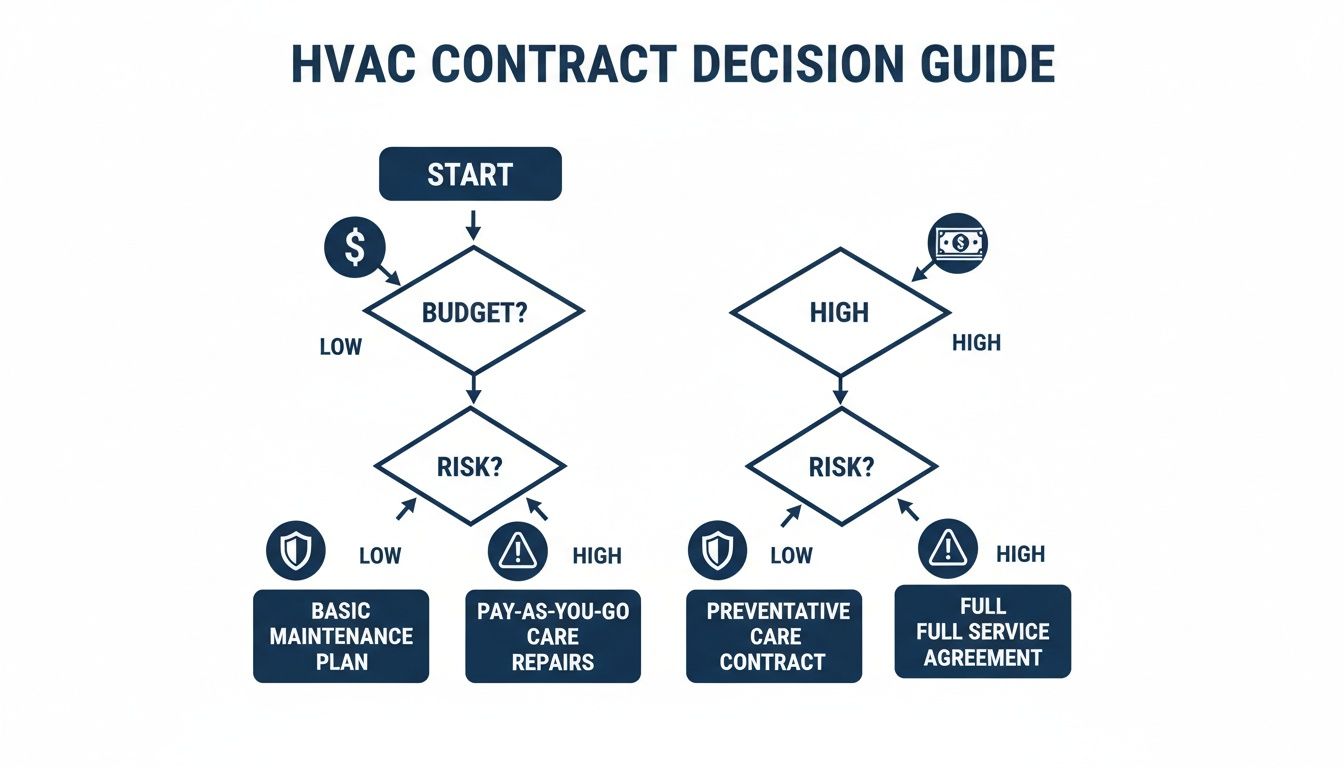
As you can see, businesses that can't afford unexpected shutdowns often find that more comprehensive contracts deliver the most value. The financial predictability is worth more than the small savings of a bare-bones plan.
How It Works on Our End (And Why It Helps You)
It also helps to understand the business model from our side, because it’s designed to benefit you, the client. For an HVAC company, commercial HVAC maintenance contracts create a predictable revenue stream. That stability is a game-changer, allowing a team like Comfort Experts to invest in things that directly improve the service you get.
Stable revenue from maintenance agreements means we can invest in better training for our technicians, keep more parts stocked on our trucks, and guarantee we have people ready to roll 24/7. It's a true win-win that makes the whole service experience better for our clients.
This financial foundation has a real, measurable impact on service quality. Across the industry, we see that well-run contractors often earn 30-40% of their annual income from these agreements. That stability builds incredible customer loyalty—retention rates often top 85%. It allows us to build an experienced team, reduce technician turnover, and increase first-time fix rates to as high as 95%. Ultimately, that means you get a more experienced technician who solves your problem faster.
For a deeper dive into the numbers and what to expect, check out our guide on commercial HVAC maintenance costs to see how a plan can be built to fit your budget.
What to Look for in Your Contract's Fine Print
That dense commercial HVAC maintenance contract sitting on your desk can feel like a chore to get through. It's easy to just skim the pages, sign on the dotted line, and file it away.
But trust me, this is one document you don't want to gloss over. The fine print is where the real value—or the expensive loopholes—of your agreement hides. Figuring this out before your system quits in the middle of a Phoenix summer is the difference between a quick, covered repair and a budget-blowing surprise.
A good contract is all about clear expectations. It's a roadmap that protects both you and your HVAC partner by spelling out exactly what gets done, when it gets done, and who pays for what. Let's break down the clauses that matter most.
Scope of Work and Visit Frequency
The "Scope of Work" is the absolute heart of your contract. This section shouldn't be a vague promise like "system inspection." If the language is fuzzy, that's a major red flag. A quality agreement gets specific, listing every single task your technician will perform on a visit.
You want to see a detailed checklist that includes things like:
- Inspecting and tightening all electrical connections.
- Measuring and recording refrigerant pressures.
- Cleaning condenser and evaporator coils.
- Lubricating all moving parts, including motors and bearings.
- Verifying thermostat calibration and system controls.
The contract must also lock in the frequency of these visits. For commercial systems here in Arizona, quarterly visits are the bare minimum to keep up with the demand. A solid contract will lay out a clear schedule—say, four planned visits per year—to make sure your equipment is ready for both the brutal cooling season and our short-but-important heating season.
To see what a truly thorough checklist looks like, you can read our commercial HVAC maintenance checklist guide for a real-world example.
Service Level Agreements and Response Times
Your Service Level Agreement (SLA) is your priority pass. This clause is your guarantee that when you call for help, you go to the front of the line. It's one of the most valuable parts of any commercial HVAC maintenance contract.
Without an SLA, you’re just another name on a list, potentially waiting days for a technician during a record-breaking heatwave. A strong SLA will define guaranteed response times based on how serious the problem is.
| Priority Level | Typical Scenario | Guaranteed Response Time |
|---|---|---|
| Critical Emergency | Complete system failure in extreme heat; safety risk. | 2-4 hours |
| Urgent Repair | Partial system failure; significant comfort issues. | Within 24 hours |
| Routine Service | Minor issue not impacting core operation. | Within 48-72 hours |
Make sure the contract clearly defines what counts as an "emergency." This confirms you get the priority service over non-contract customers that you're paying for.
Parts, Labor, and Exclusions
This is where you have to put on your reading glasses to avoid surprise invoices down the road. The contract must spell out exactly what's included when a repair is needed. Does it cover just the technician's time (labor), or does it also cover the cost of the replacement parts?
Full-service contracts, for instance, typically cover both parts and labor for most common failures, giving you the most predictable budget. Preventive plans, on the other hand, usually just cover the maintenance visit itself. Any repairs discovered during the visit are billed separately—though often at a discounted rate for being a contract client.
A contract is as much about what it doesn't cover as what it does. Always read the exclusions list to understand the limits of your agreement and prevent any future misunderstandings.
Just as important is the exclusions list. This is the section that details what is not covered. Things you'll commonly see excluded are:
- Repairs for damage from lightning, vandalism, or building-wide power surges.
- Service for problems caused by unauthorized work or tenant neglect.
- Complete system replacement (the goal of the contract is to make your current system last longer).
- Work on obsolete equipment where replacement parts are no longer manufactured.
Understanding these boundaries from the start gives you a realistic picture of your coverage and helps you plan for the unexpected.
Special HVAC Considerations for Arizona Businesses
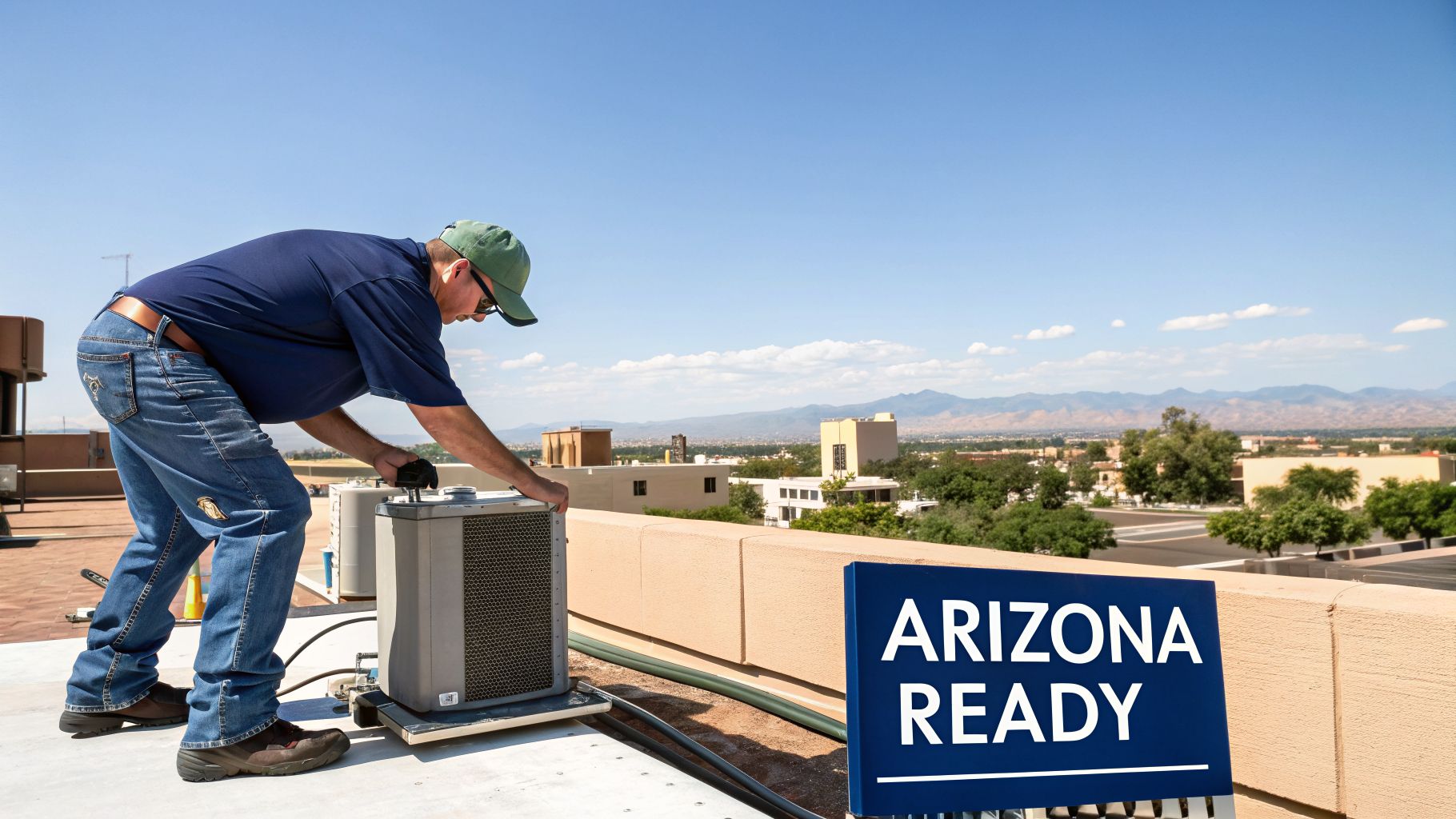
Keeping a commercial HVAC system running in most places is one thing. Keeping one alive and efficient in the Phoenix metro area is a completely different ballgame. Our environment isn't just tough on equipment—it’s actively trying to break it.
This means a generic, one-size-fits-all commercial HVAC maintenance contract isn’t going to cut it here. Not even close.
Our triple-digit summer temperatures put an unbelievable, relentless strain on every part of your system. This is especially true for the rooftop units baking under that Arizona sun all day long. It's less about simple comfort and more about fighting a battle against physics, where overheating and mechanical failure are constant threats.
Surviving the Heat and Dust
The Arizona climate is a unique combination of extreme heat and fine, gritty dust that demands a specialized maintenance strategy. Those famous haboobs aren't just a spectacle; they're giant clouds of dust that get into everything, choking your system's airways.
A standard maintenance plan might call for coil cleaning once a year. For a business in the Valley, that's a recipe for disaster.
Aggressive Coil Cleaning: Your condenser coils are like your system's lungs, breathing out all the heat it has removed from your building. When they're caked in a blanket of dust and dirt, they can't breathe. This forces the compressor to work overtime, spiking your energy bills and paving the way for a very expensive failure. For any Arizona business, frequent and thorough coil cleaning is non-negotiable.
Refrigerant Level Monitoring: Those extreme outside temperatures directly affect the refrigerant pressures inside your AC. If a system is even slightly off on its charge, it will struggle to cool, lose capacity, and risk destroying the compressor. Regular checks make sure the pressures are dialed in for our specific climate.
Ensuring Robust Airflow: Clogged air filters are one of the top killers of HVAC systems out here. A proper maintenance plan must include frequent filter changes to keep air moving freely. It’s absolutely critical for preventing the motors and compressors from overheating.
In Arizona, proactive HVAC maintenance isn't just about efficiency—it's about survival. A system choked by dust and struggling against 115-degree heat is a system on the verge of a very expensive and disruptive breakdown.
On top of the brutal environment, commercial properties in cities like Mesa, Chandler, and Phoenix have to follow specific local building codes and safety rules. These regulations cover everything from where equipment can be installed to the fine print of electrical work and system modifications.
A good local HVAC partner knows these rules inside and out.
This is especially true for rooftop units, which have their own set of safety standards for access, fall protection, and electrical disconnects. Our technicians are trained on these local codes, ensuring any work done under your maintenance contract is fully compliant. That protects you from fines and liability headaches. It's this deep, first-hand knowledge of the Valley that really counts. You can see how we apply this focus in our guide to a commercial AC tune-up in Mesa, AZ.
The value of this kind of specialized care isn’t just our opinion. The global market for commercial HVAC maintenance services hit a massive USD 36.85 billion in 2026. Here in the U.S., maintenance accounts for 46.15% of the entire HVAC service market. Smart providers tap into this by creating plans for local realities—like keeping Arizona's rooftop units from melting in July. It’s a proven strategy for businesses that can't afford downtime.
How to Choose the Right Commercial HVAC Partner
Choosing a partner for your commercial HVAC maintenance contract is just as important as picking the right contract. A service agreement is just paper—the real value comes from the team that stands behind it. Making the right choice means finding a company that’s not just a vendor, but a true partner in keeping your business running.
Honestly, this is where you separate the pros from the rest. The right partner has the licenses, real-world experience, and structure to show up and deliver when a crisis hits, especially during a brutal Phoenix summer.
Vetting Your Potential HVAC Partner
Before you sign anything, you need to vet any potential contractor. Think of it like a pre-flight check before committing to a long-term relationship that your business will depend on. Here’s what you should be digging into.
Verify Licenses and Insurance: This is table stakes, not a bonus feature. A legitimate contractor must be licensed and insured. For instance, Comfort Experts proudly operates under ROC #275914. This protects you from liability and proves the company meets Arizona’s standards for professional work.
Confirm Deep Commercial Experience: Don’t be shy about this. Ask for proof they’ve worked on your specific type of equipment. A company that mostly handles residential AC units might be lost when faced with a 25-ton rooftop unit or a complex VAV system. Ask about their work with businesses just like yours.
Inquire About Technician Training: The quality of the tech who shows up at your door is everything. What kind of training and certifications do they have? At Comfort Experts, our partnership with brands like Trane means our technicians get continuous, advanced training on the latest commercial systems. They aren't learning on your equipment.
Check for 24/7 Emergency Service: Your HVAC system doesn’t care about business hours. A critical failure can easily happen at 2 AM on a Sunday. You need a partner that guarantees 24/7 emergency availability for their contract clients, ensuring you’re never left stranded when it matters most.
When selecting a commercial HVAC partner, understanding their operational stability is crucial. This often includes examining their approach to financing for HVAC contractors, ensuring they have the resources to invest in quality equipment and skilled personnel to deliver reliable service.
The Impact of a Solid Service Program
A strong service program isn't just good for customers; it’s the sign of a healthy, well-run company. Data shows that preventive maintenance will make up 46.15% of the projected USD 18.98 billion U.S. HVAC services market by 2026. HVAC companies that build great maintenance programs see profit margins 5-10 points higher than the industry average.
That financial stability directly benefits you—it’s how we invest in the training, tools, and talent needed to prevent emergencies at businesses across Mesa, AZ. For a broader look at identifying top-tier service, check out our guide on finding the best HVAC company near you.
Choosing the right HVAC partner isn't just about technical skill. It's about finding a company with a proven track record, transparent credentials, and a business model built around long-term reliability and customer success.
Common Questions About HVAC Maintenance Contracts
Sorting through commercial HVAC maintenance contracts can bring up a lot of questions for business owners. You just want straight answers so you can make a good decision that protects your property and your bottom line.
Here are the questions we hear almost every day from businesses right here in the Phoenix area.
How Much Should a Commercial HVAC Maintenance Contract Cost?
There's no flat rate. The cost can swing wildly depending on your system's size, age, and complexity, not to mention the level of service you need. A simple preventive plan for a small office might run a few hundred dollars a year, while a full-service contract for a big industrial facility could easily be in the thousands.
Here’s the real math, though: you’re weighing the fixed, predictable cost of a contract against the massive, unpredictable expense of an emergency repair—plus the lost revenue when your business has to shut down. Any good provider will do an on-site evaluation to give you a transparent, custom quote based on your actual equipment.
Is a Maintenance Contract Worth It for a Brand New System?
Absolutely. Think of it like the required oil changes you need to keep the warranty on a new company truck. Most manufacturer warranties for commercial HVAC equipment are voided without documented, regular professional maintenance. A contract is the easiest way to make sure you meet those strict rules, protecting your big investment from day one.
Plus, professional service right out of the box makes sure your new system runs at peak efficiency. It keeps your energy bills as low as possible and helps stretch the unit's lifespan far beyond what you’d get without consistent care.
A maintenance contract for a new system isn't just another expense; it's the insurance policy that protects your warranty and locks in years of peak performance and energy savings.
What Is a Typical Emergency Response Time Under a Contract?
This is one of the most valuable parts of a contract and a key piece of your Service Level Agreement (SLA). For our contract clients, emergencies always jump to the front of the line. A typical SLA guarantees a 2-4 hour response time for a critical failure (like a total system shutdown in July) and maybe a 24-hour response for less urgent problems.
Non-contract customers, on the other hand, are usually serviced on a first-come, first-served basis. During a major Phoenix heatwave, that can mean waiting days for a technician. That guaranteed priority service is your lifeline to getting back up and running fast.
When you're ready to partner with a team that delivers honest diagnostics and customized maintenance solutions for businesses all over the Phoenix Valley, Comfort Experts is here to help. To get started, give us a call at 480-207-1239 or schedule service online for an expert assessment of your commercial property.