When you get the news that your furnace needs a major repair, it's natural to feel a little stressed, and the cost to replace a furnace heat exchanger is a significant concern for any homeowner. This repair isn't just about comfort; it's a critical safety issue that demands immediate and expert attention. This guide will give you a clear, no-nonsense look at the numbers and factors involved so you can make the best decision for your Arizona home.
Your Quick Guide to Heat Exchanger Replacement Costs
When your furnace's heat exchanger cracks, you’re facing one of the most involved repairs you can get. Honestly, this isn't a quick part swap. The total cost comes down to two big things: the price of the new heat exchanger itself and the intensive, skilled labor needed to install it safely and correctly.
Why does it cost so much? You know what? It’s because the job is a big one. To get to this core component, a technician pretty much has to perform open-heart surgery on your furnace—taking the entire unit apart and then meticulously putting it back together again. That process can easily take several hours of focused, expert work from a seasoned professional.
The heat exchanger is the single most important safety component in your furnace. Its replacement cost reflects not just the part, but the expertise needed to protect your home from dangerous carbon monoxide leaks.
A Clear Cost Breakdown
To help you budget, it’s useful to see how the national numbers stack up against what we typically see here in the Phoenix Valley. Here’s a look at the estimated costs you can expect.
Estimated Furnace Heat Exchanger Replacement Costs
This table breaks down the key expenses, giving you a realistic picture of the investment required.
| Cost Component | National Average Range | Typical Phoenix Valley Range |
|---|---|---|
| Heat Exchanger Part | $350 – $850 | $400 – $750 |
| Labor for Replacement | $650 – $2,150 | $800 – $1,500 |
| Total Estimated Cost | $1,000 – $3,000 | $1,200 – $2,250 |
This gives you a solid ballpark figure for the repair itself.
Now, here's a crucial detail that often tips the scales. While many manufacturers' warranties cover the heat exchanger part for 10-20 years, they almost never cover the labor to install it. For any furnace over 15 years old, this reality often makes a full furnace replacement a much smarter long-term investment.
This financial breakdown is the starting point, but it's not the whole story. The big question becomes whether to repair this one part or invest that money into a brand-new, more efficient furnace. That's a key decision we'll dig into next.
What a Furnace Heat Exchanger Does for Your Home
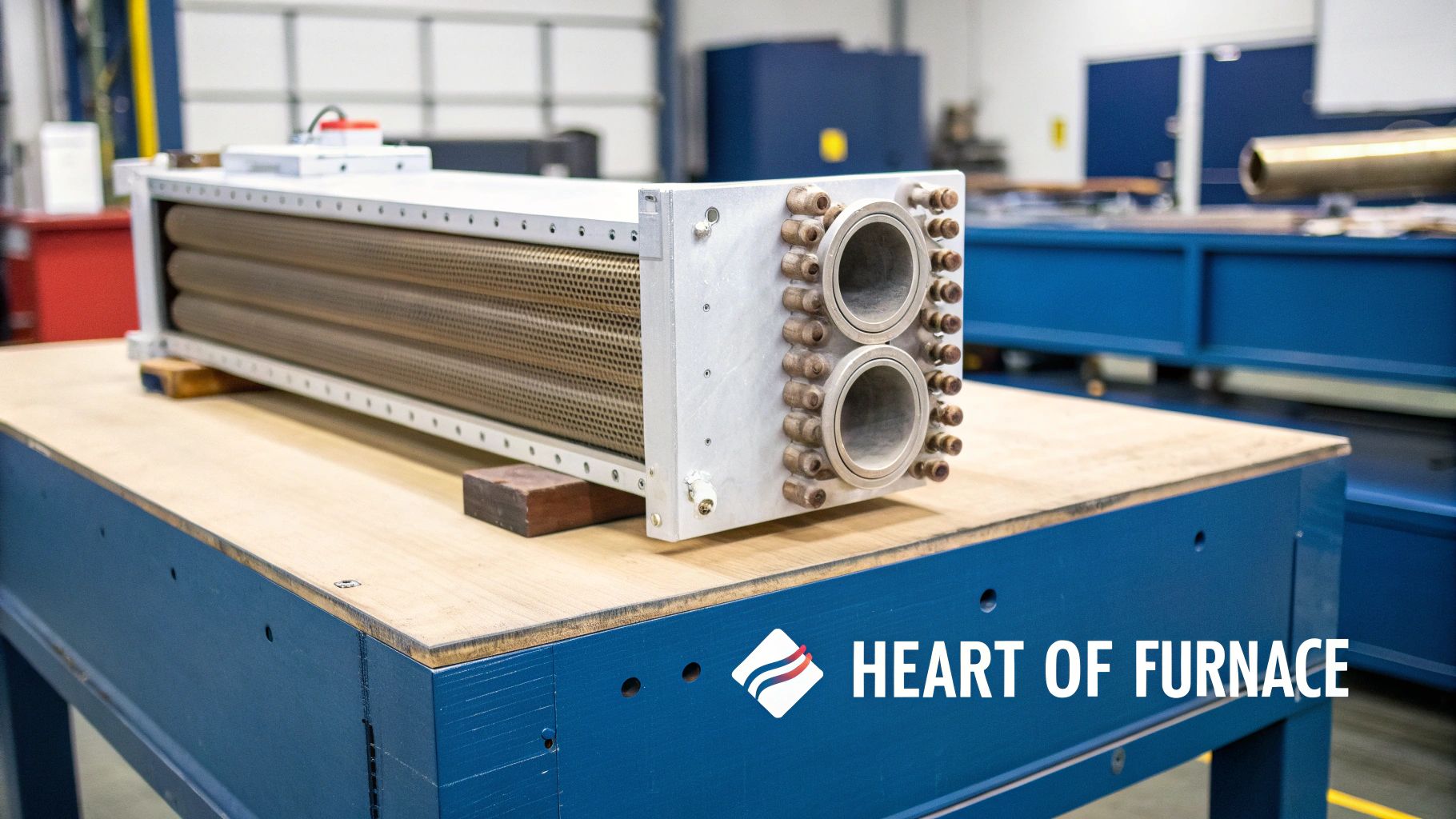
Before we start talking numbers about the cost to replace a furnace heat exchanger, it helps to know what this part actually does. Think of it as the quiet, hardworking heart of your furnace. It’s a carefully designed set of metal tubes and shells that handles one of the most important jobs in your entire house.
Its main purpose is to transfer heat safely. When your furnace burners fire up, they get the metal walls of the heat exchanger piping hot. Your system’s blower then pushes your home's cool air across the outside of these super-heated walls, warming it up before sending it on its way through your vents.
The Most Important Wall in Your Home
Here’s the thing—the heat exchanger isn't just about making things warm; it’s about doing it safely. It acts as a solid, sealed barrier, keeping the dangerous byproducts of combustion completely separate from the clean air you and your family breathe.
Those combustion gases include some nasty stuff, with the most dangerous being carbon monoxide (CO)—an odorless, colorless, and potentially lethal gas. The heat exchanger’s job is to trap all those fumes and channel them safely outside your home.
A heat exchanger is the crucial dividing line between your home's breathable air and the furnace's toxic exhaust fumes. Even a tiny crack can compromise this barrier, turning a heating issue into a serious health emergency.
A crack, no matter how small, breaks this critical seal. That breach allows toxic gases like carbon monoxide to mix with your home’s air supply. This is exactly why a cracked heat exchanger is an immediate "red-tag" situation that requires urgent attention.
It’s not just a mechanical failure; it's a direct threat to your family's safety. Understanding that risk is key to seeing the real value of professional furnace repair services in Mesa, AZ.
Telltale Signs Your Heat Exchanger Is Failing
So, how can you tell if your heat exchanger is in trouble? Luckily, a furnace will almost always whisper—or shout—that something is wrong long before it gives up completely. Catching these clues early protects your family and helps you get ahead of a major repair bill.
Many of these signs start small, but they point to a serious internal problem that needs a pro’s eyes on it right away. Ignoring them doesn’t just risk a bigger repair down the road; it puts your home’s safety on the line.
Odors, Sounds, and Smells
One of the first things you might notice is a strange smell coming from your vents when the heat kicks on. Homeowners often describe a sharp, metallic, or chemical odor that smells a bit like formaldehyde. This isn't just the smell of dust burning off; it’s a red flag that combustion gases might be mixing with your breathing air.
You’ll also want to listen for unusual sounds. While furnaces make noise, a failing heat exchanger can cause loud popping, rattling, or banging sounds as the stressed metal expands and contracts. Those aren't normal operating noises.
A healthy furnace flame should burn a steady, vibrant blue. If you see a flame that’s flickering, dancing, or yellow, it’s a sign of poor combustion. This puts extra stress on the heat exchanger and can be a symptom of an existing crack.
Visible Signs of Trouble
Sometimes, the evidence is something you can actually see. If you’re comfortable taking a quick look at your furnace unit, there are a few unmistakable red flags.
- Soot Buildup: Dark, black streaks of soot around the furnace cabinet or on internal components are a huge warning sign. Soot means incomplete combustion, a classic symptom of a damaged heat exchanger.
- Visible Cracks or Corrosion: In some cases, you might be able to see physical cracks, rust, or corrosion on the heat exchanger itself. Any visible damage like this means it’s time to shut the system down and call for help.
- Water on the Floor: If you see water pooling around the base of your furnace (and it’s not a high-efficiency condensing model), it can mean exhaust fumes are cooling and condensing inside the unit instead of venting properly.
Alarms and Health Symptoms
The most serious sign is your carbon monoxide detector going off. If that alarm sounds, don't hesitate. Turn off your furnace, get everyone out of the house immediately, and call for emergency help. CO is odorless and invisible, which is why these detectors are absolutely essential lifesavers. It’s also a key reason we always emphasize how important it is to prepare your Arizona home for winter heating each year.
Unexplained headaches, dizziness, nausea, or other flu-like symptoms that seem to get better when you leave the house are also potential signs of low-level CO exposure. If anyone in your family is experiencing this, don't wait. A professional inspection is the only way to confirm the problem and figure out the next steps, including the potential cost to replace a furnace heat exchanger.
Key Factors That Influence Your Final Replacement Cost
No two heat exchanger replacements ever cost the exact same, do they? The final invoice you see is a blend of a few key variables, and knowing what they are helps you understand where your money is actually going. A transparent quote should break these down, so there are no surprises when you see the final cost to replace a furnace heat exchanger.
It’s a lot like getting a car repaired—the make, model, and year of the car play a huge part in the final bill. The same logic applies directly to your furnace.
Furnace Brand and Model
Not all furnaces are created equal, and the brand name on the front of your unit has a big say in the price of the replacement part. Premium brands like Trane often use higher-grade materials and more complex designs, meaning their replacement heat exchangers can cost a good bit more than parts for standard models like Goodman.
Beyond the brand, the specific model matters, too. High-efficiency condensing furnaces have a more complicated setup with a secondary heat exchanger. That part can be more expensive to get and trickier to replace than the single, straightforward exchanger found in an older, standard-efficiency unit.
Your warranty is the first line of defense against high parts costs. Most manufacturers offer a 10 to 20-year or even a lifetime warranty on the heat exchanger itself. The catch? This warranty almost never covers the labor, which is often the biggest slice of the bill.
Labor Costs and Accessibility
This is, without a doubt, the single biggest variable in the equation. The labor for a heat exchanger replacement often costs more than the part itself, typically running between $650 and $2,150 nationally. It's a job that demands specialized HVAC skills. Here in the Phoenix Valley, we often see that labor cost land somewhere between $800-$1,500, but where your furnace is located can swing that number significantly.
A furnace crammed into a tight attic, a cramped crawlspace, or a packed utility closet is a nightmare to work on compared to one sitting in an open garage. That difficult access can easily add hours—and hundreds of dollars—to the labor bill. A textbook job might take 4-6 hours, but a really tough one could stretch to 8 hours or more.
Age and Condition of the Furnace
The age of your furnace is a huge piece of the repair-or-replace puzzle. Sinking $2,000 into a 15-year-old furnace that has other aging parts—like a blower motor or control board on its last legs—is usually a bad investment. It’s like putting a brand-new engine in a car with a rusty frame.
An older unit is also more likely to fight back during the repair, with rusted bolts, brittle wiring, and other gremlins that make taking it apart and putting it back together riskier and more time-consuming. Any certified technician will assess the overall health of your system to help you decide if a targeted repair makes financial sense, or if you’d be better off putting that money toward a new, reliable system. You might even find that available HVAC rebates can make a new system much more affordable than you think.
The Critical Decision: Repair or Replace Your Furnace?
When you’re staring down the barrel of a cracked heat exchanger diagnosis, you've hit a major fork in the road. The real question isn't just about the repair—it's whether it makes more sense to replace that single (and very expensive) part or put that money toward a whole new furnace. This isn't just a technical problem; it's a big financial decision for your home.
Let me explain: while replacing only the heat exchanger might seem like the cheaper fix on paper, it’s often a short-term patch on a long-term problem. You really have to step back and look at the bigger picture—your furnace’s age, its overall health, and what other expensive repairs might be hiding right around the corner.
Weighing Your Options
The right choice really boils down to a few honest questions. How old is your furnace? Is the heat exchanger still covered by a warranty? What kind of shape are the other major parts in, like the blower motor or the control board? Answering these will pretty clearly point you in the right direction.
Think about it this way: spending over a thousand dollars to fix a 15-year-old furnace is a tough pill to swallow. That unit is already living on borrowed time. Another critical part could easily give out next winter, and you'll be right back where you started, but with less money in your pocket.
Investing in a new, high-efficiency furnace isn't just about dodging future repair bills. It's an upgrade to your home's performance, a way to lower your monthly energy costs, and a chance to get the peace of mind that only comes with a reliable, modern system.
This decision tree gives you a quick visual guide to the key factors that help determine whether a repair or a full replacement makes the most sense for your situation.
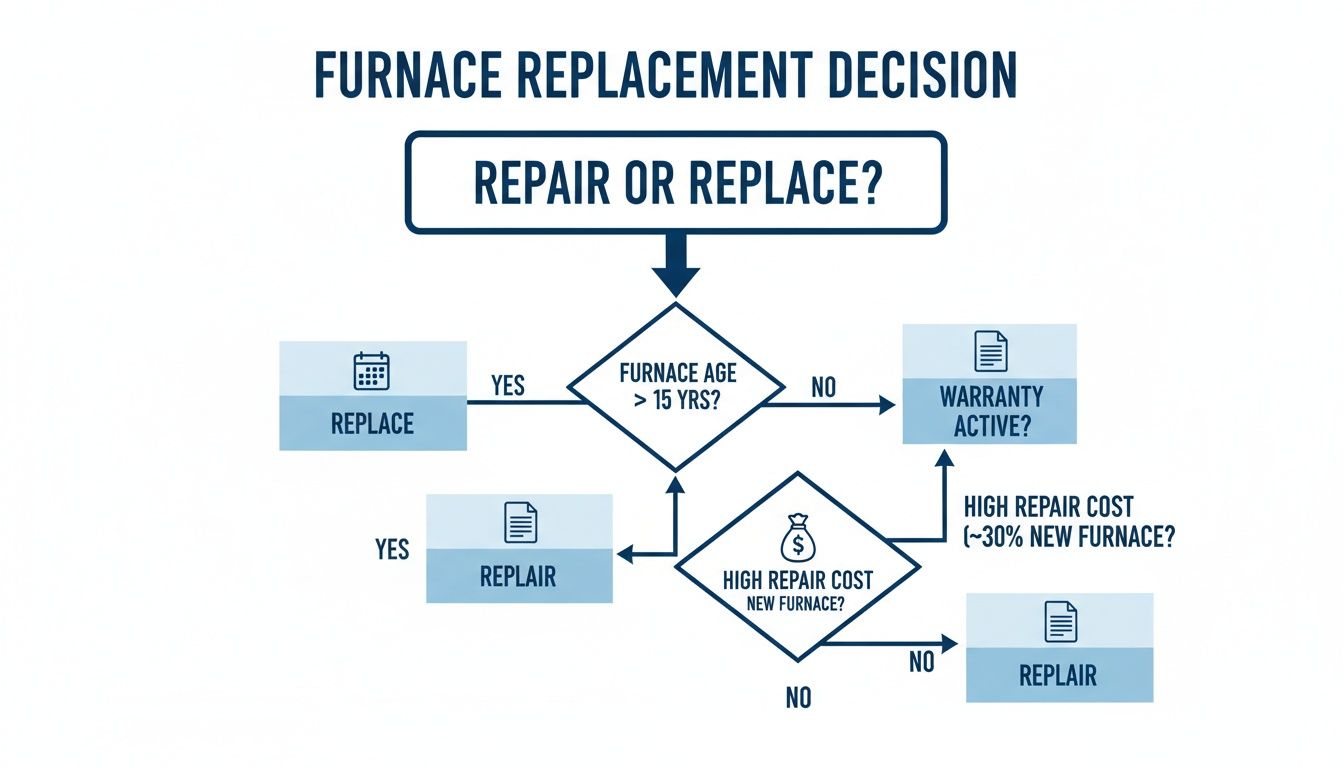
As the chart shows, your furnace's age and the total cost of the repair are usually the strongest signals that it's time to start thinking about a full system replacement.
Heat Exchanger Repair vs. Full Furnace Replacement
Let's break this down head-to-head. A heat exchanger replacement is one of the most expensive furnace repairs out there, often landing in the $1,500 to $3,500 range. For furnaces that are over 15 years old, a new unit can deliver up to 20% better energy efficiency, which translates directly into real savings on your utility bills year after year.
If you're facing a pricey repair on an older furnace, getting an expert opinion is always a smart move. You can always get a second opinion on your furnace diagnosis from our team to make sure you have all the facts before making a decision.
Heat Exchanger Repair vs. Full Furnace Replacement
Use this table to weigh the key decision factors when choosing between repairing your current furnace or investing in a new system.
| Decision Factor | Replace Heat Exchanger Only | Replace Entire Furnace |
|---|---|---|
| Upfront Cost | Lower initial cost | Higher initial investment |
| Furnace Age | Best for units under 10 years old | Best for units over 12-15 years old |
| Long-Term Reliability | Risks other old parts failing soon | New system with a full warranty |
| Energy Efficiency | No change in efficiency | Significant improvement and lower bills |
| Peace of Mind | Lingering worry about future repairs | Total confidence for 15+ years |
When you look at it this way, choosing a full furnace replacement often transforms what would have been a costly, short-term repair into a valuable, long-term home improvement.
Why a Heat Exchanger Replacement Is Not a DIY Job
With a world of online tutorials at your fingertips, it’s easy to feel confident tackling just about any home repair. But when it comes to replacing a furnace heat exchanger, this is one job you absolutely must leave to a licensed professional. The risks go way beyond a simple mistake; we’re talking about serious safety hazards that can put your entire family in danger.
This isn't like swapping out a faucet or a light fixture. A heat exchanger replacement involves disconnecting and reconnecting gas lines, a process where even a microscopic error can lead to a gas leak and create a significant fire hazard. An improper installation can also wreck your furnace's combustion process, which is what directly causes deadly carbon monoxide (CO) to be produced in the first place.
The Dangers of an Improper Installation
A botched heat exchanger job can turn your furnace from a source of warmth into a life-threatening appliance. The two biggest risks are fire and carbon monoxide poisoning, and neither is worth gambling on.
- Fire Hazard: A poorly sealed gas line is a ticking time bomb. All it takes is a single spark from the furnace ignitor to cause a catastrophic fire in your home.
- Carbon Monoxide Poisoning: If the new heat exchanger isn't sealed perfectly, it allows that deadly, odorless CO gas to mix directly with the warm air being circulated through your vents and into every room.
Professional technicians use specialized diagnostic tools, like combustion analyzers and tiny camera scopes, to verify a safe and correct installation. This equipment is essential to prove your furnace is operating properly and not leaking CO. It’s a level of precision you simply can't achieve with a standard home toolkit.
At Comfort Experts, our commitment to your safety is everything. Our technicians are highly trained, and we proudly display our credentials (ROC #275914) as proof of our expertise and trustworthiness. Protecting your family isn’t a place to cut corners, and a professional installation is the only way to guarantee this critical job is done right.
Getting a Professional Diagnosis from Comfort Experts
Figuring out a major furnace repair can feel overwhelming, but you absolutely don't have to go it alone. The single most important thing to know is that a cracked heat exchanger is a serious safety hazard that needs a professional’s eyes on it, fast.
While our guide gives you a solid idea of the potential costs, the next critical step is getting an expert diagnosis. It’s the only way to know for certain what you're up against and make a smart decision for your home. On our end, we use modern tools like HVAC business management software to keep our service efficient and organized, so we can focus on what matters: finding and fixing your problem.
Our Commitment to Honest Assessments
Here at Comfort Experts, we’ve built our reputation on giving honest, straight-up assessments to homeowners across the Phoenix Valley. Our certified technicians use state-of-the-art diagnostic tools, including tiny camera scopes, to physically show you the condition of your heat exchanger. We believe in giving you clear, factual information—not a high-pressure sales pitch.
Our process is simple and is always focused on what’s best for you and your family:
- A Thorough Inspection: We don’t just look for a crack. We perform a complete check-up on your entire furnace to get a clear picture of its overall health.
- Clear Communication: We’ll explain what we find in plain English, show you the camera footage, and lay out all your options, from a simple repair to a full system replacement.
- Transparent Quoting: You’ll get a detailed, upfront quote for any work we recommend. You’ll see exactly where every dollar goes so you can make a choice that fits your budget, no surprises.
A professional diagnosis isn't just about finding a problem; it's about giving you the clarity and confidence to make the right long-term decision for your home's safety and your family's comfort.
You should never feel pressured or confused when facing a repair this significant. Knowing the true cost to replace a furnace heat exchanger all starts with a diagnosis from someone you can trust. Our team is here to provide exactly that, making sure your home is safe and your furnace is ready for the years ahead.
For a definitive diagnosis from a trusted Phoenix Valley technician, trust Comfort Experts. To ensure your home is safe and your furnace is reliable, call our team today at 480-207-1239 or schedule service online for an honest, expert assessment.