
Auxiliary heat is automatic backup heat that runs alongside the heat pump, and EM HEAT is a manually selected mode that shuts the heat pump off and runs only the backup source. On a cold Mesa morning, a homeowner who raises the thermostat and sees AUX often faces heat pump auxiliary heat vs emergency heat as a practical question, not a settings puzzle. The display alone doesn't say whether the pattern is normal, so the outdoor unit, the selected mode, and how long the label stays on all matter.
What AUX and EM HEAT Mean on Your Thermostat
AUX means the control has called for supplemental heat while normal heat pump operation continues. EM HEAT means someone has selected backup-only operation, so the heat pump stage is bypassed. A brief AUX indication is often normal, while EM HEAT belongs to a heat pump that's out of service or can't provide heat.
The Federal Building Science Education lecture notes on heat pumps note that auxiliary heat may be triggered by low outdoor temperature or by slow recovery after a setpoint change, and identify approximately 35°F as a commonly used outdoor temperature threshold for preventing auxiliary heat from activating too early. That threshold isn't universal. Controls vary by equipment and climate, and thermostat labels vary by brand and model.
Reading the Display With the Outdoor Unit
The label shows what the control is asking for. It doesn't explain why a room feels cold, whether airflow is restricted, or whether the outdoor unit has stopped. A useful check pairs three observations, the display, the selected mode, and whether the outdoor fan and compressor are running.
| Thermostat display | Likely situation | Outdoor unit | Normal or check | Next step |
|---|---|---|---|---|
| AUX for a few minutes on a cold morning or after a large setpoint increase | Normal recovery supplemental heat | Running | Normal if it ends and the room reaches setpoint | Note the time and move on |
| AUX during a brief pause in the outdoor fan | Possible outdoor-coil defrost | Pauses briefly, then resumes | Often normal for the equipment design | Note duration and frequency |
| AUX running for most of a mild day | Heat pump cannot meet the load from airflow, sizing, dust, or setup | Running | Not normal, investigate | Log readings and schedule service |
| EM HEAT selected by the owner | Backup-only mode with the compressor locked out | Compressor off | Expected only with a clear reason | Confirm the reason with a technician |
| AUX or EM HEAT with cool air, no heat, or a silent outdoor unit | Possible outdoor-unit, refrigerant-side, or control fault | Fan or compressor not running | Not normal | Stop heavy use and call |
Owners who aren't sure whether a thermostat is configured for heat pump staging can review what proper thermostat installation covers before changing anything. The label is a clue to classify, not a diagnosis. Duration and the outdoor unit's behavior turn that clue into a decision.
Automatic Supplemental Heat vs Selected Emergency Mode
In a common all-electric system, both modes use the same electric resistance strips in the indoor air handler. The difference is control logic, not a second heater hidden in the cabinet. AUX adds backup heat to compressor output, while EM HEAT removes compressor output from the sequence.
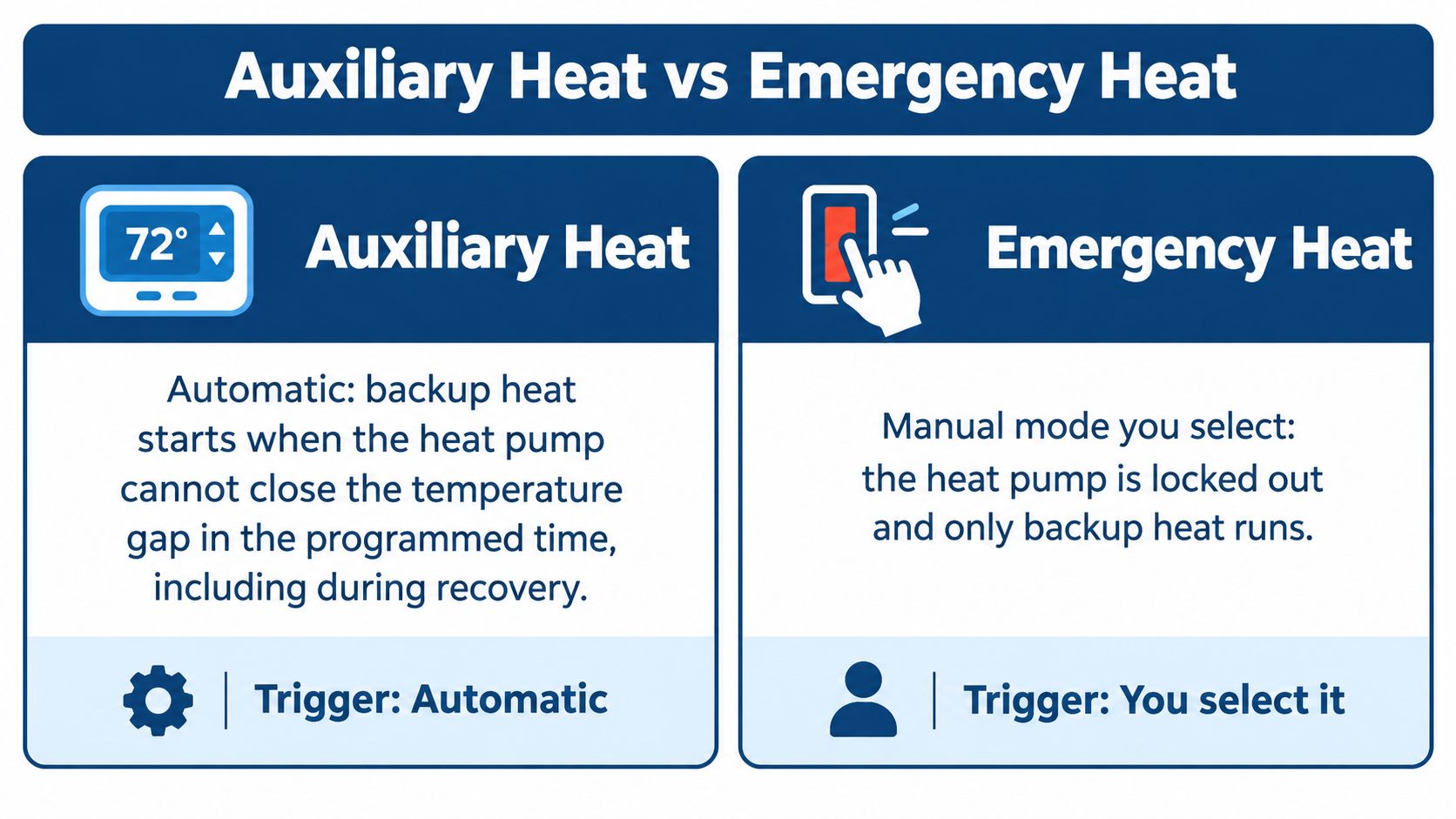
Auxiliary heat starts automatically when the heat pump can't close the gap between room temperature and setpoint within the programmed time. It also appears during recovery after a setpoint jump and when outdoor conditions reduce heat pump capacity. The compressor keeps running, so the home receives heat from both sources during that period.
Side by Side on the Same Criteria
| Feature | Auxiliary Heat (AUX) | Emergency Heat (EM HEAT) |
|---|---|---|
| Who starts it | Thermostat, automatically | Owner, manually |
| Compressor | Keeps running | Locked out |
| Typical trigger | Temperature gap, slow recovery, reduced capacity, defrost | Heat pump failure, service need, or owner decision |
| Heat source | Backup heater working with the heat pump | Backup heater alone |
| Efficiency | Mostly heat-pump output with some resistance heat | Resistance heat only, usually less efficient |
| Routine use | Expected on the coldest mornings and during recovery | Not a routine setting |
Emergency heat is manual. The owner selects it, the thermostat locks out the compressor, and the backup source carries the full heating load until the mode changes. That setting fits a failed compressor, a refrigerant-system problem, or a heat pump that's intentionally out of service. It doesn't fit a working system on a cold night.
The energy logic is plain. The DOE Building Science Education heat pump training material gives electric resistance elements an effective COP of approximately 1.0, while heat pumps commonly operate at COP values above 2 and can reach approximately 3 to 5 under favorable conditions. One unit of electricity therefore produces roughly one unit of resistance heat, but a working heat pump moves more heat per unit of electricity. Forcing EM HEAT while the compressor can run raises electricity use for the same indoor temperature.
Some homes don't use strips at all. A dual-fuel system uses a gas furnace as backup, which changes the cost and sequencing picture. That equipment difference is where generic thermostat advice starts to break down.
Why the Same Label Depends on Your Equipment
Two Mesa homes can show AUX on the same morning and be running different hardware. An electric air handler uses resistance strips for both supplemental and emergency operation. A dual-fuel system pairs the heat pump with a gas furnace, and its controls decide when the furnace takes over.
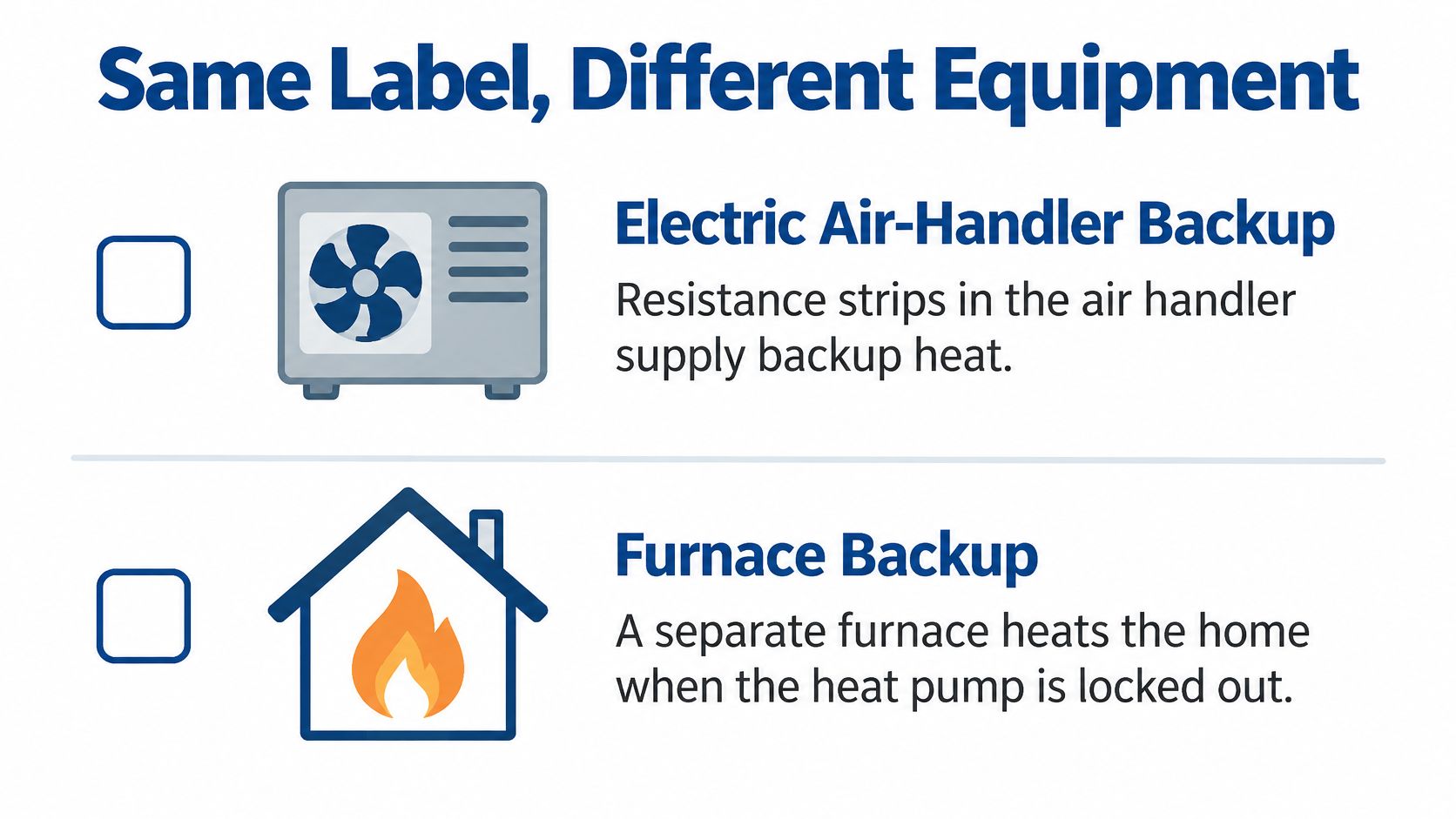
The Lennox FAQ on emergency heat and auxiliary heat distinguishes electric air-handler backup from dual-fuel sequencing. Trane owner guidance likewise treats these configurations as model-dependent and technician-configured. There's no universal lockout setting that a homeowner can safely assume applies to every system.
Universal Behavior and Model-Specific Behavior
Universal behavior is narrow. AUX is automatic, EM HEAT is a manual compressor lockout, and defrost or recovery can trigger AUX. Everything else sits in the model-specific column.
- Lockout temperature: The outdoor temperature that limits or permits backup heat is set for the specific equipment.
- Staging and delay: The wait before supplemental heat starts, and whether AUX runs with the compressor, follow the control setup.
- Backup source: Electric strips, a gas furnace, or another configured source changes cost, sequencing, and what EM HEAT runs.
Owners planning year-round comfort with a heat pump get better answers from documentation than from display labels alone. A short checklist, gathered without changing any installer settings, gives a technician what the thermostat can't.
Documentation Checklist for the Service Visit
- Model numbers: Outdoor and indoor model numbers copied from the data plates.
- Backup heat source: Electric strips, gas furnace, or dual-fuel, as named on the equipment paperwork.
- Thermostat details: Make and model, with the owner's manual if available.
- Recorded settings: Any lockout or balance-point values on installation or service paperwork, copied exactly as written.
- Observed symptoms: The label shown, start and end times, outdoor temperature, and whether the outdoor fan ran.
- Service history: The date of the last service visit and any mode changes made at that visit.
That list belongs in the technician's hands at the door. It replaces guessing about hidden settings with facts tied to the installed equipment.
Defrost, Recovery and Mild Arizona Winters
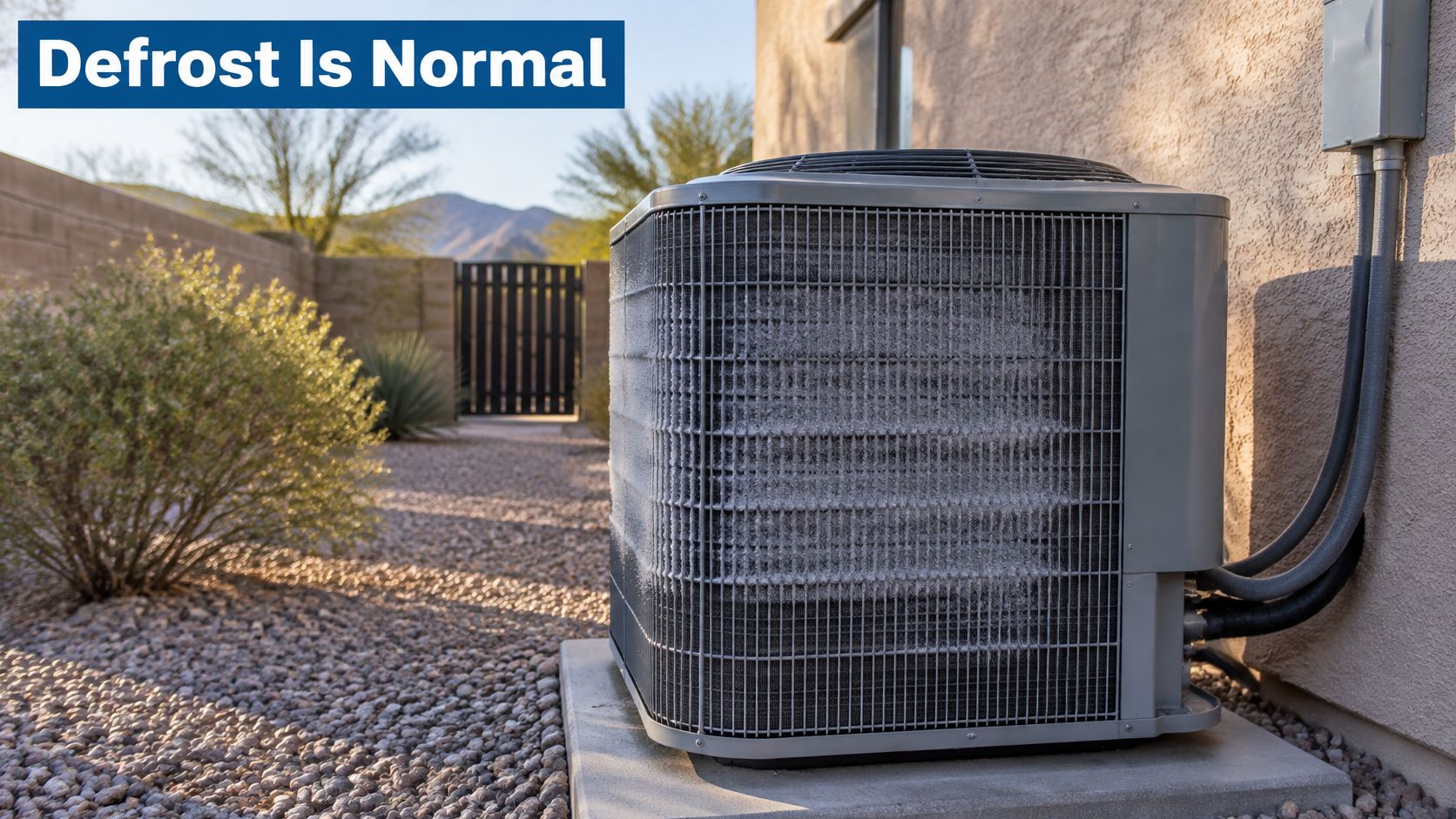
Two normal events put AUX on the display without any manual mode choice. During defrost, frost builds on the outdoor coil when it gets cold enough to freeze moisture, so the heat pump briefly reverses to send heat outdoors and melt that frost. Backup resistance heat may run during that interval to reduce cool air delivery indoors.
Recovery is the second event. After a nighttime setback or a large setpoint increase, the thermostat may add supplemental heat while the house is still warming toward the new setting. Deep setbacks invite this pattern because the control sees a large gap and a slow climb.
An Observable Test for Owners
A short AUX run that ends on its own, with the room reaching setpoint, fits a normal pattern. A long run looks different. Repeated AUX with the outdoor fan silent, or AUX that continues after the room reaches setpoint, is a reason to check the system rather than wait for the next bill.
Cold-climate field data shows why duration matters. In a U.S. Department of Energy field-validation study of air-source heat pumps in cold climates, auxiliary-heating energy at five monitored sites exceeded nearly 40% of the compressor-based heating energy, and auxiliary heaters operated during and/or immediately after outdoor-coil defrost cycles. Those are cold-climate results. They don't transfer directly to Mesa, where extended freezing conditions are less common, but they show that backup heat can become a large share of heating energy when controls or capacity fall short.
Capacity loss at low temperature explains part of that risk. NREL modeling for standard-performance heat-pump rooftop units reports that capacity and efficiency retention at 0°F relative to 47°F fall to about 40% and 38%, respectively. When compressor output drops that far, AUX energizes because delivered capacity no longer meets the load. Mesa winters rarely test that extreme, which is exactly why steady AUX on a mild East Valley day deserves investigation instead of routine acceptance. For background on low-temperature behavior, Comfort Experts explains heat pump limits in a separate guide.
Arizona Conditions That Raise Backup Use
Several local conditions reduce capacity or raise the heating load, and each one is worth raising with a technician.
- Fine dust on the outdoor coil: Desert dust coats coil fins and cuts heat transfer at the side-yard unit.
- Restricted filters: A loaded filter starves the air handler and slows recovery.
- Leaky ducts in hot attics: Heated air lost in the attic never reaches the rooms calling for heat.
- Oversized or mismatched equipment: Poor sizing leaves the control calling for help the compressor can't time correctly.
- Aggressive setbacks: Large morning jumps trigger supplemental heat during recovery.
- Monsoon debris: Wind-blown material packed against the outdoor unit restricts airflow long after storm season ends.
Rooftop and package units, common on older East Valley homes, follow the same mode logic. Airflow and access checks on a roof belong to a technician, not a homeowner with a ladder. Occasional AUX on the coldest morning is expected in the desert. AUX as a daily companion is the signal to act.
Symptoms That Mean It Is Time to Call a Technician
The symptoms below move a mode question into a service question. Each one pairs something an owner can observe with the likely system area and a single next action. Guesswork about settings doesn't help here, since several of these patterns point to equipment or controls that need testing.
| Symptom | Likely area | Owner action |
|---|---|---|
| AUX most of a mild day, bill rising | Heat pump not keeping up from airflow, sizing, or outdoor coil dust | Log hours and outdoor conditions, then schedule service |
| EM HEAT on with no known reason | Heat pump locked out, possibly needing repair | Ask why it was selected, then schedule service |
| Outdoor fan or compressor silent while thermostat calls for heat | Outdoor unit or control fault | Stay out of the cabinet and call |
| Frost or ice on outdoor coil that does not clear | Defrost or refrigerant-side problem | Call promptly and do not chip ice |
| Burning smell, scorching odor, or breaker trips | Electrical fault in heater section | Switch the system off at the thermostat and call now |
| Weak airflow with a clean filter | Blower, ductwork, or sizing | Check the filter as the manual describes, then schedule service |
| Hot rooms with repeated AUX | Duct leakage or zoning gap | Schedule a duct sealing review |
A rising winter bill alongside all-day AUX is often the first measurable sign. The heat pump runs, the house stays near setpoint, and the strips quietly carry a share of the load they shouldn't carry in mild weather. Logging the hours, the outdoor temperature, and whether the outdoor fan ran gives heat pump diagnostics a starting point that a single thermostat photo can't provide.
Safety Limits for Owners
Three limits apply to every row in the table. Owners shouldn't open the outdoor cabinet, work on electrical or refrigerant components, or chip ice off a coil. A breaker that trips once is information, and repeated resets turn that information into risk.
A burning smell or scorching odor changes the order of operations. The system goes off at the thermostat first, and the call comes second. Weak airflow allows one owner check, the filter, handled the way the manual describes. Anything past the filter sits with a technician who can test the blower, ducts, and controls together.
Questions to Ask Your Technician Before Any Setting Change
The right answers to mode questions are model-specific, so they should be written down rather than guessed. Seven questions cover the ground that a display label can't. Each one can be answered directly from the equipment, the paperwork, or a test at the thermostat.
- Backup source: Which backup source does the system use, and is it shared with a gas furnace?
- Lockout setting: What lockout or balance-point setting is installed, and is it written on the service paperwork?
- Compressor pairing: Does AUX run alongside the compressor on this model, and under which conditions?
- Thermostat configuration: Is the thermostat configured for this equipment so the labels match what the system is doing?
- Failure mode: If the heat pump fails, which mode should be selected, and what indoor temperature should the home expect?
- Logged readings: Which logged AUX readings look normal for this model, and what should be recorded before the next visit?
- Change control: Who should change settings, and will each change be documented?
What a Good Answer Sounds Like
A good answer names the model, ties the setting to the paperwork, and ends up in writing. Vague reassurance about AUX being normal, without a duration or a condition attached, leaves the owner in the same position next month. Specific answers also make future heat pump maintenance visits faster, because the next technician can compare current behavior against recorded settings.
One boundary holds regardless of the answers. Owners shouldn't change installer-menu settings or lockout values on their own. Any change should come from the technician, with the old and new values recorded on the service paperwork.
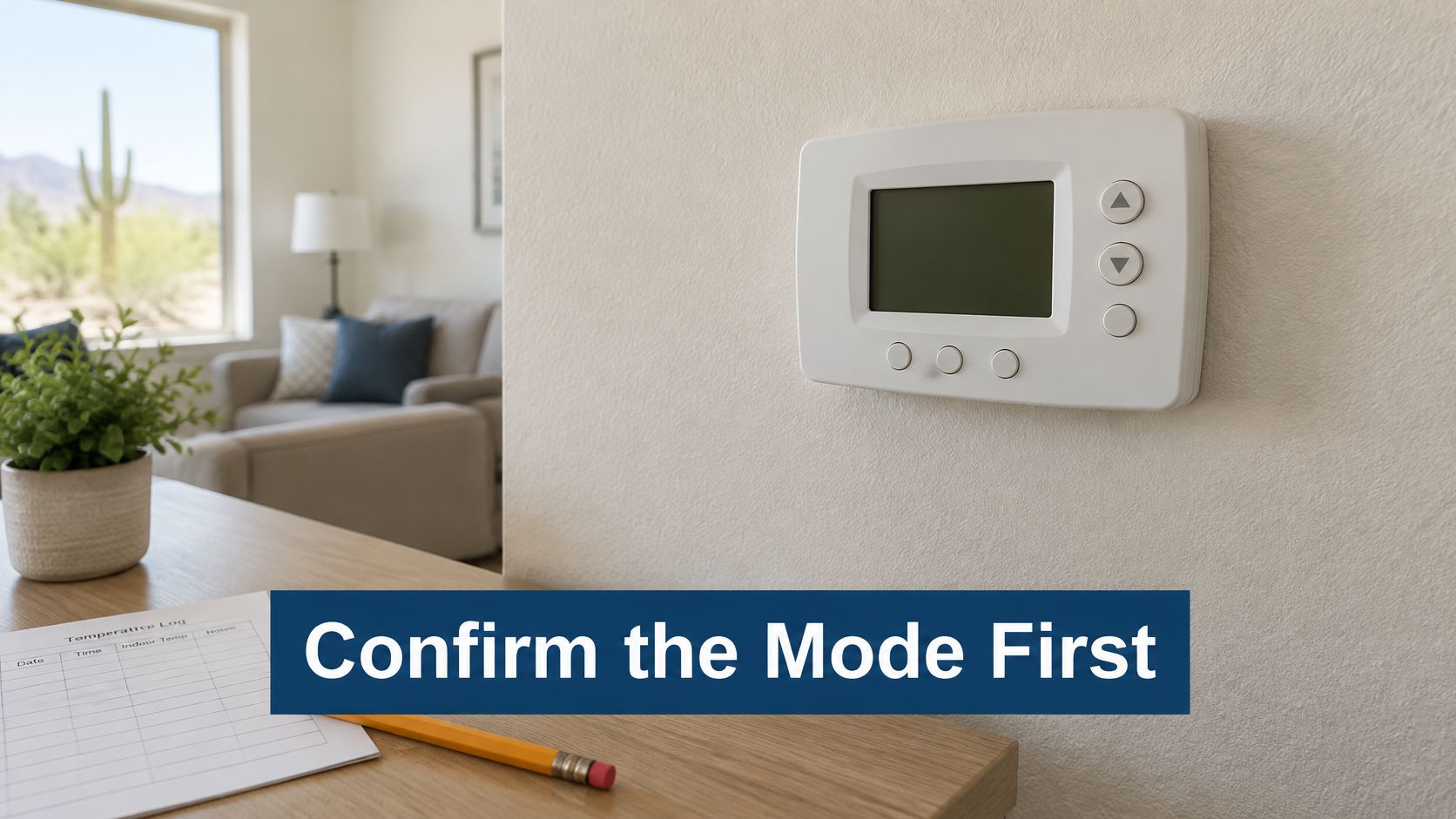
Confirm the Mode Before You Schedule Service
Three outcomes cover most AUX and EM HEAT sightings. Monitor when AUX appears briefly during a cold start, a setback recovery, or a short outdoor-fan pause, ends on its own, and the home reaches setpoint. Log the pattern and move on.
Schedule service when AUX runs for long stretches on mild days, EM HEAT was selected without a clear reason, bills climb, or heat feels weak in one or more rooms. Owners in that position can review what heat pump service in Mesa covers before booking, then use the schedule service form or call 480-207-1239.
Call now for the immediate conditions in the symptom table, including a silent outdoor unit, persistent ice, a burning smell, or a tripping breaker. Owners who phone after hours and wonder how shops handle those calls can read about measuring ROI from HVAC answering services as background on the business side.
The recap is short. Brief AUX with a running outdoor unit is a pattern to monitor, long AUX or unexplained EM HEAT is a reason to schedule, and the safety symptoms mean calling now. Any mode change should be confirmed with a technician before it's made.
Homeowners in Mesa and the East Valley who see AUX running for hours or EM HEAT set without a clear reason can get the mode, controls, and outdoor unit checked together. Visit Comfort Experts to request a heat pump visit and bring the thermostat log and equipment paperwork along.