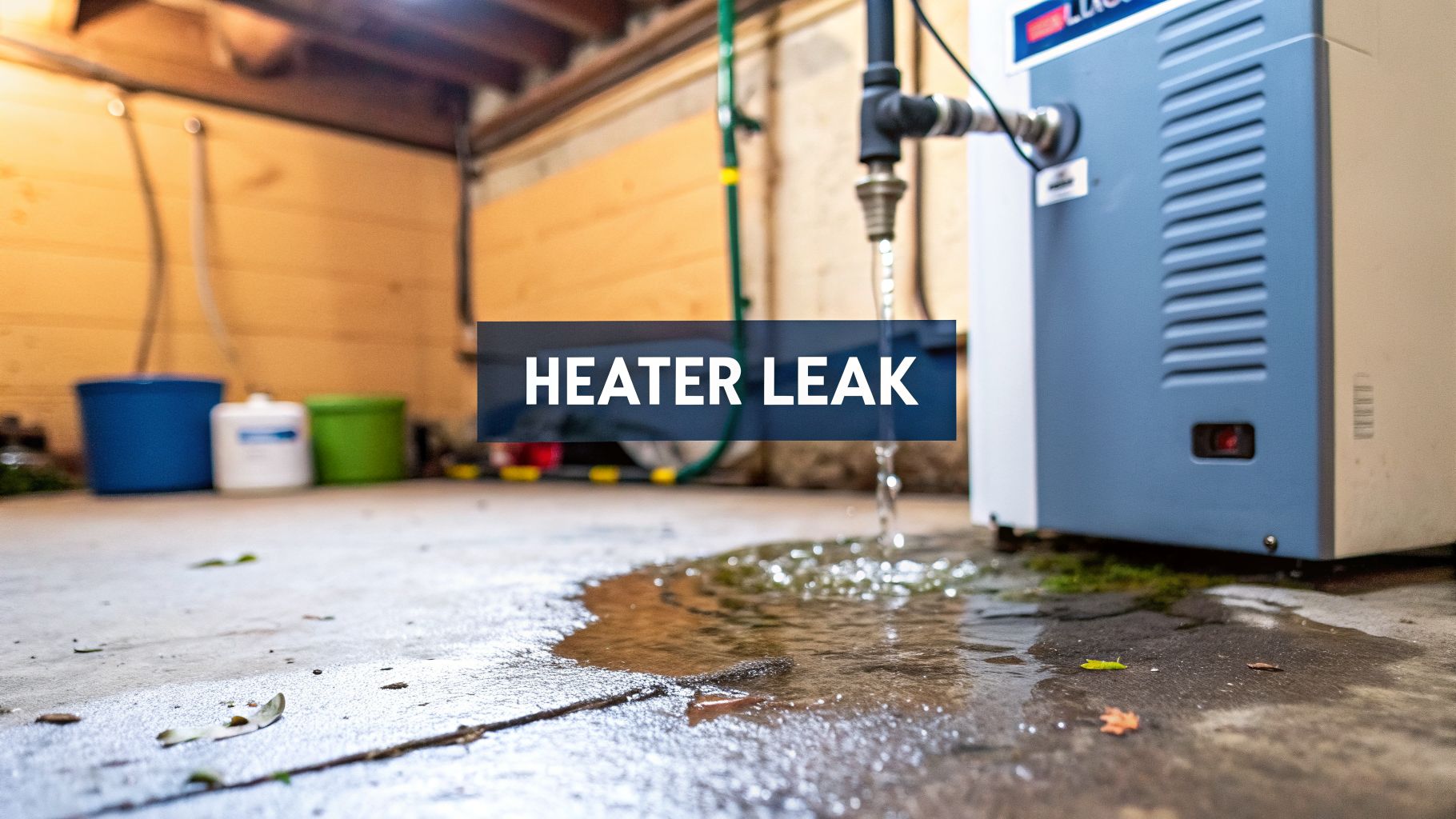
It’s a sight that always causes a little panic: a puddle of water spreading out from the base of your heater. That sinking feeling is universal, but before you assume the worst, take a breath. A heater leaking water is a clear warning sign, but it rarely points to a catastrophic failure that can't be fixed.
That Puddle Under Your Heater Is a Clear Warning
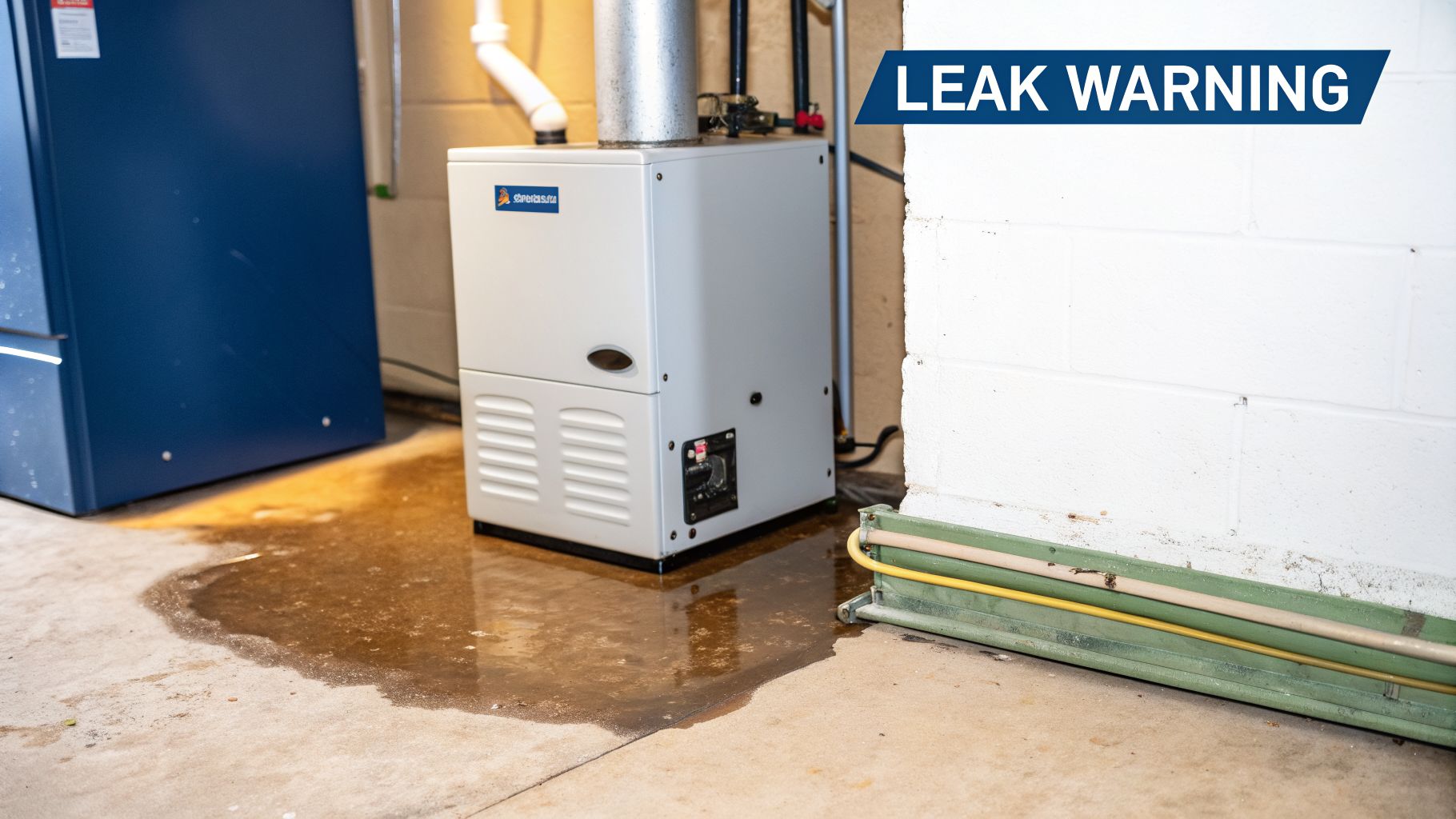
When you find water pooling around your furnace, the first question is usually, "Where is this even coming from?" After all, your furnace isn't hooked up to your home’s plumbing like a water heater is. Let me explain. The water you're seeing is actually a byproduct of an efficient heating process: condensation.
Modern high-efficiency furnaces are designed to wring every last bit of heat out of the combustion gases. When those gases cool down enough, the water vapor in them turns back into a liquid. That water—the condensate—is supposed to flow harmlessly out of your home through a dedicated drain line. When it ends up on your floor instead, something has gone wrong with that drainage system.
Understanding what’s happening is the first step toward a fix. Knowing how to detect water leak issues in general can also help you quickly rule out other plumbing problems that might be happening nearby.
Key Insight: A leaking heater doesn't mean your furnace is full of water. It means the system designed to remove condensation has failed, and that failure needs attention before it causes water damage.
As HVAC professionals with decades of experience serving the Phoenix area, we’ve seen it all. We’re going to walk through the most common culprits we find on service calls, which usually include one of these four things:
- A clogged condensate drain line (our #1 suspect in the dusty Phoenix area)
- A problem with an attached whole-home humidifier
- An improperly sloped flue pipe that isn't draining correctly
- A failed or overwhelmed condensate pump
In a lot of cases, it’s a simple fix you might even be able to handle yourself. But sometimes, it's one of the first signs your furnace needs repair from a professional. We'll help you tell the difference.
Common Causes for a Heater Leaking Water in Phoenix
That frustrating puddle spreading from your furnace can be a real head-scratcher. Your heater isn’t hooked up to a water supply like a sink or a toilet, so the first question we always get is, "Where is all this water coming from?"
In nearly every case, the culprit is condensation. Modern high-efficiency furnaces produce this moisture as a normal part of the heating process. The problem isn’t the water itself—it’s that the water isn't draining away like it's supposed to. Here in Phoenix, as seasoned experts from Comfort Experts, we see a few repeat offenders that turn harmless condensation into a damaging leak.
Clogged Condensate Drain Line
Honestly, this is the number one cause we find on service calls across the Valley. Your furnace collects condensation in a pan, and a simple PVC pipe—the condensate drain line—is supposed to carry it outside. Over time, that line gets choked with dust, algae, and other gunk.
With our dusty Arizona environment, is it any wonder these lines get blocked? When that happens, the water has nowhere to go but back into the drain pan. Eventually, the pan overflows, and you’re left with a puddle. While this problem is notorious for air conditioners in the summer, it’s just as common with high-efficiency furnaces. You can see how this exact issue affects cooling systems in our article about an air conditioner dripping water.
A bad clog can even trigger a safety float switch, which shuts down your entire system to prevent water damage. It’s a smart feature, but it’s still a major headache when you just want the heat on.
Failed Condensate Pump
Many Phoenix homes have furnaces tucked away in an attic or a closet where gravity can't help drain the water away. In these setups, a small device called a condensate pump is used. It’s a little box that collects the water and actively pumps it outside.
But these pumps are mechanical, and like any motor, they can wear out and fail. The float switch might get stuck, the motor could burn out, or an internal valve can go bad. When the pump gives up, its reservoir overflows quickly, spilling water onto whatever is below. If your furnace is in the attic, a failed pump can cause serious ceiling and drywall damage before you even realize there's a problem.
Expert Tip: Any furnace in an attic should have a secondary drain pan underneath the entire unit. This pan needs its own float switch. It’s a critical backup that shuts the system off if the main pan or pump overflows, saving your home from a disastrous leak. This is a best practice we implement to protect our clients' homes.
Leaks from a Whole-Home Humidifier
Our dry desert air makes whole-home humidifiers a fantastic upgrade for comfort, but they introduce another potential source of water. Unlike the furnace, a humidifier is directly connected to a water supply line, and a leak can spring from a few different spots:
- A cracked water feed line: The small tube feeding the humidifier can get brittle and crack over time.
- A faulty solenoid valve: This electronic valve controls water flow and can get stuck open, letting water run constantly.
- A clogged drain: Humidifiers also produce wastewater. If their small drain line gets blocked with mineral scale, it will back up and overflow.
Since the humidifier is mounted right on your ductwork, a leak from it can easily look like it’s coming from the furnace itself. Carefully checking the humidifier and its water connections is a key step in diagnosing the real source of the leak.
Improper Flue Pipe Drainage
High-efficiency furnaces don't use metal chimneys; they use white PVC pipes for the exhaust flue. These pipes are designed to vent cooled combustion gases outside, and those gases are full of water vapor.
To work correctly, the flue pipe must have a specific slope—at least ¼ inch of fall for every foot of pipe—running back toward the furnace. This slope lets any condensation that forms inside the pipe drain back into the system's collector box to be properly removed. If the pipe was installed without the right slope or sags in the middle, water will pool up inside and eventually start dripping from the joints. This is something our technicians check during every installation and tune-up, ensuring long-term reliability.
How to Safely Diagnose and Fix a Leaking Heater
Walking into your garage or utility closet and seeing a puddle of water spreading from your heater is a surefire way to ruin your day. But before you panic, take a breath. Many times, you can figure out what’s going on with a few simple checks.
This is all about a safe, methodical inspection. Before you even think about touching anything, we need to talk about safety. This is the one step you absolutely cannot skip.
Turn off all power to your furnace at the circuit breaker. Find your home's breaker panel—it's usually in the garage, a closet, or on an exterior wall—and flip the switch labeled "Furnace," "Heater," or "HVAC" to the OFF position. Working on an HVAC unit with live electricity is incredibly dangerous.
Once you're positive the power is off, grab a flashlight. Your mission is to find where the water is actually coming from, not just where the puddle ended up. Is it dripping from a white pipe? A box attached to the unit? Or does it seem to be seeping from the furnace cabinet itself?
Start with the Usual Suspect: The Condensate Drain
In our experience as Comfort Experts, a furnace or air handler leaking water almost always comes down to one thing: the condensate drain system. Find the white PVC pipe that runs out of the side or bottom of your indoor unit. This little pipe is public enemy number one.
- Check the connections: Run your fingers around the fittings where the PVC pipe connects to the furnace. Are they wet? Sometimes these connections just work themselves loose over time.
- Look inside the drain pan: If you can, peek inside the furnace cabinet at the primary drain pan. If it’s holding standing water, you've almost certainly found the problem—a clog somewhere downstream is causing it to back up and overflow.
- Inspect the pipe for cracks: It’s less common, but the PVC pipe itself can develop tiny cracks, especially at the joints or elbows. A slow, nagging drip is often the result.
To help you mentally walk through the process, this decision tree shows the first critical steps for tracking down the source of the leak.
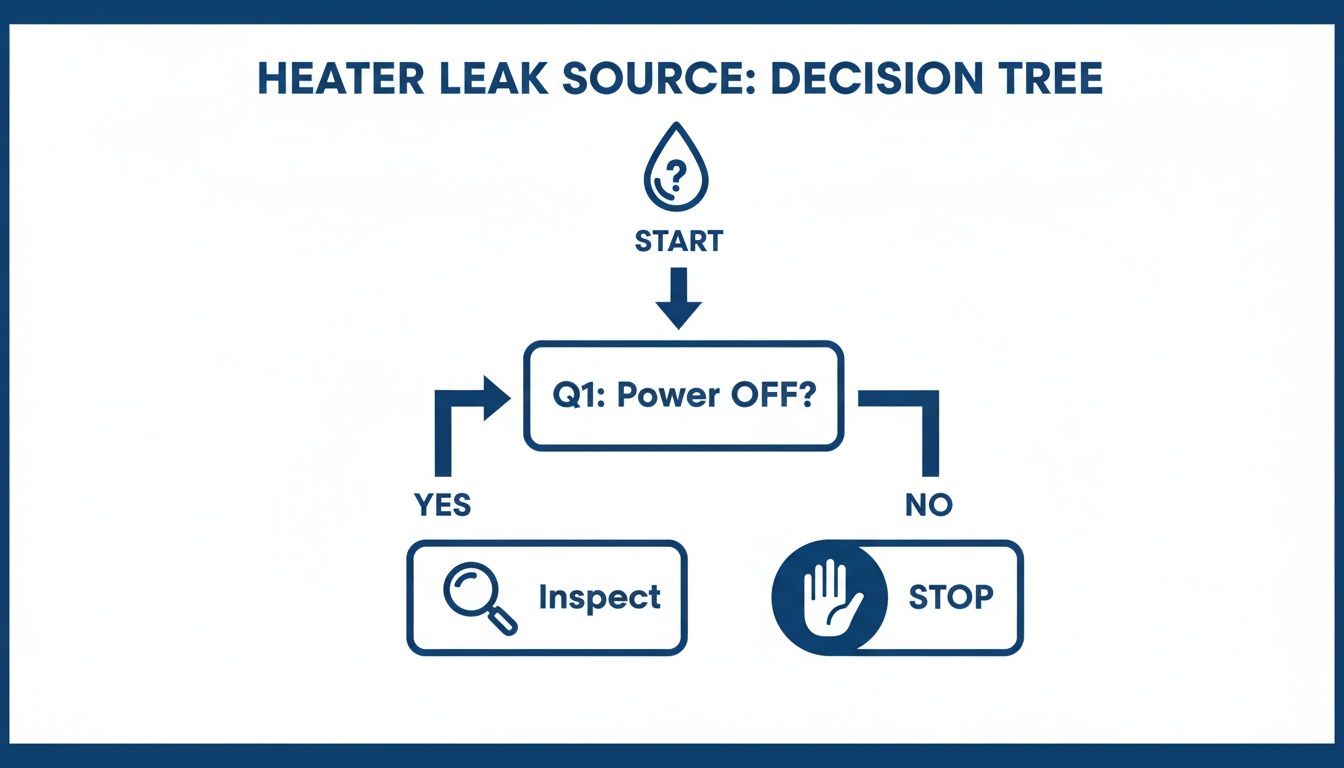
As you can see, it all starts with safety and a good visual check. If you’ve traced the water back to that drain line, a simple DIY fix might be all you need.
How to Safely Clear a Clogged Drain Line
For many Phoenix homeowners, clearing a clogged condensate line is a completely manageable task, and it's incredibly effective. Here’s the thing: the best tool for the job is a wet/dry shop vacuum.
First, you'll need to find where the condensate line exits your house. It’s typically a small PVC pipe sticking out of a wall near your outdoor AC condenser. Once you've got it, press the nozzle of your shop vac firmly over the end of the pipe. You can use your hands or a damp rag to create a tight seal.
Now, turn the vacuum on for 60 to 90 seconds. That powerful suction is usually more than enough to pull the entire clog—a nasty clump of dust, sludge, and algae—right out of the line. You might even hear a satisfying "thump" as the blockage breaks free. Check the vacuum canister afterward to see what you pulled out.
Know Your Limits: This DIY fix is great for a simple clog in the primary drain line. But if it doesn't solve the leak, if you saw water coming from a different component like a humidifier, or if you feel out of your depth at any point, it's time to stop. It is always better to call a professional than to risk turning a small problem into a big, expensive one.
If the water keeps coming, or if you noticed it was dripping from a whole-house humidifier or a small pump during your initial inspection, the problem is more complex. Trying to fix a bad pump or a faulty internal valve without the right experience can easily make things worse.
This is where preventative maintenance really pays off. Having these components cleaned and inspected annually, as detailed in our furnace maintenance checklist, is the single best way to avoid surprise leaks and emergency calls.
When a Leak Means You Need a Pro Right Away
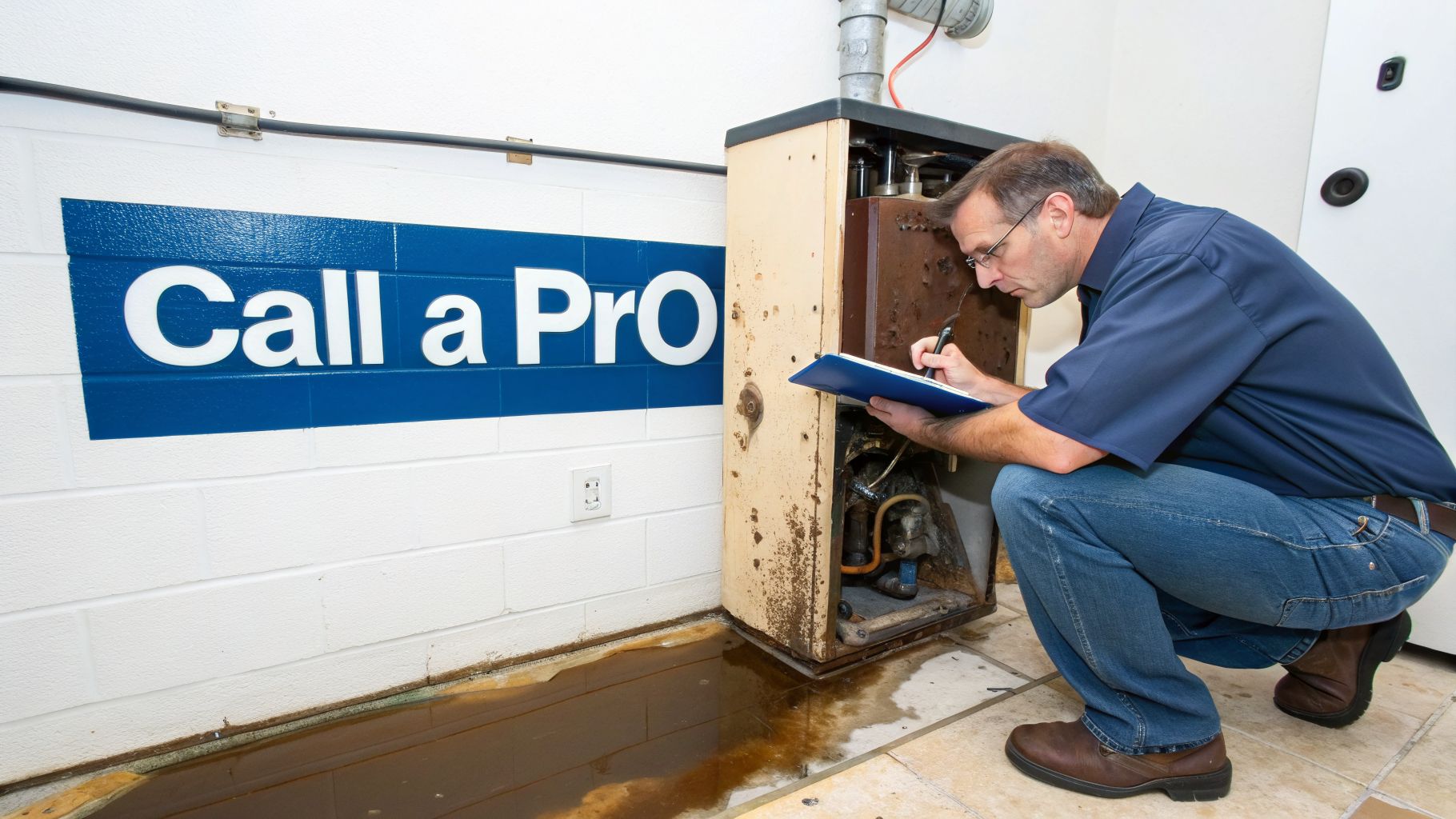
Look, we get it. Most of the time, a small puddle from your HVAC system is just a clogged drain line you can clear yourself. But some situations are different. They aren't just minor drips; they're urgent warnings of a major system failure or a serious safety hazard.
These are the red flags that mean you need to shut the system down and call a professional immediately. Don't wait. Ignoring them can lead to thousands in property damage or, far worse, put your family’s health at risk.
| Red Flag | Why It's Urgent | Recommended Action |
|---|---|---|
| Large Volume of Water | A sudden, significant leak points to a much more severe failure than a simple clog, like a cracked internal pan or disconnected pump. | Shut off power at the breaker and call for emergency service. |
| Furnace Won't Restart | This often means a safety switch has tripped, indicating a serious overflow or electrical fault that needs professional diagnosis. | Do not try to bypass safeties. Call a certified technician. |
| Heavy Rust/Corrosion | Indicates a long-term, hidden leak has been eating away at the furnace cabinet, compromising its structural integrity and internal parts. | Schedule an immediate professional inspection to assess the damage. |
| Water from Cabinet Seams | Water inside the main furnace cabinet could mean a cracked secondary heat exchanger, posing a carbon monoxide risk. | This is an emergency. Turn off the furnace and call for emergency furnace repair. |
Significant Rust and Corrosion
A little surface rust on an outdoor unit is one thing, but heavy corrosion on your indoor furnace cabinet is a huge problem. If you see rust blooming around the seams or near the base, it's a dead giveaway that a slow, hidden leak has been at work for a long time.
Water has likely been sitting inside the unit, eating away at the metal for weeks or even months. This isn't just cosmetic. That corrosion can compromise critical internal parts and weaken the entire structure of the furnace, setting the stage for a catastrophic failure. Our team is trained to spot this kind of long-term damage during service calls.
Water Leaking From the Furnace Cabinet Itself
This is the big one. If you see water seeping directly from the seams of the main furnace cabinet—not from a connected pipe, drain, or pump—you have a serious internal problem. Water should never be inside the main body of your furnace.
A leak like this often means a component deep inside the unit has failed.
A leak coming from inside the furnace cabinet could be a cracked secondary heat exchanger. This is a critical failure that not only causes water damage but can also create a risk of carbon monoxide (CO) entering your home's air supply.
Because a heater leaking water can be a symptom of a much larger issue, understanding the critical signs it's time to call a plumber or an HVAC technician helps you act fast. If you even suspect an internal leak, getting a professional diagnosis is the only safe move. In these scenarios, acting fast is always the most cost-effective choice.
The Best Way to Prevent Future Heater Leaks
After dealing with the stress of a leak, the last thing you want is a repeat performance. You know what? The best way to handle a heater leaking water is to stop it from happening in the first place. It’s all about shifting from reactive, middle-of-the-night emergency calls to proactive, preventative care.
For homeowners in the Phoenix Valley, this is especially true. Our climate is tough on HVAC equipment. It gets a double-punch: relentless summer heat followed by chilly winters where we suddenly ask that same system to keep us warm. All the while, our fine desert dust and notoriously hard water are working overtime to clog lines and wear down parts.
What Proactive HVAC Maintenance Really Means
Proactive maintenance isn't just sitting around and waiting for something to go wrong. It's a scheduled, professional check-up designed to keep your entire system running at its best, catching small issues before they snowball into a huge headache.
Think of it like a regular oil change and inspection for your car; it’s a small investment in reliability that pays off big time. For your furnace, this service is what we call a "tune-up." A proper tune-up is the single best way to address the common causes of heater leaks we've already covered, making sure your system is clean, safe, and ready for winter.
Expert Insight: Here's a number that always gets a homeowner's attention: industry data shows that regularly maintained HVAC systems are up to 95% less likely to have an unexpected breakdown. That simple act of prevention saves you a lot of money and the stress of a no-heat emergency.
What a Comfort Experts Tune-Up Includes
When one of our Comfort Experts technicians performs a furnace tune-up, it’s not just a quick glance. We follow a detailed checklist to clean, inspect, and test your entire heating system. This service is specifically designed to stop problems like a heater leaking water before they can even start.
Here’s a quick look at what our comprehensive service actually involves:
- Condensate System Flush: We don't just pour some cleaner down the pipe. We thoroughly clean and flush the entire condensate drain line, removing the sludge, dust, and algae buildup that causes most overflows. We’ll also test your condensate pump (if you have one) to make sure it's working properly.
- Heat Exchanger Inspection: We perform a careful visual inspection of the primary and secondary heat exchangers. We're looking for any signs of stress cracks or corrosion that could lead to water leaks or, far more seriously, a dangerous carbon monoxide issue.
- Flue Pipe and Venting Check: Our technicians make sure the exhaust flue is properly sloped for correct drainage and is completely free of obstructions. This prevents corrosive water from pooling up and leaking out at the joints.
- Safety Control Testing: We test all the critical safety switches—like the high-limit switch and the float switches in your drain pan and pump—to confirm they’ll shut the system down properly if a problem ever occurs.
This preventative approach doesn't just stop leaks. A clean, well-maintained furnace runs more efficiently, which means lower monthly energy bills. To see the full breakdown of everything we check, you can explore our detailed HVAC preventive maintenance checklist. By catching normal wear and tear early, you can add years to the life of your equipment.
A puddle under your heater is the last thing you want to see, but you don’t have to figure it out on your own. Here at Comfort Experts, our team has handled just about every kind of heater leak the Phoenix Valley can throw at a system, and we're ready to get your home's comfort and safety back on track.
From a simple drain line clog caused by our fine desert dust to a more complex internal part failure, we have the experience to find the real problem and fix it right the first time. We built our reputation on honest work and clear communication, treating your home the way we’d want ours treated. Don't let a small leak spiral into a major headache with costly water damage.
If you're staring at a leak or just want to schedule a maintenance visit to prevent one, give our local team a call. You can reach Comfort Experts today at 480-207-1239 or schedule service online for the fast, professional help you deserve.