If your furnace still runs but sounds rough, heats unevenly, or keeps needing one more repair, you’re probably already asking the right question. High efficiency furnace replacement cost in Mesa and the Phoenix area is not just about the price of the box in the closet or attic. It is about venting, sizing, permits, ductwork, and whether the new system will save you money instead of creating a new set of problems.
Is It Time for a New Furnace Signs to Watch For
A lot of furnaces do not fail all at once. They get noisy. They run longer. Some rooms stay chilly while others feel stuffy. Your gas bill creeps up in winter, and you start wondering whether it makes sense to keep fixing an older unit.
Warning signs that matter
Some signs are obvious. No heat is obvious. Many of the expensive mistakes happen when homeowners ignore the less dramatic signs.
- Higher winter gas bills: If usage habits have not changed but heating costs have, the furnace may be losing efficiency.
- New noises: Clanking, rattling, whistling, and booming sounds often point to wear, airflow issues, or burner-related problems.
- Uneven heating: One side of the house feels fine while bedrooms stay cold. That can point to airflow problems, duct restrictions, or a furnace that is no longer operating the way it should.
- Frequent repairs: One repair by itself does not mean replacement. Repeated repairs on an aging system usually do.
- Short cycling: The furnace starts, stops, then starts again too quickly. That often means poor sizing, airflow trouble, or internal control issues.
If you want a broader checklist before making the repair-versus-replace call, this guide on signs your furnace needs repair is a useful starting point.
Age changes the math
In the field, older furnaces often become expensive before they become completely dead. You spend money to keep them going, but comfort does not really improve. That is the frustrating part.
A furnace can still produce heat and still be a bad long-term investment.
If the unit is older, every repair deserves a harder look. Heat exchangers, inducer motors, blower assemblies, ignition parts, safety switches, and control boards add up. Even when the repair is technically possible, the homeowner may still be putting money into a system with lower efficiency, older venting, and more wear waiting around the corner.
What uneven heat really tells you
Uneven heat is not always just a “furnace problem.” It can signal:
- Duct leakage or restrictions
- An oversized furnace
- A weak blower or dirty wheel
- A thermostat location issue
- A home envelope problem such as poor insulation or hot-cold room exposure
That matters because replacing the furnace without checking the whole setup can leave you with the same comfort complaints.
Repair or replace
Ask yourself a few practical questions:
- Is this the first repair, or one of many?
- Has comfort gotten worse over time?
- Are utility bills rising without a clear reason?
- Do you want the cheapest immediate fix, or the better long-term answer?
That last question is the critical one. Nobody likes replacing a furnace. But replacing before a full breakdown gives you time to compare options, schedule the job properly, and avoid making a rushed decision on the coldest night of the season.
Decoding High-Efficiency Furnace Costs in Phoenix
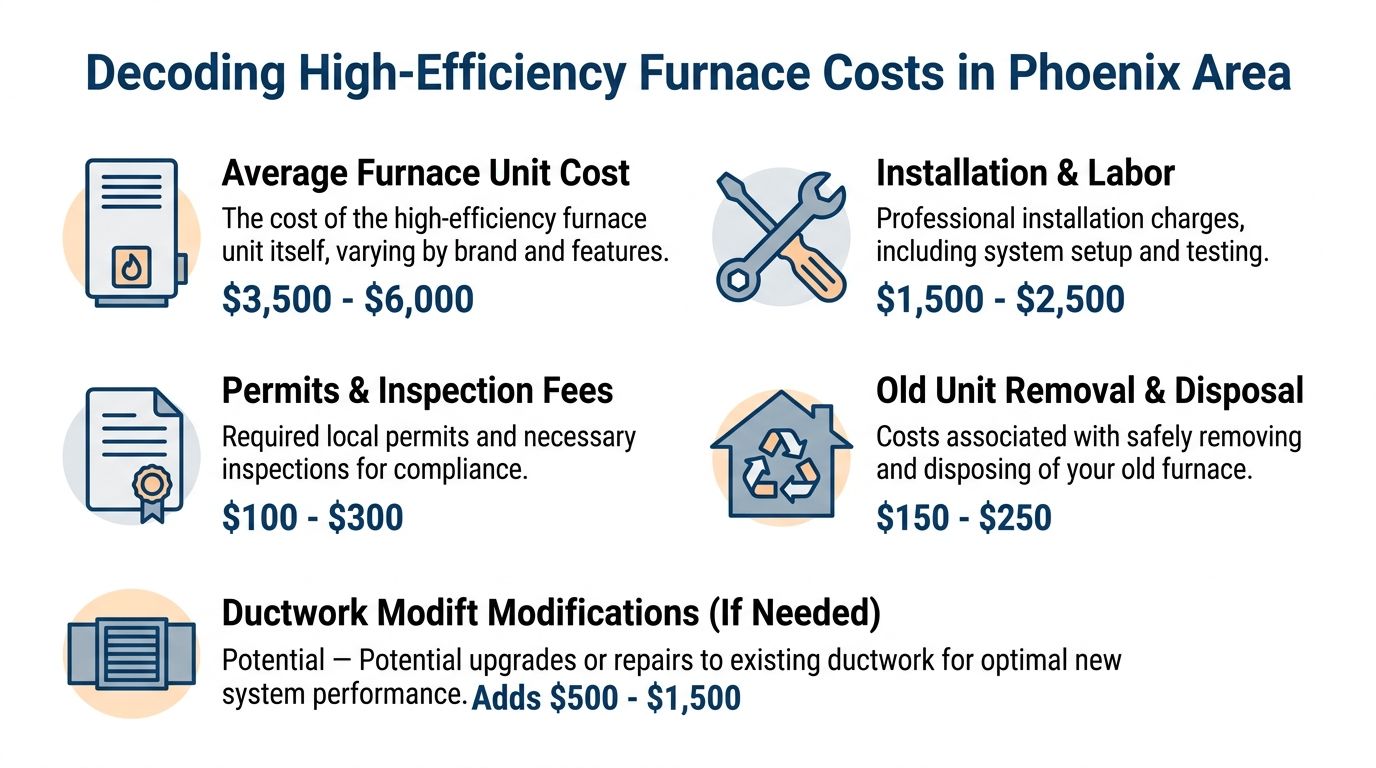
A Mesa homeowner gets a furnace quote in November and sees a number that is much higher than the basic online estimates. Usually, the surprise is not the furnace cabinet. It is the venting, drain work, duct transitions, permit, and access issues that show up once a contractor looks at the home.
What high efficiency means
A high-efficiency gas furnace is generally 90% AFUE or higher, as noted in Royalty Heating & Air’s furnace replacement cost estimate. AFUE stands for Annual Fuel Utilization Efficiency. It measures how much fuel becomes usable heat over a heating season.
That higher rating changes the installation, not just the utility bill. An 80% AFUE furnace vents hotter exhaust through metal flue pipe. A 90%+ AFUE condensing furnace pulls more heat out of the combustion gases, which means cooler exhaust, PVC venting, and condensate drainage. In Phoenix-area homes, those details often decide whether the job stays straightforward or starts climbing in price.
What homeowners are really paying
The installed price matters more than the equipment tag. Royalty Heating & Air reports high-efficiency gas furnaces commonly run $3,300 to $10,000 installed, with national averages around $7,000. That same source puts a typical 1,500 to 2,000 square foot home in the $3,500 to $7,500 range, while many 80% AFUE systems land lower.
That spread is normal. Two homes in Mesa can need the same furnace size and still have very different replacement costs. One may have easy closet access and a clean vent path. The other may need a new PVC flue route, drain line work, a return transition, and code updates before the furnace can even be started.
Fuel savings still matter, especially if the old unit is inefficient or oversized. But in our market, the key question is whether the added install cost makes sense for your house, your gas usage, and how long you plan to stay.
Phoenix area cost drivers people underestimate
National guides usually skip the parts that push Valley quotes higher. Older Mesa and Phoenix homes are the best example. A condensing furnace may need changes that were never part of the original setup.
Here are the local items that usually move the number:
| Cost factor | Why it changes the quote | What it usually means in real life |
|---|---|---|
| Furnace size | Larger heating demand requires higher output | Bigger equipment costs more, but oversizing creates comfort and airflow problems |
| Access | Tight attic platforms, hallway closets, and garage installations take more labor | Hard access raises labor time and can limit venting options |
| PVC venting | 90%+ furnaces need proper intake and exhaust routing | Long or awkward vent runs add materials and labor fast |
| Condensate drain | Condensing furnaces produce water that has to drain correctly | Drain routing, pump additions, or drain protection can add cost |
| Duct transitions | New cabinets rarely match the old plenum exactly | Sheet metal modifications are common, especially in older homes |
| Controls and wiring | Older thermostats and low-voltage wiring are not always compatible | Small electrical updates can turn into a line item quickly |
| Permit and inspection | Local code enforcement varies by city and job scope | Proper permits add cost, but they also protect the homeowner |
PVC venting is one of the most overlooked expenses. On some Phoenix jobs, there is a clean route to the outside and it is no big deal. On others, the furnace location forces a longer run, roof or wall penetration work, strapping, slope corrections, and finishing around the penetration. That is why one high-efficiency quote can look reasonable and another can jump.
Large repairs also affect the decision. If the original problem was a failed major part, it helps to compare the repair against the bigger picture. This breakdown of the cost to replace a furnace heat exchanger shows why some homeowners stop repairing and put that money toward replacement instead.
Why timing matters in the Valley
Phoenix winters are short, but the service rush is real. The first cold nights fill schedules fast, especially for older gas furnaces that have been ignored since last season.
Homeowners who replace in the shoulder season usually have better appointment options and more time to compare scope, not just price. That matters because the cheapest quote often leaves out the drain work, vent changes, or duct modifications that show up later as change orders.
The Anatomy of Your Replacement Quote A Detailed Breakdown
A good furnace quote in Mesa should read like a scope of work, not a round number with a brand name attached.
On a Phoenix-area replacement, I look for three things first. What equipment is being installed, what field work is required to make it fit and vent correctly, and what code items are included instead of pushed into change orders later. That is where significant price differences show up.
Why one quote is $4,000 and another is $8,000
Part of the gap is the furnace itself. Analysts at HomeGuide’s high-efficiency furnace cost guide place total installed cost for a high-efficiency furnace at roughly $3,800 to $11,500, and they note that condensing systems often need sealed combustion intake, PVC exhaust venting, and condensate drainage, which can add $500 to $2,000+ depending on the job.
The bigger issue in Arizona is the house, not the brochure rating. A furnace in a tight hall closet with an easy sidewall vent is one price. A furnace in an attic or interior location that needs a longer vent run, drain routing, roof penetration work, sheet metal changes, and control updates is a different job entirely.
That is why two bids with the same AFUE can be far apart and both still be honest.
A realistic way to read a Phoenix-area quote
For a 95% AFUE furnace replacement in a 2,000 square foot home, the quote usually breaks into the parts below.
| Cost Component | What it usually covers | What affects the final price |
|---|---|---|
| Furnace equipment | The cabinet, heat exchanger, blower, and controls | Efficiency level, staging, variable-speed blower, brand, and warranty |
| Installation labor | Removal of the old unit, setting the new furnace, gas connection, electrical tie-in, startup, and safety testing | Attic access, closet access, crane or lift needs, and how much has to be rebuilt onsite |
| PVC venting and combustion air | Intake and exhaust piping for a condensing furnace | Length of run, number of fittings, roof or wall penetration, and whether the route needs to be reworked to meet slope requirements |
| Condensate drainage | Drain piping and management for the moisture a high-efficiency furnace creates | Distance to an approved drain point, pump requirements, and attic versus closet location |
| Duct transitions | Supply and return adaptations so the new furnace connects properly | Size mismatch, plenum condition, restrictive return setups, and whether airflow problems need correction |
| Thermostat and control updates | Thermostat replacement, low-voltage rewiring, setup for staging or blower features | Existing control wire, smart thermostat compatibility, and whether the old stat can run the new furnace correctly |
| Permits and inspection | City permit, inspection, and code documentation | Local jurisdiction, gas code items, and electrical corrections found during the job |
| Haul-away and cleanup | Removal and disposal of the old furnace and jobsite cleanup | Access difficulty and whether extra debris removal is needed |
One line item homeowners miss is sizing. National square-foot rules are only a starting point. Before anyone prices a replacement around house size alone, it helps to spend a minute understanding the appropriate BTU per square foot and then compare that rough estimate to the actual duct system, insulation level, and floor plan. In Mesa, I see more comfort problems from oversized equipment and bad airflow than from a furnace being slightly undersized.
Line items worth slowing down and questioning
PVC venting deserves a close look. High-efficiency furnaces are less forgiving here. If the pipe run is too long, poorly supported, or sloped wrong, you can end up with nuisance shutdowns, water issues, and callbacks in the first season.
Drain work matters just as much. Condensing furnaces produce water every time they run. In an attic install, that can mean a condensate pump, secondary protection, and more labor than homeowners expect from a simple furnace swap.
Sheet metal transitions are another common blind spot. New furnaces rarely match the old cabinet exactly. If a contractor writes “minor modifications as needed,” ask what that means in dollars and whether the supply plenum, return drop, or filter rack is being rebuilt.
Thermostat compatibility can add cost fast. A basic stat may heat the house, but it may not control a two-stage furnace or variable-speed blower the way it should. That leaves comfort and efficiency on the table.
Permit scope should be clear in writing. If it is not listed, ask whether the permit, inspection, and any code corrections are included.
Homeowners comparing bids can also review a local furnace installation and replacement service in Mesa to see the kind of scope questions a contractor should answer before work starts.
What a stripped-down quote usually leaves out
The cheapest proposal often looks clean because the messy parts are missing. Vent rerouting is missing. Drain work is vague. Duct adaptation is reduced to one line. Startup testing is assumed instead of listed.
That is where jobs go sideways.
A high-efficiency furnace has to be installed cleanly, vented correctly, and set up to match the house. If the contractor guesses on airflow, skips combustion checks, or leaves the vent and drain details for later, the final bill usually climbs after the job starts.
Choosing the Right Furnace Type for Your Arizona Home
A Mesa homeowner will often ask me the same question in December after a cold night. Should they pay more for the fanciest furnace on the sales sheet, or buy the simpler unit and save the money? In our climate, that answer depends less on raw heating power and more on how the furnace runs, how the home is ducted, and whether the installation adds extras like PVC venting or cabinet modifications.
Single-stage, two-stage, and modulating
Furnace types are best understood by how they deliver heat: single-stage, two-stage, or modulating.
A single-stage furnace runs at full output every time it turns on. It usually costs less up front and it can be a reasonable fit for a smaller Phoenix area home that does not have major comfort complaints. The trade-off is shorter, louder heating cycles and less control over temperature swings.
A two-stage furnace has a low setting and a high setting. In Arizona, that low stage often provides a significant advantage. It can run longer and gentler on cool mornings, which usually feels better than a quick blast of hot air followed by a shutdown. It also tends to pair better with comfort-focused thermostats and variable-speed blowers.
A modulating furnace adjusts heat in smaller steps. When the duct system, thermostat, and setup are all right, it gives the most even indoor temperature and the quietest operation of the three. It also costs more to buy and usually takes more care to set up correctly, so it makes the most sense for homeowners who plan to stay in the house and want the best comfort, not just the lowest bid.
Sizing matters more than the brochure
In Phoenix and Mesa, I see more problems from poor sizing than from the furnace brand itself. A unit that is too large can heat the house quickly, then shut off before the airflow and room temperatures settle out. That leads to temperature swings, extra cycling, and a house that never feels as comfortable as it should.
Bigger equipment does not automatically mean better comfort.
Sizing should be based on the house as it sits today. Square footage matters, but so do insulation levels, window exposure, ceiling height, leakage, and duct layout. If you want a basic starting point before an estimate, this guide on understanding the appropriate BTU per square foot can help you frame the conversation. The final furnace size should still come from a real load calculation, not a guess based on the old unit.
What usually makes sense in Arizona
Arizona homes do not use the furnace the way homes in colder states do. That changes the value equation.
For many households in Mesa, a two-stage furnace often lands in the sweet spot. It usually gives a noticeable comfort upgrade over single-stage equipment without pushing the price as high as a modulating setup. If the home already has airflow issues, hot and cold rooms, or an older thermostat, spending extra on premium furnace features before fixing those problems may not pay off.
Some houses should have a bigger heating conversation anyway. If the cooling side of the system is aging too, or if you want to compare gas heat with electric options, it helps to review how a heat pump works before deciding. In the Phoenix area, that comparison is often more relevant than national furnace guides make it sound.
The furnace type also affects what has to change around it. A high-efficiency condensing furnace may need new PVC vent routing and a condensate drain path. A variable-speed or communicating furnace may need a thermostat upgrade. In some attics and closet installations around Mesa, tighter clearances can turn a straightforward equipment choice into a more involved job.
That is why the right furnace is not merely the highest AFUE model on paper. It is the unit that fits the house, the duct system, the controls, and the budget without creating installation surprises halfway through the job.
The Payback Period Energy Savings Rebates and Financing
A lot of Mesa homeowners call after the first cold snap, right when the furnace quits and they are staring at a repair bill they did not plan for. At that point, the primary question is not whether a new furnace costs money. It does. The question is whether keeping the old one will cost more over the next few winters.

When replacement starts to make financial sense
As noted earlier, replacement pricing has climbed in recent years. That makes the repair-versus-replace call harder, not easier. Still, once a furnace is older and the repair is expensive, I usually tell homeowners to stop looking at that one invoice by itself.
Look at the full picture. An aging furnace often brings repeat service calls, higher gas use, and more wear on related parts like the inducer motor, control board, or blower assembly. In Phoenix and Mesa, heating season is shorter than it is in colder states, so the payback on efficiency alone can be slower. But higher fuel costs amplify the value of efficiency savings, and reduced breakdown risk has value too.
A homeowner who spends heavily on one major repair may still be facing another one next season. That is where replacement often wins.
Phoenix-area payback is not just about the AFUE rating
National articles tend to oversell energy savings and skip the installation details that affect your actual return. Around here, the payback calculation should include the extras that come with many high-efficiency upgrades.
A condensing furnace may need new PVC venting, a condensate drain, and sometimes duct or platform modifications to fit correctly in an attic, garage, or closet installation. If those items are part of the job, they raise the upfront cost and stretch the payback period. On the other hand, if your old furnace is oversized, noisy, or short-cycling, a better-matched replacement can improve comfort and reduce service headaches, which matters even if the gas savings alone are modest.
Seasonal timing matters too. Homeowners who replace equipment before winter demand picks up usually have more time to compare options, ask about duct corrections, and sort out financing without making a rushed decision.
Rebates, tax credits, and local program details
Rebate and tax credit availability can lower the net cost, but only if the equipment and installation meet the program rules. Efficiency tier, model number, and supporting paperwork all matter. That is why I tell people to verify the exact match before they count incentive money into the budget.
For a local starting point, review the current Mesa and Phoenix HVAC rebate options and confirm what applies to your system.
Financing can help, but read the job scope carefully
Financing makes sense for plenty of homeowners, especially when the alternative is pouring money into an unreliable furnace. The mistake is focusing only on the monthly payment.
A lower payment does not automatically mean a better deal if the quote leaves out needed venting changes, drain work, return-air fixes, or thermostat upgrades that show up later as add-ons. In Mesa, I would rather see a homeowner finance the full job correctly once than choose the cheapest quote and pay for corrections afterward.
Some homes also benefit from pairing the furnace project with other energy efficiency upgrades, especially if duct leakage, insulation gaps, or electrical issues are dragging down system performance.
A practical way to judge the numbers
Keep the decision simple and honest:
- What will this repair buy you. One more season, or a few more years?
- How likely is another major repair on this furnace?
- What extra installation costs are tied to the new equipment choice?
- Do current rebates or tax credits apply to the exact system being quoted?
- Is the financing helping you solve the full problem, or just delaying it?
The cheapest choice on paper is often the one that keeps costing money. A smart replacement decision lowers surprise repairs, controls fuel use, and avoids the hidden installation shortcuts that come back to bite homeowners later.
What to Expect During Your Furnace Replacement Process
Homeowners usually feel better once they know what installation day looks like. The process is straightforward when the crew is organized and the scope was quoted properly.
Arrival and prep
The team starts by protecting the work area. That means floor coverings, careful movement through the house, and a quick confirmation of the job scope before tools come out. If the furnace is in an attic, garage, or closet, access and safety setup happen first.
Then the old unit is disconnected. Gas, power, venting, drain components, thermostat wiring, and duct connections are removed in a controlled order. The goal is to keep the work clean and avoid damage to surrounding finishes.
Removal and fitting the new unit
Once the old furnace is out, the crew checks the platform, plenum transitions, and connection points. Hidden issues often show up at these points. Rusted flue pieces, poor return connections, undersized transitions, and old workmanship are common findings on replacement jobs.
The new furnace is then set in place and connected. That includes:
- Gas piping connection and leak check
- Electrical reconnection
- Duct attachment and sealing
- PVC vent and intake routing for high-efficiency systems
- Condensate drain installation
- Thermostat hookup and control setup
Testing matters more than homeowners realize
A furnace is not done when it turns on. It is done when it has been tested.
A proper startup should include verifying ignition sequence, airflow, temperature rise, venting, drain operation, thermostat communication, and general safety performance. If staging or blower settings need adjustment, this is the time to do it.
A clean startup prevents a lot of nuisance issues later, especially on two-stage and modulating equipment.
Timeline and disruption
Most straightforward replacements typically take a day or two. Complicated vent routes, attic access issues, duct modifications, or additional system corrections can stretch that. Homeowners should expect some noise, technician movement through the house, and short periods without heating during the swap.
By the end, the crew should review operation with you, explain any maintenance points, and leave the workspace clean. A good install should feel orderly, not chaotic.
Your Action Plan for a Smart Furnace Investment
If you are comparing quotes, slow down just enough to protect yourself. A furnace replacement is too expensive to buy on guesswork.
Use this checklist before you sign
- Ask for a load calculation: Do not accept “same size as the old one” as the whole sizing method.
- Review the venting plan: High-efficiency systems need proper PVC intake and exhaust routing.
- Check permit details: Make sure permit and inspection scope is clear in writing.
- Look for ductwork notes: If the quote says nothing about duct transitions or airflow, ask why.
- Confirm thermostat compatibility: Better furnaces often need better controls to perform properly.
- Compare warranty terms carefully: Equipment warranty and labor warranty are not the same thing.
- Verify licensing and insurance: Comfort Experts is licensed and insured, ROC #275914, and any company you consider should be equally transparent.
- Read the proposal line by line: A lower price may mean important work was excluded.
Questions worth asking every contractor
Some questions reveal a lot, fast.
| Question | Why it matters |
|---|---|
| How did you determine the furnace size? | Prevents oversizing and short cycling |
| What venting changes are included? | Condensing furnaces require different infrastructure |
| Will you inspect the duct system? | Furnace performance depends on airflow |
| Is the thermostat included and compatible? | Advanced systems need the right controls |
| What exactly is covered in labor and cleanup? | Avoids surprise add-ons later |
What usually leads to regret
The bad outcomes tend to come from the same decisions:
- Choosing by price alone
- Reusing an old thermostat that cannot control the new furnace properly
- Ignoring duct issues because the furnace itself is new
- Skipping permits
- Accepting an oversized system because “more heat sounds better”
Let me explain in simple terms. A good furnace replacement should solve a problem, not just replace a machine. If the house still heats unevenly, cycles too often, or costs too much to run, the project missed the mark.
If you want a detailed, no-pressure quote from a local team that serves Mesa and the Phoenix Valley, contact Comfort Experts. You can call 480-207-1239 or schedule service online.