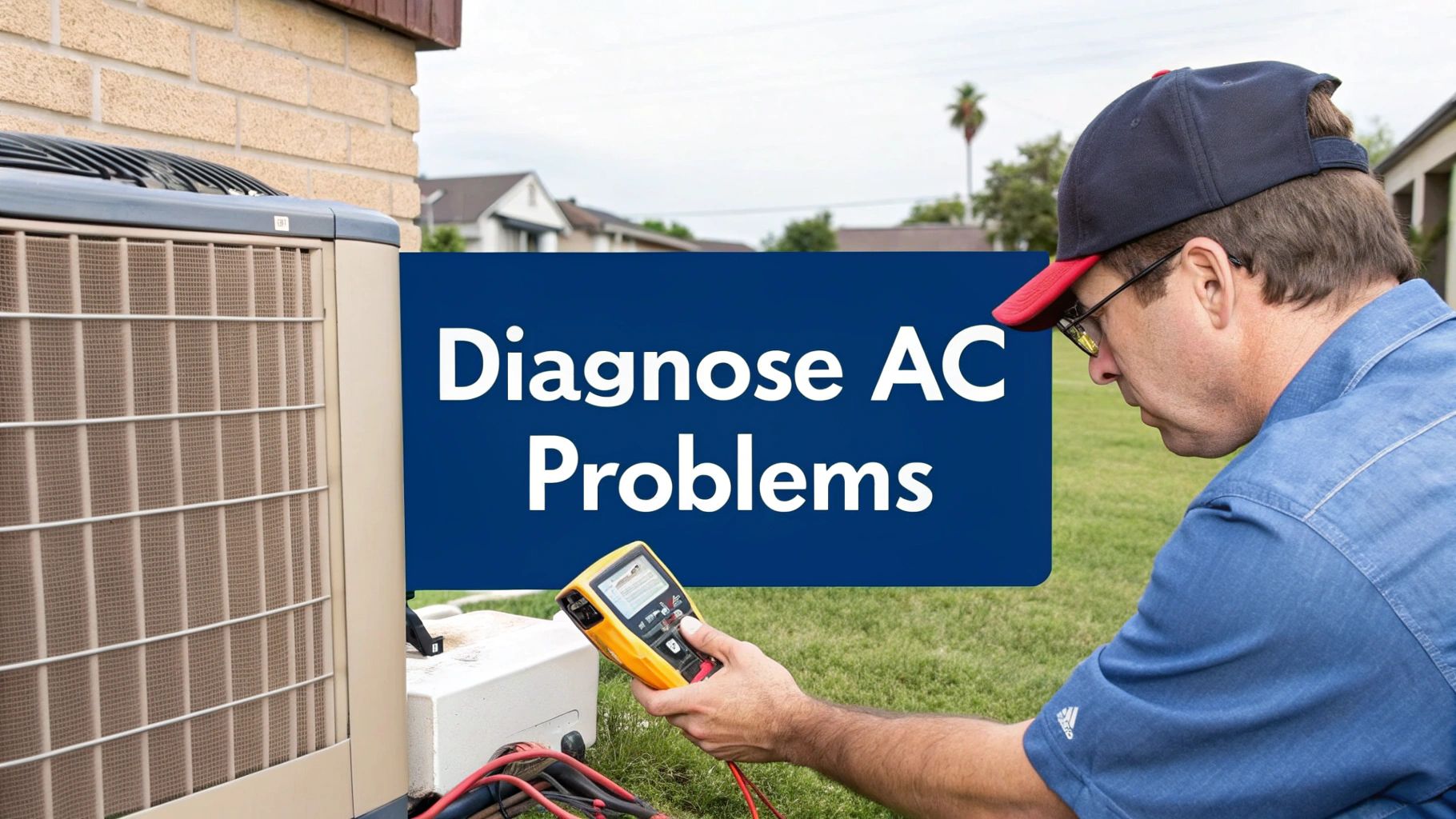
When it's a sweltering Phoenix afternoon and the air from your vents suddenly isn't cold, that quiet dread starts to creep in. But before you assume the worst, take a deep breath; knowing how to diagnose ac problems often starts with a few quick checks you can do yourself. Most of the time, the fix is simpler than you think.
What to Do When Your AC First Acts Up
When an air conditioner starts giving you grief, the solution is often hiding in plain sight. The trick is to rule out the easy stuff first. You know what? A huge chunk of our service calls could be avoided by running through these basic diagnostics.
Start at the Source: Your Thermostat
The thermostat is the brain of your entire cooling system, so it's always the first place we look. It sounds almost too simple, but you'd be shocked how many "broken" AC units are just a matter of a wrong setting.
Before touching anything else, check these three things:
- Is it set to ‘Cool’? It’s easy to forget you switched the system to 'Heat' or 'Off' after a cool spring night. Double-check that it’s in cooling mode.
- Is the temperature set low enough? To get your AC to kick on, the set temperature needs to be at least 5 degrees below whatever the current room temperature is.
- Are the batteries dead? If you have a digital thermostat with a blank or fading screen, it's screaming for new batteries. Swap in a fresh pair and see if it comes back to life.
Next, Check the Electrical Panel
Okay, so the thermostat is set correctly, but the AC is still completely dead—no hum, no fan, nothing. Your next stop should be the main circuit breaker panel. An overloaded circuit or a quick power surge can cause a breaker to trip, cutting power to the unit as a safety precaution.
Find the breaker labeled for your "AC," "Air Conditioner," or "HVAC." If it’s flipped to the 'Off' position or is stuck in the middle, push it firmly all the way to 'Off,' then back to 'On.' Give it a few minutes. If the AC starts up, you’re good. If it trips again right away, that points to a bigger electrical problem that needs a pro. If your unit still won't power on after a reset, our guide can help you figure out if you need an emergency AC repair.
A tripped circuit breaker is your home’s electrical safety net. A single trip now and then isn't a big deal. But a breaker that trips repeatedly is a clear warning sign of an underlying issue that you should never ignore.
Finally, Inspect the Air Filter
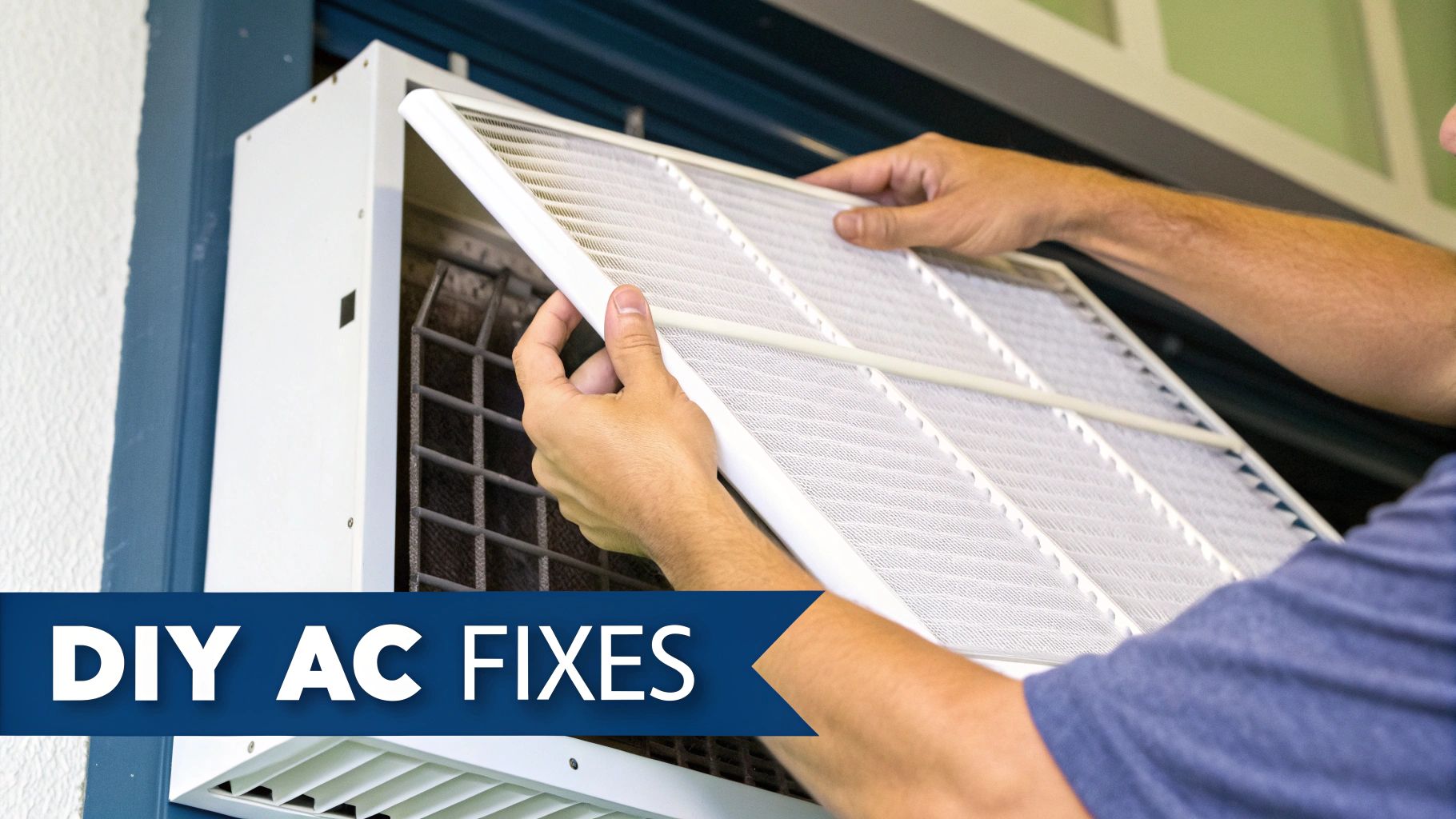
This is the big one. A filthy, clogged air filter is probably the single most common culprit behind cooling problems. When the filter is packed with dust and debris, it chokes off the airflow your system needs to work properly. This can cause weak cooling, a frozen indoor coil, or even a complete system shutdown.
Slide your filter out of its slot and hold it up to a light. Can you see the light through it? If not, it’s long overdue for a change. Replacing it is a five-minute job that can make a world of difference in your AC's cooling power and efficiency.
Learning the Language of Your Air Conditioner
Your air conditioner is a bit like a quiet roommate—most of the time, you barely notice it's there. That is, until it stops doing its job or starts making a racket. When things go wrong, your system almost never fails silently. It will try to tell you something is wrong through a distinct language of sounds, smells, and performance hiccups.
Learning to interpret those signals is the very first step in knowing how to diagnose ac problems before a small annoyance turns into an expensive, middle-of-the-summer emergency.
Think of it this way: your AC has specific symptoms for different ailments. A loud, metallic grinding isn't just background noise; it's a desperate cry for help, often pointing to a failing motor or shot bearings. Hear a sharp hissing sound? That’s the classic sign of a refrigerant leak, which is like your AC slowly bleeding out the very thing that makes it cool.
Even subtle changes tell a story. If the air coming from your vents feels more humid or lukewarm than refreshingly cold, that's an early warning. Same goes for airflow that feels weaker than it used to. These are often the first signs of a dirty evaporator coil or a struggling blower motor—problems that only get worse if you ignore them.
Decoding the Sights, Sounds, and Smells
To really figure out what's going on, you have to become a bit of a detective. Start by paying close attention to what your senses are telling you.
Are there strange odors? A musty or moldy smell can mean moisture is building up in your ductwork or you have a clogged condensate line—a super common issue here in Arizona. But a sharp, burning smell? That’s much more serious. It could signal an electrical problem that needs immediate attention.
You also need to listen for any changes in the system’s normal operating sounds. The gentle hum it makes when it kicks on is perfectly normal. A sudden bang or clank, on the other hand, is not. That could mean a component like a piston pin or connecting rod has broken loose inside the compressor, which is a potentially catastrophic failure.
The most important thing you can do is get to know your system’s normal baseline. When you know what "right" sounds, smells, and feels like, you’ll immediately recognize when something is off.
This flowchart gives you a simple, logical path for those first few checks. It walks you from the easiest things to rule out (the thermostat and breaker) to the most common culprit for cooling issues (the air filter).
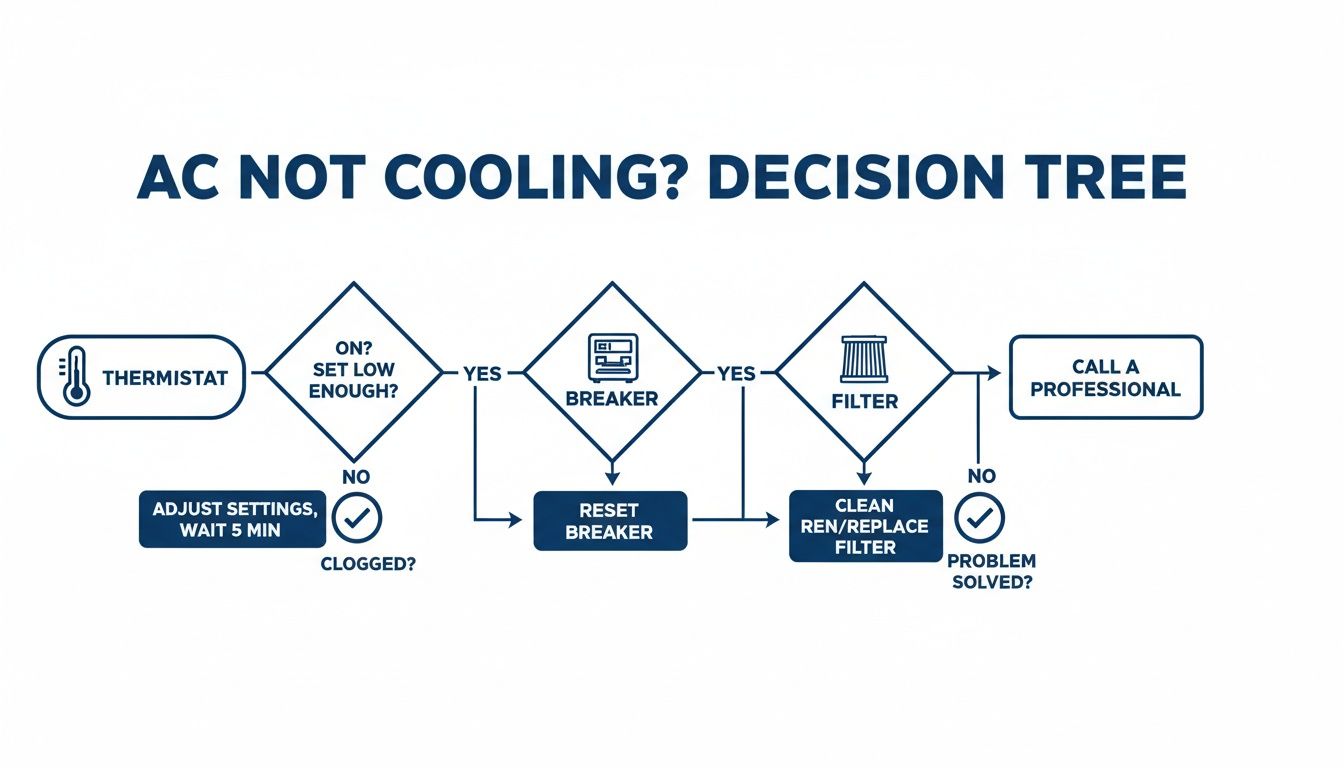
As you can see, troubleshooting should always start with the simple stuff before you ever assume there's a major mechanical failure.
Common AC Symptoms and What They Mean
Recognizing the signs is one thing; knowing what they actually mean is another. Let me explain. We put together this quick-reference table that maps common AC symptoms to their most likely causes. Think of it as your go-to cheat sheet for translating your system's language into something you can act on.
| Symptom | Potential Cause | DIY Check | When to Call a Pro |
|---|---|---|---|
| Weak Airflow | Clogged Air Filter, Blocked Vents, Ductwork Leak | Check/replace the filter and make sure all vents are open and unblocked. | If the filter and vents are clear, it could be a blower motor or duct issue. |
| Lukewarm Air | Low Refrigerant, Dirty Condenser Coils | Look at the outdoor unit. You can gently clean debris off the coils with a hose. | If coils are clean, a refrigerant leak is likely and requires a certified technician. |
| Unusual Noises | Squealing: Worn Belt Grinding: Failing Motor Hissing: Refrigerant Leak |
Listen carefully to pinpoint where the noise is coming from. | All of these sounds point to a mechanical failure that needs a professional diagnosis. |
| Water Leaks | Clogged Condensate Drain Line, Cracked Drain Pan | Use a wet/dry vac on the outdoor drain line to try and clear the clog. | If clearing the line doesn’t stop the leak or you see visible cracks, call for service. |
| Constant Cycling | Oversized Unit, Low Refrigerant, Faulty Thermostat | Check your thermostat settings and replace the batteries if they're old. | If settings are correct, it’s a system issue like a refrigerant leak or sizing problem. |
| Bad Odors | Musty: Mold/Mildew Burning: Electrical Issue |
Check the drain line for clogs and put in a fresh air filter. | A burning smell requires an immediate shutdown and an emergency call. A persistent musty smell may need professional duct cleaning. |
By using this table, you can move from just noticing a problem to having a pretty good idea of what’s causing it. This empowers you to handle the small stuff yourself while giving you valuable, specific information to share with a technician if you do need to make that call.
Digging Into Common AC System Faults
Alright, so you’ve already checked the thermostat, flipped the breaker, and swapped the filter, but the AC still isn't cooperating. Now it's time to dig a little deeper.
Many of the next-level AC problems stem from a couple of key areas: the electrical parts in your outdoor unit or the refrigerant level inside the system. You don’t need to be a technician to understand the basics, and knowing what to look for can tell you if you have a simple issue or a serious problem on your hands.
Decoding Electrical Component Issues
That big, noisy box outside—your condenser unit—is where a lot of the magic happens, and it depends on a few critical electrical parts to do its job. If one of them fails, your whole system goes down. The two most common troublemakers are the capacitor and the contactor.
The Capacitor: You can think of this as a small, powerful battery. It gives the fan motor and compressor the big jolt of energy they need to start up and run smoothly. If a capacitor is dead or dying, you might hear a humming or buzzing from the outdoor unit, but the fan itself won't be spinning. Sometimes it might try to start with a jerky motion but just can't get going.
The Contactor: This is basically a heavy-duty switch. When your thermostat calls for cooling, it sends a low-voltage signal that closes the contactor, letting high-voltage power surge into the compressor and fan. If the contactor goes bad, the outdoor unit won't turn on at all, even though you heard the thermostat click inside.
A quick visual inspection can sometimes spot the problem. A failed capacitor often looks puffy, with a bulging or swollen top. But a word of caution: poking around high-voltage components is extremely dangerous without the right training and tools.
If you think you have an electrical fault, the smartest and safest move is to call a certified technician. For a better sense of what these repairs involve, take a look at our guide on the most frequent AC repairs in Arizona.
The Critical Role of Refrigerant
Now let’s talk about the lifeblood of your air conditioner: refrigerant. This is the stuff that actually absorbs the heat from your home and dumps it outside. A lot of people think AC systems "use up" refrigerant over time, like gas in a car. That's a myth. Refrigerant runs in a sealed, closed-loop system and should never need to be refilled unless there's a leak.
The exact amount of refrigerant in your system is called the "charge," and it has to be perfect. Even a small deviation can cause huge problems.
If your system is undercharged (meaning it has a leak), there isn't enough refrigerant to cool the air properly. You'll get lukewarm air from your vents, the system will run constantly, and you might even see the indoor coil freeze into a block of ice.
Even worse is an overcharged system. Too much refrigerant creates insane pressure that can quickly destroy the compressor—by far the most expensive part of your AC.
When it comes to refrigerant, "close enough" is never good enough. An improper charge doesn't just hurt cooling performance; it puts immense strain on your entire system, leading to early component failure, shocking energy bills, and the risk of catastrophic compressor damage.
This isn't just a rare fluke. A major study by the National Renewable Energy Laboratory (NREL) found that an incredible 72% of residential AC systems have the wrong refrigerant charge. Only 38% of the systems they tested were charged correctly. An incorrect charge can slash your AC's efficiency by up to 30%—a massive hit to your wallet in the Phoenix Valley heat.
Because handling refrigerant requires special licenses and equipment, this is firmly in the "call a pro" category. Federal law prohibits unlicensed individuals from working with these chemicals. If you hear a hissing sound or see ice forming on the copper lines outside, you're almost certainly looking at a refrigerant leak that needs immediate, professional attention.
Safe and Effective DIY Air Conditioner Fixes
Look, while a lot of AC issues really do need a pro, there are a handful of surprisingly effective fixes that any motivated homeowner can tackle. Getting these right not only solves some of the most common cooling problems but also stops bigger, more expensive ones from ever happening.
These aren't just temporary patches; they're the core maintenance tasks that keep your AC system healthy. Let's walk through three of the most impactful things you can do yourself to get your cool air back on track.
The Five-Minute Filter Swap
We see it every single day: a clogged air filter is the #1 cause of poor cooling and system strain. When that filter gets choked with dust, dirt, and pet hair, your AC has to fight to pull air through. That struggle skyrockets your energy bills and can even cause the indoor coil to freeze into a solid block of ice.
Swapping the filter is ridiculously easy but makes a huge difference.
- Find the filter slot. It's almost always in the return air duct or right inside the indoor air handler cabinet.
- Slide the old one out. Before you toss it, check the size printed on the filter's cardboard frame—you'll need it for the new one.
- Pop the new one in. Make sure the arrow on the new filter points toward the furnace or air handler, following the direction of the airflow.
This one simple task immediately restores proper airflow, cleans up your home's air quality, and takes a massive load off your system. To really get this right, you should check out our guide on how often you should change your air filter.
Clearing a Clogged Condensate Drain Line
Ever notice a puddle of water around your indoor AC unit? That's almost always a sign that your condensate drain line is clogged. This little PVC pipe is supposed to carry condensation away from the indoor coil, but over time, it can get gummed up with algae, mold, and sludge. When it blocks completely, a safety switch will often shut your entire system down to prevent water damage.
Here’s the good news: clearing it is surprisingly simple if you have a wet/dry shop vacuum.
- Find the end of the PVC drain line outside, usually sticking out of the wall near your outdoor condenser unit.
- Hold the shop vac hose firmly over the end of the pipe. Use your hand to create a tight seal around it.
- Turn the vacuum on for a minute or two. The suction is powerful enough to pull all that gunk right out of the line.
A clear condensate line is non-negotiable for a healthy AC. Doing this quick vacuum trick once or twice a year can prevent those frustrating surprise shutdowns and save your floors from a messy water leak.
Cleaning Your Outdoor Condenser Coils
Your outdoor unit has one main job: to dump all the heat it pulled from inside your house. It does this through the condenser coils—those thin metal fins that wrap around the unit. The problem is, those fins act like a magnet for dirt, dust, pollen, and grass clippings from the lawnmower.
When they get caked in grime, your AC can't breathe out. It’s like trying to run a marathon while wearing a winter coat. The system is forced to run longer and harder to cool your home, which kills its efficiency and puts a ton of stress on the compressor.
Cleaning the coils is a straightforward weekend task.
- First, shut off the power to the outdoor unit. Do this at the main circuit breaker and at the outdoor disconnect box (the metal box mounted on the wall near the unit). Safety first, always.
- Next, grab a garden hose with a gentle spray nozzle. Rinse the fins from the top down. Don't use a high-pressure jet, as it can easily bend the delicate aluminum fins.
- Just wash away all the visible gunk until the water running off the bottom is clear.
This simple cleaning can make a massive difference in your system’s cooling power, saving you money and helping your AC live a longer, healthier life.
Knowing Your Limits: When to Call a Professional
Troubleshooting your own AC can feel great, but knowing where to draw the line between a simple DIY fix and a professional service call is absolutely critical. Honestly, some repairs aren't just tricky—they’re genuinely dangerous if you don’t have the right training, licenses, and specialized tools.
This is all about protecting you, your family, and the very expensive HVAC system you rely on.
There are certain red flags that should immediately tell you to put down the tools and pick up the phone. Think of these as hard stops, not suggestions. When you see them, professional expertise becomes non-negotiable.
The Undeniable Red Flags for a Pro
Here’s the thing: let's get crystal clear about the symptoms that fall squarely into the "call a professional" category. Trying to fix these on your own can lead to much bigger problems, serious injury from high voltage, or exposure to harmful chemicals.
When you notice any of these, it's time for an expert diagnosis:
- Suspected Refrigerant Leaks: If you hear a hissing sound, see icy buildup on the copper lines, or feel your AC is just blowing lukewarm air even after you've cleaned everything, you’ve likely got a refrigerant leak. Handling refrigerant is legally restricted to EPA-certified technicians for a reason.
- Major Electrical Faults: Resetting a breaker is one thing. Anything beyond that is a serious risk. This includes trying to replace a capacitor (which can hold a dangerous electrical charge even when the power is off), a contactor, or figuring out why a breaker trips over and over again.
- Loud, Mechanical Noises: A sudden grinding, screeching, or banging from your outdoor unit is a cry for help. These noises often point to a failing compressor motor or shot bearings—major internal components that are complex to replace.
- A System That Won't Power On at All: You’ve checked the thermostat, the breaker, and the drain line safety switch with no luck. The problem is probably deeper inside the unit—a failed transformer, a fried control board, or a wiring issue that requires a pro to trace and fix safely.
These aren't just minor annoyances; they're signs of a system in critical condition. Trying to guess your way through how to diagnose ac problems of this scale is a recipe for a much bigger, more expensive headache.
A professional diagnostic goes way beyond just looking at the unit. We use specialized tools like multimeter gauges, refrigerant leak detectors, and combustion analyzers to get a true, data-driven picture of your system's health. This makes sure we fix the root cause, not just a symptom.
Why a Professional Diagnosis Is Different
It’s easy to think that if you can name the problem, you're halfway to solving it. But an accurate diagnosis is often the hardest part of any AC repair. What looks like one issue is often just a symptom of a deeper, hidden problem.
For example, a frozen indoor coil seems like a refrigerant issue, right? But it could also be caused by severely restricted airflow from a dirty filter, clogged coils, or even a failing blower motor. A trained technician has seen this hundreds of times and knows how to tell the difference, saving you from wasting money on the wrong repair.
Their goal is to provide a reliable, lasting solution that gets your system back to peak performance. This is where finding the right partner is crucial; our guide on how to choose the right HVAC company can help you make a confident decision.
The Reality of System Degradation
It’s also important to remember that air conditioners don't last forever. Their performance naturally slips over time. A study from the Florida Solar Energy Center showed clear drops in cooling efficiency over just one year.
After auditing 46 households, researchers found that 77% of the ACs were either over- or under-charged with refrigerant and 44% had deficient airflow. These are exactly the kind of subtle, efficiency-robbing issues that only a pro diagnostic can catch and correct.
This slow decline is why a problem might seem to appear out of nowhere. In reality, the system has probably been struggling for a while. A professional tune-up can catch these performance slips before they turn into a full-blown breakdown on the hottest day of the year.
Recognizing your limits isn't admitting defeat—it's the smartest move you can make for your home's comfort and your system's future.
Proactive Maintenance to Prevent Future Breakdowns
The easiest AC problem to fix is the one that never happens in the first place. Once you've spent time chasing down issues, the smartest thing you can do is shift from reactive repairs to proactive care. Regular, intentional maintenance is hands-down the best way to keep your system reliable and avoid those miserable breakdowns in the middle of a July heatwave.
This isn't about taking on complicated, time-consuming chores. A few simple tasks on your end, combined with a yearly visit from a pro, create a powerful defense against most common AC failures. By staying ahead of wear and tear, you’re not just dodging repair bills—you're protecting your system's efficiency and helping it last longer.
Your Simple Year-Round Maintenance Checklist
When it comes to AC care, consistency is everything. A few minutes each month and a bit of time each season can make a massive difference. Think of it as a small investment that pays you back with lower energy bills and uninterrupted comfort when you need it most.
Here’s a practical schedule you can actually stick to:
- Once a Month: Check your air filter. This is non-negotiable, especially in dusty Arizona. Just hold it up to a light source. If you can’t see the light clearly through it, it’s time for a new one. A clean filter is critical for healthy airflow, which your system needs for both cooling power and its own longevity.
- Twice a Year (Spring & Fall): Clean your outdoor condenser unit. Grab your garden hose (no pressure washer!) and gently rinse the coils to wash away the caked-on dust and debris that can suffocate your system. While you're out there, trim back any bushes, weeds, or tree branches to give the unit at least two feet of clear space on all sides. It needs to breathe.
The connection between regular maintenance and how long an AC lasts is undeniable. A well-maintained air conditioner can run for up to 50% longer than a neglected one. That can save you thousands in premature replacement costs—it’s the difference between a system that struggles for a decade and one that performs reliably for 15 years or more.
The Undeniable Value of an Annual Professional Tune-Up
While these homeowner tasks are vital, they can’t replace the deep diagnostic work of a certified HVAC technician. An annual professional tune-up is the single most important thing you can do to guarantee your AC is ready for the brutal Phoenix summer.
A technician doesn’t just wipe a few things down; they perform a comprehensive, data-driven system checkup that goes far beyond what a homeowner can safely do. We're talking about testing electrical connections to prevent fire hazards, lubricating motors to cut down on friction, verifying refrigerant levels to ensure peak efficiency, and checking safety controls to make sure they'll work when needed.
This service is an investment that truly pays for itself by restoring lost efficiency and catching tiny issues before they snowball into catastrophic failures. It gives you peace of mind knowing your system is in top shape. You can learn more about specific AC maintenance tips for Arizona residents in our dedicated guide.
Ultimately, proactive care is the best strategy for anyone who wants to avoid the stress and expense of an unexpected AC problem.
Whether you're facing an issue you can't solve or you want to get ahead of future problems with a professional tune-up, Comfort Experts is here to help. For an honest, expert diagnosis from a team that treats you like a neighbor, call us today at 480-207-1239 or schedule service online.