
Ever wonder why some rooms in your house feel like an icebox while others stay stubbornly warm? It often comes down to one critical, behind-the-scenes factor: how your ducts are sized. Learning how to size ductwork properly is the difference between an efficient, comfortable home and an HVAC system that's constantly fighting a losing battle against the Phoenix heat.
Why Proper Duct Sizing Is Critical In Phoenix
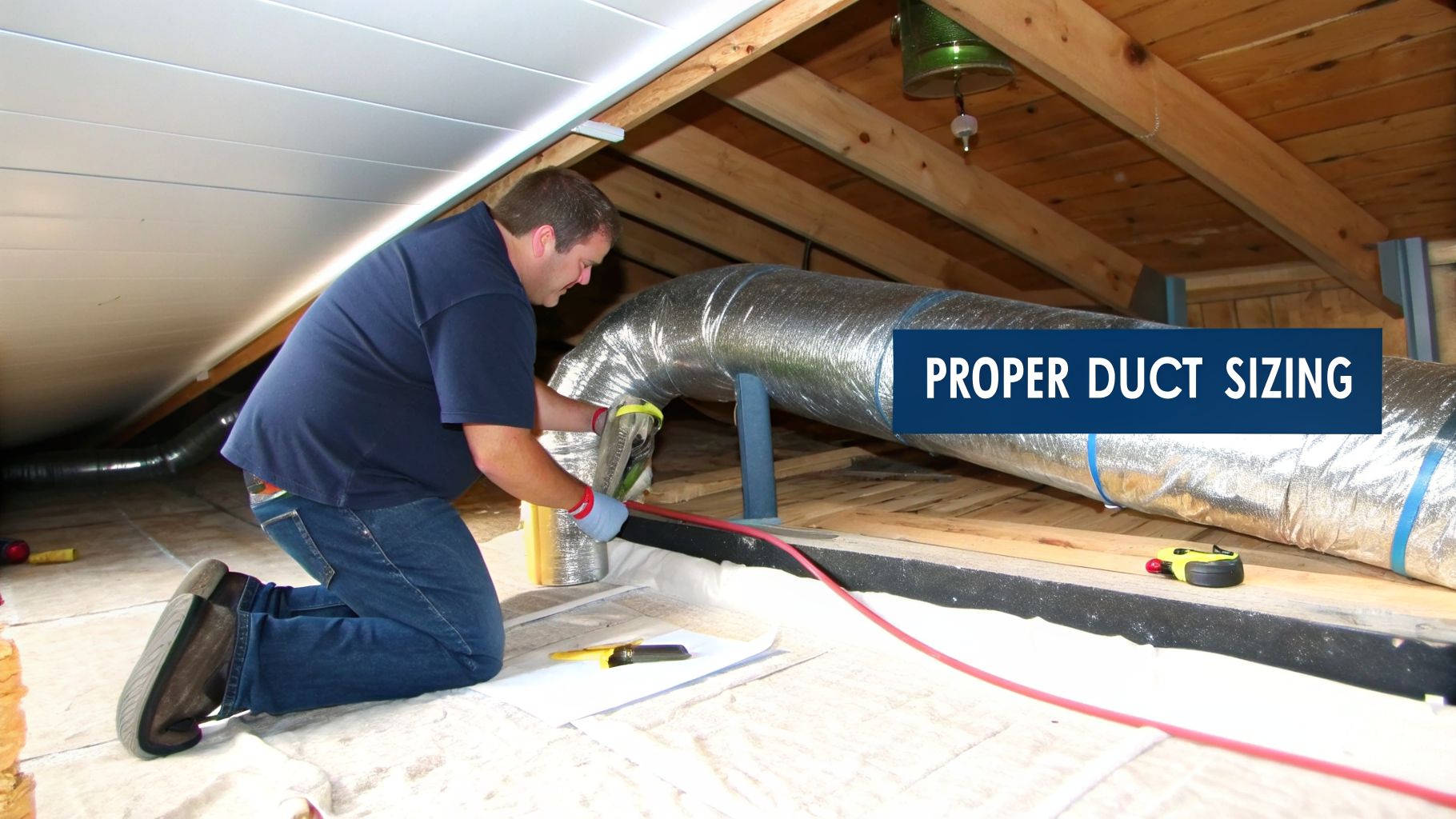
Think of your HVAC system like your home's respiratory system. The AC unit is the lungs, and the ductwork is the network of airways carrying cool, conditioned air to every room. If those airways are too narrow or too wide, the whole system struggles to "breathe." This isn't just a convenient metaphor; it's a reality our Comfort Experts team sees in homes across the Phoenix area every single day.
Proper duct sizing is a science, not a guessing game. As professionals with decades of combined experience, we can tell you it has a direct, measurable impact on your monthly APS or SRP bill, the lifespan of your expensive air conditioner, and—most importantly—your family’s actual comfort during our brutal summers. Getting it wrong is a recipe for frustration and wasted money.
The High Cost Of Getting It Wrong
Let me explain. When ducts are the wrong size, your air conditioner has to work much harder than it was ever designed to. That constant strain snowballs into several serious problems that we see plague Phoenix homeowners all the time.
- Skyrocketing Energy Bills: Your AC unit burns more electricity trying to shove air through undersized ducts or failing to build enough pressure in oversized ones.
- Reduced Equipment Lifespan: All that extra stress on the blower motor and compressor can cause them to fail years ahead of their expected 15-to-20-year lifespan.
- Uneven Temperatures and Hot Spots: You get that classic "freezer in one room, sauna in another" situation, which is a textbook sign of bad airflow distribution.
- Poor Indoor Air Quality: Badly sized and sealed ducts can suck dust, insulation fibers, and allergens straight from your attic into the air you breathe. If you're seeing a lot of dust, our guide on professional duct cleaning in Mesa, AZ is a great resource.
According to the U.S. Department of Energy, a typical home can lose 20% to 30% of its conditioned air through leaky or poorly designed ductwork. In Phoenix, losing nearly a third of your refrigerated air into a 140°F attic is a financial disaster.
Impact Of Duct Sizing Errors
The problems you’ll experience are different depending on whether the ducts are too small or too large. Honestly, both scenarios create major headaches, just in different ways. Knowing the specific symptoms can help you figure out if your own system has a problem.
| Issue | Undersized Ducts (Too Small) | Oversized Ducts (Too Large) |
|---|---|---|
| Airflow & Pressure | High resistance, high pressure, low airflow volume. | Low air velocity, poor pressure, insufficient "throw." |
| System Noise | Loud "whooshing" or whistling sounds from vents. | Minimal noise, but air may not reach the far end of the room. |
| Energy Efficiency | Very poor. The AC blower motor works overtime. | Poor. Air loses temperature as it moves slowly through ducts. |
| Comfort Impact | Rooms feel "stuffy" and may not get cool enough. | Leads to uneven temperatures and poor air mixing. |
| Equipment Strain | High risk of premature blower motor and compressor failure. | Can cause short-cycling and inconsistent performance. |
Modern duct design is a huge factor in HVAC efficiency, especially here in the Phoenix Valley. Getting it right can slash your energy bills. We’ve seen firsthand how leaky or undersized ducts force an AC unit to run nonstop, and it’s no surprise when you hear that a shocking 80% of U.S. buildings suffer from duct leakage. For a deeper look at market trends and efficiency, you can explore detailed HVAC ductwork market research.
Calculating Your Home's Cooling Load Using Manual J
Before you can even think about what size ducts you need, you have to answer a much bigger question: how much cooling does your home actually need? This is what we in the industry call the "cooling load," and it’s the absolute foundation for a high-performing HVAC system. The only professional way to find this number is with a process called a Manual J calculation.
Thinking you can guess based on square footage is one of the most common—and costly—mistakes we see homeowners make. A real Manual J goes much, much deeper. It’s a detailed audit of every single factor that causes your home to gain heat from the sun and from within.
What Goes Into A Manual J Calculation
Let's be clear: a true Manual J isn't a quick guess. It's a comprehensive thermal audit of your house, and the process is incredibly thorough. Our technicians measure and analyze dozens of data points to build a complete profile of your home's unique cooling needs.
These factors include things like:
- Home Orientation: Which direction do your walls and windows face? That blistering afternoon sun on a west-facing wall is a huge factor.
- Window Specifications: We look at the size, type (single-pane vs. double-pane), efficiency rating, and how much solar heat they let in.
- Insulation Levels: What's the R-value in your attic, walls, and floors? Here in Phoenix, where attics can easily top 150°F, this is a massive piece of the puzzle.
- Air Leakage: How "tight" is your home? We assess how much of your expensive cool air is escaping through gaps and cracks.
- Internal Heat Sources: Heat generated by your big-screen TV, oven, computers, and even the number of people living in the house all adds up.
This deep dive gives us a final number, measured in British Thermal Units (BTUs). This BTU figure represents the total amount of heat your air conditioner must remove every hour to keep you comfortable on the hottest Phoenix day of the year.
Why A Simple "Rule Of Thumb" Fails In Phoenix
You’ve probably heard simplified shortcuts, like needing one ton of cooling for every 500 or 600 square feet. While tempting, these rules of thumb are dangerously inaccurate for our climate. A 2,000-square-foot house with old, leaky windows taking a direct hit from the sun will have a massively different cooling load than a well-shaded 2,000-square-foot home with modern, efficient windows.
Here’s the thing: Using a generic square footage rule to size your AC and ducts is like getting a prescription from someone who only asked for your height. Without knowing your home's specific conditions, you're guaranteed to get it wrong, leading to an oversized or undersized system that wastes energy and fails to keep you comfortable.
For a deeper dive into this topic, you might be interested in our guide on choosing the right air conditioner size for your home.
The Role Of Room-By-Room Calculations
A complete Manual J doesn't stop at a single number for the whole house. It breaks the cooling load down room by room, which is absolutely essential for learning how to size ductwork correctly.
Think about it. A west-facing primary bedroom with a huge picture window will gain far more heat than a small, north-facing office with no windows. The Manual J assigns a specific BTU load to every single room. This is the exact data we need to figure out how much airflow (and therefore what size duct) is required to keep every corner of your home perfectly comfortable. Without it, you're just guessing—and that's how you end up with some rooms feeling like a meat locker while others never seem to cool down.
Translating Cooling Load To Airflow And Using A Ductulator
Once you have that BTU number from your Manual J calculation, you’re holding the key. But a BTU number doesn’t move any air. The next step is to translate that heating and cooling load into something we can actually work with: airflow.
Airflow is measured in CFM, or Cubic Feet per Minute. It’s the metric that tells us how much air your AC needs to move to keep your home comfortable. The rule of thumb we’ve used in the field for years is pretty simple: you need roughly 400 CFM of airflow for every ton of cooling.
So, if your Manual J says you need a 3-ton (or 36,000 BTU) system, your target for the whole house is 1,200 CFM (3 tons x 400 CFM/ton). That’s the total amount of air the blower needs to push through the ductwork.
Distributing Airflow To Each Room
But that 1,200 CFM doesn't just get blasted into the house through one giant vent. We have to divide it up, sending the right amount of air to each specific room based on its individual cooling needs.
Think of it like this: a big living room with a wall of west-facing windows is going to need a much bigger slice of that 1,200 CFM pie than a small, shaded bathroom on the north side of the house. Your room-by-room Manual J report gives you the blueprint for this.
You just need to do a little math. Find the percentage of the total load each room is responsible for, and give it that same percentage of the total airflow.
Here’s a quick example:
- Total System Need: 36,000 BTUs (which we know is 1,200 CFM)
- Master Bedroom Load: 7,200 BTUs (that’s 20% of the total)
- Master Bedroom Airflow: 20% of 1,200 CFM = 240 CFM
You’ll repeat that process for every single conditioned space in your home. When you add up all the individual room CFM values, it should come right back to your system’s total—in this case, 1,200 CFM.
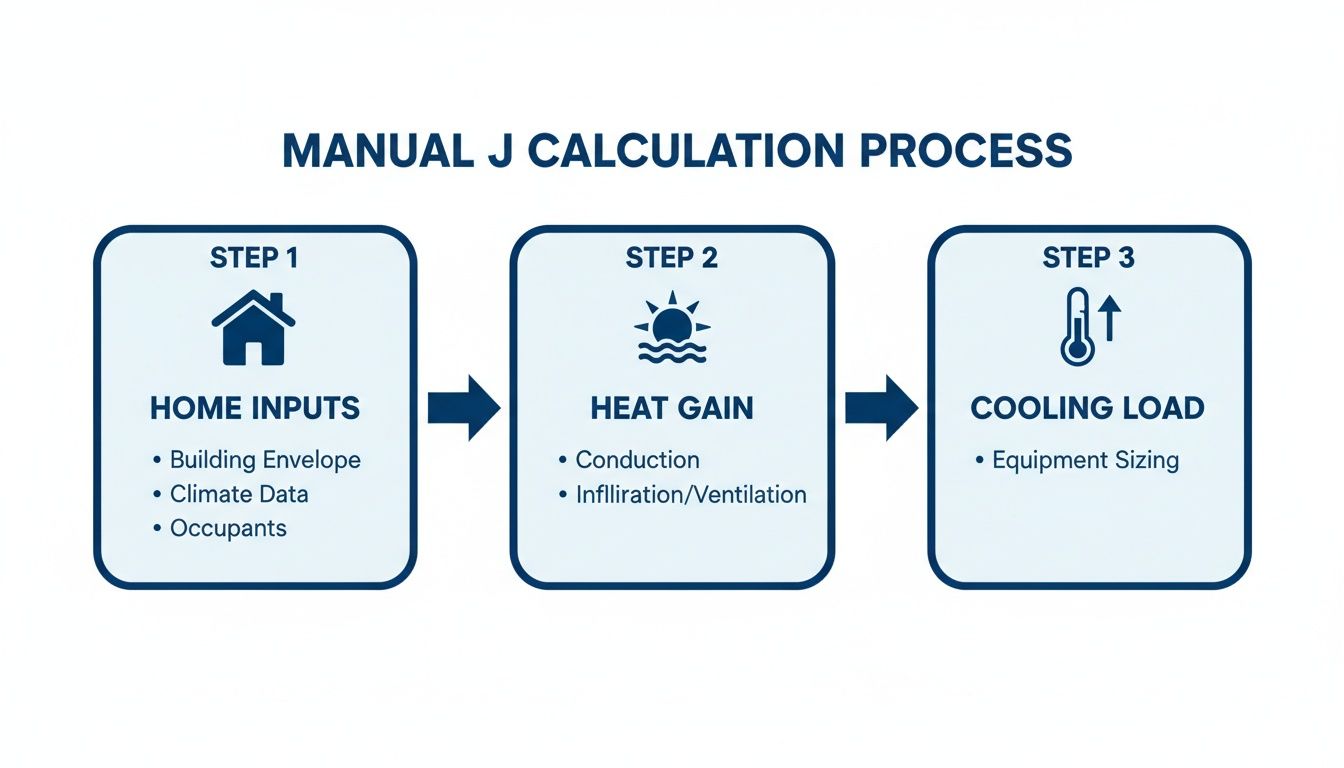
This is how the details about your home's windows, insulation, and layout directly translate into a precise plan for comfort. It's what separates a professional design from a wild guess.
Introducing The Ductulator
Okay, so you know the master bedroom needs 240 CFM. Now what? How big does the duct running to that room need to be? This is where every seasoned HVAC tech pulls out their secret weapon: the ductulator.
It’s basically a specialized slide rule for everything duct-related.
A ductulator is the tool that turns all our numbers into physical duct sizes. It lets us balance four things: airflow (CFM), friction loss, air velocity, and the actual diameter or dimensions of the duct. You slide two values you know, and it tells you the other two.
In residential work, we almost always design around a target friction loss rate. This is the resistance—or pressure drop—that happens as air rubs against the inside of the duct. We aim for a friction loss of about 0.08 inches of water column (in. w.c.) per 100 feet of duct. This number hits the sweet spot, giving us good airflow without forcing the blower motor to work too hard or requiring enormous ducts.
Understanding why this matters is all about grasping the concept of static pressure in ductwork, which is a huge factor in your system’s overall performance.
Using a ductulator is surprisingly simple:
- You find your target friction rate (we’ll use 0.08 in. w.c.).
- You find your required airflow for the duct you’re sizing (our 240 CFM for the master bedroom).
- The tool lines everything up and shows you the right-sized round duct (in this case, about a 9-inch duct) and the equivalent sizes for rectangular ducts.
Getting this right isn't just about comfort; it's about efficiency and money. Research shows that a properly sized duct system can improve energy efficiency by 20% or more, which directly impacts your monthly bills and how long your AC unit lasts. A system that has to fight against poorly sized ducts is a system that’s going to fail early.
Even with perfect sizing, old, leaky ducts can kill your efficiency. Sealing them up is one of the best ways to get the most out of your system, which we cover in our guide to Aeroseal duct sealing reviews.
Choosing The Right Duct Shape And Material
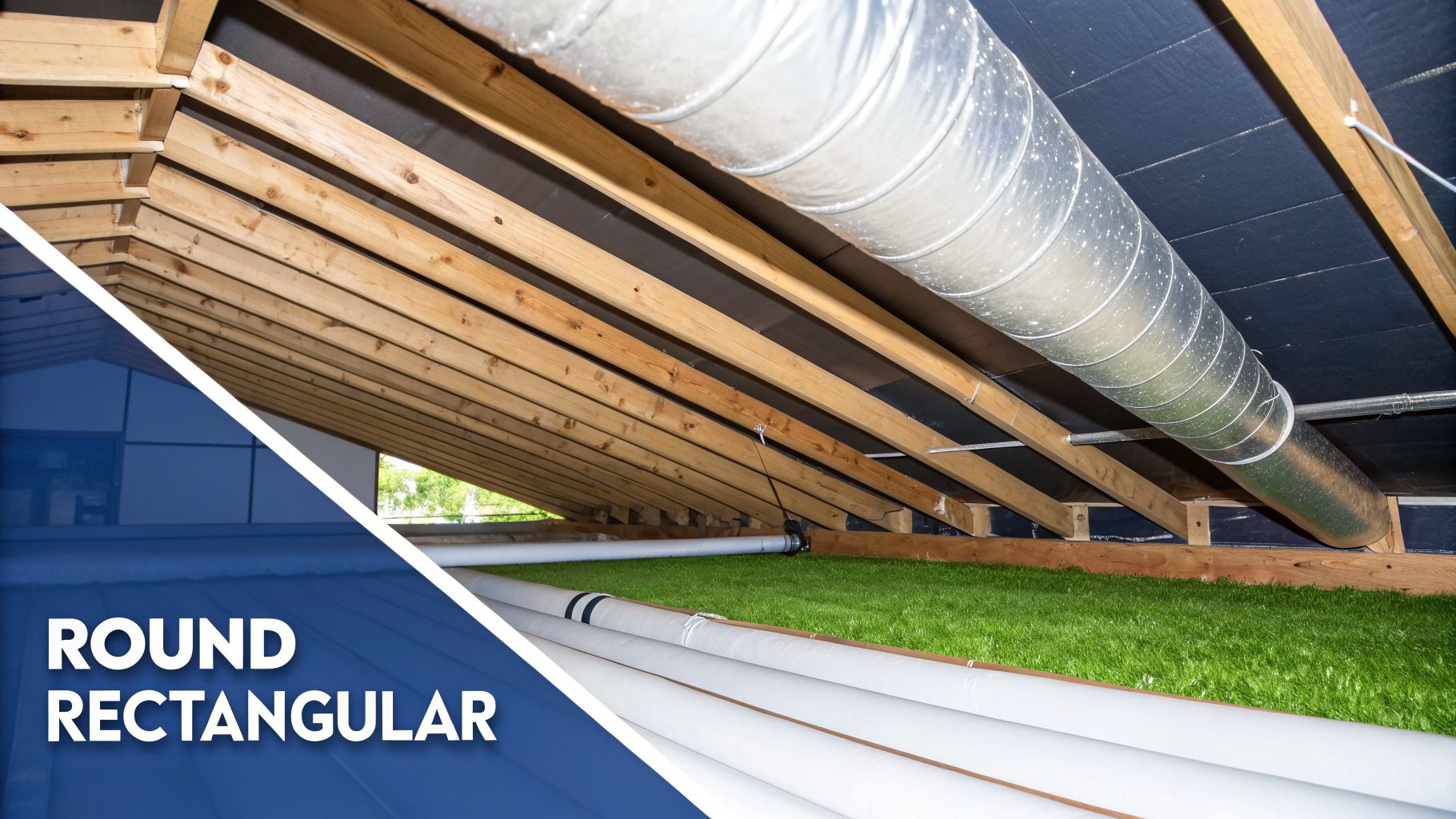
You know what? Not all ducts are created equal. After you do the hard work of figuring out how much air each room needs, you have to decide what kind of ducts will actually deliver it. The choice between shapes and materials isn't just about what fits—it’s a critical decision that directly impacts your system's efficiency, your monthly energy bills, and how well your AC performs.
You’ll almost always see two shapes in residential homes: round and rectangular. Both have their place, but they come with very different performance trade-offs. As experts in the field, we know these differences are key to making the right call for your home's layout, especially here in the Phoenix heat.
Round Ducts: The Efficiency Champions
From a pure airflow perspective, round ducts are the undisputed winners. They offer the least amount of resistance as air moves through the system. Just think of water flowing through a pipe; a smooth, circular path is always going to be more efficient than one with sharp corners.
This streamlined design gives homeowners some serious real-world benefits:
- Less Friction: A smooth, corner-less interior means less friction loss. Your AC's blower motor doesn't have to work as hard to push air where it needs to go, which translates directly into lower energy use.
- Reduced Heat Gain: Round ducts have the least surface area for the volume of air they carry. In a scorching Phoenix attic that can easily hit 140°F, less surface area means less opportunity for that brutal heat to seep into your cool, conditioned air.
- Better Airflow: With less resistance, round ducts move air more efficiently. This helps ensure that rooms at the far end of a long duct run actually get the airflow they need to stay comfortable.
Because of this superior efficiency, we almost always recommend round ducts for main trunk lines in accessible spaces like an open attic. They're the ideal choice when performance is the top priority and space isn't a major constraint.
Rectangular Ducts: The Practical Problem-Solvers
So, if round ducts are that much better, why do we see rectangular ducts in so many homes? The answer is simple: practicality. While they aren't as efficient from an airflow standpoint, rectangular ducts are often the only solution that works with the realities of modern home construction.
Their biggest advantage is their ability to be fabricated to fit into tight, awkward spaces.
Rectangular ducts are the go-to solution for running ductwork inside wall cavities, soffits, or shallow ceiling joist bays where a round duct simply wouldn't fit. Their flat profile makes them indispensable for navigating the structural elements of a finished home.
The decision between duct types often comes down to this trade-off between peak performance and practical installation. For instance, in a typical Phoenix home, we might use highly efficient, well-insulated round ducts for the main runs in the attic but then transition to a properly sized rectangular duct to drop down inside a wall and feed a vent in a first-floor room.
The global HVAC market reflects this. While round ducts can reduce airflow resistance by up to 35%—making them a perfect match for the high-efficiency Trane systems we install—rectangular ducts often lead in market share because they are so much easier to install in tight residential spaces. For more on this trend, you can review the latest HVAC air ducts market analysis.
Duct Materials Matter, Too
The material your ducts are made from is just as important as their shape. You’ve got a few common options, and each one has its own list of pros and cons.
| Material | Best For | Key Considerations |
|---|---|---|
| Galvanized Steel | Main trunk lines and runs where durability is key. | Very durable, rigid, and has a smooth interior for good airflow. Heavier and more labor-intensive to install. |
| Flex Duct | Final connections to vents; navigating tight, complex spaces. | Easy to install but creates high friction if not pulled taut. Must be properly supported to prevent kinks and sagging. |
| Fiberboard | Quiet operation and built-in insulation. | Lighter than sheet metal, but the rough interior surface creates more friction. Not suitable for areas with moisture. |
For most new systems we install, a hybrid approach works best. We often use rigid galvanized steel for the main trunk lines to ensure long-term durability and optimal airflow, then use properly installed flex duct for the final few feet connecting to each room's supply vent.
If your existing ducts are old, leaky, or damaged, even the best new AC unit won't work right. A professional duct repair or replacement can have a massive impact on your system's overall performance and your home's comfort.
Common Duct Sizing Mistakes To Avoid
Even with the best intentions and a stack of calculations, it's surprisingly easy to get duct sizing wrong. Over the years, our technicians have seen just about every possible pitfall in homes across the Phoenix Valley. These aren't just minor technical errors; they're the kinds of missteps that lead directly to sky-high energy bills, uncomfortable hot spots, and premature system failure.
This is where our direct, local experience as Comfort Experts really pays off. Understanding the theory is one thing, but applying it correctly when you're staring at a 150°F attic or a home with a brand-new addition is another ballgame entirely. Let's walk through the most frequent and damaging mistakes we see so you can steer clear of them.
Reusing Old, Undersized Ductwork
This is, without a doubt, the most common and destructive mistake we run into. A homeowner invests in a brand-new, high-efficiency 4-ton Trane air conditioner but connects it to the same 30-year-old ducts that were originally installed for a less powerful 3-ton unit.
The new system is designed to move 1,600 CFM of air, but the old ducts can barely handle 1,200 CFM. The result is a disaster. The air conditioner is essentially trying to breathe through a straw, which creates immense static pressure that chokes the entire system.
This single mistake guarantees a few things, none of them good:
- Reduced Airflow: The system simply can't deliver the cool air you're paying for, leaving you with stuffy, warm rooms no matter how low you set the thermostat.
- Premature Blower Failure: The blower motor runs under constant strain, burning out years ahead of its expected lifespan.
- Frozen Evaporator Coils: When not enough air moves across the indoor coil, it can ice over, bringing your cooling to a complete halt.
A new HVAC system is so much more than just the outdoor unit. The ductwork is an integral part of that system. Connecting a modern, high-performance AC to old, undersized ducts is like putting a race car engine in a golf cart—you will never, ever get the performance you paid for.
Ignoring Friction Loss From Fittings And Turns
Many DIY calculations focus only on the length of straight duct runs, completely forgetting about the impact of every single twist, turn, and junction. Each elbow, tee, and register box adds resistance, or friction loss, to the system. A sharp 90-degree elbow adds a whole lot more friction than two gentle 45-degree turns.
When you don't account for the "equivalent length" of these fittings, your calculations will be flat-out wrong. You might figure that a 10-inch duct is plenty for a 30-foot run, but after factoring in the friction from three sharp turns and a poorly designed junction box, the system might actually need a 12-inch duct to overcome the added resistance. This oversight is a primary cause of weak airflow to rooms at the end of long, complex duct runs.
Overlooking Phoenix-Specific Challenges
Sizing ducts in a mild climate is one thing; doing it right here in Phoenix is an entirely different challenge. Our extreme summer heat creates unique problems that absolutely must be factored into any design.
A frequent error is failing to properly insulate ducts running through an attic. That brutal attic heat radiates directly into the ductwork, reheating your freshly cooled air before it even gets to your living space. A system that is technically sized "correctly" can still fail to cool a home if the ducts aren't protected with adequate, high-R-value insulation.
Another common Phoenix mistake is not properly balancing airflow for sun exposure. A west-facing bedroom that gets blasted by the afternoon sun needs significantly more CFM than an identical-sized room on the shaded north side of the house. A "one-size-fits-all" approach to room-by-room airflow will always leave someone sweating.
Phoenix Ductwork Do's And Don'ts
To help you get it right, we put together this quick-reference guide. These are the practices that are especially critical for Valley homeowners who want to get the most out of their air conditioning system.
| Best Practice (Do) | Common Mistake (Don't) |
|---|---|
| DO use Manual J to calculate loads for each specific room. | DON'T apply a single CFM value to all rooms of a similar size. |
| DO install ducts with high R-value insulation (R-8 or higher) in attics. | DON'T leave ducts exposed to the extreme heat of a Phoenix attic. |
| DO use smooth, gradual turns wherever possible to minimize friction. | DON'T use multiple sharp 90-degree elbows in a single duct run. |
| DO ensure all flex duct is pulled completely taut and properly supported. | DON'T allow flex duct to sag or have sharp kinks, as this kills airflow. |
Following these simple rules can make the difference between a system that struggles and one that keeps you comfortable and your bills manageable, even on the hottest August day.
Why Trust A Professional For Your Ductwork Project
After reading through the steps, you can see just how much precision goes into designing a duct system that actually works. We get it—it can be tempting to try and tackle it yourself. But this isn't a weekend project where “close enough” gets the job done.
A single miscalculation on airflow or friction loss can cause a chain reaction. You end up with years of high energy bills, annoying hot and cold spots, and an air conditioner that’s working itself to death. This is one of those areas where a pro’s experience is worth every penny.
The Difference Between Theory and a Comfortable Home
There's a huge gap between knowing the formulas and executing a flawless installation in a real-world attic. A certified technician has spent years in the field, seen every strange home layout imaginable, and understands the little things that a calculator can't predict.
A professional doesn’t just run the numbers; they interpret them. They know how your home’s specific layout, sun exposure, and construction quirks will affect the design, and they make the critical adjustments needed for it to perform perfectly.
For example, a pro knows that navigating local Phoenix building codes for duct installation and insulation is non-negotiable. They’re also trained on advanced diagnostic tools to perform tasks like precise static pressure testing, which is the only way to be sure your system is breathing correctly. They may even use tools like Exayard HVAC estimating software to accurately map out material costs and labor for the job.
Where Professional Service Is Non-Negotiable
Some jobs just aren't suited for DIY. They require a level of training and specialized equipment that you can't just pick up at the hardware store. These are the steps where hiring a professional is the only way to guarantee the job is done right.
- Official Manual J, S, & D Reports: Performing a truly accurate load calculation (Manual J), equipment selection (Manual S), and duct design (Manual D) is a complex, certified process.
- Airflow Balancing: After the install, a technician uses specialized hoods and manometers to measure the airflow at every single vent, adjusting dampers until each room gets exactly the air it needs.
- Code Compliance: A pro ensures every part of the installation—from the type of duct sealant used to the insulation’s R-value—meets or exceeds all local and national building codes.
At the end of the day, learning how to size ductwork helps you recognize a quality installation when you see one. When you're ready for a system that's truly designed for maximum comfort and efficiency, it's time to call in the experts. Making the right choice from the start is critical, and knowing how to choose the right HVAC company is a big part of that process.
At Comfort Experts, our certified technicians have the experience and training to design and install the perfect duct system for your Phoenix home. If you're ready for unmatched comfort and efficiency, call us at 480-207-1239 or schedule service online today.