

A report that says the air conditioner operated and that the supply air felt colder than the return is a baseline, not proof of correct refrigerant charge, duct performance, capacity, or remaining service life. Treat the purchase as a two-stage decision: accept the general inspection as a same-day record of what was accessible, then commission a defined HVAC assessment whenever age, symptoms, access limits, or the report's own wording leave a question open, and get that assessment done before the inspection contingency expires. In Mesa and the East Valley, where a cooling system has to hold a house through triple-digit summers, the second stage is where the purchase decision gets made.
What a Home Inspection Misses and When to Commission an HVAC Assessment
The report lands on a 1990s Mesa block home. Under the cooling section the inspector wrote that the system operated and that the air at a supply register was cooler than the return. That note is worth having. It also stops well short of an HVAC diagnosis.
Arizona's adopted home-inspection standards, published by the Arizona Board of Technical Registration, require inspectors to report on identified systems and components. They don't require a life-expectancy figure, the cause of a major repair, or a prediction of when equipment will fail. A report can therefore record that a condenser ran without establishing whether the compressor is worn, the charge is right, the ductwork leaks, or the system holds up when the afternoon high passes 105 degrees.
That's a scope line, not a criticism. The fastest way to see where it falls is to put the two visits side by side.
| Buyer question | General home inspection | HVAC specialist assessment | Neither can guarantee |
|---|---|---|---|
| Did it operate during the visit | Checks accessible heating and cooling operation and reports observed defects | Confirms operation in the context of symptoms and measurements | That it will operate through the next summer |
| Temperature change | May note thermostat response or a basic temperature differential | Can record supply and return temperatures under the conditions found | Even room temperatures on every future hot day |
| Refrigerant condition | Not a required charge diagnosis | May include refrigerant-related observations or readings when the agreed scope calls for them | No future leak and no sealed-system repair |
| Duct leakage | Visible disconnected, crushed, or poorly sealed duct where accessible | Airflow findings and, if commissioned, a duct-leakage test | Every hidden leak behind finishes or insulation |
| Condensate drainage | Visible pan, drain, and signs of water | Drain, pan, trap, and overflow condition where accessible | That a slow drain will not clog later |
| Age and remaining life | May describe apparent age or a system judged near the end of its life | Uses model, serial, and installation records to frame repair versus replacement risk | A numbered remaining service life or failure date |
| Repair scope and price | Not required to specify methods, materials, or costs | Written findings and a price for defined work before work starts | A final price if access later reveals hidden damage |
Read the middle two columns together and the shape of the purchase becomes clear. The inspection gives you the first column today, in writing, for the whole house. The specialist fills in the second column at a defined scope and a known price. Nobody in the table promises the fourth column, and any company that does is overselling a single visit.
Triggers for a separate HVAC assessment
Most buyers don't need an HVAC assessment on every house. They need one when a specific condition appears.
- Age without paperwork. A condenser or air handler near the end of its expected era, with no invoice showing when it was installed.
- Noise or short cycling. Grinding, banging, or rapid on-off operation during the visit, which points to a part, an airflow problem, or a control issue rather than "just an old unit."
- Weak airflow or hot rooms. Supply registers that barely move air, or bedrooms that never catch up with the rest of the house.
- Water at the air handler. A stained pan, a full pan, or rust at the base of an attic unit.
- Heavy dust at returns. Return grilles loaded with dust suggest duct or filtration problems that a general report won't measure.
- A further-evaluation note. When the inspector writes that a component needs evaluation by a specialist, that sentence is the instruction.
- Equipment nobody could safely access. A locked closet, an attic handler behind insulation, or a package unit that wasn't opened.
Airflow testing and load calculations answer different questions
Airflow and duct-leakage testing close the distribution question: is the system moving conditioned air into the rooms you'll live in? A load calculation is a different tool, added only when capacity is disputed.
A dedicated HVAC inspection typically costs between $200 and $440, with an average of about $320, according to Forbes Home Improvement's HVAC inspection cost guide. Weigh that against learning the answer in August with no contingency left.
The HVAC pages also sit inside a longer document. A home inspection checklist for buyers helps you work through the rest of the report so the mechanical questions don't get buried under roof and plumbing notes.
Circle every HVAC line that says limited access, further evaluation, or gives a condition with no measurement behind it. Those circled lines are the scope of the second visit, and a proper assessment meets them with symptoms, system condition, airflow, controls, equipment history, and actual operating measurements rather than a guess.
Equipment Identity, Seller Records, and the Due-Diligence Worksheet
Build the sheet during the inspection contingency, while there's still room to act on what it shows. Four columns do the work: the record or observation, what was seen, the question still open, and the specialist check that answers it.
| Item | Record or observation | Question still open | Specialist assessment to request |
|---|---|---|---|
| Maintenance history | Invoices, filter changes, coil cleanings, and any refrigerant note | Whether service was routine or a recurring failure | Review records against current condition |
| Equipment identity | Indoor and outdoor model and serial numbers, fuel or electric heat, package or split | Age and whether the indoor and outdoor sections match | Decode nameplate data and confirm system type |
| Comfort | Rooms that stay hot, wide temperature swings, or weak supply air | Equipment, ducts, or the building envelope | Temperature split and airflow observations by area |
| Condensate | Stains, a full pan, algae, or a rusted secondary pan | Active leak versus an old stain | Accessible drain, trap, pan, and overflow check |
| Duct clues | Dusty grilles, disconnected flex, crushed attic duct, or a whistling return | How much conditioned air is being lost | Visual duct review and leakage testing only if commissioned |
| Noise or short cycling | Banging, grinding, rapid on-off operation, or a tripped breaker note | Failing part versus airflow or control issue | Operating check tied to the named symptom |
| Access limits | Locked closet, rooftop package unit, attic handler, or unsafe approach | What nobody actually saw | Return visit with safe access arranged |
Filling the identity rows properly
Photograph the data plate on both the outdoor unit and the indoor air handler or furnace. The plate gives you the brand, model, and serial, and the serial usually carries a manufacture date. Confirm what kind of heat the house has, whether that's a gas furnace, electric heat strips, or a heat pump, and whether the equipment is a split system or a package unit sitting on the roof or a pad.
A manufacture date isn't an installation date. When the two differ, a permit record or an invoice is the document that settles it, and a seller who can produce one is telling you something useful about how the house was maintained.
If a plate is faded or the field names are unfamiliar, a HUD data plate glossary entry explains what each field represents before you copy anything into the sheet.
What a maintenance record actually proves
A useful record names the date, the address, the equipment, what was cleaned or replaced, and any measured finding. A line that says "serviced annually" proves that somebody billed for a visit. It doesn't show whether the same capacitor, blower motor, or drain line failed twice.
Age matters for planning, and it never sets a date. The Comfort Experts AC lifespan guide covers what age does and doesn't predict about a Valley condenser. Put the age in the sheet as a fact, then let the open questions carry the decision.
Fannie Mae's buyer guidance lists heating and cooling alongside the roof, plumbing, electrical, insulation, ventilation, and structural components as areas commonly reviewed during an inspection, and its report guidance describes central-air checks for basic operation, thermostat temperature differential, filters, drain pans, airflow, and installation quality, per Fannie Mae's home inspection guidance. Those items build the first column of your sheet, not the last.
From one row to a defined scope
Say the duct row reads like this. Record: dusty supply grilles in two bedrooms and a visibly disconnected flex run above the garage. Observed: the run was seen but never measured. Open question: how much conditioned air is being lost. Specialist check: a visual duct review, plus leakage testing if you commission it.
That single row is now the purpose of the visit, and the written report you get back can be checked against the question you asked. For equipment planning, Comfort Experts gathers model information, repair history, room-level comfort concerns, and any duct or control work already completed, which is the same set of facts the sheet is built to capture.
Mark any row that affects safety or cooling during extreme heat as one to resolve before closing. Those rows don't belong in a "we'll deal with it later" pile.
Comfort Ducts Condensate and Age in Desert Homes
A thermostat reading is not delivered comfort. Here's how that gap shows up in Valley houses.
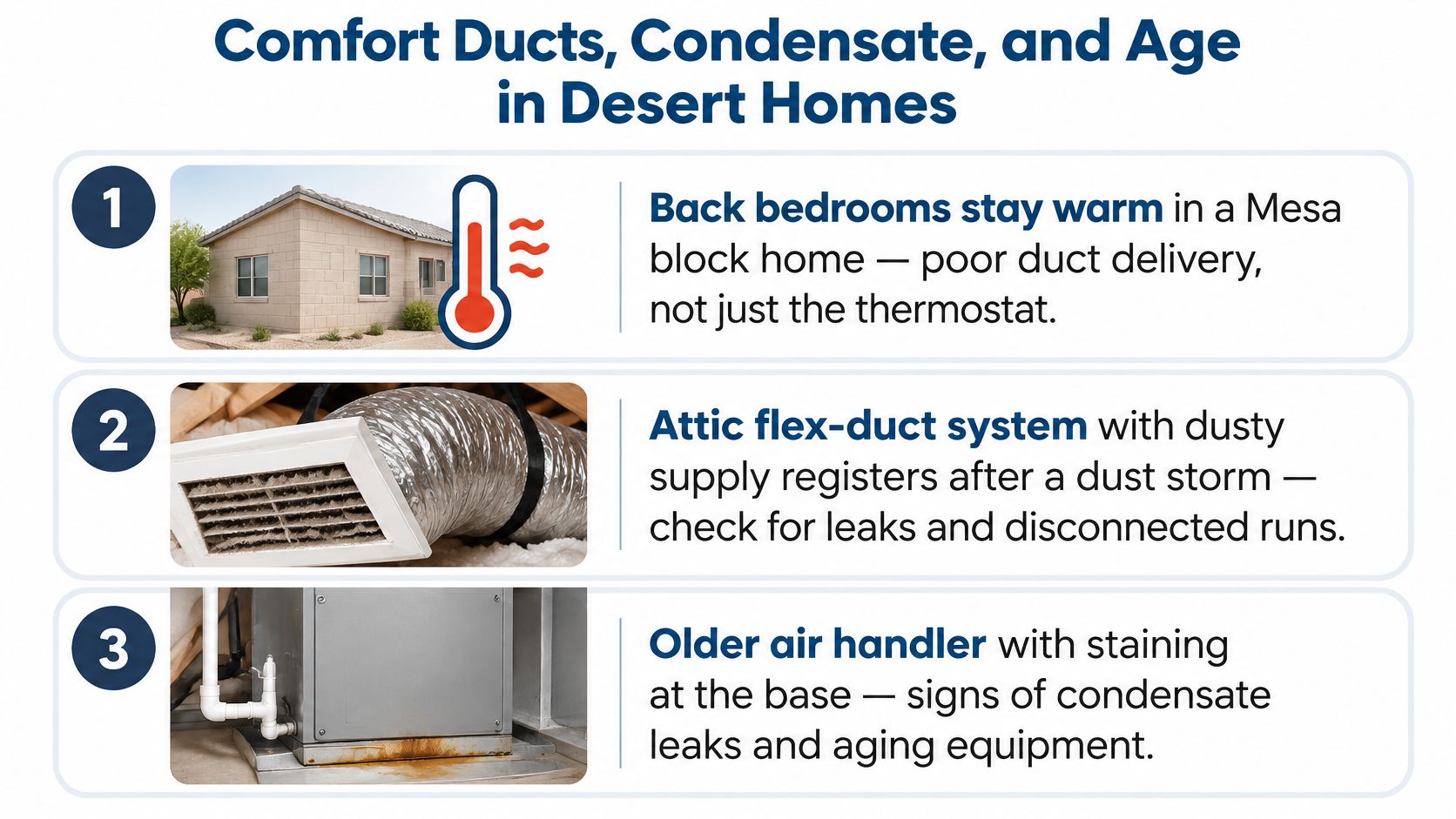
A block ranch with two back bedrooms that never catch up is usually a distribution story before it's an equipment story. Weak supply registers and a wide spread between the living room and the far bedrooms raise one question: is the system short on capacity, or is the air not arriving?
An attic flex-duct system that leaves dusty supply grilles after a monsoon-season dust storm points at leakage or disconnection. Crushed insulation and a whistling return are clues worth photographing, because they change what the technician should look for.
An older air handler with staining at the base is a condensate question. A slow drain or a pan that has overflowed once can turn into ceiling damage or a rusted cabinet even though the system still cools.
Ducts matter more than most buyers assume. The U.S. Department of Energy reports that studies found approximately 10% to 30% of conditioned air escapes from the ducts of an average central air-conditioning system. Return-side leakage pulls hot attic air and dust into the system; supply-side leakage dumps cooled air outside the living space. Both reduce what reaches a room, and the return side is the one that affects indoor air quality.
Age belongs in the conversation as wear, corrosion, noisy operation, and missing records, not as a countdown number. A 2024 nationwide ClearVantage survey for American Home Shield found that repairing an air-conditioning unit could cost up to $6,000, while heating-unit repairs could reach $5,600, according to American Home Shield. That's the exposure a buyer is trying to size, not predict.
When ducts are the finding, the right request is duct repair or sealing rather than a new condenser, and the assessment should say which.
Questions to Ask the Inspector and HVAC Technician
Bring a written list to both visits. Ask the questions in this order and note the answers while you're standing there.
For the home inspector
- Which HVAC components were observed? Outdoor condenser, indoor coil or furnace, thermostat, disconnect, condensate system, accessible ducts.
- Which parts were not reachable, and why? A locked closet, roof access limits, insulation, or an unsafe approach all count.
- How is the system labeled? Functioning properly, deficient, unsafe, or near the end of its service life, and what evidence supports that label.
- Was any measurement taken, or was this a visual and operational check? A temperature differential is not a refrigerant or airflow measurement.
For the HVAC technician
- What system is it, exactly? Confirm type and equipment identity from the data plates before anything else.
- Which measurements were taken? Supply and return temperatures, airflow, condensate drain condition, blower operation, filters.
- Were installation and accessible electrical conditions reviewed? Within safe professional practice, and noted in writing.
- Does the return side draw attic air, and are the supply connections sealed?
- Is airflow or leakage testing needed to answer the distribution question, and is a load calculation needed only if capacity is disputed?
- Is a heat pump or furnace check part of this scope, and only if that equipment is present?
- What's excluded from this visit? Ask before it starts, so the report never implies a guarantee of finding hidden defects.
If the technician's answers sound like a diagnostic walkthrough, that's the right sign. This cooling diagnostic guide for Arizona homeowners shows the sequence a real assessment follows, which makes it easier to spot a visit that only turned the thermostat down.
Written Findings Before Any Repair Is Authorized
Home-inspection standards address readily accessible, visually observable components rather than destructive testing or guaranteed future performance. The ASHI Standard of Practice requires inspectors to report systems that, in their professional judgment, are not functioning properly, significantly deficient, unsafe, or near the end of their service lives, and it states that the inspector isn't required to determine correction methods, materials, or costs.
That limit is exactly why a buyer who wants methods and numbers needs them from the HVAC contractor. A useful write-up contains four things.
- Equipment identified. Model, serial, type, and the fuel or heat source.
- What was accessible, and what wasn't, with the reason.
- Conditions on the day, including outdoor temperature and how the system was running.
- Measurements taken, with the split between an immediate safety or operating problem, ordinary maintenance, and longer-term replacement risk.
Authorization should name the work, the equipment, and the price before anything starts. If a different hidden condition turns up once the panel comes off, that deserves a fresh explanation and a fresh approval, not an open-ended go-ahead.
Keep duct sealing, airflow correction, coil cleaning, and equipment repair as separate written items. A filter change is not a duct repair, and a report that blurs the two leaves you unable to tell what you paid for. Attic, closet, and rooftop access limits stay on the list as open items until someone gets to them safely. For equipment within a few years of replacement, it's worth reading up on warranty terms to compare before replacing while the paperwork is still in front of you.
Comfort Experts explains the findings, price, and next step before work starts, and recommendations depend on the property, equipment condition, measured findings, access, and the work included in writing. If the assessment turns up a defined cooling fault, have the equipment diagnosed by Comfort Experts' Mesa AC repair service rather than approving work off a verbal guess.
Decide the Next HVAC Step Before Closing
Three paths cover almost every inspection report. Pick the one the paperwork actually supports.
| Situation after the inspection | Next step |
|---|---|
| Equipment identified, operated, no water or airflow concern, and no HVAC follow-up in the report | Keep the inspection as the baseline and plan normal maintenance after move-in |
| Records, comfort, ducts, condensate, age, or access remain unresolved | Commission a written HVAC assessment before closing rather than relying on the phrase that it appeared to operate |
| Findings show a defined operating or safety problem | Authorize only the stated work after the scope and price are explained |
The first path is the common one, and it's a good outcome. A documented, operating system with clean records and no comfort complaints doesn't need a second visit because of a calendar. Put a filter schedule and a pre-summer check on the list and move on.
The second path is where buyers get hurt. An unresolved question doesn't resolve itself at closing, and the phrase "appeared to operate" carries no weight in August. If the HVAC decision is wrapped into a larger set of inspection follow-ups, a Destin Buyer's Agent page on buyer representation shows how one agent organizes findings before closing, which can help you see the pattern even in another market.
The third path needs discipline rather than speed. Authorize the stated work, in writing, with a price. Then decide separately whether the remaining life justifies keeping the equipment, which is the same logic covered in this comparison of AC repair vs replacement.
No inspection, general or specialist, can promise a failure date or guarantee that every hidden defect gets found. What a defined assessment can do is replace a sentence about the system operating with measurements, records, and a written scope you can act on before closing.
Comfort Experts is a locally owned Mesa HVAC company serving buyers and homeowners across Mesa and the East Valley, and a pre-purchase assessment is the same kind of diagnostic visit the team runs on any system. Call 480-207-1239 to talk through what the report left open, or schedule service and bring the inspection pages with you.
A purchase decision deserves better than a one-line note about the air conditioner. Comfort Experts handles pre-purchase HVAC assessments across Mesa and the East Valley, identifying equipment, reviewing records, measuring supply and return temperatures, checking airflow, condensate, and duct condition, and putting the findings in writing before anything gets authorized. Visit Comfort Experts to see how the team works, or call the Mesa office when the inspection report leaves an HVAC question open.