

Use Cool when the room is too hot, and use Dry only when the temperature is already near comfort but the air feels muggy. Neither mode is a dedicated dehumidifier or a guaranteed energy saver, a useful distinction when an East Valley bedroom feels sticky even though the remote shows a comfortable setting.
Which Mode Fits the Room Right Now
The practical answer to mini split dry mode vs cool mode starts with the room's actual temperature and humidity, not the weather icon on the remote. A room thermometer and a digital hygrometer give a better starting point than the impression that the air feels heavy.
Cool, dry, fan, or stop and call
| Room condition | Temperature | Humidity | Use this | Do not expect |
|---|---|---|---|---|
| Hot afternoon | Well above the setpoint | Usually low outside monsoon | Cool | Dry mode to replace strong cooling |
| Mild but sticky | Near the setpoint | Above the EPA 30% to 50% band | Dry for a limited run | A guaranteed energy savings percent |
| Already comfortable | At the setpoint | About 30% to 50% | Fan if the remote offers it | Moisture removal with the compressor off |
| Dry mode overcooling the room | Falling below the target | Moderate or already in range | Cool, or a higher setpoint if the manual allows | Dry as an all-night June default |
| Humidity will not come down | Acceptable or already cool | Still above 60% after a long run | Stop relying on the mode | Dry mode as a whole-home dehumidifier |
| Water, ice, odor, or a code | Any | Any | Stop and call | Another mode change as the repair |
The EPA humidity bands in this matrix are indoor moisture guidelines, not a promise that any particular mini-split can maintain them. The owner's manual still controls which settings are available and how the equipment operates.
Choose the symptom before the setting
A hot room needs temperature control first. That includes a hot room during a monsoon storm. Selecting Dry because the outdoor air feels humid can leave the main cooling job unfinished.
A mild but sticky room is a better candidate for a watched Dry-mode trial. Dry still produces cooling, so a falling room temperature matters just as much as a falling humidity reading. A bedroom that becomes chilly hasn't reached a better result merely because it feels less damp.
Fan mode serves a different purpose. With the compressor off, it moves air but doesn't provide active moisture removal through a cold refrigeration coil. It belongs in an already comfortable room when air movement is the only goal, subject to the model's operating instructions.
Keep comfort and electricity claims separate
No row in the matrix promises a percentage off the electric bill. A mode that keeps running after the room is already comfortable isn't automatically an economical choice.
For broader thermostat decisions, the cooling advice for East Valley homeowners provides useful local context. For readers comparing equipment approaches in a much wetter climate, Heatwave's guide to Florida cooling options from Heatwave Air Conditioning, Plumbing, & Electric offers a separate regional comparison, not an Arizona operating rule.
Before leaving a setting on overnight, check the matching matrix row against a thermometer and hygrometer. Then confirm the remote's mode labels and operating restrictions in the correct owner's manual.
How Cool and Dry Modes Share One Coil but Lock Different Controls
Cool and Dry aren't separate refrigeration systems. They use the same basic equipment: the compressor, indoor evaporator coil, and indoor fan. The difference is how the controls operate those components.
Room air crosses the cold indoor coil. The system removes sensible heat, meaning heat that changes air temperature, while moisture can condense when the coil surface is below the air's dew point. That liquid must drain away rather than remain around the indoor head.
A ductless-system installation manual describes Dry operation as automatically cycling between cooling and fan-only operation to dehumidify the room. That explains why Dry can sound and feel different without involving separate moisture-removal hardware.
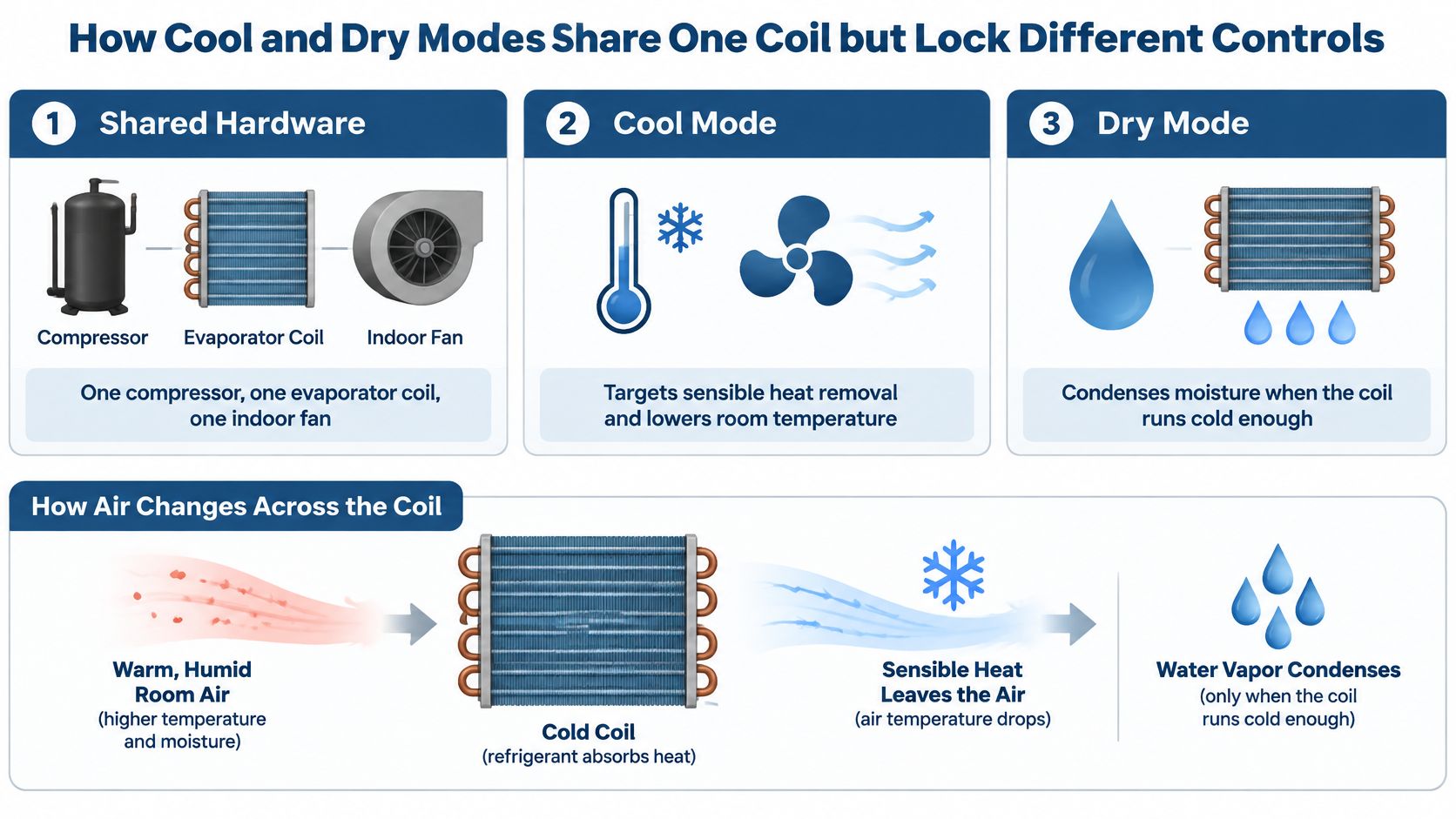
Cool targets temperature while Dry changes the operating pattern
In Cool mode, the thermostat's temperature demand is the main target. When a room is hot, the controls can call for stronger cooling and airflow to bring it toward the selected temperature.
Dry mode commonly reduces airflow and changes compressor operation to favor condensation. Lower airflow changes how air passes over the cold coil, but it doesn't eliminate heat removal. A small room can become colder than expected.
The Trane mini-split technical service manual describes a Dry sequence that initially operates like cooling, then uses a lower internal temperature target with the indoor fan at low speed and the fan-speed setting disabled. On equipment using that sequence, an unresponsive fan-speed button can be normal behavior rather than a broken remote.
The broader explanation of how ductless mini splits work helps distinguish these control choices from the equipment's underlying refrigeration process.
The droplet icon doesn't identify every control limit
Different manufacturers program Dry differently. The Lennox operating documentation specifies a recommended Dry-mode temperature range of 76°F to 79°F for the equipment it covers and notes that cooling occurs as a side effect.
That range isn't a universal instruction for every wall head. It illustrates why a setting recommended for one model shouldn't be transferred to another.
Before selecting Dry, check these manual entries:
- Fan control: Determine whether Dry locks the fan, selects it automatically, or permits adjustment.
- Humidity sensing: Look for an explicitly listed room-humidity sensor or humidity target. A droplet icon alone doesn't establish that either exists.
- Temperature limits: Check the allowed Dry setpoint range and any explanation of automatic temperature offsets.
- Operating behavior: Note whether compressor cycling and pauses are described as normal.
A missing manual is a reason to record the indoor and outdoor model numbers, not to copy another brand's button sequence. If the equipment label isn't safely accessible, a service visit can establish the correct model information.
Condensate drainage also matters. Extracted moisture has to leave the indoor unit, so visible water at the wall calls for attention rather than a different fan setting. Homeowner observation should stop short of opening equipment cabinets or attempting refrigerant, wiring, or internal drain repairs.
Humidity and Temperature Limits of Each Mode
Temperature control and moisture control aren't interchangeable. Cool is the dependable starting point when a room needs substantial temperature reduction. Dry is useful only when its moisture-removal benefit doesn't push the room past an acceptable temperature.
The 2018 Florida Solar Energy Center variable-capacity mini-split study found that standard and Dry controls improved humidity control, yet indoor relative humidity still rose above 60% during overnight summer periods under the tested conditions. A selected mode didn't guarantee the desired indoor result.
For one tested SEER 14 variable-capacity configuration, that study also found Dry-mode daily energy use was nearly the same as standard-mode energy when the daily average temperature difference was greater than approximately −1°F. At lower cooling loads, Dry could use more energy than necessary, especially when relative humidity was already below 60%.
The operating conditions matter more than the label
Those findings don't establish an Arizona savings formula. They show why compressor stage, supply-air temperature, airflow, and runtime matter more than a mode name.
The study's practical conclusion favored the lowest effective cooling stage, with sufficiently cold supply air and effective airflow per ton. That's an equipment-control issue, not an instruction for homeowners to change internal fan programming.
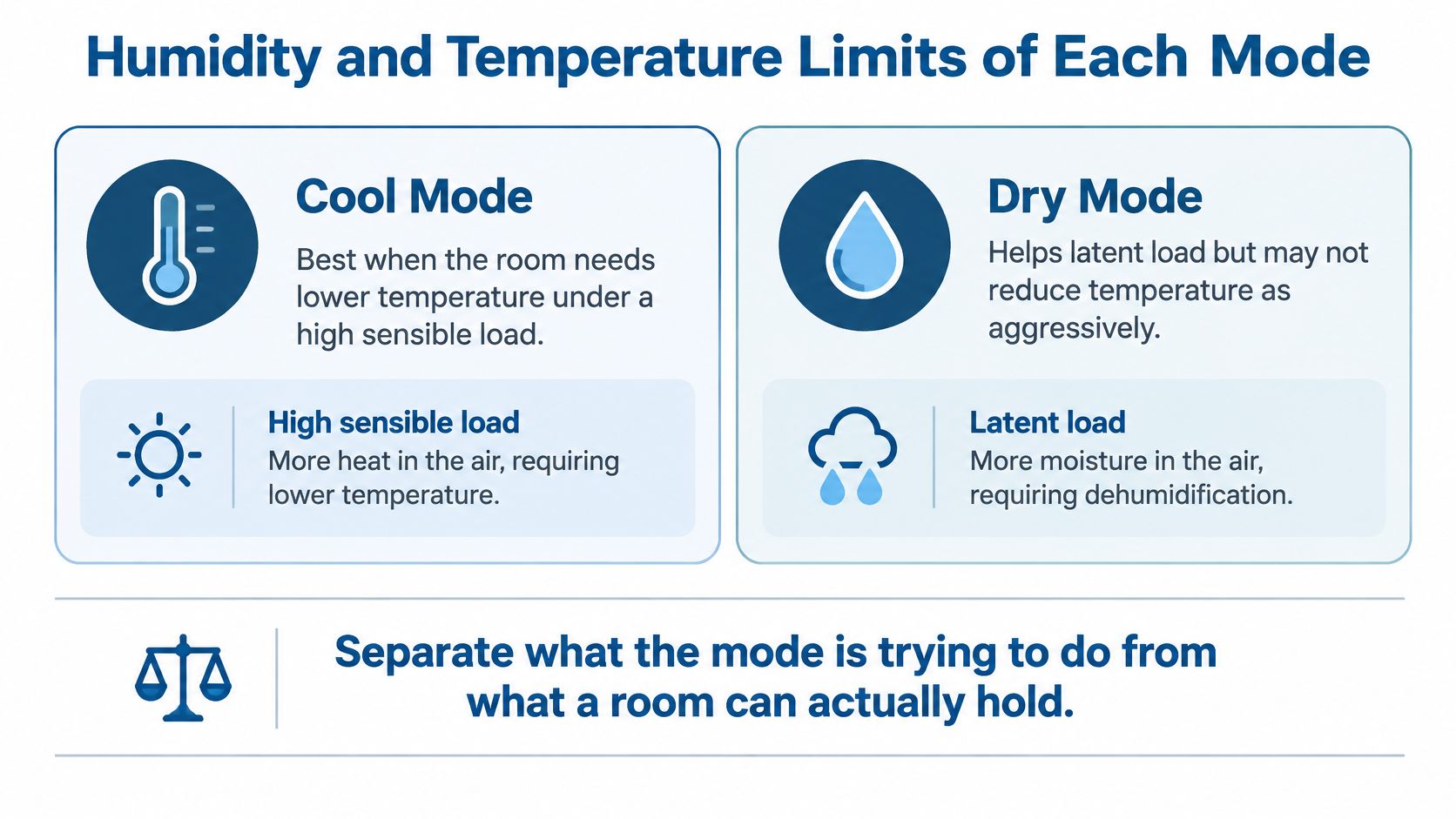
A Purdue University multi-split comparison documented the comfort trade-off directly: Dry prioritized moisture removal but allowed significant overcooling below the intended room-temperature target. Less moisture didn't necessarily mean a more comfortable room.
A university review discussing University of Central Florida testing reports that supply air needed to remain at or below approximately 57°F under the tested conditions for effective humidity control. That is a test-specific supply-air finding, not a thermostat recommendation or a guaranteed performance threshold for every home.
Recognize the limit before lowering the target again
A guest room that becomes clammy and then too cold has reached a practical limit. Continuing to lower the setpoint doesn't establish whether the problem is sizing, controls, airflow, incoming moisture, or insufficient standalone humidity control.
- Temperature remains high: Prioritize Cool and evaluate whether the unit is meeting the room's cooling demand.
- Humidity improves but comfort worsens: End the Dry trial rather than accepting an excessively cold room.
- Neither reading improves: Record the result and arrange an equipment assessment.
There's no defensible universal savings percentage for switching from Cool to Dry. Practical ways to reduce humidity in your home involve the moisture source and the building as well as the remote.
Dry June Heat Versus Monsoon Humidity
A June afternoon and a muggy monsoon evening can require different settings in the same room. The useful distinction is the measured indoor load, not a rule that Dry belongs to summer or Cool belongs only to dry weather.
Consider a casita after a stretch of dry heat. The room temperature is climbing, the air doesn't feel damp, and the head has a clear temperature-reduction job. Cool is the appropriate starting point.
During a dry stretch, prioritize the heat
Dry isn't a sensible default merely because it sounds gentler. If the room doesn't have a moisture problem, a drying-oriented operating sequence doesn't address the main complaint as directly as temperature control.
The same applies to a converted garage or a sunny addition. The thermometer in that room matters more than the temperature in the main house, particularly when each space has separate equipment and different exposure.
- Use the occupied room: Take readings where people sit or sleep, away from the direct discharge air.
- Compare against the chosen target: A remote setting isn't proof that the room has reached that temperature.
- Watch the actual result: Don't judge cooling performance solely by whether the fan sounds strong.
For that dry, hot scene, the decision is straightforward: leave temperature control in charge rather than adding a Dry-mode experiment.

During a muggy evening, measure before switching
Now consider the same casita after a humid evening. The room has reached an acceptable temperature, but the hygrometer shows increased moisture. That is a reasonable setting for a limited, observed Dry trial within the manufacturer's operating rules.
If the room remains hot, stay with Cool first. Rain outside doesn't cancel the need to lower an excessive indoor temperature.
A single-head guest room deserves its own thermometer during the trial. A favorable reading in the living room doesn't establish that the guest room isn't becoming too cold, and the result shouldn't be assumed to apply throughout the house.
Open windows during damp weather can also complicate the comparison. Keep the room's conditions reasonably consistent while observing the equipment rather than changing the mode, windows, and setpoint together.
The practical approach to AC humidity management during Arizona monsoons is to match operation to the room and investigate poor results. Neither mode is a monsoon cure-all, and a dirty or poorly draining system needs more than seasonal remote adjustments.
When the Room Stays Cold or Damp
A chilly room after a Dry trial and water running down a wall are different problems. The first can reflect the programmed operating sequence. The second warrants stopping operation and arranging a check.
For moisture control, the U.S. Environmental Protection Agency recommends indoor humidity below 60%, ideally between 30% and 50%, because excessive moisture increases the likelihood of biological contaminants and mold growth. Persistent readings above that upper guideline deserve investigation, not indefinite operation in Dry.
Separate a control limitation from a warning sign
Overcooling that follows the model's documented Dry sequence is a reason to reconsider the setting. It isn't proof of a refrigerant problem, and it doesn't justify adding refrigerant without diagnosis.
Other symptoms require a different response:
- Dirty filter: Visible loading and weak airflow warrant attention under the owner's instructions. Continued poor performance calls for service.
- Dirty coil: Suspected coil buildup needs assessment, especially when airflow or cooling remains poor. Internal coil work isn't a remote-setting fix.
- Slow or blocked condensate drain: Water collecting around or below the head suggests a drainage concern. Stop operation if water appears at the wall.
- Musty odor: An odor from the indoor head warrants inspection for moisture and contamination rather than masking it with continuous fan operation.
- Ice or a displayed code: Stop testing modes and record the symptom or code for the technician.
These are warning signs, not homeowner diagnoses. A filter, coil, sensor, or drain can't be identified as the cause from a humidity reading alone.
Record the room before changing modes again
A short observation log makes the complaint specific. Record actual readings over a few comparable evenings, without continuing a trial once water, ice, or a fault appears.
Room observation log before changing modes again
| What to record | Cool mode entry | Dry mode entry | Manual limit to note |
|---|---|---|---|
| Time and outdoor condition | Afternoon heat or monsoon evening | Same room, later reading | Season or operating conditions the manual assumes |
| Setpoint and mode | Temperature the remote is holding | Dry setpoint if the remote allows one | Allowed Dry range |
| Room temperature | Start and end temperature | Any drop below the target | Overcooling note in the manual |
| Relative humidity | Hygrometer at the start and after the run | Hygrometer after the Dry trial | No universal removal rate |
| Runtime | Observed run duration | Whether operation appeared steady or intermittent | Fan locked or adjustable |
| What was observed | Airflow, noise, normal condensate | Water, ice, odor, or a code | Stop and call if a fault appears |
Compressor operation may not be obvious from indoor fan noise. If runtime can't be confirmed, record the observed behavior rather than guessing.
Comfort Experts diagnoses a system using symptoms, system condition, airflow, controls, equipment history, and actual operating measurements. A ductless assessment can include indoor-head filters, coils, blower, vanes, controls, and condensate, plus communication, wiring, sensors, and displayed codes.
The log helps distinguish a mode-choice question from a condition requiring ductless AC repair. It also prevents an intermittent evening problem from being reduced to a vague report that the room sometimes feels wrong.
Confirm the Manual Then Book a Check
The owner's manual should settle what the remote can command. Use the manual matching the equipment model, not a similar-looking wall head or a video showing another brand's remote.
If the room is hot, return the head to Cool. If the temperature is acceptable but measured moisture remains high, a monitored Dry trial is reasonable only within the model's setpoint and fan-control rules.
Make the manual check specific
Look for the Dry operating range, any locked fan setting, temperature offsets, and any stated humidity-sensing function. If the manual doesn't describe humidity sensing, don't assume the equipment is maintaining a selected moisture target.
A missing or unclear manual shouldn't lead to repeated button combinations. Record the model information and the behavior already observed instead.
Before an appointment, gather:
- Equipment details: Equipment type and safely accessible model information.
- Selected settings: Mode, temperature target, fan setting, and any timer.
- Visible symptoms: Water, ice, odors, unusual sounds, and displayed codes.
- History: When the condition began and any recent service.
- Room measurements: The temperature, humidity, and observation log.
Comfort Experts provides ductless service for Mesa homes and surrounding communities, with service routes for active repairs, maintenance, new-zone decisions, and replacement planning. Those are separate decisions, and a remote-setting question shouldn't automatically become a replacement conversation.
A successful setting produces an acceptable room, not merely a different icon. When temperature and moisture can't both stay reasonable, the next useful step is an assessment supported by observations.
Comfort Experts offers ductless assessment and service to help separate a control-setting issue from an airflow, drainage, or equipment problem. For a room that stays damp, overcools, or shows warning signs, schedule service or call 480-207-1239, with the model information and room log ready.