

If you're staring at the thermostat in a Phoenix summer and wondering why the house still feels off, you're not alone. Air conditioning temperature sounds like a simple setting, but real comfort in the Valley comes from how your whole cooling system works together, not from chasing one magic number.
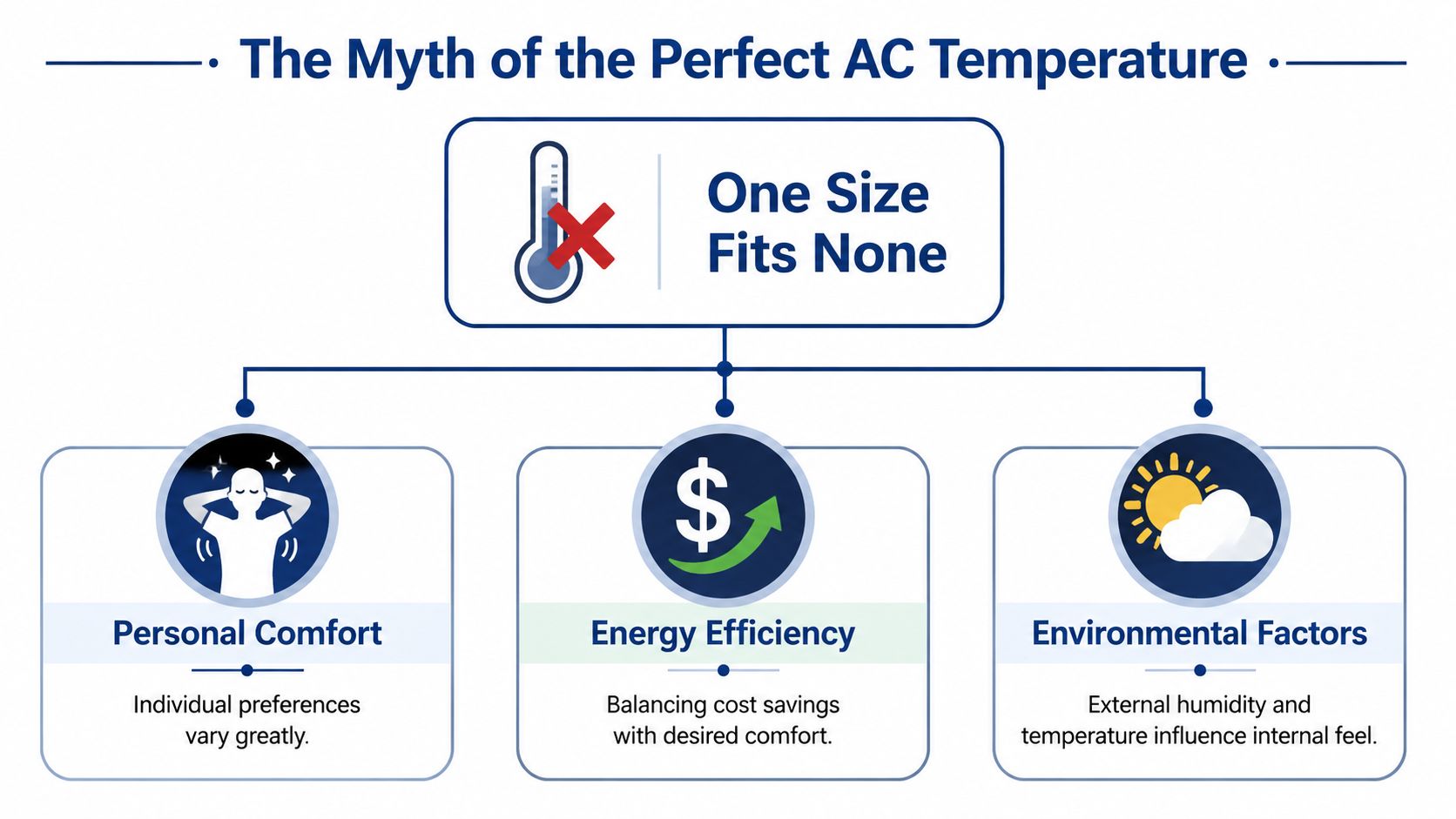
The Myth of the Perfect AC Temperature
A lot of online advice treats thermostat settings like there's one correct answer for everybody. Set it to this number, save money, stay comfortable, done. In real homes across Mesa and the Phoenix area, that's not how it works.
A thermostat setting is always a trade-off between comfort, energy use, and equipment strain. Push too low and you may feel cooler for a while, but the system runs longer and harder. Push too high and you save runtime, but some rooms start feeling sticky, uneven, or just plain miserable.
A benchmark is not a magic number
For occupied homes, a widely used benchmark is 75°F to 78°F, and Energy Star guidance cited by Bryant recommends raising the setpoint by 4°F when asleep and 7°F when away. Bryant also notes that every degree you raise the setpoint reduces compressor runtime, which is why modest increases can lower seasonal energy use without changing equipment at all. You can review that summer thermostat guidance in Bryant's thermostat setting recommendations.
That range is useful. It is not universal.
A shaded single-story home with decent airflow may feel fine at the upper end of that range. A two-story house with hot west-facing rooms may feel rough at the same setting. The same thermostat number can feel different depending on ceiling height, window exposure, insulation, duct condition, humidity, and how long the system has been running.
What actually matters in Phoenix
In the Phoenix heat, the question isn't “What's the perfect number?” It's “What setting gives me a livable house without wasting runtime or masking a system problem?”
That's a different mindset, and it leads to better decisions.
- Comfort first means realistic comfort: If your family can sleep well, move around the house without hot spots, and the AC cycles in a normal pattern, you're in a workable range.
- Savings come from strategy, not suffering: A smart schedule, shade control, and airflow improvements usually help more than forcing the thermostat way down and hoping for a miracle.
- System health matters: Running a unit endlessly at a low setpoint in extreme heat doesn't fix bad airflow, weak duct delivery, or poor sizing.
You know what? Homeowners often assume the thermostat is the boss of comfort. It's really just a request button. The rest depends on whether the system and the house can deliver.
If you want practical ways to cut cooling waste without making the house unbearable, these HVAC energy saving tips for Arizona homes are a useful next read.
Stop chasing colder and start chasing balance
A lower setpoint doesn't always create better comfort. Sometimes it just creates longer run times and frustration. If the house feels muggy, uneven, or slow to recover, the problem may not be the chosen number at all.
That's why the best approach to air conditioning temperature in Phoenix is balanced control:
| Priority | What works | What usually doesn't |
|---|---|---|
| Comfort | Small setpoint adjustments, better airflow, room-by-room evaluation | Dropping the thermostat drastically |
| Efficiency | Raising temperature modestly when asleep or away | Keeping one low temperature all day |
| Equipment longevity | Realistic expectations during peak heat | Forcing the system to chase an unreachable indoor target |
The right temperature is the one your home can maintain reasonably, your family can live with, and your system can handle without fighting itself all day.
Understanding Humidity and Your Comfort
Phoenix gets labeled as “dry heat,” and a lot of the year that's fair. Then monsoon season shows up and reminds everyone that moisture changes everything. A house can read acceptable on the thermostat and still feel heavier, warmer, and less comfortable.
That's not your imagination. Moisture changes how your body experiences indoor air.
AC was built to control moisture too
The history of air conditioning says a lot about what comfort really means. The first modern electrical air-conditioning unit was developed by Willis Carrier in 1902 to solve a humidity problem that was wrinkling magazine pages at a printing plant, not just to make people feel cooler. That's why modern AC has always been about controlling both temperature and moisture, as explained in the U.S. Department of Energy's history of air conditioning.
That matters in Arizona more than many homeowners realize.
When monsoon moisture climbs, lower temperature alone may not give you the relief you expect. If the system can't remove enough indoor moisture, the air feels clammy and stagnant even when the thermostat number looks fine. That's one reason some homes feel better at a slightly higher setting than others. Their systems are managing indoor moisture more effectively.
Why the house feels different in August
The thermostat reports temperature. It doesn't tell you the whole comfort story.
Humidity affects comfort in a few practical ways:
- Indoor air feels heavier: Rooms can feel stuffy even when the system is running.
- Sweat evaporates less efficiently: Your body loses one of its natural cooling tools.
- Hot spots feel worse: A room with weak airflow becomes much more annoying when the air also feels damp.
That's also why moisture control matters beyond comfort. During humid stretches, building materials and indoor contents can suffer if moisture lingers. If you want a non-HVAC perspective on that side of the issue, this overview of Phoenix humidity and property damage gives useful context.
Airflow and cleanliness matter more when moisture rises
A dirty system struggles more when the air gets heavier. Return airflow, filter condition, blower performance, and duct cleanliness all matter. If the system can't move air properly across the coil, moisture removal suffers and comfort drops.
That's one reason homes with dusty returns or neglected ducts often feel worse during humid periods. Not every house needs duct cleaning, but when airflow is restricted or indoor air quality is poor, it can be part of the solution. This guide on duct cleaning in Mesa homes explains when it makes sense.
The real comfort target
A Phoenix home doesn't need to feel icy. It needs to feel dry enough, even enough, and stable enough that you can relax in it. That's a much better target than trying to force one low thermostat number all summer.
Let me explain. If your house only feels comfortable when the thermostat is set unusually low, there's a good chance the system is compensating for another problem. Moisture control, airflow, duct delivery, or insulation may be the actual issue.
Why Your Thermostat Reading Can Be Misleading
A thermostat is only as useful as the conditions around it. If it sits in a warm hallway, near sunlight, close to a return, or in a dead-air spot, it can give you a number that doesn't match how the main living areas feel.
That's why homeowners say things like, “It says 76, but the bedroom feels way hotter.” They're often right.
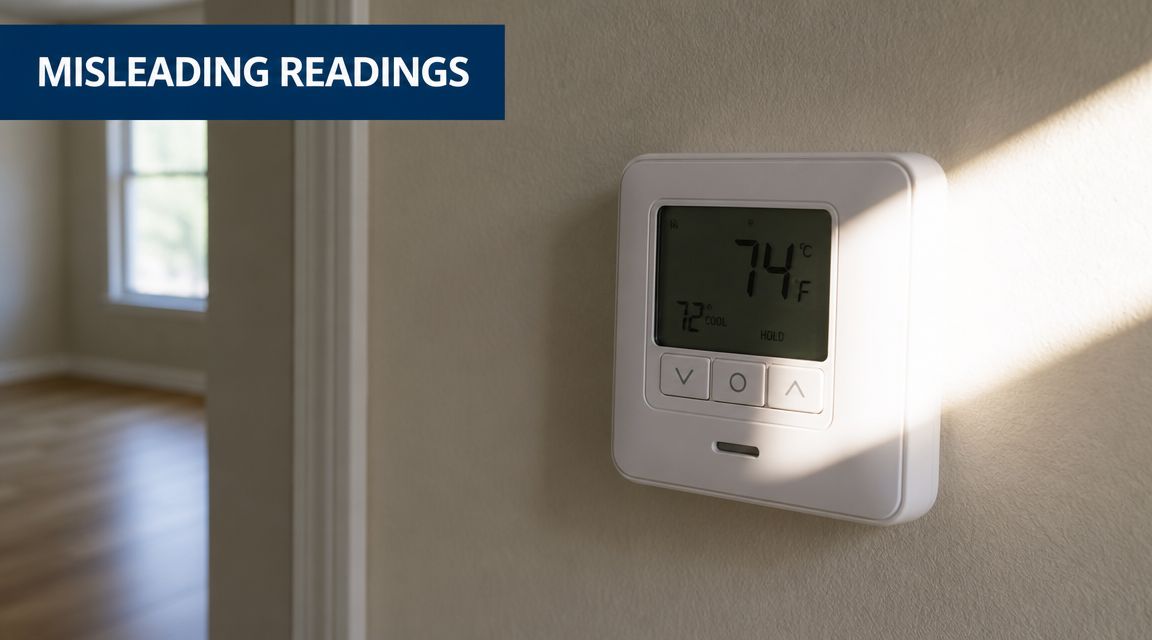
The thermostat may be reading one house, while you live in another
A single wall thermostat represents one location. Your house is a collection of different loads.
A few common examples:
- Hallway thermostat, hot bedrooms: The hallway may satisfy first while closed rooms stay warm.
- Sunlit wall location: The thermostat thinks the house is hotter than it is and runs the system longer.
- Near a supply vent or return path: The reading gets distorted by moving conditioned air.
- Two-story layout: Heat gathers upstairs, while the thermostat may sit downstairs in a more stable zone.
The setpoint may be realistic, but the equipment may not be
There's another layer to this. Sometimes the thermostat is fine, but the system can't deliver what the setting demands.
A common but overlooked issue is that a home's cooling performance is often constrained by whether the AC unit is properly sized and installed, not by the thermostat setting itself. An undersized AC may run continuously and still never reach the target temperature, and many systems can typically cool only about 15°F to 25°F below outdoor conditions in extreme heat, as discussed in this explanation of why an AC may struggle below certain settings.
That doesn't mean your system is broken every time it runs hard in the afternoon. It means expectations need to match reality. On brutal days, there's a difference between “working hard” and “failing.”
Quick checks before blaming the thermostat
Before you replace a thermostat or assume the AC is bad, look at the whole picture.
| Symptom | Possible cause | What to check first |
|---|---|---|
| House feels warmer than thermostat reading | Poor thermostat placement | Sun exposure, nearby vents, hallway location |
| One room always hotter | Airflow imbalance | Register airflow, door position, duct delivery |
| System runs non-stop in peak heat | Capacity or heat gain issue | Filter, outdoor unit condition, insulation, windows |
| Setting changes don't seem to matter | Control or sensor issue | Thermostat batteries, programming, reset need |
If your control seems erratic, this guide on how to reset an AC thermostat can help with the basics before you assume a bigger failure.
What works better than constant thermostat fiddling
Changing the setpoint over and over rarely solves the root problem. It usually just changes how frustrated you feel while the same issue keeps happening.
What helps more:
- Compare rooms, not just one reading
- Track problem times of day
- Notice whether the issue is airflow, humidity, or recovery speed
- Look for repeated patterns tied to sun exposure or occupancy
When you do that, the thermostat becomes one clue, not the whole diagnosis.
Creating a Smart Thermostat Schedule for Phoenix
A smart thermostat works best when it follows the rhythm of the day. In Phoenix, that means thinking ahead. If you wait until the house already feels hot in late afternoon, you're asking the system to fight the worst outdoor conditions all at once.
A better plan is to keep the house stable in the morning, protect comfort during occupied hours, and allow a controlled rise when nobody needs the space as cool.
A practical weekday schedule
This sample is meant as a starting point for a typical Phoenix summer weekday. Adjust it based on occupancy, sleeping comfort, insulation, pets, and whether someone is home during the day.
| Time of Day | Recommended Temp (°F) | Reasoning |
|---|---|---|
| Early morning | 75 | Outdoor conditions are usually less punishing, so the system can cool the house more efficiently before the day ramps up. |
| Mid-morning | 76 | Keeps comfort steady without overcooling the home once people are up and moving. |
| Midday when away | 82 | Lets the temperature drift upward while the home is unoccupied, reducing unnecessary runtime. |
| Late afternoon | 80 | Brings the house back toward comfort without demanding an aggressive pull-down during the harshest part of the day. |
| Evening occupied hours | 76 | Supports comfort when the household is active and using the main living spaces. |
| Sleep hours | 79 | Aligns with the common recommendation to raise the setpoint when asleep, while still keeping most homes reasonably comfortable. |
Why this approach works better than one fixed setting
A flat temperature all day sounds simple, but it often costs more and doesn't improve comfort much. The key is using timing to your advantage.
- Morning stability: The system can cool with less stress before the hottest window of the day.
- Controlled daytime drift: Empty houses don't need living-room comfort.
- Gentle evening recovery: A moderate step-down usually works better than demanding a major catch-up.
- Sleep adjustment: Many people can tolerate a slightly higher setpoint overnight, especially with ceiling fans and good airflow.
Common scheduling mistakes
Some schedules look efficient on paper but create comfort problems in real life.
- Too much daytime setback: If the house gets excessively warm, recovery can feel slow and uncomfortable.
- Sharp evening drop: Asking the AC to pull down hard at the hottest part of the day often backfires.
- Ignoring occupancy changes: School breaks, remote work, and pets all change what “away” should mean.
- Weekend copy-paste: Saturday and Monday rarely need the same schedule.
If you're still using a manual thermostat or only scratching the surface of your controls, this guide on the benefits of a smart thermostat is worth reviewing.
Build around comfort zones, not one number
The best smart schedule creates a range, not a rigid command. Some homes do fine with mild setbacks. Others need tighter control because of sun load, upper-floor bedrooms, or slower recovery.
If your schedule leaves the house feeling stale, sticky, or uneven, that's your sign to look past the thermostat and into airflow, humidity handling, and duct performance.
Advanced Cooling Strategies Beyond the Thermostat
Some comfort problems don't respond to better scheduling because the thermostat was never the main bottleneck. If one side of the house bakes every afternoon, or the upstairs never matches the downstairs, changing settings only treats the symptom.
Nearly 90% of U.S. households used air conditioning in 2020, according to the U.S. Energy Information Administration summary on household AC use. In a place like Phoenix, where cooling is basic infrastructure, efficiency and system performance affect everyday household costs in a real way.
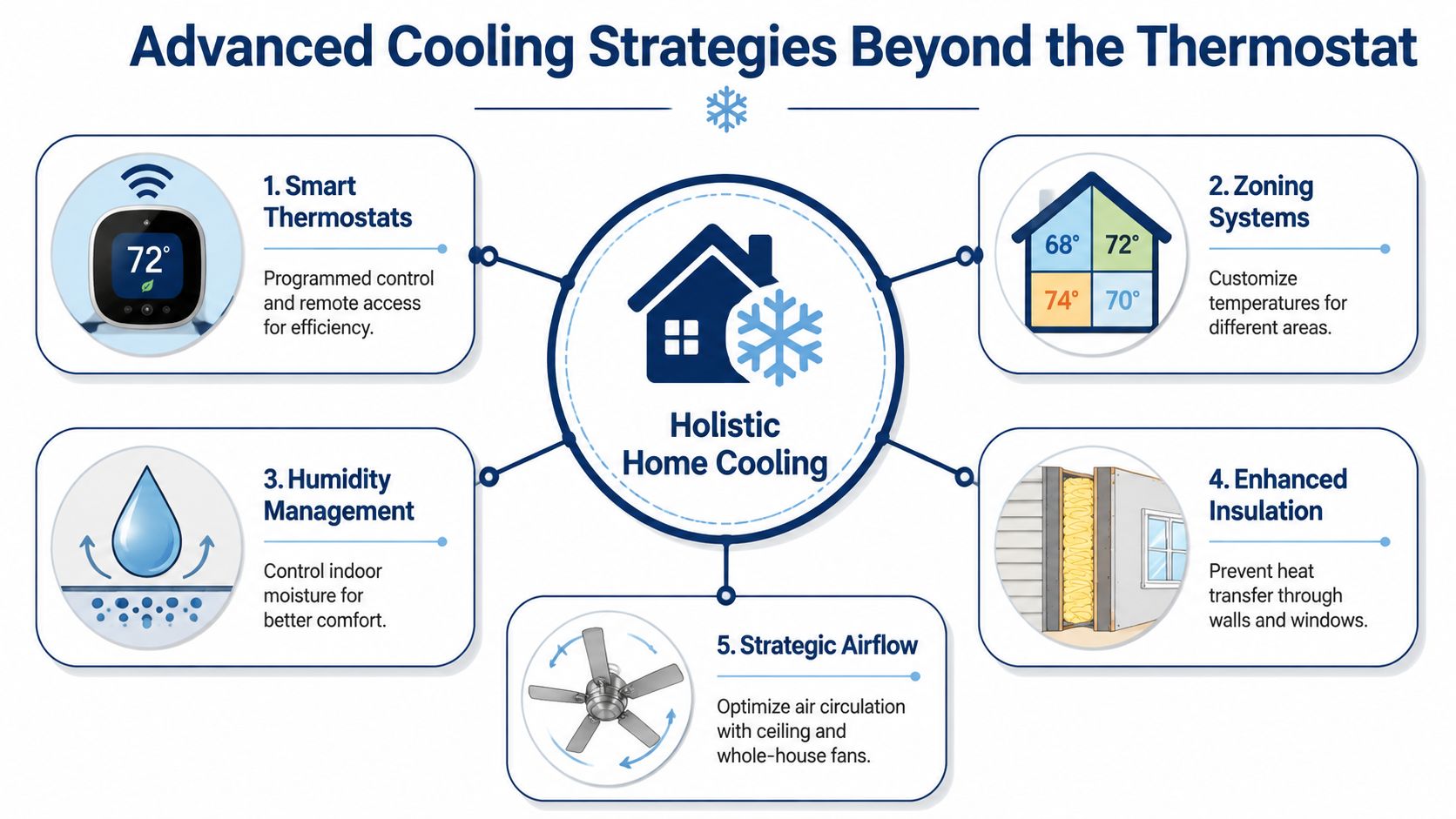
Fix the house side of the cooling equation
Your AC can only work with the load the house gives it. If solar gain is high, comfort drops faster and runtime climbs.
Window shading is a good example. Homes with strong afternoon sun often improve noticeably with better window management. If you're looking at exterior shading options, this homeowner's guide to solar screens gives a solid overview of where they fit.
Other house-side improvements often include:
- Attic insulation upgrades: Helps slow heat transfer into living spaces.
- Air sealing around leaks: Reduces unwanted hot air infiltration.
- Room darkening during peak sun: Especially useful on west-facing rooms.
Fix the air delivery side
A lot of Phoenix comfort complaints are really airflow complaints. The system may be producing cooling, but it's not delivering it evenly.
System-level work matters here:
| Strategy | Best for | What it changes |
|---|---|---|
| Zoning | Two-story homes, hot/cold areas | Lets different areas run to different comfort targets |
| Duct sealing | Weak rooms, uneven delivery | Reduces air loss before conditioned air reaches rooms |
| Variable-speed equipment | Homes with comfort swings | Improves steady operation and better overall control |
| Return air improvements | Rooms that feel stale or stuffy | Helps the system move air more effectively through the house |
When equipment upgrades make sense
Not every problem requires replacement. But some homes need more than a thermostat tweak and more than a tune-up.
Variable-speed and multi-stage systems can help when the goal is steadier indoor conditions instead of a simple blast-on, blast-off pattern. Zoned control can help where one thermostat can't represent the whole house. Duct sealing can make rooms usable again when supply loss is the issue.
Comfort Experts in Mesa offers services such as zoning, smart thermostat upgrades, duct sealing including Aeroseal, and high-efficiency system replacement, which are all tools that can address these system-level comfort problems when basic thermostat adjustments haven't solved them.
The point is simple. If you've already tried changing the air conditioning temperature and your house still fights you every day, you may need a whole-home solution instead of another setpoint experiment.
Signs You Need an AC Repair Not a New Setting
Sometimes the answer is behavioral. Sometimes it's mechanical. Knowing the difference saves time and keeps you from chasing the thermostat while the system gets worse.
If the house was cooling normally and suddenly stopped keeping up, that's not a scheduling issue. If airflow dropped, noises started, or temperatures became erratic, a repair check makes more sense than more thermostat adjustments.
Use the 20 degree split as a quick field check
A properly operating air conditioner should deliver supply air about 20°F cooler than the return air entering the system. If indoor air is 85°F, the air leaving the vents should be around 65°F. A much smaller temperature difference often points technicians toward low refrigerant, poor airflow, dirty coils, or compressor trouble, based on this 20-degree AC temperature split guidance.
You can use that as a simple homeowner check.
- Measure return-side air: Near the filter grille or return path.
- Measure supply-side air: At a nearby vent after the system has been running.
- Compare the difference: If the gap is much smaller, the system needs a closer look.
Red flags that point to repair
Some symptoms usually mean the problem has moved beyond settings:
- Weak airflow: Air comes out, but barely.
- Long run times with poor comfort: The unit runs and runs, but rooms stay warm.
- Warm supply air: The vent air doesn't feel meaningfully cooler.
- Odd sounds: Buzzing, rattling, grinding, or hard starts.
- Uneven cooling that developed recently: Especially if the house used to cool more evenly.
- Frequent thermostat changes with no real effect: The system isn't responding the way it should.
Don't confuse strain with normal summer operation
In Phoenix, AC systems work hard. That part is normal. What isn't normal is a system that loses its temperature split, blows weak air, or suddenly can't recover at night the way it used to.
If those signs sound familiar, a repair diagnosis is the next move. This local guide to AC repair service near you covers what to expect when it's time for a professional inspection.
Phoenix AC Temperature FAQs
What temperature should I keep my AC at in Phoenix?
Start with a consistent setting, then adjust based on comfort, occupancy, and how your house performs. Many homes land in the commonly used occupied range covered earlier, but the better question is whether the home feels balanced and the system is keeping up without constant struggle.
Why does my upstairs feel hotter than downstairs at the same setting?
Heat rises, upper floors take more roof load, and one thermostat usually can't represent both levels well. That's often an airflow or zoning problem, not a sign that you need to keep dropping the setpoint for the whole house.
Is it safe to run AC when it's cool outside?
Not always. Guidance commonly says manufacturers recommend testing or operating central AC only when outdoor temperatures are above roughly 60°F, and running below about 60°F to 65°F can risk coil freezing and long-term damage, as explained in this overview of when outdoor temperatures are too cold for AC operation.
What should I set the AC to when leaving town?
Raise it enough to reduce runtime, but don't treat the house like a storage shed. You still want indoor conditions controlled so the home doesn't build unnecessary heat and moisture. If your thermostat has vacation mode, use that instead of random manual changes.
Why does my house still feel hot when the thermostat says it reached the setpoint?
Because comfort is bigger than the number on the wall. Airflow, humidity, insulation, sun exposure, duct leakage, and equipment capacity all affect whether that number feels good in real life.
If your home still won't stay comfortable after you've adjusted the schedule, checked airflow, and stopped chasing a magic number, it's time for a real diagnosis. Comfort Experts helps Phoenix-area homeowners identify whether the issue is the thermostat, the duct system, the equipment, or the home itself. Call 480-207-1239 or schedule service online.