
If you're thinking about trying to block air vent airflow in one room, you're probably dealing with a house that never feels even. In Phoenix, that problem gets old fast when one bedroom feels stuffy, another feels like a freezer, and the AC seems to run forever.
The All-Too-Common Comfort Problem
A Phoenix homeowner notices it first in the afternoon. The back bedroom over the garage is too warm. The office with two computers feels stuffy. The front guest room stays cold enough that nobody wants to use it. So they do what seems logical. They close a vent, slide furniture over a grille, or stuff something into the register to push more air somewhere else.
That instinct makes sense.
When a room feels uncomfortable, people want a fast fix that doesn't involve opening walls, checking ductwork, or calling for service in the middle of a brutal cooling season. They want balance. They want lower bills. They want the air to go where they need it.
Who hasn't been tempted?
In real homes, the decision to block a vent usually comes from a reasonable goal:
- Too much air in one room: A nursery or guest room gets colder than the rest of the house.
- Not enough air somewhere important: The main bedroom never catches up at night.
- Furniture placement problems: A couch, bed, or dresser ends up in front of a vent because the room layout leaves no good options.
- Dust or allergy concerns: Someone feels air blowing directly on them and assumes blocking the vent will help.
Sometimes the concern goes beyond comfort. A homeowner may wake up dry, irritated, or stuffy and start connecting that feeling to airflow in the bedroom. If you're sorting through whether symptoms are tied to air movement, dryness, allergens, or sleep environment, this guide on waking up congested gives useful context.
Phoenix homes magnify this issue. Long run times, hot attics, solar gain on west-facing rooms, and older duct layouts can turn a small airflow mismatch into a daily frustration. The vent becomes the obvious target because it's visible. The actual cause usually isn't.
Why the simple fix feels right
Closing a vent feels like pinching off waste. If one room has "too much" cold air, why not redirect it?
Because forced-air systems aren't built like a set of independent room fans. They're a pressure-driven network. Air has to be supplied, moved, and brought back. When one part gets restricted, the effect travels through the rest of the system.
What homeowners are really trying to solve
People often aren't trying to sabotage their HVAC system. They're trying to solve one of these deeper issues:
- Uneven airflow from poor balancing
- Leaky or poorly routed duct runs
- A return-air problem
- A dirty filter restricting circulation
- Room-by-room load differences from sun exposure or insulation
Those are real problems. A vent cover just isn't a real solution.
Supply vs Return Vents What You Must Know First
Before you cover a grille with furniture, magnetic covers, or a rug, figure out whether it is a supply or a return. In Phoenix, that mistake gets expensive fast because air conditioners already run hard through long cooling seasons.
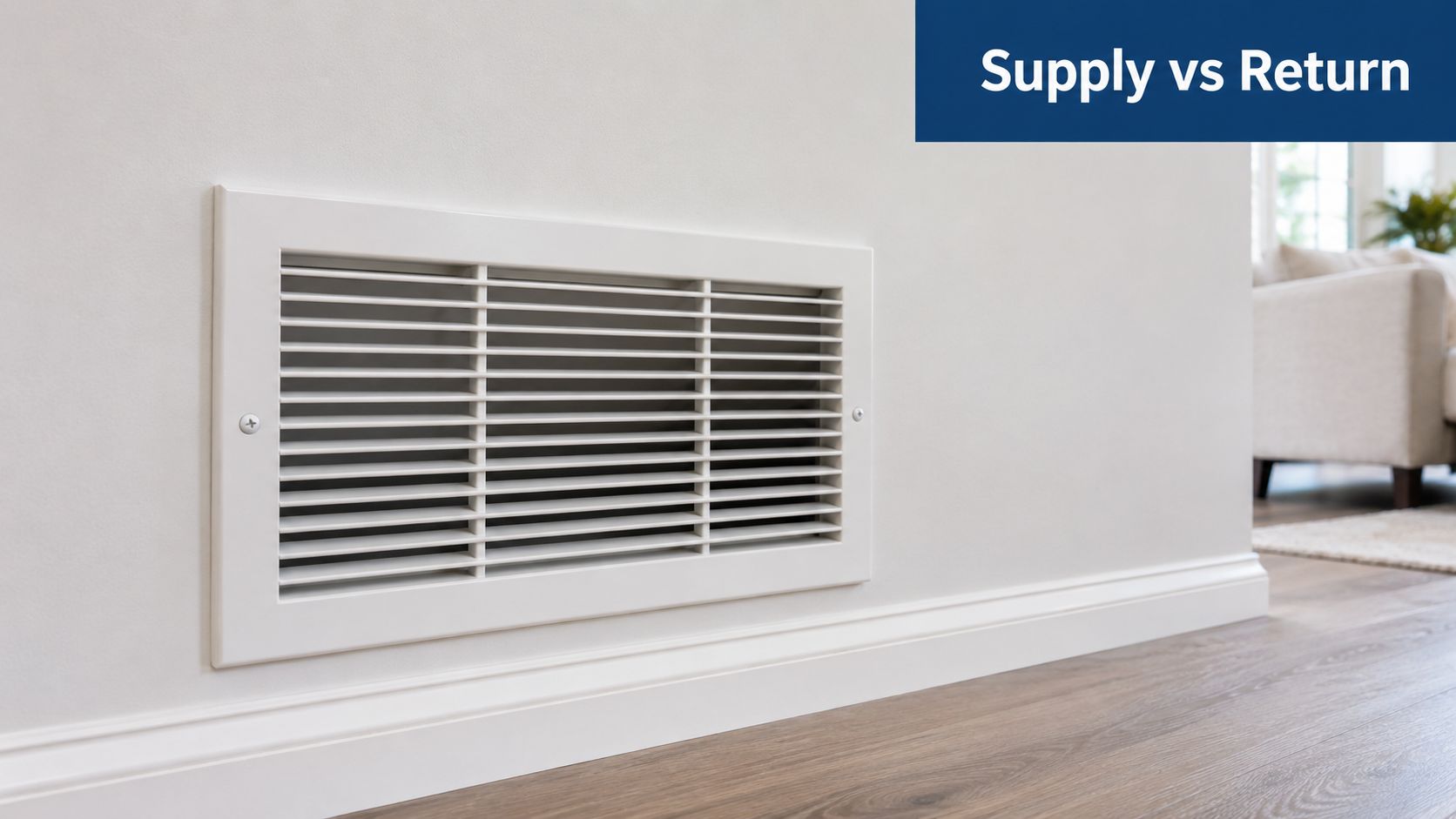
Supply vents deliver conditioned air into the room. Return vents pull room air back to the equipment so it can be cooled again. Both matter, but they do different jobs, and blocking the wrong one can throw the whole system off balance.
How to tell which vent is which
Use a simple check while the system is running.
Try the paper test
Hold a tissue or light sheet of paper near the grille. If air pushes it away, that is usually a supply vent. If the paper gets pulled toward the grille, that is usually a return.Check the grille size
Return grilles are often larger because they need to move a high volume of air back to the air handler.Look at the room layout
Supply vents are placed to wash a room with cooled or heated air. Returns are set up to pull air back out of the living space. In many homes, they are separated on purpose to keep air circulating instead of short-cycling in one spot.
Return airflow keeps the whole loop working
A return vent is the system's intake. Covering it is like asking your AC to breathe through a straw. Airflow drops, room pressure changes, and comfort usually gets worse instead of better.
This is also where filter condition matters. A clogged filter can act like a partially blocked return even when every grille is open. If you are not sure where yours is located, this guide on where your house air filter is usually installed can help you check the right spot first.
A vent can be open and still be restricted
Homeowners miss this all the time. The grille looks visible, so it seems fine. Air does not care what looks open. It cares about space to move.
These are common airflow restrictions:
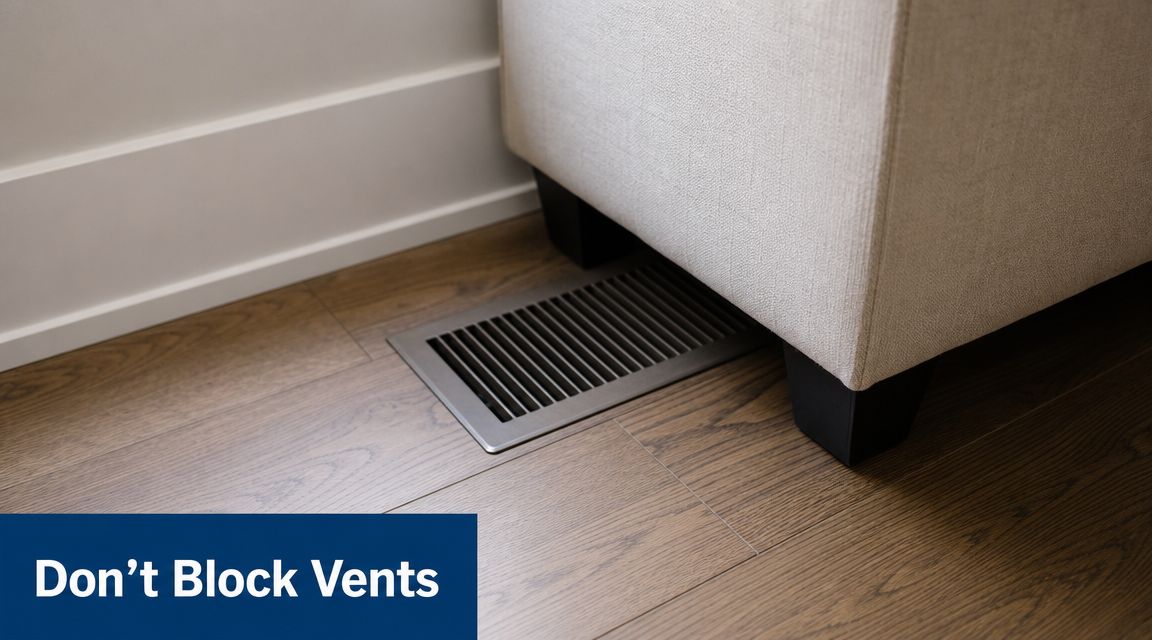
- A bed frame parked over a floor register
- A couch pressed against a wall return
- A decorative grille cover that cuts down free area
- Curtains draped across a supply vent
- Dust buildup in the system, which is one reason some homeowners look into air duct cleaning near me
If you are trying to block air vent output in one room, identify the vent type first. Restricting a supply creates pressure problems. Restricting a return is usually worse because the entire system depends on that path back to the equipment.
The Hidden Dangers of Blocking Air Vents
Closing or covering a vent doesn't make the system smarter. It makes the system push against resistance.
IndoorTemp explains that closing air vents is technically possible but not recommended, especially when multiple vents are closed and left that way, because the main problem is high static pressure that makes the blower motor work harder. The same source also notes that closing vents doesn't reduce system energy use. The furnace or AC still uses the same power to push air through the ducts, even when that airflow is redirected or backed up why closing vents raises static pressure.
Think of it like a pinched garden hose
This is the easiest way to picture static pressure.
Your blower is trying to move air through a duct system. When you block vents, you're narrowing the exits. The pressure inside the ductwork rises, just like water pressure rises when you pinch a hose. The system doesn't relax and save effort. It strains.
That strain shows up in ways homeowners notice:
- More noise at grilles
- Whistling or hissing
- Rooms getting less predictable
- Longer run times with worse comfort
- Extra wear on the blower and airflow components
The safety side homeowners often miss
Too many articles stop at comfort. That's not enough.
If airflow drops too far in cooling mode, components can operate outside the conditions they were meant to see. In heating mode, airflow problems can also affect how heat is carried away from the equipment. Either way, restricting air is not a harmless experiment.
If you're trying to understand how a furnace handles heat and why airflow matters to that process, this overview of what a heat exchanger does is worth reading before you start closing registers around the house.
Blocked by furniture still counts as blocked
Homeowners usually picture "blocking a vent" as shutting louvers. In practice, I see these problems just as often:
- Sectionals parked over floor registers
- Bookshelves covering wall returns
- Storage bins in front of mechanical-room grilles
- Decorative vent screens with poor airflow
- Dust and debris buildup reducing free opening
That last one matters. Airflow isn't just about grille size. In field airflow discussions, professionals look at net free area, not just the outside dimensions of the grille. A return can look big and still be restrictive if the actual free opening is too small. One expert example showed that moving 744 CFM while holding a return under 250 fpm required far more effective opening than the grille label suggested, and a 10×30 grille with 67.4 square inches of free area would need seven such returns to meet that target net free area and grille sizing example.
If you're chasing musty smell, dust, or poor airflow, some homeowners also compare maintenance options like air duct cleaning near me. Just remember, cleaning can help when contamination is part of the issue, but it doesn't replace correcting pressure, return capacity, or bad duct design.
What usually happens instead of "more air elsewhere"
People expect blocked vents to boost another room. In reality, the results are messy. Air may not shift where you want. The house can become more uneven, and the equipment sees the penalty first.
Smarter Solutions Professional Alternatives to Blocking Vents
If you want better comfort, the right move is to control airflow without choking the system. That's a different mindset. Instead of forcing the house to behave by closing registers, rework the airflow path so the system can stay balanced.
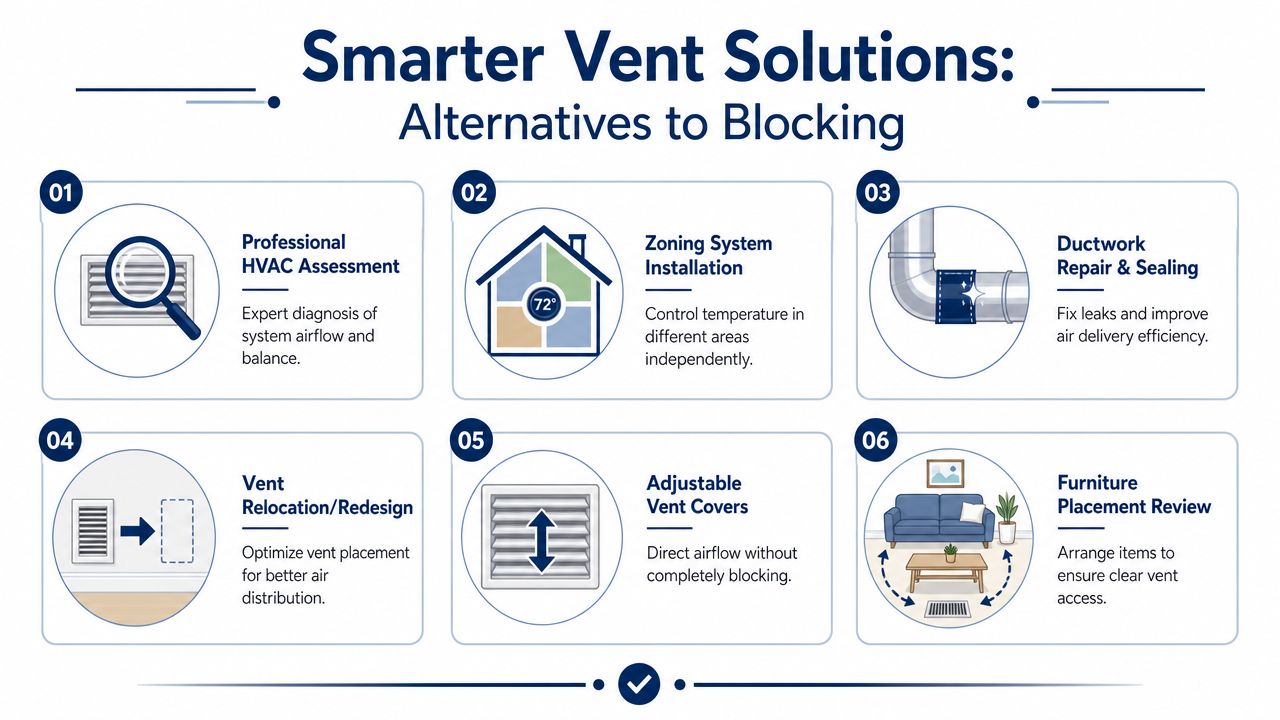
Expert HVAC guidance increasingly points to that exact approach. Supply and return openings are part of a balanced system, and the more effective path is to re-engineer airflow with solutions such as smart zoning, professional airflow balancing, and higher-performance filtration upgrades instead of blocking vents and creating pressure problems modern airflow balancing approach.
What actually works in the field
Some fixes are simple. Some require testing and duct modifications. The best option depends on whether the problem is one room, one wing of the house, or the whole system.
Minor register adjustment
This is the only "DIY-style" vent change I consider reasonable in many homes. Slightly adjusting a supply register can help direct air away from a bed or seating area without fully closing the vent.
Use restraint here. The goal is direction, not shutdown.
Filter and return-side improvements
If the system struggles to pull enough air back, fixing return-side restrictions can help the entire house feel more stable. Sometimes that means a better filter strategy. Sometimes it means adding or enlarging return capacity.
Return airflow issues often show up as rooms that feel stuffy, doors that move when the system starts, or rooms that never feel right no matter what you do at the supply vent.
Professional airflow balancing
A technician measures, adjusts, and diagnoses instead of guessing. Dampers, duct branch behavior, grille performance, and room-by-room delivery all come into play. A balance issue often looks simple from the room. It usually isn't.
Duct sealing or duct repair
Air can't cool a room if it never gets there. Leaks, disconnected sections, crushed flex duct, and bad transitions all change how much air reaches a space. That's one reason many Phoenix homes benefit from duct inspection and sealing. If you want background on one sealing method, Aeroseal duct sealing reviews explain how that process is used to reduce leakage inside duct systems.
Zoned HVAC with motorized dampers
For homes with persistent hot and cold areas, especially larger two-story layouts or homes with rooms that get very different sun exposure, zoning is often the answer. This uses controlled dampers and separate temperature management for different areas of the home.
One factual example from the local market is that Comfort Experts provides zoned system service along with duct sealing, filtration upgrades, and smart thermostat integration for Arizona homes.
Airflow Control Methods Compared
| Method | Effectiveness | System Risk | Best For |
|---|---|---|---|
| Slight register adjustment | Moderate when used carefully | Low if not overdone | Reducing drafts at one supply vent |
| Moving furniture away from vents | Moderate | Very low | Rooms where airflow is physically obstructed |
| Filter replacement and return clearing | High when restriction is the issue | Very low | Weak circulation and stuffy rooms |
| Professional airflow balancing | High | Low when performed correctly | Uneven comfort across several rooms |
| Duct sealing or duct repair | High when delivery losses exist | Low when diagnosed properly | Rooms with chronic weak airflow |
| Zoned HVAC system | Very high for persistent room-by-room imbalance | Low when designed correctly | Homes with recurring hot and cold zones |
Good alternatives share one trait
They preserve airflow while improving control.
That's the difference between a house that sort of copes and a house that feels even.
The Phoenix Factor Why Airflow Balance is Critical in Arizona
At 5 p.m. in a Phoenix summer, the thermostat may say 74, but the west bedroom still feels like a closed garage. That is the point where many homeowners start looking at a vent cover or a piece of cardboard and think, "I'll just force more air somewhere else."
In this climate, that shortcut backfires fast.
Phoenix does not give an AC system much room for error. Long run times, superheated attics, and rooms with heavy afternoon sun expose airflow problems that might stay tolerable in a milder city. Here, a small imbalance can turn into a daily comfort fight, especially in homes with long duct runs, undersized returns, or builder-grade duct layouts that were never dialed in after installation.
The pattern is familiar across the Valley. The far bedroom gets starved first. The hallway feels decent. The system keeps running because one trouble spot is dragging the whole house down. Homeowners lower the thermostat, but that does not fix weak delivery or poor return air. It just asks the equipment to work harder in extreme heat.
Pressure is the part people do not see.
A forced-air system works like lungs. Supply pushes conditioned air out. Return pulls the same volume back so the house stays stable. Start blocking registers, and pressure builds where it should not. Air gets noisier, some rooms get less predictable, and leakage at weak duct joints matters more. In Phoenix, where attic ducts already deal with brutal temperatures, that added stress is a bad trade.
That is also why I do not treat vent blocking as a harmless room-by-room adjustment. In Arizona, one airflow restriction can ripple through the whole system because the AC is already under heavy load for long stretches.
If the house also has dust buildup, matted filters, or dirty return pathways, diagnosis gets harder. Homeowners who are sorting out airflow and indoor air quality together often start by reading about duct cleaning in Mesa and what it can and cannot fix. Cleaning can help if buildup is restricting movement, but it will not correct poor balancing, return shortages, or duct design problems.
Phoenix heat exposes weak airflow the same way a steep hill exposes a weak engine. A system that seems "close enough" in spring can struggle every afternoon in July. That is why airflow balance matters more here. The margin for error is small, and the cost of guessing is higher.
When It's Time to Call in the Comfort Experts
If a vent tweak solved the issue, you probably wouldn't still be searching for answers. Persistent imbalance usually means the house needs diagnosis, not another experiment.
Call for professional help when you notice any of the following:
- One or more rooms are consistently unusable: Too hot in summer, too cold in winter, or always stuffy.
- You hear noise at the vents: Hissing, whistling, or rushing air often points to restriction or pressure trouble.
- The AC runs and runs without evening out the house: That usually signals delivery or return problems.
- Furniture placement is forcing you to cover grilles: The room layout may be exposing a deeper design issue.
- You've already tried filters and basic adjustments: If comfort still isn't right, guessing won't improve it.
- You suspect the issue is bigger than one register: Duct leakage, balancing, zoning, or return capacity may be involved.
If those signs sound familiar, it's also smart to review whether the issue overlaps with broader AC repair service near me concerns, especially when weak airflow comes with poor cooling performance.
If your home feels uneven and you're tempted to block a vent just to get through another Phoenix afternoon, get the system checked before a comfort shortcut turns into an equipment problem. Comfort Experts can inspect the airflow issue, identify the actual cause, and recommend the right fix. Call 480-207-1239 or schedule service online.