
If your rooftop units are aging, tenant complaints keep coming in, and summer power bills make you wince, you're not alone. A commercial HVAC retrofit often makes more sense than waiting for a full breakdown, especially in Phoenix where cooling isn't optional and every inefficiency gets exposed fast.
Why You Should Consider a Commercial HVAC Retrofit
A retrofit is not the same thing as tearing everything out and starting over. In practical terms, it means upgrading the parts of your existing HVAC system that are dragging down performance, reliability, or comfort, while keeping what still has useful life left.
Are your summer electricity bills getting harder to look at each year?
That question usually comes up right around the time a property manager notices a pattern. One unit short-cycles every afternoon. Another struggles to hold setpoint on west-facing suites. Service calls start stacking up. Occupants complain about hot spots, cold spots, stale air, or noise. At that point, the issue isn't just mechanical. It's operational.
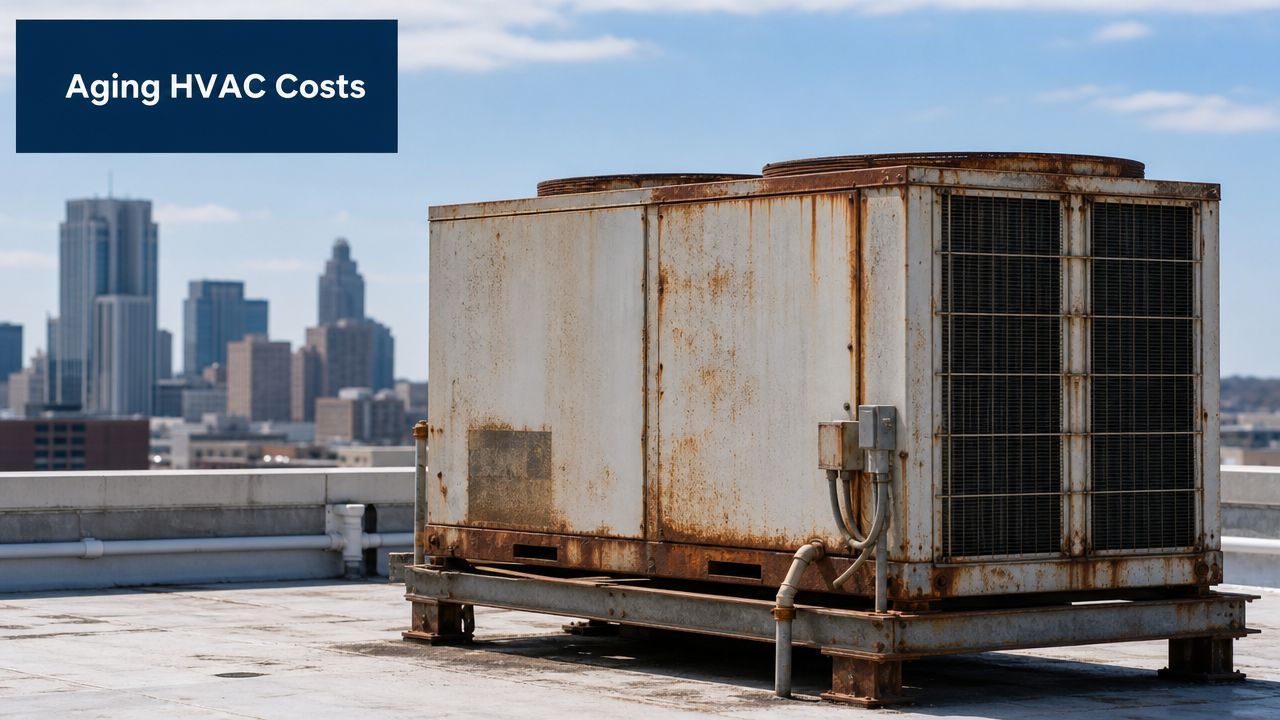
What makes a retrofit different from a replacement
A full replacement removes the old system and installs a new one across the board. A retrofit is more selective. It can include:
- Controls upgrades that stop the system from running harder than the building needs
- Fan and motor improvements that improve airflow and reduce strain
- Duct corrections that address leakage, poor balancing, and comfort complaints
- Targeted equipment replacement for units or components that no longer justify repair
- Air quality improvements that help in dusty commercial environments
That selective approach matters when you're trying to protect budget, limit disruption, and still fix the core problem.
According to Ambient Enterprises' commercial HVAC retrofit guidance, most commercial HVAC systems have a useful life of 15 to 25 years, and retrofit assessment becomes appropriate when energy bills rise, service calls increase, or equipment falls out of regulatory compliance.
The business case in Phoenix
In the Valley, comfort problems quickly become tenant-retention problems. Retail spaces lose customer comfort. Offices see more complaints. Light industrial and mixed-use properties struggle with uneven temperatures between zones. And when the cooling plant or rooftop package units run inefficiently through an Arizona summer, the utility cost impact shows up fast.
A retrofit usually serves three business goals at once:
- Lower operating cost: Better controls, better airflow, and right-sized upgrades reduce waste.
- Better occupant comfort: Balanced air delivery and smarter zoning help reduce complaint cycles.
- Stronger compliance position: Older systems can drift out of alignment with newer standards and operational expectations.
Property managers watching longer-term labor and service trends may also find the broader HVAC contractor demand forecast useful context, because it reinforces why planning ahead matters instead of waiting until peak season failure forces a rushed decision.
For properties trying to reduce waste before investing in major equipment, Comfort Experts also publishes practical HVAC energy saving tips for Arizona properties that can help identify where efficiency losses are showing up first.
The Most Impactful Retrofit Options and Technologies
Not every building needs the same retrofit. An office with comfort complaints needs a different solution than a retail strip with failing rooftop units, and both are different from a warehouse with ventilation and dust issues.
Controls and building automation
Problem: The system runs on a fixed schedule that no longer matches how the building is used.
This is one of the most common issues in older commercial properties. Tenants change. Occupancy shifts. Server rooms get added. Hours extend. Meanwhile, the HVAC controls still operate like it's ten years ago.
A controls retrofit can include smarter thermostats, revised scheduling, zone control, sensor upgrades, and integration into a building automation system. Done correctly, this improves comfort and cuts waste without replacing every major component.
This is often the first place to look when a building has complaints that seem inconsistent. One suite is freezing. Another is warm. The units themselves may not be the core issue. The control logic may be.
Rooftop unit upgrades and targeted replacements
Problem: Existing RTUs still run, but reliability is dropping and efficiency isn't where it should be.
In Phoenix, rooftop units live a hard life. High roof temperatures, long cooling seasons, and airborne dust put constant stress on coils, fans, and electrical components. Sometimes the smart move is replacing one or two weak links rather than doing a property-wide rip-and-replace.
Targeted RTU retrofit work can involve higher-efficiency packaged units, upgraded economizer controls where appropriate, improved curb transitions, and better integration with existing zones.
Duct sealing and airflow correction
Problem: The unit is working, but the air isn't getting where it needs to go.
This is a classic retrofit trap. A manager replaces equipment and still gets comfort complaints because the distribution side never got fixed. Leaky ducts, poor balancing, bad diffuser placement, and pressure issues can sabotage otherwise solid equipment.
For buildings where airflow is the hidden problem, Aeroseal duct sealing insights and reviews are worth reviewing alongside a proper duct assessment.
VRF and heat pump retrofit considerations
Problem: The property needs zoning flexibility or is evaluating electrification options.
Variable Refrigerant Flow systems can be a strong fit for certain commercial buildings, especially where zoning control matters and the building layout supports it. Heat pump retrofits are also getting more attention, but they are not an automatic answer for every site.
According to Windy City Reps on heat pump retrofit viability, suitability depends heavily on building age and existing system condition. Mid-life systems are often better candidates for heat pump retrofits, while older systems may be better suited for full replacement.
That nuance matters. If the building's core mechanical infrastructure is still sound, retrofit can be cost-effective. If the system is already near the end of useful life, forcing a partial solution can waste money.
IAQ upgrades for dusty Arizona conditions
Problem: The building cools, but occupants still complain about air quality.
Phoenix properties deal with constant dust loading. That pushes filtration, increases coil fouling, and can affect both comfort perception and maintenance demands. Retrofit options here include improved filtration, UV treatment in the right applications, better outside-air management, and static pressure review to make sure the upgraded filters don't create a new airflow problem.
| Technology | Primary Benefit | Best For | Typical ROI Period |
|---|---|---|---|
| Controls and BAS upgrades | Better scheduling, zoning, and operating efficiency | Offices, retail centers, mixed-tenant buildings | Often faster than equipment-heavy projects, depending on building operation |
| Targeted RTU replacement | Improved reliability and cooling performance | Properties with aging rooftop units and recurring repairs | Depends on runtime, existing condition, and utility costs |
| VRF retrofit | Precise zone control and flexible conditioning | Office renovations, multi-zone commercial spaces | Typically longer upfront recovery, stronger where zoning issues are severe |
| Duct sealing and airflow balancing | Better comfort delivery and reduced distribution losses | Buildings with hot/cold spots and weak airflow | Often favorable when comfort complaints are tied to leakage |
| IAQ filtration and purification upgrades | Cleaner indoor air and coil protection | Dust-prone offices, retail, healthcare-adjacent spaces | Measured more through occupant outcomes and maintenance reduction than direct payback alone |
The Commercial Retrofit Process from Start to Finish
Most property managers don't need more jargon. They need a clean process, a realistic scope, and a contractor who doesn't skip the hard diagnostic work.
Let me explain how a project like this typically unfolds.
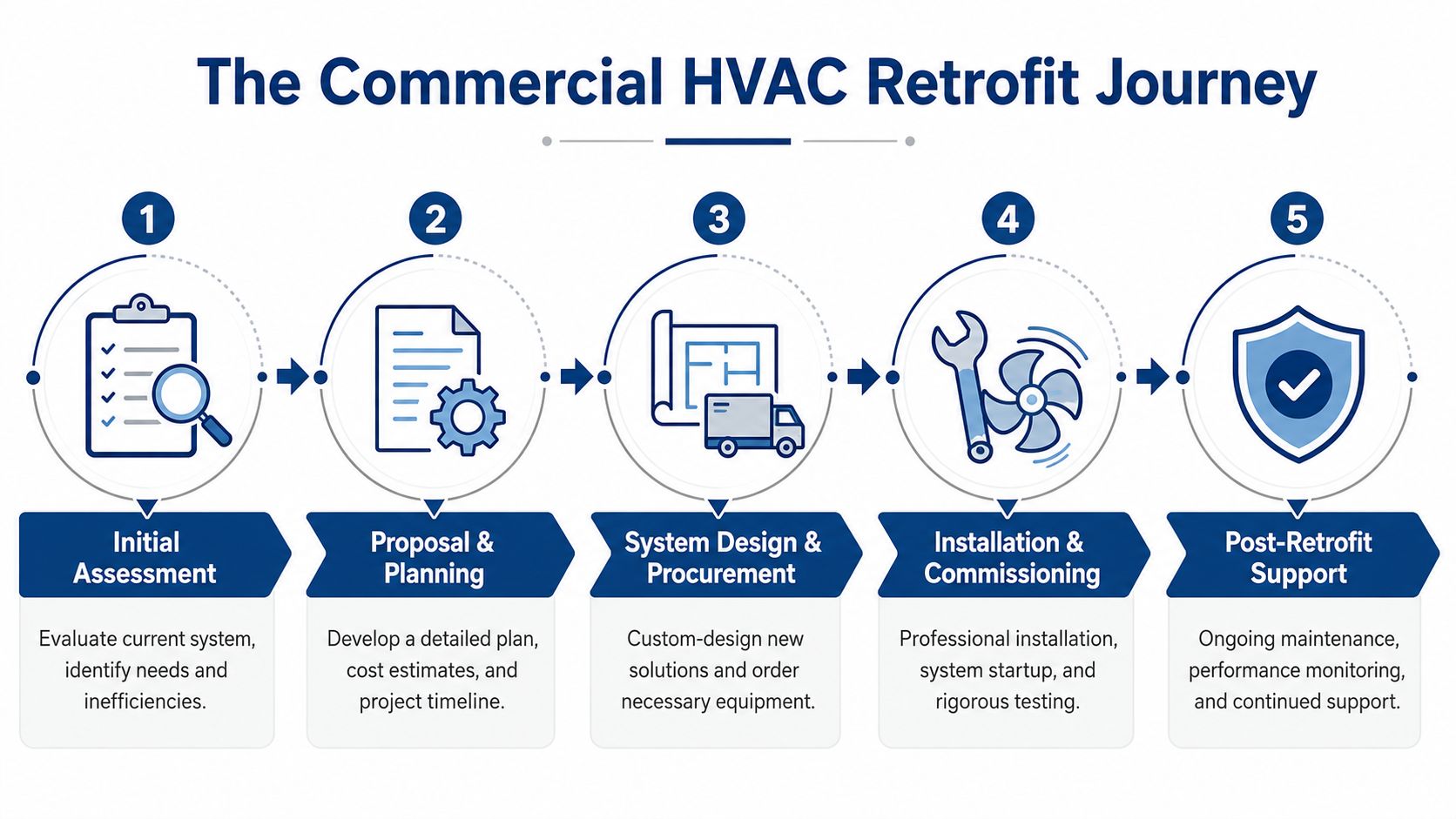
Assessment before equipment talk
The first visit shouldn't start with equipment model numbers. It should start with how the building is being used now.
That means reviewing occupancy, hours of use, tenant layout, known hot and cold zones, ventilation needs, service history, and operating pain points. It also means checking the duct system, controls, and equipment condition before anyone talks about "just swapping units."
Industry guidance from HMH Mechanical on planning a commercial HVAC retrofit warns that successful retrofit work must begin with a load recalculation, not a like-for-like swap, because changes in occupancy, internal equipment, and the building envelope can make rule-of-thumb sizing inefficient and underperforming.
Design and scope development
Once the load and building conditions are understood, the scope can be built around actual needs. At this stage, solid project managers separate symptoms from causes.
A good retrofit design usually answers questions like these:
- What problem are we solving first: Reliability, comfort, operating cost, code pressure, or all of them together?
- What should stay: Not every piece of existing infrastructure needs to be removed.
- What creates future flexibility: Controls, zoning, and access for maintenance matter more than people think.
For larger or more involved projects, the next step may include engineered drawings, phased installation planning, and coordination with tenants so business operations don't get disrupted more than necessary. For properties needing cooling-specific commercial work in the East Valley, commercial cooling services in Mesa can support this type of planning and field execution.
Installation, commissioning, and handoff
Installation is only one phase. A retrofit isn't complete when the unit powers on.
That includes confirming airflow, checking control sequences, verifying thermostat and sensor response, reviewing economizer function if applicable, and making sure the zones behave as the occupied spaces require. Handoff should also include documentation, filter specs, maintenance requirements, and a clear explanation of what the site team should watch after startup.
Understanding Retrofit Costs and Financial Incentives
Cost is the first question most owners ask, and that's fair. A retrofit can range from a relatively contained controls or duct improvement project to a major capital upgrade involving rooftop units, zoning revisions, and air quality enhancements.
The honest answer is that price depends on scope, accessibility, operating hours, building type, and how many hidden problems show up once a system is inspected. A property with decent equipment and poor controls may have a very different budget path than a site with failing RTUs, bad duct leakage, and chronic balancing issues.

Cost should be judged against business impact
The better question is not "What does the retrofit cost?" It's "What does the current system keep costing us?"
That includes utility waste, repeat service calls, tenant dissatisfaction, premature equipment stress, and management time spent dealing with complaints. In many Phoenix properties, the soft costs become just as frustrating as the utility bills.
A practical way to review retrofit economics is to separate them into buckets:
- Low-disruption upgrades: Controls changes, sensor corrections, balancing, and selected duct improvements
- Mid-scope retrofit work: Motor upgrades, filtration improvements, partial RTU replacement, and zoning fixes
- Major retrofit projects: Multi-unit replacement, central control strategy changes, or broad system redesign
Incentives can materially change the decision
Arizona businesses should always review rebate and incentive opportunities before finalizing scope. Utility programs can shift which measures make sense now versus later, especially when efficiency improvements line up with qualifying equipment or control upgrades. Federal tax treatment may also affect timing and project structure depending on ownership model and property type.
You know what? A lot of owners wait too long because they assume the whole project has to be paid entirely out of pocket. That's often not how these projects get done in practice.
If you're evaluating what may be available locally, Comfort Experts maintains an Arizona HVAC rebates page that can help you review current rebate directions before locking in a scope.
ROI isn't just an energy story
A retrofit can pay back through multiple channels at the same time:
- Energy reduction through better control and lower waste
- Repair avoidance by retiring the worst-performing components
- Occupant retention when comfort becomes stable
- Asset value support because the property is easier to lease and operate
- Risk reduction when aging equipment is no longer one failure away from emergency replacement
That combined return is why retrofit decisions are usually strategic, not just mechanical.
Phoenix-Specific Challenges for HVAC Retrofits
Phoenix is not a generic market, and retrofit decisions that look reasonable on paper can fail in the field if they aren't built around desert conditions.
According to Fact.MR's commercial HVAC equipment market analysis, the retrofit and replacement segment accounted for approximately 60.3% of commercial HVAC equipment market activity in 2024. The same source projects the market to grow from USD 18.9 billion in 2025 to USD 36.9 billion by 2035, at a 6.9% CAGR, which reflects sustained demand tied to aging systems and efficiency-driven upgrades.
Extreme heat changes the margin for error
In a milder climate, an imperfect system may limp along without major consequences. In Phoenix, undersized equipment, weak airflow, dirty coils, or poor control sequences get exposed quickly.
A system designed for a milder climate just won't cut it here.
Roof exposure matters. West-facing glass matters. Occupancy patterns matter. Internal heat from lighting, electronics, and process loads matters. If a retrofit plan ignores those details, the building may still struggle even after money has been spent.
Dust, monsoons, and water quality all affect retrofit choices
Dust is not just a housekeeping issue. It loads filters faster, fouls coils, affects heat transfer, and can push static pressure problems when filtration is upgraded without reviewing the fan side of the system.
Monsoon season introduces another layer. Humidity events may be temporary, but they can expose weaknesses in ventilation control, drainage, sensor placement, and building pressurization. A property that feels acceptable most of the year can become uncomfortable quickly when outside conditions shift.
Hard water also matters, especially where evaporative components or water-dependent systems are involved. Material selection, maintenance access, and coil protection deserve attention during retrofit design.
Operational planning matters just as much as equipment selection
Phoenix-area retrofit work often needs to be phased around business hours, heat exposure windows, roof access restrictions, and tenant sensitivity. Permitting and inspection coordination in the Valley can also affect schedule planning.
For that reason, strong retrofit execution usually includes:
- Early roof and access review so crane, staging, and tenant impact are accounted for
- Filtration strategy review so dust control doesn't create airflow penalties
- Drainage and condensate planning so monsoon humidity doesn't expose weak points
- Maintenance access checks because a system that's hard to service won't stay efficient for long
Real-World Retrofit Examples in the Valley
Most owners don't make decisions from theory alone. They want to know what this looks like in a building that feels like theirs.
The examples below are illustrative scenarios based on the kinds of conditions Phoenix-area property managers commonly face. They are not presented as measured case studies.
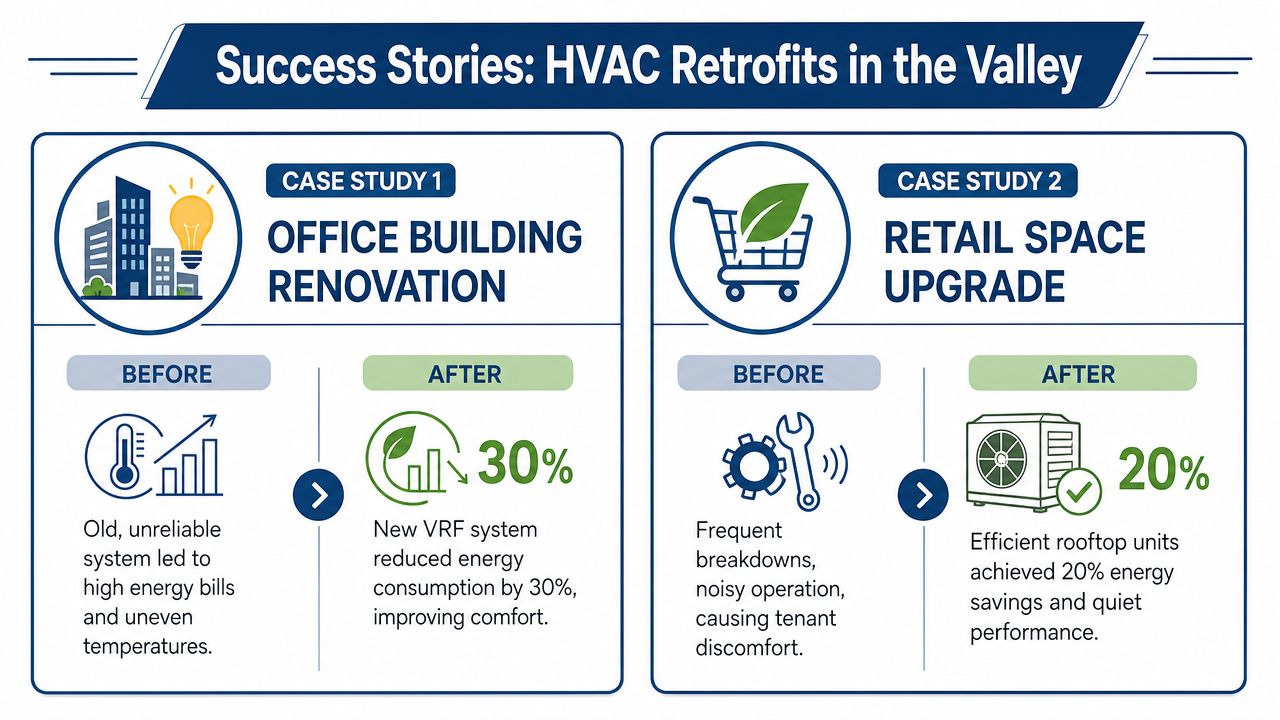
Office property with comfort complaints
This kind of project is common. The equipment isn't always the only problem. Sometimes the building has outgrown the assumptions behind the old design.
Retail space with failing rooftop equipment
Retail owners usually care about two things right away. Will customers feel comfortable, and will the system stop interrupting business?
For older rooftop-driven properties that have reached the point where selective retrofit no longer makes sense, commercial AC replacement options in Mesa may be the more direct path.
What these examples have in common
Both scenarios point to the same lesson. The best retrofit plan doesn't start with a product catalog. It starts with how the building fails in daily operation.
A useful evaluation usually asks:
- Where does discomfort show up first: Perimeter zones, open office cores, front-of-house retail, or back rooms?
- What keeps breaking: Controls, motors, compressors, drainage, or airflow-related components?
- What business problem matters most: Utility spend, customer comfort, tenant retention, or downtime?
When those answers are clear, the retrofit path gets clearer too.
Protecting Your Investment with Proper Maintenance
A retrofit only delivers long-term value if the system is commissioned correctly and maintained with discipline afterward.
Commissioning is the verification step. It confirms that controls respond properly, airflow matches design intent, sensors are reading accurately, and the equipment performs the way the project called for. Without that step, even a well-designed retrofit can drift into mediocre performance right after startup.
Maintenance keeps that from happening. Filters need to be changed on schedule. Coils need cleaning, especially in dusty Phoenix conditions. Refrigerant charge, electrical components, drain systems, fan performance, and control sequences need periodic review. If those basics slip, efficiency and comfort usually slip with them.
What a good maintenance plan should include
- Scheduled filter and coil service to protect airflow and heat transfer
- Control verification so setbacks, zoning, and sensor logic don't drift
- Mechanical inspection for belts, motors, bearings, drains, and electrical connections
- Performance review to catch comfort problems before occupants start complaining
Facility teams that want a broader operations perspective may also find these insights for facility managers on HVAC useful alongside their in-house maintenance planning.
The point is simple. If you spend capital improving the system, protect that investment with a maintenance standard that matches the building's workload and Arizona's climate.
If you're weighing a retrofit against ongoing repair costs, tenant complaints, and Phoenix heat stress, Comfort Experts can help you evaluate the viable options for your property. To talk through your building with a local team, call 480-207-1239 or schedule service.