Figuring out what size air conditioner do i need can feel like a high-stakes guessing game, but it’s one of the most critical decisions you'll make for your home's comfort and your wallet. It's a bit like buying a new pair of shoes—too small and they're painful, too big and you're tripping all over the place. A properly sized AC keeps your home perfectly cool without wasting a dime on electricity, which is a big deal during a brutal Phoenix summer.
Your Quick Guide To Choosing The Right AC Size
Let's cut right to it. Finding the right AC size is all about matching your home’s unique cooling needs with the right piece of equipment. When we talk about an air conditioner's "size," we aren't talking about its physical footprint. We're talking about its cooling power, which is measured in British Thermal Units (BTUs).
A common starting point that gets you in the right ballpark is the 20 BTU per square foot rule of thumb. It's a quick and easy way to get a rough estimate. Just take your home's total square footage and multiply it by 20.
A Quick Sizing Reference
For example, a 1,500 square foot home would need roughly 30,000 BTUs (1,500 sq ft x 20 BTU). While this is a great first step, remember that factors unique to living in Arizona—like that intense sun beating down on your roof and those tall vaulted ceilings—will definitely adjust this number. For those in smaller spaces, choosing the right air conditioners for apartments involves its own specific set of considerations that differ from a single-family home.
To make things easier, here's a simple table to give you a general idea based on that basic rule.
Key Takeaway: Using a simple square footage calculation is a great way to start the conversation, but it doesn't tell the whole story. It leaves out critical factors that have a huge impact on your home's real cooling needs, especially here in our climate.
AC Sizing Rule Of Thumb Based On Square Footage
This responsive table offers a general estimate of the AC size needed based on your home's square footage. Note these are starting points and do not replace a professional load calculation.
| Area To Cool (Square Feet) | Estimated BTUs Needed | Common AC Size (Tons) |
|---|---|---|
| 1,000 – 1,200 | 24,000 BTUs | 2.0 Tons |
| 1,200 – 1,500 | 30,000 BTUs | 2.5 Tons |
| 1,500 – 1,800 | 36,000 BTUs | 3.0 Tons |
| 1,800 – 2,100 | 42,000 BTUs | 3.5 Tons |
| 2,100 – 2,400 | 48,000 BTUs | 4.0 Tons |
| 2,400 – 3,000 | 60,000 BTUs | 5.0 Tons |
The First Step Toward True Comfort
While this table is a helpful reference, think of it as the foundation, not the final blueprint. The truth is, things like how much insulation is in your attic, the quality of your windows, and even your ceiling height play a massive role. In the next sections, we'll dive deeper into what these numbers really mean and walk through all the variables that guarantee your home gets the perfectly sized system it deserves.
Decoding The Language Of Cooling: BTUs And Tons
When you start shopping for a new air conditioner, you’ll immediately run into terms like “BTUs” and “tons.” It can honestly sound like a foreign language, but getting a handle on these two terms is the key to figuring out the right size AC for your home.
Let’s clear one thing up right away: a "ton" of air conditioning has nothing to do with weight. It’s actually a throwback term from the days before modern refrigeration when giant blocks of ice were used for cooling.
The term stuck. A "ton" of cooling power refers to the amount of heat it takes to melt a one-ton block of ice over a 24-hour period. Today, we just translate that old-school measurement into a more precise, scientific unit.
What Is A BTU?
A British Thermal Unit (BTU) is the modern standard for measuring heat energy. The easiest way to think of it is like calories for your house. Everything from the sun beating on your roof to the oven running in your kitchen adds "heat calories" that your AC has to burn off.
Every air conditioner has a BTU rating that tells you exactly how much heat it can remove from your home in one hour. More BTUs means more cooling power. Simple as that.
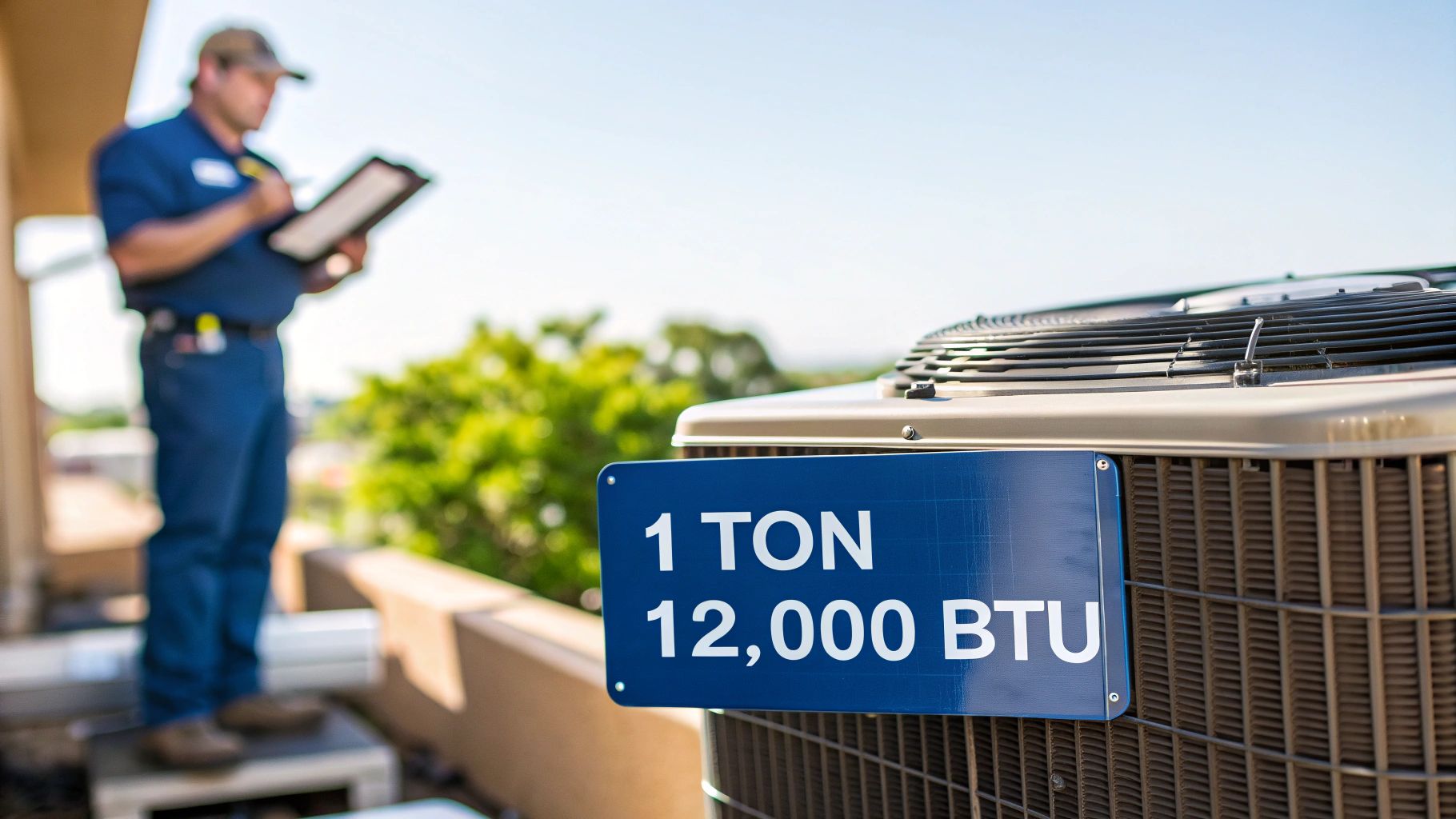
The Key Relationship: One ton of AC capacity is equal to removing 12,000 BTUs of heat per hour. This is the single most important conversion to remember when you're looking at different units.
So, if you see a 3-ton AC unit, you know it has the muscle to remove 36,000 BTUs of heat every hour (3 tons x 12,000 BTUs). A big 5-ton unit? That’s 60,000 BTUs per hour. This is how we match a system’s raw power to what a specific home actually needs.
Matching Tons To Your Home
The goal is to find a system with just the right amount of BTUs to win the daily battle against the heat your home absorbs. It’s a delicate balance.
Here’s how the tonnage usually breaks down for residential systems:
- 2 Ton Unit: 24,000 BTUs/hour
- 3 Ton Unit: 36,000 BTUs/hour
- 4 Ton Unit: 48,000 BTUs/hour
- 5 Ton Unit: 60,000 BTUs/hour
While this explains what the terms mean, remember that the cooling capacity you need is completely unique to your home. You're not just buying a machine; you're investing in the precise amount of cooling power required to keep your family comfortable during the absolute worst of a Phoenix summer.
This cooling power (BTUs/tonnage) works hand-in-hand with the system's efficiency. You can learn more about how that’s measured in our guide on what a SEER rating is. But before we dive into efficiency, we need to understand all the other factors that determine the right cooling capacity for your home.
Why Square Footage Is Only Part Of The Story
You know what? Plugging your home’s square footage into an online calculator is a fantastic start. But it’s only the first chapter of the story, especially when you’re trying to cool a home in the Phoenix Valley. Relying on square footage alone is like trying to guess the weather by only looking at the calendar—you’re missing all the details that actually matter.
A simple calculator can’t see the real-world factors that dictate how much cooling power your home truly needs. Let's dig into what those formulas miss and why a one-size-fits-all approach is a recipe for an uncomfortable, inefficient home in our unique climate.
Beyond The Floor Plan: Ceiling Height
First, let's think vertically. Most sizing rules of thumb are based on a standard eight-foot ceiling. But here in Arizona, beautiful vaulted and high ceilings are common.
A 15×20 foot room with an eight-foot ceiling has 2,400 cubic feet of air to cool down. Take that exact same room but give it a twelve-foot ceiling, and suddenly you’re dealing with 3,600 cubic feet—that's 50% more air your AC has to chill.
That extra volume, the cubic footage, adds a massive cooling load that a square footage number completely ignores. Your AC doesn't just cool the floor; it has to cool every last cubic foot of air.
Windows: The Good, The Bad, And The Ugly
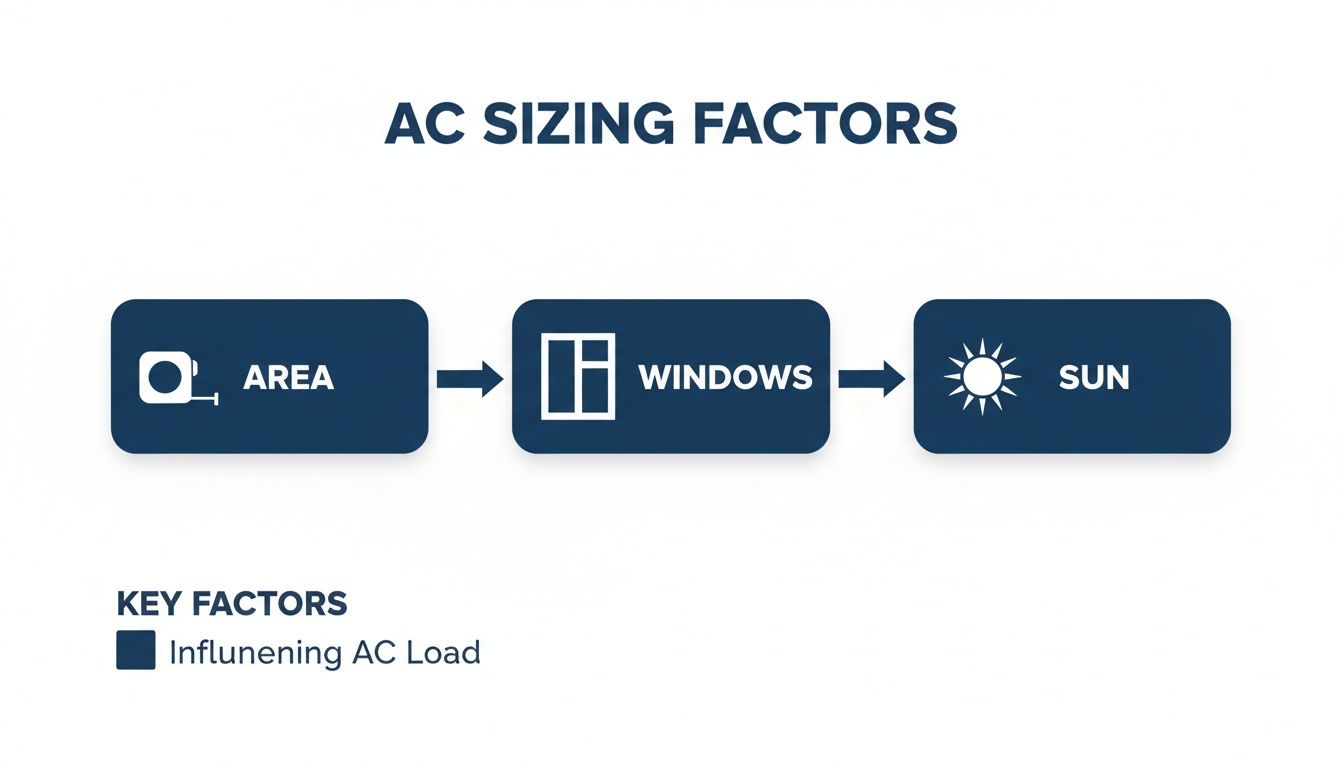
Windows are one of the biggest players in your home's "heat gain," which is just a technical way of saying "how much heat gets inside." The number of windows you have, their size, their quality, and which way they face can radically change your cooling needs.
Picture a living room with a huge, old, single-pane window facing west. On a Phoenix afternoon, that window basically turns into a giant space heater, pouring thermal energy into your home and making your AC work overtime. A nearly identical home with modern, double-pane, low-E windows will block a huge portion of that solar heat.
When professionals do a real load calculation, they go way beyond just counting windows. They look at efficiency metrics like U-Factor and R-Value, which scientifically measure how well a window resists heat transfer. It’s a much more accurate picture.
Insulation: Your Home's Thermal Shield
Insulation is your home's main line of defense against our punishing summer heat. Think of it as a thermal barrier, slowing down the heat trying to bake its way in from your scorching attic and sun-beaten walls.
The amount and quality of insulation you have can make a night-and-day difference. A home with thin, old insulation is in a constant, losing battle against heat infiltration, forcing the AC to run nonstop. A well-insulated home, on the other hand, holds onto its cool air, giving the system a much-needed break.
Expert Insight: An R-value measures thermal resistance—the higher the R-value, the better the insulation is at its job. Here in Arizona, we often recommend attic insulation between R-38 to R-60 to effectively fight back against our extreme temperatures.
The Power Of The Sun And Your Home's Orientation
Which way your home faces has a massive impact on how hard your AC has to work. It’s not just about the sun being "out," it's about where it hits and when.
- West-Facing Walls: These get absolutely hammered by the low-angle afternoon sun, which is the hottest part of the day. This can dramatically heat up any rooms with west-facing windows.
- South-Facing Walls: These get intense sun for much of the day, though the high summer sun is less direct than the western exposure.
- East-Facing Walls: These catch the morning sun, heating up the house early.
- North-Facing Walls: These get the least direct sunlight, making these parts of a home naturally cooler.
A home with a ton of west-facing glass will need a more powerful AC than the exact same house shaded by big trees or neighboring buildings. It’s that simple.
The Hidden Heat Sources Inside Your Home
It’s not just the sun we have to worry about. Your AC also has to fight all the heat being generated inside your house. The number of people who live there, your lights, and your appliances all add to the cooling load.
Think about these internal heat sources:
- Occupants: Every person in your home gives off body heat, roughly equal to a 100-watt light bulb. A family of five adds a lot more heat to a room than a single person.
- Appliances: Ovens, stovetops, dishwashers, clothes dryers, and even big-screen TVs and gaming computers release a surprising amount of heat.
- Lighting: Old-school incandescent bulbs were notorious for producing heat. Modern LEDs are way better, but a house full of lights still contributes to the internal heat gain.
All these little things add up. Getting this sizing equation right is why the HVAC industry is so critical. The global air conditioning market is projected to grow from USD 146.27 billion in 2025 to USD 285.73 billion by 2035, largely because rising temperatures and energy costs make efficiency more important than ever. In fact, an improperly sized system can waste 10-30% more energy—a statistic that really shows why getting it right from the start matters to your wallet.
Finally, we can't forget about your ductwork. Leaky or poorly insulated ducts can lose a huge amount of cool air into your attic before it ever reaches the rooms you live in. This forces your AC to run much longer to make up the difference. Our team can show you the importance of duct repair and replacement in achieving true whole-system efficiency.
The Dangers Of Oversizing And Undersizing Your AC
When it comes to your air conditioner, bigger isn’t always better, and “close enough” can be a recipe for disaster. Choosing the wrong size AC isn’t a small mistake. It’s a decision that can lead to years of discomfort, sky-high energy bills, and premature system failure.
Both oversizing and undersizing create huge problems that completely undermine the reason you have an AC in the first place.
The Problem With An Undersized AC Unit
An undersized air conditioner is like asking a small sedan to tow a giant boat—it’s just not built for the job. On a scorching Phoenix afternoon, this unit will run constantly, desperately trying to reach the temperature you set on the thermostat but never quite getting there.
This nonstop operation leads to a whole cascade of issues:
- Extreme Energy Bills: Because the system never shuts off, your energy consumption goes straight through the roof. It’s one of the fastest ways to get a shocking utility bill during the summer.
- Premature Failure: Constant use puts immense strain on critical components like the compressor and fan motors. This excessive wear and tear can lead to frequent breakdowns and shorten the lifespan of your entire system.
- You're Never Actually Comfortable: Most importantly, you’ll never feel truly cool. Your home will stay warm and stuffy, especially during the peak heat of the day, defeating the whole purpose of your investment.
The Surprising Risks Of An Oversized AC Unit
This is where things get counterintuitive. You might think an oversized unit would be a safe bet, providing extra cooling power "just in case." In reality, it’s just as damaging as an undersized one, if not more so. The primary issue with an oversized system is a nasty phenomenon called short-cycling.
Here’s the thing: the unit is so powerful that it blasts your home with cold air, quickly satisfying the thermostat and shutting down. Then, moments later, the temperature rises, and it kicks back on. This aggressive on-off-on-off cycle happens over and over.
Key Insight: An air conditioner needs to run for a sustained period to effectively pull humidity out of the air. Short-cycling prevents this crucial dehumidification process from ever getting done.
This leaves you with a home that feels cold but also unpleasantly damp and clammy—a classic complaint during Arizona's monsoon season. That lingering moisture can even contribute to mold and mildew growth. On top of that, the constant starting and stopping puts incredible stress on the compressor, which can lead to an early and very expensive system failure. If you're looking for ways to keep costs down without compromising comfort, check out our guide on how to reduce cooling costs during an Arizona summer.
The global demand for air conditioners is skyrocketing as heat seasons lengthen, with the market expected to reach USD 211.90 billion by 2032. However, industry audits show that up to 40% of homes in the U.S. have incorrectly sized systems. In a place like Mesa, where temperatures can hit 113°F, a unit undersized by just one ton can increase energy bills by 25% and leave indoor humidity at an uncomfortable 60%. You can learn more about these market trends and their impact on homeowners.
How Professionals Guarantee The Perfect AC Size
Let me explain: while online calculators and those old rules of thumb can give you a rough idea, they’re just not precise enough for a decision this important. Guessing on your AC size is a recipe for high energy bills and premature system failure.
The only way to know exactly what size air conditioner your home needs is with an industry-standard method called a Manual J load calculation. Think of it less as a simple formula and more as a complete energy audit of your home.
Developed by the Air Conditioning Contractors of America (ACCA), the Manual J is a deep dive into every single thing that makes your house gain or lose heat. It’s the detailed blueprint of your home’s unique thermal personality. A certified technician doesn't just peek at your floor plan; they're in there measuring rooms, checking the R-value of your insulation, and identifying the type and efficiency of every window.
The Science Behind Perfect Sizing
This analysis goes so much deeper than the basics. A proper Manual J calculation accounts for all the little details that those quick online tools completely ignore.
- Air Infiltration: It calculates how much hot outside air is leaking into your home through tiny, unseen cracks and gaps.
- Building Materials: It considers your home’s construction—stucco, brick, or wood siding—because each material absorbs and radiates heat differently.
- Internal Heat Gain: The calculation even factors in the heat generated by the people, lights, and appliances inside your home.
- Ductwork Condition: The length, insulation, and potential leaks in your duct system play a huge role, and Manual J accounts for that, too.
The result isn’t just an estimate. It’s a precise, scientific calculation of your home's total cooling load, measured in BTUs. This is the definitive number we use to select an AC unit that is perfectly matched to your home's specific needs.
The Professional Promise: A Manual J calculation takes all the guesswork out of the equation. It ensures your new system is never overworked or underutilized, giving you the gold standard in efficiency, comfort, and long-term reliability.
Why It Matters So Much In Mesa
Here in Arizona, where Mesa homeowners are up against triple-digit heat for months, getting the size right is everything. An undersized unit will run constantly just to keep up, potentially jacking up your energy bills by 30% while wearing out the compressor years ahead of its time.
At Comfort Experts, we’ve seen the consequences of bad sizing firsthand since 2011. It’s why we rely exclusively on Manual J—it forces us to consider your home's insulation, windows, and ceiling height, not just the square footage.
This isn't just a local problem. With the U.S. air conditioner market hitting 14.3 million units in 2021, studies show that poor sizing is a leading cause of the 20-40% of AC systems that fail prematurely. You can discover more insights about these market trends to see just how widespread the issue is.
Ultimately, investing in a professional load calculation is the most critical first step you can take. To see how we put this into practice, you can learn more about our AC replacement and installation services in Mesa, AZ. It’s the only way to ensure your investment pays off with years of reliable, cost-effective cooling, even when the Arizona sun is at its worst.
Ready for an AC Sizing Estimate You Can Trust?
You've done the homework and now you know just how much goes into correctly sizing an air conditioner. The next step is getting a real, no-pressure assessment for your home so you can stop wondering, "what size air conditioner do I need?" and start getting clear answers.
Here at Comfort Experts, we've been helping families across the Phoenix Valley stay cool since 2011. Our whole approach is built on honest diagnostics and solutions that actually fit your home and budget. We run professional Manual J load calculations to nail down the exact cooling your home needs, ensuring the system we recommend is a perfect match for years to come.
Getting this first step right is the foundation of any smart AC investment. If you're wondering how to find a reliable partner for this job, our guide on how to choose the right HVAC company is a great place to start.
Don't guess on your home's comfort. A professional assessment is the only way to be sure you're investing in a system that's perfectly matched to your home—delivering peak efficiency and heading off expensive future repairs. To get the ball rolling and make sure you're ready for the next heatwave, give our team a call at 480-207-1239 or schedule service and get your free, no-hassle estimate online.