

A bedroom on the west side of a Mesa home can feel comfortable in the morning and noticeably hotter by late afternoon. The thermostat may show the target temperature, while that one room still feels stale, warm, and difficult to sleep in. The reason is usually traceable to heat gain, airflow, return-air pressure, or the way the home's HVAC system was designed.
Why One Room Is Hotter Than the Rest of the House in Mesa
A single hot room often appears during the most demanding part of an Arizona summer day. Sunlight enters through a west-facing window, the attic above the room absorbs intense heat, and the air-conditioning system sends cool air through ducts that may run across a dusty, unconditioned attic. In an older East Valley home, several of those conditions can affect the same room at once.
The useful question is not just whether the AC is running. It's whether the hot room is receiving enough supply air and providing enough return-air flow for the system to work properly. That distinction helps separate a blocked register or dirty filter from a crushed branch duct, inadequate return path, insulation problem, or equipment limitation.
A room-specific comfort problem also doesn't automatically mean the entire air conditioner has failed. If most rooms cool normally, the problem may be isolated to one duct branch, one return-air path, or one part of the building envelope. Equipment issues still matter, especially when a system is aging, poorly sized, or struggling during extreme Phoenix-area heat, but a whole-system replacement shouldn't be the first guess.
Mesa conditions make small weaknesses obvious
Desert homes face several pressures that expose uneven cooling:
- Strong afternoon sun can overwhelm a room with large south- or west-facing glass.
- Hot attic spaces transfer heat through ceilings and warm ducts before conditioned air reaches distant registers.
- Dust and monsoon debris can load filters and restrict airflow.
- Older duct layouts may include long runs, undersized branches, loose connections, or flex duct compressed by storage.
- Single-zone controls can satisfy a thermostat in a cooler hallway while a distant room remains uncomfortable.
Some checks are safe for a homeowner, including inspecting filters, clearing registers, adjusting shades, and comparing temperatures. Attic duct inspections, pressure measurements, airflow balancing, refrigerant work, electrical testing, and equipment sizing require professional tools and training.
The goal is to identify the cause before choosing the fix. A fan or closed vent may change how a room feels temporarily, but neither addresses a leaking duct or missing return path.
The Main Causes of Uneven Cooling in Arizona Homes
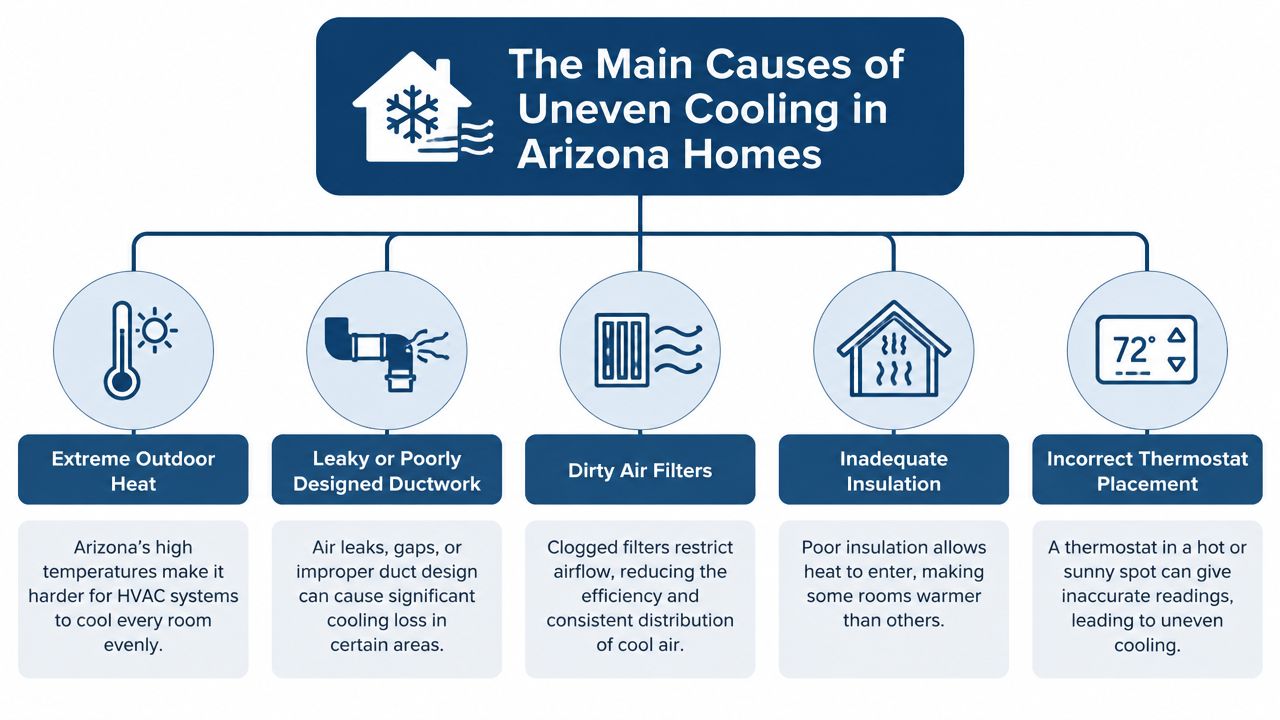
A hot room usually points to a distribution or heat-load problem, not an automatic failure of the entire air conditioner. Four connected causes appear repeatedly in Mesa homes: solar gain, duct problems, restricted return air, and equipment or sizing limits.
Solar heat gain and the building envelope
A room with large windows or strong western exposure may carry a much larger cooling load than the rest of the house. Windows account for about 25%–30% of residential heat gain, and one west-facing window can add thousands of BTUs during a sunny afternoon, as summarized by Arizona-focused HVAC guidance on solar heat gain.
That pattern is common in Mesa. The room feels comfortable earlier in the day, then falls behind as the afternoon sun reaches the glass. Curtains, exterior shades, window film, weak weatherstripping, and thin insulation all affect whether the AC can keep up.
The envelope continues storing heat after outdoor conditions peak. Research summarized in the same source found that a 1°C increase in average outdoor temperature over the preceding 24 hours was associated with about a 0.36°C increase in indoor summer temperatures in temperate-climate studies. Results vary by house, but poorly insulated ceilings and air leaks make Arizona heat easier to carry indoors.
Duct leakage and poor distribution
Ducts must deliver enough conditioned air to each room. Field surveys and industry summaries report average leakage of about 10% of supply air and 12% of return air, while some residential sources cite 20%–30% total conditioned-air loss before air reaches the room, according to this explanation of duct-related hot rooms.
In older East Valley homes, a branch may be undersized, disconnected at the register boot, crushed beneath attic storage, or leaking into an attic or wall cavity. The register can still blow air while the room receives much less cooling than the system appears to provide. Long runs through a hot attic make that shortfall more noticeable.
A dusty filter can reduce airflow across the whole system. The room at the end of a long branch often suffers first because nearby rooms provide easier paths for the available air.
Return-air limitations
A bedroom with a closed door and no return path can become pressurized. Supply air enters, but air cannot leave efficiently, weakening circulation even when the register feels active. Opening the door briefly can help distinguish this condition from a weak supply branch before a technician arrives.
Equipment and sizing issues
An aging or incorrectly sized AC may cool rooms near the air handler while the highest-load room falls behind. Rooftop and packaged units are common in the region, and older homes may still have ductwork designed for a different floor plan, insulation level, or room use.
Professional testing can show whether the blower, filter, ducts, and registers are working within a reasonable airflow range. The AC static pressure testing benefits include identifying restrictions that a homeowner cannot confirm by touch alone.
How to Diagnose a Hot Room Before Calling a Technician
A few observations can reveal more than repeatedly lowering the thermostat. The most useful test compares the hot room with a nearby room that feels comfortable under the same cooling call.
Start with airflow and temperature
Check that the hot room's supply register is fully open and isn't covered by furniture, rugs, curtains, or bedding. Hold a tissue near the register and compare the movement with a register in a comfortable room. This isn't a calibrated airflow test, but a clear difference is useful evidence.
Use a thermometer to compare the temperature at the hot-room register with the temperature at a comparable register elsewhere. A supply temperature difference of more than 5–7°F, or 2.8–3.9°C, suggests meaningful airflow imbalance or leakage, according to duct-leak diagnostic guidance. The same source notes that branch-duct leakage can be confirmed when pressure-pan readings exceed 3 Pa, or 0.012 inches water column.
Use the door-open test
Close the hot room's door for a period while the AC runs, then open it and observe whether the room improves noticeably.
- The room improves with the door open: inadequate return-air flow is more likely. The open doorway provides an easier path for air to move back toward the central return.
- The room changes very little: supply-air weakness, duct leakage, solar load, insulation, or equipment capacity becomes more likely.
- The room worsens only during afternoon sun: window exposure or attic heat deserves priority.
- The room has weak airflow at all times: a register restriction or duct problem deserves attention.
A temperature difference of more than 3–4°F between rooms is commonly treated as evidence of a real imbalance, as discussed in this guide to hot rooms and return-air testing. The test isn't a substitute for pressure or airflow instruments, but it gives a technician a useful starting point.
For a structured visit, homeowners can review what happens during AC trouble diagnosis in Mesa homes. The important result is not a generic recommendation to “balance the system.” It's knowing whether the room lacks supply air, return air, or protection from outside heat.
Quick Homeowner Fixes That Can Help Immediately
Start with the simple actions that remove obvious restrictions. A filter should be clean enough to allow normal airflow, and every supply register in the hot room should be open and clear. A return grille also needs open space around it, since furniture, curtains, and dust can limit the air path.
Window control is particularly valuable in Mesa. Close blinds or curtains before the afternoon sun reaches the glass, and consider exterior shading where practical. Interior shades help, but exterior shading can stop more solar energy before it reaches the window.
A ceiling fan can improve perceived comfort by mixing stagnant air. It doesn't lower the room's actual heat load, and it can't replace missing supply air, but it can reduce the sensation of heat near occupants while the underlying issue is being evaluated.
Avoid the most common balancing mistake
Closing vents in comfortable rooms seems logical because it appears to redirect cool air toward the hot room. In practice, that can increase static pressure and reduce overall system performance, particularly when the system already has restricted filters, undersized ducts, or limited return capacity. A partially closed register also doesn't repair a leaking branch duct.
Keep interior doors open enough to support circulation when privacy and household routines allow. If the room cools better with the door open, the result supports a return-air diagnosis rather than proving that the AC needs more refrigerant.
Homeowners can also use the Comfort Experts thermostat reset when the thermostat appears unresponsive or has a control issue. Resetting controls won't correct a duct leak, solar heat gain, or inadequate return path, so the temperature test should be repeated afterward.
Know when DIY has reached its limit
A filter change, shade adjustment, and register inspection are reasonable homeowner tasks. Climbing into a hot attic to move insulation, reconnect flex duct, alter dampers, or inspect electrical components is a different matter. Attics can contain unsafe surfaces, extreme heat, and equipment hazards, and duct repairs that are sealed poorly may fail again.
If these basic changes don't reduce the room-to-room difference, the next useful step is measurement rather than another adjustment.
When to Call a Pro and What Solutions Actually Last
Call a professional when the hot room stays uncomfortable after basic airflow restrictions are removed, or when its temperature changes sharply compared with the rest of the house. Weak airflow, repeated short cycling, damaged attic ductwork, and a system that struggles to cool the entire home all justify a diagnostic visit. A technician can measure supply and return airflow, static pressure, temperature difference, and duct condition instead of guessing from the thermostat reading.
Older East Valley homes deserve close attention to duct layout and sealing. Long runs, poorly supported flex duct, crushed sections, and disconnected attic branches can leave the farthest room with less conditioned air. Mesa's hot attic temperatures make those losses more noticeable, while dusty filters and west-facing windows add load that a marginal duct system may not handle.
The right repair depends on the evidence:
| Solution | Best for | Typical limitation |
|---|---|---|
| Duct sealing and repair | Leaking, disconnected, crushed, or poorly connected branches | It will not remove a major window heat load or give a room its own zone |
| Zoning and control upgrades | Homes with different loads between floors, sides, or frequently used rooms | Existing ductwork must support proper damper control and airflow |
| Ductless mini-split | A bonus room, addition, office, or isolated space that never cools with the central system | It adds an indoor unit and requires appropriate installation planning |
| Insulation and envelope work | Rooms under hot attics or beside poorly protected exterior surfaces | HVAC changes alone will not stop heat entering through ceilings or windows |
| Repair or equipment replacement | Mechanical faults, aging equipment, or capacity and design limitations | Replacement should follow performance and sizing evaluation, not room temperature alone |
Match the fix to the evidence
A strong supply register combined with improvement when the door opens points toward a return-air problem. If the register remains weak with the door open, investigate duct delivery, leakage, or balancing. A room that becomes hottest after western sun reaches it may need shade or envelope improvements before adding HVAC capacity.
The AC repair vs replacement choice depends on whether the equipment fault is isolated and repairable or part of a wider capacity and distribution problem. Replacement may fit a system that no longer matches the property, but a new unit will not repair a disconnected branch duct or create a missing return path.
Comfort Experts can evaluate duct distribution, cooling equipment, thermostats, zoning, and ductless options as separate solutions. That keeps the recommendation tied to measured room conditions rather than treating every hot room as a reason to replace the entire system.
What to Do Next for Lasting Room Comfort
The answer to why one room is hotter than the rest of the house usually comes from a combination of heat gain, supply-air delivery, return-air movement, and system design. Mesa's intense sun, hot attic spaces, dust, monsoon conditions, and older duct layouts can turn a small weakness into a daily comfort problem.
Use a simple decision path:
- Check the filter, registers, return grilles, window shades, and thermostat location.
- Compare the hot room with a comfortable room.
- Run the door-open test.
- Note whether the problem follows afternoon sun, closed-door use, weak airflow, or the entire cooling cycle.
- If the imbalance persists, request professional airflow and equipment testing.
If duct leakage is confirmed, duct sealing may improve delivery. If the room has a different heat load, zoning, insulation work, window shading, or a ductless system may make more sense than forcing more air through the existing layout.
Contact Comfort Experts at 480-207-1239 for help separating an AC repair issue from a duct, return-air, or room-specific comfort problem. Homeowners can also schedule service for a Mesa-area evaluation based on the symptoms and measurements gathered at home.
Comfort Experts can diagnose uneven cooling, inspect air distribution, repair AC equipment, and discuss duct sealing, zoning, or ductless mini-split options when one room won't keep up. Visit Comfort Experts to choose the next practical step for a cooler, more balanced Arizona home.