Ever wonder how one machine can handle both a scorching Phoenix summer and a chilly winter night? It sounds a little like magic, but the answer for many homeowners is a single, incredibly efficient system. So, how does a heat pump work to provide that year-round comfort?
Your All-in-One Solution for Arizona Comfort
Think about your kitchen refrigerator for a second. It works by pulling heat out of the insulated box to keep your food cold, then releasing that heat into your kitchen through the coils on the back. A heat pump runs on that exact same principle, just on a much bigger scale for your whole home. It’s essentially a two-way air conditioner.
During our brutal Arizona summers, it acts just like a standard AC. The system pulls heat from your indoor air and pumps it outside, leaving your home cool and comfortable. But here’s the clever part: when winter rolls around, the whole process flips. The system finds and absorbs ambient heat from the outdoor air—yes, even when it feels cold to us—and moves it inside to warm your home.
From Summer Cooling to Winter Warmth
This dual-function design makes a heat pump a perfect match for the Phoenix Valley climate. We don't get the deep, prolonged freezes common in other parts of the country, which means there’s almost always enough heat in the outside air for the unit to grab and use efficiently. Since 2011, our team at Comfort Experts has specialized in this technology, helping local homeowners get reliable, year-round comfort from one energy-saving machine. We've seen firsthand how this technology transforms a home's energy profile, which is a core part of our mission.
Let me explain. Imagine walking into your Mesa home on a chilly winter evening and feeling instant warmth, but without the familiar roar of a gas furnace kicking on. That's a heat pump in action. Because it moves existing heat instead of creating it, it uses significantly less electricity than old-school electric resistance heaters. This all-in-one approach can even be paired with renewable energy, which you can learn more about in guides to solar-powered HVAC systems.
A heat pump's genius is its simplicity: it doesn't waste energy creating new heat, it just relocates it. This makes it one of the most efficient ways to both cool and heat your home.
This incredible efficiency is why so many homeowners are making the switch. If you're curious about what a new system involves, you can get a better feel from our guide on heat pump installation in Mesa, AZ.
Heat Pump Functions: Heating vs. Cooling
To make this even clearer, here’s a responsive table breaking down what your heat pump is doing in each season. This gives you a quick snapshot of how a heat pump shifts its job from winter to summer.
| Function | Heating Mode (Winter) | Cooling Mode (Summer) |
|---|---|---|
| Heat Source | Absorbs heat from the outdoor air. | Absorbs heat from your indoor air. |
| Heat Destination | Releases the collected heat inside your home. | Releases the collected heat outside your home. |
| Primary Goal | To efficiently warm your living spaces. | To effectively cool your living spaces. |
It’s a simple concept with a powerful impact on both your comfort and your energy bills. By just reversing its cycle, a heat pump gives you exactly what you need, no matter the season.
The Science Behind the Magic: The Refrigeration Cycle
At the heart of every heat pump is a continuous, elegant process that might sound complicated but is actually the same basic trick your refrigerator uses to keep food cold: the vapor-compression refrigeration cycle. It’s the engine that powers your home’s comfort, moving heat from where you don’t want it to where you do.
Think of the special fluid inside your heat pump, called refrigerant, as a dedicated "heat sponge." Its entire job is to soak up heat in one place and then get wrung out to release it somewhere else. This whole process hinges on four key components working together in perfect harmony.
The Four Key Players in the Cycle
To really get how a heat pump works, you need to know what each part does. Imagine them as a team on an assembly line, passing that "heat sponge" along to get the job done.
- Evaporator: This is where the magic starts. The refrigerant enters the evaporator coil as a cold, low-pressure liquid. As air from your home (or the outside) blows across the coil, the refrigerant absorbs its heat and boils into a gas—just like water turning to steam.
- Compressor: This is the muscle of the operation. The compressor takes that low-pressure gas and squeezes it hard, jacking up its pressure and temperature. Now you've got a super-hot, high-pressure gas ready to do some work.
- Condenser: The hot gas moves into the condenser coil. Here, as air blows across it, the refrigerant dumps all that heat it was carrying, cools down, and condenses back into a high-pressure liquid.
- Expansion Valve: Finally, that high-pressure liquid zips through the expansion valve, which acts like a tiny nozzle. This instantly drops its pressure and temperature, getting it cold and ready to head back to the evaporator to grab more heat and start the cycle all over again.
The real secret is how the refrigerant changes from a liquid to a gas and back again. This transformation allows it to absorb and release a massive amount of heat with surprising efficiency, all powered by the compressor.
This diagram shows you exactly how the process flows, whether the system is in heating or cooling mode.
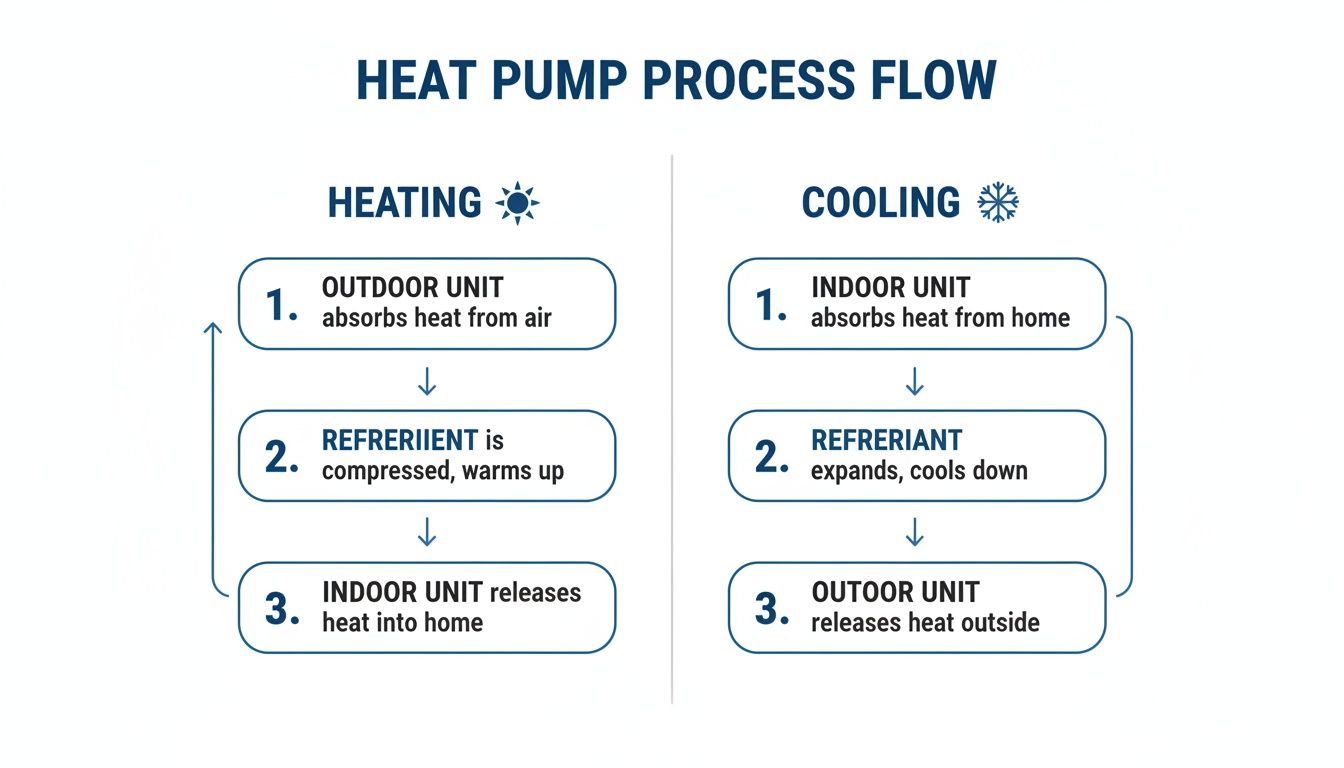
As you can see, the core components never change—the system just cleverly reverses the refrigerant's direction to either heat or cool your home.
The Reversing Valve: The System's Traffic Cop
So, how does the same machine go from cooling your house during a blistering Phoenix summer to warming it up on a chilly winter morning? The secret weapon is a small but brilliant device called the reversing valve.
Think of this valve as a traffic cop for the refrigerant. When you switch your thermostat from "cool" to "heat," the reversing valve simply changes which way the refrigerant is flowing.
- In summer (cooling mode), the valve directs the hot, compressed gas to the outdoor coil to release heat outside. Meanwhile, your indoor coil acts as the evaporator, absorbing heat from your home's air and sending it on its way.
- In winter (heating mode), the valve flips. It sends that hot gas to your indoor coil first, releasing warmth directly into your home. The outdoor coil then becomes the evaporator, pulling ambient heat from the outside air—even when it's cold—to start the cycle again.
This simple reversal is what makes a heat pump such a versatile, all-in-one comfort machine. The refrigerant itself, often known by brand names like Freon, is the key ingredient. If you want to get into the weeds, you can learn more about what Freon is and how it works in our detailed guide. It's this one component that transforms your HVAC system from a simple air conditioner into a year-round workhorse.
Exploring Different Types of Heat Pumps
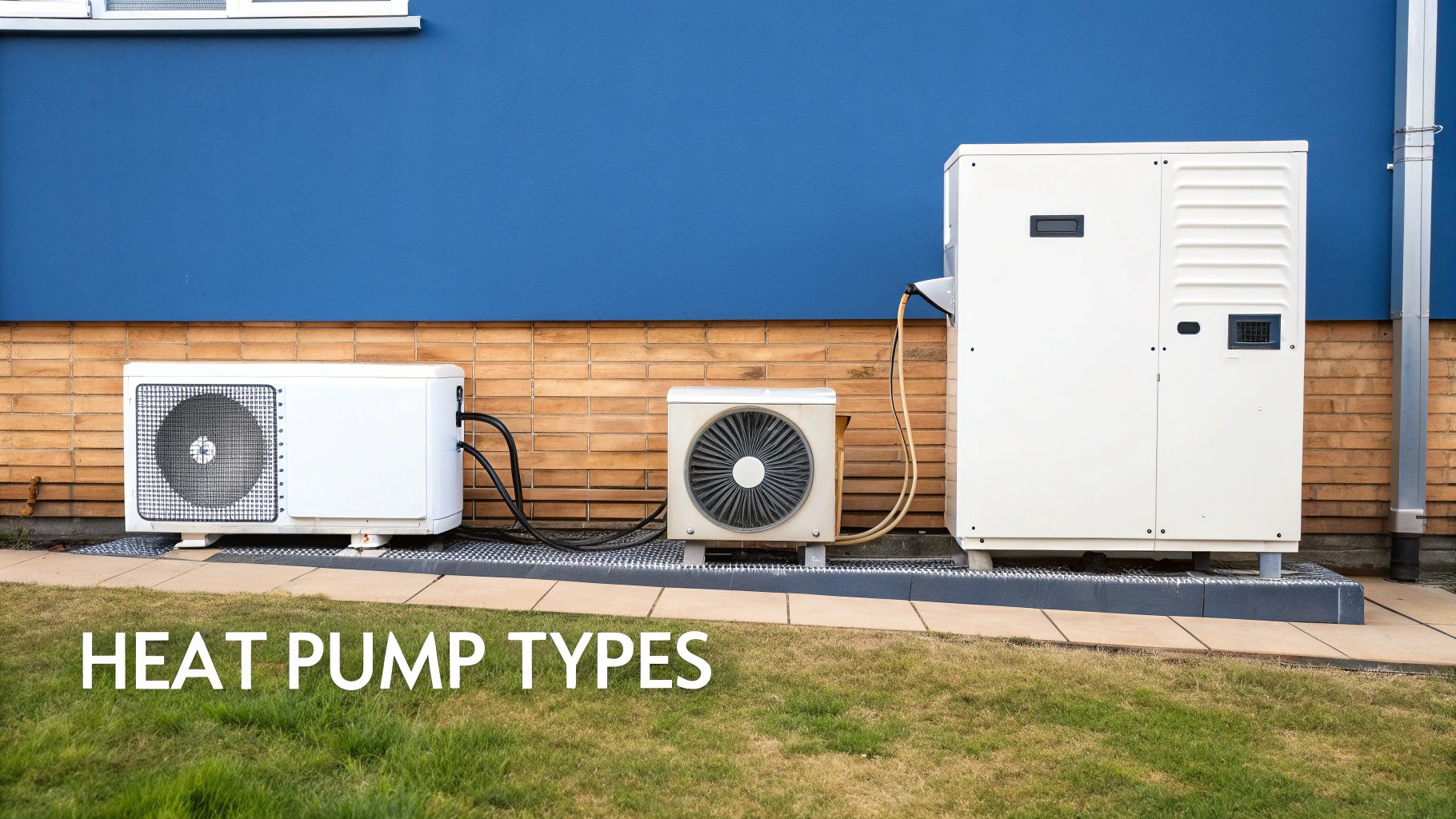
Here’s the thing: "heat pump" isn't a one-size-fits-all term. Are you looking for a whole-home solution or just trying to cool that stubborn back bedroom? Choosing the right type is the single most important decision for getting the comfort and efficiency you're paying for. The technology has come a long way, and today's options are designed to solve very specific problems for Phoenix Valley homeowners.
Let's break down the most common models you'll encounter.
Air-Source Heat Pumps: The Arizona Standard
When most people talk about a heat pump, they’re almost always picturing an air-source heat pump. This is the workhorse of the residential HVAC world and, by far, the most popular choice for homes all across Arizona.
These are "split systems," which just means they have two main parts: an outdoor unit (the compressor/condenser) and an indoor unit (the air handler/evaporator). They connect to your home's existing ductwork to push cool or warm air around, making them a pretty straightforward swap for an old furnace and AC combo. Their popularity comes down to being a versatile and cost-effective solution for our climate. Air-source systems do their magic by pulling heat from the outside air in winter and dumping your home's indoor heat outside in the summer. It sounds a little wild, but modern units are incredibly good at this, easily finding warmth even when nighttime temperatures dip into the 30s—plenty of power for a typical Phoenix winter.
Ductless Mini-Split Heat Pumps
But what if your home doesn’t have ductwork? Or maybe you're building a new sunroom or converting a garage? That's exactly where ductless mini-split heat pumps come in. They work on the same heat-moving principles but deliver conditioned air straight into a specific room or "zone" through a sleek, wall-mounted indoor unit.
You can connect several of these indoor heads to a single outdoor compressor, giving you incredible control over the temperature in different parts of your house. They're a fantastic problem-solver for:
- Older Homes: Perfect for historic properties where trying to install a whole new duct system would be a nightmare.
- Home Additions: An easy way to get heating and cooling into a new space without messing with your main HVAC system.
- Problem Areas: Ideal for those stubbornly hot or cold spots like garages, workshops, or west-facing bonus rooms.
Because they skip the ducts entirely, mini-splits avoid the energy loss that can rob a traditional system of its power—sometimes accounting for up to 30% of energy use. If you want to see how these systems fit into real homes, you can learn more about our ductless AC installation services.
The biggest game-changer in modern HVAC is the rise of variable-speed technology. Instead of just blasting on at full power and then shutting off, these smart systems adjust their output in tiny increments to precisely match your home's needs, maintaining consistent temperatures and maximizing energy efficiency.
Geothermal and Variable-Speed Models
While they’re the undisputed champions of efficiency, geothermal heat pumps are pretty rare in our area. They use the stable, year-round temperature of the earth to transfer heat, which makes them incredibly effective but also much more complex and expensive to install.
For most homeowners in the Valley, the real technological leap is in variable-speed technology. This is the secret sauce behind how modern heat pumps can handle our brutal summers and mild winters so gracefully. It's all thanks to that vapor-compression cycle, now supercharged with inverter-driven compressors found in most new units. This tech is what pushes SEER ratings to 25+ and helps slash peak energy demand by 30-50% during a heatwave. That’s a massive benefit that also happens to align perfectly with rebates from utilities like APS.
Decoding Heat Pump Efficiency Ratings
Honestly, when you start shopping for a new HVAC system, the alphabet soup of acronyms—SEER, HSPF, COP—can feel a little intimidating. You’re not just buying a machine; you’re making a long-term investment in your home’s comfort and your energy bills. Understanding these ratings is the key to knowing exactly what you're getting and how it will perform when that summer SRP bill arrives.
Think of these ratings as the "miles per gallon" sticker on a car. They don't just tell you if a heat pump is good or bad; they tell you how efficiently it uses electricity to do its job. That efficiency translates directly into money saved each month.
SEER for Summer Cooling Performance
The Seasonal Energy Efficiency Ratio (SEER) is the rating you’ll want to pay close attention to for our scorching Phoenix summers. It measures how efficiently a heat pump cools your home over an entire cooling season. It's pretty simple: the higher the SEER rating, the less electricity the unit consumes to keep you cool. For a deeper dive into this specific metric, you can learn more about what a SEER rating is and why it's so crucial for Arizona homes.
HSPF for Winter Heating Efficiency
Next up is the Heating Seasonal Performance Factor (HSPF). This is the flip side of SEER, measuring the unit's heating efficiency over an entire winter. Just like with SEER, a higher HSPF number indicates a more efficient system that requires less energy to keep your home warm and cozy. Our winters might be mild compared to other parts of the country, but an efficient heating system still makes a noticeable difference on your utility bills during those cooler months.
COP: The Real-Time Efficiency Snapshot
Finally, there’s the Coefficient of Performance (COP). Unlike SEER and HSPF, which measure efficiency over a whole season, COP gives you a real-time snapshot of the system's efficiency at a specific outdoor temperature. A COP of 4, for example, means the heat pump is producing four units of heat for every one unit of electricity it consumes.
That’s the magic of how a heat pump works: it’s not creating heat from scratch, it’s multiplying the energy it uses to move existing heat. This metric clearly shows how a heat pump can be 300% to 400% more efficient than traditional electric resistance heating.
Comparing Heat Pump Efficiency Ratings
This responsive table shows the difference between standard and high-efficiency heat pump ratings and what it means for homeowners.
| Rating | What It Measures | Standard Efficiency | High Efficiency |
|---|---|---|---|
| SEER2 | Cooling efficiency over a season | 14.3 (Federal Minimum) | 20+ |
| HSPF2 | Heating efficiency over a season | 7.5 (Federal Minimum) | 9.0+ |
| COP | Instantaneous efficiency | 2.0 – 3.0 | 4.0+ |
As you can see, investing in a high-efficiency model means you’re getting a system that works smarter, not harder. That higher initial investment pays for itself over time through substantially lower monthly energy costs—a welcome relief for any Arizona homeowner.
Weighing the Pros and Cons for Phoenix Homeowners
Let's get practical. You get the science behind how a heat pump works, but is it the right choice for every single home in Mesa, Chandler, or Scottsdale? The only way to make a smart decision is to look at the full picture—both the powerful advantages and the potential trade-offs of living in the Valley.
A balanced perspective is everything. As your local HVAC partners since 2011, we believe in giving you honest, straightforward information so you can feel confident in your investment. This is about finding the right fit for your home, your family, and your budget.
The Clear Advantages of a Heat Pump
For most Phoenix-area homeowners, the benefits of a modern heat pump are tough to argue with. They offer a unique mix of efficiency, convenience, and year-round performance that feels like it was made for our climate.
- Exceptional Energy Efficiency: This is the headliner. Because heat pumps move heat instead of burning fuel to create it, they operate with incredible efficiency, especially during our mild winters. That translates directly into lower monthly energy bills from providers like SRP and APS.
- One System for All Seasons: Why manage two separate machines—an air conditioner and a furnace—when one can do it all? A heat pump simplifies your home's HVAC setup, reducing maintenance needs and providing seamless comfort whether it's 115°F in July or 45°F in January.
- Improved Indoor Air Quality: Heat pumps don't burn fossil fuels, so they don't create combustion byproducts like carbon monoxide. They also constantly circulate and filter your home's air, which can help cut down on dust, allergens, and other airborne particles.
Addressing the Potential Drawbacks
Of course, no system is perfect for every situation. It’s just as important to understand the potential downsides so there are no surprises down the road. The biggest hurdle for many homeowners is the higher upfront installation cost. A heat pump typically costs more to install than a traditional air conditioner and gas furnace combo. However, this initial investment is often paid back over time through significant energy savings and potential rebates.
Another common concern is performance in extreme cold. You know what? That old myth that heat pumps just can't keep up when temperatures drop is history. Modern systems have completely changed the game, powering 55.3% residential growth in the market. Advanced sensors and enhanced evaporators with defrost cycles allow them to pull heat from the air even when it’s as cold as 5°F. Here in the Phoenix Valley, where a winter night might dip into the 30s, a professionally installed heat pump can deliver up to 40% energy savings compared to older systems. You can learn more about these global heat pump market trends to see just how far the technology has come.
For our climate, the question isn't if a heat pump can handle the cold, but rather how efficiently it does so. Modern variable-speed heat pumps are more than capable of providing powerful, consistent heat throughout our entire winter season.
Maintaining Your Heat Pump for Peak Performance
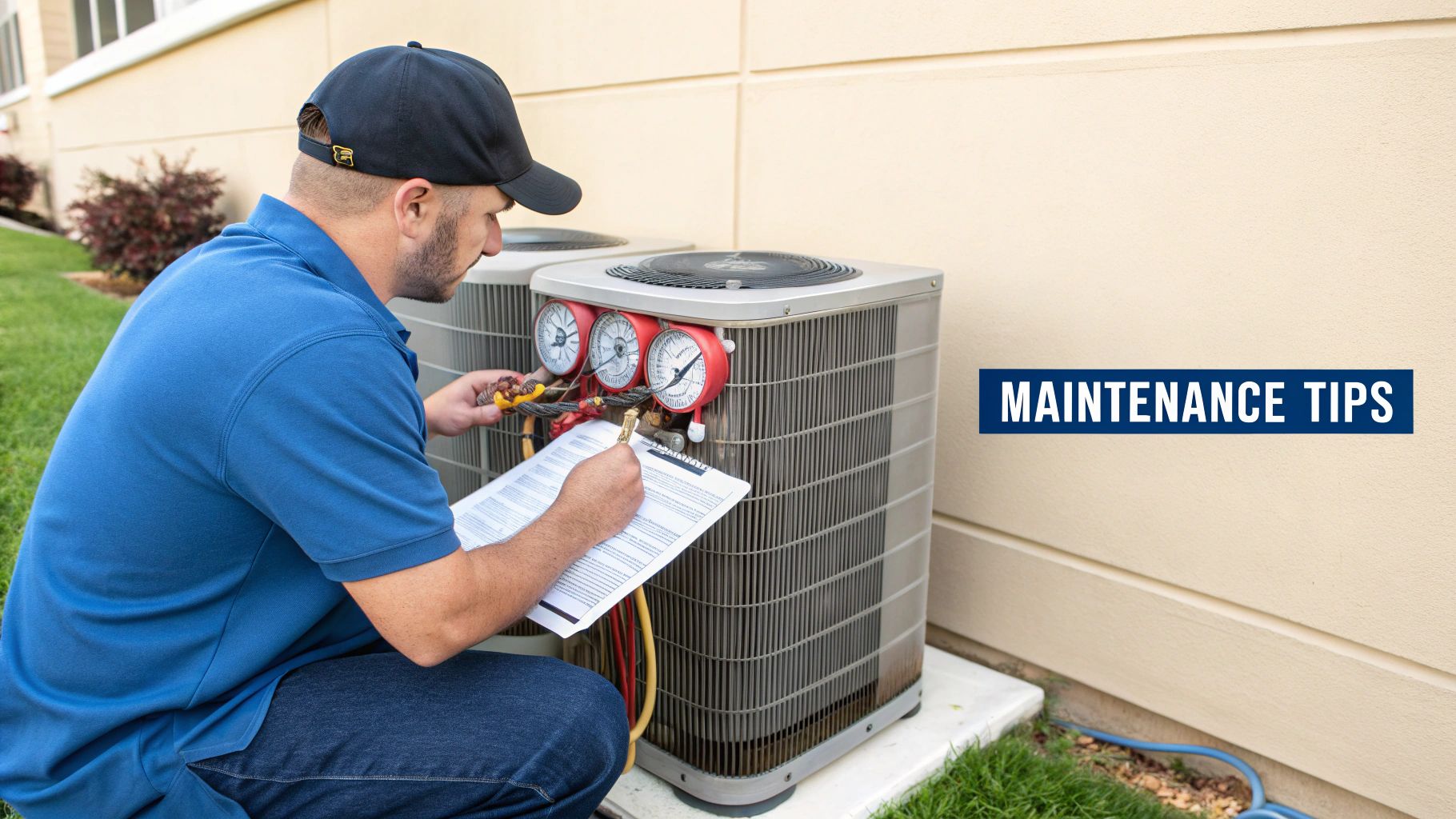
Think of your heat pump as a serious investment in your family’s comfort. Just like a car, it needs a little TLC to keep running smoothly, and protecting it with simple, consistent care is one of the smartest things a Phoenix homeowner can do. Proper maintenance keeps it efficient, prevents those dreaded surprise breakdowns during a heatwave, and can add years to its lifespan.
Simple DIY Maintenance Tasks
These straightforward steps don't require any special tools, but they make a huge difference in your system's health and your monthly SRP bill. To really get the most out of your system, it helps to understand how to maintain your HVAC system for peak performance.
- Check Your Air Filter Monthly: This is non-negotiable and the single most important task. A clogged filter chokes your system, forcing it to work way harder to move air. That wastes energy and can cause it to overheat. Check it every 30 days and swap it out when it's dirty—usually every 1-3 months.
- Keep the Outdoor Unit Clear: Your outdoor unit has to breathe. Make sure there’s at least two feet of clear space around the entire thing. Regularly trim back bushes and weeds, and clear away any leaves or grass clippings that could block the coils and restrict airflow.
- Listen for Unusual Noises: You know what your house is supposed to sound like. If you suddenly hear grinding, squealing, or rattling from your heat pump, that’s its way of telling you something is wrong. Don't just turn up the TV; call for a professional inspection right away.
Why Professional Tune-Ups Are Non-Negotiable
While your DIY efforts are huge, they can't replace the in-depth service of a trained HVAC technician. Think of an annual professional tune-up as a preventative measure that catches small issues before they snowball into catastrophic (and expensive) failures. It’s what keeps your system running at factory-fresh specs.
A professional tune-up is like a comprehensive health check-up for your heat pump. Our technicians use specialized tools to diagnose, clean, and optimize every critical component, ensuring safety, efficiency, and longevity.
During a maintenance visit from Comfort Experts, our certified techs perform a detailed inspection and service that includes:
- Inspecting and Cleaning Coils: Dirty evaporator and condenser coils can't transfer heat effectively, which absolutely cripples your system's efficiency.
- Checking Refrigerant Levels: The refrigerant charge has to be exact. Too little or too much can damage the compressor and tank its performance.
- Testing Electrical Components: We tighten connections and check capacitors and contactors to prevent sudden electrical failures on a 115-degree day.
- Lubricating Moving Parts: Proper lubrication reduces friction and wear on motors and bearings, keeping things running quietly and smoothly.
- Verifying Thermostat Calibration: We make sure your thermostat is communicating correctly with the system for accurate, reliable temperature control.
Protecting your investment is easy when you have the right partner. You can learn more about our thorough process with our guide to heat pump maintenance in Mesa, AZ. A little regular care from our team keeps your system humming along when you need it most.
Common Questions We Hear About Heat Pumps in Arizona
Even with a good handle on the tech, Phoenix Valley homeowners always have a few more practical questions about how these systems really hold up in our climate. As your local HVAC crew since 2011, we’ve heard just about all of them. Here are the straight answers to the questions we get asked every day.
Do Heat Pumps Actually Work Well in Extreme Arizona Summer Heat?
Absolutely. There's a common myth that a heat pump is somehow a "weaker" air conditioner. The truth is, when a heat pump is in cooling mode, it is an air conditioner. It uses the exact same refrigeration cycle to pull heat out of your house and dump it outside. Modern, high-efficiency heat pumps are built specifically to handle the brutal, non-stop heat of a Phoenix summer. When a seasoned pro installs one, you get powerful, reliable cooling.
How Long Does a Heat Pump Typically Last in the Phoenix Area?
In Arizona, a well-maintained heat pump will generally last somewhere between 10 to 15 years. Our HVAC systems work a lot harder here than in most other places, and that intense summer workload takes a toll. But that lifespan really depends on two things: the quality of the original installation and how consistently it’s been maintained. Getting a professional tune-up every year can genuinely extend your system's life.
What Are the Signs My Heat Pump Needs Repair or Replacement?
Your system will usually give you a few warning signs when it’s struggling. The most common one is a sudden, unexplained jump in your power bills—that’s a classic sign the unit is losing efficiency and has to work way too hard. Other red flags to watch for include:
- Strange Noises: Any new grinding, squealing, or rattling sounds are not normal.
- Frequent Cycling: If your system is constantly kicking on and off, it could be oversized, low on refrigerant, or have an electrical issue.
- Lukewarm Air: If the air from your vents just isn't as cold (or warm) as it used to be, that points directly to a performance problem.
If your heat pump is over a decade old and you’re starting to face frequent, expensive repair bills, it’s often smarter to replace it. A modern, high-efficiency model can quickly pay for itself through lower energy costs and better reliability.
If you spot any of these signs, your best bet is to call a trusted technician for a professional diagnosis. Once you understand how a heat pump works, it's easier to tell when it isn't working right.
At Comfort Experts, our goal is to give homeowners honest information and expert service. Whether you’re having trouble with your current system or just have more questions about switching to a high-efficiency heat pump, our team is here to help. Give us a call today at 480-207-1239 or schedule service online for a professional consultation.