If you're staring at an old AC that can't keep up with a Mesa summer, you're probably asking the same question a lot of homeowners ask right now. How do you replace the system without overpaying and still capture the salt river project rebates that are available?
Decoding SRP Rebates What's Actually on Offer for Homeowners
Your AC dies in July, the house is climbing past 85, and every quote starts to blur together. One contractor talks about efficiency, another talks about tonnage, and somewhere in the middle you hear there may be money back from SRP. That part is real, but the homeowners who save the most are usually the ones who treat SRP as one piece of the deal, not the whole deal.
SRP offers residential rebates because lower-demand equipment helps reduce strain during Arizona cooling season. On the HVAC side, the program Mesa homeowners ask about most is Cool Cash, which can pay up to $1,125 on a qualifying replacement system, according to SRP's residential rebates page.
The key point is simple. A rebate is tied to a specific equipment match and a specific set of rules. It is not a general reward for buying something labeled high efficiency.
Who qualifies and who doesn't
Cool Cash is aimed at permanent SRP residential customers in eligible homes, including single-family homes, mobile homes, and certain apartments or condos under the current program rules. It applies to replacement of an existing central system. It does not apply to brand-new construction.
That replacement detail matters more than homeowners expect. If a split system is being replaced, SRP requires the matched indoor and outdoor equipment, installed by an Arizona-licensed contractor. Swapping only half the system may keep the house cooling for now, but it can knock out rebate eligibility and create performance problems later. I see that trade-off come up all the time. The cheaper partial replacement often costs more once you factor in lost incentives, poorer efficiency, and shorter equipment life.
A few common exclusions catch people off guard:
- New construction is not part of the Cool Cash replacement program.
- Window units are not eligible.
- Garage installs are excluded under program rules.
- Late applications can lose the rebate because SRP requires submission within 6 months of installation.
Practical rule: SRP pays for qualifying equipment, installed in a qualifying home, with the paperwork turned in on time.
How the Cool Cash rebate is calculated
SRP does not use one flat rebate for every system. The amount depends on equipment type, efficiency tier, and tonnage. In plain English, a basic qualifying single-stage unit usually earns less than a qualifying multi-stage or variable-capacity system.
Here is the structure homeowners should expect under current program terms:
| Equipment Type | Minimum Efficiency (SEER2) | Rebate per Ton | Example Rebate (3-Ton Unit) | Example Rebate (5-Ton Unit) |
|---|---|---|---|---|
| Single-stage AC or heat pump | 15.2 SEER2 or higher | $75 per ton | $225 | $375 |
| Multi-stage or variable capacity AC or heat pump | Qualifying high-efficiency tier under SRP | $150 per ton | $450 | $750 |
Larger systems can reach the $1,125 cap.
Good planning yields dividends. A higher-end system costs more up front, so it is not automatically the right answer for every house. But if that system also qualifies for an SRP rebate, a federal tax credit, and a manufacturer promotion, the price gap can shrink fast. Homeowners who only ask, "What's the SRP rebate?" often leave the biggest savings on the table.
Where homeowners get tripped up
The miss usually happens at the model-number level.
A proposal says "16 SEER2 high-efficiency system," and the homeowner assumes the rebate is covered. Then the installed combination does not line up in the AHRI directory, or the indoor and outdoor units are not the matched pair that earns the incentive. The equipment may still run. It may even run well. But the rebate can get denied.
That is why rebate jobs need to be built backward from eligibility. Start with the exact outdoor unit, indoor unit, and matched rating. Then price the job. Then check what can be stacked on top.
If you want a local summary of utility offers before you sign a contract, Comfort Experts keeps a rebate resources page that helps homeowners compare the basics. It also helps to look at related incentive categories like solar rebates if you are planning broader energy upgrades, because the same rule applies across programs. Specific equipment and clean paperwork get the money.
The deadline that matters
Program timing matters because rebate rules can change, funding can shift, and special promotions do not always run year-round. The current Cool Cash rules state that installation must occur before April 30, 2026, but homeowners should verify that deadline with SRP because program dates can change.
Waiting rarely improves the deal. If your system is already limping through a Mesa summer, the better move is to confirm eligibility early and see what incentives can be stacked now. The strongest rebate jobs are usually the least dramatic ones. The system qualifies, the match is correct, the installer is licensed, and every form goes in on time.
Your Pre-Installation Rebate Checklist
A Mesa homeowner gets three quotes on the same day. One looks cheap, one looks polished, and one takes the time to list exact model numbers, rebate assumptions, and tax credit notes. The third quote usually wins in the long run, even if it is not the lowest number up front.
That is because the money is made or lost before the crew ever shows up. If you want the SRP rebate, the federal tax credit, and any manufacturer promo you can stack on top, the system has to be chosen with all three in mind. I have seen plenty of installs that would cool the house just fine but leave rebate dollars on the table because nobody checked the match, the efficiency rating, or the paperwork path early enough.

Start with incentive strategy, then choose equipment
Homeowners often start with brand names. Rebates do not.
A smart pre-install plan starts with four questions. Does the system qualify for SRP? Does it also line up with the Inflation Reduction Act tax credit rules? Is there a manufacturer promotion available on that exact equipment? And can your contractor document all of it cleanly on the final invoice?
That stack matters. A unit that carries a slightly higher installed price can still produce better return if it qualifies for multiple incentives. A cheaper option that misses one piece of the stack can cost more by the time the dust settles.
Start with the contractor, not the brochure
The contractor controls whether the job is quoted correctly in the first place. Good installers build the proposal around eligible equipment combinations, proper sizing, and clean documentation. Sloppy ones sell "high efficiency" as a label and sort out the details later.
Use this checklist before you sign anything:
- Verify Arizona licensing: SRP requires installation by an Arizona-licensed contractor.
- Ask for exact indoor and outdoor model numbers: Broad descriptions are not enough for rebate review or tax credit verification.
- Confirm the AHRI match: The condenser and air handler or furnace have to be listed as a matched system when the rebate requires it.
- Check efficiency details, not just brand reputation: The system needs to meet the qualifying thresholds tied to the incentives you want to claim.
- Make sure the quote reflects the full scope required: If the program requires a complete split-system replacement, the proposal should show that clearly.
- Ask what incentives are being stacked: SRP rebate, federal tax credit, and manufacturer promo should all be discussed before approval, not after install.
- Get responsibility in writing: Know who is filing what, what documents you will receive, and what deadlines apply.
A vague quote can erase savings faster than a high labor rate.
Questions worth asking before you sign
You do not need to know HVAC like a technician. You need the contractor to answer plain questions with specific answers.
Ask these:
Is this exact system eligible for the SRP rebate and any federal tax credit you expect to claim?
The exact match matters.Can you show me the matched system certificate or qualifying combination?
If they cannot produce it during the quote stage, that is a warning sign.Are there manufacturer promotions on this equipment right now, and do they stack with SRP?
Many homeowners miss this piece because they stop after the utility rebate.Will the final paid invoice list all installed model numbers clearly?
Clean paperwork saves headaches later.What size system are you recommending, and how did you arrive at that size?
Oversizing can hurt comfort, efficiency, and long-term value. If you want a clearer baseline before comparing proposals, this guide on what size air conditioner do I need explains how sizing should be handled.Who submits the rebate paperwork, and what do I need to keep for my tax records?
Never assume the installer handles every form unless that is stated clearly.
What a strong quote should include
The best quotes are boring in a good way. They spell everything out.
| Quote Element | What you want to see |
|---|---|
| Equipment listing | Exact indoor and outdoor model numbers |
| System match | Confirmation that the combination qualifies as proposed |
| Job scope | Clear replacement scope for the existing central system |
| Contractor status | Arizona license information |
| Incentive plan | Notes on SRP eligibility, tax credit fit, and any manufacturer promo |
| Documentation | Promise of a final paid invoice and supporting install records |
Where homeowners get tripped up
The common mistake is comparing price without comparing eligibility. Two proposals can look similar on the surface and lead to very different net costs once incentives are applied.
I see this a lot with replacement jobs in older Mesa homes. One contractor quotes a lower-cost outdoor unit and pairs it with existing or mismatched indoor equipment. Another quotes the proper matched system that qualifies for rebates and may also line up with a tax credit. The first number looks better on paper for five minutes. The second number usually looks better after the homeowner adds back the incentive dollars and avoids future paperwork fights.
The safe move is simple. Confirm the exact equipment, confirm the match, confirm the stack, then sign.
Most homeowners breathe easier once the new system is installed. That's understandable, but the rebate isn't done at startup. The rebate is done when your documents are complete, your application is accurate, and SRP accepts it.
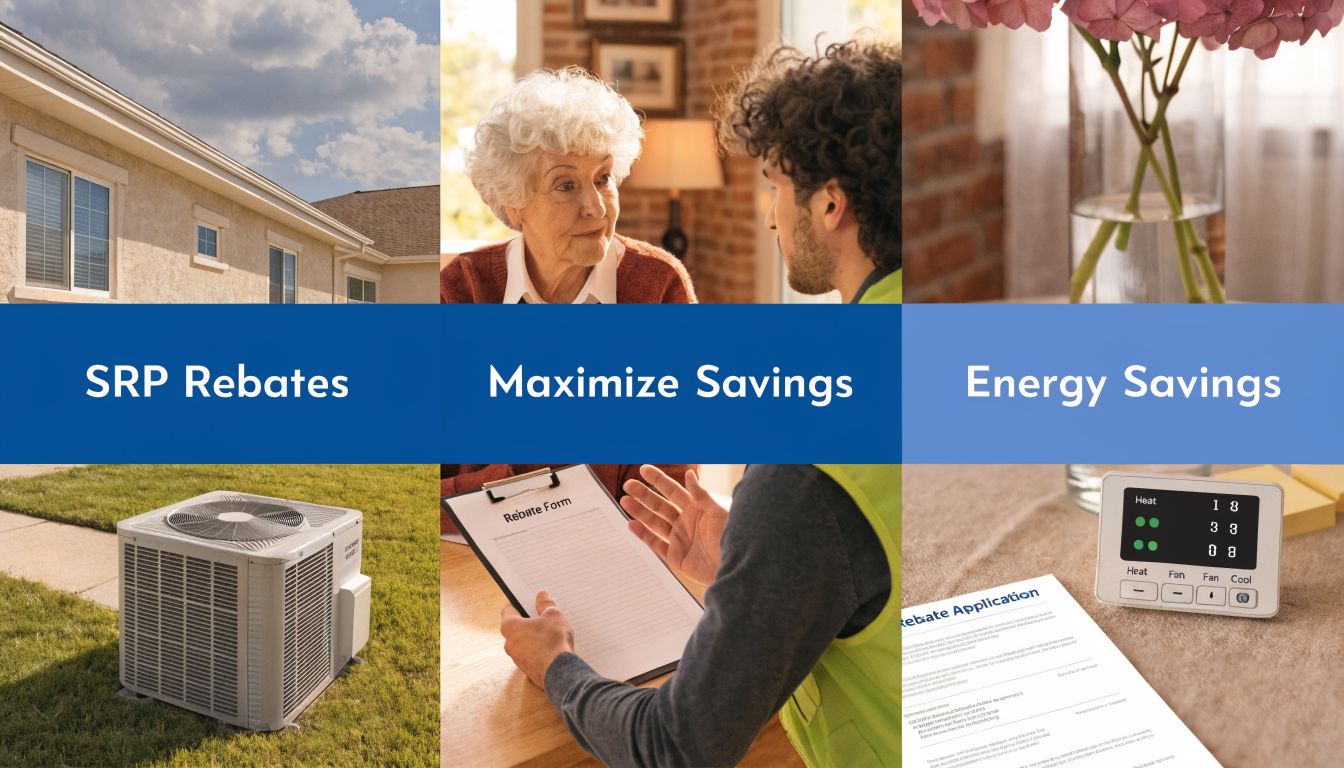
This visual gives the big picture first.
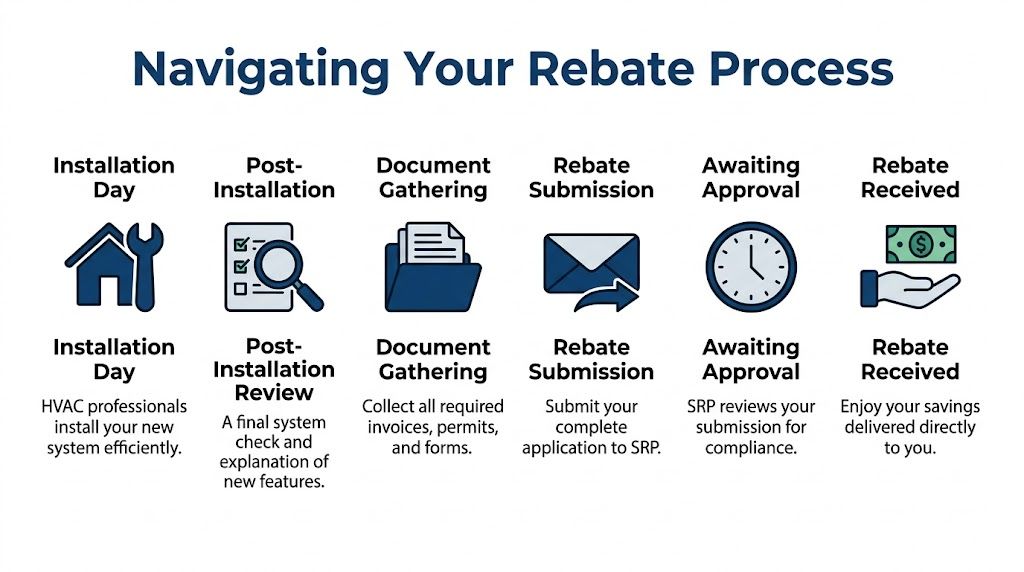
What to collect on installation day
Before the crew leaves, make sure you know what you're getting. Homeowners who wait weeks to chase down missing paperwork often run into delays, confusion, or incomplete submissions.
Keep a folder with these items:
- Final paid invoice: It should clearly identify what was installed.
- Model numbers: The indoor and outdoor equipment should be easy to identify on the paperwork.
- AHRI certificate or matched-system proof: This helps confirm the installed combination is the one intended for rebate eligibility.
- Permit or job completion records if provided: Keep everything tied to the project in one place.
- Your installation date: That date matters because SRP requires the rebate application within the allowed submission window covered earlier.
If any line item looks vague, ask for clarification right away. It's much easier to fix paperwork while the job is fresh than after invoices are archived and office staff have to reconstruct the install.
What the homeowner should review before submitting
Walk through the finished installation with the contractor and compare the actual installed equipment to the proposal. Don't assume the box that showed up is the same model that appeared on the quote.
Check these points:
| Item to Review | Why it matters |
|---|---|
| Installed model numbers | They should match the qualifying system discussed before installation |
| Scope of work | The completed project should reflect a replacement, not a partial shortcut |
| Invoice details | Clear paperwork supports a smoother application |
| Home address and customer information | Simple entry mistakes can slow down review |
| Contractor information | Accurate installer details help support the submission |
The rebate application is not the place to guess. If a field asks for a model number, use the exact model number from the installed equipment paperwork.
Filling out the application without avoidable mistakes
The online process isn't technically hard. What trips people up is incomplete information and mismatched entries.
A clean application usually follows this order:
Enter customer information exactly as it appears on the SRP account.
Small discrepancies can create unnecessary back-and-forth.Use the installation date from your final paperwork.
Don't estimate.Enter the equipment information from the invoice and supporting documents.
Copy carefully. A single wrong character in a model number can create a problem.Upload supporting documents in readable form.
Blurry photos and missing pages are a headache.Review the submission before hitting send.
Take one extra minute here. It can save weeks of annoyance later.
Some homeowners prefer to spread replacement costs out instead of paying everything at once, especially when moving into higher-efficiency equipment. If that applies to your project, it's worth looking at HVAC financing options before install day so the payment plan and rebate plan work together.
Where people usually get hung up
The most common paperwork problems are not dramatic. They are ordinary mistakes.
A homeowner uploads the invoice but forgets a supporting document. Someone enters the outdoor unit model correctly but shortens the indoor unit number. A family replaces the system and then lets the rebate sit in a kitchen drawer until the deadline feels uncomfortably close.
You don't need special tricks to avoid that. You need a checklist and a habit of keeping everything together.
What a smooth rebate process feels like
It feels organized. Installation day ends with complete paperwork. The homeowner has one folder, one set of model numbers, one clear invoice, and one plan for submission.
That's the whole game. Not speed for its own sake. Not rushing through screens. Just accurate records and timely follow-through.
Beyond SRP Maximizing Your Total HVAC Savings
A lot of Mesa homeowners stop at the SRP rebate and assume they have found the whole savings picture. In practice, the biggest payoff usually comes from pairing that rebate with a federal tax credit and any manufacturer promo available at the time of install.

That approach changes how you should shop for equipment. The right question is not just, "What rebate does SRP offer?" The better question is, "Which matched system gives me the lowest net cost after every available incentive is counted?"
I see this missed all the time. A homeowner compares two quotes, picks the lower upfront number, and never checks whether the higher-efficiency option also qualifies for a federal heat pump tax credit or a factory rebate. On paper, the cheaper system wins. After incentives are added up, sometimes it does not.
Here is where the math can improve:
- SRP utility rebate for qualifying equipment under the current program
- Federal tax credit under the Inflation Reduction Act for eligible heat pump systems
- Manufacturer promotions tied to specific brands, model families, or seasonal sales windows
- Lower operating cost from better efficiency over the life of the system
Those layers do not all apply to every job. Equipment matchups matter. Timing matters too. Manufacturer promos come and go, and federal credit rules are not always the same as utility rebate rules. A system can qualify for one program and miss another if the indoor and outdoor components are not paired correctly.
That is why net cost beats sticker price as the comparison tool.
A basic replacement with a lower invoice may still be the right call for a homeowner planning to move soon or working within a tight budget. But if you expect to stay in the house, a qualifying higher-efficiency system can pencil out better once you count the SRP rebate, tax treatment, and monthly utility savings together. Years in the field have taught me that a careful quote review yields significant returns. The best option is the one that fits the home, the budget, and the incentive rules at the same time.
Manufacturer offers deserve a close look as well. Some are instant discounts. Some require separate submission after install. Some only apply to certain tonnages or system combinations. Comfort Experts checks active offers during evaluations and helps customers line up the paperwork so a good rebate opportunity does not get missed because a detail was overlooked.
Long-term value also includes upkeep. A written HVAC maintenance contract can give homeowners a clear idea of what ongoing service agreements usually include before they sign up. That will not increase a rebate check, but it can help protect the efficiency and lifespan of the equipment you just paid to install.
After the system is in, day-to-day habits still affect your return. Good thermostat settings, clean filters, and steady airflow make the new equipment perform closer to its rated potential, which is why these practical HVAC energy-saving tips for Arizona homeowners are worth reviewing.
Homeowners who save the most usually do one thing differently. They stack every legitimate incentive first, then choose the system based on total value instead of the first price on the quote.
Common Rebate Pitfalls and How to Sidestep Them
A Mesa homeowner replaces a failing AC in July, signs the quote that looks good, and expects the rebate to follow. A few weeks later, the claim stalls because the model numbers on the invoice do not match the qualifying equipment, or the paperwork sat too long on the kitchen counter. I see that pattern a lot. The expensive part is not just losing the SRP rebate. It is losing the chance to stack that rebate with a federal tax credit or a manufacturer promo that depended on the same equipment details.

SRP rebate programs follow written requirements. So do federal tax credits and many factory promotions. If one piece is wrong, the whole savings plan can shrink fast. Homeowners usually do not get in trouble because of one huge mistake. They lose money through a series of small misses that could have been caught before install day.
Pitfall one buying a system that only sounds eligible
Words like "high efficiency" and "rebate ready" are not enough. Eligibility comes down to the exact indoor unit, outdoor unit, air handler or furnace, and sometimes the thermostat or other supporting details.
I have seen homeowners approve a lower quote that looked close enough, then find out the installed combination did not qualify for the rebate they were counting on. In some cases, it also knocked them out of a better manufacturer offer.
How to sidestep it:
- Get exact model numbers on the proposal before you sign
- Ask whether the quoted combination is the actual qualifying combination
- Make sure the final invoice matches what was approved
- Check the full savings stack, not just the SRP piece
Pitfall two waiting too long to gather documents
Paperwork problems usually start after the install, when everybody is tired and ready to move on. The system is running. The old unit is gone. Then the rebate forms, AHRI certificate, invoice, and permit details get scattered.
That delay can cost real money, especially if you planned to combine SRP incentives with a time-sensitive manufacturer promotion. Keep everything together from day one.
How to sidestep it:
- Create one digital or paper folder for the rebate file
- Save the proposal, invoice, model numbers, and any matching certificates together
- Submit as soon as the required documents are available
- Confirm who is handling each submission, the contractor, the homeowner, or both
Missing the paperwork window usually means missing the rebate check.
Pitfall three treating the install like a partial swap
A cheaper quote can hide an eligibility problem. Maybe the plan keeps an older component. Maybe the system is not a matched combination. Maybe the scope leaves out work that should have been documented clearly.
That matters because rebate programs and tax credits often depend on the equipment being installed as a qualifying system, not as a loose collection of parts. A shortcut that saves a little on the front end can wipe out much more in total incentives.
| Mistake | Better move |
|---|---|
| Approving a vague scope of work | Get a written scope with exact equipment and installation details |
| Keeping mismatched components to save money | Verify that the full setup still qualifies before approval |
| Comparing quotes on price alone | Compare net cost after SRP, tax credits, and manufacturer offers |
| Assuming a near match is good enough | Treat model and documentation requirements as exact |
Pitfall four hiring an installer who treats paperwork like an afterthought
Good mechanical work matters. So does the admin side. Rebate jobs need both.
An installer can put in the equipment correctly and still leave the homeowner exposed if the proposal is vague, the invoice is incomplete, or nobody confirms the rebate path before the job starts. That is why process matters. Homeowners should ask how the contractor documents model numbers, who prepares the rebate paperwork, and how they help protect other incentives that can be stacked onto the job.
If you want a second set of eyes before you commit, book an HVAC rebate eligibility review and installation quote. It is a lot easier to fix these issues before the old unit is hauled away than after a claim gets denied.
Start Your Savings Journey with Comfort Experts
Homeowners in Mesa and the Phoenix Valley don't need a finance degree to make sense of salt river project rebates. You need clear equipment information, a qualifying installation path, and a plan for paperwork that doesn't fall apart after the crew drives away.
The biggest misconception is that the rebate is the whole savings story. It isn't. A smart replacement decision looks at equipment eligibility, total installed value, and whether other incentives can be stacked in a way that lowers your net cost without creating compliance problems later.
That practical approach matters most when your current AC is failing and you're under pressure to decide quickly. Fast decisions are easier when the proposal is specific, the rebate path is understood, and the install scope is documented before work begins.
Homeowners who want a straightforward next step can review their options and schedule service when they're ready to have their system and rebate eligibility looked at together.
If you want help sorting out qualifying equipment, paperwork, and the best path to total savings, contact Comfort Experts by calling 480-207-1239 or use the schedule service form.