If you're in Mesa and your AC has been grinding through dust, triple-digit afternoons, and monsoon swings, residential air conditioning maintenance isn't optional. It's the difference between a system that keeps up in July and one that quits when your house needs it most.
The Real Stakes of AC Maintenance in the Phoenix Valley
In the Phoenix Valley, air conditioning isn't a luxury appliance. It's part of how you safely live in your home for months at a time. When the outdoor temperature climbs and your unit runs for long stretches, every small maintenance issue gets magnified.
A lot of national advice treats AC upkeep like a once-in-a-while chore. That mindset doesn't hold up well in Mesa, Chandler, Gilbert, Tempe, or anywhere else around Phoenix. Dust builds up faster, outdoor units bake in direct sun, filters clog sooner during haboob season, and neglected systems don't get much grace when the heat settles in for weeks.
The practical reason to stay ahead of maintenance is simple. The U.S. Department of Energy estimates homeowners can achieve 5-20% annual energy savings through proper AC operations and maintenance, and industry data shows thorough planned maintenance can cut total HVAC costs by up to 50% compared to a reactive approach, according to HVAC maintenance statistics compiled here.
What wastes money in Phoenix isn't usually one dramatic failure. It's a system running a little dirtier, a little hotter, and a little longer every day.
Efficiency matters more here
Phoenix-area homeowners feel AC inefficiency fast. You may not notice a minor issue in mild weather, but you will notice it when the unit runs most of the afternoon and into the evening. A clogged filter, matted condenser coil, weak capacitor, or leaking duct can force the equipment to work harder just to hold the thermostat setting.
That shows up as longer run times, uneven cooling, hotter bedrooms, and higher electric bills. It also shows up as frustration. Nobody wants to stand at a supply vent and wonder why the air feels weak when the system is technically "on."
If you're also looking at home-wide ways to lower heat gain, some broader strategies to beat the summer heat can help you think beyond the AC itself. Roofing, attic conditions, shade, and insulation all affect how hard your cooling system has to work.
Lifespan is tied to the boring stuff
Most AC failures don't start as dramatic failures. They start as ignored basics. Dirty coils reduce heat transfer. Airflow restrictions stress the blower and compressor. Loose electrical connections create heat. A drain issue starts as moisture and turns into a service call.
In a climate this hard on equipment, maintenance is what keeps normal wear from turning into early replacement. Homeowners often focus on whether the unit still turns on. Techs look at how it's turning on, how long it's running, what the temperature split looks like, whether amperage is normal, and whether the system is moving air the way it should.
Safety and reliability aren't separate issues
People usually think of maintenance as a comfort issue or a money issue. It's both, but it's also a reliability issue in a place where indoor temperatures can rise fast after a breakdown. A system that's been checked, cleaned, and tested is less likely to leave you scrambling during a heat wave.
That peace of mind matters. So does predictability.
What works and what doesn't
Some homeowners wait until the unit starts making noise, stops cooling well, or trips the breaker. That's a repair strategy, not a maintenance strategy. It usually costs more, creates more stress, and gives you fewer scheduling options during the busiest part of the season.
What works better is steady care:
- Change filters on schedule: In dusty neighborhoods or homes with pets, don't assume a filter will last as long as the package suggests.
- Keep the outdoor unit clear: Desert landscaping, leaves, plastic bags, and windblown debris all interfere with airflow.
- Book professional service before peak demand: Spring is ideal, and fall matters too if the system ran hard all summer.
- Pay attention to small warning signs: Weak airflow, short cycling, warm spots, unusual odors, and water near the indoor unit rarely fix themselves.
Thinking about AC maintenance isn't a favorite pastime. Fair enough. But in Phoenix, ignoring it is usually more expensive than handling it.
Your Complete Phoenix AC Maintenance Checklist
Good maintenance is not one task. It's a rhythm. Some things belong on your monthly routine, some should happen around the start and end of heavy cooling season, and some need trained hands once a year.
Monthly checks that actually help
The monthly list is short, and that's a good thing. If homeowners do too much, they often end up poking at parts they shouldn't touch. The goal is to catch simple problems early and protect airflow.
- Check the air filter: Pull it out and look at it, not just the calendar. If it's visibly loaded with dust, replace it.
- Look at the outdoor unit: Remove tumbleweeds, leaves, and windblown debris from around the condenser.
- Listen during operation: A healthy system has a familiar sound. Buzzing, rattling, or hard starts deserve attention.
- Watch the thermostat behavior: If the unit runs much longer than usual or struggles to reach the set point, that means something changed.
- Check supply airflow at vents: If one room suddenly gets weak airflow, that points to a filter, duct, blower, or balancing issue.
Let me explain. Airflow is the blood pressure reading of your cooling system. You can ignore it for a while, but once airflow drops, the whole system starts operating under strain.
Seasonal tasks for spring and fall
Spring is the big one in the Valley because that's your best chance to catch problems before real heat arrives. Fall still matters because long summer run time leaves wear behind, and it's smart to see what the season did to the equipment.
Spring priorities
- Replace the filter before sustained heat starts
- Rinse visible dirt from the outdoor cabinet surface gently
- Trim plants back and keep clearance around the condenser
- Confirm the condensate drain is draining properly
- Test the thermostat in cooling mode before the first major heat stretch
Fall priorities
- Inspect for monsoon debris around the outdoor unit
- Look for damaged insulation on exposed refrigerant lines
- Pay attention to rust, corrosion, or signs of water intrusion
- Note any rooms that cooled poorly all summer and mention them at service time
A spring tune-up catches what winter dust and neglect started. A fall inspection catches what summer punishment exposed.
Why coil cleaning matters so much in Arizona
Coils are where a lot of Phoenix systems lose efficiency. Homeowners often think of the AC like a sealed box that should work until it doesn't. That's not how it behaves. The evaporator coil and condenser coil have to transfer heat efficiently, and dirt gets in the way.
According to ENERGY STAR, dirty evaporator and condenser coils can increase an AC's energy consumption by 15-30%. In Arizona, where units run over 2,000 hours annually, cleaning them can restore the system's SEER rating and yield 10-20% savings on cooling bills, as outlined in this ENERGY STAR maintenance checklist.
Think of a dirty coil like a dusty radiator on a truck pulling a heavy load in summer. The machine still runs, but not efficiently, and not kindly.
If you want a deeper look at one part of that process, this guide on how to clean an evaporator coil helps explain what homeowners should understand before trying anything themselves.
What a good annual maintenance visit should include
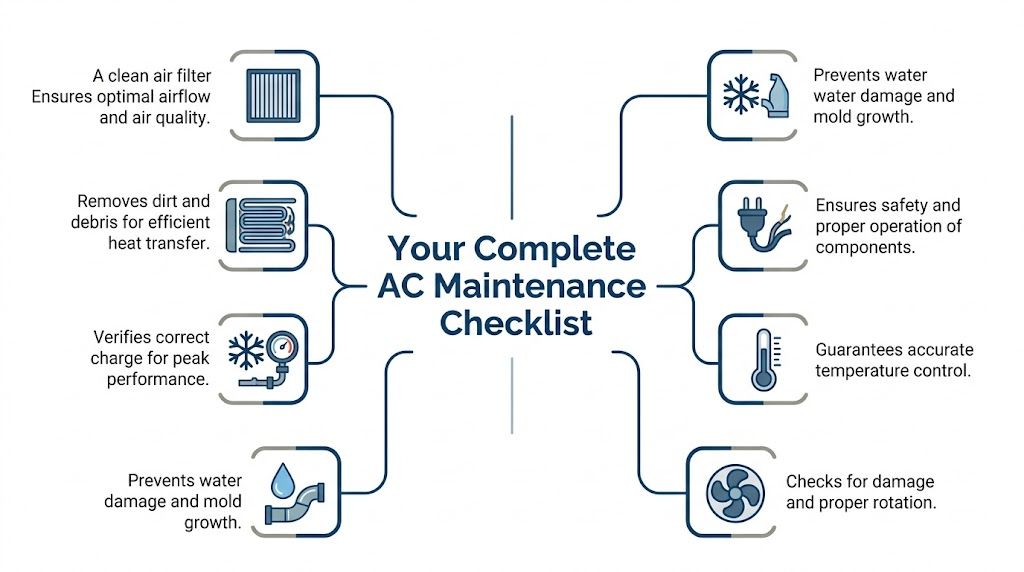
A professional visit shouldn't be a quick glance and a bill. It should involve inspection, testing, cleaning, and basic performance verification. Different contractors phrase it differently, but a solid visit usually includes work like this:
- Electrical inspection: Tightening connections, checking contactors, and looking for signs of overheating.
- Capacitor testing: Weak capacitors are common and often show symptoms before full failure.
- Coil inspection and cleaning: Both indoor and outdoor sides matter.
- Drain line clearing: This prevents nuisance shutdowns and water damage.
- Refrigerant performance check: Not just pressure guessing. The system should be evaluated for signs of improper charge or leakage.
- Blower and fan review: Dirty blower components can drag down airflow even when the filter is clean.
- Thermostat verification: Bad readings create comfort complaints that get blamed on the AC.
- Temperature split evaluation: Supply and return temperatures tell a useful story about performance.
Phoenix-specific habits worth adopting
Generic maintenance advice often misses local conditions. In the Valley, these habits pay off:
- After a dust storm, inspect the filter sooner than usual
- After monsoon winds, check the condenser for lodged debris
- Keep roof and attic work coordinated with HVAC care
- Don't block vents in rarely used rooms just to "save money"
- Watch for hot west-facing rooms in late afternoon
You know what? A lot of AC problems in Phoenix homes aren't dramatic mechanical failures. They're systems that never get enough airflow, never get properly cleaned, and never get checked until the first miserable day of summer.
DIY Maintenance vs When to Call a Professional
Some AC maintenance belongs to the homeowner. Some should stay firmly in professional hands. Knowing the difference can save money, prevent damage, and keep you safe.
A useful rule is this. If the task involves opening sealed components, testing live electrical parts, handling refrigerant, or reaching the indoor coil area, don't guess.
Industry data shows only 42% of homeowners hire professionals for routine AC maintenance, while emergency calls often involve capacitor failures in 36% of calls and refrigerant leaks in 25% of calls, according to this HVAC statistics roundup. Those are not casual DIY fixes.
DIY tasks that are usually safe
These are the jobs most homeowners can handle without special tools or training:
- Changing or checking the filter
- Keeping supply and return vents clear
- Removing debris around the condenser
- Checking thermostat batteries and settings
- Watching for water around the indoor unit
- Listening for unusual noise changes
If you're not sure which filter your system uses or where it's installed, this guide on where your air filter may be located in the house is a practical starting point.
Professional-only work for good reason
The trouble starts when people move from light upkeep into diagnosis without the training to support it. AC systems can fool you. A symptom that looks simple may have several possible causes.
| Task | DIY Friendly? | Why It's Pro-Level |
|---|---|---|
| Replace return air filter | Yes | Low risk, straightforward, protects airflow |
| Clear leaves and trash from around condenser | Yes | Exterior housekeeping only |
| Flush or treat drain line access if manufacturer setup allows | Sometimes | Easy to overdo or spill if setup is awkward |
| Clean indoor evaporator coil | No | Access can be difficult, fins bend easily, contamination can spread |
| Test capacitor and contactor | No | Live electrical risk and misdiagnosis risk |
| Check refrigerant charge | No | Requires gauges, training, and proper interpretation |
| Diagnose weak airflow in multiple rooms | Usually no | Could involve ducts, blower, coil, balancing, or controls |
| Deep-clean blower wheel | No | Requires disassembly and careful reassembly |
| Inspect duct leakage and recommend sealing approach | No | Requires trained inspection and solution matching |
If a repair involves voltage, refrigerant, or opening up major components, the risk goes up fast and the odds of a bad guess go up with it.
The trade-off homeowners should understand
DIY maintenance is worthwhile when it prevents obvious neglect. It's not a substitute for diagnostics. Homeowners can absolutely help their system by staying on top of filters, airflow, and outdoor debris. That's useful, real maintenance.
But when the unit starts hard, freezes up, smells burnt, leaks refrigerant, or cools unevenly despite a clean filter, that's no longer a cleanup job.
If you happen to use evaporative cooling on another property or know someone comparing cooling system service options, a licensed cooler repair electrician can be helpful for understanding how electrical and cooling issues overlap on different equipment types. It's a separate system category, but the lesson is the same. Diagnosis matters.
The True Cost of AC Maintenance in Arizona
Most homeowners don't mind paying for maintenance. What they hate is paying for avoidable damage. That is the essential financial discussion.
You know what's more expensive than a tune-up? A neglected system that runs inefficiently all summer, develops airflow problems, stresses the compressor, and then needs major repair during peak heat. And if the house has duct leakage on top of that, the waste stacks up.
In older Phoenix homes, leaky ducts can waste up to 40% of cooling energy. Professional duct sealing with Aeroseal can reduce leakage by 90% and provide up to 20% savings on cooling costs. The same source notes that every $1 in deferred maintenance can become $4 in future repair expenses, according to this discussion of the hidden costs of a neglected HVAC system.
That matters because many Arizona comfort complaints aren't just equipment complaints. They're distribution complaints. The AC may be producing cooling, but the house isn't receiving it evenly because conditioned air is escaping into an attic, crawlspace, or wall cavity before it reaches the room.
What homeowners are really paying for
When you pay for maintenance, you're not just paying for someone to "look at the AC." You're paying for several things at once:
- Early detection: Catching weak parts before they fail on a hot weekend
- Performance verification: Making sure the system is cooling correctly, not just running
- Cleaning where neglect hurts efficiency: Coils, drains, blower-related airflow restrictions
- Professional judgment: Deciding whether a symptom points to a repair, adjustment, or larger issue
- Documentation: Helpful for planning, budgeting, and tracking repeat issues
A good service visit also helps you avoid the expensive habit of replacing parts based on guesswork.
Why Arizona homes create different maintenance costs
Phoenix-area homes vary a lot. A newer home with tight ductwork, good insulation, and a well-placed air handler usually behaves differently than an older home with attic duct runs and years of dust buildup. The maintenance need isn't the same.
Homes with these conditions usually require closer attention:
- Older duct systems
- Heavy dust exposure
- Pets that load filters faster
- Rooms with chronic airflow complaints
- Long daily runtime through summer
- Recent remodeling that changed airflow patterns
This is also why one home's "simple tune-up" can uncover another home's airflow project, duct sealing need, or thermostat issue.
Cost clarity matters
Homeowners should ask what is included before scheduling. Some companies offer a basic inspection. Others include cleaning, testing, drain clearing, and more detailed reporting. Those aren't the same service, so the value isn't the same either.
If you're comparing options, this page on what affects AC tune-up cost gives helpful context on what can change pricing and why the cheapest appointment isn't always the best deal.
The lowest maintenance price can become the highest overall cost if the visit skips the checks that would have caught a real problem.
What works financially
The best financial move is usually boring. Keep the system clean, verify airflow, deal with duct leakage when needed, and fix small issues before the hottest part of the season. That's not flashy, but it's how homeowners avoid panic spending.
Reactive repairs feel cheaper right up until they aren't. In Arizona, where cooling isn't optional for much of the year, steady maintenance usually produces the less stressful bill pattern.
How to Choose the Right AC Maintenance Plan
Not all maintenance plans are worth the paper they're printed on. Some give you real preventive care. Some just guarantee a visit on the calendar.

The right plan should fit your equipment, your home, and how hard your system works. In the Phoenix Valley, that means a plan needs to account for dust, extreme runtime, airflow issues, and the fact that some homes have more than one cooling setup to maintain.
What to look for in a plan
A useful plan should answer simple questions clearly. How many visits per year? What tasks are included? Are coils inspected? Are electrical components tested? Is the condensate drain addressed? Will the technician document issues that need attention?
Look for these features:
- At least seasonal service timing: Spring is critical, and another check later can make sense after heavy summer operation.
- A detailed checklist: Not vague promises. Actual inspection and maintenance tasks.
- Repair priority: Helpful during peak demand periods.
- Clear recommendations: You want notes, not mystery.
- Coverage for your equipment type: Central AC, heat pump, ductless mini-split, or a mix.
Mini-splits need their own maintenance conversation
A lot of plans are built around central split systems and treat ductless units like an afterthought. That's a mistake in Arizona.
Most guides focus on central AC, but ductless mini-splits have grown in Arizona, with a 12% rise post-2024 heatwaves. In dusty Phoenix conditions, their efficiency can drop by 20-30% without at least bi-annual professional cleaning of the indoor unit's coils and blower wheel, according to this discussion of maintenance gaps for mini-splits.
That detail matters if you added a mini-split to a garage, casita, office, or bonus room. Homeowners often clean the visible filter and assume that's enough. It isn't. The blower wheel and indoor coil can collect buildup that subtly drags down performance.
Good plans make it easy to be consistent
The best plan is often the one you will keep. If scheduling is complicated, the checklist is thin, or communication is poor, homeowners stop using it properly. Then the value disappears.
A strong maintenance plan usually feels like this:
- Simple scheduling
- Clear visit scope
- Technicians who explain findings plainly
- No pressure to replace equipment without evidence
- Support for all major brands
- Real attention to airflow and duct condition, not just the outdoor unit
Questions worth asking before you sign
Ask direct questions and listen for direct answers.
- What exactly happens during each visit?
- Do you inspect ducts or only the equipment?
- How do you handle mini-split maintenance?
- Are repair discounts or priority scheduling included?
- Is the agreement transferable if I move?
- Will I get written notes on system condition?
If you want a benchmark for what a more complete option can include, reviewing a professional HVAC maintenance plan can help you compare features side by side.
A good provider should be licensed, insured, and comfortable servicing the equipment common in the Valley. That includes major brands, modern thermostats, ductless systems, and older homes with duct leakage problems that generic service visits often miss.
Stay Cool and Confident with Comfort Experts
Phoenix-area homeowners don't need generic AC advice. They need maintenance habits that hold up in dust, monsoon weather, and long stretches of brutal heat. The right upkeep protects comfort, helps control operating costs, and reduces the chance that a small issue turns into a miserable breakdown.
A well-maintained system should cool evenly, run cleanly, and give you fewer surprises. It should also come with clear answers about what condition it's in, what needs attention now, and what can wait.
If you're ready for help from a local team that knows Mesa and the wider Valley, contact Comfort Experts through 480-207-1239 or schedule service.
Frequently Asked Questions About AC Maintenance
How often should a Phoenix homeowner schedule AC maintenance
For most homes in the Valley, one professional visit before peak cooling season is the minimum. Two visits can make sense for systems that run hard, homes with dust issues, older equipment, or households with comfort complaints that keep returning.
If you have a ductless system, don't assume the same maintenance pattern as a standard central system. Those units often need more targeted cleaning of the indoor components.
Does a brand-new AC system still need maintenance
Yes. New equipment still collects dust, still depends on proper airflow, and still has electrical and drainage components that need checking. A newer system may not need repairs, but it still benefits from inspection and routine care.
Skipping maintenance early is a common mistake. New doesn't mean immune.
New equipment usually fails less often, but poor airflow, dirt buildup, and drainage issues can still shorten its best years.
What's the biggest maintenance mistake homeowners make
The most common one is waiting for obvious symptoms. By the time the house isn't cooling well, the unit is short cycling, or one room is consistently hot, the problem has usually been developing for a while.
The second mistake is assuming a filter change covers everything. Filters matter a lot, but they don't test capacitors, clean blower wheels, inspect coils, or reveal duct leakage.
Can AC maintenance help with indoor air quality
It can, especially when the problem is tied to dirty filters, poor airflow, dust accumulation, or neglected ductwork. Maintenance also helps identify when a house may benefit from upgraded filtration, duct sealing, or other indoor air quality improvements.
That said, maintenance alone doesn't solve every allergy or dust complaint. Sometimes the AC is only part of the picture.
Is it normal for some rooms to stay hotter than others
It's common, but it isn't something to ignore. Uneven cooling can come from duct leakage, poor balancing, airflow restrictions, insulation issues, thermostat placement, or equipment sizing problems. In Phoenix homes, west-facing rooms often reveal these weaknesses first.
A maintenance visit can help identify whether the issue is simple or part of a bigger airflow problem.
Should I cover my outdoor AC unit when it's not in use
Usually, a full cover isn't necessary and can even trap debris or moisture if used poorly. Keeping the area clean is more important than wrapping the entire cabinet. If you do cover anything, follow manufacturer guidance and avoid blocking ventilation in a way that creates problems later.
What should I do after a dust storm or monsoon
Check the filter sooner than usual. Inspect the outdoor unit for debris, branches, or stuck leaves. Listen for unusual sounds when it starts up. If cooling changed right after the storm, don't assume it will sort itself out.
Monsoon season is rough on outdoor equipment because wind-driven debris can lodge where airflow matters.
Will maintenance prevent every repair
No. Parts still wear out, and age still matters. Maintenance doesn't make an AC immortal. What it does is improve the odds that your system runs efficiently, catches problems earlier, and avoids some of the avoidable breakdowns caused by dirt, airflow issues, and neglected components.
That's why maintenance is best viewed as risk reduction, not a magic shield.
Comfort matters more in Arizona because the consequences of AC trouble are immediate. If you want neighborly, experienced help from Comfort Experts, you can schedule service and get your system checked before the next stretch of serious heat.