
Is your garage basically unusable from May to October? If it feels more like a sauna than a part of your home during a scorching Phoenix summer, you're not alone. This guide is here to change that by walking you through everything you need to know to choose the best air conditioner for a garage, turning that sweltering hotbox into a space you can actually use.
Your Guide to Choosing the Best Garage Air Conditioner
Making your garage a functional part of your home is more than a luxury here in Arizona—it's a game-changer. Whether you're dreaming of a comfortable workshop, a home gym that doesn't feel like a hot yoga studio, or just climate-controlled storage, getting the cooling right is step one. But cooling a garage comes with its own set of challenges, especially in our climate.
We’ll cover the different types of AC units, how to figure out the right size for your space, and why having a pro handle the installation is almost always the smart move. And if you're looking for more ways to make your entire home more efficient, check out our other HVAC energy saving tips.
The Unique Problems of Arizona Garages
You might think of your garage as just another hot room, but it’s a unique microclimate with its own set of challenges. The biggest offender is radiant heat. Your concrete slab floor, asphalt driveway, and even the garage door itself soak up solar energy all day and keep pumping that heat back into the space long after sunset.
This creates an oven effect, with temperatures that can easily soar past 120°F. This isn't just uncomfortable; that kind of extreme heat will ruin things you store inside, from your car's battery and tires to tools, paint, and electronics. A dedicated AC unit is built to fight that constant, intense heat source head-on.
A dedicated AC for your garage works on its own, tackling that extreme heat without stealing cool air from your living room or pushing your primary HVAC system to the brink of failure. It’s the only truly effective way to get real comfort and protection.
On top of that, the way a typical garage is built makes it an energy nightmare. Uninsulated walls, a bare ceiling, and a poorly sealed roll-up door add up to a ton of air leaks. Trying to force cold air from your home’s system into this unsealed box is like pouring water into a bucket full of holes—a complete waste of money and energy.
Protect Your Home and Everything in It
An overheated garage doesn't keep its problems to itself. If your garage is attached, that shared wall acts like a giant radiator, constantly bleeding heat into your home. This makes your main air conditioner run longer and harder, which means more wear and tear and a shorter lifespan for your most expensive appliance.
By adding a dedicated unit, you create a temperature buffer zone. Not only does this make your garage a usable, functional space, but it also helps lower the cooling load on the rest of your house. It’s a smart move for your comfort and for the long-term health of your primary HVAC system.
This isn't just a local trend; homeowners everywhere are demanding better cooling for these kinds of spaces. The US Air Conditioners market is on track to hit USD 42.3 billion by 2032, driven by people wanting efficient solutions for garages, workshops, and additions. When you live in a hot climate like Phoenix where cooling can be up to 70% of your summer energy bill, a smarter setup just makes sense.
Comparing the Top Garage Cooling Solutions
Picking the right AC for your garage is the biggest choice you’ll make in turning that sweltering hotbox into a usable workspace or gym. It's not just about getting cool air; it's about finding a solution that’s tough enough for a brutal Arizona summer, efficient enough to keep your SRP or APS bill from exploding, and practical for your specific garage.
Let's walk through the four most common options you'll see—ductless mini-splits, window units, portables, and even heavy-duty packaged systems. We’ll break them down based on what actually matters to Phoenix-area homeowners.
Ductless Mini-Splits: The Powerhouse Choice
For most Arizona garages, a ductless mini-split system is the answer. We see it time and time again. These are the systems that truly transform a garage from a storage space into a comfortable extension of your home.
It’s a two-part system: a quiet, sleek indoor unit mounts high on a wall, and a powerful outdoor compressor sits outside. They're connected by a small conduit that holds the power and refrigerant lines, which only needs a tiny three-inch hole. No big gaps, no blocked windows, and no security risks.
The real magic is their efficiency. Modern inverter technology allows the compressor to adjust its speed, providing steady, even temperatures without the constant, energy-guzzling on-and-off cycles of older units.
As HVAC professionals in the Phoenix Valley, we consistently find that ductless mini-splits offer the best combination of powerful cooling, quiet operation, and long-term energy savings for garage applications. Their ability to handle extreme ambient heat while maintaining high efficiency makes them the superior choice for transforming a garage into a truly usable, year-round space.
Mini-splits simply don't flinch when it's 115°F outside. While the upfront cost is higher, the dramatic savings on your monthly energy bills and the sheer level of comfort deliver a return you'll appreciate every summer. You can see how they stack up against traditional systems in our detailed guide comparing ductless mini-splits versus central air conditioning.
Window and Through-the-Wall AC Units
Window ACs are the classic, budget-friendly option everyone knows. A through-the-wall unit is its close cousin, but it’s installed through a framed opening in an exterior wall instead of a window, which gives it a more secure and permanent fit.
Both are self-contained boxes, making them cheaper upfront and relatively simple to install. But that's where the good news usually ends, especially for a garage. They are noisy, inefficient, and can create a security weak point.
Worse yet, most residential window units just can't keep up when the Arizona sun is baking your garage door. In an uninsulated two or three-car space, they run constantly but often fail to overcome the radiant heat. You end up with a garage that’s merely "less hot" instead of actually comfortable.
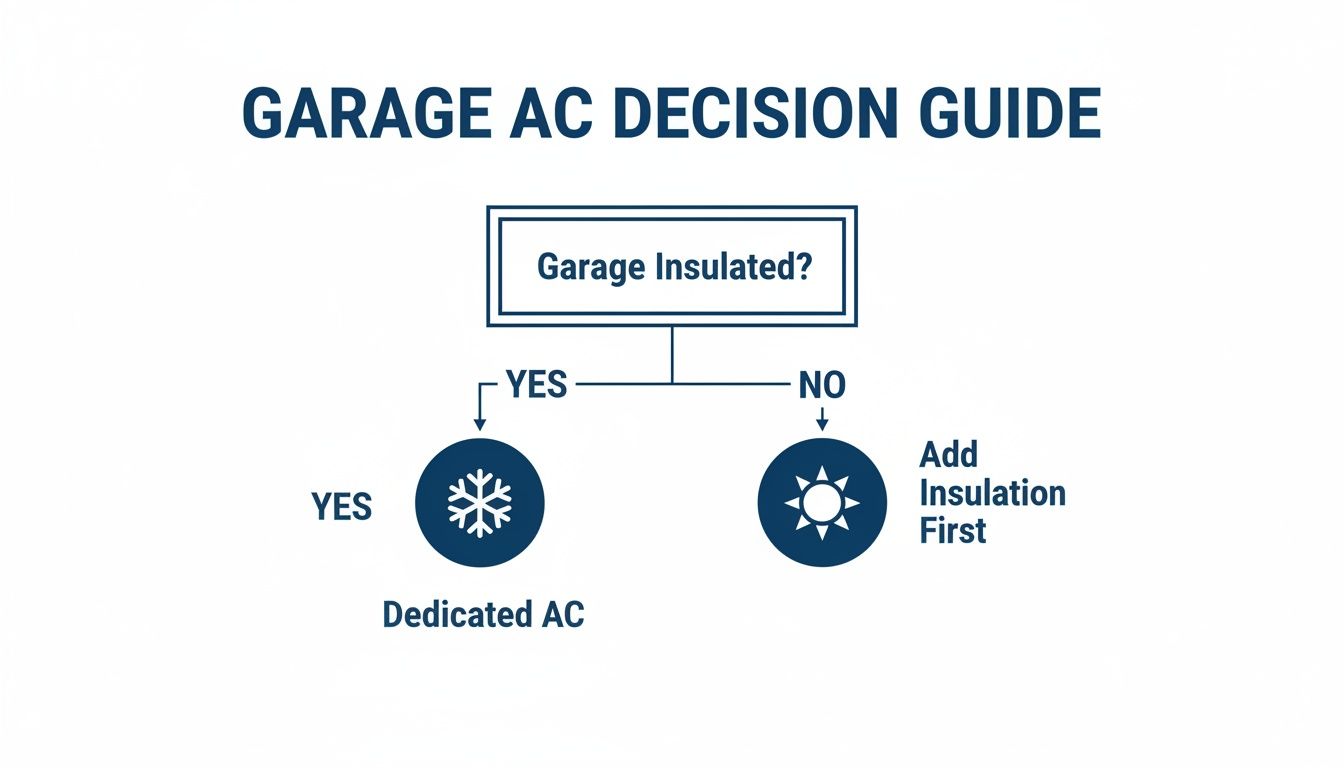
The flowchart above drives home a critical point: insulation is your first step. Without it, any AC will struggle, but a less powerful window or portable unit is fighting a battle it’s guaranteed to lose.
Portable Air Conditioners: The Temporary Fix
Portable ACs look tempting because of their flexibility. You can roll one out for a weekend project and tuck it away after. This can work for renters or those who need cooling for just a few hours a month.
But that convenience comes at a serious performance cost. Portable ACs are, by far, the least efficient cooling option. They use a large exhaust hose to vent heat and moisture outside, which creates negative air pressure in the garage. This literally pulls hot, dusty air in from outside through every crack and gap, forcing the unit to work even harder.
In a Phoenix garage, it's an endless, inefficient cycle. You’re constantly paying to re-cool hot air that the unit itself is pulling into the space. They're best reserved for a very small, well-sealed, one-car garage or as a true last resort.
Rooftop Packaged Units: The Heavy-Duty Solution
For a massive workshop, a commercial-style "man cave," or a garage over 1,000 sq ft, a rooftop packaged unit becomes a real possibility. These are the same all-in-one, commercial-grade systems you see on top of small businesses, delivering conditioned air through dedicated ductwork.
Make no mistake, this is a serious project. It requires professional engineering, significant structural work on your roof, and heavy-duty electrical upgrades.
However, if you've fully converted a three or four-car garage into a true living or working space, a packaged unit provides unmatched cooling power and durability. For the vast majority of residential garages, though, it's complete overkill.
Garage Air Conditioner Comparison for Arizona Homes
To pull it all together, here’s a quick responsive table comparing these options on the factors that matter most for Arizona homeowners.
| AC Type | Best For (Garage Size) | Typical BTU Range | Efficiency (SEER2) | Installation Needs | Estimated Cost |
|---|---|---|---|---|---|
| Ductless Mini-Split | 1-3 Car Garages (Insulated) | 9,000 – 24,000 | 18 – 30+ | Professional | $$$$ (High) |
| Window/Thru-Wall | 1-2 Car Garages | 8,000 – 15,000 | 10 – 14 | DIY / Professional | $$ (Low-Mid) |
| Portable AC | 1 Car Garage (Temporary) | 5,000 – 12,000 | 6 – 9 | DIY | $ (Low) |
| Rooftop Packaged | 3+ Car / Custom Shops | 24,000+ | 14 – 18 | Professional Only | $$$$$ (Very High) |
Ultimately, choosing the best air conditioner for a garage is about matching the right technology to your specific needs, your budget, and the brutal reality of our desert climate.
Calculating the Right AC Size for Your Garage
Getting the size of your garage AC wrong is one of the easiest and most frustrating mistakes you can make. A unit that’s too small will run constantly without ever making a dent in the heat. One that’s too big will blast the space with cold air and shut off immediately.
That quick on-and-off process is called short cycling, and it’s a huge problem. It hammers your electric bill and, worse, it never runs long enough to pull humidity out of the air, leaving you with a garage that feels cold but damp.
Here’s the thing: we measure an AC’s cooling muscle in British Thermal Units (BTUs). Simply put, a BTU is the amount of heat the unit can pull out of a space in one hour. More BTUs means more cooling power.
Start with a Baseline BTU Calculation
The first step is a quick bit of math to find a starting point. Think of this as the absolute bare minimum before we start accounting for the reality of a Phoenix-area garage.
- The Basic Formula:
- First, measure your garage to get the square footage (Length x Width = Square Footage).
- Then, multiply that square footage by 20. This is a common rule of thumb for a standard, insulated room.
A typical two-car garage is about 20 feet by 20 feet, which is 400 square feet. Multiply that by 20, and you get a baseline of 8,000 BTUs.
This is where most online calculators stop, and it’s a recipe for disappointment in our climate. That number is almost always way too low for an Arizona garage.
Adjusting for Arizona's Brutal Reality
Now for the important part. A garage isn't like a bedroom; it's a hotbox designed to soak up heat. We have to adjust that baseline number for the real-world conditions it's going to face.
These are the factors that matter most:
- Insulation: Are the walls and ceiling insulated? If not, you’re fighting a losing battle and need way more cooling power.
- Sun Exposure: Do you have a west- or south-facing wall that gets baked by the afternoon sun? That's a massive source of heat.
- Ceiling Height: Most calculations assume an 8-foot ceiling. If yours is taller, you have a lot more air volume to cool.
- The Garage Door: An uninsulated metal garage door is basically a giant radiator pointed at your cars.
To get a more realistic number, we need to increase our baseline BTUs based on these factors. Here's a better way to think about it.
| Adjustment Factor | BTU Modification |
|---|---|
| No Wall/Ceiling Insulation | Increase BTUs by 30-40% |
| Heavily Sun-Exposed Walls | Increase BTUs by 10-15% |
| Uninsulated Garage Door | Increase BTUs by 15-20% |
| Ceiling Over 8 Feet | Increase BTUs by 10% for each extra foot |
The single biggest variable is insulation. An uninsulated garage acts like an oven, trapping and radiating heat. Adding insulation to your garage door and walls can easily reduce your required BTU capacity by 30% or more. This often means you can buy a smaller, less expensive AC unit that will also cost less to run every month.
Let’s go back to our 400-square-foot garage example. We started with a baseline of 8,000 BTUs. If it's totally uninsulated (+35%) and has a sun-drenched west-facing wall (+10%), you’re no longer looking at an 8,000 BTU unit. You’re now in the ballpark of 11,600 BTUs.
This is why just grabbing a unit off the shelf rarely works out. For a more complete rundown of these calculations, you can learn more about what size air conditioner you might need in our detailed guide.
Essential Features for a Phoenix Garage AC Unit
Picking the right type of AC is only half the battle. Not all air conditioners are built to handle a Phoenix summer, especially not inside a garage where temperatures can be punishing. Getting the features right is just as important, and it’s what separates a garage you can actually use from one you have to avoid from May to October.
Let me explain: sealing up your garage is just as critical as the AC unit itself. Before you even think about BTUs, think about insulation. Investing in an energy-efficient garage door can make a massive difference by stopping radiant heat from baking the space. A well-sealed garage lets your AC work smarter, not harder.
High-Efficiency Performance
When you see SEER2 (Seasonal Energy Efficiency Ratio 2), just think of it as the MPG for your air conditioner. A higher SEER2 number means the unit squeezes more cooling power out of every kilowatt of electricity it uses. With our relentless heat, choosing a high-efficiency unit isn’t a luxury—it's a smart financial move that pays for itself in lower energy bills.
In Arizona, where cooling can be a huge chunk of your summer budget, a high SEER2 rating is a necessity for any system you plan to run regularly. Don't settle for the bare minimum; the long-term savings are real.
You know what goes hand-in-hand with great efficiency? Inverter technology. Old-school compressors just slam on and off, creating huge energy spikes. An inverter-driven compressor, on the other hand, constantly adjusts its speed to match the cooling demand. This gives you incredibly quiet, steady temperatures and avoids those jarring energy surges, making it perfect for a garage AC. We take a deeper dive into how these ratings affect your wallet in our comparison of SEER 14 vs 16 systems.
Essential Modes and Smart Controls
A solid dehumidification mode—often labeled "Dry Mode"—is a lifesaver during our humid monsoon season. This feature slows the fan and tweaks the cooling cycle specifically to pull moisture out of the air. It can make the garage feel dramatically more comfortable without needing to drop the thermostat to a bone-chilling temperature.
Smart controls aren’t just a gimmick, either; they’re a must-have for a garage unit. Here are the features we see customers use the most:
- Wi-Fi Control: Lets you fire up the AC from your phone on your way home. You walk into a cool space without having to run the unit all day long.
- Programmable Schedules: You can set the AC to run only when you actually plan to be in the garage, which automates your energy savings.
- Auto-Restart: Automatically powers the unit back on to its previous settings after a power outage—a common headache during our summer storms.
Future-Proof Technology
Garages aren't just for parking cars anymore. They're becoming home gyms, workshops, and serious hobby spaces. For those bigger garage conversions over 1,000 sq ft, even rooftop packaged units—which already make up 50.8% of the global AC market—are becoming a viable option.
These modern systems are increasingly using inverter technology, which can slash running costs by up to 40%. Plus, the entire industry is shifting to A2L refrigerants by 2026, which cut the Global Warming Potential (GWP) by 75% compared to the old R-410A refrigerant. Choosing a unit with these forward-looking features ensures your investment stays effective, efficient, and compliant for years to come.
Professional Installation Versus a DIY Approach
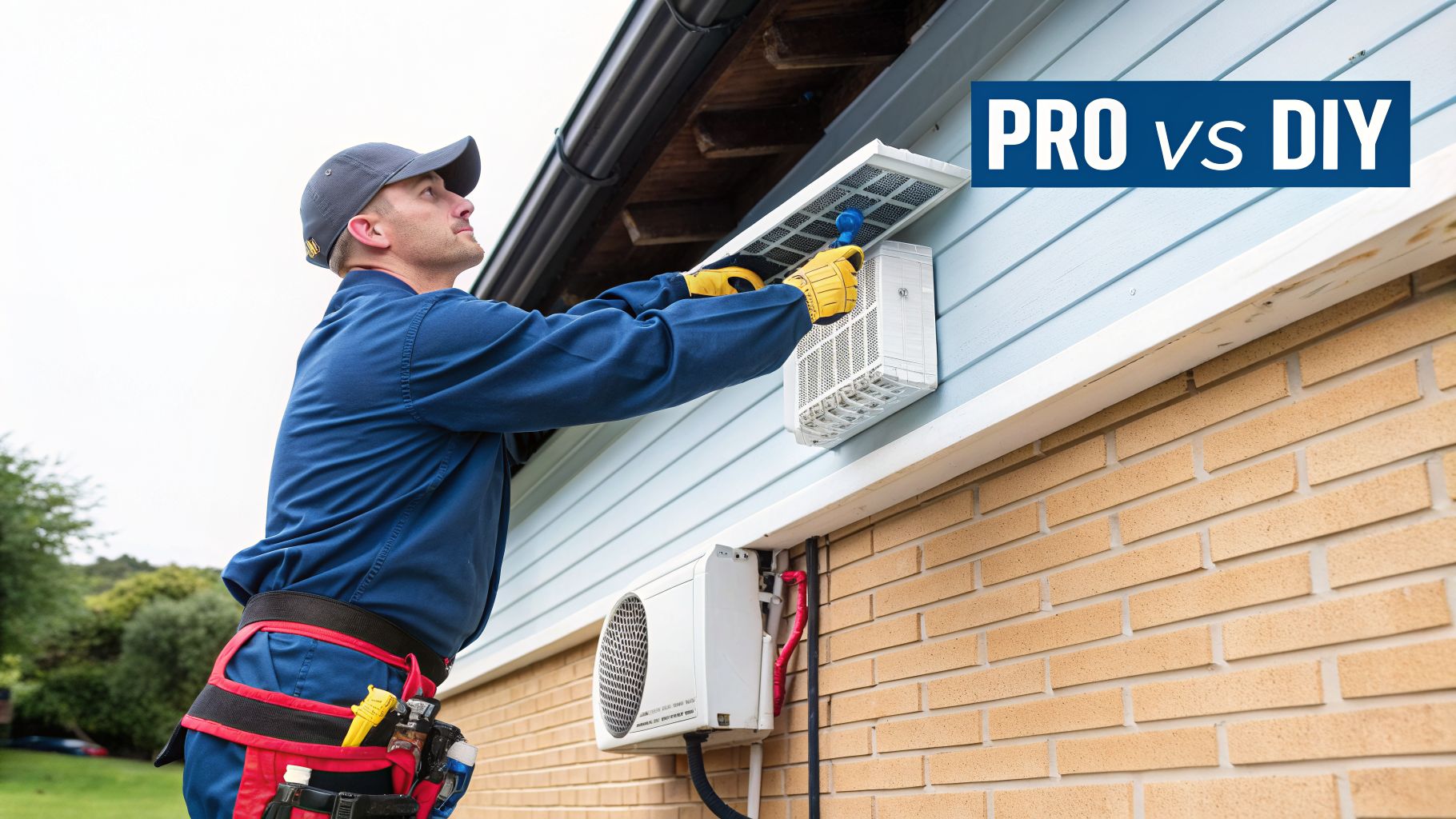
So, should you install the unit yourself or call a pro?
Honestly, plugging in a portable AC or sliding a window unit into place is a totally reasonable weekend project for most handy folks. But the story changes completely when you step up to a permanent, high-performance solution like a ductless mini-split.
The Risks of DIY Mini-Split Installation
A ductless mini-split is the top choice for a reason—it’s powerful, quiet, and incredibly efficient. That performance, however, is directly tied to a correct installation, which is a lot more involved than a few YouTube videos might suggest.
First, there’s the electrical side. These systems almost always need a dedicated 240-volt circuit run straight from your home’s main panel. This isn’t like wiring a new light switch. It involves high voltage, proper load calculations, and a real risk of fire if you get it wrong.
Then you have the refrigerant. The fluids that make an AC work, like R-410A, are strictly regulated by the federal government for a reason. Only an EPA Section 608 certified technician is legally allowed to handle them. A DIY attempt that causes a refrigerant leak isn't just bad for the environment and illegal—it will cause your brand-new system to fail.
Why Professional Installation Is a Smart Investment
Hiring a professional isn't just about avoiding problems; it's about making sure you get every bit of performance and efficiency you paid for. An experienced technician guarantees every part of your new AC works perfectly from day one.
If you’re not sure who to trust, our guide on how to choose the right HVAC company is a great place to start.
Here’s what a real pro brings to the job:
- Correct Sizing and Placement: We don't guess. A proper load calculation considers your garage's insulation, sun exposure, and how you plan to use the space to pick the right size unit. We also know the best spot for the indoor and outdoor units to maximize airflow and efficiency.
- Safety and Code Compliance: Licensed installers make sure all electrical work is up to local code, keeping your home and family safe. No shortcuts.
- Warranty Protection: This one is huge. Most major manufacturers, including top brands like Trane, will void the warranty if the system isn't installed by a licensed HVAC professional. A pro install protects your investment for the long haul.
You know what? The money you might "save" on a DIY installation is often lost tenfold in efficiency losses, costly repairs, and a voided warranty. A professional install guarantees the system performs at its peak SEER2 rating, saving you money on every energy bill.
What to Expect During a Professional Install
When a team from a company like Comfort Experts shows up, the process is structured, clean, and transparent. We’ve done this thousands of times.
Here is a quick checklist of what to expect:
- Site Assessment: We confirm the final placement for the indoor and outdoor units and map out the cleanest path for the refrigerant lines.
- Mounting: We securely mount the indoor air handler inside and set the outdoor condenser on a solid, level pad.
- Core Drilling: We drill a small, neat hole (usually about 3 inches) through the wall for the line set, which is then completely sealed.
- Line Set and Electrical: We carefully run and connect the refrigerant lines, communication wire, and power between the two units.
- System Charging: This is non-negotiable. We use a vacuum pump to pull every bit of air and moisture out of the lines before charging the system with the exact amount of refrigerant specified by the manufacturer. This step is absolutely critical for performance and longevity.
- Final Checks and Commissioning: We power up the unit, run it through all its cycles, check temperatures, and then walk you through how to use your new system and remote.
Choosing the best air conditioner for a garage is a big decision. Making sure it’s installed correctly is the final, crucial step to guaranteeing years of comfort and efficiency.
Frequently Asked Questions About Garage Air Conditioners
Even with a game plan in mind, you probably still have a few questions rolling around. That’s smart. Making a big upgrade to your garage is worth thinking through, so we've gathered a few of the most common questions we hear from Phoenix homeowners.
How Much Does It Cost to Air Condition a Garage in Arizona?
Let’s get right to the numbers. The final cost to cool your garage really depends on which road you take. A small, off-the-shelf portable AC might only run you a few hundred dollars, which is tempting for a quick fix.
But for a permanent solution, a professionally installed ductless mini-split system for a typical two-car garage usually falls in the $3,500 to $7,000 range. While that’s a bigger upfront investment, its massive efficiency advantage means you’ll save a lot more on your power bills over the long haul. It’s almost always the smarter financial move over the unit's lifetime.
Can I Just Use a Portable AC in My Garage?
You can, but it's important to set realistic expectations. For a small, single-car garage that you only use occasionally, a portable AC can definitely knock the worst of the heat down.
The catch is that portable units just aren’t very efficient, and you have to deal with venting the hot exhaust somewhere. For any two-car garage or for anyone wanting a truly powerful, permanent cooling system that can handle a brutal Arizona summer, a ductless mini-split is the way to go for consistent comfort.
A common mistake is thinking all cooling is the same. Here in Phoenix, a portable AC often just makes the garage "less hot." A properly sized mini-split system transforms it into a genuinely comfortable, climate-controlled space you can actually use all year.
Does Adding AC to My Garage Increase My Home's Value?
Absolutely. In a climate like ours, a fully air-conditioned garage is a huge selling point that makes a house stand out. You’re not just adding comfort; you’re adding valuable, usable square footage to your property, and buyers notice.
A finished garage that doubles as a workshop, a home gym, or just secure, climate-controlled storage is a feature that grabs attention. A professional install like a ductless mini-split doesn't just improve your daily life—it can deliver a real, tangible return on your investment when you decide to sell. It sends a clear signal that the home has been well-maintained and thoughtfully upgraded. A great first step is also looking into simple garage insulation strategies to maximize your investment.
Ready to turn your garage into a comfortable, usable space all year long? The team at Comfort Experts has been delivering honest diagnostics and expert installations across the Phoenix Valley since 2011. As a licensed, insured (ROC #275914), and locally owned Trane partner, we have the experience to recommend and install the perfect cooling solution for your garage. For fair pricing and fast, reliable service, call us today at 480-207-1239 or schedule service online to get a personalized consultation.


![Read more about the article Commercial HVAC Maintenance Contracts Explained [Updated 2026]](https://azcomfortexperts.com/wp-content/uploads/2026/04/commercial-hvac-maintenance-contracts-hvac-contracts-300x169.jpg "Commercial HVAC Maintenance Contracts Explained [Updated 2026] 7")