Are you tired of battling sneezing fits, itchy eyes, and a stuffy nose right inside your own home? For many of us here in the Phoenix area, the air indoors is surprisingly loaded with allergens like dust and pollen. If that sounds familiar, you already know that finding the best air purifiers for allergies isn't a luxury—it's a critical step toward a healthier, more comfortable life.
Why Your Home Might Be an Allergy Hotspot
Your home is supposed to be your sanctuary, but have you ever wondered if microscopic intruders are turning it into the epicenter of your allergy symptoms?
Airborne particles like dust, pet dander, and pollen sneak in through doors and windows, get trapped inside, and just keep circulating through your air. Here in Arizona, our dry climate and frequent dust storms only make things worse. All those particles can trigger relentless sinus irritation, wrecking your sleep and your overall comfort.
The frustrating truth is that indoor air can be significantly more polluted than the air outside. That’s why tackling your indoor air quality is absolutely essential if you’re suffering from persistent allergies.
As experts in indoor air quality for over 20 years, we've seen firsthand how the right air purifier can transform a living space from an allergen trigger zone into a clean air haven, built to handle the unique challenges of our Arizona environment.
How Air Purifiers Trap Invisible Allergens
So, how do these machines actually pull irritating allergens out of the air and give you some relief? Think of an air purifier as a high-tech net for all the invisible gunk floating around your home—pollen, dust mites, pet dander, and mold spores. It uses a fan to suck in the room's air and shoves it through a series of very fine filters.
It's a bit like an incredibly advanced sieve, one that’s fine enough to catch microscopic particles while letting fresh, clean air pass right back out. This isn't a one-and-done process, either. The best purifiers use a multi-stage approach to make sure nothing gets missed.
The One-Two Punch of Filtration
Most high-quality air purifiers rely on a simple but effective combination to really scrub your air clean. This system is designed to snag a whole range of particle sizes, from the dust bunnies you can see to the pollen you can't.
- The Pre-Filter: This is your first line of defense. Its main job is to grab the big stuff like pet hair, lint, and larger clumps of dust. This not only cleans the air of obvious debris but also acts as a bodyguard for the more sensitive main filter, helping it last longer.
- The Main Filter: Once the air gets past the pre-filter, it's forced through the most important component. For anyone dealing with allergies, this is almost always a True HEPA filter—the undisputed gold standard for allergen removal.
The power of this combo is its efficiency. The pre-filter handles the heavy lifting, which lets the HEPA filter focus all its energy on trapping the tiny, invisible troublemakers that make your sinuses miserable.
Why HEPA Filters Are the Gold Standard for Allergies
"HEPA" stands for High-Efficiency Particulate Air, and a True HEPA filter isn't just a marketing term. It’s a government standard, and this is where the real magic happens for allergy sufferers.
A True HEPA filter is certified to capture a whopping 99.97% of airborne particles as small as 0.3 microns. For a little perspective, a single human hair is about 50-70 microns thick. These filters are grabbing the stuff you can't see—pollen, mold spores, and pet dander—that your immune system hates.
For homeowners here in Phoenix battling seasonal allergies or year-round dust, a purifier with a HEPA filter can be a game-changer. Our experience installing these systems has shown they can significantly reduce symptoms for our clients. In fact, some clinical studies have shown they can reduce asthma attacks by up to 39% just by removing these common triggers from the air.
Of course, a portable purifier is just one part of the solution. Understanding the role of the main air filters for your home is just as important, since your HVAC system is constantly moving air, too. It all works together to create a cleaner, more breathable space.
Understanding the Metrics That Matter
When you start shopping for an air purifier, you’re hit with a confusing alphabet soup of acronyms: HEPA, CADR, ACH. Honestly, it can feel like you need an engineering degree just to figure out which machine is right for your home.
But these terms are just the industry's way of measuring how well a machine actually cleans your air. Let's break them down into plain English. Knowing what they mean is the key to choosing a purifier that will genuinely help your allergies, not just one that looks good on the shelf.
The Gold Standard: HEPA Filtration
You'll see "HEPA" thrown around a lot, but not all HEPA filters are created equal. For real allergy relief, what you absolutely need is a True HEPA filter. This isn't just marketing fluff; it's a strict performance standard.
A certified True HEPA filter is lab-tested to capture 99.97% of airborne particles as small as 0.3 microns. To put that in perspective, the common culprits that trigger your sneezing and itchy eyes—pollen, pet dander, and mold spores—are all easily trapped by a filter this effective.
Be wary of anything labeled "HEPA-type" or "HEPA-like." Those don't meet the rigorous standard and can let smaller, irritating particles pass right through.
This simple diagram shows exactly how it works—drawing in dirty air and pushing out clean air.
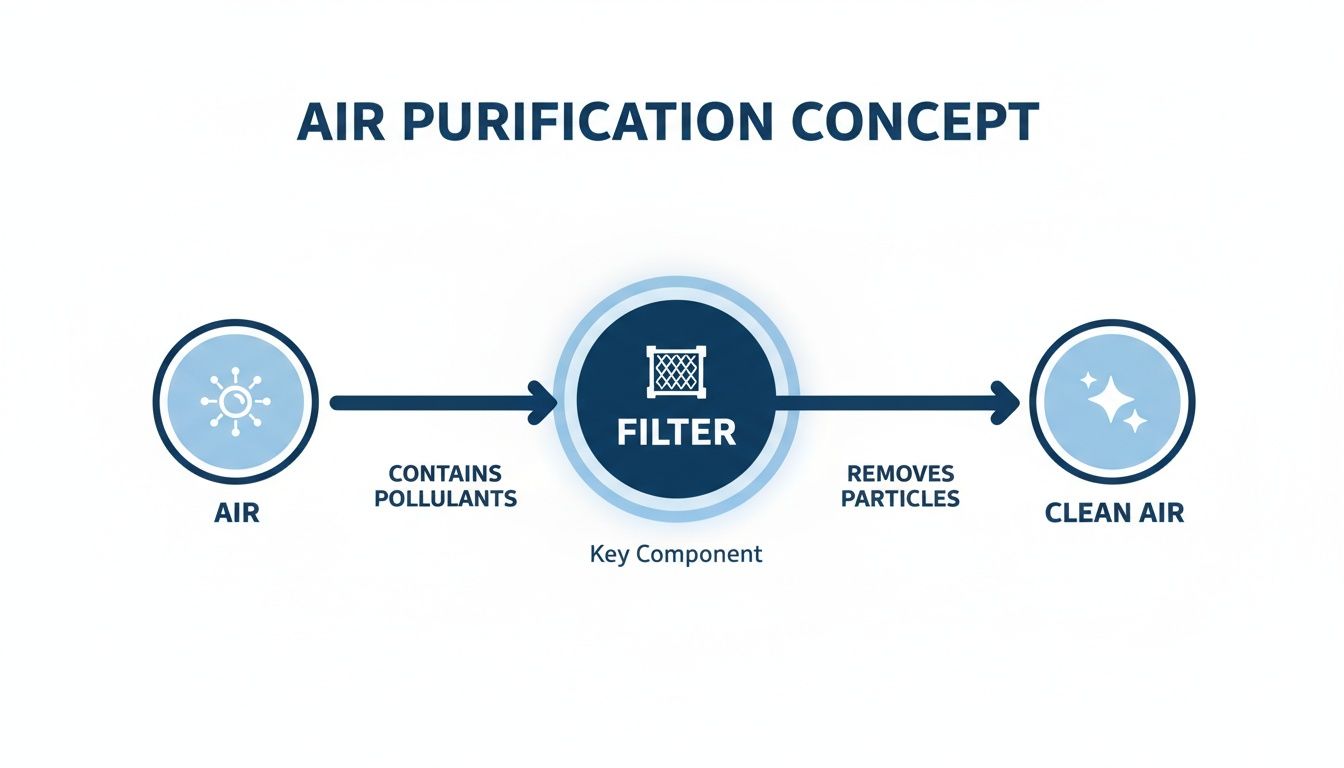
It's a straightforward concept: the fan pulls air through a dense filter, physically trapping the tiny particles you don't want to be breathing.
Your Measures of Speed and Power: CADR and ACH
So, a great filter is essential. But how do you know if the machine is powerful enough for your room? That's where two other key metrics come into play.
CADR (Clean Air Delivery Rate): This number tells you how quickly the purifier can clean the air in a specific room size. It’s measured for three common pollutants (dust, pollen, and smoke), and a higher CADR means faster cleaning. A good rule of thumb is to pick a model with a CADR that is at least two-thirds of your room's square footage. For a 150-square-foot bedroom, you’d want a dust CADR of at least 100.
ACH (Air Changes per Hour): This tells you how many times the purifier can filter all the air in a room every hour. For allergy sufferers, this is huge. You want a unit that can deliver 4 to 5 ACH. This ensures allergens are being pulled from the air constantly, keeping their concentration low and giving you consistent relief.
Think of it this way: CADR helps you match the purifier's horsepower to your room size, while ACH confirms it can clean the air frequently enough to keep your symptoms under control.
Air Purifier Metrics at a Glance
This table helps you understand the key performance indicators for air purifiers at a glance.
| Metric | What It Means for Allergies | What to Look For |
|---|---|---|
| HEPA | The filter's ability to trap tiny particles like pollen, dander, and mold. | A True HEPA certification, which captures 99.97% of particles down to 0.3 microns. Avoid "HEPA-type." |
| CADR | The speed and volume of air the unit can clean. | A CADR rating that is at least 2/3 of your room's square footage (e.g., 100 CADR for a 150 sq. ft. room). |
| ACH | How many times per hour the machine filters the entire room's air. | A rating of 4-5 ACH for the specific room size to keep allergen levels consistently low. |
These three metrics—HEPA, CADR, and ACH—are your best friends when comparing different models.
Beyond the Acronyms: Other Crucial Factors
While the technical specs are critical, a few other details will determine whether you actually love—and use—your air purifier day in and day out.
Ozone Generation Concerns
Some purifiers use ionizers or UV-C lights that can produce ozone as a byproduct. Ozone is a known lung irritant that can make respiratory issues like asthma even worse. To be safe, it's best for allergy and asthma sufferers to stick with purifiers that rely on mechanical filtration (like HEPA and carbon filters) or at least ensure those electronic features can be turned off completely.
Noise Levels and Filter Costs
Let's be real—if your air purifier sounds like a jet engine, you're not going to run it 24/7. Look for models that list their noise level in decibels (dB). A unit that operates around 50 dB on high is similar to a quiet refrigerator, while settings under 30 dB are whisper-quiet, perfect for bedrooms.
Finally, think about the ongoing cost of ownership. The filters are what make the machine work, and they don't last forever. Check the price of replacement filters and how often they need to be changed (usually every 6 to 12 months). Factoring this in helps you budget properly so you don't skimp on maintenance down the road.
For a deeper dive into filter maintenance, learn more about how often you should change your air filters in our detailed guide.
Choosing Between Portable and Whole-Home Solutions
Here’s the thing: the best solution for a small apartment isn't the same as for a sprawling family home in Mesa. Once you get the basics of how an air purifier works, the next big question is a matter of scale. Should you get a standalone, portable unit for one room, or invest in a system that cleans the air in your entire house?
This decision really boils down to your specific living situation, your budget, and just how widespread your allergy problems are. A college student in a dorm has totally different needs than a family with pets, a few allergy sufferers, and a much larger home.
Let's break down the practical differences to help you figure out which path makes the most sense.
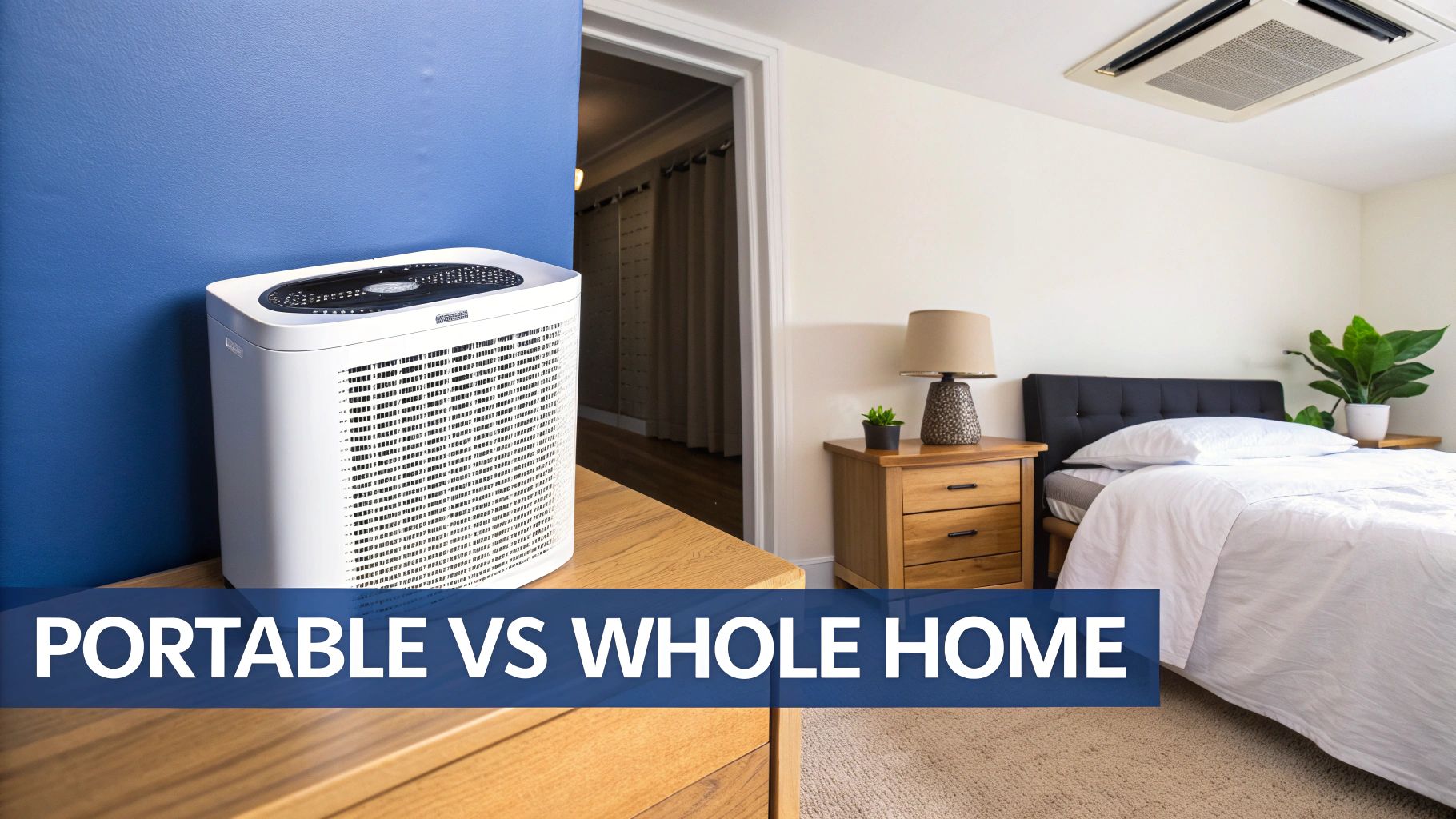
Portable Single-Room Air Purifiers
Portable air purifiers are what most people picture—standalone units you plug into a wall outlet. They’re built to clean the air in a single, defined space, like a bedroom, home office, or living room.
Their biggest advantage is flexibility and a lower initial cost. You can grab one for the most critical area (like the bedroom, to get better sleep) and just see how it works for you. If you decide you need more coverage later, you can always add another one.
The catch, though, is that their effectiveness is limited. A purifier running in the living room won't do a thing for the allergens building up in your bedroom on the other side of the house. This targeted approach means you’re only getting pockets of clean air, while allergens keep circulating everywhere else.
Whole-Home Air Filtration Systems
A whole-home solution takes a completely different angle. Instead of placing small units in different rooms, a powerful filtration system is installed directly into your home’s existing HVAC system. This means that every single time your air conditioner or heater kicks on, it’s pushing clean, filtered air through every vent in your house.
The result is consistent, house-wide air quality. You aren’t just cleaning one room; you’re treating the air in your entire home as one integrated system. This is a game-changer for families where multiple people have allergies or for homes with pets that spread dander everywhere. You can learn more about our whole-home air purifiers and see how they fit into a setup like yours.
A whole-home system treats the source of your air circulation—the HVAC unit—transforming it into a massive, house-wide air purifier. This proactive approach ensures that clean air is distributed evenly and consistently, rather than just playing defense in one room at a time.
A Practical Comparison
The growing focus on health has really pushed the air purifier market forward. In the residential world, demand jumped 25% from 2021-2025, hitting USD 5.25 billion globally. This trend shows that more and more people understand that clean indoor air is a cornerstone of a healthy home.
To help you make the right call, let's compare these two options side-by-side on the factors that matter most.
| Feature | Portable Air Purifiers | Whole-Home Filtration Systems |
|---|---|---|
| Effectiveness | Cleans a single room; limited impact on overall home air quality. | Cleans the air in the entire house consistently through the HVAC system. |
| Initial Cost | Lower upfront investment (typically $150 – $800 per unit). | Higher upfront investment for professional installation. |
| Ongoing Costs | Requires frequent filter replacements for each individual unit. | Filter replacements are less frequent (often once or twice a year). |
| Maintenance | Multiple units to clean and maintain filters for. | A single, centralized filter to manage as part of HVAC maintenance. |
| Space & Noise | Takes up floor or table space; can be noisy depending on the model/setting. | Invisible and silent, as it operates within your existing ductwork. |
For a single person in a small apartment focused on sleeping better, a high-quality portable unit in the bedroom might be the perfect fit. But for a family in a larger Phoenix home with pets and constant dust, the piecemeal approach of portable units often falls short. In that scenario, a whole-home system offers a far more effective, convenient, and ultimately powerful solution for getting true allergy relief.
Advanced IAQ Upgrades for Phoenix Homes
A good portable unit can absolutely be one of the best air purifiers for allergies. But sometimes, it’s just not enough—especially if you have serious sensitivities or you’re aiming for the absolute cleanest air possible.
Let me explain: your home’s HVAC system can either be your greatest ally or your worst enemy in this fight. It’s the system that circulates air through every single room. If it's compromised, it can spread allergens far more effectively than any purifier can clean them up.
This is where we have to look past standalone gadgets and think about the bigger picture of your home's indoor air quality (IAQ). For Phoenix homes, where dust and pollen are a year-round battle, tackling the entire system is the only way to get lasting relief. These advanced upgrades work together to stop allergens at the source, not just trap them after they’re already floating around your living room.
Stopping Allergens at the Source with Ductwork Solutions
Think of your ductwork as your home’s respiratory system. Air is constantly moving through these hidden channels, delivering comfort to every room. But over time, those ducts can fill up with an unbelievable amount of dust, pet dander, old construction debris, and even mold.
Even worse, tiny leaks and gaps are incredibly common. These little cracks pull dusty, allergen-filled air from attics, crawlspaces, and wall cavities, and then blow it straight into the rooms where you live and breathe. No matter how hard your purifier works, it's fighting a losing battle against a constant stream of new pollution.
That’s why the first step in a truly effective IAQ strategy is often to address the ducts themselves. If your air delivery system is dirty or leaky, you’re just circulating the very allergens you’re trying to eliminate.
Professional duct cleaning is a powerful place to start. Our technicians use specialized tools to dislodge and remove years of built-up gunk, making sure the air passing through is clean right from the get-go.
The Power of Professional Duct Sealing
After cleaning, sealing up those leaky ducts is the next critical move. Even small cracks can make a huge difference in your air quality—and your energy bills.
One of the most effective methods out there is Aeroseal duct sealing. The process involves pressurizing your duct system and injecting a non-toxic, aerosolized sealant. This sealant automatically finds and seals leaks from the inside out, creating a virtually airtight system. To see how it works, check out our guide on how Aeroseal duct sealing can improve your home's air quality.
For allergy sufferers, this approach delivers two huge benefits:
- Blocks Incoming Pollutants: By sealing off pathways from your attic and walls, you prevent unfiltered, allergen-laden air from ever getting into your living space.
- Improves HVAC Efficiency: A sealed system ensures all your conditioned air gets where it's supposed to go, which improves comfort and cuts down on energy waste.
Going Beyond Filtration with UV Air Scrubbers
Now, let's talk about the microscopic threats that even the best filters can't fully stop. While a HEPA filter is fantastic at trapping particles like dust and dander, it can't actually kill living microorganisms like bacteria, viruses, and mold spores. Those captured germs can even keep multiplying right there on the filter surface.
This is where UV air scrubbers come in. These devices are installed directly inside your HVAC system and use powerful ultraviolet (UV-C) light to actively neutralize airborne pathogens.
As air passes through your system, it’s zapped with this germicidal light, which scrambles the DNA of microorganisms and makes them harmless. It's like having a sanitization chamber inside your ductwork, constantly sterilizing the air before it's delivered to your rooms.
This technology is a game-changer for:
- Homes with Mold or Mildew Concerns: UV light is extremely effective at killing mold spores, stopping them from spreading through the house.
- Families with Vulnerable Members: It adds an extra layer of protection against common airborne viruses and bacteria.
- Reducing Odors: Many air scrubbers also use photocatalytic oxidation (PCO) to break down odors from pets, cooking, or chemicals.
By combining professional duct cleaning, sealing, and a UV air scrubber, you create a powerful, multi-layered defense. You’re not just filtering the air in one room—you’re ensuring the air throughout your entire home is as clean, pure, and allergen-free as possible. This kind of holistic approach transforms your HVAC system from a potential problem into the cornerstone of your home's health.
Maintaining Your System for Lasting Relief
Buying one of the best air purifiers for allergies is a great start, but its real success comes down to something much simpler: keeping it clean. An air purifier with a choked-up filter is like a sports car trying to breathe through a straw—it just won't perform. To get that long-term relief you’re after, you have to keep the machine running like new.
Think of your purifier’s filter as a sponge. Every day, it’s soaking up dust, pet dander, pollen, and all the other gunk floating around your home. Sooner or later, that sponge gets completely full and can’t absorb anything else. When your filter hits that point, airflow drops, and its ability to clean the air takes a nosedive.
This is where a little bit of routine care makes all the difference. It protects your investment and, more importantly, ensures your family keeps breathing clean, fresh air for years to come.
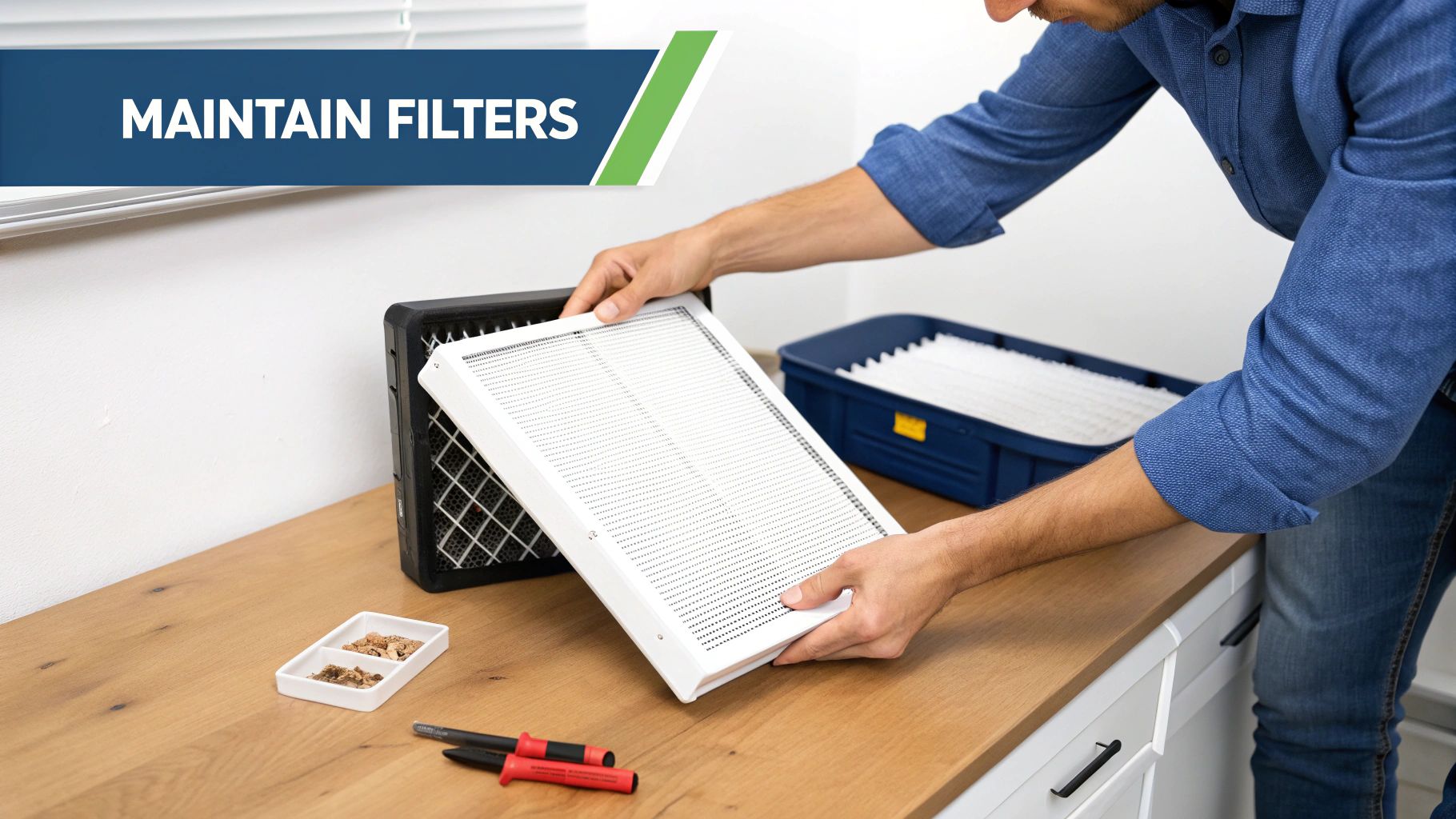
A Simple Maintenance Checklist
Keeping your portable air purifier in fighting shape isn't a huge chore. It really just boils down to a couple of key tasks anyone can handle.
- Filter Replacements: This is the big one. A True HEPA filter will usually need to be swapped out every 6 to 12 months. The activated carbon filters often need a bit more attention, typically every 3 to 6 months. Always check your owner’s manual, though, because every model is a little different.
- Regular Cleaning: Give the outside of the unit a quick wipe-down with a dry cloth about once a month. Pay special attention to the intake grills where air gets pulled in. This quick step stops dust from building up and blocking airflow before it even gets to the filter.
You know what? Forget the calendar for a second. The best guide is often just a visual check. If you pull the filter out and it looks dark, fuzzy, or caked with grime, it's time for a new one—even if the manual says you have another month to go.
Caring for Whole-Home Systems
Now, if you have a whole-home filtration system, the upkeep is a little different because it’s tied directly into your HVAC unit. You won’t be wiping down a portable device, but keeping the entire system healthy is even more critical for your home’s air quality.
The big, thick media filter in your HVAC system becomes the main line of defense. These high-efficiency filters have a much longer life than the ones in portable units, often lasting anywhere from 6 months to a full year.
But the real secret to keeping a whole-home system at peak performance is professional servicing. The system relies on your entire HVAC setup—the fan, the coils, the ductwork—to work correctly. If airflow is weak or components are dirty, even the best filter won't be able to do its job. Professional tune-ups make sure everything is working in sync.
And if you want to tackle allergens at their source, it’s worth looking into how professional duct cleaning services can clear out years of built-up dust and debris from your air ducts.
Got Questions? We've Got Answers.
We've thrown a lot of information your way, but you might still be mulling over a few things. That’s perfectly normal. To help you feel completely confident, here are some straight-up answers to the questions we hear most often from Phoenix homeowners.
How Long Does It Take for an Air Purifier to Clean a Room?
This really comes down to the unit's CADR (Clean Air Delivery Rate) and the size of your space. A correctly sized purifier is a workhorse, designed to circulate and filter all the air in a room about 4 to 5 times every hour.
So, what does that feel like? You'll likely notice a real difference within the first few hours. The key, though, is to let it run continuously. Think of it less like a sprint and more like a marathon runner—it needs to keep a steady pace to keep those allergen levels down for good.
Do Air Purifiers Help with Phoenix Dust Storms?
They absolutely do. While a purifier can't stop a haboob from rolling in, a good one with a True HEPA filter is your best defense against the aftermath. It’s incredibly effective at trapping the fine, gritty particulate matter (PM2.5) that those dust storms shove into every crack and crevice of your home.
Running your purifier during and after a dust storm is a game-changer. It can drastically cut down on the airborne dust and allergens swirling around inside, giving you a safe haven when the air outside is a mess. For anyone living in Arizona, it's pretty much a must-have tool.
Will an Air Purifier Get Rid of Pet or Smoke Smells?
Yes, but this is where you have to look beyond the HEPA filter. A HEPA filter is a master at trapping physical particles—things like dust, dander, and pollen. It can’t do a thing about gases and odors.
To tackle smells, you need a unit that also includes an activated carbon filter. This is the secret weapon. The carbon's porous surface acts like a sponge, absorbing smoke, cooking fumes, pet odors, and other volatile organic compounds (VOCs). For the best all-around performance, you’ll want a model that combines both a HEPA filter for particles and an activated carbon filter for odors and gases.
Take Control of Your Indoor Air Quality Today
You’ve now got a solid handle on how air purifiers work, what the numbers on the box actually mean, and the different ways you can tackle airborne allergens. If you're tired of letting allergies run your life and want a real, complete solution for your Phoenix home, our team at Comfort Experts is here to help.
Taking a bigger-picture view is where you’ll see the best results. Even small adjustments to things like your bedding choices and indoor air quality can move the needle. But for a truly healthier home that brings lasting relief, a comprehensive strategy makes the biggest impact. You can see how we approach the entire home environment by exploring our other indoor air quality solutions.
When you're ready to get serious about breathing easier, give us a call at 480-207-1239 or schedule service online with our trusted technicians. Let's get your family the clean, comfortable air they deserve.