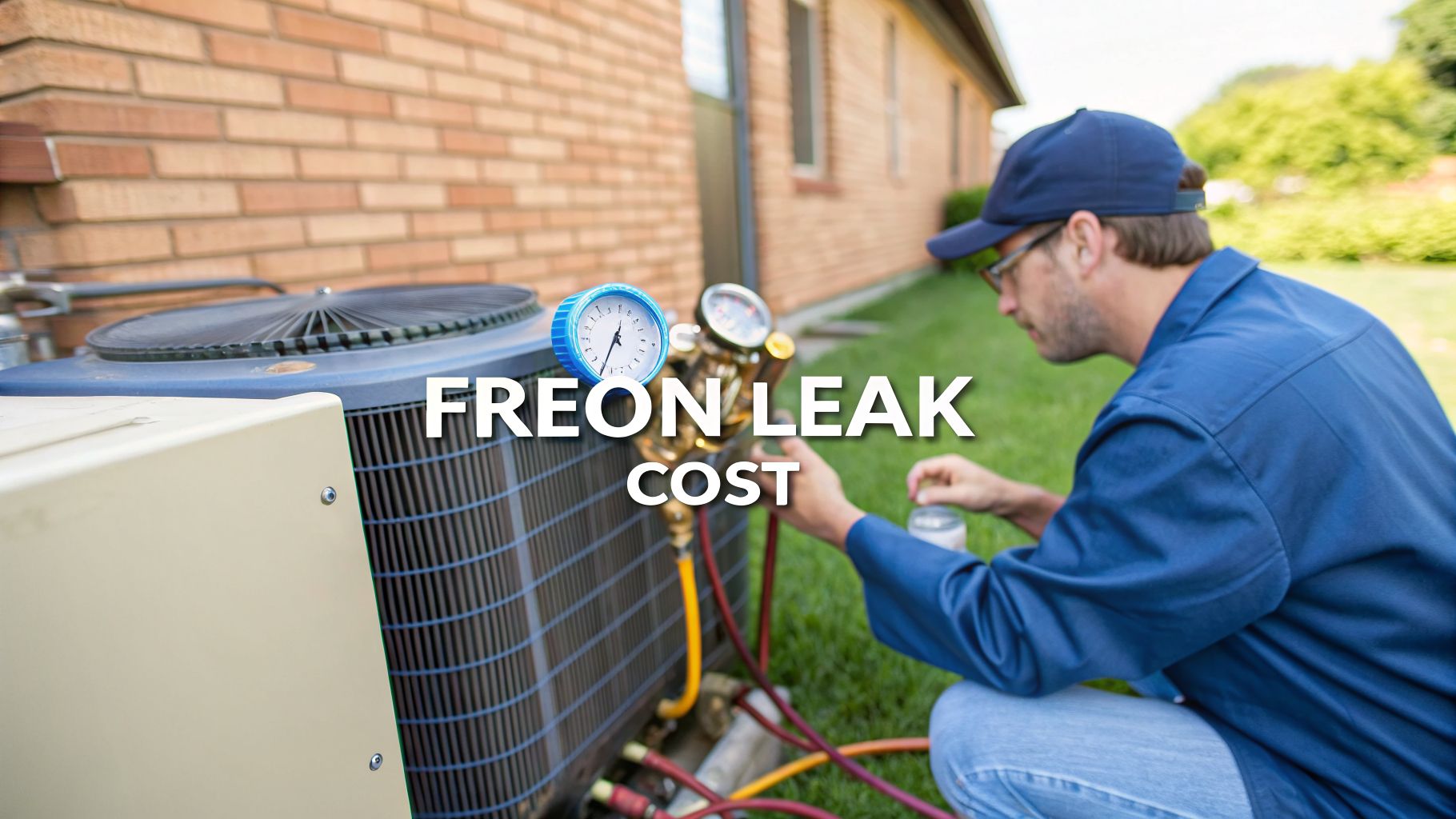
That sinking feeling when your AC gives up during a Phoenix summer is bad enough. It's usually followed by the even more dreaded question, "How much is this going to cost?" If you're worried about the cost of fixing a freon leak in an air conditioner, you’ve come to the right place for honest answers.
Let's cut right to it. The total cost of fixing a freon leak in an air conditioner can be anywhere from $350 to over $2,500. I know, that's a huge range. It’s because the final bill isn't for one thing; it's a combination of finding the leak, physically fixing it, and then refilling the lost refrigerant. Each of those steps comes with its own price tag.
The Real Cost of an AC Freon Leak

When your air conditioner isn't blowing cold anymore, it’s natural to worry about the repair bill. A freon leak—or more accurately, a refrigerant leak—isn't a simple, single-price problem. Think of it as a multi-stage process where each step has its own cost.
First, a certified technician has to play detective. We have to find where the refrigerant is escaping, and it’s not always obvious. This diagnostic work alone can take a couple of hours and requires specialized tools like electronic sniffers or UV dye.
Once we’ve pinpointed the source, the next stage is the actual repair. A tiny, easy-to-reach hole in a copper line might be a straightforward brazing job. But if the leak is buried deep inside the evaporator or condenser coil, it becomes a much more complex—and expensive—fix that can sometimes mean replacing the entire coil.
Finally, after the system is sealed tight, it has to be recharged with the right type and amount of refrigerant. This part of the bill can vary wildly. It all depends on what kind of refrigerant your AC uses (like the older, phased-out R-22 or the current standard, R-410A) and just how much of it leaked out.
A General Cost Overview
To give you a clearer picture of what you might see on an invoice, it helps to break down the individual costs. Just remember, these are typical ranges for the Phoenix Valley. Our brutal Arizona heat puts incredible strain on AC systems, which can sometimes lead to more severe and costly failures than in milder climates.
A refrigerant leak is not a normal part of AC operation. It signals a failure that needs a professional repair. A simple "top-off" without fixing the leak is illegal, a waste of your money, and only a temporary band-aid.
Here’s a table that provides a general overview of the costs for each part of the service here in the Mesa and Phoenix area.
Estimated Cost Breakdown for AC Freon Leak Repair in Phoenix Valley
This responsive table summarizes the typical cost ranges you can expect for each stage of repairing a refrigerant leak in a residential AC unit in the Phoenix area for 2026.
| Service Component | Typical Cost Range (2026) | Key Factors Influencing Cost |
|---|---|---|
| Leak Detection Service | $150 – $450 | Method used (electronic sniffer, UV dye, pressure test), accessibility of components. |
| Leak Repair Labor & Parts | $200 – $1,800+ | Location of the leak (line set vs. coil), complexity of the repair (brazing vs. component replacement). |
| Refrigerant Recharge | $150 – $1,200+ | Type of refrigerant (R-410A vs. expensive R-22), amount needed to refill the system. |
As you can see, a simple, accessible leak that's caught early will land on the lower end of that spectrum. A major leak inside a hard-to-reach coil on an older system using expensive R-22 refrigerant is what drives the cost toward that $2,500+ figure.
Understanding Why Your Air Conditioner Is Leaking Freon

Before we can even talk about the cost of fixing a freon leak in an air conditioner, we have to get one thing straight. Unlike gasoline in your car, refrigerant isn't something that gets "used up" over time. Your AC is a sealed system. If it’s low on refrigerant, there is a leak somewhere—100% guaranteed.
Think of the refrigerant lines as the circulatory system for your home's comfort, with the refrigerant itself acting as the lifeblood. A leak is like a slow, steady bleed that weakens the entire system until it just can't do its job of cooling your house anymore. Just "topping it off" without finding the source is like putting a small bandage on a deep cut; it’s a temporary fix that completely ignores the real problem.
Common Culprits Behind Refrigerant Leaks
Here in the Phoenix Valley, our air conditioners work incredibly hard. This constant, heavy use is a major factor in why parts wear down and leaks happen. Over the years, we’ve found that a few common issues are behind the vast majority of the refrigerant leaks we see in local homes.
One of the most frequent offenders is something called formicary corrosion. This is a tricky, microscopic type of corrosion that eats tiny, pinhole-sized leaks into the soft copper tubing of your indoor evaporator coil. It’s caused by a chemical reaction between the copper, moisture in the air, and airborne chemicals called volatile organic compounds (VOCs). These come from everyday household products like paints, cleaners, and even air fresheners. It’s a silent destroyer that’s almost impossible to spot without professional tools.
Another huge cause is simple vibration. Your AC system, especially the big outdoor unit, is constantly vibrating while it runs. After years of shaking through brutal summers, this vibration can weaken the brazed joints and connections where refrigerant lines meet, eventually causing them to crack and leak.
A refrigerant leak is much more than just an inconvenience; it's a critical system failure. When your AC runs low on refrigerant, the compressor—the heart of the entire system—is forced to work way too hard. This causes it to overheat and can lead to a complete burnout. This is how a manageable leak repair can quickly turn into a catastrophic and incredibly expensive compressor replacement.
The Impact of Age and Wear
Age is an undeniable factor. As an AC unit gets older, its components naturally start to break down. Metal weakens, rubber seals dry out and crack, and the service valve caps can work themselves loose. This is especially true for systems that are 10 years or older and have already survived a decade of punishing Arizona summers.
Here are a few other specific failure points we look for first:
- Weakened Joints: The connection points on the outdoor condenser and indoor evaporator coils are common weak spots due to constant expansion and contraction from temperature changes.
- Schrader Valve Cores: These are small access ports, a lot like the valve on a car tire. They can fail over time and create a slow, persistent leak.
- Physical Damage: Sometimes, the cause is just plain obvious. A rock flung from a lawnmower, a clumsy moment during landscaping, or even a hailstorm can easily puncture a refrigerant line.
Understanding these causes is the first real step toward getting a lasting solution. If you're interested in the nuts and bolts of the repair process, check out our detailed guide on how to fix an AC leak. Knowing what causes a leak empowers you to have a much better conversation with your technician and appreciate why a thorough repair is always a smarter move than a quick, temporary recharge.
A Detailed Breakdown of AC Leak Repair Costs
So, you know there’s a leak. Now we get to the part that really matters to your budget: unpacking every line item you might see on the final invoice. Let me explain it this way: figuring out the total cost isn't a one-size-fits-all calculation. The price for a simple, easy-to-reach fix is a world apart from a major component replacement.
To give you a completely transparent look at what to expect, we'll break down the three core stages of any leak repair job: finding it, fixing it, and refilling the refrigerant.
Stage 1: The Diagnostic and Leak Detection Fee
Before anyone can even think about repairs, a technician has to find the exact source of the leak. This isn't a guessing game; it's a methodical process that requires specialized tools. This initial hunt has its own fee, which is separate from the actual repair cost.
Here’s what our Comfort Experts technicians do to find the source:
- Electronic Leak Detectors: You'll often hear us call these "sniffers." These handheld devices are our first line of defense, sensitive enough to detect tiny amounts of refrigerant gas in the air. This lets us quickly zero in on the general area of the problem.
- UV Dye Test: If a leak is playing hard to get, we can inject a special fluorescent dye into your AC system. As refrigerant circulates, the dye escapes right along with it. When we shine a UV light on the components, the exact leak location will glow brightly, leaving no room for doubt.
- Nitrogen Pressure Test: For very small or intermittent leaks, this is the most definitive method we have. We'll evacuate any remaining refrigerant and then pressurize the system with inert nitrogen. Since nitrogen molecules are smaller than refrigerant, they escape more easily. We can then listen for the tell-tale hissing sound or use soapy water to watch for bubbles at the leak site.
The cost for this detection service typically ranges from $150 to $400. The final price really just depends on how much time it takes and which methods we need to use to be 100% certain we've found the leak.
Stage 2: The Cost of the Actual Repair
Once we know where the leak is, the next step is the physical repair. The cost here is almost entirely driven by two things: the location of the leak and the parts needed to fix it. A small, exposed leak is a much simpler and cheaper job than one buried deep inside a major component.
Here are a few common repair scenarios and what they typically cost:
| Repair Type | Description & Common Location | Typical Cost Range (Labor & Parts) |
|---|---|---|
| Brazing a Line Set | A pinhole leak on an exposed copper line. This is a straightforward fix where we solder the hole closed. | $200 – $400 |
| Replacing a Valve Core | The Schrader valve (just like the one on a tire) is leaking. It's a quick and simple component swap. | $175 – $350 |
| Patching a Coil | A small, accessible leak on the outdoor condenser coil. This is more involved than brazing a simple line. | $450 – $900 |
| Replacing an Evaporator Coil | The leak is inside your indoor unit, requiring a full coil replacement. This is a major, labor-intensive job. | $1,500 – $3,000+ |
As you can see, a straightforward braze is a minor expense. But if the leak is in the evaporator coil, the cost can jump significantly. In those cases, you'll need to weigh the repair against a full system replacement, especially if your unit is getting on in years. If a major component like the compressor is the culprit, you might want to look at our guide on the cost to replace an AC compressor to understand those potential expenses.
Let me be blunt: A cheap quote that doesn't involve a thorough leak search is a huge red flag. It likely means the contractor just plans to do a "recharge and run"—a practice that's illegal, wastes your money, and puts your AC's compressor at risk of a catastrophic, expensive failure.
Stage 3: The Refrigerant Recharge Cost
After the leak is permanently sealed, the final step is to recharge the system with the correct amount of refrigerant. The cost of this step can swing wildly based on the type and amount of refrigerant your system needs. This has become a huge factor in the total cost of fixing a freon leak in an air conditioner.
A recent HomeAdvisor analysis found that AC leak repairs can get pricey, and our experience right here in the Phoenix Valley confirms it. With higher local labor rates and the insane stress our heat puts on AC units, costs can range from $1,800 to $4,200 for significant repairs. These figures often include several hours of labor for detection and repair, plus the high cost of the refrigerant itself—especially for older R-22 systems. You can read more about what influences these costs from various industry analyses.
How Refrigerant Type Affects Your Repair Bill
The type of refrigerant coursing through your AC unit is one of the biggest wildcards in your final repair bill. Honestly, this is where the cost to fix a leak can swing from a manageable expense to a major financial headache. Understanding what's actually inside those copper lines is crucial.
Not all refrigerants are created equal, especially when it comes to their price and availability. If your system was installed before 2010, there's a good chance it uses R-22, the refrigerant most people know by its brand name, Freon. But because of its harmful effect on the ozone layer, the U.S. government mandated a complete phase-out of R-22 production and importation as of January 1, 2020.
So, what does that mean for you? If you have an older R-22 system with a leak, the repair costs are going to be significantly higher. The supply of R-22 is now extremely limited, made up only of recycled or stockpiled quantities. This scarcity has sent prices through the roof.
The High Cost of R-22 (Freon)
If your technician discovers your aging system uses R-22, you need to be prepared for a tough conversation about costs. A simple "top-off" has become incredibly expensive.
- Sky-High Prices: The cost of R-22 per pound can run from $100 to $250 or more.
- Large Quantities Needed: A typical residential AC needs 2-4 pounds of refrigerant per ton. A leak that requires a full recharge on a 3-ton unit could mean adding 6-12 pounds of this pricey gas.
- A Temporary Fix: Just topping off a leaking R-22 system is like pouring money down the drain. That expensive gas will just leak out again, and it's illegal to knowingly vent refrigerants into the atmosphere anyway.
Because of these factors, any reputable HVAC company—including us at Comfort Experts—will strongly recommend replacing an old, leaking R-22 system rather than sinking money into a costly and temporary repair. It almost always makes more financial sense in the long run. If you'd like to dive deeper, you can learn more about what Freon is and why it was phased out in our detailed article.
The Current Standard R-410A and Its Future
Modern air conditioners, meaning those made since 2010, use a refrigerant called R-410A. It’s much better for the ozone layer than R-22 and, until recently, was far more affordable. Right now, you can expect to pay between $40 and $90 per pound for R-410A.
However, the regulatory landscape is shifting again. Under the AIM Act, the EPA is now phasing down the production of HFC refrigerants like R-410A due to their high Global Warming Potential (GWP). This phase-down is already starting to nudge prices upward and will continue to do so.
The refrigerant market is constantly changing due to environmental regulations. What is standard today may become obsolete and expensive tomorrow. This trend is a major factor in deciding whether to repair an older unit or invest in a new, future-proof system.
We've seen this movie before. Historical data for Sun Belt cities like Phoenix shows that after the EPA cracked down on R-22 production post-2015, legacy repair costs skyrocketed, forcing many homeowners into full system replacements. Today's R-410A fixes are more moderate, but with 2026 projections showing a potential 25% price hike from HFC phase-downs, reclaimed R-410A could also become very expensive. Industry leaders like Goodman are already adapting to these regulatory changes.
The bottom line? The type of coolant in your AC is a massive factor in your repair bill, both today and in the coming years.
Deciding Between AC Repair and Replacement
When you’re staring at a big repair bill—especially for something expensive like a leaking evaporator coil—you hit a fork in the road. Do you sink more cash into an aging air conditioner, or is it time to put that money toward a brand-new, high-efficiency system?
It’s a tough call, and there’s no single right answer. But there is a smart way to think through it, and we can help you make the best choice for your home and your wallet.
One of the simplest tools we use to help homeowners get some perspective is the "5,000 Rule." Think of it as a quick, back-of-the-napkin calculation.
The 5,000 Rule: Multiply the estimated repair cost by the age of your AC unit in years. If that number is more than $5,000, it’s a strong sign that replacement is the smarter financial move.
Let's say your system is 12 years old and you're looking at a $600 repair for a minor leak. The math is simple: 600 x 12 = $7,200. Even though the repair itself isn't catastrophic, that $7,200 figure tells you you’re putting good money into a unit that’s already past its prime and likely to have more problems soon. In that scenario, a replacement is probably the wiser long-term investment.
Factors Beyond the 5,000 Rule
While the 5,000 Rule is a great starting point, other critical factors come into play. Here in the Phoenix Valley, where a reliable AC is non-negotiable, these details matter even more.
- Age and Efficiency (SEER Rating): An AC unit that's 10-15 years old is already on borrowed time in our climate. On top of that, older units have much lower SEER (Seasonal Energy Efficiency Ratio) ratings. Swapping an old 10 SEER unit for a modern, high-efficiency 16 SEER Trane system can slash your cooling costs from SRP or APS, delivering savings that add up year after year.
- Refrigerant Type: As we’ve covered, if your system still uses the phased-out R-22 refrigerant, any repair that involves a recharge will be incredibly expensive. Pouring more money into an R-22 system is almost never a good investment.
This decision tree shows just how much the refrigerant type can steer your choice.

As you can see, an R-22 system leads straight down a path of high costs and obsolescence, making replacement the only logical choice. An R-410A system, on the other hand, still has viable repair options.
The Financial Realities of an AC Leak in Arizona
Just picture it: it’s the peak of a Phoenix summer, temperatures are sailing past 115°F, and your AC suddenly gives out because of a Freon leak. It’s a nightmare scenario, but it happens.
Industry data shows the average cost of fixing a freon leak in an air conditioner in a major market like ours can range from $1,200 to $3,500. Worse, the extreme heat here can make an existing leak worse, accelerating refrigerant loss by up to 15% faster than in milder climates. Waiting to fix it can also cause your energy bills to spike by 25% or more as the system struggles to keep up.
Ultimately, you have to weigh the short-term pain of a repair bill against the long-term benefits of a full replacement. A new Trane system is a larger upfront investment, but it buys you superior reliability, lower energy bills, and most importantly, peace of mind.
If you're leaning toward a new system, our guide on the cost to replace an AC unit can give you a much clearer picture of what to expect.
Your Trusted Partner in Phoenix Valley Cooling
When your air conditioner gives out during a scorching Phoenix summer, you need more than a quick fix. You need a team you can trust for honest answers, fair pricing on the cost of fixing a freon leak in an air conditioner, and solutions that actually last—not a high-pressure sales pitch.
Here’s the thing: as a local, family-owned business serving Mesa and the greater Phoenix Valley since 2011, we treat our customers like neighbors. Because they are our neighbors. Our whole approach is built on genuine expertise and earning your trust, making sure you get service you can count on when you need it most.
Our Commitment to You
We believe in being straight with you from the moment you call. That isn’t just a slogan; it’s how we run our business every single day.
- Licensed and Insured: We are fully licensed and insured for your protection (ROC #275914), giving you complete peace of mind.
- Customer-First Service: Our job is to solve your problem efficiently and affordably. We’ll give you clear explanations and upfront pricing so you’re never left in the dark.
- Proven Expertise: As a dedicated Trane partner, we have proven expertise in handling all makes and models, from simple refrigerant leak repairs to complex system replacements.
It’s also helpful to know how good local companies make sure you can find them in the first place. Effective local SEO strategies for HVAC companies are what help businesses like ours connect with families who need urgent help with a broken AC.
We’re not a faceless corporation. We are part of your community, and our reputation is built on the thousands of successful service calls and happy homeowners we’ve helped stay cool right here in Arizona.
Choosing the right HVAC partner is a big decision, and it goes way beyond a single repair. You can learn more about what sets a great company apart in our guide on selecting the best HVAC company near you. We’re dedicated to proving we are that company for you.
Common Questions About AC Freon Leaks
When your AC starts acting up, a million questions can race through your mind. It’s totally normal to feel a bit lost in the technical jargon, especially when you’re worried about what a repair might cost. To give you some real-world clarity, we’ve put together answers to the questions our technicians hear most often from homeowners right here in the Phoenix area.
Can I Just Add More Freon Instead of Fixing the Leak?
It’s tempting to think of a refrigerant recharge as a quick, cheap fix—just “top it off” and get back to cool air, right? Unfortunately, that’s never a good idea. For starters, it’s illegal under EPA regulations to knowingly vent these chemicals. It's also a complete waste of money, because that brand-new, expensive refrigerant is just going to leak right back out. You'll be right back where you started, only poorer.
More importantly, it’s actively dangerous for your air conditioner.
Running an AC with low refrigerant forces the compressor—the heart of the entire system—to work way harder than it was designed to. This stress can cause it to overheat and burn out, turning a manageable repair into a catastrophic and costly full system replacement. A certified, professional technician will always find and fix the leak first.
How Can I Tell if My Air Conditioner Is Leaking Freon?
Your AC will almost always give you some warning signs when it’s in trouble. Catching these clues early is the key to minimizing the damage and keeping the final cost of fixing a freon leak in an air conditioner as low as possible.
Here are the tell-tale signs to watch out for:
- AC is blowing warm or lukewarm air: This is the most common and obvious symptom. The system is running, but your home just isn't getting any cooler.
- Your unit runs constantly: If your air conditioner seems to be on all the time but can't reach the temperature on your thermostat, it's likely struggling to keep up due to low refrigerant.
- Ice or frost on the copper lines: Finding a buildup of ice on the refrigerant lines or the outdoor unit is a classic sign of a leak. It seems counterintuitive, but low refrigerant causes the system's pressure to drop, letting the coils get too cold.
- Hissing or bubbling noises: You know what? You might actually hear a faint hissing sound coming from your unit. That’s the sound of refrigerant gas escaping the lines.
- Sudden spike in energy bills: An inefficient system has to run longer and harder to do its job, and that extra work will show up loud and clear on your monthly statement from SRP or APS.
If you spot any of these issues, it's best to turn the system off to prevent more damage and call a pro for an inspection right away.
Is a Freon Leak Dangerous to My Family?
In most homes, a slow refrigerant leak from an outdoor unit poses very little immediate health risk. The gas is heavier than air, but it usually dissipates quickly in the open air.
However, the situation is different if the leak is happening indoors—say, from the evaporator coil in your attic or a utility closet. In a poorly ventilated space, the escaping refrigerant can displace the oxygen in the room. This could lead to symptoms like headaches, dizziness, or even shortness of breath. Because of this risk, not to mention the environmental damage, any suspected leak should be treated as a serious issue needing immediate professional attention.
How Long Does It Take to Fix a Freon Leak?
The time it takes to wrap up a repair can really vary. It all comes down to where the leak is and how bad it is.
- A simple, easy-to-reach leak on an external line might be found, brazed shut, and recharged in just 2-4 hours.
- On the other hand, if the leak is buried deep inside the evaporator coil, the job gets a lot more complicated. The coil often has to be pulled out for the repair or replaced entirely, which can easily stretch the job to 5-8 hours or more.
A proper repair isn't just a quick patch. The full process involves finding the leak, making the repair, pressure testing the system to make sure the fix is solid, pulling a deep vacuum to remove all air and moisture, and finally, recharging the unit with the exact factory-specified amount of refrigerant. Your technician can give you a much better time estimate after they've had a chance to diagnose the problem firsthand.
Don't let a struggling AC ruin your summer. The certified professionals at Comfort Experts are here to provide honest diagnostics and reliable repairs that last. If you think you might have a refrigerant leak, give our local team a call at 480-207-1239 or schedule service online for a fast, expert solution to keep your home cool and your family comfortable.