Nothing’s more frustrating on a cool Phoenix night than a furnace that decides to blow cold air instead of comforting warmth. But when your furnace not blowing hot air, it’s usually a sign of a simple, fixable issue, not a total system meltdown. In fact, many of the service calls we get at Comfort Experts are for problems you can often solve yourself in just a few minutes.
Common Causes When Your Furnace Blows Cold Air
This guide will walk you through the most common culprits we see in the field, from a simple thermostat setting that got bumped to a clogged air filter that's choking your system. As seasoned HVAC professionals with years of experience serving the Phoenix area, our goal is to help you figure out if this is a quick DIY fix or something that needs a professional’s touch, potentially saving you the time and expense of a service call. You know what? A furnace that isn't producing heat is one of the top reasons people call us during the winter, but the good news is that a huge chunk of these issues don't point to a catastrophic failure.
Simple Fixes vs Professional Repairs
Across the HVAC industry, simple maintenance and control issues are behind a surprising number of "no-heat" calls. Industry data shows that about 42–48% of these calls trace back to things like thermostat settings, clogged filters, or power problems—not a broken furnace. Even better, regular tune-ups could prevent up to 75% of these headaches by catching dirty flame sensors or clogged drains before they shut your heat down. If you want to dig deeper into the numbers, Service Champions' blog has some great stats on common failure points.
This flowchart gives you a quick visual guide to start the troubleshooting process.
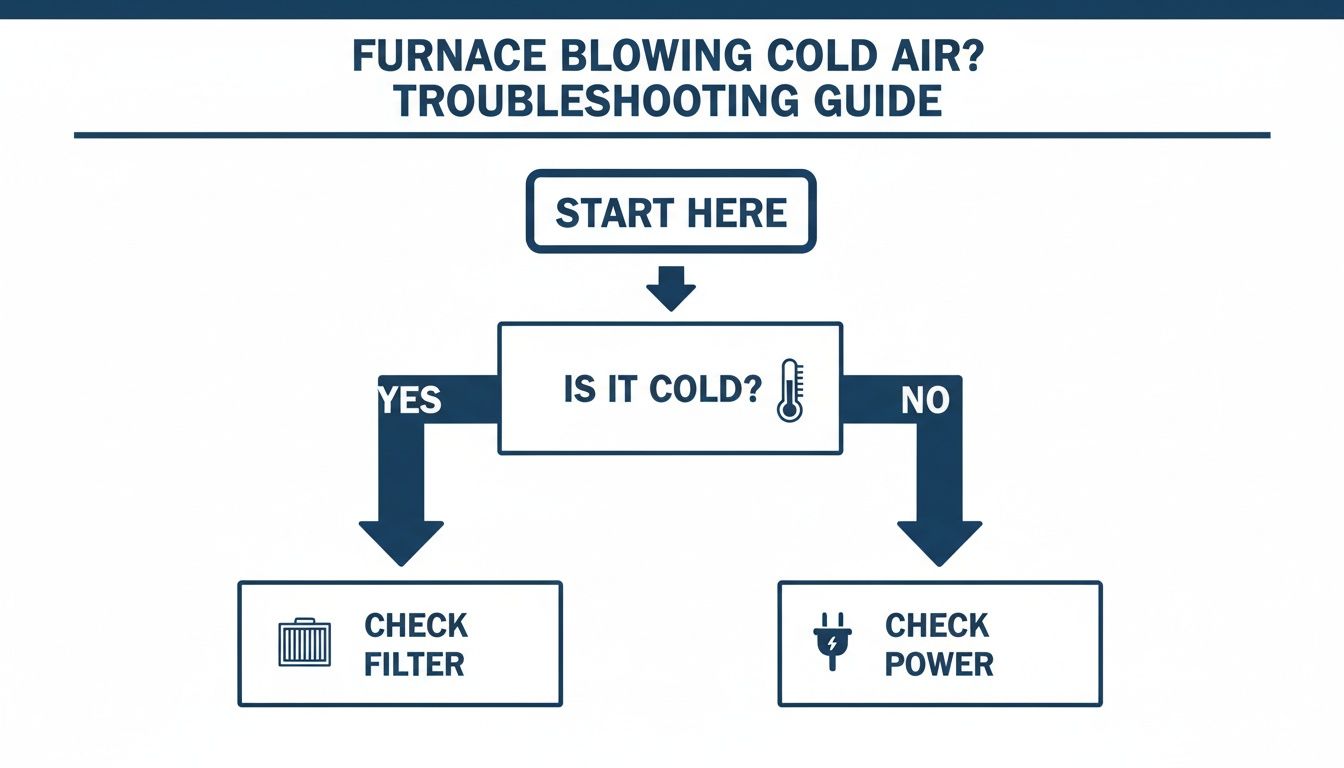
As you can see, the first steps are always the simplest. Based on our direct experience, we always check for power and clear airflow before ever assuming there's a serious mechanical failure. This methodical approach ensures we diagnose problems accurately and efficiently, which is a cornerstone of trustworthy service.
Understanding the Symptoms
Before you start pulling off panels, it helps to match what you’re seeing and hearing with its likely cause. Does your furnace try to start, run for a minute, and then give up? That small detail is a huge clue for a technician.
Pro Tip: Pay close attention to the sequence of events. Does the furnace click on but never ignite? Does it run for a few minutes and then shut off? These small details are crucial clues that speak volumes to a trained technician, helping us pinpoint the problem faster.
Quick Troubleshooting Checklist
Use this table to quickly identify the issue, its potential cause, and whether you can fix it yourself or need to call a professional. This checklist is based on the most frequent issues our team at Comfort Experts encounters.
| Symptom | Potential Cause | Recommended Action |
|---|---|---|
| No air blowing at all | No power to the furnace | Check the circuit breaker and furnace power switch. |
| Air is cool, not lukewarm | Burners aren't igniting | Could be a dirty flame sensor, failed igniter, or gas supply issue. |
| Air is lukewarm, not hot | Restricted airflow | Most likely a severely clogged air filter causing overheating. |
| Furnace runs briefly, then stops | Overheating or sensor issue | A dirty filter is the main culprit; could also be a faulty limit switch. |
This checklist covers the most frequent issues we encounter. If your symptom isn't listed here or the recommended action doesn't solve the problem, it's time to move on to the more detailed steps in the next sections.
Start with the Thermostat and Power Supply
Before you start imagining a worst-case scenario with a busted furnace, let's check the two most common culprits. You'd be amazed how many of our service calls for a furnace blowing cold air get solved right at the wall thermostat, without us ever needing to open up the furnace itself.
Let's start with the simple settings that are so easy to overlook.
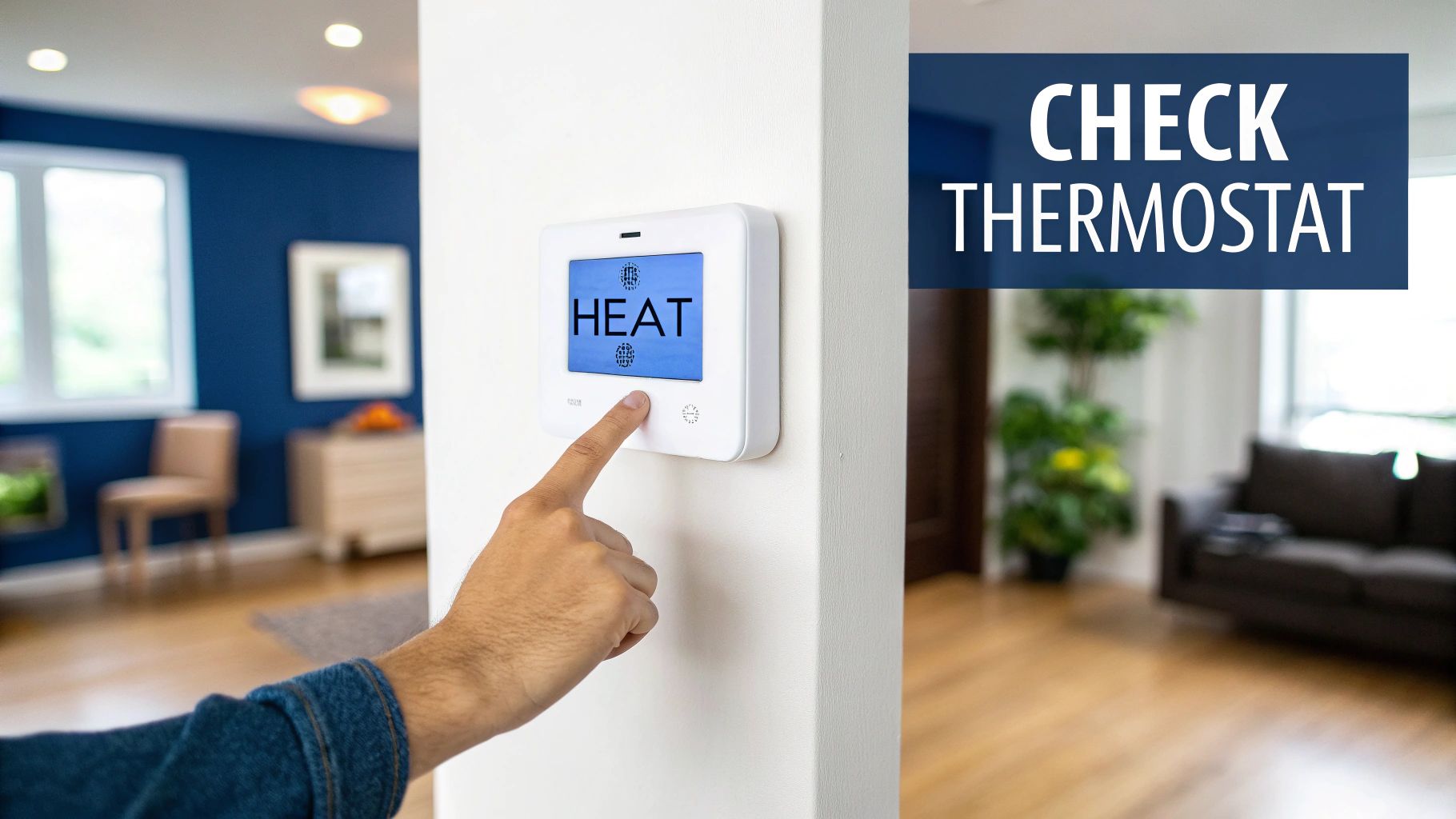
Double-Check Your Thermostat Settings
First things first: make sure your thermostat is actually asking the furnace to make heat. It sounds almost too simple, but a quick check here can save you a lot of frustration.
- System Mode: Is the thermostat set to HEAT? It’s surprisingly easy for it to get bumped to “COOL” or “OFF,” especially after a mild day.
- Temperature Setting: The temperature you set needs to be higher than the current room temperature. If it's not, the furnace has no reason to run. Try bumping it up by five degrees and give it a minute or two to respond.
- Fan Setting: This one gets people all the time. Check if the fan is set to ON instead of AUTO. When the fan is set to “ON,” the blower will run 24/7, circulating air even when the furnace isn't actively heating. This is probably the #1 reason homeowners call us about cool air coming from the vents.
If you've confirmed all these settings are correct, the thermostat itself could be the issue. Low or dead batteries are a common cause of malfunctions, so popping in a fresh set is an easy and inexpensive troubleshooting step. If you’re dealing with more complex thermostat problems or thinking about an upgrade, we have more info on professional thermostat installation in Mesa.
Check for Power at the Breaker Box
Okay, so the thermostat settings are right, but the furnace is still silent. The next place to look is the power supply. A simple tripped breaker is another top contender for why your heat isn't working.
A tripped breaker can create a confusing situation. Sometimes, the indoor blower fan (powered by the air handler's circuit) has power, but the furnace's heating components are on a separate, tripped circuit. The result? The fan runs, but it's just blowing unheated air around your house.
Find your home's main electrical panel and look for the breaker labeled “Furnace,” “Heater,” or “HVAC.” If the switch is flipped to the middle or “OFF” position, push it firmly back to the “ON” side.
If it immediately trips again, do not reset it a second time. This is a clear sign of a more serious electrical problem that needs a professional technician.
Also, look for a dedicated power switch on or near the furnace unit itself—it usually looks just like a light switch. Make sure it hasn't been accidentally turned off.
The Critical Role of Your Air Filter
Let’s be honest—a dirty air filter is the number one reason we get called out for furnace issues across Mesa and the entire Phoenix Valley. It's the simplest thing to check and, thankfully, the easiest to fix.
When that filter gets packed with dust and debris, it's like trying to breathe through a pillow. Your furnace gets suffocated, unable to pull in the air it needs to work correctly.
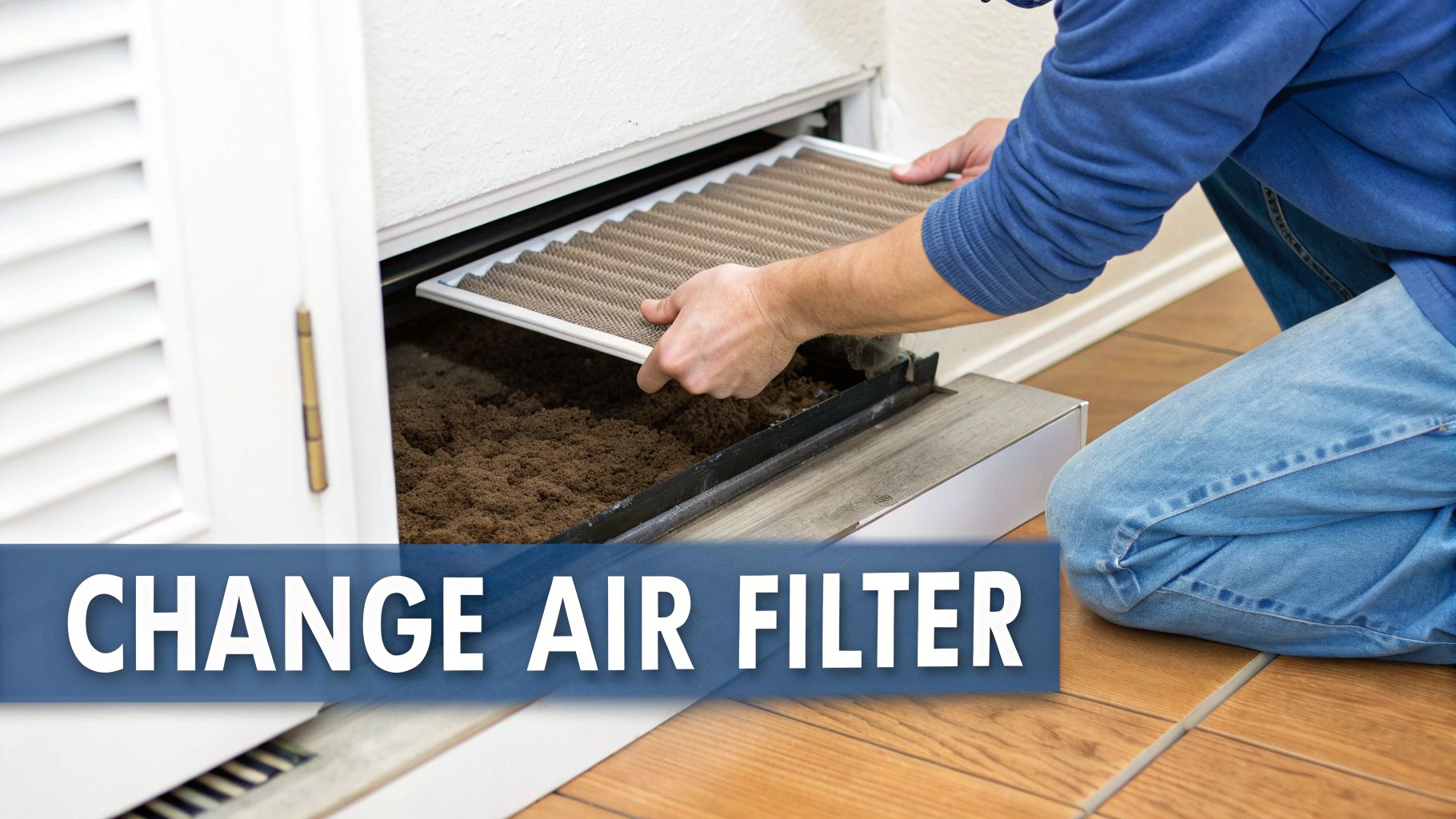
Inside your furnace is a safety device called a high-limit switch. Its only job is to shut down the burners if the internal temperature gets dangerously high. When a clogged filter blocks airflow, all that heat has nowhere to go. The furnace quickly overheats, and click—the safety switch does its job.
The fan, however, might keep running to try and cool things down. That's exactly why you feel cool, unheated air coming from your vents when the real problem is a simple clogged filter.
How to Check and Replace Your Filter
First, you have to find it. The filter is usually in a slot on the side, bottom, or top of the furnace cabinet, right where the big return duct connects. Some homes have it behind a large grille in a wall or ceiling instead.
- Kill the power first. Always. Find the power switch on or near the furnace and flip it off. For good measure, turn it off at the circuit breaker, too.
- Slide the old one out. You may need to open a small access door. Just pull the old filter straight out of its slot.
- Give it the light test. Hold the filter up to a light source. If you can't easily see light passing through it, it’s toast. Time for a new one.
A clogged filter isn't just an inconvenience. It forces your entire HVAC system to work harder, driving up energy bills and putting a ton of strain on expensive parts like the blower motor. This is a fact we see demonstrated in the field constantly; regular filter changes are the single most effective way to extend the life of your equipment.
From a technical standpoint, clogged filters are behind 30–40% of residential heating performance problems simply because they restrict airflow, cause overheating, and trip that high-limit switch.
Why Filter Choice and Schedule Matter in Arizona
Here in our dusty desert climate, you can't get lazy with your filter schedule. For the common 1-inch filters, we tell our customers to swap them out every 30 to 60 days. If you have one of the thicker 4- or 5-inch media filters, you can go longer, but you should still give it a look every couple of months.
To help you stay on top of this crucial task, check out our guide on how often to change your air filters.
Remember, even with a clean filter, badly clogged air ducts can cause similar airflow problems. If you're curious about the actual impact of cleaning your air ducts, it's worth a read. But start with the filter—it’s your first line of defense for reliable heat, better efficiency, and cleaner air.
Taking a Look at the Ignition and Burners
Alright, so you’ve confirmed the thermostat is calling for heat and the filter isn’t clogged. Now we get to the heart of the furnace: the ignition system and the burners. This is where the magic is supposed to happen, and when it doesn't, you get that frustrating blast of cold air from your vents.
Unlike older furnaces that had a pilot light burning 24/7, modern systems rely on electronic parts to light the gas safely. The two main players here are the hot surface igniter and the flame sensor. They work hard every heating season, and eventually, they can wear out.
One of the most common things we hear from homeowners is, "I hear the furnace click like it's starting, but then… nothing." That little bit of information almost always points to a problem in this exact area.
What Does the Igniter Do?
Think of the hot surface igniter as the match. It's a small ceramic or silicon component that glows intensely hot—like the filament in an old lightbulb—to light the gas that flows to the burners. It’s a critical first step in the heating cycle.
- How They Fail: These igniters are surprisingly fragile. They're usually made of silicon carbide or silicon nitride, and they can crack from age or even from the oils on your fingertips if handled improperly during a previous repair. Over years of heating up and cooling down, they just burn out.
- What to Look For: Most furnaces have a small viewport on the front panel where you can safely watch the startup sequence. You should see the igniter glow a bright orange or yellow. If it doesn't glow at all, or if you can see a visible crack in it (with the power off, of course), you’ve probably found your culprit.
Because these parts are so delicate, swapping one out is a job best left to a pro. It’s too easy to snap the new one or create a dangerous gas leak if it isn't seated perfectly.
Safety First: Before you even think about opening a furnace panel, kill the power. Shut it off at the switch right next to the furnace, and then flip the corresponding breaker in your electrical panel. You're dealing with high voltage and natural gas—this is not the place for guesswork.
The Flame Sensor's Crucial Job
Located right next to the burners, you’ll see a thin metal rod with a ceramic base. This little part is the flame sensor, and its job is all about safety.
Once the igniter glows and the gas valve opens, the flame sensor has just a few seconds to detect an actual flame. If it doesn't "see" that flame, it signals the furnace's control board to immediately shut off the gas. Here's the thing: this is a critical safety feature that prevents raw, unburned gas from being pumped into your house.
The problem is, these sensors get dirty. Over time, a layer of carbon soot and residue builds up on the rod. When that happens, the sensor can't detect the flame, even if the burners are lit perfectly. The furnace, thinking there's no flame, does its job and shuts everything down after a few seconds. This leads to that classic symptom of the furnace trying to start, running for a moment, and then quitting.
While some DIY guides might show you how to clean a flame sensor with steel wool, it’s a delicate task. Scratching or damaging the sensor can turn a simple cleaning into a more expensive part replacement.
For a safe and reliable fix, it's always best to have a certified technician handle these sensitive parts. If you need dependable furnace repair in Mesa, our team at Comfort Experts can diagnose ignition problems in minutes and get your heat running safely again.
How Safety Switches and Drainage Can Stop the Heat
Believe it or not, your furnace is loaded with safety devices designed to shut things down before a small issue becomes a dangerous or expensive one. When one of these protectors trips, it can feel frustrating, but it's actually the system doing its job perfectly—it’s raising a red flag that something needs attention.
Two of the most common culprits we see are the high-limit switch and the condensate drain line.
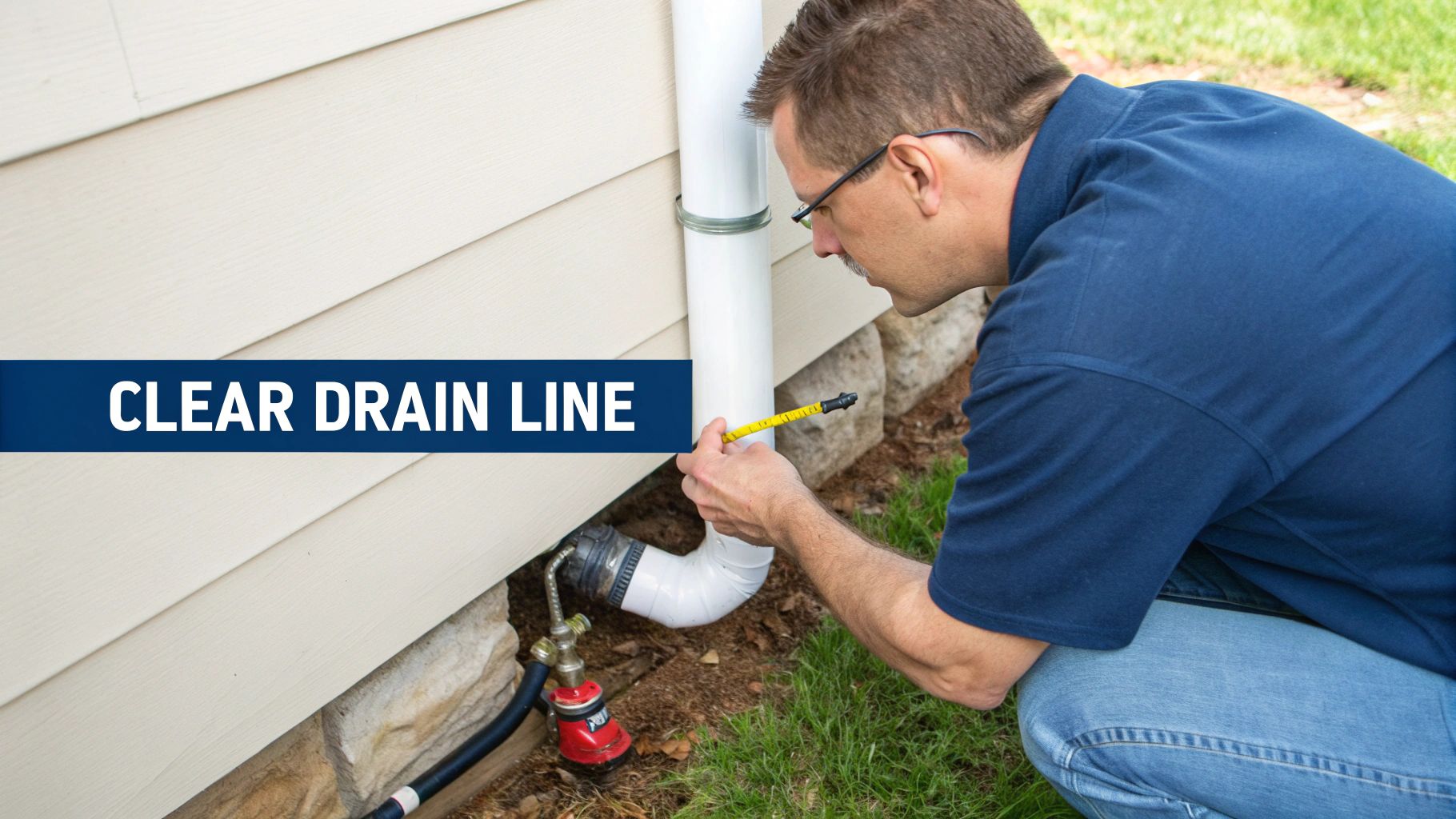
This is especially true for modern high-efficiency furnaces, which create condensation as a normal part of the heating cycle. Let me explain. That water has to go somewhere, usually through a small PVC pipe. If that line gets clogged with algae or dust, a sensor shuts the whole system down to keep water from backing up and causing a leak inside your home.
The Role of the High-Limit Switch
We mentioned this briefly when talking about air filters, but the high-limit switch deserves a closer look. Its only job is to watch the internal temperature of your furnace.
If the furnace gets too hot—almost always because of restricted airflow from a dirty filter or blocked vents—this switch trips. It immediately cuts power to the burners to protect the heat exchanger, which is one of the most vital and expensive parts of your furnace. The blower fan, however, will often keep running to try and cool things down. That’s why you might feel cool air coming from your vents even though the heat isn't working.
This sequence is a classic sign of an airflow problem. If you cycle the power, the furnace fires up for a few minutes, then the heat cuts out again, a tripped high-limit switch is the prime suspect. Go back and give that air filter another look!
Checking the Condensate Drain Line
For anyone with a high-efficiency furnace, a clogged condensate line is an incredibly common reason for a no-heat call, particularly in our dusty Arizona climate. Here’s a quick and safe way to check yours.
- Find the Drain Line: Look for a white or clear PVC pipe coming from the side of your furnace. Follow it to where it ends—usually outside near your AC unit or into a floor drain.
- Inspect for Blockages: Check the very end of the pipe for any visible gunk or debris. Sometimes the clog is right at the exit.
- Clear the Line (If You Can): If you see the blockage right at the end, you can often clear it yourself. Using a wet/dry vac to suction out the clog from the termination point outside is a pro trick that often gets the system running again in minutes.
The absolute best way to keep these safety lockouts from happening in the first place is with regular, professional tune-ups. During a routine heating maintenance visit, our technicians thoroughly inspect and clear the condensate drain, test all safety switches, and make sure everything is running exactly as it should—long before it can leave you stuck in the cold.
When It’s Time to Call for Professional Furnace Repair
Look, while we’re all for a good DIY fix, there are moments when the smartest move is to put the tools down and call in a pro. Knowing the difference between a simple fix and a serious problem is key to keeping your family safe and avoiding a much bigger repair bill down the road.
Some symptoms are non-negotiable. If you smell gas, hear loud metallic grinding or banging, or see error codes flashing relentlessly on the furnace panel, that’s your cue. Don't hesitate.
Red Flags That Absolutely Require a Pro
These are the kinds of issues that point to something serious happening inside the unit—problems that require specialized tools and the kind of know-how that comes from years of experience.
- Faulty Gas Valve: That rotten egg smell means a potential gas leak. This is a major safety hazard, not a DIY project.
- Failing Blower Motor: A loud, shrieking, or banging sound often signals that the motor is on its last legs.
- Cracked Heat Exchanger: This is the big one. A crack here can leak carbon monoxide into your home, which is incredibly dangerous.
When you hit a wall with a serious issue like this, you’ll eventually need an expert. It's helpful to understand how homeowners search for professional furnace repair when their system quits—it reinforces that moment when you know you're in over your head.
At Comfort Experts, our licensed technicians are trained to handle these complex and potentially dangerous repairs. We can safely get to the bottom of the problem and get your heat back on the right way. Our authority and expertise are built on years of hands-on experience solving these exact problems for families right here in our community.
Your Top Furnace Questions Answered
Over the years, we've heard just about every furnace question you can imagine from homeowners across the Phoenix Valley. When your heater isn't working, you just want straight answers. Here are a few of the most common ones we tackle every week.
Why Is My Furnace Kicking On and Off Every Few Minutes?
That constant on-and-off dance is what we call “short cycling.” More often than not, the culprit is a dirty, clogged air filter. The furnace can't breathe, so it overheats and a safety switch shuts it down to protect itself.
Another common cause is a dirty flame sensor. If that little metal rod can't detect a flame, it tells the system to shut off the gas as a safety measure. Always start by checking your filter—if a fresh one doesn't fix it, it’s time to have a technician look at the sensors and controls.
Is It Normal to Smell Something Burning When I Turn the Heat On?
Yes, a faint burning smell is pretty typical the first few times you fire up the furnace for the season. Dust and particles settle on the heat exchanger during our long Arizona summers, and that stuff simply burns off when the system ignites.
The smell should go away in an hour or two. But if it's a strong odor, smells like melting plastic, or sticks around after a couple of heating cycles, shut the system off immediately. That’s a clear sign you need a professional inspection.
What's the Average Cost to Fix a Furnace That Won't Heat?
This is a tough one because the price really depends on what’s wrong. A simple fix, like cleaning out a flame sensor or clearing a clogged condensate line, is on the lower end of the cost spectrum.
On the other hand, a major part failure—like a bad blower motor or a fried control board—can be a much bigger investment. Here at Comfort Experts, our process is to find the exact cause of the problem first, then give you a clear, upfront price for the repair before we touch anything. No surprises, just honest answers.
If you’ve run through all the checks and your furnace is still just blowing cold air, let our team take it from here. The team at Comfort Experts is ready to help; give us a call at 480-207-1239 or schedule service online to get a certified technician heading your way for a fast, honest diagnosis.