
Let's cut right to the chase. You want to know how long do ac units last in our brutal Arizona heat, and the answer you find in a national guide just doesn't apply here. While an average AC unit might live a long, happy life in a milder state, our systems are fighting a completely different battle.
For anyone living in the Phoenix Valley, the hard truth is that our air conditioners have a much shorter lifespan.
The Real Lifespan of an AC Unit in Arizona
It’s a huge misconception that an air conditioner’s lifespan is a fixed number across the country. Those national averages you see online often paint a rosy picture of a 15 to 20-year service life. That figure simply doesn't hold up under the strain of an Arizona summer.
Let me explain. Our cooling season isn't a neat three-month affair. It's a grueling 8-month marathon where your AC runs almost nonstop, often pushing against triple-digit heat for weeks on end. That kind of prolonged, intense use is like putting a decade's worth of wear and tear on a car in just a few years. Every single component, from the compressor to the fan motor, is pushed to its absolute limit.
Why Arizona Is a Different Beast
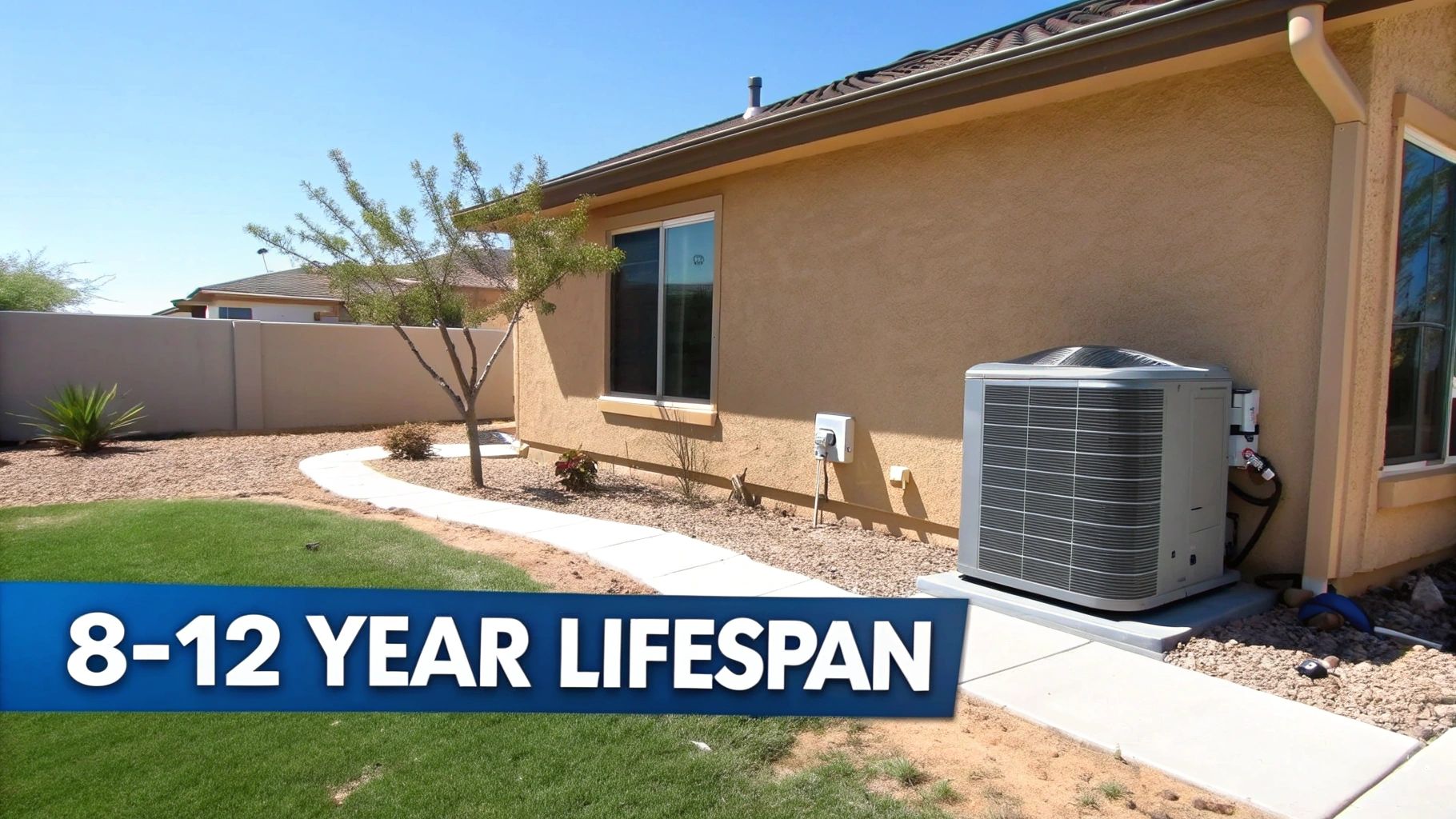
The U.S. Department of Energy gives a general guideline that central air conditioners last about 15 to 20 years. But the reality for us here in Mesa and the greater Phoenix Valley is a whole different story because of our unique climate. Industry experience and research show that systems in extreme heat zones like ours typically last between 8 to 12 years—a massive drop from the national average. You can discover more insights about HVAC longevity in hot climates on AC Direct.
This drastic reduction boils down to a few key local factors:
- Extreme Operating Temperatures: When it's 115°F outside, your AC has to work incredibly hard just to keep your home at a comfortable 75°F, causing accelerated wear on every part.
- Prolonged Cooling Season: Unlike regions with four distinct seasons, our air conditioners get very little downtime, leading to constant operational stress.
- Intense UV Exposure: That relentless Arizona sun can degrade and crack the plastic components and wiring on your outdoor unit much faster than in other places.
- Dust and Debris: Our infamous dust storms (haboobs) can quickly clog your outdoor unit's condenser coils, forcing the system to run hotter and work even harder to cool your home.
At Comfort Experts, we've seen firsthand how the Arizona climate punishes HVAC equipment. A unit that might last 17 years in a moderate climate often shows signs of critical failure by year 10 here in the Valley. As local HVAC specialists for over two decades, our experience provides us with a unique perspective on equipment longevity that national guides simply can't offer.
To make this crystal clear, let's compare the expected lifespan in a typical climate versus the harsh reality here in Phoenix. This quick breakdown highlights just how much our environment impacts your system's longevity.
AC Lifespan At a Glance National Average vs Arizona
This responsive table provides a quick, scannable comparison of AC unit life expectancy in a temperate climate versus the harsh conditions of the Phoenix Valley.
| Climate Zone | Average AC Lifespan | Key Contributing Factors |
|---|---|---|
| National Average (Temperate Climate) | 15 – 20 Years | Milder temperatures, shorter cooling seasons, and less overall operational stress on components. |
| Phoenix Valley, Arizona (Hot Climate) | 8 – 12 Years | Extreme heat, an 8-month cooling season, intense UV exposure, and frequent dust storms. |
The takeaway is simple: your location is the single biggest factor determining how long your AC will last. What's considered "middle-aged" for an AC unit elsewhere is "senior citizen" status here in Arizona.
Factors That Determine Your AC's Lifespan
Here’s the thing: not every AC unit in Phoenix is on the same countdown timer. Answering the question of how long do ac units last isn't a simple number; several critical factors can either shave off years or add precious time to your system's life. You might be surprised to learn that a huge part of your AC's destiny was sealed long before you ever touched the thermostat.
It really all starts with the day it was installed. A shoddy installation job is like building a house on a shaky foundation—it’s doomed from the start. Things like improperly sized ductwork, the wrong amount of refrigerant, or sloppy electrical connections force the system to work way harder than it should. This constant strain leads to premature breakdowns and a much shorter life.
An improperly installed air conditioner can suffer a performance loss of up to 30%. This doesn't just inflate your power bills; it puts a ton of stress on the compressor—the heart of your system—which can dramatically cut down its lifespan.
Think of it this way: a professional, by-the-book installation ensures every part works in harmony. It minimizes stress and maximizes longevity right out of the box. This is why trusting an experienced local technician is absolutely non-negotiable around here.
The Impact of Sizing and Maintenance
Ever wonder if an air conditioner can be too powerful? You bet it can. An oversized unit will blast your home with cold air too quickly, shutting off before it has a chance to properly dehumidify the air. This constant starting and stopping, known as "short cycling," puts brutal wear and tear on the system's most expensive parts.
On the flip side, an undersized unit is even worse in our climate. It will run nonstop, struggling to ever hit the temperature you set on a blistering Arizona afternoon. That relentless operation sends your energy bills through the roof and pushes the whole system toward an early grave. Proper sizing is everything. A good technician runs detailed calculations to match the unit perfectly to your home's layout, windows, and insulation.
Beyond the initial setup, the single biggest factor you can control is simple, routine maintenance.
- Routine Tune-Ups: Think of this like a regular oil change for your car. A pro can clean the coils, check electrical connections, and spot small problems before they turn into catastrophic failures in the middle of July.
- Clean Air Filters: A clogged filter forces your AC to breathe through a straw. It chokes off airflow, making the system strain and causing critical parts to overheat.
- Clear Outdoor Unit: Our famous dust storms (haboobs) can cake the outdoor unit's coils with a thick layer of dirt and debris. Keeping that area clean is vital so it can properly release heat.
Proactive care is the secret sauce to a long AC life. We cover this in more detail in our article on essential AC maintenance tips for Arizona residents. Skipping these basic tasks is one of the fastest ways to shorten your system's life and get hit with a massive, unexpected repair bill when you can least afford it. It’s the difference between a system that thrives and one that just survives.
Warning Signs Your AC Unit is About to Fail
Your air conditioner rarely just gives up without putting up a fight. Long before it quits on a sweltering 115°F day, it starts sending out distress signals. Learning to spot these signs can save you from a miserable, sweaty emergency and give you time to actually plan ahead.
Think of it like the check engine light in your car. Ignoring these warnings only leads to bigger, more expensive problems down the road. An aging AC unit trying to keep up with the Arizona heat will start showing its age in some very specific ways.
Noises That Should Make You Worry
Often, the first sign of trouble is what you hear. Your AC has a familiar hum, but when that sound changes, it’s time to listen closely. Strange noises are the mechanical parts crying out for help.
- Grinding or Scraping: This is a serious red flag. It usually points to a problem with the fan motor's bearings, which can cause a total system failure if you let it go.
- Squealing or Hissing: A loud squealing can mean a failing belt or motor. A hissing sound, on the other hand, often suggests a refrigerant leak—a problem for both performance and the environment.
- Loud Banging or Clanking: This could mean a loose or broken part inside the compressor, like a connecting rod or piston pin. You should shut the system down immediately to prevent catastrophic damage.
If your AC suddenly starts making sounds that belong in a mechanic’s shop, don't just turn up the TV. These are clear signs that a critical part is on the verge of breaking. A prompt diagnosis is the only thing standing between you and a complete system meltdown. You can learn more about common AC repair signs in our article.
Performance and Efficiency Problems
Sometimes, the signs are less about what you hear and more about what you feel—both in your home and in your wallet. When your system’s performance starts to dip, its days are numbered. If your utility bill suddenly rivals a car payment, your AC's efficiency is in a nosedive.
This happens because worn-out parts force the system to run longer and harder just to get the same cooling result. It’s working overtime, and you’re the one footing the bill for all that wasted energy.
Other performance-related warning signs to watch for include:
- Weak Airflow: If the air trickling from your vents feels weak or lazy, it could be a failing compressor or even issues deep within your ductwork.
- Inconsistent Cooling: Are some rooms comfortable while others feel like a sauna? This is a classic sign your unit no longer has the oomph to cool your home evenly.
- Constant Running: An AC that never seems to shut off isn't just working hard; it's losing the battle. It's struggling to reach the temperature you set on the thermostat, a clear signal that it's losing its cooling power for good.
The Hidden Financial Drain of an Aging AC Unit
Honestly, nursing an old, inefficient AC through another brutal Arizona summer often costs you far more than just the repair bills. Beyond those stressful service calls lies a hidden financial drain that quietly empties your wallet: skyrocketing energy bills. Understanding the true cost of running aircon helps shine a light on this very expensive problem.
Here’s what’s happening behind the scenes. As your air conditioner ages, it doesn’t just become more prone to breakdowns; it gets worse at its one and only job. This gradual decline is called efficiency degradation.
Think of it like a veteran athlete trying to keep up with the rookies—they have to work a lot harder just to get the same result. Your AC is no different. After years of battling 110-degree days, its components are worn down, forcing it to run longer and burn way more electricity just to keep your home comfortable.
This isn't a small dip, either. After a decade of service in the Arizona heat, that drop-off becomes a serious financial burden.
The Real Cost of Inefficiency
That creeping increase in your summer power bills isn't just in your head. It's the direct result of your AC losing its cooling muscle year after year. The extra cash you're sending to SRP or APS could be going toward a new, hyper-efficient system that delivers better comfort for less money.
Industry data shows a clear and costly pattern. By its 10th birthday, the average central AC system is only delivering about 80 to 85 percent of its original cooling power. For us here in the Phoenix Valley, that can mean paying 25 to 30 percent more on cooling bills compared to a modern, high-efficiency unit.
When you consider that new systems often have SEER2 ratings 40 to 50 percent higher than older models, the investment in a replacement can pay for itself in energy savings alone in just 5 to 7 years.
Upgrading an aging air conditioner isn't just another expense—it's a strategic investment in your home's value and your long-term financial health. The monthly savings from a new, high-efficiency unit make a real, noticeable impact on the household budget.
This shifts the question of how long do ac units last from a mechanical one to a financial one. Pushing that old, inefficient unit for another two or three years could easily cost you thousands in wasted electricity—money that could have covered a huge chunk of a brand-new, reliable system.
For more immediate ways to save, check out our guide on how to reduce cooling costs in the Arizona summer.
The Smart Way to Decide Between Repair And Replacement
It’s the ultimate dilemma every Phoenix homeowner faces eventually: your AC is on the fritz, and you’re stuck wondering whether to sink more money into repairs or just bite the bullet and invest in a new system. It’s a tough call, but there’s a logical way to approach it that takes the guesswork out of the equation.
The decision shouldn't be made in a panic, especially not when you’re sweating through a hot afternoon. Instead, a simple industry guideline we call the "5,000 Rule" can bring immediate clarity. It's a quick calculation that helps you weigh the cost of a repair against the remaining value of your unit.
Here’s how it works. You simply multiply the age of your air conditioner by the estimated cost of the repair.
If the total is more than $5,000, replacement is almost always the smarter financial move. If it's less than $5,000, a repair is likely your best bet, especially if the unit is still relatively young.
Let's say you have a 10-year-old unit and the repair bill is $600. Your total comes to $6,000. According to the rule, that’s a strong signal to start looking at new systems. On the other hand, a $300 repair on an 8-year-old unit ($2,400 total) is a clear vote for a fix. This simple math helps you see if you're about to put good money into a failing investment.
When To Repair Vs When To Replace
Beyond the 5,000 Rule, other factors can tip the scales one way or the other. Things like how often your AC breaks down and the type of refrigerant it uses heavily influence this decision. It’s also a good time to consider the broader benefits of energy-efficient home upgrades, which can dramatically improve your home’s comfort and produce real long-term savings.
This decision tree shows how age and high bills point toward replacement, which saves money in the long run.
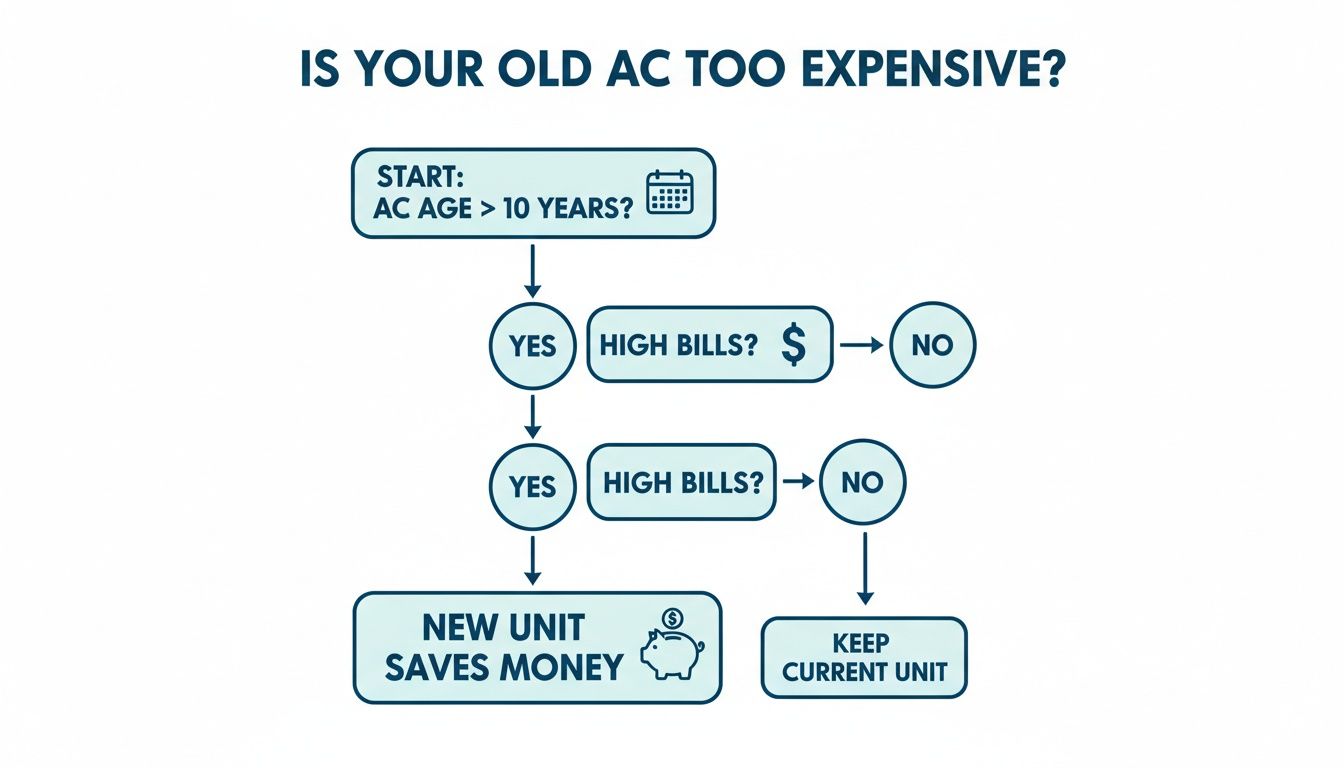
As you can see, once a unit gets past that 10-year mark, rising utility costs often make replacement the most logical path forward.
To simplify things even further, we’ve put together a quick comparison table to help you see where your current situation falls.
Decision Guide: Repair vs. Replace
This side-by-side view lines up the most common scenarios we see in the field, helping you get a gut feeling for which path makes more sense for you.
| Consider Repairing If… | Consider Replacing If… |
|---|---|
| Your unit is under 10 years old and has a good maintenance history. | Your unit is over 12 years old, well past its prime in the Arizona climate. |
| The repair cost is less than a third of the price of a new system. | Repair costs are high, and you’re facing multiple breakdowns per year. |
| Your energy bills have remained relatively stable and consistent. | Your energy bills have spiked dramatically, signaling severe inefficiency. |
| The unit uses modern R-410A refrigerant, which is readily available. | The unit uses R-22 refrigerant, which is phased out, scarce, and extremely expensive. |
When you start seeing multiple red flags in the "replace" column, it's time for a serious conversation about an upgrade. If you want to dig deeper, our detailed guide explores the other signs it's time to replace your air conditioner.
At Comfort Experts, we provide honest diagnostics to help you make the best, most informed decision for your home and your budget—no pressure, just clear options.
Frequently Asked Questions About AC Lifespan
We've covered a lot of ground, but you probably still have a few questions rattling around. Let’s tackle some of the common things homeowners ask us about how long their AC units will really last. I want to give you clear, straight-up answers so you can feel confident in your decisions.
Does the Brand of My AC Unit Really Affect Its Lifespan?
Absolutely. Brand and build quality play a huge role. We install a lot of Trane systems for a reason—they’re known for tough components and rigorous testing that holds up to the punishing heat we get here in Arizona.
But here’s the honest truth: even the best unit on the market will die an early death if it’s installed poorly or never maintained. That’s why choosing a qualified, thorough installer is every bit as important as the logo on the side of the unit.
Will a Smart Thermostat Help My AC Unit Last Longer?
It can, indirectly. A smart thermostat is all about optimizing how your system runs. By preventing extreme temperature swings and reducing the number of times your system has to kick on and off, it eases the daily strain on the compressor and fan motor. Think of it as less stop-and-go traffic for your AC.
It's a great way to boost both efficiency and the longevity of your equipment. Our techs at Comfort Experts can help you pick out a model that works best for your home and get it installed right.
Is My Old AC Obsolete Because of Its Refrigerant?
This is a big one we hear a lot, especially for systems over 10 years old. Many of those units run on R-22 refrigerant (often called Freon), which has been phased out by the government for environmental reasons. While you’re not breaking any laws by running an R-22 system, the refrigerant itself is now incredibly expensive and hard to source.
A major repair that requires adding more R-22 often makes replacing the entire unit the smarter financial move. New systems use the more efficient and readily available R-410A refrigerant, which saves you from a huge bill down the road.
Got more questions? We’ve compiled answers to just about everything on our full HVAC FAQ page.
Keeping your home cool in the Valley doesn't have to be a stressful guessing game. You know what? You shouldn't have to face a confusing repair-or-replace decision by yourself. If you're getting worried about your aging system or facing that tough decision, let our experienced team at Comfort Experts help you find the best path forward. Give us a call at 480-207-1239 or schedule service online to get a professional evaluation you can count on.