
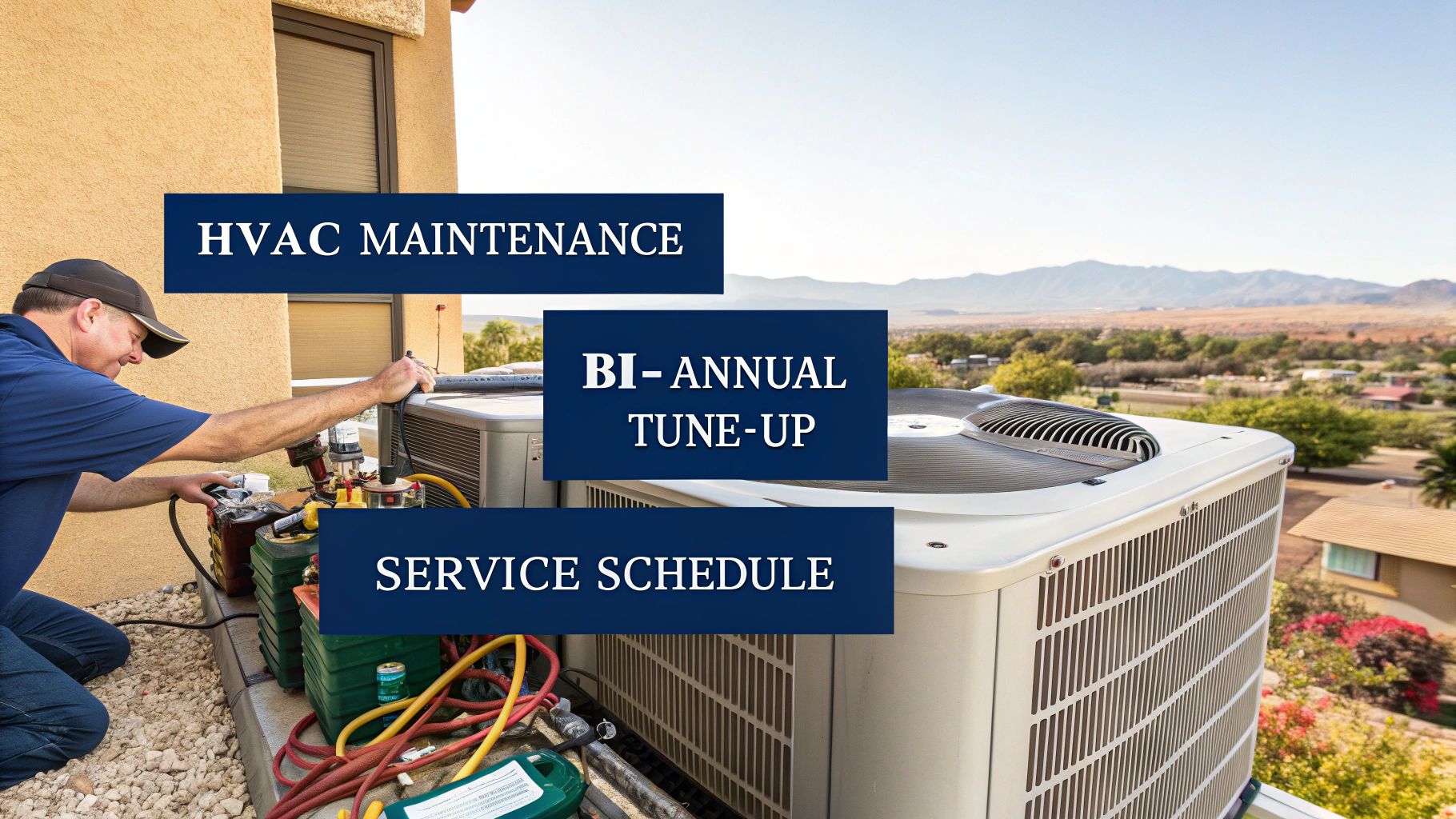
Here in the Phoenix Valley, a working AC isn't just a nice-to-have—it's everything. So, when people ask, "How often should my HVAC be serviced?" we give them the straight answer based on decades of experience keeping Arizona homes comfortable. For Arizona homeowners, the magic number is twice a year—once in the spring for your air conditioner and once again in the fall for your heating system.
Why a Twice-Yearly Schedule is Your Best Defense
Imagine your HVAC system is a star athlete preparing for two completely different championship seasons every year. First up is the blistering summer, followed by the surprisingly chilly desert winter. Each season demands peak performance, and you wouldn't send an athlete into the big game without a proper physical and warm-up, would you?
That's exactly how you should think about your home's most important appliance. A spring tune-up gets your AC ready for the relentless 110°F+ days ahead. Then, a fall tune-up makes sure your furnace is safe and prepared for those cold winter nights. Here at Comfort Experts, we've seen firsthand how this proactive approach prevents disasters. Our technicians aren't just following a manual; they're applying years of in-the-field experience in the unique conditions of the Valley to keep your system at peak performance.
Recommended HVAC Service Schedule for Arizona Homes
Let me explain the ideal schedule. To make it as simple as possible, here's a quick reference guide for how often you should have your system serviced, based on what you have in your Phoenix-area home.
| System Type | Recommended Frequency | Best Time for Service |
|---|---|---|
| Central Air Conditioner | Twice a year (Cooling & Heating) | Spring (AC), Fall (Furnace) |
| Heat Pump | Twice a year | Spring & Fall |
| Gas or Electric Furnace | Once a year | Fall (before winter) |
| Ductless Mini-Split | Once or twice a year | Spring (if used for cooling) |
This table covers the most common setups we see, ensuring you're covered no matter what system is keeping your home comfortable. This schedule is the foundation of our authoritative recommendations, built to address the specific demands of the Arizona climate.
The Real-World Impact of Consistent Maintenance
Sticking to this schedule does a lot more than just prevent a miserable breakdown in the middle of July. You know what? It's one of the smartest financial moves you can make as a homeowner.
Regular service can extend your system's lifespan by up to 40%. On top of that, the U.S. Department of Energy figures that proper maintenance can lead to 5-20% in annual energy savings. On the flip side, neglected systems can burn up to 30% more energy just trying to keep up. When you think about how long our cooling season is, those savings add up fast.
By investing in proactive care, you’re not just paying for a service call. You're buying peace of mind, lower utility bills, and a longer life for your equipment. Our Comfort Experts maintenance plan is designed to make this essential care simple, predictable, and affordable, demonstrating our trustworthiness and commitment to our customers.
Why Twice-Yearly Service Is Essential in Arizona
Here’s the thing about our beautiful but brutal Arizona climate: it puts an incredible amount of strain on HVAC systems. An air conditioner in Mesa or Phoenix works so much harder and longer than one in a milder part of the country. This isn't just about the triple-digit heat; it's about the unique combination of environmental challenges our systems face day in and day out.
Think of your HVAC system like a car that’s constantly being driven through extreme desert conditions. You wouldn't skip its oil changes or filter replacements, would you? The same logic applies here, making a bi-annual maintenance schedule a flat-out necessity, not just a friendly suggestion. Our expertise comes from seeing the direct results of neglect in this harsh environment every single day.
The Desert's Assault on Your AC Unit
Our environment is just plain tough on machinery. Two major culprits are constantly working against your air conditioner's health and efficiency:
- Fine Dust and Debris: Arizona is dusty. That fine, powdery sand gets pulled into your outdoor unit, where it cakes onto the condenser coils and clogs them up. When coils are caked in dirt, the system can't get rid of heat effectively, forcing it to run longer and harder just to cool your home. This leads directly to higher energy bills and parts failing way too soon.
- Relentless Summer Heat: The sheer intensity of our summers accelerates the wear and tear on every single part of your AC. Critical components like capacitors, fan motors, and compressors are pushed to their absolute limits for months on end. This constant high-stress operation is the number one cause of those unexpected—and expensive—mid-July breakdowns.
Investing in two tune-ups a year isn't just an expense; it's a crucial strategy to avoid costly emergency repairs, especially during a triple-digit heatwave when you need your AC the most.
Proactive Care Is Your Best Defense
Waiting for a problem to announce itself is a risky and expensive game to play in the Valley. A proactive, twice-yearly approach lets our technicians catch and fix small issues before they snowball into catastrophic failures.
Nationally, data shows that only 42% of homeowners get professional AC maintenance every year. But get this: those who do see their units last up to 40% longer. Considering our AC units run almost non-stop from May through October, that statistic is even more critical for us here in Arizona.
This consistent care is the foundation of an efficient system. By cleaning out all that dust and addressing the damage from the heat, professional tune-ups can seriously lower your cooling costs. On that note, you might also be interested in other ways to reduce cooling costs during an Arizona summer in our detailed guide.
The True Cost of Skipping HVAC Maintenance
Honestly, thinking you can "save money" by skipping an HVAC tune-up is one of the most expensive gambles a homeowner can make. It’s a classic case of short-term thinking that almost always leads to long-term financial pain.
The real cost of neglect isn't the price of that one maintenance call. It’s the sum of all the expensive, stressful problems that ambush you when a system is ignored. When you weigh a simple tune-up against a surprise emergency repair, a system dying years too soon, and months of inflated energy bills, the math becomes painfully clear.
Sky-High Energy Bills
An unserviced HVAC system is an inefficient one, plain and simple. Dirty coils, clogged filters, and worn-out parts force your unit to fight just to do its job. It has to run longer and harder to produce the same amount of cool air.
That extra effort isn't free—it shows up directly on your monthly utility bill. A struggling system is one of the biggest energy hogs in your home, and skipping maintenance is like telling it to waste as much money as possible. For specific tips on how to lower heating costs, the conversation almost always starts with making sure your system is running right in the first place.
Surprise Emergency Repairs
You know when HVAC systems love to fail? At the absolute worst possible moment. Think record-breaking heatwaves, holiday weekends, or right before you have guests over. These emergency calls aren’t just inconvenient; they’re expensive.
You’ll pay premium rates for after-hours or weekend service, turning what could have been a minor, preventable issue into a major, unexpected expense. Imagine your AC starts blowing warm air on a scorching July afternoon. A technician finds a failed capacitor—a common part that gets checked during a tune-up. Now, instead of a simple preventative fix, you're facing a multi-hundred-dollar emergency bill just to get cool again.
The U.S. Department of Energy quantifies it perfectly: proper HVAC maintenance can deliver 5-20% in energy savings every year and cut total system costs by up to 50% compared to a reactive, "fix-it-when-it-breaks" approach.
Premature System Replacement
This is the big one—the financial hit everyone wants to avoid. A well-maintained air conditioner or furnace can easily last 15-20 years in Arizona. A neglected one might give up the ghost in under a decade.
The constant strain from running inefficiently causes catastrophic wear on major components like the compressor, which can cost thousands to replace on its own. Often, it makes more financial sense to just replace the whole system than to sink big money into a major repair on an aging, neglected unit.
Suddenly, that decision to "save" a hundred dollars on a tune-up turns into an unexpected $8,000 – $15,000 replacement cost. Studies have shown that homeowners who stick with yearly maintenance see their units last up to 40% longer, pushing that massive expense years down the road.
A Practical HVAC Maintenance Checklist
So, what can you handle yourself, and when is it time to call in the pros? Knowing the difference is a huge part of being a smart homeowner. Your efforts are fantastic for keeping things running smoothly day-to-day, but they simply can't replace the deep safety and performance checks a trained technician provides.
The simple tasks you do help the system breathe easy between professional visits. But the technical work? That gets to the heart of the machine—its electrical connections, mechanical moving parts, and refrigerant levels. Getting those right is absolutely critical for both safety and a long lifespan.
DIY vs. Professional HVAC Maintenance Tasks
To make it crystal clear, here’s a quick breakdown of what falls into your court versus what needs our specialized tools and training. This table is a reflection of our commitment to homeowner education, a key part of trustworthy service.
| Task | DIY Friendly? | Professional Task? |
|---|---|---|
| Changing Air Filters | Yes | No |
| Clearing Debris from Outdoor Unit | Yes | No |
| Cleaning Indoor Vents | Yes | No |
| Inspecting Electrical Connections | No | Yes |
| Checking Refrigerant Levels | No | Yes |
| Cleaning Evaporator & Condenser Coils | No | Yes |
| Lubricating Motors & Bearings | No | Yes |
| Testing System Controls & Safeties | No | Yes |
As you can see, your role is all about airflow and cleanliness, while ours focuses on the complex mechanical and electrical components that make the whole system work.
DIY Tasks for Homeowners
These are simple but high-impact jobs every Arizona homeowner should tackle to keep their system running strong:
- Change Your Air Filters: This is the #1 most important thing you can do. Check them monthly and swap them out when they look dirty, or at the very least every three months. A clogged filter chokes your system, drives up bills, and tanks your indoor air quality.
- Keep the Outdoor Unit Clear: Your condenser outside needs room to breathe. Make a habit of clearing away leaves, dust, weeds, and anything else crowding the unit. A good rule of thumb is to maintain at least two feet of clear space on all sides.
- Check and Clean Vents: Walk through your home and make sure all the supply and return vents are open and not blocked by furniture, rugs, or drapes. A quick wipe with a damp cloth is usually all it takes to keep them free of dust.
This simple flowchart shows exactly what’s at stake. It’s a clear picture of the consequences that come from skipping service versus staying on top of it.
The path is pretty clear: proactive service is a direct line to savings, while neglect almost always leads to bigger bills and, eventually, a full system replacement.
Professional Maintenance Tasks
Now for the critical checks that require specialized tools, years of training, and a licensed technician's expertise. Never try to tackle these yourself.
While DIY steps are helpful, only a professional tune-up can verify the safe and efficient operation of your system's complex electrical and mechanical components.
During a scheduled tune-up, a Comfort Experts technician digs much deeper. We perform a detailed inspection that always includes:
- Inspecting Electrical Connections: We meticulously tighten all electrical contacts and measure the voltage and current on motors. A single loose wire can cause unsafe operation and seriously damage your system.
- Checking Refrigerant Levels: An incorrect refrigerant charge is a silent killer for compressors and a major drain on efficiency. We check for the precise factory-specified level your system needs to perform its best.
- Cleaning Coils: We thoroughly clean both the indoor evaporator and outdoor condenser coils. Clean coils are essential for proper heat transfer, which directly impacts your cooling power.
- Lubricating Moving Parts: Just like in a car, proper lubrication reduces friction in motors and bearings, which helps extend the life of your equipment for years to come.
- Testing System Controls: We run the system through its paces to verify that it starts, operates, and shuts off exactly as it should, ensuring it’s performing safely and reliably.
Taking on a few simple tasks can make a real difference, but knowing when to pick up the phone for professional help is what truly protects your investment. For a more detailed guide, check out our post on essential AC maintenance tips for Arizona residents.
Recognizing Warning Signs Your HVAC Needs Service
Your HVAC system almost never dies without a little drama first. Long before it gives up on a hot afternoon, it sends out distress signals—some subtle, some as loud as a rattling fan blade. Learning to spot these clues is the key to catching problems early, often turning a catastrophic failure into a simple fix.
Ignoring these warnings here in Arizona is a huge gamble. Acting fast is what keeps a minor hiccup from spiraling into a full-blown, expensive breakdown.
Clues You Can See, Hear, and Smell
Believe it or not, your own senses are some of the best diagnostic tools you have. If something looks, sounds, or smells wrong with your AC or furnace, it probably is. Just pay attention to any changes from how it normally runs.
Here are the most common red flags that mean your system needs a professional's attention right away:
- Strange Noises: Your system should just be a steady, low hum. If you suddenly hear grinding, squealing, banging, or rattling, that’s a clear sign of failing mechanical parts, like a bad motor bearing or a loose component that’s about to break free.
- Unusual Smells: A burning odor can point to an electrical problem, while a musty, dirty-sock smell often means mold or mildew is growing somewhere in the unit or ductwork. You don't want to ignore either of those.
- Weak Airflow: Does the air trickling out of your vents feel weak or anemic? This could be something as simple as a clogged filter, but it could also be a dying blower motor or a serious blockage deep in your ducts.
- Frequent Cycling: Is your air conditioner or furnace kicking on and off constantly, running for just a few minutes at a time? This "short cycling" puts a ton of wear and tear on the system and can be caused by anything from an oversized unit to a bad thermostat or a refrigerant leak.
- Visible Leaks or Ice: Finding a puddle of water around your indoor unit is a classic sign of a clogged drain line. If you see ice forming on the copper lines or coils, that’s another major warning sign, usually pointing to low refrigerant or a severe airflow problem.
Ignoring these signs is like driving your car with the check engine light on—you might make it a few more miles, but a breakdown is pretty much guaranteed. The longer you wait, the more damage you're letting happen.
Recognizing these signals is the first step. If you're noticing any of these things, your system is telling you it's overdue for a professional tune-up. To dig a little deeper, you can learn more about the 5 common signs you need AC repair in Mesa in our detailed guide.
What to Expect From a Professional Tune-Up
Deciding who to trust with your HVAC service is a big deal—just as important as remembering to schedule it in the first place. You need to feel good about the technician walking into your home, knowing they’re thorough, honest, and actually know what they’re doing.
A real professional tune-up isn’t just a quick peek and a filter change. It’s a deep, multi-point inspection designed to get your system running efficiently, confirm it’s operating safely, and spot small issues before they turn into big, expensive headaches.
Here at Comfort Experts, our NATE-certified techs follow a strict, detailed process we’ve refined over years of working in the Phoenix Valley heat. We’re not just looking for what’s broken; we’re actively fine-tuning your system to handle the brutal Arizona climate. That level of detail is what makes a regular service schedule so valuable.
Our Comprehensive Tune-Up Process
When a Comfort Experts technician shows up, they’re ready to do a deep dive into your system’s health. We check everything from the big mechanical parts down to the small details, like your air conditioning controller functionality, to make sure the "brain" of your system is communicating correctly.
Here’s a look at what our process covers:
- Thorough Cleaning: We don’t just wipe things down. We meticulously clean the condenser and evaporator coils, blower components, and condensate drain lines. This clears out all that Arizona dust and grime that literally chokes your system and makes your energy bills skyrocket.
- Electrical Inspection: Loose wires are no joke. We tighten every electrical connection and measure the voltage and current on motors. Faulty electrical parts aren’t just a leading cause of system failure—they’re a serious safety hazard.
- Mechanical Checks: Our technicians lubricate all moving parts to cut down on friction and wear. We also give the blower motor and any belts a close inspection to make sure they’re in solid shape for the season ahead.
- Safety and Performance Tests: We check your system’s refrigerant levels to ensure they match the factory specs—too little or too much can wreck your compressor. Then we test all safety controls and watch the entire start-up and shutdown cycle to be certain everything is working exactly as it should.
Once we’re done, you get a full report that clearly explains your system's condition. It gives you a straightforward picture of its health, so you can make smart, informed decisions about your home’s comfort and safety.
Understanding the real-world value of this service is key. You can learn more about how this investment pays off by reading our guide on the average AC tune-up cost and what factors into it.
Got Questions? We’ve Got Answers.
We talk to homeowners across the Phoenix Valley every single day, and we tend to hear the same great questions about keeping HVAC systems in good shape. Here are some straightforward answers based on what we see out in the field.
How Much Does an HVAC Tune-Up Actually Cost?
The honest answer is that it varies a bit, but a professional tune-up always costs a tiny fraction of what an emergency repair or a full system replacement will run you. Think of it as a small, predictable investment to head off massive, unexpected bills down the road.
For the exact numbers on our tune-ups and to see how our maintenance plan can save you even more, the best bet is just to give us a call.
Can't I Just Service My HVAC System Once a Year?
In a milder climate, you might get away with that. But here in Arizona? That’s a risky gamble. Our summers put a brutal amount of stress on your air conditioner, causing wear and tear that absolutely needs to be checked before you flip the switch to heating.
Skipping the fall service on your furnace is just as dicey. You won't have a clue if it's running safely and efficiently until you’re relying on it during a cold snap.
How Long Should a Professional Service Visit Take?
A real, thorough tune-up isn't a five-minute job. A qualified technician should expect to spend between 60 and 90 minutes carefully inspecting, cleaning, and testing your entire system. That gives them enough time to run through a comprehensive checklist without cutting corners.
A quick in-and-out visit is a huge red flag. True professional service is meticulous and detailed, making sure every component is checked for safety, efficiency, and reliability before the peak season hits.
What Really Happens If I Never Service My HVAC?
Putting off maintenance is a guaranteed way to get hit with higher energy bills, worse indoor air quality, and, eventually, a surprise breakdown on the hottest day of the year.
Over time, the strain will cause parts to fail years before they should, and you’ll likely find yourself replacing the whole system long before its expected lifespan is up. It’s not a question of if a neglected system will fail, but when.
Protecting your home’s most important appliance starts with consistent, professional care. The team at Comfort Experts has the local knowledge and expertise to keep your system running efficiently through the harshest Arizona seasons. When you're ready to get some real peace of mind, give us a call at 480-207-1239 or schedule service online.