
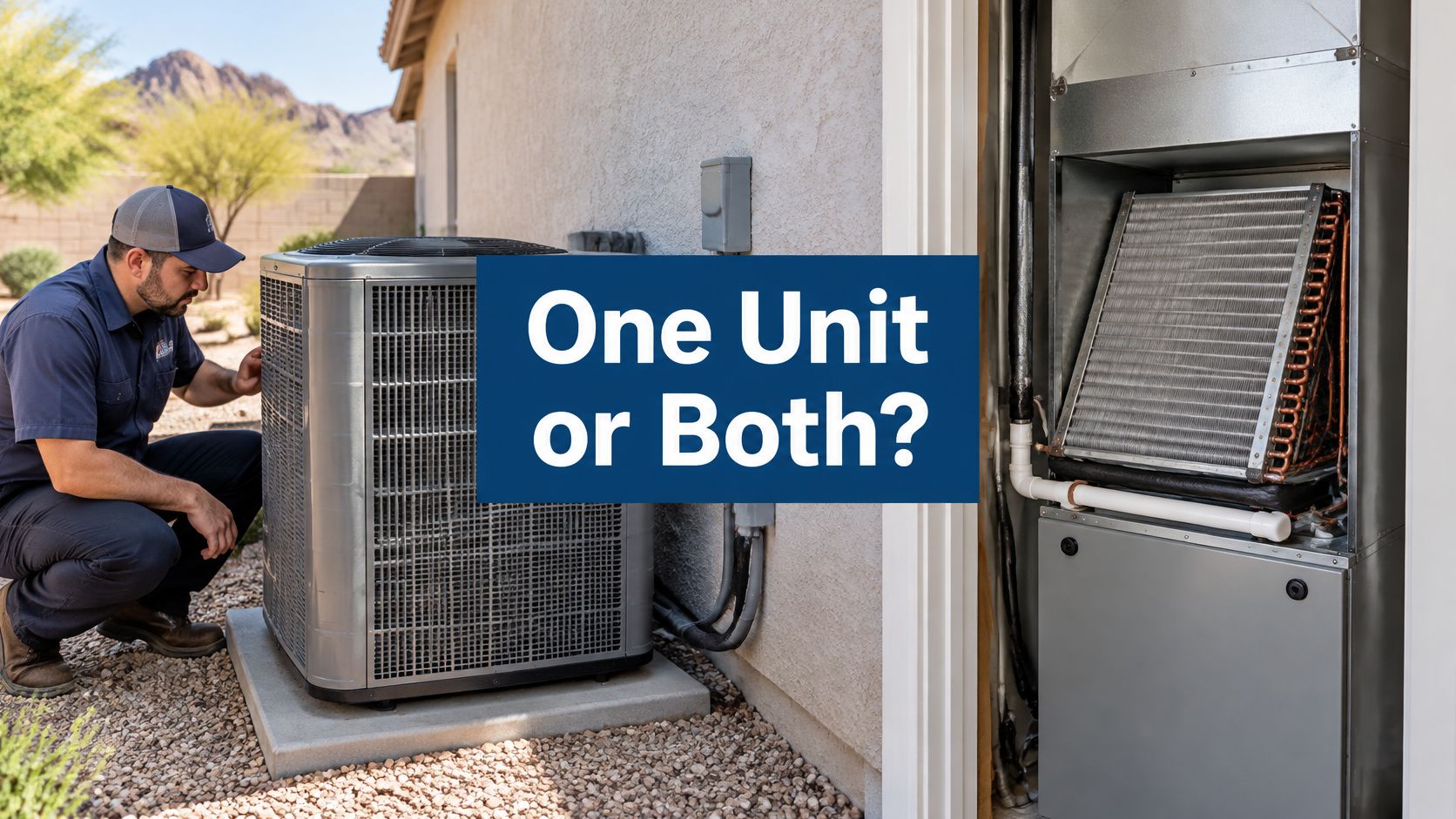
An outdoor-only replacement is acceptable only when the new condenser is certified with the existing indoor coil and air handler or furnace, with that pairing documented in writing. Otherwise, plan on replacing both sections. When the outdoor unit fails during Mesa's summer heat, that paperwork helps separate a legitimate partial replacement from a cheaper-looking mismatch.
Whether Only the Outdoor Unit Can Be Replaced
A central split-system AC isn't an outdoor appliance alone. The condenser cabinet contains the compressor, outdoor coil and fan; the indoor equipment contains the evaporator coil and blower. The U.S. Department of Energy's regional standards guidance treats replacement eligibility and efficiency as questions about the complete indoor-outdoor combination, not just the new cabinet.
That distinction matters when deciding whether to replace only the outdoor AC unit or indoor and outdoor units together. Matching dimensions, connection sizes or brand names doesn't establish a certified pairing.
Outdoor-only replacement by situation
| Situation | Outdoor-only possible? | Why it matters |
|---|---|---|
| Certified indoor-outdoor pairing documented for the new condenser | Possibly | The rating applies to the specific combination, not the outdoor unit alone |
| No certified pairing exists with the existing coil | No | Replace both sections to restore a tested system |
| Indoor coil from an R-22 era or with an incompatible refrigerant | Usually no | Metering and refrigerant design may not match the new condenser |
| Indoor coil corroded, restricted or contaminated | No | A defective coil isn't a sound component to retain |
| Rooftop or package unit | Evaluated as one unit | Heat exchanger, compressor, fan and blower share one cabinet |
| Newer system, healthy coil, written match on file | Possibly | Confirm controls, airflow and warranty terms before approving |
The DOE central air-conditioning guide distinguishes packaged systems from split equipment and explains their shared-cabinet construction. A rooftop location alone shouldn't determine the scope; the actual equipment configuration should.
A change to ductless equipment is a separate design decision, not a workaround for an unmatched central system. VerticalRent's discussion of mini split installation opportunities offers broader project context, but it doesn't establish compatibility for an existing central AC.
The first action is straightforward: gather both equipment model numbers and request the proposed matched-system rating before choosing a replacement scope.
Matched Ratings and Coil Capacity Checks
A certified match identifies specific equipment, not merely a product family. The Air-Conditioning, Heating, and Refrigeration Institute's certification explanation describes verified equipment ratings; for a replacement proposal, the useful proof is the AHRI Certified Reference Number and certificate identifying the proposed indoor and outdoor combination.
The installer should identify the existing evaporator coil and any furnace or air-handler model required by that certificate. A certificate for a similar coil isn't evidence for the coil installed.
Capacity is a screening check
A DOE test-procedure document describes certain combinations with indoor nominal capacity between 95% and 105% of outdoor nominal capacity; the table below calculates that range for common nominal sizes.
| Outdoor nominal size | Indoor capacity range, calculated at 95% to 105% |
|---|---|
| 2 tons | 1.9 to 2.1 tons |
| 3 tons | 2.85 to 3.15 tons |
| 4 tons | 3.8 to 4.2 tons |
| 5 tons | 4.75 to 5.25 tons |
This range isn't a universal coil-selection rule or permission to combine arbitrary components. An indoor coil can fall inside the arithmetic range and still lack an approved match with the proposed condenser.
Coil design, refrigerant flow and blower capability also affect the result. An unverified combination can deliver reduced capacity, weaker humidity removal, pressure faults or efficiency below the advertised rating.
Compare the certificate with the home
The quote review should include:
- Exact identification: Outdoor model, indoor coil model and applicable furnace or air-handler model.
- Certified performance: The combination's SEER2, EER2 and rated cooling capacity.
- Sizing basis: An installer-prepared load calculation, such as system sizing, rather than an assumption that the old nominal size was correct.
Mesa's high outdoor temperatures make capacity verification especially consequential. During sustained cooling demand, there's less room for a poorly selected combination to compensate.
The useful comparison is between the home's calculated requirement and the proposed combination's documented performance, not between two condenser labels.
Refrigerant and Metering Device Limits
Equipment age can signal a refrigerant compatibility problem. DOE's historical efficiency and refrigerant materials describe the 13 SEER federal minimum for equipment manufactured beginning January 23, 2006, the R-22 phaseout beginning in 2010, and the 2020 end of R-22 production and importation.
Those milestones explain why an older indoor coil shouldn't automatically stay when a newer condenser arrives. They don't establish that any particular existing system needs replacement.
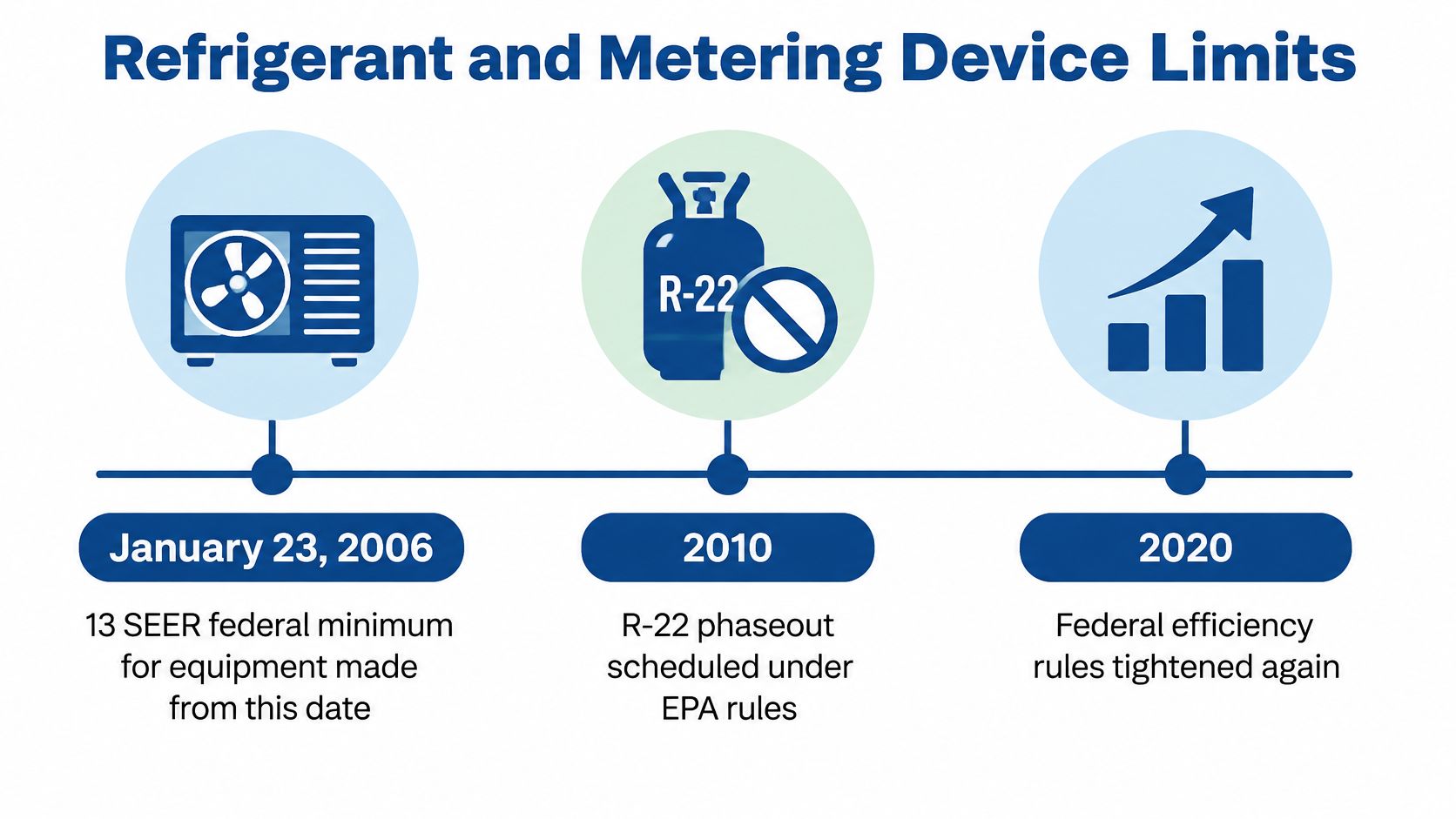
The relevant final milestone in that history concerns R-22 production and importation, not a general efficiency-standard change.
Refrigerant status and outdoor-only implications
| Refrigerant | Federal status or historical role | Outdoor-only implication |
|---|---|---|
| R-22 | Production and importation have ended | Older coil may not match a new condenser; retrofit approval is case by case |
| R-410A | Became the main replacement refrigerant in many newer products | Verify coil, metering device and manufacturer-approved pairing |
| R-454B | Lower-GWP, mildly flammable refrigerant, not for equipment undesigned for it | Full system design and listing must align; it isn't a drop-in substitute for an R-410A system |
The metering device regulates refrigerant entering the indoor coil. Retaining a coil doesn't automatically mean its existing metering device is suitable for the new condenser.
DOE-hosted compressor-manufacturer guidance evaluates refrigerant retrofits case by case and recommends a complete R-410A system replacement rather than assuming an R-22 coil can remain. That's historical retrofit guidance, not a recommendation to select that refrigerant for every current project.
The EPA's HFC phasedown questions explain why lower-GWP refrigerants such as R-454B cannot be used in systems not designed for them. Servicing existing equipment and installing a new refrigerant system are different decisions.
For additional Arizona context, homeowners can compare new AC refrigerant options.
Refrigerant recovery, charging and line connections belong to trained technicians. The quote should answer one concrete question: Are the retained coil and metering device approved for the proposed refrigerant and equipment combination?
Efficiency, Age and Controls in a Mixed System
A new condenser and an older indoor assembly have different service histories. Replacing the outdoor section doesn't renew the coil, blower or controls that remain.
Age alone isn't a diagnosis, and a clean-looking cabinet doesn't establish remaining life. Installation records, coil condition and prior repair findings provide a better basis for deciding what deserves to stay.
Compare installed performance, not advertising
The ENERGY STAR central air-conditioner and heat-pump specification.pdf) recognizes complete-system testing and rating, including combinations involving replacement components. For a current quote, the installer should provide the applicable certified combination rating and confirm the criteria relevant to that equipment.
SEER2 and EER2 belong in the comparison alongside capacity. A more efficient advertised product family doesn't establish the performance of a proposed mixed installation.
The article 16 SEER efficiency gains explained provides background for comparing efficiency labels. It shouldn't replace the current certificate for the actual proposed equipment.
Retained equipment needs a defined role
The scope should resolve these items before ordering:
- Blower capability: Document whether the existing furnace or air handler can provide the airflow specified for the proposed combination.
- Controls: Identify the thermostat, control board and communication requirements in the equipment's installation documents.
- Indoor condition: Record coil condition and any restrictions that need correction.
- Ductwork: Identify airflow concerns separately instead of assuming a new condenser addresses them.
Variable-speed and communicating equipment require particular attention to the documented control arrangement. Without the proposed manufacturer documents, no claim about a retained thermostat or blower should be accepted as settled.
For Mesa homes with dust concerns or rooms that already cool unevenly, the assessment should include those symptoms. A larger replacement scope isn't automatically better, but neither is retaining an indoor assembly without evaluating its condition and intended operation.
Warranty, Permit and Parts Constraints
A compatibility certificate doesn't answer every warranty, permitting or availability question. These are separate approval items, and the quote should identify who supplies each answer.
No model-specific manufacturer warranty or adopted Mesa code provision establishes a universal outcome for every outdoor-only replacement. A proposal therefore shouldn't promise coverage or declare that no permit is needed without the applicable documentation.

Request the actual documents
The paperwork review should include:
- Manufacturer warranty: Obtain the current terms for the exact proposed model and ask the manufacturer to clarify any matched-component or registration requirements.
- Permit determination: Ask the City of Mesa, or the property's actual permitting jurisdiction, whether the proposed scope requires a permit and inspection.
- Permit responsibility: State who obtains any required approval and whether that work is included.
- Parts plan: Identify the proposed components, confirmed availability and any unresolved substitutions.
The AC warranty comparison guide helps organize the warranty questions. It isn't a substitute for the manufacturer's own terms.
Separate an estimate from a commitment
A statement that a compatible coil should be available isn't the same as identifying an orderable component. Likewise, an anticipated delivery date isn't a guaranteed installation date unless the agreement says so.
Comfort Experts doesn't issue manufacturer warranty determinations, code rulings or insurance decisions. Manufacturer questions belong with the manufacturer, jurisdictional requirements with the permitting authority, and policy coverage questions with the homeowner's insurer.
Missing paperwork calls for clarification before approval. It doesn't automatically prove that full replacement is mandatory.
Partial Versus Full Replacement Decision Matrix
Verified compatibility is the gate. Age, budget and convenience can help choose between legitimate options, but they can't make an uncertified combination into a documented match.
The matrix below is a comparison tool, not a point system. A favorable row shouldn't cancel an unresolved equipment requirement.
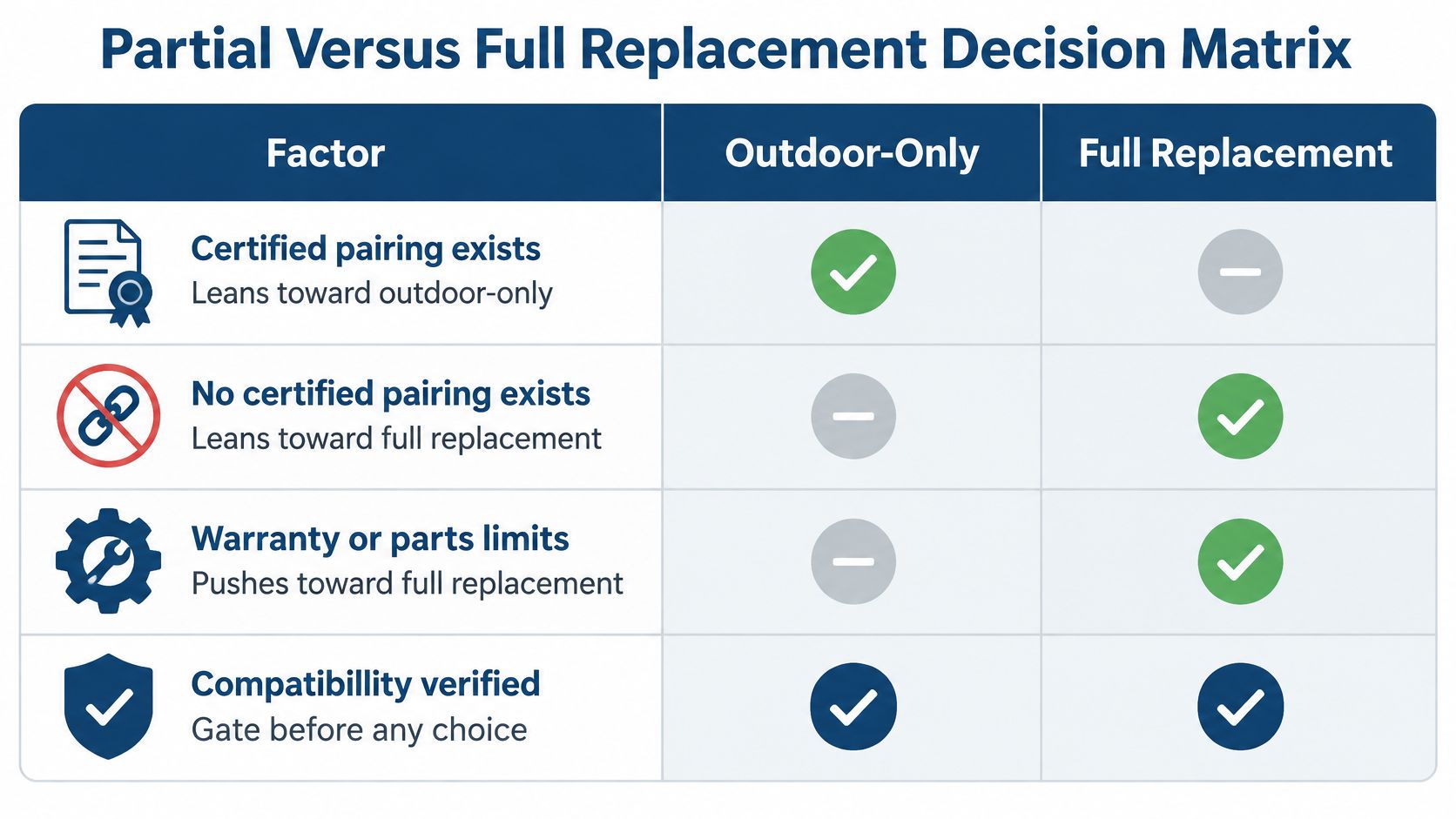
Partial versus full replacement decision matrix
| Factor | Outdoor-only may fit | Full replacement is safer | Verify by |
|---|---|---|---|
| Verified compatibility | Certified AHRI pairing with the existing coil | No certified pairing, or an obsolete coil | AHRI certificate and both model numbers |
| Age gap | Indoor section is relatively recent and worth retaining | Large age gap, or an older coil or blower | Equipment nameplates and installation records |
| Failure history | One isolated outdoor component failure | Repeated or indoor-side failures | Installer's service history |
| Efficiency | Certified pair meets the target rating | Target rating only holds for a new pairing | Certified combination rating |
| Downtime risk | Outage is manageable and parts are confirmed | Unacceptable parts wait during hot weather | Written parts status and installer schedule |
| Total scope | Outdoor work and applicable permit scope | Indoor coil, blower, controls and applicable permit scope | Itemized written quotes |
Compare complete scopes for the same home
An outdoor-only proposal may still involve metering, controls or other compatibility-related work. A full-system proposal also shouldn't include every indoor component without explaining which items are necessary.
A furnace replacement, for example, should be an explicit scope decision rather than an assumed consequence of replacing the evaporator coil. Request the manufacturer documentation supporting any equipment that must change.
National pricing isn't necessary to settle this comparison. Itemized alternatives for the same property provide a more useful basis than an unrelated average or a condenser-only equipment price.
Comfort Experts' repair-or-replace recommendations weigh system age, the failure, comfort, energy use, parts, ductwork and how long the customer plans to keep the home. The AC replacement decision guide supports that broader review.
For property decision makers coordinating several assets, capital equipment replacement scheduling offers a separate planning perspective. It doesn't verify an AC match, establish local requirements or confirm present parts availability.
Account for disruption without guessing
The useful downtime comparison includes confirmed parts status, access requirements, and what work each proposal includes. No general article can establish which option will restore a particular home's cooling sooner.
A lower partial quote deserves consideration only after its retained components and complete scope are documented. Otherwise, the proposals aren't comparable.
Compatibility Checklist and Quote Questions
A useful quote turns compatibility into named components and documents. AHRI's efficiency guidance emphasizes the importance of matched equipment rather than relying on a high-efficiency outdoor unit alone.
For equipment planning, Comfort Experts recommends gathering model information, repair history, room-level comfort concerns and details of any duct or control work already completed. Those records make the assessment more specific without requiring homeowner access to service compartments.
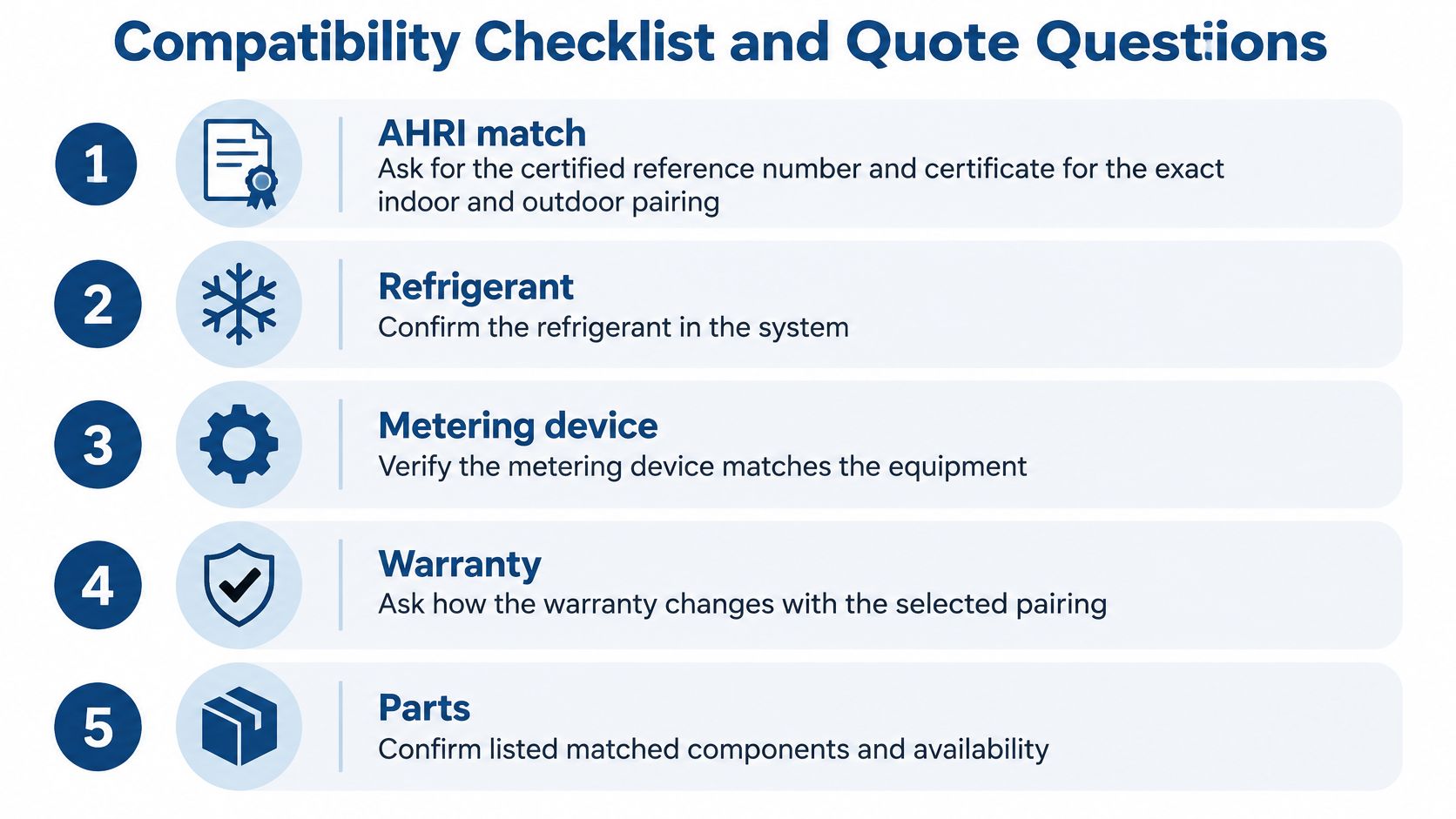
Questions to attach to each proposal
AHRI match. Request the Certified Reference Number and certificate for the exact equipment. Which models appear on the certificate, including any required furnace or air handler?
Refrigerant. Identify the existing refrigerant and proposed refrigerant. What manufacturer documentation supports retaining the indoor equipment?
Indoor coil. Record its model and assessed condition. Why is retaining this particular coil reasonable, and what findings support that judgment?
Metering device. Identify the device specified for the proposed combination. Does the scope retain it, change it or leave the decision unresolved?
Blower and airflow. Request the specified airflow and the installer's verification plan. How will the existing blower's suitability be established?
Controls. List the thermostat and applicable control components. Which existing items remain, and which manufacturer instructions support that arrangement?
Electrical data. Have the installer verify voltage, minimum circuit ampacity and maximum overcurrent protection against the equipment documents. Does the written scope include any changes the installer determines are necessary?
Warranty documentation. Obtain the manufacturer's terms and identify retained equipment separately. What coverage is being represented, and where is that representation supported?
Close the gaps before signing
The proposal should also answer who handles permits, what parts are confirmed and what happens if the proposed arrangement cannot be commissioned as specified. The SEER2 and load calc questions provide additional quote-review prompts.
Facility teams comparing climate control gear for facility managers should keep procurement separate from compatibility approval. A product category or catalog listing doesn't establish that a component belongs in a particular system.
Homeowners shouldn't open electrical panels, access pressurized components or climb onto a roof to complete this checklist. Missing information can remain marked for installer verification rather than being guessed.
Confirm the Match Before You Approve Work
Outdoor-only replacement is a reasonable option when the proposed combination is documented, the retained equipment is suitable and the installation requirements are resolved. Full replacement is the defensible direction when no certified pairing exists or the indoor equipment cannot support the proposed system.
Unanswered warranty or permit questions need confirmation, not an automatic assumption in either direction. An older blower also shouldn't be condemned solely because the condenser failed.
Choose the next step by what's missing
- Documentation is missing: Request the exact combination certificate and manufacturer requirements.
- Condition is uncertain: Arrange an assessment of the indoor coil, blower and relevant controls.
- Both sections need replacement: Compare a clearly itemized matched-system proposal.
For full-system planning, the Mesa replacement and installation planning page provides the appropriate service next step. Comfort Experts services and installs all HVAC brands, not only Trane equipment.
The decision shouldn't turn on whether a new condenser can connect to the old lines. It should turn on whether the proposed installation is documented, suitable for the home and clearly defined before work begins.
Comfort Experts is a locally owned Mesa HVAC company offering assessments and replacement planning for homeowners comparing an outdoor-only swap with a matched-system replacement. To clarify the options, schedule service or call 480-207-1239, with available model numbers and repair records ready.