Choosing a new air conditioner when the Arizona sun is at its peak is a major decision, and the seer 16 vs seer 14 debate is often at the heart of it. While both represent a significant upgrade from older, less efficient units, a SEER 16 system is approximately 13-14% more efficient, translating to noticeable long-term savings on your energy bills. Ultimately, the best choice hinges on your immediate budget, how long you plan to live in your home, and your personal comfort priorities.
Choosing Your AC Upgrade in the Arizona Heat
Let me explain. Picking a new air conditioner in Phoenix is a balancing act between the upfront cost and the long-term value you receive for years to come. A SEER rating is essentially a measure of efficiency, much like a car's MPG—it tells you how much cooling output you get for each unit of energy consumed.
A 14 SEER unit meets the modern, federally mandated minimum efficiency standards for our region. It's a massive improvement over the ancient, power-guzzling systems many homes are still relying on. Conversely, a 16 SEER system elevates this with superior technology engineered for even greater energy savings and a more consistently comfortable home environment.
You know what? It can feel overwhelming. The key is understanding that you’re choosing between a lower initial cost (14 SEER) and greater long-term savings with enhanced comfort (16 SEER).
To help you visualize the trade-offs, here’s a quick comparison of the core differences you'll encounter when deciding between a new 14 SEER vs 16 SEER AC unit.
Quick Comparison: SEER 14 vs SEER 16 At a Glance
This table provides a high-level overview of the key differences to help you quickly understand the trade-offs between a 14 SEER and 16 SEER AC unit in Phoenix. While it won't make the final decision for you, it will give you a clear sense of which option aligns better with your situation.
| Factor | 14 SEER | 16 SEER |
|---|---|---|
| Efficiency Level | Meets current federal minimums for Arizona; a solid, modern standard. | Higher efficiency, using about 13% less energy to perform the same job. |
| Upfront Cost | Lower initial investment, making it more manageable for an immediate budget. | Higher initial investment, typically by several hundred to over a thousand dollars. |
| Long-Term Savings | Good savings compared to an old, inefficient unit, but standard operating costs. | Significant long-term energy cost savings that compound over the unit's lifespan. |
| Typical Technology | Usually a single-stage compressor that is either all on or all off. | Often features a two-stage or variable-speed compressor for better comfort and humidity control. |
Ultimately, both are excellent options. The 14 SEER is a reliable workhorse, while the 16 SEER represents a strategic investment in lower monthly bills and a more finely-tuned indoor environment.
What SEER Ratings Actually Mean for Your Home
When you're trying to decide between a SEER 16 vs SEER 14 unit, it’s easy to get lost in the technical jargon. Let’s cut through the noise and discuss what these ratings truly mean for your wallet and your comfort.
Think of SEER (Seasonal Energy Efficiency Ratio) like the MPG rating on your car. The higher the number, the more cooling you get for every dollar you spend on electricity. In a place like Phoenix, where the AC runs almost continuously for months, this single rating has a massive impact on your summer power bills. A higher SEER rating simply means the system is engineered more effectively to convert electricity into cool, comfortable air.
The Shift to Higher Efficiency Standards
This push for better efficiency isn't just a recommendation; it's now a federal requirement. The U.S. Department of Energy (DOE) periodically raises the minimum standards to promote energy conservation, a particularly crucial initiative for us here in the Southwest.
A significant change occurred in 2023. The DOE officially raised the minimum efficiency requirement for new AC installations in southern states, including Arizona, to 15 SEER. This instantly rendered 14 SEER systems obsolete for any new installation, establishing 16 SEER as the new practical starting point for high-efficiency performance.
This new regulation provides important context. While you might still have a 14 SEER unit operating at your house, any new system installed today must meet this higher standard. This makes the SEER 16 vs SEER 14 conversation less about a choice and more about upgrading from an old, outdated standard to a new, superior one. If you want to dive deeper into the specifics, we have a comprehensive guide on what a SEER rating is.
Efficiency Gains: The Analogy That Matters
To put it in real-world terms, upgrading from a 14 SEER to a 16 SEER unit is like swapping an old daily driver for a modern hybrid just before a long summer road trip. That jump in efficiency might not feel significant on a single trip to the store, but over thousands of miles—or in our case, thousands of brutal cooling hours—the savings truly begin to add up.
A 16 SEER unit is roughly 13-14% more efficient than a 14 SEER model. This means for every watt-hour of electricity it uses, it produces 16 BTUs (British Thermal Units) of cooling, whereas the older model only delivers 14 BTUs. Over a long, scorching Arizona summer, that "small" difference of 2 BTUs per watt-hour translates directly into lower energy bills. Industry analysis from sites like ServiceEmperor.com confirms how SEER ratings translate to savings, demonstrating that higher efficiency genuinely pays off in hot climates.
Calculating Your Real-World Energy Savings and Costs
Honestly, what most people really want to know is how this choice impacts their wallet. Let's move past the technical jargon and translate the SEER 16 vs SEER 14 debate into actual dollar savings for a Phoenix homeowner, where our air conditioners work serious overtime.
The financial difference comes down to pure efficiency. A more efficient AC uses less electricity to produce the same amount of cold air. In our climate, that difference adds up quickly over a long, brutal summer. This is precisely where a slightly higher upfront cost starts to look like a very smart long-term investment.
Projecting Your Long-Term Savings
In the scorching Phoenix heat, where AC units run almost nonstop, upgrading from a 14 SEER to a 16 SEER unit can deliver substantial energy savings.
For a typical 3-ton system running 2,100 hours a year, a 14 SEER unit will consume about 5,400,000 watt-hours to keep you cool. By switching to a 16 SEER system, that consumption drops to 4,725,000 watt-hours. That’s a savings of 675,000 watt-hours every single year. At Arizona’s average electricity rate, this equates to approximately $87.75 in annual savings.
This chart illustrates the core efficiency difference. A 16 SEER unit simply produces more cooling (BTUs) for every watt of electricity it consumes.
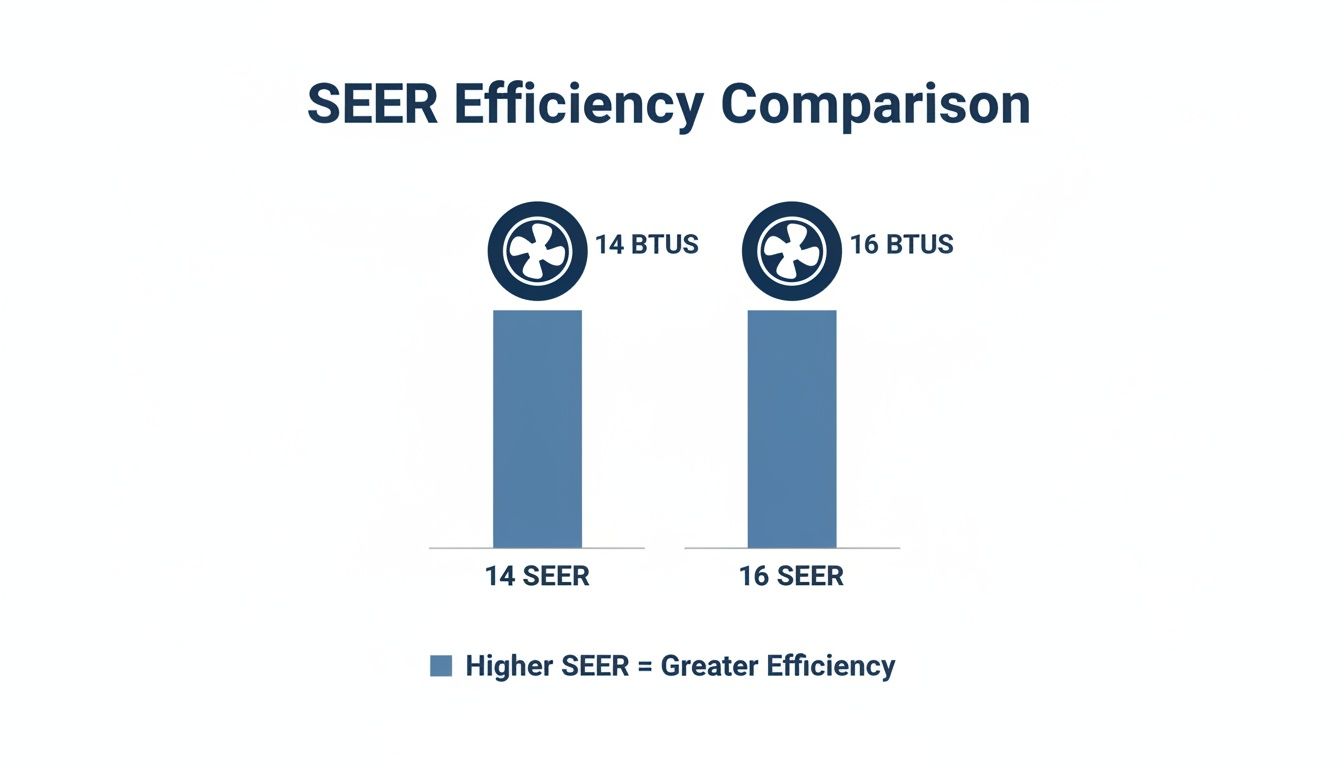
The takeaway is simple: a 16 SEER system is just better at turning your money into cold air.
Of course, these savings are just the beginning. There are plenty of other fantastic HVAC energy-saving tips you can implement to reduce your bills even further.
Understanding the Payback Period
A key concept for any homeowner is the "payback period"—the time it takes for your energy savings to completely cover the higher upfront cost of the 16 SEER unit. Think of it as your break-even point. To get a truly accurate picture of your home's total energy use and identify all areas for improvement, it’s worth scheduling an energy audit.
While the initial cost is a one-time event, the savings from a 16 SEER unit are a recurring benefit you’ll see on every summer utility bill for the next 15-20 years.
Let's examine how those savings compound over time for a typical Phoenix home. To make this crystal clear, we have compiled a table showing the financial impact over the life of your unit.
SEER 16 vs SEER 14 Potential Savings for Phoenix Homeowners
This responsive table breaks down the estimated costs and savings for a typical 3-ton AC unit in the Phoenix area, based on 2,100 annual cooling hours and an average electricity rate of $0.13/kWh.
| Metric | 14 SEER AC Unit | 16 SEER AC Unit | The Difference |
|---|---|---|---|
| Annual Operating Cost | ~$702 | ~$614 | $88 Annual Savings |
| 5-Year Savings | $0 | $440 | |
| 10-Year Savings | $0 | $880 | |
| 15-Year Savings | $0 | $1,320 |
As you can see, the savings from the 16 SEER unit steadily accumulate, turning the higher initial price into a clear financial win over the system's life. Once you pass that payback period, every dollar saved is a pure return on your investment.
Financial Incentives and Environmental Benefits
When you're comparing a SEER 16 vs SEER 14 system, the conversation isn't just about long-term energy savings. There are immediate financial perks and environmental upsides that can make the decision a whole lot easier, especially for homeowners here in Phoenix.
Upgrading to a high-efficiency unit can put real money back in your pocket right away, making that higher sticker price much easier to manage. For many homeowners we work with, these benefits are what tip the scales in favor of a 16 SEER system.
Unlocking Rebates and Federal Tax Credits
One of the biggest reasons to opt for a 16 SEER unit is the array of government incentives you can leverage. The Inflation Reduction Act, for example, introduced significant tax credits for homeowners who invest in energy-efficient upgrades, with new AC systems being a prime example.
A high-efficiency 16 SEER system is often precisely what you need to meet the strict criteria for these programs. This can substantially slash the real, out-of-pocket cost of your new system.
By meeting the right ENERGY STAR benchmarks, a 16 SEER unit can make you eligible for a federal tax credit of up to 30% of the project cost, with a cap of $2,000. This incentive is available through 2032, making this an ideal time to upgrade.
These credits aren't complicated rebates—they directly reduce what you owe on your taxes, which is like getting a straight-up discount on your powerful new air conditioner. To see what's currently available, you can explore the full list of rebates and incentives available for Arizona homeowners.
Your Environmental Impact Matters
Choosing a more efficient AC also means you're making a more responsible choice for our planet. Here in the desert, our air conditioners are one of the biggest energy consumers in the house, which means they're also a major source of carbon emissions.
Upgrading from a 14 SEER to a 16 SEER unit directly reduces your home's carbon footprint. That 13% boost in efficiency means your system uses less electricity, which in turn means power plants burn fewer fossil fuels to keep you cool.
For a standard 3-ton unit running in a Phoenix home, that amounts to saving 675,000 watt-hours every year. To put that in perspective, it’s like preventing about 0.47 tons of CO2 from entering the atmosphere. As this breakdown of SEER ratings explains, this is precisely why financial incentives are so often tied to efficiency tiers like ENERGY STAR—it’s beneficial for both your wallet and the environment.
Why a Professional Installation Matters
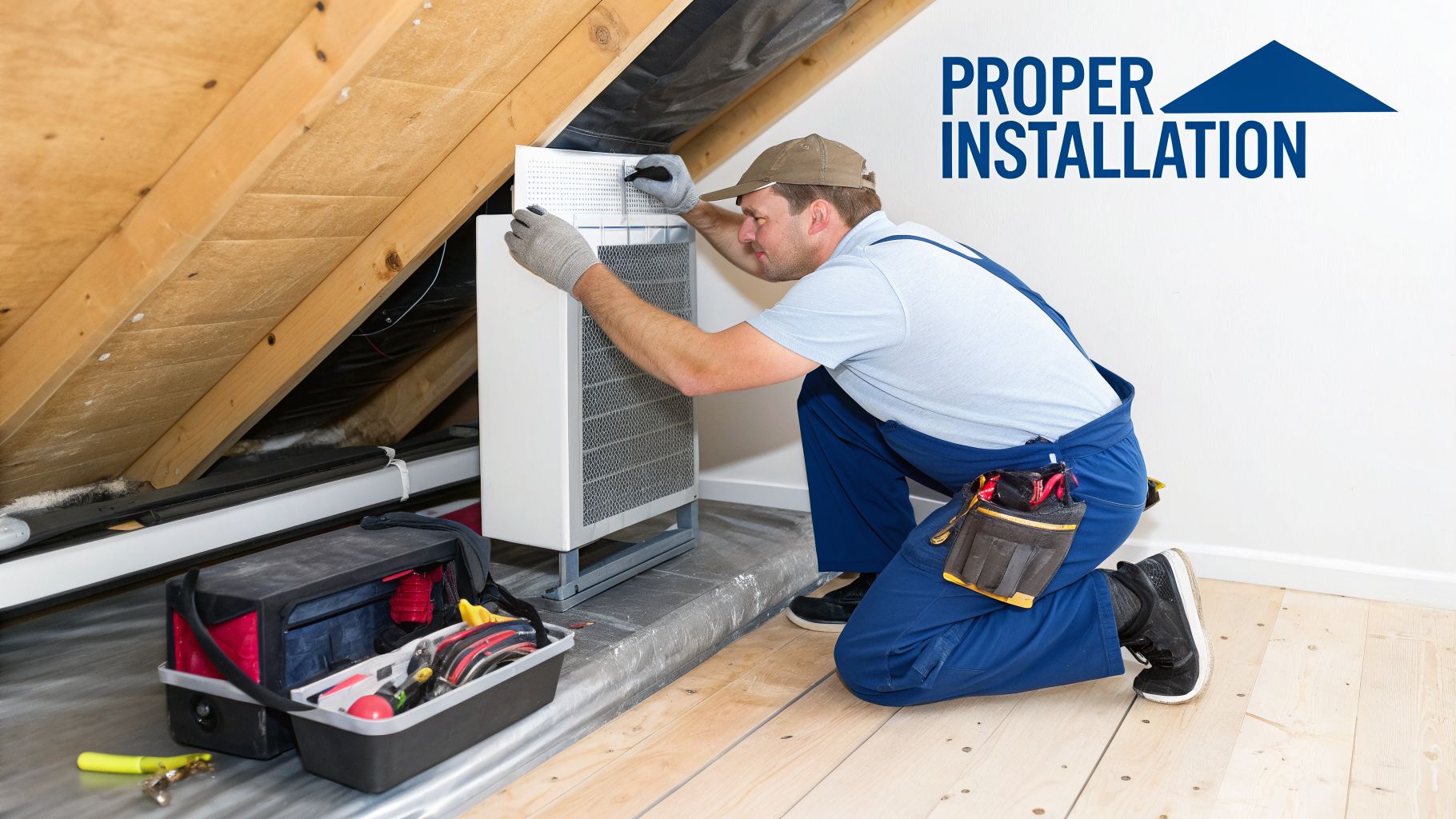
Here's the thing about the SEER 16 vs SEER 14 conversation: you can buy the most efficient air conditioner on the planet, but it will only perform as well as the team that installs it. That shiny SEER sticker on the side isn't a guarantee; it's a potential that must be unlocked through a professional installation that treats your entire system with care.
You can't just swap out the outdoor unit and expect to get the efficiency you paid for. Your AC is a matched system, meaning the indoor and outdoor components were engineered to work together as a cohesive team.
The Indoor Unit and Outdoor Unit Must Match
To achieve the advertised SEER rating, the outdoor condenser must be paired with the correct indoor air handler or furnace coil. If you connect a new, high-efficiency outdoor unit to an old, mismatched indoor coil, you are compromising its performance from day one. That old coil can't handle the job, forcing the new unit to work harder, run less efficiently, and ultimately, fail years before its time.
This is why a proper AC replacement involves the entire system. We ensure the indoor and outdoor units are a perfect factory match, so the system operates exactly as the manufacturer intended. It's the only way to get your money's worth.
The Overlooked Role of Your Ductwork
Your home’s ductwork is the highway for all that cool air, and it has a massive impact on your AC's real-world performance. You could install a top-of-the-line 16 SEER system, but if your ducts are leaky, undersized, or poorly designed, you're just paying to air-condition your attic.
Leaky ducts can sabotage even the most efficient air conditioner, wasting up to 20-30% of the cool air by spilling it into the attic, crawlspace, or walls. This forces your system to run longer and harder, erasing the efficiency gains you paid for.
As Trane specialists and Aeroseal duct sealing experts, we look at the entire picture. Just as the best solar panels require a proper setup, the performance of your new AC depends on quality installations. A professional assessment of your ductwork isn’t an upsell; it's a core component of any AC upgrade. To see what that looks like in practice, you can learn more about our approach to AC replacement and installation in Mesa, AZ.
By sizing the system correctly and addressing any duct issues, we ensure you actually get the efficiency, savings, and comfort you're expecting. It's the only way to guarantee your new AC delivers on its promise.
Making the Right Choice for Your Phoenix Home
We’ve covered a lot of numbers and data. So, how do you actually decide between a SEER 16 vs SEER 14 system? The truth is, there's no single "best" answer—the right choice comes down to your specific home, your budget, and how long you plan on staying.
For some Phoenix homeowners, a 14 SEER unit is the most sensible, practical move. For others, stepping up to a 16 SEER is a clear investment in long-term savings and superior day-to-day comfort.
It really boils down to one simple trade-off: a lower bill today (14 SEER) versus bigger savings and better comfort for years down the road (16 SEER).
Once you know where you stand on that trade-off, the decision becomes much easier. Our goal is to ensure you feel confident that the unit you choose is a perfect fit for your family and your wallet.
When a 14 SEER System Is the Smart Move
Don't let the smaller number fool you. A modern 14 SEER unit is a massive leap in efficiency compared to any system that’s a decade old. It’s a powerful, reliable machine and the perfect solution in several common scenarios we see all the time.
A 14 SEER system is likely your best fit if:
- You're working with a tighter budget: If the upfront cost is your primary concern, a 14 SEER system delivers dependable, efficient cooling without straining your finances.
- You plan on moving soon: If you expect to sell your home in the next three to five years, you likely won’t be there long enough to hit the payback period and recover the extra money spent on a 16 SEER unit.
- It's for a rental or second home: For properties that aren't your primary residence, the straightforward, cost-effective cooling of a 14 SEER system almost always makes the most financial sense.
Who Benefits Most from a 16 SEER System
On the flip side, a 16 SEER system is built for the homeowner who views their air conditioner as a long-term investment. That bump in efficiency and the advanced comfort features deliver real, tangible benefits you’ll notice every single day.
A 16 SEER unit is the clear winner for you if:
- You're in your "forever home": If you plan to stay for a decade or more, you'll sail right past the payback period and start banking pure energy savings year after year.
- You're sensitive to temperature and humidity: Can't stand those random hot spots or that sticky feeling during monsoon season? The superior humidity control and even cooling of a 16 SEER system are worth every penny.
- You work from home: Spending all day in a home office changes everything. The steady, quiet comfort from a two-stage 16 SEER system is an absolute game-changer for a productive work environment.
Your Trusted HVAC Partner in the Phoenix Valley
Sorting through the numbers on a SEER 16 vs SEER 14 system can feel overwhelming. We get it. You’re making a significant decision for your home’s comfort and your power bill, and you just want to get it right without any pressure or sales tactics. For over a decade, we’ve been the local team our neighbors in Mesa and across the Phoenix Valley count on for straight answers and fair pricing. Our reputation is everything to us, built one honest diagnosis at a time.
As a licensed and insured Trane specialist (ROC #275914), we know high-efficiency systems inside and out. But our job isn’t to sell you a specific unit—it’s to find the right solution for your home, your family, and your budget. We’ll take the time to inspect your current setup, listen to your concerns, and lay out clear options that make sense for you. You can learn more about our commitment by reading about why you should choose us.
Clearing Up a Few Common Questions
Even with all the numbers laid out, a few questions always seem to pop up when we're helping homeowners decide. It's completely normal. Are you wondering if a higher SEER cools faster or if you can just swap out the outside unit? Let's get you some straight answers to the most common sticking points we hear about the SEER 14 vs 16 choice.
| Question | Answer |
|---|---|
| "Will a 16 SEER cool my house faster?" | This is a popular myth, but no. Cooling speed comes from a unit's BTUs (its raw power). SEER is purely about efficiency. However, many 16 SEER units have two-stage compressors that run longer at a lower speed, which is far better at removing humidity and keeping temperatures even, making your home feel more comfortable all day. |
| "Is a 14 SEER unit a big upgrade from what I have now?" | Absolutely, if your current AC is over a decade old. That old unit is probably an 8 or 10 SEER at best. Making the jump to a modern 14 SEER system will be a night-and-day difference you will feel on your power bill, with potential cooling cost drops of 30-40% or more. |
| "Can I just replace the outside unit to get a higher SEER?" | Please don't do this. An air conditioner is a precisely matched system. Mismatching the outdoor condenser with an old indoor coil guarantees you won't get the SEER rating you paid for, your system will run inefficiently, and it will almost certainly void the manufacturer's warranty. |
When you're ready for personalized advice, the team at Comfort Experts is here to help you make the right choice with no pressure. Give us a call at 480-207-1239 or schedule service online to have an expert from Comfort Experts find the perfect solution for your home.