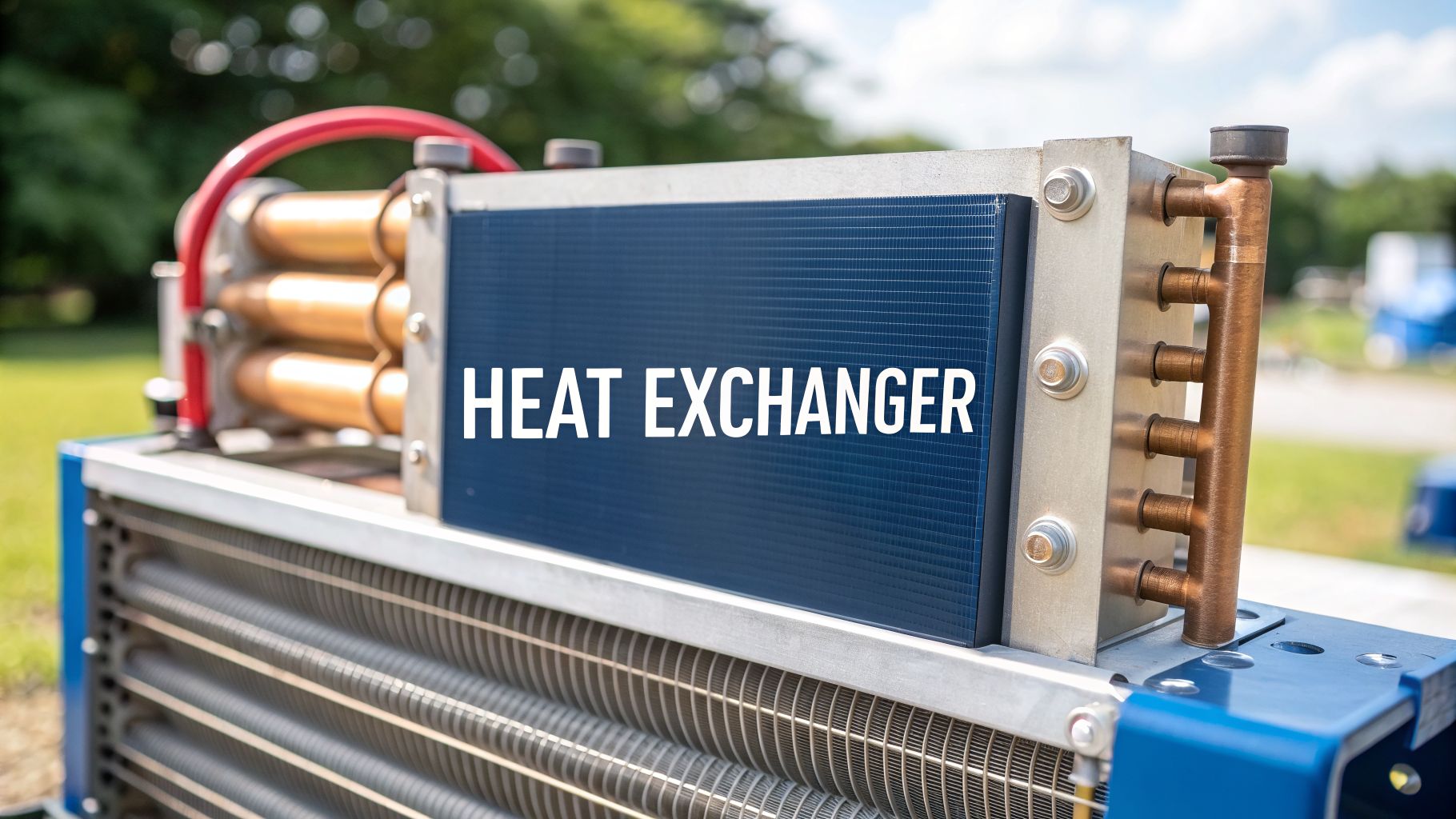
Have you ever wondered about the unsung hero working tirelessly behind the scenes to keep your Arizona home perfectly comfortable? That critical component is the heat exchanger, a single part that's absolutely vital for both heating and cooling your space. Understanding what is a heat exchanger is the first step to appreciating the immense role it plays in your daily comfort and safety.
The Unseen Engine of Your Home's Comfort
At its most basic, a heat exchanger is a device built to transfer heat from one medium (like a gas or liquid) to another without them ever touching. It’s the core principle that allows your furnace to generate warmth and your air conditioner to deliver cool, refreshing air. Here’s the thing: it's a simple concept with a profoundly important job.
Imagine a hot, sealed metal box placed inside a larger, cool room. The heat from the box radiates outward, warming the air in the room, but the air inside the box and the air in the room never actually mix. Your furnace's heat exchanger works on a similar principle, but with hot combustion gases and the air flowing to your vents.
This process is absolutely essential for your HVAC system. When you come home on a scorching 110°F Mesa summer day, your AC unit's heat exchanger is busy dumping all that absorbed indoor heat outside. It’s a workhorse. In the U.S., efficient heat exchangers can help slash residential energy bills by up to 30%, a huge deal for Phoenix Valley homeowners.
A heat exchanger’s most important job is safety. It ensures the air circulating in your home stays clean and completely separate from any harmful byproducts of combustion, like carbon monoxide, that your furnace creates.
This little device pulls double duty all year long:
- During Heating: It takes the intense heat from your furnace's burners and transfers it to the fresh air being circulated through your home, all while safely venting the dangerous exhaust fumes outside.
- During Cooling: It works in reverse. Your indoor coil (a type of heat exchanger) absorbs heat from your home's air, and the outdoor coil releases that heat into the Arizona air, leaving you with a cool, comfortable house.
Understanding this dual role is the first step in appreciating just how critical this part is. When it comes to your furnace, it’s not just about comfort—it’s about safety. You can learn more about how we keep this crucial component running safely in our professional heating services.
How a Heat Exchanger Functions in Your HVAC System
To really get what a heat exchanger does, you have to see it as a two-way player. It’s the same core component doing completely different jobs, depending on whether you need to warm up on a chilly Mesa night or cool down during a brutal Phoenix summer.
Think of it as a thermal traffic cop, directing heat from where you don’t want it to where you do. Let's break down how it pulls off this switch for both heating and cooling.
The Heating Process Explained
When your thermostat signals for heat, your furnace ignites its burners. This creates incredibly hot combustion gases that get funneled directly into the heat exchanger—a network of metal tubes or clamshell-like chambers.
The metal walls of the heat exchanger soak up this intense heat, glowing red-hot. At the same moment, your system’s blower fan pulls cool air from inside your house and forces it across the outside of these super-heated walls. As the air rushes past, it absorbs the heat, warms up fast, and is then sent through your ducts to heat your home.
Here’s the most important part: this process keeps the air you breathe completely separate from the dangerous combustion gases. Those nasty byproducts are safely funneled out of your home through a flue pipe. It’s a simple but brilliant design.
This diagram shows how that core component—the heat exchanger—manages both heating and cooling.

As you can see, it's the central gear that drives two opposite outcomes depending on what your home needs.
The Cooling Process A Masterful Reversal
When you flip the switch to air conditioning, the heat exchanger's role does a complete 180. Technically, your AC uses two heat exchangers working as a team: the indoor evaporator coil and the outdoor condenser coil.
The whole process works like a sponge, soaking up heat from inside and wringing it out outside.
- Indoor Evaporator Coil: This coil, tucked inside your home, gets ice-cold. As the blower pushes your warm, humid indoor air across its fins, the coil absorbs the heat and moisture from the air—just like how a cold drink "sweats" on a hot day.
- Outdoor Condenser Coil: The captured heat travels via refrigerant lines to the outdoor unit. There, the condenser coil releases all that collected heat into the outside air, finishing the job.
Heat Exchanger Function in Heating vs Cooling
To make it even clearer, this table breaks down how the heat exchanger's job changes between heating and cooling your home.
| HVAC Mode | Type of Heat Exchanger | Primary Function | Location |
|---|---|---|---|
| Heating | Furnace Heat Exchanger | Transfers heat from combustion gases to your home's air. | Inside your furnace. |
| Cooling | Evaporator & Condenser Coils | Transfers heat from your home's air to the outdoors. | Inside your indoor air handler and outside in the condenser unit. |
Whether it's the rugged metal chambers in your furnace or the delicate fin-and-tube coils in your AC, the principle is identical: moving thermal energy to keep you comfortable.
In a furnace, this is a life-saving safety feature, preventing dangerous gas leaks that contribute to over 5,000 injuries in the U.S. each year. For modern systems, it’s all about efficiency. Our clients with heat pumps see 300-400% efficiency gains over old electric heaters, which makes a huge difference on winter bills.
If you're thinking about upgrading, learning more about how a heat pump service in Mesa, AZ can handle both jobs efficiently is a great next step.
The Critical Safety Role of Your Furnace Heat Exchanger
So far, we've talked about how a heat exchanger keeps you comfortable. Now, let’s get to its most important job by far: keeping your family safe.
Frankly, there is no bigger risk in your entire HVAC system than a compromised furnace heat exchanger. Understanding why is non-negotiable for any homeowner.
The metal walls of your heat exchanger lead a tough life. Every time your furnace kicks on, they rapidly heat up and expand. When the cycle ends, they cool down and contract. This happens thousands of times each winter, especially here in Arizona with our surprisingly chilly desert nights.
This constant stress is like bending a paperclip back and forth. Eventually, the metal weakens and cracks.
From a Tiny Crack to a Major Hazard
A crack, no matter how small, is a serious problem. It creates a direct, uncontrolled pathway between the toxic combustion gases inside the heat exchanger and the clean air being blown into your home.
This is where the danger of carbon monoxide (CO) enters the picture.
Carbon monoxide is a natural byproduct of burning fuel, like the natural gas in your furnace. Normally, all of it is safely vented outside. But when a heat exchanger is cracked, this poisonous gas can leak directly into your air supply.

A failure like this turns a simple comfort appliance into a potential health hazard, which is why regular inspections are so important.
The Silent Killer in Your Home
CO is particularly dangerous because you can't detect it on your own. It's completely colorless and odorless—you can't see it, smell it, or taste it. This is exactly why it has earned its grim reputation.
Carbon monoxide is often called the "silent killer" because it can incapacitate its victims before they are even aware they are being poisoned. Exposure can lead to a range of devastating health effects, from mild symptoms to permanent organ damage or even death.
The initial signs of CO poisoning are tricky because they often mimic the flu. Recognizing the symptoms is critical:
- Mild Exposure: Dull headache, dizziness, nausea, and shortness of breath.
- Medium Exposure: Mental confusion, severe headaches, blurred vision, and loss of coordination.
- Extreme Exposure: Loss of consciousness, seizures, coma, and ultimately, death.
This direct link between a mechanical failure and your family's health is why you can’t afford to ignore your furnace. A routine inspection by a trained professional is the only reliable way to spot these hidden cracks before they become a tragedy.
If you have any concerns about your system's age or performance, getting professional furnace repair in Mesa, AZ is a crucial step. Protecting your household from this invisible threat has to be the top priority.
Recognizing the Warning Signs of a Failing Heat Exchanger
Knowing how your furnace heat exchanger keeps you safe is one thing; knowing when it might be failing is another. The good news is, you don’t need to be an HVAC technician to spot potential trouble. Let me explain some of the most common red flags that tell you it’s time to pay closer attention.
Your own senses—smell, sight, and hearing—are your best first line of defense. A healthy furnace operates cleanly and quietly, but a failing heat exchanger often leaves clues you can pick up on.
Visual and Audible Clues to Watch For
The first place to look for trouble is the unit itself and the area around it. Small changes on the outside can point to much larger internal problems. This is especially true because a failing core component, like a cracked heat exchanger, can make it seem like your HVAC systems fail repeatedly, even after a technician has performed other repairs.
You can be proactive by keeping an eye out for these specific signs:
- Visible Cracks or Rust: Take a look at the external components of your furnace. If you see significant rust, corrosion, or visible cracks on the casing, it's a strong indicator that the internal parts, including the heat exchanger, are also deteriorating.
- Soot Buildup: Black soot streaks on or around your furnace are a major red flag. This soot is a byproduct of incomplete combustion, which means your furnace isn't burning its fuel correctly—a process that can produce dangerous levels of carbon monoxide.
- A Change in Flame Color: Your furnace burner flame should be a steady, crisp blue. If you notice the flame is yellow or orange and appears to be flickering or "dancing" erratically, it suggests a combustion problem that could be related to a compromised heat exchanger.
Smells and Sounds You Should Never Ignore
Beyond what you can see, what you smell and hear is just as important. Some of the most serious warning signs are subtle but distinct. You know what? This is where your gut instinct as a homeowner can really pay off.
A persistent, sharp odor when the furnace first kicks on—often described as smelling like formaldehyde—can be a telltale sign of a crack. This isn't just a "furnace smell"; it's a specific chemical scent indicating a serious problem.
Also, listen for rattling, popping, or banging noises coming from the furnace closet when the heat turns on. As the heat exchanger expands and contracts with temperature changes, a crack can cause the metal to make loud, unsettling sounds.
These efficiency and safety issues are why modern HVAC technology is so critical. For instance, some stats show that advanced heat exchangers can recover up to 90% of waste heat in industrial settings. For Mesa homeowners, a high-efficiency Trane unit from Comfort Experts can boost SEER ratings to 20+, cutting cooling costs by 40% compared to older systems. If you notice any of these signs, shut your system down and call a professional immediately.
Your Guide to DIY Maintenance and Professional Service
When it comes to your HVAC system and its heat exchanger, knowing what you can tackle yourself versus when to call a pro is a big deal. It’s not just about keeping your system running well—it's about keeping your family safe.
Let's break down the clear line between DIY and "don't-even-think-about-it."

DIY Tasks for a Healthy HVAC System
You’d be surprised how much of a difference a few simple habits can make. If you do nothing else, change your air filter regularly. A dirty, clogged filter is like forcing the system to breathe through a straw. It restricts airflow, makes the whole unit work harder, and can cause your furnace to overheat—putting serious stress on the heat exchanger.
A few other quick checks can save you a lot of headaches:
- Clear Your Vents: Make sure furniture, rugs, or curtains aren't blocking any supply or return air vents. Good airflow is everything.
- Give the Outdoor Unit Space: Your outside condenser needs room to breathe. Keep leaves, grass clippings, and debris cleared away, leaving at least two feet of open space around it.
- Check the Thermostat: A dying battery or a faulty thermostat can make your system cycle on and off for no reason, causing unnecessary wear and tear.
These small, consistent actions are the foundation of a healthy system. They are the core of preventive care. For those who like to dig deeper, understanding the difference between predictive and preventive maintenance really highlights why these simple steps are so effective at stopping major problems before they start.
When to Call the Professionals at Comfort Experts
While those DIY tasks are crucial, inspecting the actual heat exchanger is a job exclusively for a trained professional. This isn’t us being overly cautious; it’s a critical safety rule.
Trying to inspect a furnace heat exchanger without the right tools and training is incredibly dangerous. You could easily miss a hairline crack that might be leaking carbon monoxide into your home.
A professional inspection from Comfort Experts is a completely different ballgame. Our NATE-certified technicians use specialized equipment that you just can't buy at a hardware store.
We’re talking about tools like:
- Combustion Analyzers: These devices measure the chemical makeup of your furnace's exhaust fumes to ensure it's burning fuel cleanly and safely.
- Video Scopes: We use tiny, flexible cameras to get right inside the heat exchanger, letting us see cracks, rust, or weak spots that are completely invisible from the outside.
This is where our team’s experience really matters. We don’t just glance at things; we analyze, diagnose, and verify that your system is safe. To see how a professional tune-up can protect your system and your family, check out our HVAC maintenance plans. It’s the best way to get peace of mind, especially with our long cooling seasons here in the Valley.
HVAC Maintenance Checklist DIY vs Professional
To make it even clearer, here’s a simple table breaking down what’s safe for you to handle and what absolutely requires a certified technician from Comfort Experts.
| Maintenance Task | DIY Friendly? | Why It's Important | Professional Task? |
|---|---|---|---|
| Change Air Filter | Yes | Prevents airflow restriction, reduces strain on the system, and improves air quality. | No |
| Clean Around Outdoor Unit | Yes | Ensures proper heat transfer and prevents the condenser from overheating. | No |
| Keep Vents Unblocked | Yes | Maintains balanced airflow, ensuring comfort and system efficiency. | No |
| Check Thermostat Batteries | Yes | Prevents incorrect system cycling and ensures accurate temperature readings. | No |
| Clean Evaporator/Condenser Coils | No | Requires special cleaners and runs the risk of damaging delicate fins. | Yes |
| Inspect Heat Exchanger | Absolutely Not | Extremely dangerous. Requires specialized tools to detect CO leaks. | Yes |
| Check Refrigerant Levels | No | A closed system; low levels indicate a leak that must be professionally repaired. | Yes |
| Test Electrical Components | No | Involves high voltage and requires a multimeter and electrical knowledge. | Yes |
| Inspect Gas Connections/Burners | No | Risk of gas leaks or improper combustion is extremely high. | Yes |
Ultimately, taking care of your HVAC system is a partnership. Your simple, regular maintenance keeps it running smoothly day-to-day, while our expert inspections ensure it's running safely year after year.
Common Questions About Heat Exchangers
Now that we’ve covered the technical side, let's get into the questions we hear all the time from homeowners here in Mesa and across the Valley. This is where the rubber meets the road—understanding these points will help you make smart, safe decisions for your home.
How Long Does a Furnace Heat Exchanger Typically Last?
In a perfect world, a furnace heat exchanger should last somewhere between 15 and 20 years. But "perfect world" isn't Phoenix in July.
That lifespan can shrink fast due to things like an oversized system cycling on and off constantly, neglected maintenance, or even the fine dust our desert environment throws at it. The best way to get the most years out of yours is with consistent professional check-ups. Catching stress cracks early is far better than dealing with a total failure on a cold morning.
Can a Cracked Heat Exchanger Be Repaired?
Let me be as direct as possible on this one: no, a cracked heat exchanger can never be safely repaired. Period. Welding it, patching it, or slapping some sealant on it is not an option. It’s a dangerous shortcut that violates every safety standard in the book.
The only safe and correct response to a cracked heat exchanger is to replace it. And frankly, if the furnace is getting up there in age, replacing the entire unit is almost always the smarter, more cost-effective investment.
Think of it like trying to patch a hole in a hot air balloon. It might look fixed for a moment, but you really don't want to be in the air when it fails. With carbon monoxide on the line, it’s a gamble you can’t afford to take.
Is a Cracked Heat Exchanger Always a Carbon Monoxide Leak?
A crack creates an immediate and unacceptable risk of a leak, even if CO isn't actively spilling out at that exact moment. The pressure inside a furnace changes constantly when the burners ignite and the blower kicks on. A crack that seems stable when the unit is off can easily open up and release poisonous gas under operating conditions.
For the safety of your family, any confirmed crack means the furnace must be shut down immediately and tagged out of service until it's replaced. There's no such thing as a "small" or "acceptable" risk when it comes to carbon monoxide. If you've got more questions about how your system works, we cover a lot of ground in our company's FAQ section.
What Does It Cost to Replace a Heat Exchanger?
The cost can swing pretty widely, but you’re typically looking at a range of $1,000 to over $2,500. The final number depends heavily on the furnace brand, how complex the job is, and whether the part is still under warranty.
Honestly, when you're facing a repair bill that high for a single part on an older furnace, it almost always makes more financial sense to put that money toward a new, high-efficiency furnace instead. You solve the safety problem for good, get a brand-new factory warranty, and enjoy lower energy bills for the next decade or more.
Trust Your Home's Heart to the Comfort Experts
Think of your heat exchanger as the quiet, hardworking heart of your entire HVAC system. It’s what keeps you safe and comfortable, season after season. Knowing what it is and what to watch for is a great first step, but when it comes to confirming it's in good shape, that’s a job for a pro.
You just can't afford to guess when your family's safety is on the line.
If you’ve spotted any of the warning signs we talked about, or if it’s been more than a year since a professional took a close look at your furnace, it’s time to make the call. Our certified technicians have the cameras, sensors, and real-world experience to see what’s really going on inside, giving you total peace of mind that your system is running safely and doing its job right.
Protect the heart of your home and the people who live in it.
For honest diagnostics and expert service right here in the Phoenix Valley, you can always count on the team at Comfort Experts. Give us a call at 480-207-1239 or schedule your service online to make sure your system is in top condition.